Performance Analysis and Implementation of SIP Multi-party Video
Conference System
1
Yujiao Wang,
2Haiyun Lin,
3Youlin Xiang,
4Jianchun Cai
1, First Author
Department of Physical Science and Technology, Kunming University, China
, [email protected]
*2, Corresponding Author
Department of Physical Science and Technology, Kunming University,
China,
[email protected]
3,4
Department of Physical Science and Technology, Kunming University, China,
[email protected], [email protected]
Abstract
Through an analysis of Session Initiation Protocol (SIP), with a combination of the characteristics of video conference system, this paper puts forward a SIP video conference system based on the hierarchical network architecture. After an exhaustive analysis of the architecture and working principle of the system, this paper comes up with a system implementation method, as well as makes a performance analysis and functional verification of the system by writing corresponding test cases. The experiment results show that this system not only breaks the bottleneck of the existing system, but also efficiently upgrades the system capacity.
Keywords
: SIP, Video Conference System, Performance Analysis, Congestion, Video Quality1. Introduction
With the development of multimedia technology and communication technology by network, the business of multimedia communication has become a leading element in internet applications [1, 2]. SIP is rather simple, flexible, opening and extendable. As soon as SIP is released, it is cared and supported. Consequently, it is significant to do research on the SIP based multimedia conference technologies [3, 4]. At present, signaling technology about audio conference system is realized based on the H.323 protocol which is presented by the ITU-T [5, 6]. Although the protocol is more mature, the realization of it is complicated and the cost of its development is very high, so it is difficult to be expanded, and the flexibility of application is not enough [7, 8]. The SIP protocol which is formulated by IETF is widely used in the multimedia communication because it is concise, flexible, and easy to expand and implement [9, 10]. Therefore, it not only realize the every function of H.323 protocol conveniently, and but also very cheaper, so there are some theoretical and practical significances to the study about SIP conference framework.
As a control protocol in the application layer [11, 12], the SIP (Session Initiation Protocol) is adopted to control the establishment, modification and conclusion of the session. The session can involve bilateral or multilateral parties, and the SIP does not focus on the specific details and medium types of the session [13, 14]. Similar to TCP/IP protocol, the SIP is capable of addressing various kinds of problems related to mobility existing in the Next Generation Network. The SIP protocol realizes various kinds of mobility in the network layer, while the SIP achieves support on various kinds of mobility in the application layer. What the SIP adopts is the Client/Server widely adopted by the IETF (Internet Engineering Task Force). The SIP protocol is provided with strong functions in the form of user-end positioning, user-capability negotiation, user-visibility judgment, call setup as well as call processing. In view of SIP session, both the calling party and called party use SIP address for marking. The SIP address adopts E-mail form such as “user@host”. The “user” stands for the user name or the telephone number, the “host” indicates the domain name or digital address. This address is one part of the SIP-URL (Uniform Resource Locator). The integrated SIP-URL is shown as SIP: [email protected].
With respect to session roles, the SIP Client can be divided into UA (user agent) Client—sender of call request, UA Server—responder of the call request [15, 16]. There are three main SIP servers, namely. Proxy server: responsible for receiving the request of the agent user, sending requests to corresponding servers in accordance with the network strategy and give reply to users in line with responses achieved. Redirect server: this is used to send the new location back to the calling party
when needed and the calling party obtains the re-call according to the new location. Register server: this is applied to receive and dispose the registering request of the Client, and accomplish the register of user’s address. Similar to the HTTP (Hyper Text Transport Protocol), the SIP protocol adopts message to realize the communication in the network. There are six basic SIP messages regulated in the RFC3261, namely, INV ITE, BYE, ACK, CANCEL, OPTION as well as REGISTER messages. Based on following certain principle, expansion can be conducted on the SIP message.
Response state codes in the SIP protocol can be divided into six categories, which are composed of three numbers to express the processed results of the request. The first number indicates the response category, and the follow-up two numbers indicates the specific response to this category. They are message-passing model (1XX), success (2XX), redirection (3XX), client error (4XX), server error (5XX) as well as overall failure (6XX) [2].
Through an analysis of Session Initiation Protocol (SIP), with a combination of the characteristics of video conference system, this paper puts forward a SIP video conference system based on the hierarchical network architecture. After an exhaustive analysis of the architecture and working principle of the system, this paper comes up with a system implementation method, as well as makes a performance analysis and functional verification of the system by writing corresponding test cases. The experiment results show that this system not only breaks the bottleneck of the existing system, but also efficiently upgrades the system capacity.
2. System structure
It mainly comprises of tight coupling conference structure and loose coupling conference structure. Tight coupling conference structure is the conference that realizes signaling centralized control by a central node; loose coupling conference structure is the conference that terminations can interact with each other without the control of center SIP signaling; loose coupling conference structure adopts a center server to provide all of system functions, centrally manage SIP terminal, centrally treat, mix and forward media flow, and have the advantages that is simple, clear level, easy to manage etc. Therefore, most of video conference systems choose coupling conference structure [3]. However, based on the actual process of video conference, larger population of people participating in video conference system, large scale of system, larger amount of transmitted multimedia data flow etc. [4][5], video conference systems with coupling conference structure cannot meet the features of video conference, so it is relatively complicated to realize the functions of signaling and media processing at the same time. Also the whole system appears too large, and it is difficult to be extended and easy to cause the single point failure, so it need to improve the structure and network layout about existing SIP video conference system, and has designed the video conference system as shown in the following fig 1. It is advantageous to develop the function entity of system, and also can develop the reusability of bottom control functions by the conference management of this system, control of SIP signaling and isolation of audio video processing module. The whole conference system adopts the client-server model, which can meet multiply access of the video conference. Logically, the server can be divided into four parts: control server, conference strategy server, media server and proxy server.
About the network distribution of system, it should distribute multiply control servers and multiply media server on the edge of network, so it can make system easy to deploy, manage and expand, and also there will be no bottleneck problems in the whole network when the scale of system is larger.
Figure 1. The Modules of SIP Video Conference System
The control server is responsible for handling member and media strategy, and maintaining the signaling connection between itself and every member of conference. The actual media mixed function is realized through media server, every which has a default member strategy except for mixer function module and can receive all of request information which is sent from the control server. Conference strategy can receive any control signaling from control server. The control server can route the media
flow of conference member to the media server through control method from the third party. If control server receives a control instruction about conference strategy from a client, it will instruct media server to execute related media strategy. Therefore, media server can be applied to multiply conferences based on different logics of control server. The interface between control server and media server generally adopts the MGCP (Media Gateway Control Protocol) protocol.
3. Realization of system function
The realization of basic function about SIP video conference system generally includes: creating conference, participating in conference, exiting the conference, gaining the relative information about the conference etc. As a kind of signaling, SIP protocol provides many methods to realize the relative functions of video conference.
3.1. Creating conference
A conference can be created through multiply methods. Generally, based on the fact that whether the conference is created previously or not, they can be divided into previously created method and instant created method.
Previously created conference is the conference that the conference logo has been built, and the conference terminal users can gain the conference logos from the web, email or some other methods and send the request to this conference server for creating conference [6].
Instant created method can be finished through the conference terminal. Conference terminal first will send INVITE request to the conference server URI which can build an instant conference. Then, the conference server produces new conference logo immediately, and sends the conference logo back to the terminal through the header field of 302 response message. At last, the conference server will resend the INVITE request based on conference logo, and build conversation process.
3.2. Participating in conference
There are five methods that use SIP message to conference:
Users send the INVITE to the conference URI for requesting for participating in conference. Control server send INVITE message to user URI for requesting for participating in the conference initiatively.
The third party requests user for participating in the conference initiatively by sending REFER request to conference URI.
The third party requests users for participating in conference by sending REFER request to the user [7].
For example, Wyj wishes Lhy join in conference, Wyj will sends REFER request to Lhy. Wyj→Lhy
REFER sip: Lhy@ kmu.edu.cn SIP/2.0 From: sip: Wyj@ kmu.edu.cn
To: sip: Lhy @ kmu.edu.cn
Refer-To: sip: Conf-ID@ kmu.edu.cn ...
And then after Lhy receiving the invitation, she can send INVITE message to the conference URI for requesting for participating in the conference.
Lhy→Focus
INVITE sip: Conf-ID@ kmu.edu.cn From: sip: Lhy @ kmu.edu.cn To: sip: Conf-ID@ kmu.edu.cn Referred-By: sip: Wyj@ kmu.edu.cn ...
If the user don’t know the conference URI, but he knows a conversational ID of conference, he can participate in the conference through using the Join message header field. For example: the users know
that there is a conversational ID which is 54sed@servers. kmu.edu.cn in conference, and then they can send INVITE request to Focus for participating in conference [4].
Lhy→Focus
INVITE sip: Focus@ kmu.edu.cn SIP/2.0 To: Focus<sip: Focus@ kmu.edu.cn >
From: Lhy <sip: Lhy @ kmu.edu.cn>; tag=1987edf Call-Id: 54sed @ kmu.edu.cn
CSeq: 125 INVITE
Contact: <sip: Lhy @ kmu.edu.cn > Join: 54sed @servers. kmu.edu.cn;
3.3. Gaining Conference Information
The gain of conference information is achieved by SIP event notification system. During the period of conference, SIP conference terminal can subscribe related issue and notification serves from conference server by sending SUBSCRIBE message to obtain current state of the conference and the participants list etc. Conference server, would send NOTIFY notification message to the conference terminal that the participants belongs to periodically or at the time of personnel changes, and the message carry the message related to the conference by the format of XML [8]. Conference terminal can update the local participant list through the participant list notification, and the local participant list not only lists all of SIP URI that related to the participants as the only identity, but also presents their media ability.
3.4. Exiting conference
There are two methods that user can exit the conference: first, users exit the conference initiatively; second, the conference let the user exit. The two methods are realized through BYE message processing [9]. To the first method, the participant must first send the exiting request to conference server, and then send the exit conference message to other participants after getting the permission of conference server to avoid the fact that the participants exit the conference at will.
With regard to the problem that video conference system will generate routing hotspots during the delivery of media streams, which is also known as the instant congestion problem, it is caused by the fact that abundant unpredictable users request stream service from a specific service node at the same time, so as to cause the submerging of the service node delivery capability and the overloading of network connection, because it is difficult for the system to predict the throughput requirements of media stream in advance. Therefore, this paper puts forward a self-adaption computational algorithm of weight factor, the AWC algorithm. Consider the media session set S={si|i=1, 2, …, R}, and all the S media sessions are transmitted by the same AG. The AG is denoted by V={vj|j=1, 2, …, M}, which promptly recounts the weight factor of incentive compatibility based on the current total flow of every V node. This algorithm is described by the following iterative equation:
2 ( ( ) ) ( 1) ( ) jdjn dj j n n
, thereinto, j contains all the values that satisfy vjv, and n≥1 (1). Thereinto, j( )n and d nj( ) are respectively the weight factor of the node vj at the nth iteration and
the observed transmission flow value. j is a positive constant. We notice that, in this algorithm, the weight factor of the node vj is only updated according to the total flow d nj( ) currently transmitted by the node. Because d nj( ) is the local information of the node vj and easy to be measured; therefore, we puts forward the AWC algorithm suited to the realization of delivery.
4. System performance analysis
4.1. Experimental environment
We adopt the Matlab to conduct simulation experiment. First, we provide the simulation topology of system stream media delivery network; the basic network topology is Euclidean space model, which is the hypercube of the D-dimensional Euclidean space. The terminal nodes are randomly scattered in the hypercube, and distance measure corresponds the Euclidean distance between nodes.
Since this model is able to generate topological mapping consisting of multiple AGs, in this experiment, we produce a random topology consisting of 200 AGs. In order to study the influence of routing hotspot avoidance mechanism on media delivery quality, in the simulation topology, we introduce the packet loss model. The loss of data packet is caused by the network congestion. Therefore, there must be large numbers of packet losses when a routing hotspot occurs. So, in terms of testing the performance of the routing hotspot avoidance mechanism, it is necessary to introduce the packet loss model. In this simulation topology, we assume that the hop count between two nodes presents a linear increasing trend along with the distance increase of the two nodes. The maximum hop account between nodes is set as 15 hops, which corresponds to a delay of 3000ms. In the experiment, with regard to the set link rate, the lateral delay of hypercube is fixed as 3000ms. Assume the bandwidth of every link is between 800Kbps and 1.4Mbps, and the average link bandwidth is 1.22Mbps.
In the experiment, we assume that every source node contains multiple video clips. With MPEG-4 fine grained coded format, the source nodes have these video clips coded into video streams and each media session delivers a video stream. Through video coding, each video clip is coded as 1.28Mbps bit stream. We assume that, the length between 3min and 5min of each video clip obeys normal distribution, with its corresponding video file size ranging from 37.8MB to 48MB.
In the experiment, we assume that the storage capacity of every node between 800Mb and 2GB obeys normal distribution. Considering the current computer configuration of households and offices, we assume that the shared storage capacity of every node is 600MB. At the same time, we assume that the reliability of a node supporting continual service between 0.1 and 0.9 obeys normal distribution.
First, we consider the convergence rate of the AWC algorithm. Second, we should consider the average congestion situation under AWC algorithm. At last, since we position the stream media delivery service, we should take into account the related performance indexes of stream media delivery service, mainly including Average Latency (AL) and Video Quality (VQ). These two indexes are defined as follows:
Average Latency (AL): It represents the distance between source node and requesting node, usually measured by RTT or hop. In this experiment, we adopt the RTT to measure AL. Obviously, the smaller AL is, and the better the routing hotspot avoidance mechanism will be.
Video Quality (VQ): It refers to the video quality felt by the terminal users. We use the peak signal to noise ratio (PSNR) to measure the video quality. For the 8-digit pictures with a color intensity between 0 and 255, PSNR is defined as PSNR= log 10255/RMSE [13]. Thereinto, RMSE (Root Mean Squared Error) represents the average absolute value. For a frame of given N*M original image g, the RMSE value of its corresponding degraded image after g, being coded can be calculated through (2): 2 0 1/ N M [ ( , ) ( , ) X Y RMSE NM
g x y g x y (2)In our simulation, the video quality felt by users are influenced by the available bandwidth and packet loss ratio. Generally speaking, the closes a requesting node is to the source node, the lower the available bandwidth packet loss ratio will be, and the better video quality the users will feel. In order to study video quality, in this experiment, we adopt RTP/UDP to deliver media streams.
4
.2. The convergence of AWC algorithm
First we investigate into the convergence of AWC algorithm. In the simulation topology consisting of 200 AGs, we randomly select an application cluster v consisting of 5 nodes as the analysis object. Its bandwidth is c= (1920, 1536, 1280, 1024, 768), its unit kbps, and it is constant. We assume that, first,
there are two media sessions which transmit media streams through node clusters, when the algorithm decides the maximum effective weight factor, v adds to a new media session, each medium will have a 1028Kbps bandwidth request when initialization [14].
In the simulation experiment, the algorithm periodically updates the weight factor, and the constant j
of equation (1) decides the convergence rate of iteration. In the simulation experiment,
s cj 1 isused to replace j, which means j=
s cj 1.It is shown in the figure 2 the weight factor value of the node v randomly selected from v and self-adaptation algorithm iteration times. The ⊥ in the picture shows that there is a new media session in the system. Thereinto, the horizontal line represents the theoretical value of weight factor, while the length of each line segment represents the convergence iteration times. As is shown in the picture, AWC algorithm fast converge the theoretical values of weight factors. Assume there are 2 media sessions that sharing the application cluster v when the experiment starts, when the session number of the shared v increase by degrees from 2 to 5 [15], AWC algorithm convergence requires the iteration time of 16, 24, 28, 39 and 51 respectively. Obviously, the convergence rate of AWC algorithm will reduce with the increasing of media sessions. That’s mainly because: for a fixed , convergence rate decreases as the media increases; the change of convergence rate is decided by j=
s cj 1 in theequation (1), whose value reduces with the increasing of media session numbers.
Figure 2. Comparison of the Value of the Weighting Factors and the Number of Iterations
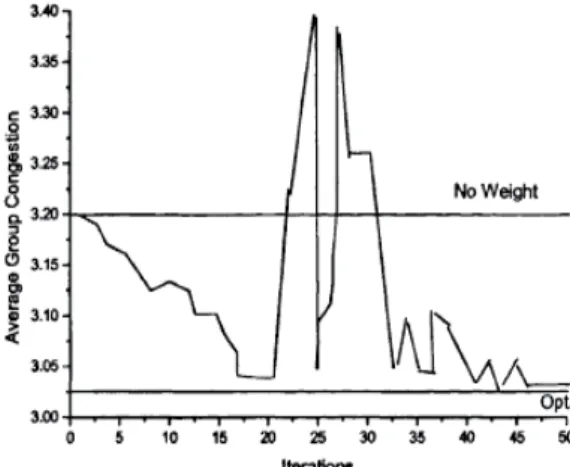
Figure 3. Average of Congestion and the Number of Iterations of the AG
The figure 3 shows the relationship between the average congestion and iteration time of V. The two horizontal lines represent the average congestion situations of the optimal network condition and
the condition when j 1 respectively. It is shown by the picture 3 that, under AWC algorithm, the average congestion of v converges to the average congestion of v in the optimal network condition. Therefore, our mechanism is an effective routing hotspot avoidance mechanism.
5. Conclusion
With its characteristics of simplicity and easy expansion, SIP will become the hot issue of widespread discussion within the industry as the core control protocol of the next generation network (NGN). Through the performance analysis and functional verification of the system, this paper proves that the new system has optimized the architecture of the existing SIP video conference system, fully upgraded the system capacity and solved the bottleneck of the existing system, so as to support the larger video conferences.
6. Acknowledgements
The work was supported by Applied Basic Research Project of Yunnan Provincial Science and Technology Department (2010ZC168).
7. References
[1] Rosenberg J., Schulzrinne H et al. SIP, “Session Initiation Protocol“. IETF RFC 3261, 2002. [2] Sparks R, “The Session Initiation Protocol (SIP) Refer Method“, IETF RFC 3515, 2003.
[3] Qiang Wei, Su Sen, Junliang Chen, “The Study of SIP-Based Centralized Multimedia Conference System, Computer Engineering and Applications“, vol.14, No.6, pp. 34-37, 2004.
[4] Do-Yoon Ha, Chang-Yong Lee, Hyun-Cheol Jeong, Bong-Nam Noh, "Design and Implementation of SIP-aware DDoS Attack Detection System", AISS, Vol. 2, No. 4, pp. 25 ~ 32, 2010
[5] Sen Wang, Weimin Lei, ”Desing and Prototype Implementation of SIP Multi-party Video Conference” , Journal of Chinese Computer Systems, vol.14, No.5, pp.22-30, 2009.
[6] Zhijun Cheng, “Design and Implementation of SIP Video Conference System Based on NGN Net”, Journal of Computer Applications and Software, vol.26, No.6, pp224-227, 2010.
[7] Zhi Cheng, “Intelligent Video System Analysis and Research on Computer and DSP”, Journal of Computer CD Software and Applications, vol.20, No.5, pp.176-177, 2011.
[8] Yuliang Tang, Weiwei Wang, “SIP Conference System Design Based on P2P Networks” Journal of Xiamen University, vol.48, No.4, pp.519-523, 2009.
[9] Zhen Liu, Weiwei Fang, Konggui Shi, Feng Liu, Fangnan Yang, "iTDTS: A SIP-based Telephone System for Train Dispatching", JDCTA, Vol. 5, No. 4, pp. 88 ~ 100, 2011.
[10]Yinglei Teng, Mei Song, Yuanyuan Liu, Ruizhe Yang, Junde Song, “A NBS Resource Allocation for Network Coding Based Subscriber Cooperation”, Journal of Beijing University of Posts and Telecommunications, vol.34, No.3, pp48-52, 2011.
[11]Xiaoji Li, Chen Chen, Hongbing Qiu, Wei Mo, “Game-theoretic approach for concurrent transmission in a single-channel for wireless Ad Hoc networks”, Journal of XIDIAN University, vol.37, No.5, pp.789-800, 2010.
[12]Xiuyu Jiang, Feng Yang, Zaihui CuI, “Improvement of SIP Header Parsing via Static Search Table”, Journal of Computer Engineering and Desing, vol.31, No.13, pp.2998-2991, 2010.
[13]Renlong He, Gangyi Jiang, Mei Yu, Randi Fu, “A New Method for Decoding Path Computation of Random Access in Multi-view Video System”, Journal of Image and Graphics, vol.14, No.4, pp.636-641, 2009.
[14]Suqin He, Zhigang Zhao, “Timing Analysis and Simulation for High-Speed Video System”, Journal of Microelectronics, vol.40, No.5, pp.680-684, 2010.
[15]Dan WU, Yueming Cai, Chengkang Pan, Yanming Sheng, Youyun Xu, “A Game-theoretical Power Control Algorithm with Relay Selection”, Journal of Electronics and Information Technology, vol.31, No.12, pp.2829-2833, 2009.
[16]Austin H Chen, Meng-Chieh Lee , "Novel Approaches for the Prediction of Cancer Classification", IJACT: International Journal of Advancements in Computing Technology, Vol. 3, No. 3, pp. 30 ~ 39, 2011