The Effect of Selected Feed Additives on the Shell
Qualitative Parameters of Table Eggs
Henrieta Arpášová
*,
Miroslava Kačániová, Martin Mellen, Cyril Hrnčár,
Veronika Pistová
Slovak University of Agriculture, 949 76-Nitra, Tr. A. Hlinku 2, Slovak Republic
Abstract
Herbs, spices and their extracts (botanicals) have a wide range of activities. It may have a beneficial effect on the gastrointestinal micro flora of animals, performance and quality of animal products. In this experiment the effects of supplementation of the diet for laying hens with different doses of thyme or oregano essential oil addition on egg shell quality parameters were studied. Hens of laying hybrid Hy-Line Brown (n=50) were randomly divided into 5 groups (n=10) and fed for 20 weeks with diets with thyme or oregano essential oil supplemented. In the control group hens received feed mixture with no additions. The diets in the first and second experimental groups were supplemented with 0.5 ml/kg or 1.0 ml/kg thyme essential oil. The diets in the third and fourth experimental groups were supplemented with 0.5 ml/kg or 1.0 ml/kg oregano essential oil. The egg shell weight (g), specific egg shell weight (g/cm3), percentage of egg shell (%), egg shell strength (N/cm2) and egg shell thickness (µm) were evaluated. The egg shell weight for the whole period was in the order of the groups 5.70±0.52; 5.65±0.44; 5.54±0.42; 5.62±0.38 and 5.49±0.48 g±S.D (P>0.05). Egg shell strength during the reporting period was in order of the groups: 27.81±6.00; 27.63±6.43; 27.17±6.36; 27.76±6.27 and 28.41±6.36 (N/cm2±S.D). Similarly, in the egg shell specific weight (g/cm3), egg shell percentage ratio (%) and egg shell thickness (µm) were observed statistically non-significant differences compared to the control group (P>0.05). The results suggest that the qualitative parameters of egg shell were not significantly influenced with thyme or oregano oil addition (P>0.05).
Keywords: egg shell, essential oil, oregano, quality, thyme
1. Introduction
Removal and restriction of sub therapeutic
antibiotics from poultry diets in many parts of the
world has amplified interest in improving
intestinal health and nutrient utilization [1].
The
use of feed additives is more and more questioned
by the consumers. Therefore, the feed industry is
highly interested in valuable alternatives which
could be accepted by the consumers [2]
.
Feed
additives cannot replace the negative impact of
diet, feeding regime or unbalanced nutrients in the
ration. They are not a source of nutrients for
* Corresponding author: Henrieta Arpášová Email: [email protected]
poultry. When absent in the ration, the animals
have not signs of nutritional deficiency [3].
Phytobiotics is a term used to describe the natural
bioactive substances of plant origin, which affect
the growth and health of the animal. Essential oils
and plant extracts [5] are often applied in the form
of powder [4].
Essential oils are intensive fragrant,
oily liquid substances contained in different parts
of the plant. Their function is based on
organoleptic effect and stimulation of organism to
the production of digestive juices. Result is a
higher digestibility and absorption of nutrients [6].
Besides antibacterial properties [7], essential oils
or their components have been shown to exhibit
antiviral
[8]
antimycotic, antioxigenic,
antiparasitic, and insecticidal properties [6].
of poultry [9], [8] the quality of poultry meat [10]
and eggs [11].
The aim of this work was to observe the influence
of different doses of thyme essential oil and
oregano essential oil addition on qualitative
parameters of shell of laying hens eggs of hybrid
Hy-Line Brown in pilot system.
2. Materials and methods
Animals, diets and treatments
Hens (n=50) of the laying hybrid Hy-Line Brown,
17 weeks old, were randomly divided into 5
groups (n=10) and fed for 20 weeks with diet
containing of different amounts of thyme or
oregano essential oils.
At the beginning of the experiment, the hens were
kept in the three–deck cage technology system,
model AGK 2000/616. The technology system
was in accordance with requirements specified by
the Directive 1999/74 EC. The layer hens were
kept by the standard bioclimatic conditions. The
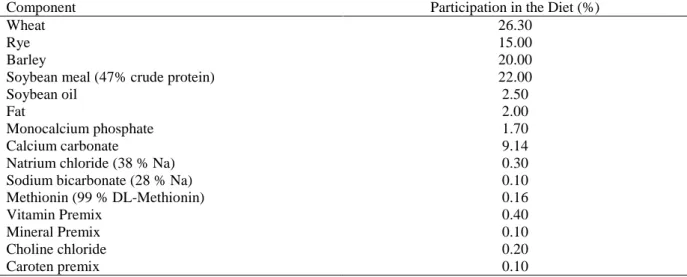
composition of the basal diet (BD) fed to the laying
hens is shown in Table 1 and Table 2.
Table 1. Composition of the trial diets
Component Participation in the Diet (%)
Wheat 26.30
Rye 15.00
Barley 20.00
Soybean meal (47% crude protein) 22.00
Soybean oil 2.50
Fat 2.00
Monocalcium phosphate 1.70
Calcium carbonate 9.14
Natrium chloride (38 % Na) 0.30
Sodium bicarbonate (28 % Na) 0.10
Methionin (99 % DL-Methionin) 0.16
Vitamin Premix 0.40
Mineral Premix 0.10
Choline chloride 0.20
Caroten premix 0.10
Table 2. Nutrient content in the trial diets
Nutrient Nutrient Content in Mixture
MEN(MJ.kg-1 of DM) 11.5
CP (g.kg-1 of DM) 177
LYS (g.kg-1 of DM) 8.81
MET (g.kg-1 of DM) 4.17
M + C (g.kg-1 of DM) 7.41
THR (g.kg-1 of DM) 6.27
LA (g.kg-1 of DM) 19.0
Ca (g.kg-1 of DM) 39.1
Pavail. (g.kg-1 of DM) 3.8
Na (g.kg-1 of DM) 1.5
* MEN: metabolisable energy for poultry, CP: crude protein, LYS: lysine, MET: methionine, M+C: methionine plus cysteine, THR: threonine, LA: linoleic acid, Ca: calcium, Pavail.: available phosphorus, Na: natrium.
In the control group hens received feed mixture
without additions. The diets in the first and second
experimental groups were supplemented with 0.5
ml/kg and 1.0 ml/kg thyme essential oil. The diets
in the third and fourth experimental groups were
supplemented with 0.5 and 1.0 ml/kg oregano
essential oil (Calendula a.s. Nová
Ľubovňa, SR).
Laying hens accepted fodder
ad libitum
.
Sample Analysis
Eggs of laying hens of Hy-Line Brown strain were
collected regularly one a month (n= 30 per group)
and were assessed immediately after collection.
The egg shell weight (g), specific egg shell weight
(g/cm
3), percentage of egg shell (%), egg shell
strength (N/cm
2) and egg shell thickness (
µ
m)
were evaluated. All these parameters were
detected using routine methods. Egg shell weight
was detected using analytical weighting machine
and the growth intensity and percentage contents
were calculated from weight data. Egg shell
strength was detected using Egg Crusher 1.1
(VEIT Electronics, Czech Republic). Experiment
lasted 20 weeks.
Statistical analysis
Statistical analysis was done using one–way
analysis of variance (ANOVA) with the post hoc
Tukey’s multiple comparison test in the program
SAS.
3. Results and discussion
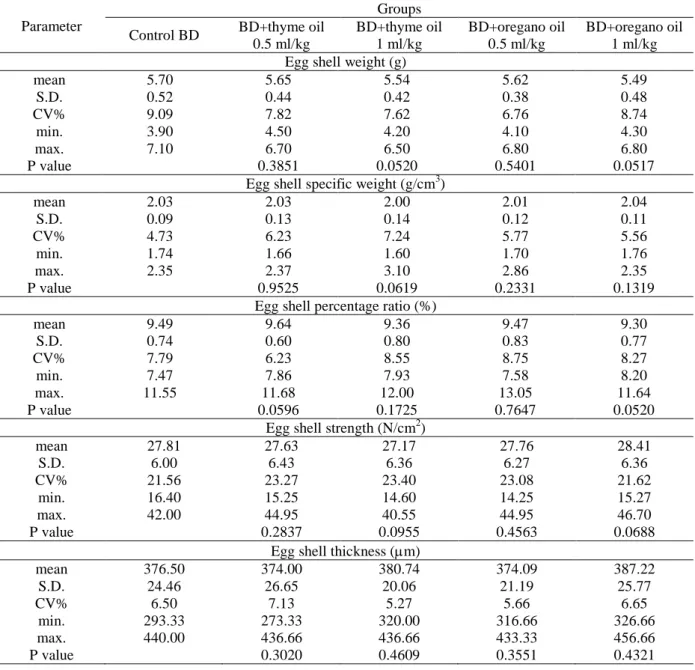
Table 3 present the changes in egg shell
qualitative parameters with plant essential oil
addition to feed.
The scientific information related to the dietary
effects of essential oil in terms of layer hens is still
very limited. Some hopeful signs were reported in
performance, immune response, and eggshell
quality of laying hens fed diets supplemented with
essential oil of thyme, sage, and rosemary [12],
[13], and an essential oil mixture [14].
The weight of the shell. The recorded value in our
experiment was lower (P>0.05) between the group
with supplement of oregano essential oil in
compared to the control group. [15] indicate the
other hand the increase in the egg shell weight
used of the addition of dietary essential oil
combination (sage, thyme, and mentha extracts),
but did not affect other egg quality parameters. In
the experiment [16] adding of 0.2% medicinal
herbs including garlic (
Allium sativum
) and thyme
(
Thymus vulgaris
) to diet increased egg yolk color
as well as blood lymphocyte counts and decreased
egg shell weight comparing to other
dietary
treatments. Similarly [17] found insignicant effect
of addition of thyme on qualitative parameters of
egg shell. In the contrary [18] suggest that powder
of garlic (
Allium sativum
) or thyme (
Thymus
vulgaris
) did not have significant effect on egg
production, egg mass, feed intake and feed
conversion ratio of laying hens. Egg weight, egg
index, Haugh unit, egg gravity and egg shell
weight were not significantly affected by dietary
treatment, too.
The egg shell strength. Impact of two essential oils
added to the feed mixture, eggshell strength in our
experiment does not influence significantly
(P>0.05). A similar results reached [19] who
reported an insignificant effect on egg weight and
quality parameters of individual parts of the egg.
In contrast, in experiments of the [14], the
percentage of cracked and broken eggs in the
group with complement of essential oils is lower
compared to the control group.
The results of [20] show that the supplementation
of thyme or hyssop essential oil into laying hens’
diet significantly decreased the egg shell weight.
The addition of thyme essential oil into the diet
significantly decreased the egg shell percentage
ratio and egg shell specific weight, too. The thyme
or hyssop essential oils addition did not influence
the egg shell strength.
Table 3. Influence of thyme and oregano essential oil addition into laying hens feed mixture on the alterations of Hy-Line Brown laying hens egg shell quality
Parameter
Groups
Control BD BD+thyme oil 0.5 ml/kg
BD+thyme oil 1 ml/kg
BD+oregano oil 0.5 ml/kg
BD+oregano oil 1 ml/kg Egg shell weight (g)
mean 5.70 5.65 5.54 5.62 5.49
S.D. 0.52 0.44 0.42 0.38 0.48
CV% 9.09 7.82 7.62 6.76 8.74
min. 3.90 4.50 4.20 4.10 4.30
max. 7.10 6.70 6.50 6.80 6.80
P value 0.3851 0.0520 0.5401 0.0517
Egg shell specific weight (g/cm3)
mean 2.03 2.03 2.00 2.01 2.04
S.D. 0.09 0.13 0.14 0.12 0.11
CV% 4.73 6.23 7.24 5.77 5.56
min. 1.74 1.66 1.60 1.70 1.76
max. 2.35 2.37 3.10 2.86 2.35
P value 0.9525 0.0619 0.2331 0.1319
Egg shell percentage ratio (%)
mean 9.49 9.64 9.36 9.47 9.30
S.D. 0.74 0.60 0.80 0.83 0.77
CV% 7.79 6.23 8.55 8.75 8.27
min. 7.47 7.86 7.93 7.58 8.20
max. 11.55 11.68 12.00 13.05 11.64
P value 0.0596 0.1725 0.7647 0.0520
Egg shell strength (N/cm2)
mean 27.81 27.63 27.17 27.76 28.41
S.D. 6.00 6.43 6.36 6.27 6.36
CV% 21.56 23.27 23.40 23.08 21.62
min. 16.40 15.25 14.60 14.25 15.27
max. 42.00 44.95 40.55 44.95 46.70
P value 0.2837 0.0955 0.4563 0.0688
Egg shell thickness (µm)
mean 376.50 374.00 380.74 374.09 387.22
S.D. 24.46 26.65 20.06 21.19 25.77
CV% 6.50 7.13 5.27 5.66 6.65
min. 293.33 273.33 320.00 316.66 326.66
max. 440.00 436.66 436.66 433.33 456.66
P value 0.3020 0.4609 0.3551 0.4321
4. Conclusions
The addition of oregano in the dose 1ml/kg slightly
increased egg shell strength and egg shell thickness.
The results suggest that the qualitative parameters of egg shell were not significantly influenced with thyme or oregano oil addition (P>0.05).
Acknowledgements
This study was supported by Grant Agency for Science, VEGA of Slovak Republic, Grant No.1/0493/12 and KEGA035SPU-4/2015
References
1. Applegate, T. J., Klose, V., Steiner, T., Ganner, A., Schatzmayr, G., Probiotics and phytogenics for poultry:
Myth or reality?, Journal of Applied Poultry Research, 19 (2), 194-210.
2. Dahiya, J. P., Wilkie, D. C., Van Kessel, A. G., Drew, M., D., Potential strategies for controlling necrotic enteritis in broiler chickens in post-antibiotic era, Animal Feed Science and Technology, 2006, 129 (1-2), 60-88.
3. Hashemi, S. R., Davoodi, H., Phytogenics as New Class of Feed Additive in Poultry Industry, Journal of Animal and Veterinary Advances, 2010, 9(17), 2295-2304.
5. Friedman, M., Overview of antibacterial, antitoxin, antiviral, and antifungal activities of tea flavonoids and teas, Molecular Nutrition and Food Research, 2007, 51, (1), 116–134.
6. Arpasova H., KAčániová, M., Gálik, B., The Effect of Oregano Essential Oil and Pollen on Egg Production and Egg Yolk Qualitative Parameters. Scientific Papers: Animal Science and Biotechnologies, 2013, 46 (1), 12
7. Adukwu, E. C., Allen, S. C. H., Phillips, C.A., The anti-biofilm activity of lemongrass (Cymbopogon flexuosus) and grapefruit (Citrus paradisi) essential oils against five strains of Staphylococcus aureus, Journal of Applied Microbiology, 2012, 113(5), 1217-1227. 8. Yossa, N., Patel, J., Millner, P., LO, Y. M., Essential oils reduce Escherichia coli O157:H7 and Salmonella on spinach leaves, Journal of Food Protection, 2012, 75(3), 488-496
9. Kačániová, M., Nováková, I., Haščík, P., Význam probiotík aich význam na mikroflóru gastrointestinálneho traktu hydiny. Nitra: SPU, 2011, pp. 181, ISBN 978-80-552-0655-4
10. Saraee, M. H. A., Seidavi, A., Dadashbeiki, M., et al., Effect of Dietary Supplementation with Different Levels of Green Tea Powder and Fish Oil or their Combination on Carcass Characteristics in Broiler Chickens, Pakistan JournaL of Zoology, 2014, 46(6), 1767-1773
11. Gálik, B., Horniaková, E., The effect of enzymatic additives on the productivity of laying hens Isa Brown, Journal of Central European Agriculture, 2010, 11(4) 381-386.
12. Bölükbaşi, S. C., Erhan, M. K., Kaynar, O., The effect of feeding thyme, sage and rosemary oil on laying hen performance, cholesterol and some proteins ratio of egg yolk and Escherischia coli count in feces, Archiv für Geflügelkunde, 2008, 72(5), 231-237. 13. Bölükbaşi, S. C., Kaynar, O., Erhan, M. K., Urupan, H., Effect of feeding Nigella sativa oil on laying hen performance, cholesterol and some proteins ratio of egg yolk and Escherichia coli count in feces, Archiv für Geflügelkunde, 2009, 73(3), 167–172 14. Cabukt, M., Bozkurt, M., Alcicek, A., Catli, A. U., Baser, K. H. C., Effect of dietary essential oil mixture on performance of laying hens in summer season, South African Journal of Animal Science, 2006, 36(4), 215-221.
15. Kaya, A., Effects of dietary supplementation of essential oils and vitamin E on performance, egg quality and Escherichia coli count in excreta, Indian Journal of Animal Research, 2013, 47(6), 515-520 16. Ghasemi, R., Zarei, M., Torki, M., Adding Medicinal Herbs Including Garlic (Allium sativum) and Thyme (Thymus vulgaris) to Diet of Laying Hens and Evaluating Productive Performance and Egg Quality
Characteristics, American Journal of Animal and Veterinary Science , 2010, 5(2), 151-154.
17. Hammershoj, M., Steenfeldt, S., The effects of kale (Brassica oleracea ssp. acephala), basil (Ocimum basilicum) and thyme (Thymus vulgaris) as forage material in organic egg production on egg quality, British Poultry Science, 2012, 53(2), 245-256.
18. Mohebbifar, A., Torki, M., Effects of adding mixed powder of garlic and thyme to diets included graded levels of rice bran on productive performance of laying hens and egg quality characteristics, Advances in Environmental Biology, 2010, 4(3), 469-476
19. Richter, G., Bargholz, J., Hartung, H., Herzog, E., Studies of applicability of faba beans (Vicia faba L.) in layig hens, Tieraerztliche Umschau, 2008, 63(2), 97. 20 Arpášová, H., Angelovičová, M., Haščík, P., Capcarová, M., Kolesárová, A., Kačániová, M., Hanová, M., Influence of plant essential oils on selected quantitative parameters of hen table eggs, Acta fytotechnica et zootechnica, ISSN 1335-258X., Roč. 12, mimoriadne č. na CD, 2009, 8-15.
21. Botsoglou, N., Florou-Paneri, P., Botsoglou, E., Dotas, V., Giannenas, I., Koidis, A., Mitrakos, P., The effect of feeding rosemary, oregano, saffron and alpha-tocopheryl acetate on hen performance and oxidative stability of eggs, South African Journal of Animal Science, 2005, 35(3), 143-151.
22. Florou-Paneri, P., Nikolakakis, I., Giannenas, I., Koidis, A., Botsoglou, E., Dotas, V., Mitsopoulos, I., Hen performance and egg quality as affected by dietary oregano essential oil and tocopheryl acetate supplementation, International Journal of Poultry Science [online], 2005, 4(7), 449-454.
23. Habib Aghdam, S., Vahid, G., Yahya E., Hasan, M., Comparison of the Effects of Thyme and Oregano on Egg Quality in Laying Japanese Quail, Journal of Basic and Applied Scientific Research, 2011, 1(1), 2063-2068
24. Hosseini Vashan, S. J., Afzali, N., Mallekaneh, M., Nasseri, M. A., Allahresan, A., The Effect of Different Concentrations of Safflower Seed on Laying Hen’s Performance, Yolk and Blood Cholesterol and Immune Systém, International Journal of Poultry Science, 2008, 7(5), 470–473.
25. Botsoglou, N., Florou-Paneri, P., Botsoglou, E., Dotas, V., Giannenas, I., Koidis, A., Mitrakos, P., The effect of feeding rosemary, oregano, saffron and alpha-tocopheryl acetate on hen performance and oxidative stability of eggs, South African Journal of Animal Science, 2005, 35(3) 143-151.