Supporting the DSL Spectrum
1David S. Wile
Teknowledge Corp., Marina del Rey, CA 90292, USA
A language tailored to the problem domain can focus on its idioms and jargon, avoiding clumsy, overly general constructs needed to support general-purpose language. The leverage provided by DSLs over conventional programming languages is often extreme; application engineers may specify as little as 2% of the code that one would need to program the same thing in a conventional programming language! But commitment to a DSL approach can be rather expensive.
It is often difficult to know when to invest in exactly how much infrastructure support for a product or product family. All of the concerns that are germane to general-purpose programming language design and support may become important in the support of a specific DSL. At the same time, there is a wide spectrum of approaches to providing DSL support. This paper relates the various DSL design approaches to alternatives for tool support, providing a kind of “DSL tool support selection frame-work,” indicating where one might expect to need to invest heavily to obtain adequate support and illustrating the spectrum of tradeoffs and situations in which each is appropriate.
Keywords: domain-specific language, language exten-sion, COTS adoption, XML, general-purpose language
1. Where to Begin?
The design and use of domain-specific lan-guages can be seen as the natural culmina-tion of the use of domain-specific techniques for program and product development. By focusing on a problem domain’s idioms and jargon, DSLs avoid the notational “noise” re-quired when using overly general constructs of a general-purpose language to express the same thing. Moreover, DSLs are not necessarily pro-gramming languages: they are languages
tai-lored to express something about the solution to a problem. Indeed for some uses of DSLs there is really no comparison with an equivalent “program.” For example, music notation con-stitutes a DSL for music; it is nearly irrelevant that modern computers can play the “program” represented by the music. Even before MIDI existed(allowing computers of various sorts to play the music), editors existed for this DSL, so printers could render the compositions with-out humans having to “retype” them on scored music sheets each time they changed them. It is generally very clear that DSL usage is very effective for the users, the practitioners in the problem domain who write specifica-tions in the languages. With a language we designed for NATO message parsing and type-checking2, we experienced a 50 to 1 improve-ment in lines of generated code vs. lines of specification Balzer94]. Additionally, confi-dence in the correctness of the specifications is greatly improved when all the extra syntactic noise is eliminated from the specifications. However, commitment to a DSL approach can be rather expensive, depending on the level of infrastructure support provided for a product or product family. All of the concerns that are germane to general-purpose programming lan-guage design and support may become impor-tant in the support of a specific DSL. These concerns include designing and specifying the actual syntax of the DSL itself; designing ab-stract or internal representations; compilation concerns, such as parsing, type checking, and
1This work was sponsored by DARPA contract numbers F30602-96-2-0224 and F30602-00-C-0200.
2NATO has a standard for messages transmitted between all kinds of vehicles and processing stations, from tanks, to planes,
code generation; the design of other analyz-ers, such as usage graphs; means for debugging DSL “programs,” often entailing an “unpars-ing” activity to map back out of the internal representation; support for persistence, versions and multiple authors; and often mechanisms for simulating or executing DSL programs.
To add to the confusion, there is a wide spec-trum of approaches for providing DSL support. Beyond ad hoc approaches — rarely worthwhile investments — there are traditional methods us-ing programmus-ing language development tool technology, such as LEX/YACC-based deriva-tives Aho86, Sharnoff01], programming en-vironment generator designs such as Reps88, Klint93], and other language support environ-mentsvan den Brand01, Mernik00a, Wile93]. A fairly popular technique is to extend exist-ing languages with abstract data types and op-erators, or object classes and methods, char-acterizing the domain so thoroughly that ap-plication engineers can become programmers without learning too much of the underlying languages Hudak00]. A related technique of recent interest in the research community is the use of so-called “generic programming” to pro-vide higher-level abstractions whose mappings into the language affect DSL-like constructs
Jeuring95]. Another related technique is to capture problem domain idioms using database schema and presentation mechanisms or spread-sheet templates. And, finally, XML-based ap-proaches are becoming popular, along with tools for mapping over the abstract syntax captured in the XML representation Attalli01, XMLSoft-ware]. We at Teknowledge are pursuing yet an-other approach, the use of a graphical interface in which “styles,” comprising icons and differ-ent kinds of arrows, can be mixed with textual and graphical attributes to form a kind of hybrid DSL technologyGoldman99].
3
In the following, advantages to DSL approaches are first discussed in Section 2. Then, in Section 3, some of the various DSL design approaches just mentioned will be elaborated in more de-tail. In order to compare the various advantages of the different approaches, Section 4 presents a brief discussion of the different issues that arise when considering adopting a particular technol-ogy. Section 5 compares the various approaches
with respect to how they handle these issues. With each approach I will indicate where one might expect to need to invest heavily to obtain adequate support and try to illustrate the spec-trum of tradeoffs and alternative approaches that might be pursued.
2. DSL Advantages
So, just what are the advantages of using a DSL, specifically?
First, with conciseness come a lot of advan-tages. Foremost is comprehensibility: one can read more at once and relate pieces whose con-nections may be completely lost in formal noise when couched in the terms of a more general-purpose language. As an aside, it is worth mentioning that there are many general-purpose problem(solution)specificationlanguages; e.g. PrologBowen01]has a bit of the flavor of one, where the evaluation model is somewhat far from the von Neuman machine model. Some of these languages are not even “evaluable”: they may allow expressing solutions in sec-ond order predicate calculusBowen01]. Even these much higher-level languages are often ex-tremely clumsy compared with a language tai-lored to the domain. To return to the thread, a second benefit to conciseness is ease of writ-ing and, consequently, introduction of fewer clerical mistakes. Finally, conciseness leads to greater productivity. The common rubric that claims that the number of lines of code per programmer per day is nearly constant, inde-pendent of the language used,probablycarries over into other specification domains.4
A second broad category of advantages accrues due to the fact that the natural internal rep-resentations for the linguistic constructs, their “abstract syntax” taken in a very broad sense, are much more attuned to the kinds of analy-sis and processing that will go on in designing analyzers, simulators, animators, and transla-tors for the languages. This has two implica-tions: (1) the analyzers can be written more easily and directly than when decoding a more general-purpose representation and(2)a more
3In fact, we are going one step further and relating these styles to specific knowledge representation “ontologies,” but I will not
go into that further in this paper Tallis01].
thorough-going job can be done of their im-plementation, since less time need be devoted to circumventing a clumsy original representa-tion. In addition, the errors can more readily be related directly to the users in problem domain terms rather than in the terms of the supporting general-purpose language. In fact, this ability to develop ancillary tool support for the appli-cation engineer, tools tailored to the domain — perhaps meaningless outside the domain, repre-sents a tremendous advantage over alternative approaches.
But of course, the single greatest advantage pro-vided by the use of domain-specific languages is that the expert at solving the problem can write specifications rather than requiring a combined expert-programmer team to code. This is not to claim that the role of programmer becomes irrelevant; far from it. The overall program-mer time investment is quite reduced indeed, but necessary for up-front infrastructure devel-opment. And in fact, the programmer skills required to provide the infrastructure are more expensive, requiring greater expertise than the normal program support staff. In some sense, the rest of the paper is devoted to illustrating just what these skills are and just how much or little of them might be needed when deciding how to provide support for the use of a domain-specific language.
3. DSL Approaches
As I mentioned above, the spectrum of ap-proaches available for providing DSL support ranges from the development of infrastructure using ad hoc methods to language development environments, to language extension, through Common Off-The-Shelf (COTS) product us-age — like Access, Excel, or PowerPoint —
and bottoms out at interchange representations. Before discussing these approaches it is worth-while to try to characterize what constitutes a DSL. And in order to do this, it will be illustra-tive to pick a particular(toy) problem domain to illustrate some of the issues.
So first, a problem domain. There are many problem domains that are “obviously” candi-dates for domain- specific languages, such as music composition and performance, inventory control, scheduling, accounting, signal process-ing, flight control, weather prediction, etc. The obvious nature of these for linguistic support comes from the fact that strong mathematical or otherwise formal languages have been used to describe problem solutions in them, and the ex-perts already know — indeed have been trained in — these dialects. Other obvious candi-dates include computer-specific domains, such as compilation (YACC), regular expressions
Klarlund99], web computingCardelli99], ca-che coherence protocolsChandra99], and de-vice driver designThibault99]. However, other less obviously likely candidates have already been given DSL support: multimedia anima-tionElliott99], music performanceHudak95], NATO message processingBalzer94, Kieburtz-94], naval ship formation movement analysis
Feather86], Interlocking in Railway Applica-tionsvan den Brand96], and census survey in-strument definitionWile00].
Unfortunately for our purposes here, all of these suffer from two defects: they require exten-sive domain understanding, too considerable to present here(even if I could)and they are some-what large themselves. So, consider the ad-mittedly contrived domain of “satellite ground
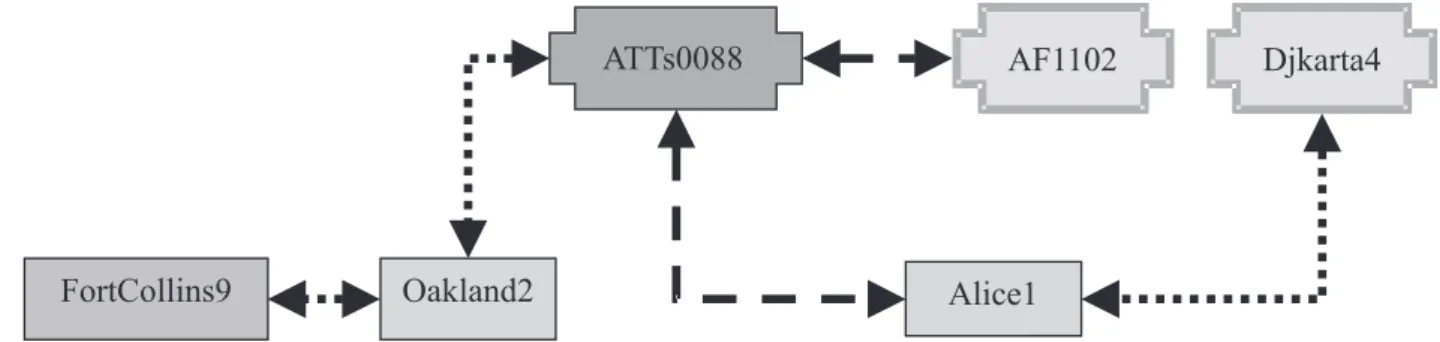
controllers” illustrated graphically in Figure 1.5 Satellites are represented using cruciform boxes and ground stations are represented using sim-ple rectangles. There are two kinds of satel-lites — communications satelsatel-lites(darker, like
ATTs0088)and probes(lighter)— and two kinds of ground stations — regular ones(lighter)and command processors(darker, likeFortCollins9). There are communications links among satel-lites and ground stations indicated by dashed double-headed arrows. In some cases these are made and broken dynamically, as they travel into and out of the ranges of each others’ re-ceivers and transmitters as the satellites revolve about the earth. Here the dynamic links are represented with dashed connectors; the static ones with dotted connectors. The problem is to support the specification of the various satellites and ground stations — called “ele-ments” from now on — in order to reason about such things as: when linkages can be estab-lished, whether the transmissions are appropri-ately secure, when they can be “reprogrammed,” how much bandwidth is required, etc. Several aspects may require specification: elements’
structure and properties, such as communica-tion protocols; their configuration into a sys-tem; their interaction and interconnection con-straints; and some aspects of their behaviors. These common elements of language design will be used in the following to evaluate the appropriateness of various approaches to pro-viding DSL support. Also, in the following discussion the strengths of the approaches will generally be emphasized; later discussion will compare the strengths and weaknesses.
3.1. Full Language Design Approach
The domain-specificlanguageapproach to this example — with emphasis on developing a new specification language — might allow language users to produce something like the specifica-tion in Figure 2. The overall specificaspecifica-tion has a bit of the look-and-feel of a set of declara-tions in a programming language. Each ele-ment type has its own particular attributes that may be specified. For some reason the country owning the element — e.g. Australia, and
pos-sibly the corporate identity of the owner — e.g.
USA’s DoD (Department of Defense), seemed important enough for it to be specified as the first atom(s) in the descriptions. Then comes the specific type of element, such assurveillance controller, and then a unique identifier or name.
Other than ownership, this same information is conveyed in the diagram in Figure 1.
There are several features of this specification that deserve emphasis. Notice that everything has apositionattribute and a protocolsattribute. Since this example is contrived, it is difficult to say exactly what these protocols might be, but my intent is for them to refer to the secu-rity of the transmissions necessary to relay the data. After the common element specifications, each element is further described with syntax germane to the element’s type, so, for example, some of the attributes used by ground stations are irrelevant to satellites — such as Field of View(see Figure 2)— and cannot be specified with them. (The field of view of the transmit-ter/receivers are given with the ground stations to reason about valid linkages.6) Notice also that position information does not include the altitude of ground stations nor communications satellites(presumably at a fixed altitude to stay in a stationary earth orbit). It is typical of DSLs to have specialized syntax for even conceptually “shared” fields.
One kind of analysis that will be important to perform on systems described using this lan-guage concerns policy analysis to determine which controllers can talk to which satellites, and through exactly which ground stations. So-me of these paths are declared explicitly. Notice that there are three link statements after the ele-ments are described in Figure 2; the intent here is to describe links that are predefined. When these occur with satellites, the satellites must actually be in a stationary earth orbit. Hence, the protocols that the ground stations affect, and the transformations in them that one can expect, are explicitly spelled out. There are two forms of these specifications used for the ground sta-tions here: one says which protocols can be sent up and down by indicating the transfor-mations of the input signals to the uplinks and the transformations to the output signals from the downlinks. The other form simply specifies
5 The intent here is to appeal to a universal shallow understanding of this domain. Deeper knowledge of the domain will
probably be a hindrance!
USAsurveillance controllerFortCollins9
Position: N40.5800 W105.0833
Protocols: outsecret S1
insecret P8
Hours: 7:00amto 9:00pmCST
USAground stationOakland2
Position: N37 48’ W122 16’
Protocols: upsecret P8
downsecret S1
outfpublic S1, secret P8g
infsecret S1, public S1g
Field of view: 60
Australiaground stationAlice1
Position: 23 48’ S 133 53’ E
Protocols: upfpublic P8=> private S1, public P8=> public S1, private S1=> private S1g
downfprivate S1=> private S1g
Field of view: 120
* * *
USAcommunications satelliteATTs0088
Corporation: ATT
Position: N21 18’ W157 52’
Multiplex4096
Rate: 100MBS
Protocols: Private P8
USDoDsurveillance satelliteAF1102
At: 655446765 UT
Position=14:06.33992hoursx 27.9943degreesx 75.66668miles]
Velocity=.2hoursx .3degreesx - .00025miles]/hour
Protocol: downsecret P8
upsecret S1
Sequencing:
Transmitter:fon-Light->off, off-receiverdata ready]->ong Receiver:fon-noinput-> data ready, ...g
EUsurveillance satelliteDjkarta4
Position=6 11’ S 106 50’ E x 75.66668 miles
Velocity=stationary
Protocol: downprivate P8
uppublic S1
Sequencing=
Camera:fon-Dark->off, off-Light-> awaitTarget, . . .g
* * *
AustralialinkAlice1toDjkarta4 USAlinkFortCollins9toOakland2 USAlinkOakland2toATTs0088
Compatibilities: public=>fAustralia, EU, USAg
secret=>fAustralia, EUg
private ATT=>fAustralia, EU, USAgATT
Fig. 2.A Satellite Groundstation Configuration Specification.
what the input, output, up and down protocols are, and one assumes (unless otherwise con-strained)that the cross product of the “in” with the “up” and the “down” with the “out” proto-cols are all possible.
This provision for syntactic sugar is common in DSLs. Notice as well that several forms of syntax have been provided for angles,
lati-tudes, longilati-tudes, etc. (e.g. “23 48’S 133 53’E” or “N21 18’W157 52’ ”). This is typi-cal in DSLs, because the application engineers are generally accustomed to using different for-mats, e.g. from different instruments.
Notice also that there are aspects of behavior
sequencing information. Naturally, it would take a domain- specific interpreter to make sense of this information for analysis and simulation purposes.
The last lines of the specification describe some domain-specific constraintsthat specifications must satisfy: namely, when using public com-munication lines, all comcom-munications among elements owned by Australia, the EU and the USA are allowed. For some reason, even secret transmissions between Australian and EU ele-ments are allowed. And, finally, private ATT communications are permitted among all three owners as well. This is a very concise way to say this and is very typical of the expressiveness of a DSL.
For now, take this sample specification as in-dicative of a rather small, but not insignificant language tailored to the domain of satellites. Next, we consider how one might implement the language support for reasoning about spec-ifications in the language.
To provide support for this language as it was presented here, one would use traditional pro-gramming language development tool technol-ogy, such as LEX/YACC-based derivatives, or perhaps the Cornell Program Synthesizer. The latter entails defining an abstract syntax for the language, for which one gets a free syntax-directed editor for specifications in the lan-guage. One must also provide a concrete syn-tax for the language, matching the synsyn-tax given here, and sets of attribute grammar rules to ef-fect various analyses and simulations that one might perform. For many situations, this is the appropriate choice to make. However, the pro-gramming expertise to deal with both the syn-tactic and semantic concerns is fairly expensive. Moreover, in some sense, the language design itself constitutes a heavy investment, and it has already been taken “for granted” here.
3.2. Language Extension Approaches
A less expensive alternative can be found in a broad category of alternatives loosely char-acterized as extensionof an existing language
to specialized constructs for the problem do-main. Technically, the trick used is to refine the language with specific abstract data types and operators, or object classes and methods, char-acterizing the domain so thoroughly that ap-plication engineers can become programmers without learning too much of the underlying languages. They use the extended language — the original plus the refinements — to express their specifications and invoke their analyses and simulations. In the following, Java and Haskell will be used to illustrate the extension technique, chosen as current representatives of the OO programming approach and the declar-ative programming approach, respectively.
Java as a DSL.To approach our example, we
might design the Java class specified in Figure 3aGosling96].
7 Based on these declarations a
domain engineer could create(part of)the spec-ification of Figure 2 using the method invoca-tions in Figure 3b. Although this may be a bit clumsy, to make data entry easier, a form-based interface could be designed for little cost. Notice that there is an inheritance hierarchy in the Java classes that would mirror the abstract syntax in a funny, inverted way. (The abstract syntax for the subclass would normally have a field whose instance was an instance of the superclass.) Notice that the definition of ele-ment is quite complex, including methods for adding and removing links in addition to an ini-tialization procedure, written “element(Stringid,
Integerown,Stringcorp, . . .)” where the ellipsis
would include all the instance variables of the class. One would write such an initializer for each of the classes — e.g. CommunicationsSa-telliteandProtocol—(not done here, for brevity) and then invoke them as in Figure 3b. Also, no-tice that in order to link the elements together into a graph structure, one has to have an ele-mentsstructure holding all the elements and a
facility to look them up,elementNamed.8
Some interesting implementation decisions have been made when building this set of class def-initions. First, instead of defining a class for each of the set-type fields, such as protocols and sequence elements, the implementation uses a “Hashset” collection device, and then relies on
7One would generally not make the instance variables public — used here for brevity — but would rather use constructors for
each class and public accessor functions to expose the parts. The examples throughout the paper are intended to be “indicative” by nature. I am not a true expert in any of the languages or support tools! The examples are incomplete, but every attempt has been made to keep them mutually consistent.
public class Element
f
public String uniqueID; public Integer owner;
//1=> Australia; 2=> EU; 3=> USA public String ownerCorp;
public Position pos;
public Hashset inProtocols;//of protocol public Hashset outProtocols;//of protocol public Hashset inLinks;//of linkage public Hashset outLinks;//of linkage
Element(String id, Integer own, String corp)//...
funiqueID=id; owner=own; ownerCorp=corp;
//... g;
public void addInLink(Element iEl)
finLinks.add(iEl);g
public void addOutLink(Element oEl)
foutLinks.add(oEl);g
public void delInLink(Element iEl) Iterator it;
Object recent;
fit=inLinks.iterator(); while(it.hasNext())f
recent=((Element)it.next()); if(recent==iEl)
it.remove();g
g
public void delOutLink(Element oEl)
f//see above g
g
public class Satellite extends Element
f
public Time initial; public Velocity v0;
public Hashset sequencing;//of SequencingRule
g
public class SurveillanceSatellite extends Satellite
f g
public class CommunicationsSatellite extends Satellite
f
public Integer multiplex; public Integer rate;//in MBS
g
Fig. 3a.Java Domain Model(1).
casting to make sure the elements are of the right type. Of course, this increases the poten-tial for errors to creep in, but one might be able to isolate the programmer entirely from the de-cision, for example, if a form-based interface were always used to construct the virtual spec-ifications. Some interesting little shortcuts in the concrete syntax show up even in this small example (Figure 3b). The latitude and
longi-public class SurveillanceController extends Element
f
public Time openFrom; public Time openTo;
//openFrom must be less than openTo g
public class GroundStation extends Element
f
public Hashset upProtocols; public Hashset downProtocols; public Hashset upLinks; public Hashset downLinks; public Angle FieldOfView;
public void addUpLink(Element fEl)
fupLinks.add(fEl);g
public void addDownLink(Element dEl)
fdownLinks.add(dEl);g
public void delUpLink(Element fEl)
f//see delInLink in element definition g
public void delDownLink(Element dEl)
f//see delInLink in element definition g
g
public class Protocol
f
public Integer security;//1=> public, 2=> private,
//3=> secret public String pathType;//S1 or P8
g
public class Velocity
f
public Time latitudinal; public Angle longitudinal; public Double altitudinal;
g
public class SequencingRule
f
public State whenState; public Hashset actions;
g
Fig. 3a. Java Domain Model(2).
tudewere converted to a decimal representation to input the position. The singleton protocol “P8” was introduced into each hashset to
repre-sent the “Up” and “Down” protocol links. Here
the country and privacy descriptions were
inP=new Hashset; outP=new Hashset; proto=Protocol(2,"p8"); inP.add(proto);
outP.add(proto);
el=CommunicationsSatellite("ATTs0088", 3, "ATT", Position(21.3, -157.867), inP, outP, 4096, 100); elements.add(el);
* * *
el.addOutLink(elements.elementNamed("Alice1")); el.addInLink(elements.elementNamed("Alice1"));
Fig. 3b. Java Satellite Program Fragment.
point here is that there is wide latitude available for mapping into an OO representation.
Haskell as a DSL.A language with which this approach to DSL design has been particularly successful is HaskellElliot99, Hudak00]. The approach is simply to design a set of data struc-tures and functions whose use with one another characterizes the execution structures of the lan-guage. These functions are organized into a so-called “combinator library” for use by the ap-plication engineers. Haskell is especially useful when a “scripting language” is an appropriate model for domain activities; such languages are normally associated with simple state machine commands, such as with operating system shell scripts, but they are quite frequently useful for describing simple processes in particular do-mains.
One could consider using such an approach for the behavioral part of the specification in Fig-ure 2. The structural part must be characterized as well, but it will primarily just be a syntac-tic variant of the Java declarations above.9 An important aspect of analyzing dynamic aspects of the Satellite domain, such as which ground stations can talk to which satellites at any given time, will be to determine the exact position of the satellites. This is essentially a straightfor-ward(though very complex, in reality)physics calculation, which can be expressed as read-ily in Haskell as in any other language. In the early 1990s, Haskell was used to describe cov-erage by AEGIS ships of enemy target regions
Carlson93]. A rather elegant conceptualiza-tion allowed them to pass funcconceptualiza-tions where most languages would require data structures to be passed. The idea is simple: think of a Region
as a mapping between a Point and a Boolean, whose value, when applied to any particular point, tells whether the point is in the region or not. One expresses that the Region is a map-ping from Points to Booleans in Haskell as:
Region :: Point -> Boolean
They defined combinators to represent various common region shapes, such as circle of radius R, centered about the point.
circle :: Radius -> Region
Notice that this function, that returns a func-tion as its value, is easily expressed in some languages, but its correct usage is fully type-checked in Haskell. In the satellite domain, we could use this same notion to describe the dy-namic coverage of a satellite as the intersection of the satellite’s broadcast cone with the earth; call this function itscoverage.
Coverage :: Satellite -> Region
One could then determine which ground stations can listen to the satellite by simply enumerat-ing the set of ground stations and keepenumerat-ing only those where the satellite’s region of coverage included the ground station’s location, viz.
(sat,gs)| gs<-groundstations, sat<-satellites,
(coverage sat)(location gs)]
One reads this “list comprehension” as: the set of all satellite — ground station pairs,(sat, gs), for which the region “coverage sat” applied to the point “location of gs” is true, i.e. the ground station is within the circle covered by the satel-lite’s transmitter. Imagining a sphere centered about the earth with the satellite’s distance from
9Actually, because of the lack of inheritance in Haskell’s algebraic data types, the structure will rather resemble the flattened-out
the center of the earth as radius, the same mecha-nism could be used to determine which satellites can hear which ground stations’ transmitters. These are all the technical calculations of cover-age. The point here is that they can be expressed elegantly, but they will probably not be used by the application engineer. Rather, a language fragment characterizing the sequencing infor-mation given in Figure 2 might be required. Briefly, the intent of the sequencing informa-tion is to provide enough of a model of the ac-tivities on-board a satellite to know when there will be enough power for operating transmitters and receivers, as well as predicting the neces-sity for such activities. The model allows the specifier to introduce arbitrary “instruments,” such as “camera,” and characterize them with simple finite state machines. These machines can transition from one state to another based on specific external stimuli — such as the solar cells being in sunlight or darkness, and signals being received or transmitted — and on transi-tions of other instruments on board the satellite between states (in the previous transition) — e.g. the receiver entered the “data ready” state. To express the collection of state machines in Haskell, one might write the Haskell program in Figure 4b. To understand it, first consider
Figu-re 4a. Often, one extends Haskell to become a DSL by constructing what is called a “monad,” a datatype that allows one to hide state informa-tion while still affording an applicative language interface. Constructing these is nontrivial and requires at least as much — but different! — expertise as using any other syntax-based sup-port mechanism. The typeSimulation in Figure
4a is such a type; it involves aSnapshot of the status of all of the modeled elements, along with the stimuli added since the last snapshot and the time the snapshot was taken. It is not impor-tant here to understand why a mapping between
Snapshots is needed (nor what the extraneous type variable a is used for), just that Snapshot must capture all of the varying state information required to perform a simulation.
So the typeSnapshot comprises a list ofStatus
tuples along with a list ofStimulusdescriptions
and a universal time. Each Status tuple com-prises a string — the element name -, position, velocity, and a list of all theinstrumentsassociated with the element, together with theStatethey are
in as of the last “tick.” Thetick function is our way of causing asimulationto progress. Given a
time interval since the last Snapshot was taken, tick must update the Status of all the elements, it must compute a new set of stimuli based on
type Simulation a=Snapshot ->(Snapshot, a)- the simulation "monad" type Snapshot=(Status],Stimulus], UniversalTime)
tick :: Time -> Simulation()
tick deltaT=nsn @(e,ut).((map e updateStatus, ut+deltaT),())
where updateStatus(n, p,v,is)=(newp p v ut deltaT, newv p v ut deltaT, map is nexts) nexts=. . . - must incorporate new stimuli and determine what new triggers arose . . . observe :: Simulation Snapshot - like getChar
command :: String -> Simulation()– like putChar
type Status=(String, Position, Velocity,(Instrument, State)] ) type Rule=(State ,Reaction] )
type Reaction=(Stimulus, State)
data Stimulus=Dark | Light | Receiving | Transmitting | Otherwise | Change Instrument State data Instrument=Instfname: String, current: State, rules:Rule] g
data Owners=Australia | EU | USA
data Element=GroundStationfuniqueID, ownerCorp:String, owner: Owners, . . . , stat:Status, rules:Rule]g| CommunicationSatellitefuniqueID, ownerCorp:String, owner: Owners, . . . , stat:Status, rules:
Rule]g| . . .
next :: Instrument ->Stimulus]-> State
next inst=– Find appropriate rule and test for reactions type State=String
type Instrument=String
ut0=333252323 – zero universal time
comsatA=110 – communications satellite standard altitude
elements=(CommunicationSatellite "ATTs0088" USA "ATT" ...
((Position 21.3 -157.867 comsatA),(Velocity 0 0 0),("transmitter", "off");("receiver", "on")] ) ("transmitter",("on" ,(Light , "off")];("off",((Change "receiver" "data ready"),"on")] )] )
("receiver",("on",("data end", "data ready")];("data ready",(Otherwise, "off")]; . . .] )] )) (SurveillanceSatellite "AF1102" ...
("camera"("on",(Dark, "off")]...)] )...]
Fig. 4b.Haskell Satellite Specification Fragment.
which instruments changed state, and it must add the time delta to the universal time. Again, the function definition here is mostly suggestive and need not be understood. The roles of anal-yses and input to the simulation are captured in theobserve and commandfunctions,
respec-tively. They respectively map information out of the Simulation and insert stimuli into it. The rest of the program in Figure 4b is straight-forward, using Haskell’s data and type state-ments to define the structures somewhat simi-larly to the Java specification in Figure 3a. No-tice that the abstract datatype construct, data, allows one to enumerate values easily, as in Own-ers. Notice thatStimulusis a similar list with the
additional possibility of adding aChangerecord describing whichInstrumententered whichState.
Probably the most interesting thing is that a do-main engineer need not really understand what technically are the lists of tuples that are being entered in the elements declaration, but simply needs to understand the form used to express them. Since the specification in Figure 4b is all that needs to be written by the domain ex-pert, very little of the complexity(or elegance) of Haskell for expressing this language comes through. That is, for representing the domain, this language extension is not too bad.
Of recent interest in the research community is the use of so-called “generic programming”
Jeuring95, Lopez97]techniques, wherein func-tions have arguments that are programs, types, type constructors, class hierarchies, or even grammars. It is possible that these can be used to provide higher-level abstractions whose map-pings into the language effect DSL-like con-structs. This approach can provide more exten-sibility than one would get from simply staying within the language. For example, although the expression above is not too far from the specifi-cation language in Figure 2, using generic pro-gramming one might be able to make itexactly
the same. The generic program’s evaluation would simply produce the description in Figure
4b from the description in Figure 2 as an inter-mediate result in the computation of the Simula-tion. As we shall see, this has all the benefits and pitfalls that a LEX/YACC approach has, when no intermediate representation is generated and maintained.
3.3. COTS-based Approaches
Another approach comprising several alterna-tives, that has gained some popularity is to ex-press the structural aspects of a DSL in terms of Common Off-The-Shelf (COTS) products, such as Microsoft Access or, more commonly, spreadsheet representations.
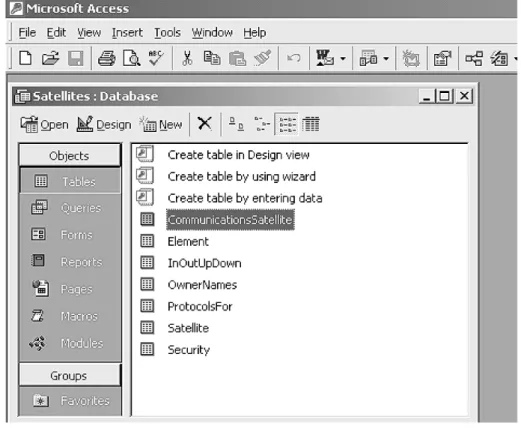
Microsoft Access as DSL.Figure 5a illustrates some of the major structures of the satellite domain expressed in Access database schemas
Microsoft Access], where types correspond with “Tables”; Figure 5b illustrates the Commu-nications Satellitetype of Figure 2 from the rela-tion schemaDesignview of Access. It is worth
comparing this definition with the correspond-ing definitions from Java, for example. Here, the entire supertype structure has been unfolded into the lowest level type. In particular, the at-tributes fromElementsand fromSatellitesare all
present in the CommunicationsSatellite “Table.”
Even though this is not necessarily how one would design a schema for this DSL in Access, it certainly represents a viable option. The al-ternative is to referenceSatellitefields, and then Satellite could reference the Element fields, us-ingkeysof the relations. The present definition makes data entry easier. Fortunately, Access has a quite intuitive interface for creating in-stances and thus is not much more cumbersome than conventional languages to use. Notice that there are no fields for theProtocols. This will be
Fig. 5a. Access Tables for Elements and Enumerated Types.
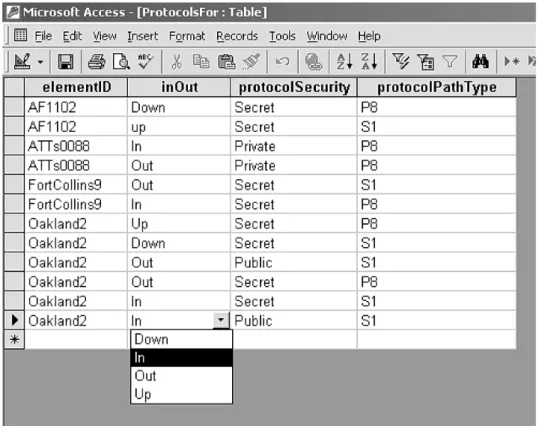
Fig. 5c.Protocol Table.
Some other shortcuts have been used in design-ing this representation. For example, what was a
Positiontype in Java, with latitude and longitude fields, has been unfolded into the definition of the satellite. Notice also that there is some flex-ibility in using SQL, the well-known database query language, to somewhat constrain the field values. In Figure 5b, we are focused on the
posLatitude field. Notice at the bottom of the
screen image that there is a “Validation Rule” restricting the values in this slot to be between -90 and 90(degrees). (“Between x And y” is a formal SQL constraint.)
Figure 5c shows how the protocols could be dealt with. When designing relational schemata there are always two choices that can be made. A single relation with several fields can be used to characterize objects that form “keys” of the relations, that is, a value that is present ex-actly once in any given row. The other way to organize relations is the so-called “entity-relationship” style, where simple binary tions relate objects to property values. The rela-tion name is the property. This is better for rep-resenting multiple-valued attributes, such as the
protocolsandlinksin this example. The elemen-tIDsdo not form keys in this kind of relationship.
The schema for the relation used in Figure 5c is an adaptation of the entity-relationship style in which the last three columns really form a sin-gle “value” expanded in a fashion similar to that done toPositions above. Figure 5c itself shows
how one would enter thedataitself, rather than the schema definition. Another feature of the database metaphor is that a table of constants — up, down, in, and out — has been defined
and the values of the column InOut have been
restricted to these values. The cursor is poised over theInOutcolumn for the last entry, whence the drop-down list of choices is being offered to the user entering the data.
XML as DSL. Another example of
<CommunicationsSatellite id="satellite. ATTs0088.007.XX3" name="ATTs0088"
owner="USA" multiplex="4096" rate="100 MBS"> <ownerCorp> ATT </ownerCorp>
<position latitude="21.3" longitude="-157.867"/> <inProtocol> Private P8 </inProtocol>
<outProtocol> Private P8 </outProtocol>
<outLink to="groundstation.Oakland2.007.XX7"/> <inLink from="groundstation.Oakland2.007.XX7"/> </CommunicationsSatellite>
Fig. 6.Possible XML version of the ATTs0088.
and XML- schema. One has a difficult problem mapping to these representations if there is no more flexible interface available than text edit-ing — i.e. they make horrible languages for humans to write — but this approach is very valuable as an adjunct approach to other ap-proaches. As one can see from Figure 6, an XML expression of just the ATT satellite above is quite a bit more verbose than even the Java version, and considerably more so than the true DSL specification in Figure 2.
Microsoft PowerPoint as DSL.We at Teknowl-edge are pursuing a hybrid approach, between COTS-based user interfaces(in particular
Pow-erPointMicrosoft PowerPoint])and our tradi-tional syntax-based approach developed in the 1980s and 1990s using program transformations for analysis and translation in the Popart system
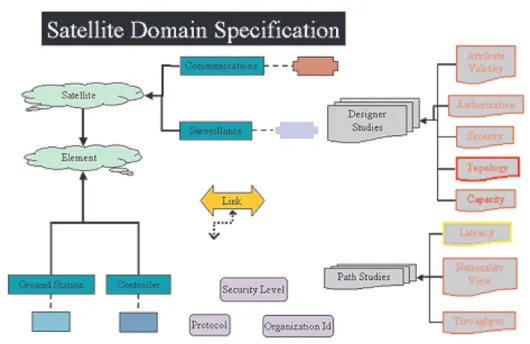
Wile86,Wile93]. Within our extension to Pow-erPoint, called the Design EditorGoldman99], the application designer designs a graphical in-terface comprising icons and different kinds of arrows. The designer also declares what at-tributes may be used to decorate the various classes and superclasses of component and con-nector (icon and arrow) types. Domain types can also be enumerated. This, so-called “archi-tecture style”10 or “domain design” takes the
Fig. 7a.Satellite Domain Specification in PowerPoint Design Editor.
10We originally designed this to provide specific notations and analyses for software architectural styles inAcme Garlan00 ],
place of a syntax for the structural aspects of the domain. Specifications can then mix graph-ics with textual and graphical attributes in this hybrid DSL technology. Figure 7a illustrates the style specification for the satellite domain; Figure 1 is an instance of a design expressed in these domain terms. Various icons here repre-sent classes of the “style” domain. The “clouds” are abstract classes with which the domain de-signer can associate attributes; here, all the slot variables of the Java specification are attributes. The mechanism for specifying these attributes is form-based and rather “clunky,” but one can express that an attribute can be optional, re-quired and/or multiple valued. Its type can be proscribed and ranges given for numeric types. There are four different kinds of components, linked to the clouds via subtype arrows. Each has an associated icon (in different colors) — cruciform shapes for satellites and rectangles for controllers. There is only one kind of con-nector, called a “Link,” represented by a dotted,
double-arrow. The three rounded rectangles la-beled Security Level, Protocol, and Organization IDare enumerated types for this domain. Right
clicking on them brings up a menu to enter the constants. The two icons labeledDesigner Stud-iesandPath Studiesare “analysis groups;” they will become major menu labels at the top of the PowerPoint screen when editing designs in the Satellite style. The menus will contain various analyses as selections, Attribute Validity, Autho-rization, etc. With each analysis one can
as-sociate parameters that must be filled in when the analysis is invoked during satellite system design and analysis time.
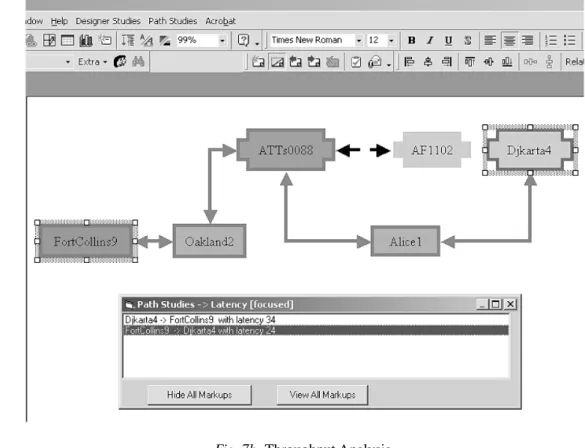
Figure 7b shows the original design being an-alyzed for Throughput. Notice that the Pow-erPoint frame segment shows the editing tools specialized for this domain in the upper left-hand corner just above the editing window. The
Djkarta1satellite and theFortCollins9ground sta-tion have been selected, so after mousing the
Path Studies > Throughput analysis menu in the
menu bar at the top of the frame, the analy-sis computed throughput values in both up and down directions between these two elements.11
Recall that the inclusion of this menu was indi-cated by the presence of the analysis hierarchy on the domain design in Figure 7a. When we
se-Fig. 7b. Throughput Analysis.
11There is not enough information in our model to do this. The example illustrated is from a style that is slightly more complex
lected the second analysis result in the analysis window(at the bottom of the screen) the path with the maximum throughput(here, the only path)was highlighted on the original diagram, i.e. the feedback from analyzers is presented right on the original diagram whenever possi-ble.
Our approach is part of a broader category of ap-proaches that also includes techniques involving the use of UML Booch99] with, for example, COM-based domain-specific analyzers.
4. DSL Support Issues
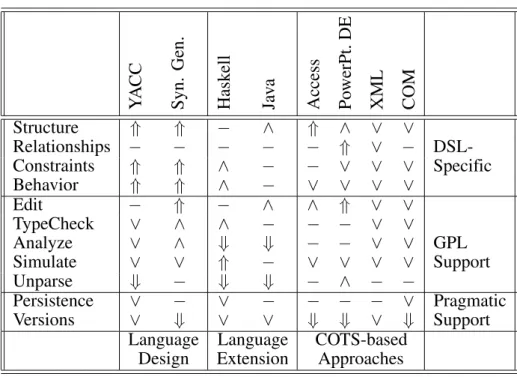
Each of the techniques presented in the previ-ous section has advantages and drawbacks that will be detailed further in the sequel, but first it is important to recapitulate why providing DSL support is potentially so difficult. Generally, there are three kinds of issues that make DSL support difficult: issues specific to the fact that we are designing a DSL, more generic issues that have already arisen in providing support for general-purpose programming languages, and pragmatic issues that transcend technical arguments for particular solutions. Before dis-cussing in further detail how each of the DSL support approaches above impacts these issues, a slightly more careful discussion of each issue is presented in the following sections. In the following section, Section 5 — Support Advan-tages for DSL Approaches, a table is presented that lists various issues as row headings and various support techniques as column headings. The boldfacelabels in the sections below will be used as the issue labels in that table.
4.1. DSL-Specific Issues
Above we focused on the design and specifica-tion of the syntax of the DSL and abstract or internal representations, demonstrating in par-ticular, that the appropriateness of the specifi-cation language is very domain-specific, some-times even “sub-domain-specific.” Some as-pects are easily characterized with traditional BNF-like syntax, others yield better to tabular approaches, and still others, to graphical repre-sentations. Worse, most domains have some as-pects of well-known languages already present,
e.g. infix operator notation, with only a limited amount of truly new syntax added for the prob-lem domain. Some ideally require a mixture of graphical, syntactic and even tabular entry. It will be useful below to separate the language design issues into four separate concerns: speci-fying thestructureof objects or concepts of the problem domain, specifying relationships be-tween objects or concepts in the domain, spec-ifying(other)constraintson objects or among concepts of the domain, and specifying behav-ior of domain objects or agents. Some DSLs have little or none of one or even two of these issues; they are all almost always present, but may be implicitly dealt with by the infrastruc-ture. For example, one need not specify in the satellite domain the constraints that actually yield computations of total path bandwidth; the analytical infrastructure provided by the DSL support designer will provide the algorithms. Specific problems that arise include:
Sub-languages present in a DSL are “rein-vented” rather than adopted directly, viz. the languages for constraints, for process, and for the various constants. It would often be better to adapt or adopt well-known lan-guages for such purposes, especially if there are no precedents for expressing these in the problem domain jargon.
The language itself may be a bit artificial for the domain. In particular, the syntax used in the example in Figure 2 for how to connect the different elements is clumsier than sim-ply drawing the connections as was done in the motivating Figure 1.
be related back to the problem domain, rather than in terms from the evaluation mechanism itself.
4.2. General-purpose Language Support Issues
All of the concerns that are germane to general-purpose programming language(GPPL)design and support may become important in the sup-port of a specific DSL. The tool supsup-port nec-essary can often be classified in GPPL support terms: editing, dereferencing, saving; compila-tion concerns, such as parsing,type checking, and code generation; static analyzer designs, such as usage graphs; means for debugging DSL “programs,” often entailing an “unparsing” ac-tivity to map back out of the internal representa-tion; support forpersistenceandversions; and mechanisms for simulatingor executing DSL programs. These issues will be elaborated in more detail below.
4.3. Pragmatic Support Issues
A final category of problematic issue, often critical in the decision of what approach to take to provide DSL support, is purely prag-matic: sometimes a particular implementation platform is important or sometimes the ability to spread effort among members of a team is crit-ical. These constraints often cause technically surprising choices to be made.
There may be sources of data and analy-ses independent from those with which the technology must interact. This is some-what related to issues that arise in Computer-Supported Cooperative Work(CSCW) Ben-Shaul95]where support of multiple sources for changes to the specification is required. Depending on applications, several engineers may need to cooperate to come up with a specification. The technologies for computer-supported cooperative work(CSCW)— trans-action control and version management — are not incorporated, for example, in the Cor-nell Program Synthesizer Generator. This
may argue for a much more fragmented ap-proach than might seem ideal, possibly re-quiring different support options for differ-ent portions of larger DSL.
The technology must run on the platforms the application engineers are familiar with. One almost never has the luxury of defining an entire programming and hardware sup-port environment for the accomplishment of particular tasks. Interoperation with partic-ular file formats, efficiency considerations, and operating system concerns can each dom-inate a technology choice decision.
Many of these problems will pertain to any of the alternative approaches to providing DSL support mentioned above. However, each ap-proach will tend to solve or ameliorate at least one of them. It is worth revisiting each approach above to see whether problems are aided, exac-erbated or untouched by the approach.
5. Support Advantages for DSL Approaches
Table 1 is an attempt to indicate how effec-tive various approaches to providing DSL sup-port are. The issues listed in the left column are keyed to the discussion above. Structure, Constraints, andBehaviorall refer to how well different language aspects can be expressed in DSLs supported by the technology to the left, not how readily the semantic support behind these sublanguages can be expressed. Other rows refer to how difficult it is to provide support for the labeled activity, not whether it is already provided by the technology. The “*” symbol indicates that outstanding support is provided by the technology; the “^” means excellent; “;,”good; “_,” fair; and “+,” poor or difficult to provide.12 The table is meant to be purely indicative and certainly represents just my opin-ion based on my own experience with some of them. There is a wide variety of other specific support tools and several of the issues above have not been dealt with because of my lack of personal experience.
A word on why the columns were chosen is plausible. The choices simply represent a group of tools with which I have some limited famil-iarity. This has some major implications with
YA
C
C
Syn.
Gen.
Hask
ell
Java Access PowerPt.
DE
XML COM
Structure * * ; ^ * ^ _ _
Relationships ; ; ; ; ; * _ ;
DSL-Constraints * * ^ ; ; _ _ _ Specific
Behavior * * ^ ; _ _ _ _
Edit ; * ; ^ ^ * _ _
TypeCheck _ ^ ^ ; ; ; _ _
Analyze _ ^ + + ; ; _ _ GPL
Simulate _ _ * ; _ _ _ _ Support
Unparse + ; + + ; ^ ; ;
Persistence _ ; _ ; ; ; ; _ Pragmatic
Versions _ + _ _ + + _ + Support
Language Language COTS-based
Design Extension Approaches
Table 1.Effectiveness of Approaches
*— Outstanding,^— Excellent,;— Average,_— Fair,+— Poor.
how the table should be considered. Notice in particular that the “PowerPoint Design Editor” labels one column. It is important to realize that were the comparison simply with PowerPoint it-self, a much more bleak support picture might be painted, something akin to those of XML or COM. By the same token, were I familiar with SmartToolsAttalli01], that effects an automatic conversion from DTD(Document Type Defini-tion) to abstract syntax trees and vice versa is supported, I might have rated its combination with XML comparable to the advantages from the Synthesizer Generator.
Other examples abound. Excel would make an excellent column label as well, but I have not used it in this context at all. Moreover, there are modern research versions of language process-ing tools, such as ASF+SDF Heering89, van den Brand01] and LISAMernik00a] that may actually be superior to the Synthesizer Genera-tor, if pragmatically acceptable to an organiza-tion. For a recent overview of such systems, see
Heering00].
In the following, each row of the table will be discussed in turn, since the table is most “indica-tive” of what to expect when using the various techniques.
5.1. Describing Structure
Explicit syntax is ideal for expressing complex declarative structures, such as in the element
specifications above, where the delineation of attributes such as location, type, name, position, velocity, and sequencing are sometimes
speci-fied. Since explicit syntax is easily provided for in YACC and the Synthesizer Generator, they do an outstanding job of representing structure. Syntactic representations are especially useful when several optional parts of the structure may be present or where there are complex con-straints between the attributes. Continuing the example, the hours, field of view, multiplex, rate, and sequencing are all optional and dependent on the element’s type; syntax can easily provide for the facile expression of that fact. Syntax can also provide for correlations between at-tributes, such as the required presence ofstate
declarations when states are used in sequenc-inginstructions. Lists of items are also handled syntactically, especially when ordering is im-plied, but these are sometime handled better as relationships(see next item).
effectively. Moreover, it is not difficult to de-scribe form-based interfaces to these in gen-eral. Java’s inheritance mechanism renders it a bit more concisely for expressing these fixed structures than Haskell, so the former was rated excellent and the latter merely good. Our form-based PowerPoint Design Editor is about the same as Java to use for specifying attributes of objects, assuming Java forms are created for at-tribute entry for each object type.
When attributes are very regular, a tabular pre-sentation is often useful, so Access can shine through here and is also given an outstanding rating. Access has built-in forms for data en-try and allows further customization of these by the designer. Access is quite awkward for interrelating both simple attributes and lists of attributes simultaneously, as was seen in the ex-ample above - Figure 5b, but recasting the lists of elements as relationships unto themselves — Figure 5c — redeems Access in this respect as well. Similar comments could also be made for COTS spreadsheet programs, useful when spe-cial simulations or analyses are easily expressed as relaxations.
XML and COM fare rather poorly here in that even though they can be used to express the same information as the others, the interfaces are quite verbose to say the same thing. They can be boosted easily enough with a good form-based interface, so they should not be discounted out-of-hand.
5.2. Describing Relationships
Pictorial representations seem to be preferred to syntactic ones when detailed relationships be-tween objects are described. Hence, our Pow-erPoint Design Editor is rated outstanding here. PowerPoint itself would not be, for there the logical structure is intertwined with the phys-ical layout structure so implicitly that there is considerable noise within the internal represen-tation. The preference for graphical support pertains even with medium-sized specifications, where the direct interactions can be seen as arrows or lines between the involved compo-nents. Larger containment structures can be represented by implicit links between “slides” in PowerPoint as well, where one slide is the definition of an icon on another. Beyond that,
PowerPoint joins the rest of the techniques in requiring some sort of file management to de-scribe aggregates.
Syntactic support for describing relationships usually requires that objects be named uniquely or relatively to some enclosing structure. Gen-erally, application engineers must use awkward techniques for finding what objects are referred to, by looking up their definitions. The pro-gramming language approaches must use simi-lar naming conventions. Although Haskell can be used to express cyclic relationships, occa-sionally it is a bit mind-numbing to understand how it works. On the other hand, Haskell can deal with lists of objects better than any of the other representations, so it is considered as “good” as the rest of the syntactic and language extension approaches. There may be explicit tool support provided for finding object defini-tions in Java or Access environments, so that can make relationships easier for application engi-neers to deal with.
XML is the worst of the bunch for expressing relationships, for one must reinvent some notion of unique identifier each time such relationships are desired. COM’s references are straightfor-ward, but accessible only through programmatic means; they can look approximately like Java object creation code.
5.3. Expressing Constraints
Constraints — with essentially complex struc-tures — are often best expressed syntactically, and hence, tools providing syntactic support are ranked outstanding, as the best way one can provide domain-specific support. Of course, specific domains may contradict this general-ization and make considerable headway with iconic constraint symbols.
syntax for conditionals and statements. Access allows some local constraint specifications us-ing SQL; moreover, a programmatic interface is available, that allows designers to provide for SQL’s use on a more global scale. Hence, these two are still good for representing constraints. The PowerPoint Design Editor and the inter-change languages, XML and COM, are all equ-ally bad here — the designer reequ-ally has to pro-vide an ad hoc constraint definition facility. Of course, one of the other techniques could be used for this in a hybrid approach, so no par-ticular method should be discounted a priori. The fact that the interchange mechanisms exist makes the potential for combining effects very promising.
5.4. Describing Behavior
Almost exact comments that apply to constraints hold for behavioral representations too. Since Access has no way of expressing behavior, it is rated merely fair in this column, but otherwise all the entries are the same for the behavior row in the table as for the constraints. In fact, some people prefer flowcharts to a structured syntax for expressing sequencing, so the PowerPoint Design Editor could be bumped up a notch for some uses. Researchers raised in the structured programming era tend to eschew such potential complexities.13 Even though graphical idioms may turn up occasionally, people tend to use a syntactic way to describe procedures, so I have generally concluded that syntax is an outstand-ing means for specifyoutstand-ing behavior.
It is worth mentioning that although Haskell is rated excellent for expressing behavior, it is not for the same reasons as for constraints, for a completely different dialect of the language will usually be useful for expressing behavior. The most common usage is for scripting, using the monad construct described briefly above.
5.5. Editing
This is the forte of the Synthesizer Generator in that it understands the structure of the syntax
and can prevent entry of erroneous text in the first place; hence, it is rated outstanding in this category. At least one other editor, the ubiq-uitous emacs, has been provided with “modes” that approximate syntactic understanding of the more popular languages. Sometimes a DSL can be designed to similar standards (like C) and take advantage of the fonting and bracket-matching features of emacs. In fact, since it is open- source, an expert can probably design such a package for a new DSL rather easily. For this reason, LEX/YACC and Haskell are rated good in this aspect. A Java emacs mode is also available, but Java is ranked excellent because there are programming environments built specifically for it, which facilitate editing to a much greater extentSun Forte].
Access and PowerPoint both have nice editing interfaces; to me PowerPoint’s feels much less clumsy than Access, so I rated the former out-standing with Access only excellent. Naturally, as with almost everything, the interchange lan-guages require that you design your own. How-ever, if the XML used matches an html applica-tion to some extent, specific form editors may be around to make editing it a somewhat less unpleasant chore than it is normally using a text editor!
5.6. Defining Type Checkers
This is another area where the Synthesizer Gen-erator excels, in that providing a set of attribute grammar declarations to do type checking is generally rather straightforward, but tedious. The computation of the attribute has to be ex-pressed for each construct in the language, but their expression is equational in terms of at-tributes of parent nodes(inherited)or children nodes(synthesized). The relaxation computa-tion proceeds until it converges.
In fact, LEX/YACC has been used long enough so that this activity is not too difficult for experts there either, perhaps requiring frequent refer-ence to “the Dragon Book”Aho86]. This is the area where support tooling really requires un-usual (read, “expensive”) expertise, however,
13This raises an interesting issue: to what extent should the DSL designer imbue the language with good design principles?
and is probably the main drawback to providing syntax-based DSL support.
There are two issues related to using language extensions for DSL support in this category: (1) how much of the language’s own type check-ing can be used to provide effective DSL type checking and(2)how hard is it to express what is left over? The table rankings are for (1), where Haskell’s native type checker is noth-ing less than astoundnoth-ing — programs that type check often run correctly the first time! Java’s strict adherence to class accessor syntax can also provide good support for type checking. Regarding(2)these languages can often be re-garded as poor for the following reason: with the exception of the data structure declarations, for which type checking programs can be writ-ten, when the user writes an actual program in the language, there is no abstract syntax repre-sentation of the program that a type checker can refer to. So, for example, if only one of two spe-cific functions should ever be called in a partic-ular context, establishing that domain-specific type constraint might require the introduction of extraneous variables at run-time to signify the correct context and the number of times one of the functions had been called. These variables have nothing to do with functionality, and if the type constraint is critical, it may be too late to delay such constraint checking. This inability to separate concerns can be damning for a lan-guage extension approach. The next best thing is to write an interpreter in the language over an abstract syntactic representation so this kind of type checking can be data-driven at analysis time.
Access and the PowerPoint Design Editor are rated good simply because their interfaces are good at enforcing adherence to a rigid syntax. Otherwise they are only fair, possibly requiring extensive programming; XML and COM can require similar amounts of programming.
5.7. Describing Analyzers
Most analyses — for usage relations, inacces-sible code regions, improper initializations, etc. — share the same technology and criticisms just enumerated for type checking, because in some sense, type checking is the quintessentialstatic
analysis activity. The rows differ only in that
Haskell and Java representations share the prob-lem mentioned above: their lack of an abstract syntactic representation of the program makes it difficult to perform analyses directly. With one caveat: if the sole purpose of the specification is to perform a particular analysis, the evalua-tion of the funcevalua-tions themselves may perform the analysis.
An example may help clarify this. Assume that we have a program extension for a musical di-alect in Haskell comprised of functions C, C#, D, D#, E, F, F#, G, G#, A, A#, B (with some equivalent functions, such as Db). Each func-tion takes two integers: one represents an octave and the other a tone duration. One could then construct a tune as a sequence of applications of these functions in a “MIDI monad,” e.g.
C 3 4; C 3 4; E 3 4; E 3 4; F 3 4; F 3 4; E 3 4
:::
(Twinkle, twinkle little star)
(Do not be concerned if the technical details seem obscure — the point is that a program could play the song you entered using this some-what clumsy technique.)
If we want to analyze this program to see whether it contains any scale progressions(a particular pattern of notes), what can we do? All we have is a big composed function and no data repre-sentation for it. However, ifallwe wanted to do was analyze the program for scale patterns, we could define the functions themselves to check for them. But then imagine we want to check for repeated themes. We have the same prob-lem. Of course, there may be more generic ways of handling this problem, perhaps making these functions of a class or perhaps even us-ing generic programmus-ing, but the applications of program extension so far have not dealt with this problem — i.e., they have all been single-use extensions.
5.8. Simulation
building the search into a monad,14 but other
languages such as PrologL¨ammel01]or simu-lation packages such as MatLab may be a better choice for some tasks. Java is another reason-able language for using the language extension as a direct program in the domain. Again, we are relying on the application engineer to write programs (as in Figure 4b) whose evaluation runs a simulation of the implied behavior. All other approaches require programming the simulator in some language and provide no spe-cific leverage on their own for this or other eval-uation activities.
5.9. Unparsing
Sometimes one needs to report errors or results of analyses back in terms of the original do-main. This unparsing activity is not difficult for approaches that keep an abstract syntax repre-sentation of the original program, such as Ac-cess and the Design Editor, and in fact, the XML and COM representations as well. The Design Editor, moreover, provides a facility for high-lighting the original objects on the PowerPoint slides, so it has been ranked as excellent for supporting analysis result reporting.
It is more difficult for the syntactic approaches to provide unparsing facilities, especially the YACC approach that does not even require in-venting an abstract syntax in the first place. The Synthesizer Generator does provide a link-age between abstract and concrete syntax, so it could be programmed there. Again, since the language extensions generally have no abstract syntax, reporting can be nearly impossible to phrase in domain terms with them. If the exten-sions are used extensively for representing data structures of the domain, the debugging facil-ities of the programming environment for the language may suffice to describe the problem structures. This is an especially serious prob-lem with generic programming approaches.
5.10. Persistence
The Synthesizer Generator, Java programming environments, Access and PowerPoint all pro-vide means for saving files, so they are at least
good choices if the specifications in the DSL need to be kept persistent. (It is not a fore-gone conclusion that persistence is necessary; the purpose of the DSL may just be to express web search queries, for example, something of generally transient utility.) YACC and Haskell require extraneous mechanisms, and thus are only rated fair. XML is rated good because there are emergent facilities for keeping XML databases persistent Dashofy01]. I know of no persistence mechanisms for general COM structures, so I presume such facilities must be programmed from scratch. This will be a non-trivial activity in general, since the structures may be cyclic and not refer to printable items, but on an ad hoc basis they should be manage-able.
5.11. Versions
Versionsis a placeholder here for all the scaling issues allowing large development efforts to use DSLs. This requirement is almost non-existent in the efforts to date, that have used a DSL-based approach. It is even possible to argue that it will never be a serious problem: large problem solutions are the result of many small problem solutions, each of which is best expressed in a DSL close to the individual problem space. Even with this argument, there will be problems of intercommunication of shared data, version management, translation between representa-tions, etc., not to mention coordination of anal-ysis and simulation activities. The table row here is the one I understand least well, but I am inclined to think that the Synthesizer Genera-tor, PowerPoint and Access are the least likely to become scalable on their own. COM is an in-memory representation and certainly is not intended for massive amounts of data either. In fact, DSLs change more frequently than general-purpose languages, exacerbating ver-sioning problems. But there is good reason to believe that language development facilities of the future will be able to cope with such rapid change, for example, based on LISA. Its tool support allows incremental develop-ment with multiple attribute grammar inheri-tanceMernik00b].