COMMENTARY
A Success Story: The Burden of Maternal, Neonatal and Childhood
Mortality in Rwanda - Critical Appraisal of Interventions and
Recommendations for the Future
DOI: 10.29063/ajrh2018/v22i2.1
Pari Shanmuga Raman Gurusamy* and Priya Darshene Janagaraj
Department of Health, Northern Territory Government of Australia*For Correspondence: Email: [email protected]
Abstract
Globally, the burden of maternal, neonatal and childhood mortality is disproportionately shared between the least developed nations and the developed nations. While the global maternal mortality has been almost halved since 1990, 99% of maternal deaths occur in developing regions. This invariably highlights the impact of poverty and, to combat poverty in its different elements, the United Nations (UN) established eight Millennium Development Goals (MDGs), including improving maternal health (MDG 5) and reducing child mortality (MDG 4). Rwanda is one of the few countries that have met both MDGs 4 and 5 ahead of time. In 2015, the UN established 17 Sustainable Development Goals (SDGs), a renewed version of targets to be achieved by 2030, including Good Health and Well-being (SDG 3). SDG 3 aims to achieve a global maternal mortality rate (MMR) of 70 or less by 2030, requiring an annual reduction in MMR by 7.5%. Rwanda is on track to achieving its SDG targets with the support of local government, donors, and international and local agencies. The multipronged approach initiated by the Rwandan government, backed by international organizations, is to be credited for this success. Studying these proven strategies and interventions will allow us to identify gaps, further develop and eventually transfer them to the rest of the world, with suitable contextualization. (Afr J Reprod Health 2018; 22[2]: 9-16).
Keywords: Sub-Saharan Africa, Rwanda, Maternal Mortality, Childhood Mortality, Neonatal Mortality
Résumé
Partout dans le monde, le fardeau de la mortalité maternelle, néonatale et infantile est partagé de manière disproportionnée entre les pays les moins avancés et les pays développés. Alors que la mortalité maternelle mondiale a presque diminué de moitié depuis 1990, 99% des décès maternels dans les régions en développement sont 14 fois plus élevés que dans les régions développées. L'Organisation des Nations Unies (ONU) a établi huit objectifs du Millénaire pour le développement (OMD), notamment l'amélioration de la santé maternelle (OMD 5) et la réduction de la mortalité infantile (OMD 4). Le Rwanda est l'un des rares pays à avoir atteint les OMD 4 et 5 à l'avance. En 2015, l'ONU a établi 17 Objectifs de Développement Durable (ODD), une version renouvelée des objectifs à atteindre d'ici 2030, y compris la santé et le bien-être (ODD 3). L'ODD 3 vise à atteindre un taux de mortalité maternelle (TMM) global de 70 ou moins d'ici 2030, ce qui nécessite une réduction annuelle du TMM de 7,5%. Le Rwanda est sur la bonne voie pour atteindre ses cibles d'ODD avec le soutien du gouvernement local, des donateurs et des agences internationales et locales. L'approche multiforme mise en place par le gouvernement rwandais, soutenue par des organisations internationales, est à mettre au crédit de ce succès. L'étude de ces stratégies et interventions éprouvées nous permettra d'identifier les lacunes, de les développer et éventuellement de les transférer dans le reste du monde, avec une remise en contexte appropriée. (Afr J Reprod Health 2018; 22[2]:9-16).
Mots-clés: Afrique subsaharienne, Rwanda, mortalité maternelle, mortalité infantile, mortalité néonatale
Introduction
Globally, the burden of maternal, neonatal, and childhood mortality is overwhelming, and is shared disproportionately between the developing and developed nations1. Rwanda is a low income
improving maternal health (MDG 5) and reducing child mortality (MDG 4). The annual rate of reduction in under-five mortality rate (U5MR) in sub-Saharan Africa has quintupled from 0.8 in 1990-1995 to 4.2 in 2005-2013. Similarly, maternal mortality rate (MMR) in sub-Saharan Africa has nearly halved from 987 in 1990 to 546 in 20151. However, the absolute rate of U5MR in sub-Saharan Africa remains high at 86 in 2015, and sub-Saharan Africa alone accounts for 66% of global maternal deaths world-wide1. In 2015, the UN established 17 Sustainable Development Goals (SDGs), a renewed version of targets to be achieved by 2030, including Good Health and Well-being (SDG 3). Rwanda is one of the few countries that have met both MDGs 4 and 5. This perspective article analyses the burden of maternal, neonatal and childhood mortality in Rwanda; studies the innovative strategies used by Rwanda to meet the MDGs ahead of time; and suggests recommendations for strengthening future interventions.
Burden of maternal, neonatal, and childhood
mortality – through the MDG era
Maternal mortality
The maternal mortality rate (MMR) is defined as the number of maternal deaths per 100,000 live births, occurring during a given period. It captures the risk of maternal death in a single pregnancy or a single live birth1. WHO‘s International Statistical Classification of Diseases and Related Health Problems (ICD) defines maternal death as:
“The death of a woman while pregnant or within 42 days of termination of pregnancy, irrespective of the duration and site of the pregnancy, from any cause related to or aggravated by the pregnancy or its management but not from
accidental or incidental causes
”.
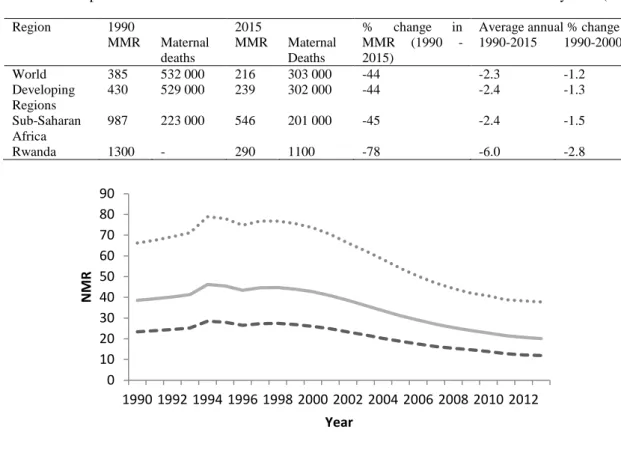
Rwanda‘s MMR has been steadily decreasing from 1300 in 1990 to 290 in 2015, demonstrating a 78% reduction between those periods. However, the burden of maternal mortality in Rwanda remains significant, given that 1300 maternal deaths have
occurred among the 414,000 live births in 20133. Of these 1300 deaths, 32 were AIDS-related indirect maternal deaths. In 2015, the lifetime risk of maternal death in Rwanda was 1 in 80, while the proportion of deaths, due to maternal causes, among women of reproductive age was 13.6%1. This is certainly an improvement from the 34.1% seen in 1990. The following table has been formulated from using estimates by WHO, UNICEF, UNFPA, the World Bank, and the United Nations Population Division. It highlights the global burden of maternal mortality, narrowed down to Rwanda as per UN MDG regions.
Neonatal and childhood mortality (under-five
mortality)
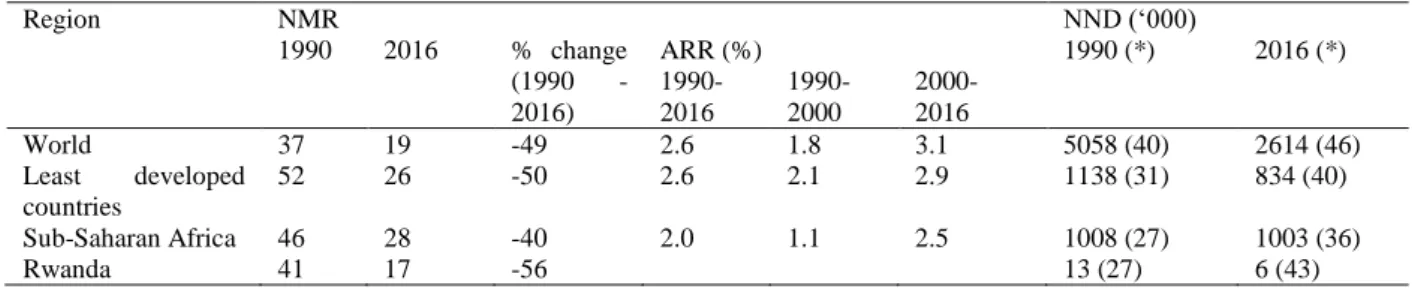
A neonatal death (NND) is defined as a death occurring during the first 28 days of life (0-27 days) and it sub classified as early neonatal death, if occurring between 0 to 6 days after birth, and as late neonatal death, if occurring between 7 to 27 days after birth4. Neonatal mortality rate (NMR) refers to the number of NND per 1000 live births. The African continent has the highest risk of NND, with 40 NND per 1000 live births, and it ranges from 40 to 46 per 1000 live births in sub-Saharan regions of Western, Central and Eastern Africa 5. In Rwanda, the NMR has fallen from 41 in 1990 to 17 in 20166. The following table depicts the changes in the burden of neonatal mortality in Rwanda during this period.
The following figure has been created from the estimates generated by the UN Inter-agency Group for Child Mortality Estimation (IGME) in 2014 and it portrays the trend of NMR in Rwanda since 19907.
Table 1: Comparison of 1990 and 2015 Estimates of Maternal Deaths and Maternal Mortality Rate (MMR)
Region 1990 2015 % change in
MMR (1990 - 2015)
Average annual % change in MMR MMR Maternal
deaths
MMR Maternal Deaths
1990-2015 1990-2000 2000-2015
World 385 532 000 216 303 000 -44 -2.3 -1.2 -3.0
Developing Regions
430 529 000 239 302 000 -44 -2.4 -1.3 -3.1
Sub-Saharan Africa
987 223 000 546 201 000 -45 -2.4 -1.5 -2.9
Rwanda 1300 - 290 1100 -78 -6.0 -2.8 -8.0
Figure 1: Estimates of Neonatal Mortality Rate (NMR) in Rwanda by Year
Under-five mortality (U5M) has been decreasing in almost all countries, except in countries affected by the HIV/AIDS epidemic9, including Rwanda, where the prevalence of HIV infection has been well documented to be at epidemic levels10, 11. Nevertheless, Rwanda has experienced a significant decline in U5MR from 1990 to 2016. Rwanda‘s U5MR was 151 in 1990 and it surpassed its MDG target of 51 in advance of 2015 to reach a rate of 39 in 2016. The increase in U5MR from 156 in 1990 to 287 1994 is coincident with the Rwandan genocide8. Post 1994, there has been an overall decline in the U5MR with a more consistent reduction noted from 1998. The following table has been created from data produced by the UN IGME, and it illustrates the burden of U5MR in the world and narrows down to Rwanda, according to UN SDG regions6. The 5.2% ARR (annual rate of reduction) in U5MR in Rwanda is higher than the Sub-Saharan African
and Global rates of 3.2% each.
Neonatal death (NND) has emerged as an increasingly prominent component of the overall Under-five mortality and is hence receiving additional attention. As such, the table below, created using data developed by the UN Inter-agency Group for Child Mortality Estimation, illustrates the burden of neonatal mortality and its share in Under-five Deaths (U5D) in the world and narrows down to Rwanda, according to UN SDG regions6. The burden of neonatal mortality has increased disproportionately and has had a relative increase of 58% since 1990 (27% in 1990 to 43% in 2016).
The Rwanda Demographic and Health Surveys (DHSs) confirm that majority of the neonatal deaths were early neonatal deaths (71.2%, 70.6% and 67.1% in the 5 years preceding the 2000, 2005 and 2010 DHSs) 12. Early neonatal deaths are invariably linked to maternal health and 0
10 20 30 40 50 60 70 80 90
1990 1992 1994 1996 1998 2000 2002 2004 2006 2008 2010 2012
N
M
R
Year
Table 2: Comparison of 1990 and 2016 Estimates of Under-five Mortality Rate (U5MR), Under-five Deaths (U5D), and Annual Rate of Reduction (ARR) 6
Region U5MR U5D (‗000)
1990 2016 % change (1990 - 2016)
ARR (%) 1990 2016
1990-2016
1990-2000
2000-2016
World 93 41 -56 3.2 1.9 4.0 12598 5642
Least developed countries
176 68 -61 3.6 2.4 4.4 3669 2101
Sub-Saharan Africa 183 79 -57 3.2 1.5 4.3 3787 2777
Rwanda 151 39 -74 5.2 - - 48 14
Table 3: Comparison of 1990 and 2016 Estimates of Neonatal Mortality Rate (NMR) and Neonatal Deaths (NND), and Annual Rate of Reduction (ARR) 6 *NND as a Share (%) of Under-five Deaths
Region NMR NND (‗000)
1990 2016 % change (1990 - 2016)
ARR (%) 1990 (*) 2016 (*)
1990-2016
1990-2000
2000-2016
World 37 19 -49 2.6 1.8 3.1 5058 (40) 2614 (46)
Least developed countries
52 26 -50 2.6 2.1 2.9 1138 (31) 834 (40)
Sub-Saharan Africa 46 28 -40 2.0 1.1 2.5 1008 (27) 1003 (36)
Rwanda 41 17 -56 13 (27) 6 (43)
interventions targeting reducing maternal mortality will yield substantial benefits towards reducing early neonatal deaths.
Approaches to reducing maternal mortality -
critical appraisal: the MDG era
Reducing the MMR by three quarters between 1990 and 2015 and achieving universal access to reproductive health by 2015 were the two targets for assessing MDG 513. Despite suffering genocide in 1994, having few natural resources, being landlocked, and having a high population growth, the Rwandan Health sector has made critical progress towards the improvement of maternal health and reducing the MMR14, achieving the MDGs. United Nations Population Fund (UNFPA) has been operating in Rwanda since 1975 and has been largely successful in advancing and advocating for the Reproductive Health and Rights at central and decentralized levels, including implementation of its sixth Country Programme. Consequently, Reproductive Health, including Family Planning and Maternal health, has been made a priority in the Rwanda‘s Ministry of Health Strategic Plan, targeting the primary problems of large percentage of births that
take place without skilled medical assistance (52%) and suboptimal utilization of family planning services and basic obstetric care15 through the following measures.
'Delivering as one’ - the sixth country
programme
Improved surveillance and accountability
Improved surveillance and accountability have played a large role in reducing the MMR and increasing the number of assisted deliveries in Rwanda. Rwanda‘s Ministry of Health (MoH) was able to better track the causes of maternal deaths throughout the country through improved surveillance methods. This resulted in improved understanding of the maternal deaths and permitted the development of more targeted policies, strategies, road maps and programs15.
Institutionalization of maternal death audit
in Rwanda
Maternal death audits are a vital mechanism to strengthen the health information systems, resulting in an improved understanding of the root causes of maternal death and highlighting the changes required to address them, especially in low-resource settings16. In 2008, post institutionalization of maternal death audit, Rwandan MoH, in collaboration with UNFPA and WHO, trained a pool of 28 maternal death audit persons, and developed validated tools for conducting facility-based deaths audits, confidential enquiry into maternal deaths and community-based deaths audits (verbal autopsy). This critical capacity building of health facilities led to an audit of 256 and 221 maternal deaths in 2009 and 2010, respectively, in Rwanda‘s 43 district hospitals, leading to formation of recommendations to prevent similar deaths in the future and identification of foci of future interventions15.
Campaign on Accelerated Reduction of
Maternal Mortality in Africa (CARMMA)
and White Ribbon Alliance (WRA)
Campaign on Accelerated Reduction of Maternal Mortality in Africa (CARMMA) was launched in 2009 by African Union (AU) at the fourth session of the Conference of Ministers of Health. CARMMA aims to accelerate the availability and usage of universally accessible quality health services, including services related to sexual and reproductive health17–19. CARMMA has led to several high-level advocacy initiatives led by the
Rwandan government, including the White Ribbon Alliance (WRA) 20, 21 and International Conferences on Maternal and Child Health. The WRA sought to attract and retain qualified healthcare workers in rural regions, increase overall availability of midwives and improve public awareness on family planning and maternal health services and rights, and enhance analysis and use of maternal mortality data22. UNFPA Rwanda Country Office has provided its support to Rwandan MoH, network of parliamentarians, NGOs, and Districts, to increase awareness in Adolescents Sexual Reproductive Health15. The interventions spanned from pre-partum stage, through to antenatal and postnatal stages, allowing continuum of care for maternal and perinatal health23. Coverage rates for interventions at all stages increased from 1992 to 201023.
Strengthening
capacity
of
health
professionals to deliver quality maternal
health services
UNFPA, UNICEF, and WHO joint interventions have enabled significant resource mobilization15. 245 women benefited from fistula repair surgeries through a Fistula Program. Through a mobile phone alert based and open-source initiative named RapidSMS, community health workers (CHWs) were trained on using SMSes for communication of maternal health and data collection, improving antenatal clinic (ANC) attendances and facility delivery rates. UNFPA has assisted Rwandan Government in acquiring essential infrastructures, including gynecological and obstetric equipment, and 6 ambulances. 3068 Community Health Workers were trained from the local population and authorized by Rwandan MoH to provide family planning services (i.e. condoms, pills, injectables and cycle beads), positively received by Rwandan population.
Recommendations for the future – engaging
government, donors and other agencies: the
era of SDG
donors, and international and local agencies. UNFPA is currently leading its eight Country Programme in Rwanda, with its priorities and commitments centered on sexual and reproductive health, youth-friendly services and population dynamics24. Paton and Soriano‘s stakeholder analysis of the sixth Country Programme states that the UN needs to keep in pace with the rapid pace of development in Rwanda, while focusing on contributing its technical expertise and applied research capabilities to build robust evidence-based policies and programmes25. These importance of policy and human resource development are universally applicable and cannot be undermined. In this respect, aligning the strategies of United Nations Development Assistance Plan (UNDAP) and any other independent or external assistance programme with the local government‘s policies and approaches would allow seamless assimilation of the programme, enhanced cooperation and improved success rates.
However, the implementation of these key strategies to reduce maternal mortality is a major challenge in sub-Saharan Africa, of which Rwanda is part of, as the health systems are often fragile and underdeveloped, leading to heterogeneous and inadequate service availability and quality of health care facilities26–29. For example, in Rwanda just 69% of deliveries occurred in health facilities and only 18% received postnatal care by a skilled health worker23.
Therefore, concerted efforts to support and strengthen existing healthcare systems to provide skilled emergency obstetric care will potentially lead to significant reduction of MMR. This is proven by Cooperative for Assistance and Relief Everywhere (CARE) Rwanda's work in Kabgayi Regional Referral Hospital, which increased met-needs from 16% in 2001 to 25% in 2004. Their works included execution of focused interventions, including hospital renovations, provision of life-saving equipment, training of healthcare staff and improvement of management system30. Such infrastructural optimization is especially important as Rwanda is still struggling to provide universal health coverage to all pregnant women due to inadequate healthcare personnel (one medical
doctor per 18,000 people and one nurse per 1,690 people) 31.
Thirty-three to fifty percent of all maternal deaths are caused by inadequate antenatal care (ANC) resulting in failure to address
pre-eclampsia, eclampsia, and antepartum
haemorrhage32. Adequate ANC facilitates, early detection of risk factors, and recognition of high-risk pregnancies requiring higher level of ANC, may include increased number of visits32 and early commencement of treatment22. Although Rwanda has implemented the WHO‘s ANC model, which recommends at least 4 antenatal visits during a pregnancy33, only 35.4% of pregnant women in Rwanda receive that level of care. Dohlsten et al
have identified limited access to healthcare, lack in knowledge, lack of male involvement, financial barriers, and cultural barriers as the five fundamental barriers to ANC22. These barriers are reported by MCA/WHO as the key reasons for women to not seek intrapartum and postnatal care as well23. Improved education about the significance of ANC, better access to ANC clinics, encouraging male involvement during pregnancy, and better insurance coverage would form the cornerstones of successful strategies to improve the quality and quantity of ANC received by the Rwandan population22.
Conclusion
nations, with suitable contextualization and improvements. If the lack of political will, as seen in several of developing countries34, is promptly addressed, backed by persistent and determined effort from all stakeholders, SDGs can certainly be achieved.
"Disclaimer: The views and opinions expressed in this article are those of the authors and do not necessarily reflect the official policy or position of any agency of the Australian Government or state and territory governments.
References
1. WHO. Trends in maternal mortality: 1990 to 2015: estimates by WHO, UNICEF, UNFPA, World Bank Group and the United Nations Population Division. Geneva: WHO; 2015.
2. The World Bank Group. Rwanda | Data [Internet]. [cited 2018 May 2]. Available from: https://data.worldbank.org/country/rwanda
3. DeSA UN. World population prospects: the 2012 revision. Popul Div Dep Econ Soc Aff U N Secr N Y. 2013; 4. WHO. Neonatal and perinatal mortality: country, regional
and global estimates. France: WHO; 2006. 5. WHO. Neonatal and perinatal mortality: country, regional
and global estimates 2004. France; 2007.
6. United Nations Inter-Agency Group for Child Mortality. Levels & Trends in Child Mortality: Report 2017, Estimates Developed by the UN Inter-agency Group for Child Mortality Estimation. New York: United Nations Children‘s Fund; 2017.
7. United Nations Inter-Agency Group for Child Mortality Estimation (UN IGME). Levels and trends in child mortality. New York: United Nations Children‘s Fund; 2014.
8. Commonwealth Health Online. Child and maternal health in Rwanda [Internet]. 2014 [cited 2018 May 2].
Available from:
http://www.commonwealthhealth.org/africa/rwanda/ child_and_maternal_health_in_rwanda/
9. Ahmad OB, Lopez AD and Inoue M. The decline in child mortality: a reappraisal. Bull World Health Organ. 2000; 78:1175–91.
10. Joint United Nations Programme on HIV/AIDS
(UNAIDS). UNAIDS DATA 2017 [Internet]. UNAIDS; 2017. Available from: http://www.unaids.org/sites/default/files/media_asse t/20170720_Data_book_2017_en.pdf
11. Spiegel PB, Bennedsen AR, Claass J, Bruns L, Patterson N, Yiweza D and Schilperoord M. Prevalence of HIV infection in conflict-affected and displaced people in seven sub-Saharan African countries: a systematic review. The Lancet. 2007 Jun 30;369(9580):2187–95.
12. Rebecca W, Pullum T, Langston A, Mivumbi N,
Rutayisire P, Muhoza D and Hakiba S. Trends in Neonatal Mortality in Rwanda, 2000-2010. DHS Further Analysis Reports No. 88. Calverton, Maryland, USA: ICF International; 2013 Aug. 13. Lomazzi M, Borisch B and Laaser U. The Millennium
Development Goals: experiences, achievements and what‘s next. Glob Health Action [Internet]. 2014 Feb 13 [cited 2018 May 2];7. Available from: https://www.ncbi.nlm.nih.gov/pmc/articles/PMC392 6985/
14. Logie DE, Rowson M and Ndagije F. Innovations in Rwanda‘s health system: looking to the future. The Lancet. 2008 Jul 19;372(9634):256–61.
15. UNFPA Rwanda. Maternal Mortality Reduction
Programme in Rwanda [Internet]. United Nations Population Fund; 2011. Available from: http://rwanda.unfpa.org/sites/default/files/pub-pdf/MaternalMortalityReductioninRwanda%28VLR %29_0.pdf
16. Rowe AK, de Savigny D, Lanata CF and Victora CG. How can we achieve and maintain high-quality performance of health workers in low-resource settings? The Lancet. 2005 Sep 17;366(9490):1026– 35.
17. Omaswa F and Crisp N. African Health Leaders: Making Change and Claiming the Future. OUP Oxford; 2014. 377 p.
18. Nkurunziza T, Muriithi A, Ouedraogo L and Toure I. Progress report on the road map for accelerating the attainment of the Millennium Development Goals relating to maternal and newborn health in Africa. (18):3.
19. Burton R. Maternal health: There is cause for optimism. SAMJ South Afr Med J. 2013 Jan;103(8):520–1. 20. White Ribbon Alliance Rwanda. Rwanda Strategic Plan
2010-2013 and year one operational plan. White Ribbon Alliance Rwanda; 2010.
21. Jolivet R. Respectful maternity care: the universal rights of childbearing women. Health Policy Proj [Internet]. 2011 Dec 13; Available from: http://www.healthpolicyproject.com/pubs/46_FinalR espectfulCareCharter.pdf
22. Dohlsten M. Barriers to antenatal care in Rwanda - A literature study on barriers for pregnant women in Rwanda to access antenatal care [Internet]. [Sweden]: University of Gothenburg; 2014.
Available from:
https://gupea.ub.gu.se/bitstream/2077/36058/1/gupe a_2077_36058_1.pdf
23. Department of Maternal, Newborn, Child and Adolescent Health. Maternal and Perinatal Health Profile. WHO & MCA; 2014.
24. UNFPA. UNFPA Rwanda 8th Country Programme 2018- 2023 [Internet]. Informal Session of UNFPA Executive Board; 2018 May 24; New York.
Available from:
https://www.unfpa.org/sites/default/files/event-pdf/Rwanda_8th_CPD_Presentation_to_Informal_E xBo.May2018.pdf
comparative advantage in Rwanda. The UN Country Team of agencies in Rwanda; 2012.
26. AMDD Working Group on Indicators. Program note: using UN process indicators to assess needs in emergency obstetric services: Benin and Chad. Int J Gynaecol Obstet Off Organ Int Fed Gynaecol Obstet. 2004 Jul;86(1):110–20; discussion 109. 27. AMDD Working Group on Indicators. Program notes.
Using UN process indicators to assess needs in emergency obstetric services: Niger, Rwanda and Tanzania. Int J Gynaecol Obstet Off Organ Int Fed Gynaecol Obstet. 2003 Oct;83(1):112–20.
28. Aslam A, Rizvi T, Syed SS, Centeno LV, Luna R, Esquiche E, Tam L, Bang HT, Ha PB and Nhuan PD. Using UN process indicators to assess needs in emergency obstetric services: Pakistan, Peru and Vietnam. Int J Gynecol Obstet. 2002;78(3):275–282. 29. Otchere SA and Kayo A. The challenges of improving
emergency obstetric care in two rural districts in Mali. Int J Gynecol Obstet. 2007 Sep 27;99(2):173– 82.
30. Kayongo M, Butera J, Mboninyibuka D, Nyiransabimana B Ntezimana A and Mukangamuje V. Improving
availability of EmOC services in Rwanda — CARE‘s experiences and lessons learned at Kabgayi Referral Hospital. Int J Gynecol Obstet. 2006 Jan 24;92(3):291–8.
31. Hong R, Ayad M and Ngabo F. Being Insured Improves Safe Delivery Practices in Rwanda. J Community Health. 2011 Oct 1;36(5):779–84.
32. Lincetto O, Mothebesoane-Anoh S, Gomez P and Munjanja S. Antenatal Care. In: Opportunities for Africa‘s newborns: practical data, policy and programmatic support for newborn care in Africa [Internet]. Cape Town: Mills Litho; 2006 [cited 2018 May 2]. p. 51–62. Available from: http://www.who.int/pmnch/media/publications/oanf ullreport.pdf
33. Hagey J, Rulisa S and Pérez-Escamilla R. Barriers and solutions for timely initiation of antenatal care in Kigali, Rwanda: Health facility professionals‘ perspective. Midwifery. 2014 Jan 1;30(1):96–102. 34. Grépin KA and Klugman J. Maternal health: a missed