Original Research Article
Anxiety and depression associated with vertigo: a cross
sectional study from India
C. S. Asha
1*, C. T. Sudhir Kumar
2, Varghese P. Punnoose
3, Joe Jacob
1INTRODUCTION
Vertigo and dizziness are among the most common
complaints in clinical practice. Population-based
epidemiologic studies have complemented earlier findings from specialist settings and provided evidence for the high burden of dizziness and vertigo in the community. Dizziness including vertigo affects about 15% to over 20% of adults yearly in large population-based studies. Vestibular vertigo accounts for about a quarter of dizziness complaints and has a twelve month prevalence of 5% and an annual incidence of 1.4%. Its
prevalence rises with age and is about two to three times higher in women than in men.1 Severely disabling symptoms of vertigo and dizziness result in high burden of disease and can have a significant impact on daily activities and quality of life. They are often under diagnosed in primary care. Vertigo and dizziness account for a significant number of specialist consultations as well. However accurate estimation becomes difficult as conditions presenting with vertigo and dizziness are usually seen among different specialities including otorhinolaryngology, neurology, psychiatry, general medicine, ophthalmology, cardiology and general practice.
ABSTRACT
Background: Vertigo is a common clinical symptom in the community as well as in specialist settings. Depression
and anxiety are common among vertigo patients and have a significant impact on the course of illness.
Methods: This study was conducted at the outpatient clinics of Department of ENT, Government Medical College,
Kottayam. Zung self-rating anxiety and Zung self-rating depression scales were used.
Results: There were 158 patients in the study. The commonest diagnosis was benign paroxysmal positional vertigo
(BPPV) (76; 48.1%) followed by migrainous vertigo (MV) (41; 25.9%), Meniere’s disease (MD) (31; 19.6%) and vestibular neuronitis (VN) (10; 6.3%). 74 (46.83%) patients had depression. Depression was most prevalent among MD (26; 83.87%) followed by MV (29; 70.73%). Mean depression score was highest with MD (58; SD=8.136) followed by MV (54.29; SD=10.441). 70 (44.03%) patients had anxiety. 50 being women and 20 men. A diagnosis of anxiety was most common in MD (25; 80.6%) followed by MV (33; 80.5%). Mean anxiety score was highest in MD (56.48; SD=11.003) followed by MV (54.15; SD=12.041), A diagnosis of anxiety was most common among patients with MD (25; 80.6%) followed by MV (33; 80.5%).
Conclusions: There is a high prevalence of depression and anxiety in Meniere’s disease and migrainous vertigo in India as evidenced by this study. Identification and appropriate management of coexisting mental health problems to address the disability, poor quality of life and protracted course is an integral part of managing vertigo.
Keywords: Anxiety, Depression, Meniere’s disease, Migrainous vertigo
1
Department of ENT, 3Department of Psychiatry, Government Medical College Hospital, Kottayam, Kerala, India
2
Honorary Consultant Psychiatrist, ARDSI, Kottayam, Kerala, India
Received: 10 January 2019
Revised: 25 January 2019
Accepted: 27 January 2019
*Correspondence: Dr. C. S.Asha,
E-mail: [email protected]
Copyright: © the author(s), publisher and licensee Medip Academy. This is an open-access article distributed under
the terms of the Creative Commons Attribution Non-Commercial License, which permits unrestricted non-commercial use, distribution, and reproduction in any medium, provided the original work is properly cited.
Peripheral vestibular disorders are the most common cause of vertigo.2 Common causes of vertigo include
benign paroxysmal positional vertigo (BPPV),
migrainous vertigo (MV), Meniere’s disease (MD) and vestibular neuronitis (VN). Point prevalence rate for Ménière's disease is 0.12-0.5% and 0.98% for vestibular migraine. For BPPV, one year incidence ranges from
0.06 to 0.6%.3 Despite being a common symptom
associated with several major conditions, there are very few prevalence studies of vertigo from India. Reports indicate that causes of dizziness and vertigo in India do follow the international trend of other similar studies. BPPV, VN, MD and migraine were found to be the most common causes of vertigo.4
Vestibular disorders have been shown to impact mood and cognitive status. Anxiety ranges between 11% and 40% and depression ranges from 4% to 22%. The prevalence rates of anxiety and depression in patients presenting with vertigo, dizziness or unsteadiness differ between studies based on the methodology used.5-7 The coexistence of these disorders with vertigo could lead to a vicious cycle of ongoing and worsening symptoms; and have a serious impact on treatment efficacy and quality of life. In India awareness about vertigo and depression is poor. Undiagnosed psychological comorbidities like anxiety, depression, panic disorders and agoraphobia can result in impaired quality of life, protracted course of illness, inappropriate treatment and high costs of care in patients with vertigo, high disability and increased health care utilization.8,9 In addition to the negative impact on the wellbeing and quality of life, vertigo has considerable impact on work productivity and healthcare resource use.10 Anxiety disorders and depression increases the risk of decreased workplace productivity and absenteeism resulting in lowered income or unemployment. Depression commonly coexists with chronic physical illnesses and is associated with a range of negative outcomes including suicide. The coexistence of depression and anxiety with vertigo compounds the negative impact of each condition and the overall impact on level of functioning and quality of life is huge. However there is a dearth of studies from India which look at the relationship between vertigo and psychiatric conditions.
Objective
This study was conducted to explore the prevalence of anxiety and depression among patients with peripheral vertigo in a tertiary centre in south India.
METHODS
Setting
This cross-sectional Study was conducted during a six month period from May to November 2017 at the Out Patient clinics of Department of Ear, Nose and Throat (ENT/ Otorhinolaryngology) at Government Medical
College Hospital, Kottayam, Kerala in India. Institutional Ethics Committee approval was obtained for the study.
Sample
Patients aged between 18 and 65 years attending ENT out-patient clinics with symptoms of peripheral vertigo were included in the study after obtaining written informed consent.
Clinical assessment
Detailed clinical history was obtained based on a semi-structured data sheet. Clinical tests including otological and neuro-otological examinations, positional test, stepping test, and vestibular function tests like spontaneous nystagmus and audiological tests were conducted. Based on these assessments, patients with peripheral vertigo were grouped into 4 sub types namely as in previous studies [Yuan]-Benign Paroxysmal Positional Vertigo (BPPV), Meniere’s Disease (MD), Migrainous Vertigo (MV) and Vestibular Neuronitis (VN). Psychological assessment was done using patient rated instruments and appropriate support was given if they found it difficult.
Criteria for the diagnosis of the subtypes of vertigo were as follows:
Benign paroxysmal positional vertigo (BPPV) -
patients with vertigo having positional variation and a positive Dix-Hallpike test were included.11
Meniere’s disease (MD) -A definite diagnosis was
made with a history of two or more definitive spontaneous episodes of vertigo twenty minutes or longer, audiometrically documented hearing loss on at least one occasion, tinnitus or aural fullness in the treated ear. Episodic vertigo is associated with horizontal rotatory nystagmus.12 MRI was done to rule out other conditions which cause similar symptoms.
Migrainous vertigo (MV)-diagnosis of migraine was
made according to the International Headache Society (IHS) criteria.13 Diagnosis of definite vestibular migraine was made according to the following criteria: episodic vestibular symptoms of at least moderate severity (rotational vertigo, other illusory self or object motion, positional vertigo, head motion intolerance, i.e., sensation of imbalance or illusory self or object motion that is provoked by head motion).14 At least one of the following migrainous symptoms during at least two vertiginous
attacks: migrainous headache, photophobia,
phonophobia, visual or other auras.
Instruments
Semi structured data sheet- was used to record the socio demographic and clinical information which was specifically designed for the purpose of the study. Detailed information regarding vertigo including onset, duration, frequency, associated symptoms of vomiting, hearing disorders, tinnitus, aural fullness and positional variation were documented.
Zung self-rating anxiety scale (SAS) was used to assess the anxiety symptoms.15 SAS is a norm-referenced Likert scale and comprises of 20 items with 4 possible responses which are as follows: 1-no or a little of the time, 2-some of the time, 3-good part of the time, 4-most of the time or all the time. Higher score represents more severe anxiety symptoms. Raw score values obtained were added and converted to anxiety index score using the conversion chart and then compared with the clinical interpretation chart as follows. Below 45- within normal range, 45–59 minimal/ mild to moderate anxiety, 60-74 marked to severe anxiety; 75 and over -most extreme anxiety.
Zung self-rating depression scale (SDS) was used to assess depression. SDS comprises of 20 items with four responses as follows: 1-no or little of the time, 2-some of the time, 3-good part of the time, 4- most of the time or all the time.16,17 The raw score was then converted to depression index score and expressed as a whole number. Index scores of 25 to 49 indicate no depression, 50-59 indicate mild to moderate depression, 60–69 indicate moderate to severe depression, and scores over 70 indicate severe depression.
Exclusion criteria
Patients with central causes of vertigo, those with a history of positional vertigo but with a negative Dix-Hallpike test and in those with contraindications for doing positional test e.g. cervical spondylosis, history of retinal detachment, severe hypertension, those currently (or within 1 week prior to assessment) using drugs like benzodiazepines, patients with a history of psychiatric disorders or current diagnosis of mental disorders or receiving treatment for the same, patients who have experienced any severe stressful life events (e.g. death among close family members, financial loss, divorce) in the last 6 months, patients with substance use disorder, were excluded.
Statistical analysis
Data obtained was analysed using SPSS version 16.0. Socio-demographic variables were tabulated. Means were compared using paired Student’s t-test and categorical variables were compared using Chi squared test. P value less than 0.05 was considered statistically significant. One way analysis of variance (ANOVA) was used for the analyses of quantitative data with normal distribution
whereas Mann Whitney was used for analysis of data of non-normal distribution.
RESULTS
Demographic profile
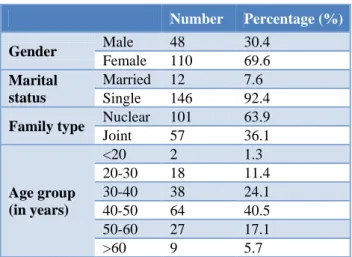
There were 158 patients in the study and the sample had a female preponderance with 110 (69.6%) women and 48 (30.4%) men. 12 (7.6%) patients were single and 146 (92.4%), married. Majority (101; 63.9%) were from nuclear families. Most patients were in the age group, 40 to 50 years (64; 40.5%) followed by the age group 30 to 40 years (38; 24.1%). Mean age of the sample was 43.68 years (SD=10.509). The oldest patient was 65 and the youngest patient was 18. Women outnumbered men in all age groups except in extremes of age (less than 20 years group and more than 60). Demographic information is described in Table 1.
Table 1: Demographic profile.
Number Percentage (%)
Gender Male 48 30.4
Female 110 69.6
Marital status
Married 12 7.6
Single 146 92.4
Family type Nuclear 101 63.9
Joint 57 36.1
Age group (in years)
<20 2 1.3
20-30 18 11.4
30-40 38 24.1
40-50 64 40.5
50-60 27 17.1
>60 9 5.7
ENT disorders associated with vertigo
The commonest ENT diagnosis was BPPV (76; 48.1%) followed by migrainous vertigo (41; 25.9%), Meniere’s disease (31; 19.6%) and vestibular neuronitis (10; 6.3%). Women outnumbered men in all diagnostic groups and the difference was statistically significant except in VN where there was an equal gender distribution. Distribution of ENT diagnosis between males and females is shown in Figure 1. Mean age of patients with MD was 45.55 (SD=9.348), BPPV 44.93 (SD=10.45), MV 41.15 (SD=10.903) and VN 38.8 (SD=10.768).
Psychiatric disorders
Figure 1: Distribution of ENT disorders between males and females.
BPPV- Benign paroxysmal positional vertigo; MD-Meniere’s disease; MV- Migrainous vertigo; VN- Vestibular neuronitis.
Figure 2: ENT diagnoses and psychiatric diagnoses among the patients in the study.
Anxiety disorder
70 (44.03%) patients had anxiety disorder, 50 of them being women and 20 men. The degree of anxiety was mild to moderate in 36 (51.43%) of them and moderate to severe among 34 (48.57%) patients. Among men with anxiety (20; 41.7%); 11 (55%) had mild to moderate anxiety and 9 (45%) patients had moderate to severe anxiety. Among women with anxiety (50; 45.45%); there was an equal proportion who had mild to moderate anxiety (25; 50%) and moderate to severe anxiety (25; 50%). There was no statistically significant difference in anxiety scores between men (42.44, SD=16.052) and women (42.19, SD=17.291; p≥0.05).
ENT diagnosis and anxiety
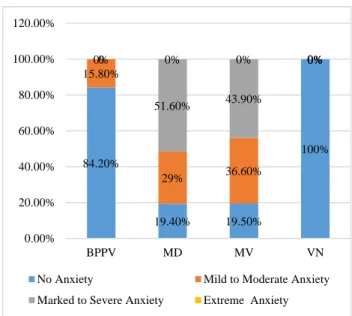
A diagnosis of anxiety was most common among patients with Meniere’s disease (25; 80.6%) followed by Migrainous vertigo (33; 80.5%). 12 (15.8%) patients with BPPV and no patient with vestibular neuronitis had anxiety. The difference across the ENT diagnoses was statistically significant (χ2
=98.95, p=0.000). Among
patients with MD, the anxiety was mild to moderate in 9 (29%) and moderate to severe in 16 (51.6%) patients. 15 (36.6%) patients had mild to moderate anxiety and 18 (43.9%) had moderate to severe anxiety among those with MV. A comparison of presence and severity of anxiety across ENT disorders is described in Figure 3.
Figure 3: Severity of anxiety across ENT disorders.
BPPV- Benign paroxysmal positional vertigo; MD-Meniere’s disease; MV- Migrainous vertigo; VN- Vestibular neuronitis.
Mean anxiety score was highest among those with MD
(56.48; SD=11.003) followed by MV (54.15;
SD=12.041), VN (33.10, SD=7.909) and BPPV (31.26, SD=12.968). One way ANOVA test for difference in anxiety scores across the 4 vertigo diagnoses group was significant (F=31.84, p=0.000).
Depression
74 (46.83%) patients had a diagnosis of depression of which 27 were men and 47 were women. Those with mild depression was 43 (58.1%), moderate depression, 28 (37.83%) and severe depression three (4.05%) patients. All 3 patients with severe depression were women. Among men with depression 12 (44.44%) had mild depression and 15 (55.56%) had moderate degree of depression. Among women, the depression was mild in 28 (59.57%), moderate in 16 (34.04%) and severe in 3 (6.38%) patients. There was no statistically significant difference in depression scores between men (46.77, SD=17.145) and women (44.45, SD=15.584; p≥0.05).
ENT diagnosis and depression
Depression was most prevalent among patients with Meniere’s disease (26; 83.87%) followed by migrainous vertigo (29; 70.73%). 17 (22.37%) patients with BPPV and 2 (20%) patients with vestibular neuronitis had depression. The difference in presence of depression across the ENT diagnoses was statistically significant
0 10 20 30 40 50 60 70 80
BPPV: N=76 MD: N=31 MV: N=41 VN: N= 10 Males Females
84.20%
19.40% 19.50%
100% 15.80%
29% 36.60%
0% 0
51.60% 43.90%
0%
0% 0% 0% 0%
0.00% 20.00% 40.00% 60.00% 80.00% 100.00% 120.00%
BPPV MD MV VN
No Anxiety Mild to Moderate Anxiety
(χ2
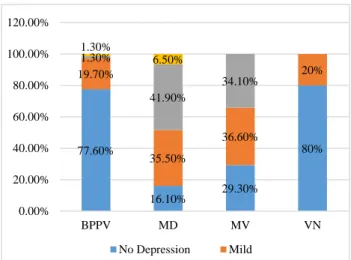
=68.59; p=0.000). Among those with MD, 11 (35.5%) had mild depression, 13 (41.9%) had moderate depression and 2 (6.5%) had severe depression. 15 (36.6%) patients had mild depression and 14 (34.1%) had moderate depression among those with MV. A comparison of presence and severity of depression across ENT disorders is described in Figure 4.
Figure 4: Severity of depression across ENT disorders.
Mean depression score was highest among those with MD (58; SD=8.136) followed by MV (54.29; SD=10.441), VN (36.6, SD=13.418) and BPPV (36.11, SD=15.06). One way ANOVA test for difference in depression scores across the 4 vertigo diagnoses group was significant (F=50.17, p=0.000).
Among patients with moderate to severe anxiety, the severity of depression was as follows: mild 11 (32.35%), moderate 17 (50%) and severe 2 (5.88%).
DISCUSSION
There is a high prevalence of anxiety and depression among patients with vertigo. Our findings are in agreement to those reported from China in that patients with Meniere’s disease and migrainous Vertigo had a significantly higher prevalence of anxiety and depression than those with BPPV or VN.18 Those with MD had the highest rates of depression and anxiety followed by those with MV in both studies. However in our study the prevalence of anxiety and depression was higher in both MD (80% and 83%) and MV (80% and 70%) when compared to the patients from China (50% and 45.9%; 28.6% and 27%). They attributed the higher rates of
psychological symptoms to possible different
mechanisms involved in different types of vertigo, as well as differences in the prevention and self-control methods adopted by the patients against the vertigo symptoms and concluded that vestibular function is not significantly associated with the risk of anxiety or depression.
Similar findings of increased prevalence of anxiety and
depression were reported in population based
epidemiological studies as well.19 Despite using a
methodology involving a structured psychiatric
instrument, patients with MD and MV showed
significantly higher prevalence of psychiatric
comorbidity (MD=57%, MV=65%) especially anxiety and depressive disorders, than patients with VN (22%),
BPPV (15%) and normal subjects (20%).20 Confirmation
of increased prevalence of mental health problems was obtained from larger studies as well.21 Increased
frequency of depression, tiredness, tenseness,
unenthusiasm and longer duration of depression than in controls was found when mental health impact was explored among large group of patients with MD. Depression could even be the differentiating feature between active and inactive MD. As the prevalence of depression was as high as 80%, resonating the findings from our study, there was a proposition to add depression to the clinical picture of active Meniere's disease; as the inactive MD group who did not have recurrent vertigo or chronic disequilibrium had only a low prevalence rate of depression.22
History of mental health problem can have an impact on the severity of vertigo symptoms and hence we excluded such patients from our study. Long term longitudinal studies help in identifying the on-going impact of one over the other. In such a study patients with a positive history of psychiatric disorders had significantly more
emotional distress.23 MV patients experienced
significantly more somatic anxiety, autonomic arousal and vertigo induced handicap than all other patients. Though a positive history of psychiatric disorders is a strong predictor for the development of reactive psychiatric disorders following a vestibular vertigo syndrome the degree of vestibular dysfunction does not correlate with the development of psychiatric disorders.24 In a longer longitudinal study it was found that three to five years after their original referral half the patients had significant psychiatric problems.25 Panic disorder with or without agoraphobia and major depression were the commonest psychiatric diagnoses. There was a significant correlation between the presence of vestibular symptoms and psychiatric morbidity, which in turn correlated with measures of anxiety, perceived stress and previous psychiatric illness.
When psychological symptoms copresent with vertigo, their relationship becomes complex and it would be hard to differentiate which started first. This becomes more difficult as some patients might be suffering from non-organic vertigo symptoms. In this study our focus was to explore psychiatric symptoms associated with organic vertigo. Previous research has shown that patients with organic vertigo and non-organic vertigo differ in their characteristics.26 When a structured clinical interview for major mental disorders was used in over five hundred patients, more than 80% had organic vertigo and just over 19% of patients had non-organic vertigo/dizziness.
77.60%
16.10% 29.30%
80% 19.70%
35.50%
36.60%
20% 1.30%
41.90%
34.10% 1.30%
6.50%
0.00% 20.00% 40.00% 60.00% 80.00% 100.00% 120.00%
BPPV MD MV VN
Patients with psychiatric comorbidity reported more vertigo-related handicaps, more depressive, anxiety and somatisation symptoms, and lower quality of life compared with patients without psychiatric comorbidity. There have also been suggestions that vertigo and dizziness are often not fully explained by an organic illness, but instead are related to psychiatric disorders. As patients with vestibular vertigo syndromes often suffer from anxiety and depression, patients with psychiatric disorders often experience subjective unsteadiness, dizziness, or vertigo leading to the hypothesis that vestibular system may be interlinked with the emotion processing systems.22
Timely identification and appropriate interventions for co-morbid mental disorders are important as they can have a significant negative impact on the course, progression of vertigo. Presence of a mental disorder is often one of the causes which makes treatment of Meniere’s disease difficult.27
Development of anxiety or a depressive disorder after the onset of the vestibular disorder is correlated with poor improvement and high persistency of vertigo and dizziness.24 Neurosis and depression were diagnosed in approximately 40% and 60%, respectively, among patients with intractable MD and psychological supports could be necessary for improving results both in the surgical and non-surgical treatments for such patients.27 Outcomes of surgical treatment was better in patients with no psychological symptoms. Patients with a longer duration and worse hearing level in the secondary affected ear had a significantly higher incidence of mental illness than those with a shorter duration and better level of hearing.28
There have been several attempts to understand the mechanisms behind an increased prevalence of anxiety and depression among patients with vertigo. Explanations ranging from the role of illness behaviour and personality
traits to disorder specific endocrinological and
neurophysiologic responses have been proposed. Some
researchers see the responsible factor for the
psychological picture observed in MD as vertigo and they propose any illness that has a symptom as disabling as vertigo can produce its own form of psychopathology.29 Behavioral characteristics of MD patients such as being more stress-causative than normal controls, may play a role in the genesis of endolymphatic hydrops, possibly through stress-related hormone.30 Plasma levels of stress-related hormones such as antidiuretic hormones and
catecholamines are elevated in conditions of
endolymphatic hydrops including MD and these hormones were believed to alter the inner ear fluid dynamics, thus producing auditory and vestibular dysfunction and the symptoms experienced in MD.31-33 Several valid and plausible explanations for increased prevalence of anxiety and depression among patients with MD and MV when compared to other vertigo types have been put forward.18 Unpredictable and uncontrollable nature of vertigo in MD and MV play a major contributory role in development of anxiety and depression in such patients. Patients with BPPV are able
to control the severity and even the attack of vertigo by avoiding the quick head shaking. Vestibular adaptation could alleviate their vertigo symptoms during the course of the illness. However, in those with MD or MV, increasing frequency and worsening severity of unpredictable vertigo makes the patient more nervous, frightened and concerned thus increasing the risk of anxiety and depression.
Anxiety, depression and migraine may share common genetic and environmental risk factors and their interaction may also be a contributory factor for their coexistence.34 Distressing clinical features such as persistent tinnitus, fluctuating hearing loss, and
recruitment or hyperacusis could worsen the
psychological burden and increase the risk of anxiety and
depression.35 Vestibular system comprises the
labyrinthine part of the inner ear and its connections in the brain stem and cerebellum which also has widespread cortical connections and plays a role in multimodal integration even at the very basic level of the vestibular nuclei.36 Dysfunctions can lead to a wide range of symptoms from basic perceptual symptoms like vertigo, dizziness, visual and balance symptoms to problems of emotion, memory, and self-perception.37
It would be important to understand possible psychological and cognitive mechanisms underlying the
relationship between vertigo and psychological
symptoms as this would help in communication between the treating doctor and patient. A complex interaction between psychosomatic (physical symptoms have a psychological origin) and somatopsychic (psychological symptoms are due to physical illness) factors result in a vicious cycle.38 Symptoms of MD worsen the emotional state which in turn worsen the symptom perception and
there is a continuous interaction between the
psychological, somatic and environmental factors. It was shown that patients with MD had more daily stressors, used certain coping strategies less often, had more anxiety and depression and a worse quality of life compared to healthy reference groups. Patients with more severe symptoms had more psychopathology and a worse quality of life than patients with mild symptoms. While exploring the cognitions associated with anxiety in MD it was found anxiety to be associated with intolerance of uncertainty, fear-avoidance of physical activity, belief that dizziness would develop into a severe attack of vertigo, and several illness perception factors.39
presence of depressive and anxiety symptoms in patients presenting with vertigo. Though otorhinolaryngologists may not be able to or expected to take a complete psychiatric history, they should be aware of the right questions to ask to decide about appropriate interventions which may include counselling, physical exercise, relaxation strategies, prescribing antidepressants or other psychotropics or referring to a psychiatrist. Prescribers should also be aware of the side effects associated with psychotropic medications including dizziness and vertigo. Patients with vertigo may be seen by a variety of specialists or general practitioners and everybody have a duty of care to look for features of mental health issues which may even result in self-harm behaviour or suicide. Close links with psychiatry departments should be forged so as to facilitate a smooth referral process. A joint management approach would be beneficial for the patient who suffers from multiple problems.
Limitations
The psychiatric assessments were done using self-rating instruments. Hence the possibility of false positive psychiatric diagnoses cannot be ruled out. However self-rated assessments give a genuine picture of how the patient feels and is a valid and reliable method of assessment. It is not clear whether the findings from this study done at a tertiary care centre are generalizable across other treatment settings including primary care. The cross- sectional study design used in this study is able to demonstrate the association between the vertigo symptoms and psychiatric problems- but not able to prove a causal relationship. A longitudinal study design for future research will be more helpful to answer the cause-effect relationship between the two groups of disorders.
CONCLUSION
There is a high prevalence of depression and anxiety among patients with Meniere’s disease and migrainous vertigo in India as evidenced by this study from a tertiary referral centre in Kerala. Specialists and general practitioners should be aware and sensitive to the presence of anxiety and depression among patients with vertigo. Identification and appropriate management of coexisting mental health problems to address the disability, poor quality of life and protracted course is an integral part of managing vertigo.
Funding: No funding sources Conflict of interest: None declared
Ethical approval: The study was approved by the Institutional Ethics Committee
REFERENCES
1. Neuhauser HK. The epidemiology of dizziness and vertigo. Handbook Clin Neurol. 2016;137:67–82.
2. Neuhauser HK, Lempert T. Vertigo:epidemiological
aspects. Seminars Neurology. 2009;29 (5):473-481.
3. Murdin L I, Schilder AG. Epidemiology of balance
symptoms and disorders in the community:a systematic review. Otol Neurotol. 2015;36(3):387-92.
4. Bansal M. Common causes of vertigo and dizziness
in Gujarat. Int J Clin Trials. 2016;3(4):250-3.
5. Piker EG, Jacobson GP, McCaslin DL, Grantham
SL. Psychological comorbidities and their
relationship to self-reported handicap in samples of dizzy patients. J Am Acad Audiol. 2008;19:337-47. 6. Hülse R, Biesdorf A, Hörmann K, Stuck B, Erhart
M, Hülse M, et al. Peripheral Vestibular Disorders:An Epidemiologic Survey in 70 Million Individuals. Otol Neurotol. 2019;40(1):88-95.
7. KetolaS, Havia M, Appelberg B, Kentala E.
Depressive symptoms underestimated in vertiginous patients. Otorhinolaryngol Head Neck Surg. 2007;137:312-5.
8. Eckhardt-Henn A, Dieterich M. Psychiatric
disorders in otoneurology patients. Neurologic Clinics. 2005;23:731–49.
9. Wiltink J, Tschan R, Michal M, Subic-Wrana C,
Eckhardt-Henn A. Dizziness:anxiety, health care utilization and health behaviour-results from a representative German community survey. J Psychosomatic Res. 2009;66:417-24.
10. Benecke H, Agus S, Kuessner D, Goodall G, Strupp
M. The Burden and Impact of Vertigo:Findings from the REVERT Patient Registry. Frontiers Neurol. 2013;4:136.
11. Magliulo G, Bertin, S, Ruggieri M, Gagliardi M. Benign paroxysmal positional vertigo and post-treatment quality of life. Eur Arch Otorhinolaryngol. 2005;262:627-30.
12. Committee on Hearing and Equilibrium guidelines for the diagnosis and evaluation of therapy in
Meniere’ disease. Am Acad Otolaryngol.
1995;113:181-5.
13. Headache Classification Subcommittee of the
International Headache Society. The international classification of headache disorders: 2nd edition. Cephalalgia. 2004;24(1):9-160.
14. Neuhauser H K, Leopold M, von Brevern M,
Arnold G, Lempert T. The interrelations of
migraine, vertigo, and migrainous vertigo,
Neurology. 2001;56:436‐41.
15. Zung WW. A rating instrument for anxiety
disorders. Psychosomatic Med. 1971;12(6):371–9.
16. Zung WW. A self-rating depression scale. Arch
General Psychiatry. 1965;12:63–70.
17. Zung WW. From Art to Science: The Diagnosis and
Treatment of Depression. Arch General Psychiatry. 1973;29(3):328–37.
18. Yuan Q, Yu L, Shi D, Ke X, Zhang H. Anxiety and
depression among patients with different types of vestibular peripheral vertigo. Medicine (Baltimore). 2015;94(5):453.
19. Bruderer SG, Bodmer D, Stohler NA, Jick SS,
Epidemiology of Ménière's Disease. Audiol Neurotol. 2017;22(2):74-82.
20. Eckhardt-Henn A, Best C, Bense S, Breuer P,
Diener G, Tschan R, et al. Psychiatric comorbidity in different organic vertigo syndromes. J Neurol. 2008;255:420–8.
21. Tyrrell J, White M P, Barrett G, Ronan N, Phoenix
C, Whinney D J et al. Mental Health and Subjective Well-being of Individuals With Ménière's: Cross-sectional Analysis in the UK Biobank. Otol Neurotol. 2015;36 (5):854-61.
22. Coker N J, Coker R R, Jenkins H A, Vincent K R. Psychological Profile of Patients with Meniere's Disease. Arch Otolaryngol Head Neck Surg. 1989;115(11):1355-7.
23. Best C, Tschan R, Eckhardt-Henn A, Dieterich M. Who is at risk for ongoing dizziness and psychological strain after a vestibular disorder? Neuroscience. 2009;164(4):1579-87.
24. Best C, Eckhardt-Henn A, Tschan R, Dieterich M. Psychiatric morbidity and comorbidity in different
vestibular vertigo syndromes: results of a
prospective longitudinal study over one year. J Neurol. 2009;256:58–65.
25. Eagger S, Luxon L M, Davies RA, Coelho A, Ron MA. Psychiatric morbidity in patients with peripheral vestibular disorder:a clinical and neuro-otological study. J Neurol Neurosurg Psychiatry. 1992;55(5):383-7.
26. Lahmann C, Henningsen P, Brandt T, Strupp M,
Jahn K, Dieterich M, et al. Psychiatric comorbidity and psychosocial impairment among patients with vertigo and dizziness. J Neurol Neurosurg Psychiatry. 2015 ;86(3):302-8.
27. Yokota Y, Kitahara T, Sakagami M, Ito T, Kimura T, Okayasu T, et al. Surgical results and psychological status in patients with intractable
Ménière's disease. Auris Nasus Larynx.
2016;43(3):287-91.
28. Furukawa M, Kitahara T, Horii A, Uno A, Imai T, Ohta Y et al. Psychological condition in patients with intractable Meniere's disease. Acta Oto-Laryngologica. 2013;133(6):584-9.
29. Wexler M, Crary WG. Meniere's disease: The
psychosomatic hypothesis. Am J Otolaryngol. 1986;7:93–6.
30. Takahashi M, Ishida K, Iida M, Yamashita H,
Sugawara K. Analysis of lifestyle and behavioural characteristics in Meniere's disease patients and a
control population. Acta Oto-Laryngologica.
2001;121:254–6.
31. Takeda T, Kakigi A, Saito H. Antidiuretic hormone
(ADH) and endolymphatic hydrops. Acta
Otolaryngologica Suppl. 1995;519:219–22.
32. Juhn SK, Li W, Kim JY, Javel E, Levine S, Odland
RM. Effect of stress-related hormones on inner ear fluid homeostasis and function. Am J Otolaryngol. 1999;20:800–6.
33. Sawada S, Takeda T, Saito H. Antidiuretic hormone
and psychosomatic aspects in Menière's disease. Acta Otolaryngologica Suppl. 1997;528:109–12. 34. Breslau N, Lipton RB, Stewart WF, Schultz LR,
Welch KM. Comorbidity of migraine and depression:investigating potential etiology and prognosis. Neurology. 2003;60(8):1308-12.
35. Krog NH, Engdahl B, Tambs K. The association
between tinnitus and mental health in a general population sample: results from the HUNT Study. J Psychosomatic Res. 2010;69(3):289-98.
36. Cullen KE. The vestibular system:multimodal
integrationand encoding of self-motion formotor control. Trends Neurosci. 2012;35:185–96.
37. Borel L, Lopez C, Péruch P, Lacour M. Vestibular syndrome:a change in internal spatial representation. Clin Neurophysiol. 2008;38:375–89.
38. Van Cruijsen N, Wit H, Albers F. Psychological
aspects of Ménière's disease. Acta
Otolaryngologica. 2003;123:340–7.
39. Van Cruijsen N, Jaspers JP, van de Wiel HB, Wit H
P, Albers FW. Psychological assessment of patients
with Menière's disease. Int J Audiol.
2006;45(9):496-502.
Cite this article as: Asha CS, Kumar CTS, Punnoose