122
Determination of the Macro Elements Content of Some
Medicinal Herbs
Ducu Sandu
Ş
tef
1, Iosif Gergen
1, Lavinia
Ş
tef
1, Monica H
ă
rm
ă
nescu
1, Cecilia Pop
2,
M
ă
rioara Drug
ă
1, Gabriel Bujanc
ă
1, Mirela Popa
11 Banat's University Of Agricultural Sciences and Veterinary Medicine, 300645, Calea Aradului, 119,Timişoara -
România
2 University Of Agricultural Science, Iasi- România
Abstract
The metals contents of plants are variable, due to the factors like differences between the plants species, geographical area, conditions of drying process. Metals contents in soil are a great importance for their effect of animals and humans, through the biologic chain: soil – plant – feed and food. Analysis of metals content was made with ContrAA-300, Analytik-Jena device, by flame atomic absorption spectrometry (FASS) in air/acetylene flame. It were analyzed the macro elements content for 33 medicinal plants. The main macro elements (Ca, Mg K and Na) were quantified for each sample. The contents in macroelements for analysed samples were in range: 3.763 % (Plantago major) – 0.442 % (Hippophae rhamnoides), for Ca; 0.718% (Urtica dioica) – 0.107% (Hippophae rhamnoides and Pinus), for Mg; 1.417% (Chelidonium majus) – 0.319% (Rhamnus frangula), for K and 1.945% (Cynara scolymus) – 0.021% (Pinus), for Na.
Keywords: calcium, macroelements, magnesium, medicinal plants, potassium, sodium
1. Introduction
Calcium, sodium, potassium and magnesium are the major components in the cells and extracellular fluids of organism [1].
Calcium is an alkaline-earth metal and it is
essential for animals and humans, particularly in cell physiology. A deficit in Calcium can affect the formation of bone and tooth, but the excess retention can cause kidney stones.1
Calcium is not only a soil component, but it is an important macroelement too. Calcium performs many functions in plants. It sustains the stability of cell wall. The main Ca2+ function is to transmit external, in point of plant and cell, signals. Many authors make the following Calcium signalling functions: response to phytohormones [2]; response to pathogen diseases elicitors [3] and response to abiotic environmental factors [4].
* Ducu Stef, 0720687239, [email protected]
The ratio of calcium to phosphorus content (Ca/P) in soil, plants, fodder and human diet is an indicator of equilibrium necessary to the regular run of processes in food chain [5].
Sodium is an alkaline metal and has very
important roles in many physiological processes.
Sodium is present in extra cellular fluids in
animals and humans. It is responsible for depolarization of cellular membrane and for the water equilibrium in intra- and extra cellular medium. In blood Sodium concentration is about 10 times more than in intracellular medium.
Potassium is also an essential macro-element for
human. It is important because: is involving in muscles contraction, in lipids metabolism, in proteins synthesis, maintaining the fluid and electrolyte balance in the body and is responsible in the nerve impulses sending. The necessary daily intake is between 2-4 g/day [6].
Magnesium is important to all the cells from
123 proteins, lipids and carbohydrates metabolisms. In plants Magnesium is present in chlorophylls. Medicinal plants or parts of them are used successfully in treatment of different kind of diseases for those therapeutically properties. The aim of this study was to determine the concentrations in Na, K, Ca, Mg and total ash of the enumerated medicinal plants.
2. Materials and methods
Medicinal plants samples preparation
Thirty three medicinal plants samples were collected of Romanian markets. The analysed medicinal plants are: Achillea millefolium, Arnica montana, Artemisia absinthium, Calendula officinalis, Capsella bursa pastoris, Chelidonium majus, Crataegus monogyna, Cynara scolymus, Echinaceae herba, Epilobium montanum, Equisetum arvense, Galium mollugo, Hippophae rhamnoides, Hypericum perforatum, Malva silvestris, Matricaria chamomilla, Melissae Folium, Mentha piperita, Phoeniculus, Pinus, Plantago major, Poligonum aviculare, Rhamnus frangula, Rosa canina, Salix babylonica, Salvia officinalis, Symphytum officinale, Taraxacum officinale, Thy mi herba, Tilia platyphyllos, Urtica dioica, Valeriana officinalis, Violae tricoloris herba.
The metals content from medicinal plants samples were analyzed after dry burning of 10 g in the quartz capsules at 650oC for 4 hours. After complete burning a nitric acid 0.5 N solution was added up to 50 mL. The solutions obtained were used for total metals contents determination by flame atomic absorption spectrometry (F-AAS) with high-resolution continuum source.
Reagents
The standard solutions (1000 mg/L) were analytical grade from Riedel de Haen (Germany). The nitric acid 65% solution used was of ultra pure grade (Merck, Germany). All solutions were prepared using deionized water.
Metals content determination
Analysis of metals content was made with ContrAA-300, Analytik-Jena device, by flame atomic absorption spectrometry (FASS) in
air/acetylene flame. The device working parameters (air, acetylene, optics and electronics) were adjusted for maximum absorption for each element. Acetylene was of 99.99 % purity. Under the optimum established parameters, standard calibration curves for metals were constructed by plotting absorbency against concentration [7]. In a definite range for each metal a good linearity was observed. All analyses were made in triplicate and the mean values were reported. All the values obtained for metals contents in analysed samples were calculated in mg/kg dry matter (ppm).
Statistical interpretation of data obtained using multivariate analyses was performed with Statistica-6 software.
3. Results and discussion
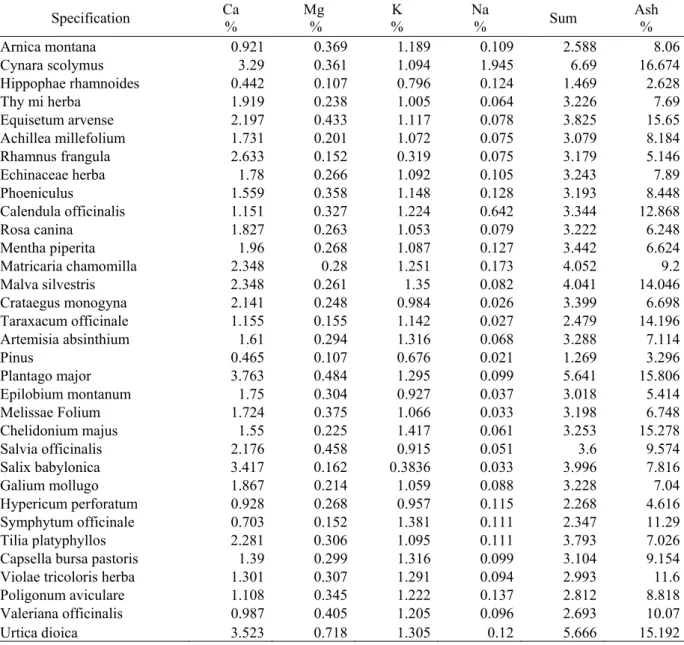
The results obtained for contents in Calcium, Magnesium, Sodium, Potassium and total ash for analyzed medicinal plants are presented in table 1.
Calcium deficiency for a long time is responsible
for osteoporosis, when the bones are deteriorated and increased the risk of fractures. The necessary daily intake is between 350 and 1100 mg/day (Mogos, 1997).
In analyzed medicinal plants the Calcium contents varied between 3.763 – 0.442 %. The highest
Calcium content was obtained for Plantago major
(3.763%), followed by Urtica dioica (3.523%) and Cynara scolymus (3.29%). The smaller Calcium concentration was determinate for Hippophae rhamnoides (0.442%).
Magnesiumdeficiency in humans caused muscle
spasms, and has been associated with a high blood pressure, many cardiovascular diseases, diabetes and osteoporosis. The necessary daily intake is 350 mg/day for men and 300 mg/day for women (Mogos, 1997).
The values obtained for Magnesium in analyzed medicinal plants ranged between 0.718 – 0.107%. The highest content was measured in Urtica dioica (0.718%) and the smallest in Pinus and Hippophae rhamnoides (0.107%).
From analyzed medicinal plants the higher
Potassium concentrations were determinate for
124
Table 1. The concentrations in Calcium, magnesium sodium, potassium and the total ash for analyzed medicinal plants
Specification Ca % Mg % % K Na % Sum Ash %
Arnica montana 0.921 0.369 1.189 0.109 2.588 8.06
Cynara scolymus 3.29 0.361 1.094 1.945 6.69 16.674
Hippophae rhamnoides 0.442 0.107 0.796 0.124 1.469 2.628
Thy mi herba 1.919 0.238 1.005 0.064 3.226 7.69
Equisetum arvense 2.197 0.433 1.117 0.078 3.825 15.65
Achillea millefolium 1.731 0.201 1.072 0.075 3.079 8.184
Rhamnus frangula 2.633 0.152 0.319 0.075 3.179 5.146
Echinaceae herba 1.78 0.266 1.092 0.105 3.243 7.89
Phoeniculus 1.559 0.358 1.148 0.128 3.193 8.448
Calendula officinalis 1.151 0.327 1.224 0.642 3.344 12.868
Rosa canina 1.827 0.263 1.053 0.079 3.222 6.248
Mentha piperita 1.96 0.268 1.087 0.127 3.442 6.624
Matricaria chamomilla 2.348 0.28 1.251 0.173 4.052 9.2
Malva silvestris 2.348 0.261 1.35 0.082 4.041 14.046
Crataegus monogyna 2.141 0.248 0.984 0.026 3.399 6.698
Taraxacum officinale 1.155 0.155 1.142 0.027 2.479 14.196
Artemisia absinthium 1.61 0.294 1.316 0.068 3.288 7.114
Pinus 0.465 0.107 0.676 0.021 1.269 3.296
Plantago major 3.763 0.484 1.295 0.099 5.641 15.806
Epilobium montanum 1.75 0.304 0.927 0.037 3.018 5.414
Melissae Folium 1.724 0.375 1.066 0.033 3.198 6.748
Chelidonium majus 1.55 0.225 1.417 0.061 3.253 15.278
Salvia officinalis 2.176 0.458 0.915 0.051 3.6 9.574
Salix babylonica 3.417 0.162 0.3836 0.033 3.996 7.816
Galium mollugo 1.867 0.214 1.059 0.088 3.228 7.04
Hypericum perforatum 0.928 0.268 0.957 0.115 2.268 4.616
Symphytum officinale 0.703 0.152 1.381 0.111 2.347 11.29
Tilia platyphyllos 2.281 0.306 1.095 0.111 3.793 7.026
Capsella bursa pastoris 1.39 0.299 1.316 0.099 3.104 9.154
Violae tricoloris herba 1.301 0.307 1.291 0.094 2.993 11.6
Poligonum aviculare 1.108 0.345 1.222 0.137 2.812 8.818
Valeriana officinalis 0.987 0.405 1.205 0.096 2.693 10.07
Urtica dioica 3.523 0.718 1.305 0.12 5.666 15.192
The lower contents in Sodium for analyzed medicinal plants were determinate in Pinus (0.021%) and Taraxacum officinale (0.027%). The highest content in Sodium was obtained for Cynara scolymus (1.945%).
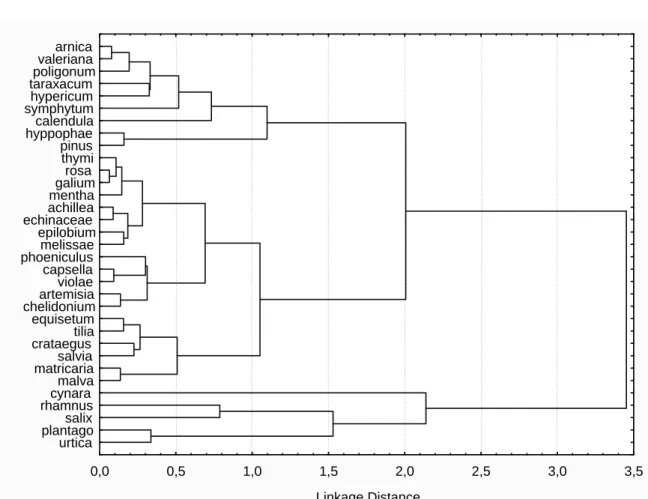
Using the variables Sodium, Potassium, Magnesium and Calcium it was performed the calculation of cases - dendrogram, presents in Figure 1.
Macroelements divided all the analyzed medicinal plants in three main clusters. First cluster are
formed by Arnica Montana, Poligonum aviculare, Valeriana officinalis, Taraxacum officinale, Hypericum perforatum, Symphytum officinale, and
Calendula officinalis, characterized by appropriate
contents in Ca (0.703 – 1.151 ppm), K (0.957 – 1.382 ppm) and Na (0.027 – 0.642 ppm).
Hippophae rhamnoides and Pinus are also
125
0,0 0,5 1,0 1,5 2,0 2,5 3,0 3,5
Linkage Distance urtica
plantagosalix rhamnuscynara malva matricariasalvia crataegustilia equisetum chelidoniumartemisia violae capsella phoeniculusmelissae epilobium echinaceaeachillea menthagalium rosa thymi pinus hyppophaecalendula symphytumhypericum taraxacumpoligonum valerianaarnica
Figure 1 Clusters of medicinal plants using macroelements
The second cluster was divided in three groups, Ca being the determinant element for this organization. One group is formed from Thymi herba, Rosa canina, Galium mollugo, Mentha piperita, Achillea millefolium, Echinaceae herba,
Epilobium montanum, and Melissae folium with
medium values for Ca (1,724 - 1,96 ppm). Phoeniculus, Capsella bursa pastoris, Violae
tricoloris herba, Artemisia absinthium, and
Chelidonium majus formed the second group with
the smaller Ca contents (1.301 – 1.61 ppm). The highest contents from the medicinal plants of this cluster were identified in the third group (2.141 – 2.348 ppm)
The third cluster included Cynara scolymus, Rhamnus frangula, Salix babylonica, Plantago
major, and Urtica dioica with the highest contents
of Ca (2.633 – 3.763 ppm).
For cluster analysis it was used Statistica-6 software. The coefficients of matrixcorrelation of variables are presented in Table 2.
Table 2 Correlation of the macroelements concentrations of medicinal plants
Macroelements Ca Mg K Na
Ca -
Mg 0.45 -
K -0.12 0.42 -
Na 0.26 0.14 0.08 -
Marked correlations are significant at p < 0.05
No consistent correlation coefficients were found between the concentrations of macroelements of medicinal plants.
4. Conclusions
126 frangula), for K and 1.945% (Cynara scolymus) – 0.021% (Pinus), for Na.
Macroelements divided all the analyzed medicinal plants in three main clusters. No consistent correlation coefficients were found between the concentrations of macroelements of medicinal plants.
Acknowledgements
This work was supported by CNCSIS –UEFISCSU, project number 1116/2009 PNII – IDEI, code 896/2008
References
1. Stroev, E.A. Biochemistry, 1989. Mir Publishers Moscow, 29
2. Cheng, S., Wilmann, M., Chen, H., Sheen, J. Plant Phisiology, 2002, 129, 469-485
3. Romeis, T., Ludwig, A., Martin, R., Jones, J. D.: EMBO J., 2001, 20, 5556-5567
4. Albrecht, V., Ritz, O., Linder, S., Harter, K., Kudla, J. EMBO J., 2001, 20, 1051-1063
5. Sapek A. Phosphorus in in human food chain in Poland. In: The cycle of elements in the nature (in Polish), B. Gworek, J. Misiak. Monografia t. II. Institute of Environment Protection, Warsaw, 2003, 53-61
6. Mogos V.T., Alimentatia in bolile de nutritie si metabolism, vol. 1, Editura Didactica si Pedagogica, R.A., Bucuresti, 1997, p. 356, 391, 409, 422.
7. Gergen I., Gogoaşă I., Drăgan Simona, Moigrădean Diana, Hărmănescu Monica, Heavy metal status in fruits and vegetables from a non-poluted area of
Romania (Banat County), Metal Elements in
Environment, Medicine and Biology, Gârban Z., Drăgan P. (Eds. Symp. Series), Tome VII, Publishing House Eurobit, Timişoara, 2006, p. 149-165.
8. *** WHO, Report on meetings of expert committees and study groups. Evaluation of certain food additives and contaminants. World Heath Organization, Geneva, Switzerland, 2001, EB109/33.
9. *** Excerpt from Romanian Ministry of Public
Health Ordinance no 975/1998. Maximum limits