The Asian Journal of Technology Management Vol. 1 No. 2 (2009) 58-70
Knowledge Management Design Using Collaborative Knowledge
Retrieval Function
Kadarsah Suryadi1*, Cahyono Sigit Pramudyo2 1
Industrial Engineering Department, Bandung Institute of Technology, Indonesia 2Industrial Engineering Department, ―Sunan Kalijaga‖ State Islamic University of Yogyakarta,
Indonesia
ABSTRACT
Knowledge is a key word in the information age. Organizational knowledge provides businesses with a way to compete effectively and efficiently in the market. The performance of many organizations is determined more by their knowledge than their physical assets. Capturing and representing knowledge is critical in knowledge management. The spread of organizational knowledge has made a difficulty in sharing knowledge. This problem creates a longer learning cycle.
This research proposes a web based knowledge map, using collaborative knowledge retrieval function, as a tool to represent and share knowledge. First, knowledge map gives a comprehensive understanding about what knowledge is needed to achieve objectives, what knowledge sources are available, and which knowledge sources are used by whom. Second, web facilitates knowledge sharing. Third, collaborative knowledge retrieval function will shorten learning cycle. Fourth, the proposed tool is applied to build a web based knowledge for an academic system in higher education.
The result of this research is a design of web based knowledge map using collaborative knowledge retrieval function. Collaborative retrieval knowledge function gives recommendations of relevant knowledge between web documents. The proposed model contributes in shortening the learning cycle.
Keywords: Knowledge map, Collaborative retrieval knowledge function, Web, Learning cycle, Knowledge Sharing.
Introduction
*Knowledge is a key word in the information age. Organizational knowledge provides businesses with a way to compete effectively and efficiently in the market. The
*
Corresponding author. Email: [email protected]
performance of many organizations is determined more by their knowledge than their physical assets. (Sung-kwan dan Sengbae, 2004).
59
and skills, and is difficult to communicate externally. Explicit knowledge can be communicated externally and captured in formal models, rules and procedures. (Vail E.F,1999). The knowledge process usually involves several stages or sub-processes. The key stages in this process can be defined as: (1)
knowledge generation, (2) knowledge
representation, (3) knowledge storage, (4) knowledge access, and (5) transfer knowledge (http://rocket.vub.ac.be).
Knowledge generation includes the creation of new ideas, the recognition of new patterns, the interaction and synergy of separate disciplines and the development of
new processes. Knowledge generation
encompasses both creating new knowledge and acquiring existing knowledge from somewhere
else. Knowledge representation, or
codification, is the process of putting knowledge into various forms that can be
accessed, leveraged and transferred
independently of the presence or absence of the individuals that might posses that knowledge. Knowledge storage incorporates both ‗hard‘ data such as numbers, facts, Fig.s, and rules as well as ‗soft‘ information such as tacit knowledge, expertise, particular experiences, anecdotes, critical incidents, stories, artifacts, and details about strategic decisions. Knowledge access incorporates technology in the form of data dictionaries and online databases facilitates the integration of systems knowledge and information. Organisational knowledge management uses repositories and improved access to make critical knowledge available wherever and whenever it is needed. Knowledge transfer is designed to enable the flow of knowledge among and between individuals and groups within an organisation.
The spread of organizational knowledge causes the knowledge stakeholder having the partial understanding of knowledge objects. The organizational knowledge exists in several
organization division. This causes
management of knowledge become
complicated. The management of knowledge is
now considered to an integral part of business activity. Information systems play a pivotal role in enabling knowledge to be managed efficiently and effectively and therefore make a significant contribution to sustaining an organisation‘s competitive advantage (Peter, et.al , 2005). Thus knowledge management is needed to compete effectively and efficiently.
Hence, given the capability of current information technology, any item stored in computer could be data, or information, or
knowledge representation. Information
technology facilitates knowledge access. Thus,
knowledge management and web-based
information technology can never be separated in exploration of modern successful business. The unique aspect of knowledge management in the internet era is application of web-based
information technology to knowledge
development. (Wang, 2002).
Knowledge map is a tool to represent knowledge. Knowledge representations include data of facts, information of summarized data and cases, knowledge representations for procedures, rules, ideas that guide actions and decisions. All these entities, in the web environment, are web documents that are semantically linked into a network as a knowledge map (Wang, 2002).
Lin and Hseuh (2006) proposes the
architecture of the knowledge map
management system. Knowledge map
management system has three main tasks: the knowledge map creation, knowledge map maintenance, and the collaborative knowledge retrieval. Lin and Hseuh (2006) have introduced the procedure of knowledge map creation and maintenance. But the procedure of the collaborative knowledge retrieval function has not been proposed.
60
retrieval in a higher education academic system.
Section 2 defines knowledge process, knowledge map, and learning cycle. Section 3 presents the proposed procedure. Section 4 presents a case study to demonstrate a detail description of the procedures. Finally, Section 5 describes conclusions.
Knowledge process, knowledge map, and
learning cycle
Knowledge process
The knowledge process usually involves several stages or sub-processes. The key stages in this process can be defined as: (1)
knowledge generation, (2) knowledge
representation, (3) knowledge storage, (4) knowledge access, and (5) transfer knowledge.
Knowledge generation
Knowledge generation includes the creation of new ideas, the recognition of new patterns, the interaction and synergy of separate disciplines and the development of new processes [Ruggles, 1997, Castells, 2000]. Knowledge generation encompasses both creating new knowledge and acquiring existing knowledge from somewhere else. According to Nonaka and Takeuchi [1995] organisational knowledge creation is a continuous, iterative process. This process is not confined within the spatial boundaries organisation, but takes place between and across organisations. Knowledge (or facts and information) can be obtained by activities such as scanning and interpreting the external environment, capturing the voice of the customer, undertaking research and development, etc. Crawford, [1996] argues that the most valuable knowledge generation involves identifying problems and suggesting solutions to rectify them. Knowledge generation requires tools, which pushes
individuals to think beyond their current functional and organisational boundaries. In general, knowledge creation and acquisition refers to the development of knowledge bases [Dodgson, 1993]. Knowledge bases are created through the acquisition, storage, interpretation, and manipulation of information both from within and outside the organisation. They usually take the form of collections of anecdotes, experiences, technical data and other types of judgement and decision supporting inputs. The purpose of developing these systems is not only to avoid ‗re-inventing the wheel‘, but also to accelerate the innovation process by facilitating synergy and idea re-combination taking into account all available inputs simultaneously.
Knowledge representation
In order to reuse knowledge, some form of representation of knowledge must take
place. Knowledge representation, or
codification, is the process of putting knowledge into various forms that can be
accessed, leveraged and transferred
61
Knowledge storagePrevious research indicates that organisational memory incorporates both ‗hard‘ data such as numbers, facts, Fig.s, and rules as well as ‗soft‘ information such as tacit knowledge, expertise, particular experiences, anecdotes, critical incidents, stories, artifacts, and details about strategic decisions [Morrison, 1993]. It is important to have mechanisms, which can store and retrieve all kinds of data,
information and knowledge. Most
organisations have various kinds of
information systems such as inventory control systems, budgetary systems, and administrative systems to store ‗hard‘ data or facts. However, they do not have similar systems to capture store and communicate ‗soft‘ information and knowledge. Brown and Duguid [1991] have also argued that ideas generated by employees in the course of their work rarely get shared beyond a small group of colleagues or team members with whom they collaborate. They believe that organisational learning can be considerably improved if these experiences and narratives are stored electronically for future reference.
Knowledge access
In traditional types of organisation, knowledge and information are fragmented in that they are located in many different places in the organisation. For instance, knowledge such as best practice accounts, lessons learned and experiences about particular processes or procedures resides with the professionals, managers and engineers, while customer information, reports and procedures are often scattered across paper files and electronic databases. In order to leverage this scattered knowledge and increase organisational performance it is imperative to integrate these systems, databases and applications to support
knowledge management objectives.
Organisational knowledge integration can be made possible by the cross-platform, open standards capabilities of an organisation‘s
intranet, which allows access to information from multiple sources. Technology in the form of data dictionaries and online databases facilitates the integration of systems knowledge and information. Organisational knowledge management uses repositories and improved access to make critical knowledge available wherever and whenever it is needed. Hypermedia -based information systems, for example, are highly beneficial in areas that deal with large, complex, richly connected, and crossreferenced bodies of information. These systems along with full-text retrieval systems and document management systems can help
store and retrieve vast amounts of
organizational knowledge with the use of modern access facilities such as navigation, queries, and personalised pathways [Cormican, 2000].
Knowledge transfer
Knowledge transfer is designed to enable the flow of knowledge among and between individuals and groups within an organisation. The cornerstone of the practice of management lies in being able to effectively communicate policies, procedures, technical reference and quality standards, all of which form an organisation‘s asset of knowledge-based
information. Knowledge transfer or
62
variety of media sources such as text, graphics, audio, video, and images.
Knowledge map
Knowledge map is a tool to represent knowledge. Lin and Hseuh (2006) propose the
architecture of the knowledge map
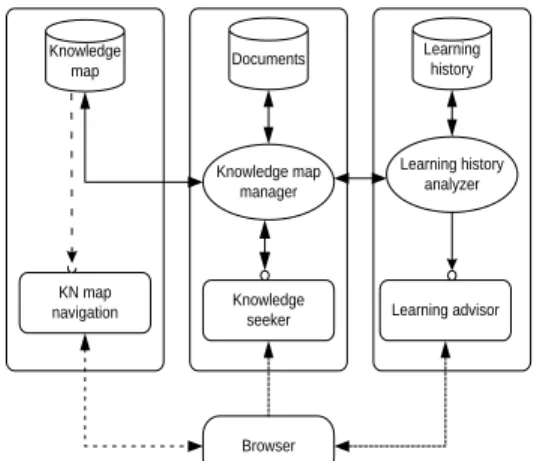
management system. The architecture is depicted in fig.1. Knowledge management systems have three main tasks:
1. Knowledge map creation
The knowledge map creation has 2 components: knowledge map and knowledge map navigation. The knowledge map navigator is used for guiding knowledge browsing according to knowledge map generated in advance by the knowledge map manager. It is useful for knowledge seekers to obtain the concept hierarchy existing in documents contributed by the community.
2. Knowledge map maintenance
The knowledge map maintenance has three components: documents, knowledge map
manager, and knowledge seeker. The
knowledge map manager is the kernel of the knowledge map management system. The knowledge map manager is responsible for coordinating the knowledge map navigation,
document seeking, and learning
recommendation with user‘s requests. The knowledge seeker is used for retrieving documents from the document base to answer users‘s requests.
3. Collaborative knowledge retrieval
The collaborative knowledge retrieval has three components: learning history, learning history analyzer, and learning advisor. The learning history in this research is defined as the set of concepts (knowledge categories) accessed by community residents in a specific problem solving process. The learning history analyzer facilitates the learning adviser by
using sequential pattern analysis techniques to generalize and store the common access patterns as the learning history repository. The learning advisor exerts collaborative document retrieval to exploit past knowledge activities to shorten the individual learning cycle.
Knowledge
map Documents
Learning history
Knowledge map manager
Learning history analyzer
KN map
navigation Knowledgeseeker Learning advisor
Browser
Figure 1. Knowledge map management system (Lin dan Hsueh, 2006)
Learning cycle
Lorsbach (2006) defines the learning cycle as an established planning method in science education and consistent with contemporary theories about how individuals learn. The learning cycle consists of three
phases (Allard dan Barman, 1994):
exploration, concept introduction, and concept application.
63
personal concepts about specific natural phenomena and for instructor to assist
students in questioning their
understanding of the natural world as well as help them with misconceptions they may uncover. For example, in a lesson of the major differences between plant and animal cells, the exploration phase would consist of students examining different cells (e.g., onion skin, squamous epithelium, and elodea) under the microscope. The students would make drawings of the cells and identify differences and similarities observed in the cells.
2. In the second phase, concept introduction, the instructor gathers information from the students about their exploration experience and uses it to introduce the main concepts of the lesson and any vocabulary related to the concepts. During this phase, the instructor uses textbooks, audiovisual, other written materials, or mini-lectures. Using the cell lesson as an example, the instructor would have the students report their microscopic observations and have them identify specific differences and similarities they observed between the plant and animal cells. The instructor would then use this information to explain the major differences between plant and animal cells. This mini-lecture could use overhead projector and include a short audiovisual presentation of the other plant and animal cells.
3. The final phase, concept application, lets students study additional examples of the main concepts of the lesson or take on a new task that can be solved on the basis of the previous exploration activity and concept introduction. In the cell lesson, students could be presented with preserved slides of additional examples of the plant and animal cells. They would be challenged to identify each cell as plant or
animal and explain the reason for their choice.
Research context
This research proposes a knowledge map with collaborative knowledge retrieval. Knowledge map, in the learning cycle context, facilitates the exploration phase. The knowledge map user browse the knowledge map for the development of a specific concept or concepts and vocabulary pertinent to the concepts. It is like students in cell lesson that was explained before. Knowledge map, in the knowledge process context, is a tool for knowledge representation.
The proposed procedure
Knowledge map building
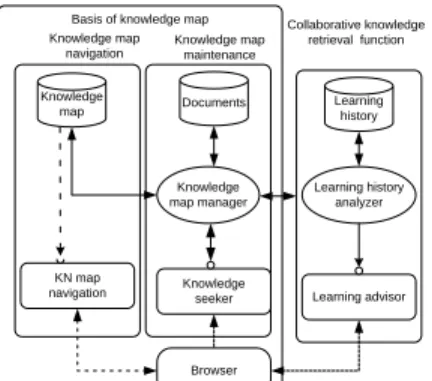
This research uses the knowledge map management system that is proposed by Lin and Hseuh (2006). This research modifies the knowledge map management system that is proposed by Lin and Hseuh, under an assumption that the knowledge map navigation and knowledge map maintenance are the basis of knowledge map. These two main tasks of knowledge map management system are supported by collaborative knowledge retrieval function in order to shorten learning cycle. Our proposed framework is depicted in fig 2.
64
Knowledgemap Documents Learninghistory
Knowledge map manager
Learning history analyzer
KN map
navigation Knowledgeseeker Learning advisor
Browser Basis of knowledge map Knowledge map
navigation Knowledge mapmaintenance
Collaborative knowledge retrieval function
Figure 2. Knowledge map management system (Lin dan Hseuh (2006) model modified)
All these entities, in the web environment, are web documents that are semantically linked into a network as a knowledge map (Wang, 2002).It means knowledge map is a knowledge representation where knowledge objects are linked into a network. Knowledge engineers make use of a number of ways of representing knowledge when acquiring knowledge from experts. These are usually referred to as knowledge models (Milton, 2003). Three important types of knowledge models are:
1. Ladders: Ladders are hierarchical (tree-like) diagrams. Some important types of ladders are concept ladder, composition ladder, decision ladder and attribute ladder.
2. Network Diagrams: Network diagrams show nodes connected by arrows. Depending on the type of network diagram, the nodes might represent any type of concept, attribute, value or task, and the arrows between the nodes any type of relationship.
3. Tables and Grids: Tabular
representations make use of tables or grids. Three important types are forms, frames, timelines and matrices/grids.
In this research, we select ladder as knowledge map design approach, because ladder is a standard knowledge engineering technique (Milton, 2003).
In this research, we follow the procedures of building the knowledge map that is adapted from Kim et.al (2003). Knowledge map building, in this research, consists of 4 steps:
1. Defining organizational knowledge 2. Knowledge extraction and profiling 3. Knowledge linking (ladder)
4. Knowledge map validation
Collaborative knowledge retrieval
Collaborative knowledge retrieval can be developed by generalizing document retrieval patterns from individual knowledge access histories (Lin and Hseuh, 2006). There are several methods to generalize pattern recognition:
1. k-nearest neighbour
2. market basket basket analysis
Mobhaser (2001) research has shown that the market basket analysis recommendation framework can, in fact, improve on the k NN-based collaborative filtering both in terms of
the precision and coverage of
recommendations, while at the same time maintaining the computational advantage over
kNN attained due to the off line discovery of frequent patterns. Thus, in this research we use market basket analysis approach as the proposed algorithm.
In this research, we use 3 phases to design collaborative knowledge retrieval function. These three phases is used in Mobhaser (2001) research. The three phases are:
1. Data preparation, 2. Pattern discovery, and
3. Recommendation
These phases are relevant with three
component of collaborative knowledge
65
Learning history
Learning History Analyzer
Learning Advisor
Figure 3. Collaborative knowledge retrieval function (Lin dan Hsueh, 2006)
recommendation equals with learning advisor. The collaborative knowledge retrieval function model is depicted in Fig. 3.
Learning History
Learning history component stores document access history (log). This component consists of several fields which are depicted in table 1.
Table 1. Document Access History (log)
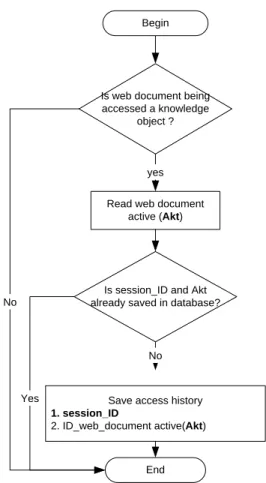
The major step of the learning history approach are depicted in Figure 4.
The learning history in this research is defined as the set of concepts (knowledge categories) accessed by community residents in a specific problem solving process. The learning advisor exerts collaborative document retrieval to exploit past knowledge activities to shorten the individual learning cycle.
Save access history 1. session_ID
2. ID_web_document active(Akt) Read web document
active (Akt) Begin
Is session_ID and Akt already saved in database?
No Is web document being accessed a knowledge
object ?
yes
End No
Yes
Figure 4. Learning history procedure
Learning history analyzer
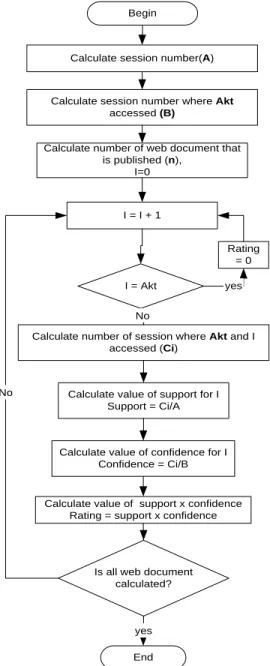
The learning history analyzer facilitates the learning advisor by using sequential pattern analysis techniques to generalize and store the common access patterns as the learning history repository. The major steps of the learning history analyzer approach are depicted in Figure 5.
Learning advisor
The learning adviser is responsible for recommending documents according to the learning history generalized by the learning history analyzer. The major steps of the learning history analyzer approach are depicted in Figure 6.
Field Type
ID
66
Calculate session number(A)Calculate session number where Akt accessed (B)
Calculate number of web document that is published (n),
I=0
Calculate value of support for I Support = Ci/A
I = I + 1
Calculate value of confidence for I Confidence = Ci/B
Calculate number of session where Akt and I accessed (Ci)
Calculate value of support x confidence Rating = support x confidence No
Is all web document calculated?
I = Akt
No
yes
End Begin
yes
Rating = 0
Figure 5. Learning history analyzer procedure
Case study
Knowledge map building
Knowledge map building, in this research, consists of 4 steps:
1. Defining organizational knowledge
In this case study, we build the knowledge map in the higher education academic system, especially about standard operating procedures. The higher education academic system consists eight components:
a. New Students Enrollment b. Registration
c. Study planning d. Lecture evaluation
e. Lecture and laboratory activity
f. Middle and final semester
examination g. Final examination h. Graduate celebration
2. Knowledge extraction and profiling
According to deep investigation and analysis, every component of standard operating procedure consists of 5 elements:
a. The purpose of SOP b. The scope of SOP c. The definition in SOP d. The user of SOP e. The procedure of SOP
3. Knowledge linking (ladder)
Based on the comparison of ladder forms, thus process ladder is fit with the higher
education academic system component.
Because the standard operating procedure is made based on process approach, we can
Sorting value of support x confidence descending
View the bigest value support x confidende as link
Stop Begin
67
Academic System
New students enrollment
Lecture and laboratory activity
Final examination Middle and final
semester examination Study planning
Lecture evaluation Registration
Graduate celebration
Figure 7. Process ladder higher education academic system component
depict the knowledge model of higher education academic system component in Figure 7.
Based on the comparison of ladder forms, thus composition ladder is fit with the higher education academic system elements. We can depict the knowledge model of higher education academic system elements for new students enrollment component in Figure 8.
New students enrollment
(NSE)
Purpose
Scope
Procedure Users Definition
NSE by writing test
NSE by free writing test
NSE for specific area NSE for the best students
General requirements Registration requirements
Flow chart
General requirements
Registration requirements
Flow chart
General requirements
Registration requirements
Flow chart
General requirements
Registration requirements
Flow chart
Figure 8. Composition ladder for new students enrollment component
4. Knowledge map validation using
prototyping
After the knowledge extraction and profiling step, we transform the knowledge
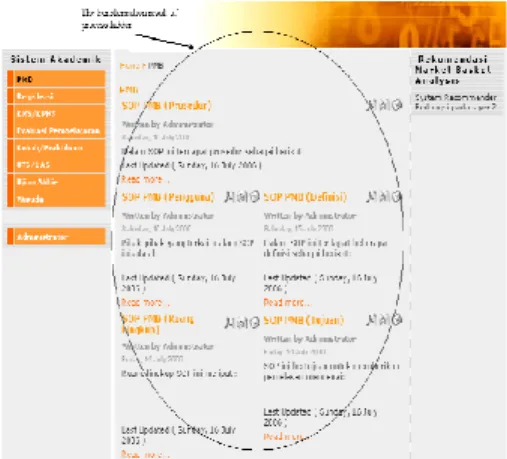
model into web menu. We depict the transformation of knowledge model into web menu in Fig. 9 and 10.
Figure 9. Web page of higher education academic system component (1st Layer)
Knowledge map consists 40 knowledge objects as web document, 8 agregator of web page (for every component), and 1 main page.
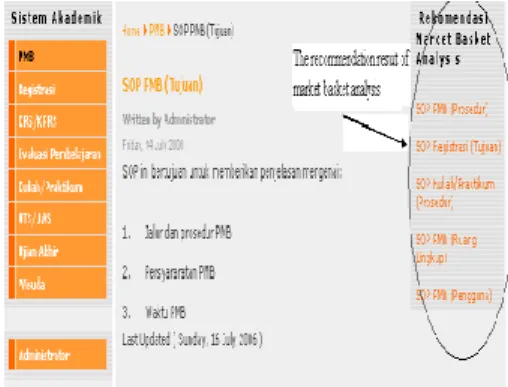
Figure 10. Web page of higher education academic system elements for new student
68
Collaborative knowledge retrievalIn this case, the level of recommendation is given in the 2nd layer. For a better understanding, we give a case study. Example:
1. The active knowledge object 1 is being accessed
2. There are 10 users accessed the
knowledge map site.
3. The system sets to recommend 2
knowledge objects.
a. Learning history
In this case study, we use the history access as follow in Table 2.
Table 2. Learning History
1 2 3 4 5 6 7 8 9 10 1 v v v v v v v v
2 v v v v v v
3 v v v v v v
4 v v v v v
5 v v v v v
6 v v v v v
7 v v v v v
8 v v v v v
9 v v v v v
10 v v v v v v
Knowledge_object_ID_acce ssed
Access_ID
b. Learning history analyzer
Learning history analyzer is responsible to calculate the support and confidence values:
1. Session number : 10
2. Number of access for active web document 5
3. Calculate support x confidence . The results of calculation is depicted in table 3.
c. Learning advisor
From the calculation, the learning advisor sort the support and confidence values. The result of sorting values is depicted in table 4.
Table 3. Learning History Analyzer
Web_dokumen ke-i Ci Support x Confidence
1 5 0
2 4 0.32
3 1 0.02
4 1 0.02
5 5 0.5
6 4 0.32
7 5 0.5
8 4 0.32
9 1 0.02
10 1 0.02
Table 4. Learning Advisor
Thus, the system recommends web document 5 and 7 to be viewed as links. The recommendation link is depicted in Fig. 11.
Figure 11. Recommendation links
Learning cycle
The final purpose of this research is to shorten the learning cycle. For a better understanding, we give a case study. Example:
Web_dokumen ke-i Ci Support x Confidence
5 5 0.5
7 5 0.5
2 4 0.32
6 4 0.32
8 4 0.32
3 1 0.02
4 1 0.02
9 1 0.02
69
Session id 1 access knowledge object with the knowledge object ID 1,2,3,5,6,7,8,9. the knowledge object position is depicted in table 5.
Thus, the user of knowledge map site with session id 1 has to access 17 web pages, if the system without collaborative knowledge retrieval. The web pages have to be accessed are:
1. Main page
2. NSE agregator page 3. NSE SOP (Purpose) page 4. NSE agregator page 5. NSE SOP (Scope) page 6. NSE agregator page
7. NSE SOP (Definition) page 8. NSE agregator page
9. NSE SOP (Procedure) page 10. Registration agregator page 11. Registration SOP (purpose) page 12. Registration agregator page 13. Registration SOP (Scope) page 14. Registration agregator page 15. Registration SOP (Definisi) page 16. Registration agregator page 17. Registration SOP (User) page
Thus, the user of knowledge map site with session id 1 has to access 10 web pages. The web pages have to be accessed are:
1. Main page
2. NSE agregator page
3. NSE SOP (Purpose) page can be accessed by collaborative knowledge retrieval. 4. NSE SOP (Scope) page can be accessed by
collaborative knowledge retrieval.
5. NSE SOP (Definition) page can be accessed by collaborative knowledge retrieval.
6. NSE SOP (Procedure) page can be
accessed by collaborative knowledge retrieval.
7. Registration SOP (purpose) page can be accessed by collaborative knowledge retrieval.
8. Registration SOP (Scope) page can be accessed by collaborative knowledge retrieval.
9. Registration SOP (Definisi) page can be accessed by collaborative knowledge retrieval.
10. Registration SOP (User) page can be accessed by collaborative knowledge retrieval.
\ Table 5. Knowledge object position
ID Knowledge object
Agregator page
Agregator name
1 SOP NSE (Purpose) 2 SOP NSE (Scope) 3 SOP NSE (Definition) 4 SOP NSE (User) 5 SOP NSE (Procedure) 6 SOP Registration (Purpose) 7 SOP Registrasi (Scope) 8 SOP Registrasi (Definition) 9 SOP Registrasi (User) 10 SOP Registrasi (Procedure)
I
New students enrollment (NSE)
70
In this example, collaborative knowledge retrieval function reduced 7 web pages in accessing knowledge map site.
Conclusion
First, knowledge map gives a
comprehensive understanding about what knowledge is needed to achieve objectives, what knowledge sources are available, and which knowledge sources are used by whom. Second, web facilitated knowledge sharing. Third, collaborative knowledge retrieval function will shorten learning cycle. Fourth, the proposed tool is applied to build a web-based knowledge map for an academic system in higher education. The result of this research is a design of knowledge map based on web using collaborative knowledge retrieval function. Collaborative retrieval knowledge function gives recommendations of relevant knowledge between web document. The recommendation will shorten the learning cycle
References
Abdullah, M.S. et.al. (2004). Developing a UML profile for modelling knowledge-based
systems. Proceedings of Model-Driven
Architecture Foundations and Applications
2004.
Lin, F.-r. and Lin, S.-c. (2001). A conceptual model for virtual organizational learning.
Journal of Organizational Computing and Electronic Commerce, Vol. 11, No. 3, pp. 155– 178.
Larose, D.T. (2005). Discovering Knowledge: An Introduction to Data Mining, John Wiley & Sons. Inc.
Lin, Fu-ren., Hsueh, Chih-ming. (2006), Knowledge map creation and maintenance for virtual communities of practice. Information Processing and Management, 42.
Milton, N. (2003). Knowledge Models . Available at: www.epistemics.co.uk.
Milton, N. (2002). Personal Knowledge Techniques, Phd desertation, University of Nottingham, Juli 2002.
Ong, Thian-Huat., et.al. (2005). Newsmap: a knowledge map for online news. Decision Support System, 39.
Montaner, M., et.al. (2003). A Taxonomy of recommender agents on the internet. Articial Intelligence Review , Vol. 19, pp. 285-330.
Peter, E.D. Love., et.al. (2005). Knowledge enabled information system applications in construction: Editoral. Automation in Construction.
Pyo, S. (2005). Knowledge map for tourist destinations – need and implications, Tourism Management, 26.
Suyeon, K., et al. (2003). Building the knowledge map: an industrial case study.
Journal of Knowledge Management.
Vail, E.F. (1999). Mapping organizational knowledge. Knowledge Management Review, May/June 1999.
Suyeon, K., et.al. (2003). Building the knowledge map: an industrial case study.
Journal of Knowledge Management.
Wick, M.R. and Wagner, P.J. (2006). Using market basket analysis to integrate and motivate topics in discrete structure.