Distributed Representations Based on Geometric Algebra: The Continuous
Model
Agnieszka Patyk-Ło´nska, Marek Czachor Gda´nsk University of Technology
ul. Narutowicza 11/12, Gda´nsk 80-233, Poland E-mail: {patyk, mczachor}@pg.gda.pl, http://www.pg.gda.pl/ patyk
http://www.mif.pg.gda.pl/kft/czachor.html
Diederik Aerts
Centrum Leo Apostel (CLEA), Vrije Universiteit Brussel Krijgskundestraat 33, 1160 Brussels, Belgium
E-mail: [email protected] http://www.vub.ac.be/CLEA/aerts/
Keywords:distributed representation of data, geometric algebra, HRR, BSC, scaling
Received:October 23, 2011
Authors revise the concept of a distributed representation of data as well as two previously developed mod-els: Holographic Reduced Representation (HRR) and Binary Spatter Codes (BSC). A Geometric Analogue (GAc— "c" stands forcontinuousas opposed to its discrete version) of HRR is introduced – it employs
role-filler binding based on geometric products. Atomic objects are real-valued vectors inn-dimensional Euclidean space while complex data structures belong to a hierarchy of multivectors. The paper reports on a test aimed at comparison of GAcwith HRR and BSC. The test is analogous to the one proposed by Tony
Plate in the mid 90s. We repeat Plate’s test on GAc and compare the results with the original HRR and
BSC — we concentrate on comparison of recognition percentage for the three models for comparable data size, rather than on the time taken to achieve high percentage. Results show that the best models for storing and recognizing multiple similar structures are GAc and BSC with recognition percentage highly above
90. The paper ends with remarks on perspective applications of geometric algebra to quantum algorithms.
Povzetek: ˇClanek se ukvarja s porazdeljeno predstavitvijo podatkov, ki uporablja geometrijsko algrebro.
1
Introduction
Distributed representations of data are very different from traditional structures (e.g. trees, lists) and complex struc-tures bare little resemblance to their components, therefore great care must be taken when composing or decomposing a complex structure. The most widely used definition of a distributed representation is due to Hinton et al. [13]. In adistributed representation of dataeach concept is repre-sented over a number of units and each unit participates in the representation of some number of concepts. The size of a distributed representation is usually fixed and the units have either binary or continuous-space values. In most dis-tributed representations only the overall pattern of activated units has a meaning.
Let us consider an example of storing the following
in-This paper is based on A. Patyk-Ło´nska, M. Czachor and D. Aerts
Some tests on geometric analogues of Holographic Reduced Representa-tions and Binary Spatter Codespublished in the proceedings of the 1st
International Workshop on Advances in Semantic Information Retrieval (part of the FedCSIS’2011 conference).
formation: “Fido bit Pat". The action in this statement is biteand the features (i.e. roles) of this action are an agent and an object, denotedbiteagtandbiteobj, while their
f illersareF idoandP atrespectively. If we consider stor-ing the way that the action is performed, we can add a third feature (role), e.g.biteway. If we storeF ido,P at,biteagt andbiteobjas vectors, we are able to encode “Fido bit Pat" as
biteagt∗F ido+biteobj∗P at.
The operation of binding, denoted by “∗", takes two vectors and produces another vector, often called achunk
of a sentence. It would be ideal for the resulting vector not to be similar to the original vectors but to have the same di-mensions as the original vectors. Superposition, denoted by “+", is an operation that takes any number of vectors and creates another one that is similar to the original vec-tors. Usually, the superimposed vectors are already the re-sult of the binding operation.
statements, such as “John saw Fido bit Pat":
J ohn∗seeagt+ (biteagt∗F ido+biteobj∗P at)∗seeobj.
In order to decode information, we have to use the op-eration ofunbinding— it is the inverse (an exact inverse or a pseudo-inverse) of binding enabling us to extract an information from a complex statement, provided that we have one of the bound vectors or a very similar vector as a cue. Marking the unbinding operation by “♯" we obtain the following answer to “Who bit Pat?":
(biteagt∗F ido+biteobj∗P at)♯ biteagt=F ido′.
We cannot definitely say that the resulting vectorF ido′will be an exact copy ofF ido, as even an optimal scheme will generate a considerable amount of noise. Since we cannot expect that a noisy decoded information will be identical to what was encoded, we have to rely heavily on various similarity measures — they vary mostly by time taken by computation and the accuracy.
Clean-up memory is an auto-associative collection of all atomic objects and complex statements produced by the system. Given a noisy extracted vector such structure must be able to recall the most similar item stored or indicate, that no matching object had been found.
Independently of the scheme considered, any represen-tation should possess the following qualities
– composition and decomposition — rules of composi-tion and decomposicomposi-tion must be applicable to all el-ements of the domain, irrespectively of the degree of complication of a given element. Further, decomposi-tion should support structure-sensitive processing.
– fixed size — structures of different degree of compli-cation should take up the same amount of space in or-der to facilitate generalization. In the GAcmodel this feature has been given up. Still, structures of different complexity will be of the same type.
– similarity — the representation scheme should pro-vide a quick way to compute similarity between anal-ogous structures (e.g. F ido bit P at Smith and
F ido bit J ohn).
– noise reduction — decomposed statements should re-semble their original counterpart.
– productivity — the model should be able to construct complex nested structures using a set of only few rules.
As far as previously developed models are concerned, Holographic Reduced Representations (HRR), Binary Spatter Codes (BSC), and Associative-Projective Neural Networks (APNN) are distributed representations of cog-nitive structures where binding of role–filler codevectors
maintains predetermined data size. In HRR [23] binding is performed by means of circular convolution
(x~y)j = n∑−1
k=0
xkyj−kmodn.
of realn-tuples or, in ‘frequency domain’, by component-wise multiplication of (complex)n-tuples,
(x1, . . . , xn)~(y1, . . . , yn) = (x1y1, . . . , xnyn).
Boundn-tuples are superposed by addition, and unbinding is performed by an approximate inverse. A dual formal-ism, where real data are bound by componentwise multi-plication, was discussed by Gayler [9]. In BSC [14, 15] one works with binaryn-tuples, bound by componentwise addition mod 2,
(x1, . . . , xn)⊕(y1, . . . , yn) =
= (x1⊕y1, . . . , xn⊕yn),
xj⊕yj = xj+yjmod 2, (1)
and superposed by pointwise majority-rule addition; un-binding is performed by the same operation as un-binding. APNN, introduced and further developed by Kussul [16] and his collaborators [17], employ binding and superposi-tion realized by a context-dependent thinning and bitwise disjunction, respectively. As opposed to HRR and BSC, APNN do not require an unbinding procedure to retrieve component codevectors from their bindings. A detailed comparison of HRR, BSC and APNN can be found in [24].
2
Geometric Algebra
One often reads that the above models represent data by
vectors, which is not exactly true. Given two vectors one does not know how to perform, say, their convolution or componentwise multiplication since the result depends on basis that defines the components. Basis must be fixed in advance since otherwise all the above operations become ambiguous. It follows that neither of the above reduced representations can be given a true and meaningful geomet-ric interpretation. Geometgeomet-ric analogues of HRR [5] can be constructed if one defines binding by the geometric prod-uct, a notion introduced in 19th century works of Grass-mann [11] and Clifford [8].
In order to grasp the main ideas behind a geomet-ric analogue of HRR let us consider an orthonormal ba-sis b1, . . . , bn in some n-dimensional Euclidean space. Now consider two vectors x = ∑nk=1xkbk and y = ∑n
k=1ykbk. Thescalar
x·y=y·x
is known as theinner product. Thebivector
x∧y=−y∧x
is the outer product and may be regarded as an oriented plane segment (alternative interpretations are also possible, cf. [7]). 1 is the identity of the algebra. The geometric product ofxandythen reads
xy =
n ∑
k=1
xkyk 1
| {z }
x·y
+∑
k<l
(xkyl−ykxl)bkbl
| {z }
x∧y
.
Grassmann and Clifford introduced geometric product by means of the basis-independent formula involving the mul-tivector
xy=x·y+x∧y (2)
which implies the so-called Clifford algebra
bkbl+blbk= 2δkl1.
when restricted to an orthonormal basis. Inner and outer product can be defined directly fromxy:
x·y = 1
2(xy+yx),
x∧y = 1
2(xy−yx).
The most ingenious element of (2) is that it adds two ap-parently different objects, a scalar and a plane element, an operation analogous to addition of real and imaginary parts of a complex number. Geometric product for vectorsx,y,
zcan be axiomatically defined by the following rules:
(xy)z = x(yz), x(y+z) = xy+xz,
(x+y)z = xz+yz, xx = x2 = |x|2,
where|x|is a positive scalar called the magnitude ofx. The rules imply thatx·ymust be a scalar since
xy+yx=|x+y|2− |x|2− |y|2.
Geometric algebra allows us to speak of inverses of vectors:
x−1 =x/|x|2.xis invertible (i.e. possesses an inverse) if its magnitude is nonzero. Geometric product of an arbitrary number of invertible vectors is also invertible. The possi-bility of inverting all nonzero-magnitude vectors is perhaps
the most important difference between geometric and con-volution algebras.
Geometric products ofdifferentbasis vectors
bk1...kj =bk1. . . bkj,
k1 < · · · < kj, are called basis blades (or just blades). In n-dimensional Euclidean space there are 2n different blades. This can be seen as follows. Let{x1, . . . , xn}be a sequence of bits. Blades in ann-dimensional space can be written as
cx1...xn=b
x1
1 . . . b xn
n
whereb0
k = 1, which shows that blades are in a one-to-one relation withn-bit numbers. A general multivector is a linear combination of blades,
ψ =
1 ∑
x1...xn=0
ψx1...xncx1...xn, (3)
with real or complex coefficientsψx1...xn. Clifford algebra
implies that
cx1...xncy1...yn=
= (−1)∑k<lykxlc
(x1...xn)⊕(y1...yn), (4)
where⊕is given by (1). Multiplication of two basis blades is thus, up to a sign, in a one-to-one relation with exclusive alternative of two binary n-tuples. Accordingly, (4) is a projective representation of the group of binary n-tuples with addition modulo 2.
The GAcmodel is based on binding defined by geomet-ric product (4) of blades while superposition is just addi-tion of blades (3). The discrete GAd[19] is a version of the GAcmodel obtained ifψx1...xn in (3) equal±1. The first
recognition tests of GAd, as compared to HRR and BSC, were described in [19]. In the present paper we go further and compare HRR and BSC with GAc, a version employ-ing “projected products” [5] and arbitrary realψx1...xn. We
also repeat Plate’s scaling test ([22], [23] – Appendix I) and compare test results for GAc, HRR and BSC models.
Throughout this paper we shall use the following no-tation: “∗" denotes binding roles and fillers by means of the geometric product and “+" denotes the superposition of sentence chunks. Additionally, “~" will denote binding performed by circular convolution used in the HRR model anda∗denotes the involution of a HRR vectora. A “+"’ in the superscript ofx+ denotes the operation of reversing a blade or a multivectorx: (bk1...kj)
+ =b
kj. . . bk1. Asking
a question (i.e. decoding) will be denoted with “♯". The
sizeof a (multi)vector means the number of memory cells it occupies in computer’s memory, while themagnitudeof a (multi)vector V = {v1, . . . , vn} is its Euclidean norm √∑n
i=1v2i.
superpositions are less noisy than the ones based on con-volutions, say. Such operations are in general unknown to a wider audience, which explains popularity of tensor and convolution algebras. Geometric product preserves dimen-sionality at the level 2n-dimensional multivectors, where
nis the number of bits indexing basis vectors. Moreover, all nonzero vectors are invertible with respect to geometric product, a property absent for convolutions and important for unbinding and recognition. A detailed analysis of links between GAc, HRR and BSC can be found in [5]. In partic-ular, it is shown that both GAcmodel and BSC are based on two different representations (in group theoretical sense) of the additive group of binaryn-tuples with addition modulo 2. Actually, the latter observation was the starting point for studying geometric algebra forms of reduced represen-tations [6].
3
The GA
cModel
Multivector (3) associated with n-dimensional Eu-clidean space can be represented by the 2n-tuple
(ψ01...0n, . . . , ψ11...1n). Geometric product of two such
2n-tuples is again a2n-tuple. In this sense geometric prod-uct is analogous to bindings employed in HRR or BSC, but we can still proceed in several inequivalent ways. For ex-ample, since a product of two basis blades is again a basis blade multiplied by±1, we can require thatψx1...xn=±1.
Such a discrete version of GA HRR was tested vs. HRR and BSC in [19], and will be denoted here by GAd (dis-crete GA HRR).
The continuous GAc model differs greatly from GAd. First of all, we do not begin with a general2n-dimensional multivector. Atomic objects are real-valued vectors inn -dimensional Euclidean space, in practice represented byn -tuples of components taken in some basis. A hierarchy of multivectors is reserved for complex statements, formed by binding and superposition of atomic objects. An n -dimensional vector, when seen from the multivector per-spective, is a highly sparse 2n-tuple: Only n out of 2n components can be nonzero.
The procedure we employ was suggested in [5]. The space of 2n-tuples is split into subspaces corresponding to scalars (0-vectors), vectors (1-vectors), bivectors (2-vectors), and so on. At the bottom of the hierarchy lay
vectorsV ∈ Rn, having rank 1 and being denoted asV1. An object of rank 2 is created by multiplying two ele-ments of rank 1 with the help of the geometric product. Let
1
V={α1, α2, α3}and 1
W={β1, β2, β3}be vectors inR3. A multivectorX2 of rank 2 inR3comprises the following elements (cf. [18])
2
X=V1
1
W=
αα12
α3 ββ12
β3 =
α1β1+α2β2+α3β3
α1β2−α2β1
α1β3−α3β1
α2β3−α3β2 ,
the first entry in the array on the right being a scalar and the remaining three entries being 2-blades. For arbitrary vectors inRnwe would have obtained one scalar (or, more
conviniently: ( n 0 ) scalars) and ( n 2 ) 2-blades.
LetX2={γ1, γ2, γ3, γ4}and 1
V={α1, α2, α3}be two mul-tivectors inR3. A multivectorZ3 of rank 3 inR3may be created in two ways: as a result of multiplying eitherV1by
2
X orX2 byV1. Let us concentrate on the first case
3
Z=V1
2
X=
αα12
α3 γ1 γ2 γ3 γ4 =
α1γ1−α2γ2−α3γ3
α1γ2+α2γ1−α3γ4
α1γ3+α2γ4+α3γ1
α1γ4−α2γ3+α3γ2 .
Here, the first three entries in the resulting matrix are 1-blades, while the last entry is a 3-blade. For arbitrary
multi-vectors of rank 1 and 2 inRnwe would have obtained ( n 1 ) vectors and ( n 3 )
trivectors. We cannot generate
multivec-tors of rank higher than 3 inR3, but it is easy to check that
in spaces Rn>3 a multivector of rank 4 would have ( n 0 ) scalars, ( n 2 ) bivectors and ( n 4 )
4-blades. The number of
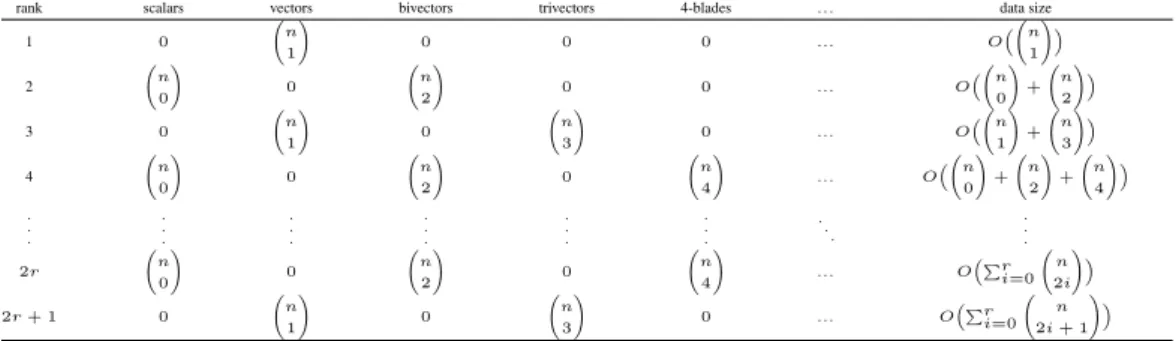
k-blades in a multivector of rankris described by Table 1. It becomes clear that a multivector of rankroverRnis ac-tually a vector over a∑⌊
r
2⌋
i=0 (
n
2i+rmod2
)
-dimensional
space.
As an example let us consider the following roles and fillers being normalized vectors drawn randomly fromRn with Gaussian distribution N(0,n1)
P at = {a1, . . . , an}, male = {b1, . . . , bn},
66 = {c1, . . . , cn},
name = {x1, . . . , xn}, sex = {y1, . . . , yn}, age = {z1, . . . , zn}.
P Smith, who is a 66 year old male named Pat, is created by first multiplying roles and fillers with the help of the geometric product
P Smith=
= name∗P at+sex∗male+age∗66 = name·P at+name∧P at+sex·male+
sex∧male+age·66 +age∧66
= ∑n
i=1(aixi+biyi+cizi)
a1x2−a2x1 +b1y2−b2y1 +c1z2−c2z1
a1x3−a3x1 +b1y3−b3y1 +c1z3−c3z1 .
. .
an−1xn−anxn−1 +bn−2yn
−bnyn−1 +cn−1zn−cnzn−1
= [d0, d12, d13, . . . , d(n−1)n]T
= d0+d12e12+d13e13+· · ·+d(n−1)ne(n−1)n,
Table 1: Numbers ofk-blades in multivectors of various ranks inRn
rank scalars vectors bivectors trivectors 4-blades . . . data size
1 0
(
n
1
)
0 0 0 . . . O((n
1 )) 2 ( n 0 ) 0 ( n 2 )
0 0 . . . O((n
0 ) + ( n 2 )) 3 0 ( n 1 ) 0 ( n 3 )
0 . . . O((n
1 ) + ( n 3 )) 4 ( n 0 ) 0 ( n 2 ) 0 ( n 4 )
. . . O((n
0 ) + ( n 2 ) + ( n 4 )) . . . . . . . . . . . . . . . . . . .. . . . . 2r ( n 0 ) 0 ( n 2 ) 0 ( n 4 )
. . . O(∑ri=0
(
n
2i
))
2r+ 1 0
( n 1 ) 0 ( n 3 )
0 . . . O(∑ri=0
(
n
2i+ 1
))
should have the same magnitude as vectors representing atomic objects, therefore it needs to be normalized. Finally,
P Smithtakes the form of
P Smith = [ ˆd0,dˆ12,dˆ13, . . . ,dˆ(n−1)n]T,
wheredˆi= √∑(nd−1)i n
j=0,12 d2j
.
P Smithis now a multivector of rank 2. The decoding operation
name+P Smith
= name+(name·P at+name∧P at
+sex·male+sex∧male+age·66 +age∧66)
will produce a multivector of rank 3 consisting of vectors and trivectors. However, the originalP atdid not contain any trivector components — they all belong to the noise part and the only interesting blades in name+P Smith are vectors. The expected answer is a vector, there-fore there is no point in calculating the whole multi-vector name+P Smith and only then comparing it with items stored in the clean-up memory. To be efficient, one should generate only the vector-part while computing
name+P Smithand skip the noisy trivectors.
Let ⟨·⟩k denote the projection of a multivector on k -blades. To decodeP Smith’snamewe need to compute
⟨name+P Smith⟩1
= name+nameP at+⟨name+(name∧P at
+sex·male+sex∧male+age·66 +age∧66)⟩1
= P at+noise=P at′.
The resultingP at′will still be noisy, but to a lesser degree than it would have been if the trivectors were present.
Formally, we are using a map∗1
1,2that transforms a mul-tivector of rank 1 (i.e. an n-tuple) and a multivector of rank 2 (i.e. a(1 +(n−21)n)-tuple) into a multivector of rank 1 without computing the unnecessary blades. LetX be a multivector of rank 2
X =⟨X⟩0+⟨X⟩2=x0+ ∑
l<m
xlmelem,
wherexlm =−xml. IfA = (A1, . . . , An)is a decoding vector (actually, an inverse of a role vector), then
A∗11,2X = x0A+ ∑
l,m
Alxlmem
= ∑
k (
xAk+ ∑
l
Alxlk )
ek
= ∑
k
Ykek=Y,
withY = (Y1, . . . , Yn)being ann-tuple, i.e. a multivector of rank 1. More explicitly,
Yk= (A∗11,2X)k=x0Ak+ k−1 ∑
l=1
Alxlk− n ∑
l=k+1
Alxkl.
The map∗1
1,2 is an example of aprojected product, intro-duced in [5], reconstructing the vector part ofAXwithout computing the unnecessary parts. The projected product is basis independent, as opposed to circular convolutions. In general,∗m
l,ktransforms the geometric product of two
mul-tivectorsAl andBk into a multivectorCm.
We now need to compareP at′ with other items stored in the clean-up memory using the dot product, and since
P at′ is a vector, we need to compare only the vector part. That means, if the clean-up memory contained a
multivec-tor 2Mt+1of an odd rank, we would also need to compute
about only the roles or only the fillers. It becomes clear, that recognition based on the hierarchy of multivectors and the projected product is best applicable to tasks in which questions need to be asked only on one side of the sentence or in which sentences have predetermined structure.
Before providing formulas for encoding and decoding a complex statement we need to introduce additional no-tation for the projected product and the projection. We have already introduced the projected product ∗m
l,k trans-forming the geometric product of two multivectors of ranks
l and k into a multivector of rank m. This will not al-ways be the case for complex statements, since we can pro-duce a multivector that will not be of any given rank. Let
∗m
l,{α1,α2,...,αk} denote the projected product transforming
the geometric product of a multivectorAl and a multivec-tor B containing α1-blades, α2-blades,. . . and αk-blades into a multivector Cm. In this way, the projected product
∗1
1,2 may be written down as ∗ 1
1,{0,2}. By analogy, let
⟨·⟩{α1,α2,...,αk} denote the projection of a multivector on
components spanned byα1-blades,α2-blades,. . . andα m-blades.
LetΨdenote the normalized multivector encoding the sentence “Fido bit PSmith", i.e.
Ψ =biteagt∗F ido
| {z }
rank 2
+biteobj∗P Smith| {z }
rank 2
| {z }
rank 3
.
MultivectorΨwill contain scalars, vectors, bivectors and trivectors and can be written down as the following vector
of dimension∑3i=0 (
n i
)
Ψ = |{z}α
a scalar +
n ∑
i=1
βiei | {z }
vectors +
n ∑
1=i<j
γijeij
| {z }
bivectors
+
n ∑
1=i<j<k
δijkeijk
| {z }
trivectors
.
4
More Examples of Encoding and
Decoding Sentences
The following examples illustrate various ways of asking questions in the GAcarchitecture.
“Who was bitten?"
The answer to that question will be a multivector of rank 2
Ψ♯ biteobj = ⟨bite+objΨ⟩{0,2}
= bite+obj∗21,{0,1,2,3}Ψ = P Smith′ ≈P Smith.
Letbiteobj = {y1, . . . , yn},P Smith′ will then have the form
P Smith′ = (y1e1+· · ·+ynen)∗21,{0,1,2,3}
(
n ∑
i=1
βiei+ n ∑
1=i<j<k
δijkeijk)
=
n ∑
k=1
ykβk | {z }
a scalar +
n ∑
1=i<j
θijeij
| {z }
bivectors
,
where
θij=yiβj−yjβi+ n ∑
t=1
t̸∈{i,j}
ytδijt
with δijt = δtij = −δitj. As previously, P Smith′ should be compared with appropriate items from the clean-up memory to produce the most probable answer.
“What happened to PSmith?"
Asking about roles poses a problem of inverting a (multi)vector. Since not all multivectors are invertible, we have to be satisfied with reverses [5] of multivectors. We will need another type of a projected product: let
∗m
{α1,α2,...,αl},kdenote the projected product transforming
the geometric product of a multivector B containing α1 -blades, α2-blades,. . . and αl-blades and a multivector
k
A
into a multivectorCm. The answer to our question will be a vector
Ψ♯ P Smith = ⟨ΨP Smith+⟩1
= Ψ∗1{0,1,2,3},2P Smith+
= bite′obj ≈biteobj.
If we denoteP Smithas
P Smith=z0+z12e12+· · ·+z(n−1)ne(n−1)n
then
bite′obj = (
n ∑
i=1
βiei+ n ∑
1=i<j<k
δijkeijk)
∗1
{0,1,2,3},2(z0− n ∑
1=i<j
zijeij)
= ζ1e1+· · ·+ζnen,
where
ζk =βkz0− k∑−1
i=1
βizik+ n ∑
i=k+1
βizki− n ∑
1=i<j i,j̸=k
δijkzij,
withδijk =δkij=−δikj.
The last question in this example will produce an answer having the form of a vector
Ψ♯ F ido = ⟨ΨF ido+⟩1
= Ψ∗1{0,1,2,3},1F ido+
= bite′agt ≈biteagt.
IfF ido={v1, . . . , vn}, then
bite′agt = (α+γ12e12+· · ·+γ(n−1)ne(n−1)n)
∗1
{0,1,2,3},1(v1e1+· · ·+vnen)
= ϑ1e1+. . . ϑnen,
where
ϑk =αvk− k−1 ∑
i=1
γikvi+ n ∑
i=k+1
γkivi.
Those tedious calculations imply that the GAcmodel is best applicable to sentences having a similar or identical complexity structure, otherwise it may be hard to automa-tize the process of asking questions and retrieving answers. Because of this limitation, this construction seems to be a promising candidate for a holographic database.
5
Overview of Plate’s Scaling Test
Plate [23] describes a simulation in which approximately 5000 HRR 512-dimensional vectors were stored in the clean-up memory. The purpose of his simulation was to study efficiency of the HRR model but also to provide a counterexample to the claim that role-filler representations do not permit one component of a relation to be retrieved given the others. We will repeat Plate’s test on several mod-els and compare the results.
Let us consider the following atomic objects
numx(x= 0, . . . ,2500),
times, plus,
fillers,
result, operand.
} roles
At the beginning of the scaling test, relations concerning multiplication and addition are constructed. For example, “2·3 = 6" is constructed as
times2,3 = times+operand∗(num2+num3)
+result∗num6.
Generally, relations are constructed in the following way
timesx,y = times+operand∗(numx+numy)
+result∗numx·y,
plusx,y = plus+operand∗(numx+numy)
+result∗numx+y.
xandyrange from 0 to 50 withy ≤ xmaking a total of 2501 number vectors and 2652 instances of eachtimesx,y andplusx,y. As one can notice, the sameoperandrole is used for bothxandyto preserve commutativity of multi-plication and addition.
Plate writes, that a relation can be “looked up" by sup-plying enough information to distinguish a specific relation from others. For example, to look up “2·3 = 6" one needs to find the most similar relationRto any of the following fragmentary statements
(case 1) times+operand∗num2
+operand∗num3, (case 2) times+operand∗num2
+result∗num6,
(case 3) times+operand∗num3
+result∗num6,
(case 4) operand∗num2+operand∗num3
+result∗num6.
Retrieving the missing piece of information in the first three cases can be done by asking any of the subquestions
(case 1) R ♯ result,
(case 2) R ♯ operand,
(case 3) R ♯ operand.
Case 4 is somewhat more problematic — to look up a miss-ing relation name (timesorplus) one needs to have a sep-arate clean-up memory containing only relation names or to use an alternative encoding in which there is a role for relation names. We will alter Plate’s test by using the latter method.
Plate states that he had tried one run of the system mak-ing a query for each component missmak-ing in every relation — this amounted to 10608 queries. A further 7956 queries had been made to decode the missing component except for the relation name. Plate goes on to claim, that the system made no errors.
There appear to be two misstatements in Plate’s claims. Firstly, we cannot treat subquestions regarding cases 2 and 3 separately, as there are two equally probable answers to each of these subquestions, provided that relationsR2and
R3point correctly totimesx,y. Secondly, consider a frag-mentary piece of information
times+operand∗num0+result∗num0.
In this situation, the missing component can be any of the numbersnumxwherex∈ {0, . . . ,50}and thus, there are 51 atomic objects that are equally probable to be the right answer. This suggests that Plate regards several answers as valid ones, as long as the similarity of these answers ex-ceeds some threshold. To work out the missing component, one then needs to check which of those potential answers is not in the original set used for retrieval.
– Inaccuracies mentioned above act as a test if all atomic objects are created and treated equally. Ideally, ev-ery atomic object of the numx form should be rec-ognized as a correct answer to the “zero problem" for
number of trials
51 ·100%of the time.
– Prime numbers greater than 100 do not appear in any oftimesx,y andplusx,y relations, therefore they test if the model is immune to garbage data.
– Numbers ranging fromnum0tonum100may be con-structed in a multitude of ways by addition (num0by multiplication) and any given sentence chunkresult∗ numzwill appear quite often in theplusx,y relation. Hence, this is a great way of checking if the model deals with excessive similarity of a number of com-plex statements.
– Atomic objects bound withoperandandresultrange in variety. On the other hand, there are just two atomic objects acting as an operation — does it affect in any way the recognition ofoperationfiller? Indeed, it will be shown in Section 7 that recognition of the
operationchunk turns out to be quite interesting de-pending on the choice of the architecture.
6
Notation
For the purpose of explaining test results, let us introduce the following notation. LetSx,y∗ andS+
x,ydenote relations
Sx,y∗ = operation∗times+operand∗numx+
operand∗numy+result∗numx·y,
Sx,y+ = operation∗plus+operand∗numx+
operand∗numy+result∗numx+y,
for y ≤ x. We chose to use a separate role for a rela-tion name to enable encoding the informarela-tion given only operands and the result. Let Fi,x,yop denote fragmentary statements fori∈ {1,2,3,4}andop∈ {∗,+}
F1op,x,y = Sx,yop −result∗numx op y,
F2op,x,y = Sx,yop −operand∗numx,
F3op,x,y = Sx,yop −operand∗numy,
F4op,x,y = Sx,yop −operation∗op.
Ifv is an element of the clean-up memory, then letN(v)
denote the closestneighbor of v, i.e. an element of the clean-up memory that is most similar tov. Ifv has more than one neighbor, then all subquestions during the test are asked to all ofv’s neighbors. In HRR, GAd (with the Hamming measure of similarity) and GAc it is extremely unlikely for an element of the clean-up memory to have more than one neighbor due to the continuous nature of data in these architectures. Let Qopi,x,y = N(Fi,x,yop ) for
i∈ {1,2,3,4}andop∈ {∗,+}. During the test we asked
subquestions concerning components missing inFi,x,yop and obtained the following (sets of) answers
q1op,x,y = N(Qop1,x,y♯ result), q2op,x,y = N(Qop2,x,y♯ operand), q3op,x,y = N(Qop3,x,y♯ operand), q4op,x,y = N(Qop4,x,y♯ operation).
We assume that a missing component is identified correctly if it is the only neighbor to appropriate answerq·op,x,y or it belongs to the set of neighbors ofqop·,x,y.
7
Test Results
The software for all tests was developed by A. Patyk-Ło´nska in Java language. All tests were performed on an ordinary PC with dualcore AMD processor with 2 GB RAM.
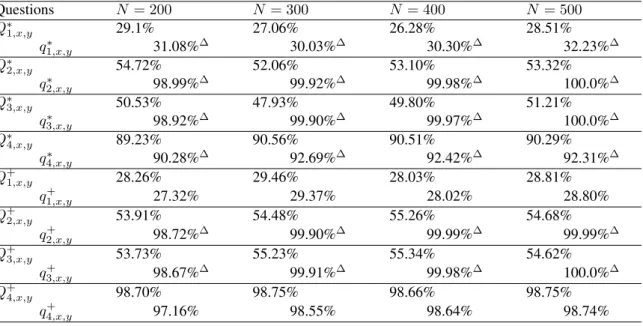
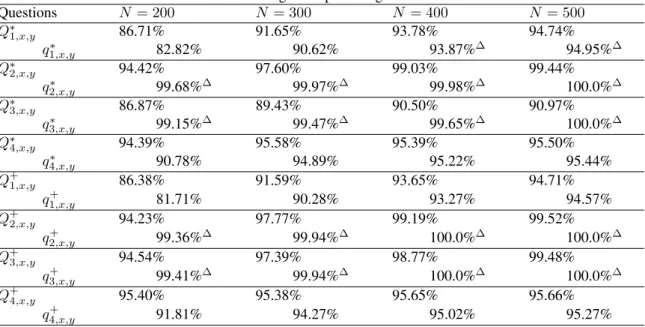
Tables 2 through 4 compare scaling test results for
– GAcand HRR, both using dot-product as a similarity measure.
– BSC using Hamming distance as a similarity measure.
Although BSC and HRR models need onlyn-dimensional vectors, this is not quite the case for and GAc, which needs
1 + n(n2−1) numbers to represent multivectors of rank 2 overRn. We present recognitions test results close to 100% and comment on vector length required for each model to achieve such percentage. The real number of memory cells used up by each model is given in brackets in the table headings.
The answers to subquestions Qop2,x,y ♯ operand and
Qop3,x,y ♯ operandwere considered to be correct if any of the two possible operands came up as the item most sim-ilar to those subquestions. In case of other questions and subquestions only exact answers were taken into consider-ation.
50 runs of the test were performed on each model. Un-like in Plate’s test,xandyranged from 0 to only 20. Hence, there are 401 number vectors and 462 relation vectors.
The “zero problem" is clearly visible in each tested model, as the recognition percentage ofQ∗3,x,y barely ex-ceeds 90%. Nevertheless,Q∗3,x,yalmost always contains at least one of the operands from the original sentenceS∗x,y
Table 2: Recognition percentage for GAc.
Questions R10 R20 R30 R40
(46) (191) (436) (781)
Q∗1,x,y 89.76% 99.98% 99.99% 100.0%
q∗1,x,y 39.44% 95.28% 99.58% 99.88%
Q∗2,x,y 91.12% 99.73% 99.98% 100.0%
q∗2,x,y 36.24% 83.86% 97.92% 99.81%
Q∗3,x,y 83.97% 91.15% 91.33% 91.34%
q∗3,x,y 41.27% 84.92% 98.05%∆ 99.82%∆
Q∗4,x,y 98.90% 99.60% 99.63% 99.59%
q∗4,x,y 42.01% 95.56% 99.24% 99.52%
Q+1,x,y 89.39% 99.99% 100.0% 100.0%
q+1,x,y 39.09% 95.99% 99.76% 99.95%
Q+2,x,y 86.96% 99.59% 99.96% 100.0%
q+2,x,y 35.32% 83.84% 97.97% 99.79%
Q+3,x,y 87.00% 99.63% 99.96% 100.0%
q+3,x,y 35.12% 83.84% 97.98% 99.79%
Q+4,x,y 99.05% 99.53% 99.51% 99.54%
q+4,x,y 45.84% 94.73% 99.14% 99.49%
Table 3: Recognition percentage for HRR.
Questions N = 200 N = 300 N = 400 N = 500
Q∗1,x,y 29.1% 27.06% 26.28% 28.51%
q1∗,x,y 31.08%∆ 30.03%∆ 30.30%∆ 32.23%∆
Q∗2,x,y 54.72% 52.06% 53.10% 53.32%
q2∗,x,y 98.99%∆ 99.92%∆ 99.98%∆ 100.0%∆
Q∗3,x,y 50.53% 47.93% 49.80% 51.21%
q3∗,x,y 98.92%∆ 99.90%∆ 99.97%∆ 100.0%∆
Q∗4,x,y 89.23% 90.56% 90.51% 90.29%
q4∗,x,y 90.28%∆ 92.69%∆ 92.42%∆ 92.31%∆
Q+1,x,y 28.26% 29.46% 28.03% 28.81%
q1+,x,y 27.32% 29.37% 28.02% 28.80%
Q+2,x,y 53.91% 54.48% 55.26% 54.68%
q2+,x,y 98.72%∆ 99.90%∆ 99.99%∆ 99.99%∆
Q+3,x,y 53.73% 55.23% 55.34% 54.62%
q3+,x,y 98.67%∆ 99.91%∆ 99.98%∆ 100.0%∆
Q+4,x,y 98.70% 98.75% 98.66% 98.75%
Table 4: Recognition percentage for BSC.
Questions N = 200 N = 300 N = 400 N = 500
Q∗1,x,y 86.71% 91.65% 93.78% 94.74%
q1∗,x,y 82.82% 90.62% 93.87%∆ 94.95%∆
Q∗2,x,y 94.42% 97.60% 99.03% 99.44%
q2∗,x,y 99.68%∆ 99.97%∆ 99.98%∆ 100.0%∆
Q∗3,x,y 86.87% 89.43% 90.50% 90.97%
q3∗,x,y 99.15%∆ 99.47%∆ 99.65%∆ 100.0%∆
Q∗4,x,y 94.39% 95.58% 95.39% 95.50%
q4∗,x,y 90.78% 94.89% 95.22% 95.44%
Q+1,x,y 86.38% 91.59% 93.65% 94.71%
q1+,x,y 81.71% 90.28% 93.27% 94.57%
Q+2,x,y 94.23% 97.77% 99.19% 99.52%
q2+,x,y 99.36%∆ 99.94%∆ 100.0%∆ 100.0%∆
Q+3,x,y 94.54% 97.39% 98.77% 99.48%
q3+,x,y 99.41%∆ 99.94%∆ 100.0%∆ 100.0%∆
Q+4,x,y 95.40% 95.38% 95.65% 95.66%
q4+,x,y 91.81% 94.27% 95.02% 95.27%
Table entries marked with a “∆" indicate that despite the wrong recognition of a fragmentary sentence, the miss-ing component has been identified correctly. In all tested models such situations arise for sentences with one of the operands missing. For HRR, however the missing item has been “accidentally" correctly identified also in cases of missingoperation∗timesandresult∗timesx,y compo-nents. Such recognition did not occur in cases of missing
operation∗plusandresult∗plusx,ycomponents, which is distressingly asymmetric.
HRR turned out to be the worst model during this exper-iment. The recognition percentage ofQ∗1,x,yandQ+1,x,yis dangerously low when compared to otherQ’s. BothQ∗1,x,y
andQ+1,x,y are retrieved from the clean-up memory given only two operands and the operation type. Since we have only two operation types,Q∗1,x,yandQ+1,x,ywill not differ greatly from each other. This phenomenon is also observ-able in BSC (but not in GAc), where the recognition per-centage ofQ1’s is only slightly lower than that of the other
Q’s. Apart from that weakness, BSC performs as well as GAcfor adequate data size.
8
Conclusion
Authors developed a new model of distributed representa-tions of data based on geometric algebra. Although the data representations of sentences encoded in this model may have varying lengths (as opposed to HRR and BSC), it can be justified by the fact that it is quite logical for sentences that hold more information to have larger ”volume".
Tedious calculations presented in Section 3 imply that the GAc model is best applicable to sentences having a similar or identical complexity structure, otherwise it may be hard to make the process of asking questions and re-trieving answers automatic. Because of this limitation, this
construction seems to be a promising candidate for a holo-graphic database.
Although research in distributed representations has been thriving in the past decades, no one has yet developed a software tool that would employ distributed representa-tions to implement databases with real-life contents. Of course, some attempts at scaling has been made so far, but they were rather narrowly aimed at specific tasks. Authors hope to develop such a tool in the (near) future.
9
Further Perspectives –
Quantum-like Computation Based
on Geometric Algebra
Quantum algorithms [17] employ tensor product binding and thus are analogous to Smolensky’s tensor product rep-resentations [25]. The peculiarity of quantum computation is in its putative implementation: hardware based on the rules of micro-world automatically guarantees parallelism of processing the entire superposition of bound objects. The same property, however, makes quantum processors extremely sensitive to noise so it is by no means evident that working devices will be practically constructed.
Acknowledgement
This work was supported byGrant G.0405.08of theFund for Scientific Research Flanders.
References
[1] D. Aerts and M. Czachor (2004), “Quantum aspects of semantic analysis and symbolic artificial intelli-gence",J. Phys. A, vol. 37, pp. L123-L13.
[2] D. Aerts and M. Czachor (2007), “Cartoon computa-tion: Quantum-like algorithms without quantum me-chanics",J. Phys. A, vol. 40, pp. F259-F266.
[3] M. Czachor (2007), “Elementary gates for cartoon computation",J. Phys. A, vol. 40, pp. F753-F759. [4] D. Aerts and M. Czachor (2008), “Tensor-product
versus geometric-product coding", Physical Review A, vol. 77, id. 012316.
[5] D. Aerts, M. Czachor, and B. De Moor (2009), “Geo-metric Analogue of Holographic Reduced Represen-tation",J. Math. Psychology, vol. 53, pp. 389-398. [6] D. Aerts, M. Czachor, and B. De Moor (2006),
“On geometric-algebra representation of binary spat-ter codes". preprint arXiv:cs/0610075 [cs.AI].
[7] D. Aerts, M. Czachor, and Ł. Orłowski (2009), “Tele-portation of geometric structures in 3D ",J. Phys. A
vol. 42, 135307.
[8] W.K. Clifford (1878), “Applications of Grassmann’s extensive algebra",American Journal of Mathematics Pure and Applied, vol. 1, 350–358.
[9] R. W. Gayler (1998), “Multiplicative binding, repre-sentation operators, and analogy",Advances in Anal-ogy Research: Integration of Theory and Data from the Cognitive, Computational, and Neural Sciences, K. Holoyak, D. Gentner, and B. Kokinov, eds., Sofia, Bulgaria: New Bulgarian University, p. 405.
[10] H. Grassmann (1877), “Der Ort der Hamilton’schen Quaternionen in der Ausdehnungslehre”, Mathema-tische Annalen, vol. 3, 375–386.
[11] G. E. Hinton, J. L. McClelland and D. E. Rumel-hart (1986), “"Parallel distributed processing: Ex-plorations in the microstructure of cognition", vol. 1, 77 ˝U109, "Distributed representations", The MIT Press, Cambridge, MA.
[12] P. Kanerva (1996), “Binary spatter codes of ordered k-tuples”. In C. von der Malsburg et al. (Eds.), Arti-ficial Neural Networks ICANN Proceedings, Lecture Notes in Computer Sciencevol. 1112, pp. 869-873.
[13] P. Kanerva (1997), “Fully distributed representa-tion”.Proc. 1997 Real World Computing Symposium (RWCŠ97, Tokyo), pp. 358-365.
[14] E. M. Kussul (1992),Associative Neuron-Like Struc-tures. Kiev: Naukova Dumka (in Russian).
[15] E.M. Kussul and T.N. Baidyk (1990), “Design of Neural-Like Network Architecture for Recognition of Object Shapes in Images",Soviet J. Automation and Information Sciences, vol. 23, no. 5, pp. 53-58. [16] N.G. Marchuk, and D.S. Shirokov (2008), “Unitary
spaces on Clifford algebras”, Advances in Applied Clifford Algebras, vol 18, pp. 237-254.
[17] M.A. Nielsen and I.L. Chuang (2000), Quantum Computation and Quantum Information. Cambridge: Cambridge University Press.
[18] A. Patyk (2010), “Geometric Algebra Model of Distributed Representations", inGeometric Algebra Computing in Engineering and Computer Science, E. Bayro-Corrochano and G. Scheuermann, eds. Berlin: Springer. Preprint arXiv:1003.5899v1 [cs.AI].
[19] T. Plate (1995), “Holographic Reduced Representa-tions",IEEE Trans. Neural Networks, vol. 6, no. 3, pp. 623-641.
[20] T. Plate (2003), Holographic Reduced Representa-tion: Distributed Representation for Cognitive Struc-tures. CSLI Publications, Stanford.
[21] D.A. Rachkovskij (2001), “Representation and Pro-cessing of Structures with Binary Sparse Distributed Codes",IEEE Trans. Knowledge Data Engineering, vol. 13, no. 2, pp. 261-276.