Hungarian Association of Agricultural Informatics European Federation for Information Technology in Agriculture, Food and the Environment
Journal of Agricultural Informatics. 2015 Vol. 6, No. 2
journal.magisz.org
A computer-based vision systems for automatic identification of plant species
using kNN and genetic PCA
Oluleye Babatunde1, Liesa Armstrong2, Jinsong Leng3, Dean Diepeveen4
I N F O
Received 20 Apr 2015 Accepted 23 Apr 2015 Available on-line 29 Jun 2015 Responsible Editor: M. Herdon
Keywords:
Precision Agriculture, Plant Species Classification, Image Processing, Principal
Component Analysis, k Nearest Neighbor, Genetic Algorithm.
A B S T R A C T
Precision farming involves integration of different areas of disciplines to lower production costs and improve productivity. One major arm of precision farming or agriculture is the development of computer-based vision systems for automatic identification of plant species.This work involves application of k Nearest Neighbour (kNN) and genetic principal component analysis (GA-PCA) for the development of computer-based vision systems for automatic identification of plant species. As the first contribution, several image descriptors were extracted from the images of plants found in the Flavia dataset. Lots of these image features are affine maps and amalgamation of such massive features in one study is a novel idea. These descriptors are Zernike Moments (ZM), Fourier Descriptors (FDs), Lengendre Moments (LM) Hu 7 Moments, Texture, Geometrical properties and colour features. The GA-PCA (1907 x 41) feature space improved the classification accuracy of kNN from 84.98% to 88.75%.
1. Introduction
Plant species identification is traditionally carried out by manual matching of the plant’s features, relating to components of the plant, such as leaves, flowers, and bark, against an atlas (Meeta, 2012) and (Abdul, Lukito, Adhi and Santosa, 2012). According a survey (Babatunde, Armstrong, Leng and Diepeveen, 2015) attempts to automate this process have been made, using features of plants extracted from images as input parameters to various classifier systems. This work further examines the application of genetically selected principal components combined with k Nearest Neighbor (kNN) algorithm. The main strength of this article is the application of a GA to automatically select the minimum number of principal components needed for optimal accuracy based on the available dataset.
2. Literature Reviews
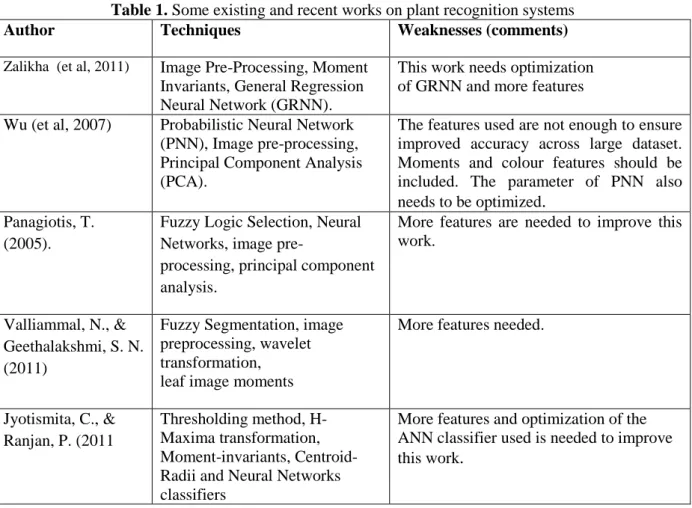
Several plant species recognition systems have been developed based on various features and classifiers. Many of these works were based on artificial neural networks (ANN) as Machine Learning Models due to their adaptability and scalability. Table 1 below shows some recent works on computer-based vision systems for automatic identification of plant species. A report on their weaknesses are shown in the last column. A deeper literature reviews on recent works on computer-based vision
1Oluleye Babatunde
School of Computer and Security Science, Edith Cowan University, Perth, WA, Australia;
Department of Information and Communication Technology, Osun State University, Osogbo, Osun State, Nigeria
2Liesa Armstrong
School of Computer and Security Science, Edith Cowan University, Perth, WA, Australia [email protected]
3Jinsong Leng
Security Research Institute, Edith Cowan University, Perth, WA, Australia [email protected]
4Dean Diepeveen
systems for plant species identification can be found in the paper (Babatunde, Armstrong, Leng & Diepeveen, 2015).
Table 1. Some existing and recent works on plant recognition systems
Author Techniques Weaknesses (comments)
Zalikha (et al, 2011) Image Pre-Processing, Moment Invariants, General Regression Neural Network (GRNN).
This work needs optimization of GRNN and more features
Wu (et al, 2007) Probabilistic Neural Network (PNN), Image pre-processing, Principal Component Analysis (PCA).
The features used are not enough to ensure improved accuracy across large dataset. Moments and colour features should be included. The parameter of PNN also needs to be optimized
.
Panagiotis, T. (2005).
Fuzzy Logic Selection, Neural Networks, image pre-
processing, principal component analysis.
More features are needed to improve this work.
Valliammal, N., & Geethalakshmi, S. N. (2011)
Fuzzy Segmentation, image preprocessing, wavelet transformation, leaf image moments
More features needed.
Jyotismita, C., & Ranjan, P. (2011
Thresholding method, H-Maxima transformation, Moment-invariants, Centroid-Radii and Neural Networks classifiers
More features and optimization of the ANN classifier used is needed to improve this work
.
3. Methodology
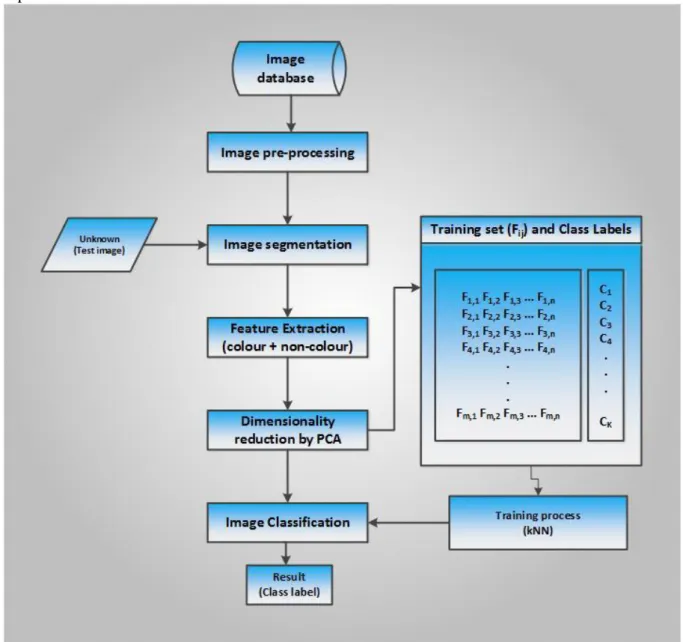
This section discusses the adopted methodology in designing the proposed model (kNN-GA-PCA) for automatic identification of leaves. The used dataset is detailed in section 3.1, while section 3.2 discusses Principal Component Analysis (PCA) which was used for both feature transformation and dimensionality reduction. Genetic Algorithm and k Nearest Neighbour are detailed in section 3.3 and 3.4 respectively. The proposed approach includes image acquisition, image pre-processing, image segmentation, feature extraction, automatic selection of number of principal components by GA and image classification.
3.1 Data set
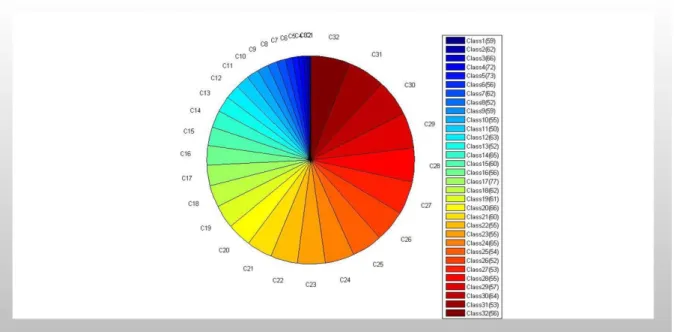
Figure 1. Proportion of plant species in the Flavia dataset
Table 2. 112 Features in the extract from the Flavia dataset
SN Descriptor Feature Index Descriptor Cardinality
1 Zernike Moments (ZM) F01, F02, …, F20 20
2 Legendre Moments(LM) F21, F22, …, F40 20
3 Hu 7 Moments (Hu7M) F41, F42, …, F47 7
4 Texture Features (TF) F48, F49, …, F69 22
5 Geometric Features (GF) F70, F71 , …, F79 10
6 Fourier Descriptors (FD) F80, F81,…, F100 21
7 Colour features (CF) F101, F102,…F112 12
3.2 Principal Component Analysis (PCA)
technique. The PCA accepts a dataset and rotates it in such a way that the maximum variability can be visible. The operation of PCA is given as follows:
1.
Given a dataset
x
n,
n
1
(
1
)
N
, andx
n is a N-dimensional vector, (N = 112 for this study)2.
Task ?: To project the given data onto an M-dimensional subspace, where M < N , and M, N are positive integers.3.
Assumption: The projection is assumed to be represented as
Ax
y
...(1)where
]
,...,
,
,
[
u
1Tu
2Tu
3Tu
MTA
...(2)and
u
iTu
i
1
fori
1
(
1
)
M
...(3)The objective now is to maximize the variance of
y
n, which is the trace of the covariance of matrixy
H of
y
n. Therefore the actual objective now is to find the maximum of TRACE (Hy) where
N n T ny
y
y
N
H
1)
(
1
...(4) and
N n ny
N
y
11
...(5)If we assume
H
xto be the covariance matrix ofx
n and since)
(
)
(
H
ytrace
AH
xA
Ttrace
...(6)the Langrangian multiplier and derivatives gives
i i i
x
u
u
H
...(7)where
u
i is the largest vector ofH
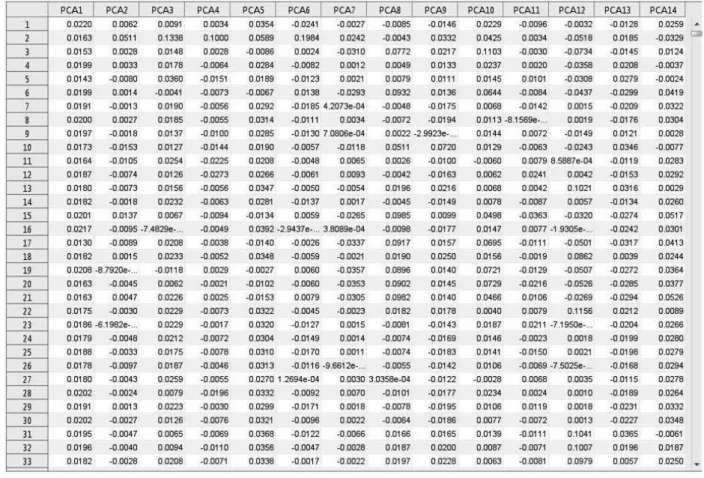
xwhich corresponds to the ith largest eigenvalue. The first 33Figure 2. The first 14 principal component of the original feature set
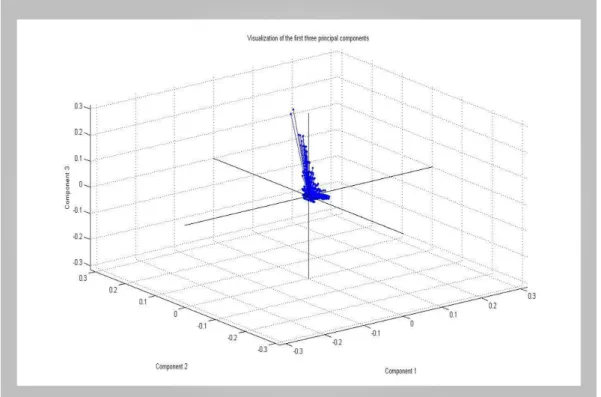
Figure 4. A 3D view of the first three principal components
Figure 5. Distribution of the principal components
3.3 Genetic Algorithm (GA)
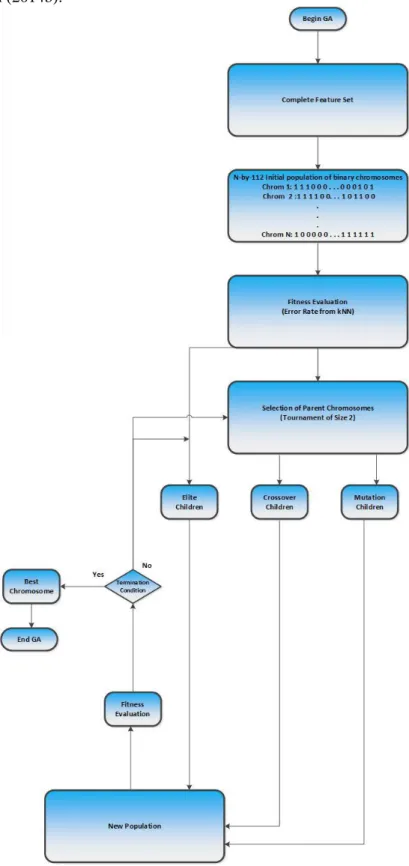
fittest). In comparative terminology to human genetics, chromosomes are the bit strings, gene is the feature, allele is the feature value, locus is the bit position, genotype is the encoded string, and phenotype is the decoded genotype (Sivanandam & Deepa, 2008). The fitness of each chromosome is evaluated using a function commonly referred to objective function or fitness function. In other words, the fitness function (objective function) reports numerical values which are used in ranking the chromosomes in the population. The fitness function used for both GA and PSO is given as Equation 2. The detailed description of the GA can be found in the companion paper of Babatunde, Armstrong, Leng and Diepeveen (2014b).
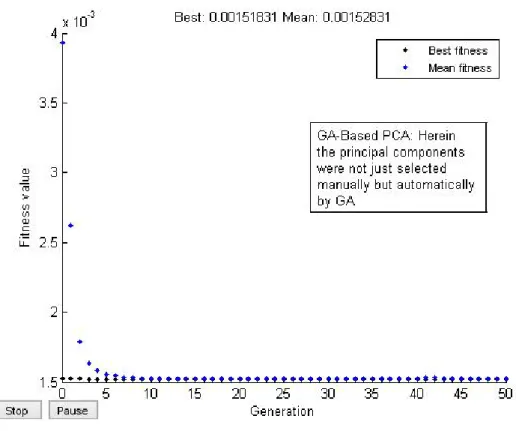
Figure 7. Simulation diagram on genetically selected principal components
3.4 K Nearest Neighbour
The kNN is metric-based algorithm that solves classification problem by looking for the shortest distance between the test data and training sets in the feature space. The distance is generally computed in Pythagorean sense (by finding the square root of the sum of differences). Suppose the training set, using the features in Table 2 is defined as
MN M M M N N Nx
x
x
x
x
x
x
x
x
x
x
x
x
x
x
x
x
3 2 1 3 33 32 31 2 23 22 21 1 13 12 11 ...(8)where M = 1907, the number of observations in these dataset. The number of features here is N. The kNN algorithm computes Euclidean distance between test data
x
TEST and all entries in the training sets and then finds the nearest point (shortest distance) from the training set to the test set as:2 1
)
(
)
,
(
M m m TEST mTEST
x
x
x
x
D
...(9),where
m
1
,
2
,
3
...,
M
. The kNN considers only the k nearest neighbours denoted as{
x
1,
x
k}
as themember(s) of the set (a normed linear space).
xj |d(x,xi) d(x,xj)
kNNSpace ...(10)
shown in Figure 9. The kNN counts each category m in the class information and the report classification results based on the expression
))
(
max(
arg
count
x
m ...(11)subject to
M
i
m
class
x
count
1)
(
...(12)Figure 8. A diagram showing k = 3 nearest neighbours
4. Experimental Design and validation
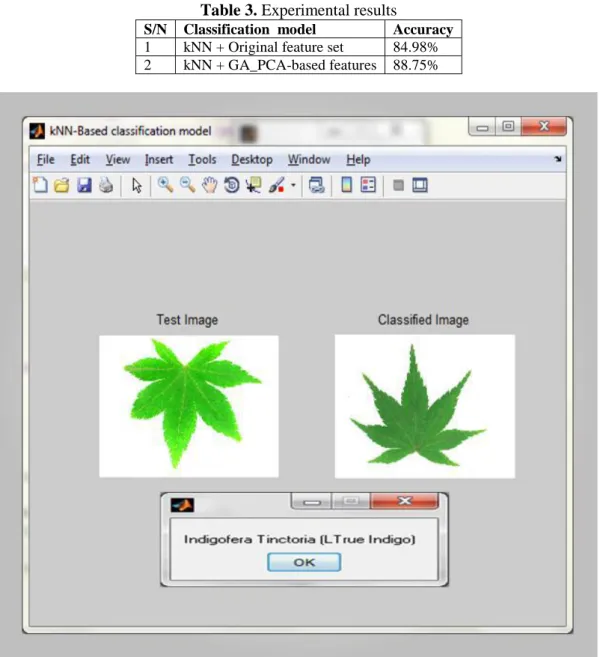
The research approach used in this work is shown in Figure 10. The classification model was kNN. The different distance metric that can be used with the kNN are Euclidean, standard Euclidean, Mahalanobis, Minkowski, Chebychev, Cosine, Correlation, Jaccard and Spearman distance. The choice distance metric for this study is Euclidean distance. A sample screen shot of the kNN-based classification model. The feature space generated from the Flavia dataset discussed in section 3 was partitioned into two disjoints set (training and test set) via 10-fold cross validation as shown in Figure 11. The feature space (PCA space) itself was a reduced feature space as GA was used to automatically select the number of principal components (PC) finally used. The number of PCs was 41. The implementation was done in MATLAB 2013.
Table 3. Experimental results
S/N Classification model Accuracy
1 kNN + Original feature set 84.98% 2 kNN + GA_PCA-based features 88.75%
Figure 11. kNN-based classification model
6. Conclusion
Precision agriculture is a multidisciplinary field, integrating various disciplines such as agronomy, computer science, statistics, economics, environmental science, automatic control, telecommunications and microelectronics. The purpose of this paper is to emphasize the role of image processing methods in precision agriculture. This work centers on the application of kNN and genetically selected principal components (PCs) for the development of computer-based vision systems for the identification of plant species. The major new idea involved in this work is the application of GA to automatically select the minimum PC needed to achieve improved accuracy. The original feature space was a 1907 x 112 matrix of real numbers (PCs) while the genetically selected PCs were a 1907 x 41 matrix of real numbers (PCs). The approach in this work can be embedded in agricultural robots in distinguishing weeds from crops. This work can be used in automatic identification of farm animals and other applications involving image processing techniques.
References
Andreas, B., Asuka, K., Marion, B., Nick, M., Guido, S. & Andrew, F. (2010) Leafprocessor: a new leaf phenotyping tool contour bending energy and shape cluster analysis. NewPhytologist, 187, pp. 251-261. doi: 10.1111/j.1469-8137.2010.03266.x
Arora, A., Gupta, A., Bagmar, N., Mishra, S. & Bhattacharya, A. (2012) A plant identication system using shape and morphological features on segmented leaves: Teamiitk,clef 2012. Department of Computer Science and Engineering ,Indian Institute of Technology, Kanpur, India and Department of Computer Science and Engineering, University of Florida,Gainesville, USA, pp. 1-14.
Babatunde, O., Armstrong, L., Jinsong, L. & Dean, D. (2014a) On the application of genetic probabilistic neural networks and cellular neural networks in precision agriculture. Asian Journal of Computer and Information Systems, 2(4), pp. 90-100.
Babatunde, O., Armstrong, L., Leng, J. & Diepeveen, D. (2014b) A genetic algorithm-based feature selection. International Journal of Electronics Communication and Computer Engineering, 5, pp. 889–905.
Babatunde, O., Armstrong, L., Leng, J. & Diepeveen, D. (2014c) Zernike moments and genetic algorithm: Tutorial and application. British Journal of Mathematics and Computer Science, 4(15), pp. 2217-2236. doi: 10.9734/bjmcs/2014/10931
Babatunde, O., Armstrong, L., Leng, J. & Diepeveen, D. (2015) A survey of computer-based vision systems for automatic identification of plant species. Journal of Agricultural Informatics, 6(1), pp. 61-71. doi: 10.17700/jai.2015.6.1.152
Jyotismita, C. & Ranjan, P. (2011) Plant leaf recognition using shape based features and neural network classifiers. International Journal of Advanced Computer Science and Applications (IJACSA), pp. 41-47. doi: 10.14569/ijacsa.2011.021007
MathWorks. (2013) Genetic algorithm. Global Optimization Toobox.
Meeta, K., Mrunali,K.,Shubhada,P.,Prajakta,P., & Neha, B. (2012) Survey on techniques for plant leaf classifica- tion. International Journal of Modern Engineering Research (IJMER),1(2), pp. 538-544.
McBratney, A., Whelan, B., Ancev, T. (2005) Future Directions of Precision Agriculture. Precision Agriculture, 6, pp. 7-23. doi: 10.1007/s11119-005-0681-8
Nixon, M.S. & Aguado, A.S. (2002) Feature extraction and image processing. Academic Press.
Panagiotis, T. (2005). Plant leaves classification based on morphological features and a fuzzy surface selection techniques. Fifth International Conference on Pattern Recognition, Greece, pp. 365-370.
Sivanandam, S. N. & Deepa, S. N. (2008) Introduction to genetic algorithms. Springer-Verlag , Berlin, Heidelberg. doi: 10.1007/978-3-540-73190-0
Valliammal, N. and Geethalakshmi, S. N. (2011b). Hybrid image segmentation algorithm for leaf recognition and characterization. International Conference on Process Automation, Control and Computing (PACC), pp. 1-6. doi: 10.1109/pacc.2011.5978883
Wu, S.G., Bao, F.S., Xu, E.Y., Wang,Y.-X., Chang, Y.-F. & Xiang, Q.-L. (2007) A leaf recognition algorithm for plant classification using probabilistic neural network. In Signal Processing and Information Technology, 2007 IEEE International Symposium on (pp. 11-16). IEEE doi: 10.1109/isspit.2007.4458016