Hungarian Association of Agricultural Informatics European Federation for Information Technology in Agriculture, Food and the Environment
Journal of Agricultural Informatics. Vol. 11, No. 1 journal.magisz.org
Digitalized business processes – assessment and opportunities of Hungarian
agri-food companies
Szilvia Botos1, Róbert Szilágyi2, Mihály Tóth3, Gergely Ráthonyi 4, János Felföldi 5
I N F O
Received 08-06-2020 Accepted 19-06-2020 Available on-line 17-07-2020 Responsible Editor: L. Várallyai
Keywords:
food, enterprises, ICT, assessment, business processes.
A B S T R A C T
Digitalization in agri-food supply chain has become increasingly important since safe and secure food supply is a priority for stakeholders. ICT-based (Information and Communication Technologies) business solutions have an impact on the whole food supply chain and separately the participants (producers, processors, distributors, retailers and consumers). Advanced technologies support many business activities as proving traceability and transparency, improving internal business processes, simplifying cooperation with partners and establishing the capability to develop supplementary value-added services. The main objective of the current paper is to determine the development potentials of digitalized business processes related to the operation of companies related to the production and processing of agricultural products and food. For this aim, we analysed the differences between food producers and food processors regarding their evaluation of ICT solutions in their partnerships and for certain business activities. Institute of Applied Informatics and Logistics at University of Debrecen has prepared a questionnaire for a survey on the assessment of ICT by food producer and food processor enterprises (n=500). We go into a little bit more depth about the role of information share with the final consumers as they are more and more conscious about their food and may have special information requirements for food products. Thus, we supplemented our research with another questionnaire that was aimed at young food consumers (n=376) to survey their attitude to the main food information and the opportunities to support their choice. For the analyses, we used descriptive statistical methods and Mann-Whitney test. Our results show that both enterprise categories assessed the variables tested as being rather medium importance. Statistically, processors evaluated two variables significantly higher compared to producers these were the ‘Fast evaluation of business performance’ (Sig(2-tailed=0,010) and ‘Operating high-quality website’ (Sig(2-tailed)=0.012). For the respondent consumers, food component list is one of the most important product information. The importance of this variable was the third during the purchase (after price and quality) and second in product comparison (after price). The majority (64%) often or always read this information on the package. Most respondents indicated a willingness to use such mobile applications that may support easy information access.
1.
Introduction
1 Szilvia Botos
University of Debrecen [email protected]
2 Róbert Szilágyi
University of Debrecen
3 Mihály Tóth
University of Debrecen [email protected]
4Gergely Ráthonyi
University of Debrecen
5 János Felföldi
University of Debrecen
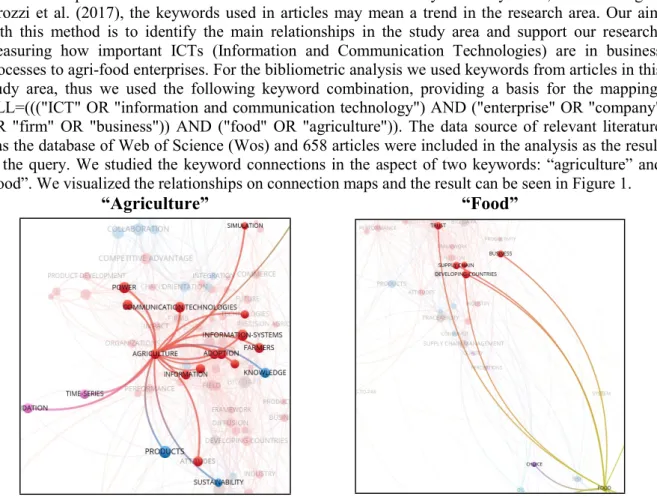
The conceptual framework of our article is based on our analysis of keywords, as according to Strozzi et al. (2017), the keywords used in articles may mean a trend in the research area. Our aim with this method is to identify the main relationships in the study area and support our research: measuring how important ICTs (Information and Communication Technologies) are in business processes to agri-food enterprises. For the bibliometric analysis we used keywords from articles in this study area, thus we used the following keyword combination, providing a basis for the mapping: ALL=((("ICT" OR "information and communication technology") AND ("enterprise" OR "company" OR "firm" OR "business")) AND ("food" OR "agriculture")). The data source of relevant literature was the database of Web of Science (Wos) and 658 articles were included in the analysis as the result of the query. We studied the keyword connections in the aspect of two keywords: “agriculture” and “food”. We visualized the relationships on connection maps and the result can be seen in Figure 1.
“Agriculture”
“Food”
Figure 1. Comparison of connection maps: the main keyword connection from agriculture and food (Source: own editing based on Web of Science (WoS) database)
Studying the connection maps, agriculture shows many connection points with research topics dealing with information, ICTs or adoption, while from “food”, there are no direct connections towards these areas. Besides the analysis of direct relationships of the relevant keywords, we also made analysis using MCA (Multiple Correspondence Analysis) to cluster common concepts. Based on the keywords, two clusters were evolved and Figure 2. shows the one which contains mainly words generally used in socio-economic research papers.
From our point of view, the most relevant keywords in one cluster support the concept of the current paper. Analyzing the role of ICTs and information flow in agriculture and food sector may lead us to determine barriers to and opportunities for ICT usage. Thus, on the one hand, this paper presents an analysis of how important agri-food companies consider ICT solutions in their business processes. On the other hand, we highlight a typical information interface between business to consumer, complemented with a consumer analysis based on another survey.
Literature review
Information and communication technologies (ICTs) play an increasingly important role in business, there are hardly any areas that are not been affected by them. However, the simple use of these technologies is no longer enough. Digitalization from production to consumption may have an impact on the performance both in the case of smaller and larger companies. Mobile applications can be used in any part of the food supply chain (e.g. production, logistics, performance evaluation, food tracing, quality monitoring) including the final consumers (e.g. applications for food information). In this section, we review the importance of smooth information flow in FSC (food supply chain) and the trends of applying ICTs in general business processes and at companies operating in the food value chain, from agriculture to food processing.
Analysis of information flow and the impact of digitalization on it has received much attention over the last two decades. Several review papers, empirical articles and case studies have been published on the key role of information sharing and the advantages of using ICTs in business processes (Chen, 2003; Consoli, 2012; Viet, Behdani & Bloemhof, 2018; Costantino et al., 2015; Wu & Jia, 2018). It is important to share information for supply chain stability (Singh et al., 2019) that is more and more affected by network and dynamic business environment and by ICTs (Fiala, 2005). Marketing, communication, networking and resource planning are the areas that ICT impacts the most (Taruté & Gatautis, 2014). Regarding corporate performance, Millán et al. (2019) claim there are grounds to expect that differences in the usage of ICT among firms may affect firm performance. Digital transformation is taking place along the entire value chain (Bogner et al., 2016; Kilimis et al., 2019). Researchers have recently started investigating different aspects of digital agriculture in relation to farm production systems, value chains and food systems (Klerkx, Jakku & Labarthe, 2019).
Annosi et al. (2019) highlighted a few Technology 4.0 opportunities (e.g. Cloud services, Internet of Things, Big Data Analytics) that can be important in the agriculture and food industry equally. In the article of Látečková, Bolek & Szabo (2018) cloud computing was underlined as a solution that can help in virtualisation of processes and it establishes a single modern and complex system of agricultural smart enterprises supported by ICTs. Internet of Things would have a contribution to the change of agri-food processes and towards data-driven farming supported by decision-making tools (Verdouw, Wolfert & Tekinerdogan, 2016). Panetto et al. (2020) highlight the key role of technology in the operations and decision-making of the agri-food sector. The use of digital information sources may play a potential role during organizational partner selection (Tóth, Nieroda & Koles, 2020). In agriculture, improved availability of information and knowledge will lead to increased production for the farmers through better decision-making (Ali & Kumar, 2011). Analyzing the concept of Agriculture 4.0, Lezoche et al. (2020) found that Big Data may be a tool to a better understanding of consumer needs and target higher value markets. In the food sector, besides efficiency and process control, consumer communications are also closely related to the use of ICTs (Lehmann, Reiche & Schiefer, 2012). In this regard, the level of ICT usage determines the success of customer services and customer satisfaction that according to Kilimis et al., (2019) could also be important indicators in the performance of the companies.
easily accessible for consumers. On websites, they can find only some subsets of relevant information (Kaloxylos et al. (2013). Räisänen & Tuovinen (2020) researched on rural micro-enterprises regarding online appearance and based on their results, respondents were interested in website development and social media usage among other survey questions aimed at improving online information flow. For instance, Kubicová, Predanocyová & Kádeková (2019) analysed the dairy sector and they found information that could be appeared digitalized (e.g. country of origin, nutrition data or composition). In the food sector, there is a wealth of research opportunity in B2B2C (business to business to consumer) business models regarding the benefit of customer social media interactions (Iankova et al., 2019) as these companies are a prime example of the B2B2C type of marketing (Pillai, 2020). Making easier access to information by all food chain actors (including consumers) is a need to maximize the benefits of ICTs in food chains and it is necessary to develop applications and services that are user-friendly, relevant, localized and affordable (El Bilali & Allahyary, 2018). There is a potential of digitalization to find new customers and design new services (Räisänen & Tuovinen, 2020), such as applications or using Augmented Reality supporting food choice.
ICT applications may also help in improving collaboration between different stakeholders and results in enhanced food supply performance (Singh et al., 2019). However, strategic decisions on digital transformation do not automatically improve performance, because it requires enterprises to rethink and change their business model (Bouwman, Nikou & de Reuver, 2019). More intensive deployment of ICT is needed inter alia for the optimization of the company’s internal processes (Ahmedova, 2015). Strong and dynamic corporate entrepreneurship is needed to seize the benefits of ICT by integrating them into organizational strategies and creating the right corporate culture for ICT adoption, use, and innovation diffusion (Yunis, Abbas & Kassar, 2017).
2.
Materials and methods
Our study used a primary source of data collected with the help of a structured survey. The target population was the food producing and food processing companies operating in Hungary. The survey was conducted in the fourth quarter of 2017, and a market research company was involved to make the interviews and data recording. Respondents were the leaders or a member of the management of the companies. Sampling based on some economic features of the companies, these were the size (number of employees), region (NUTS-2 level) and activity (Nace Rev.2.). The data source for sampling was the Hungarian Central Statistical Office (hereinafter HCSO). The database contains data on ICT usage characteristics about 500 enterprises operating in the agriculture and food industry as a producer or processor. The exact sector of respondent enterprises can be seen in Table 1.
Table 1. NACE Rev.2 Codes of Respondent Enterprises
A (Agriculture, forestry and fishing)
01 (Crop and animal production, hunting and related service activities)
01.11 – Growing of cereals (except rice), leguminous crops and oil seeds 01.13 – Growing of vegetables and melons, roots and tubers
01.21 – Growing of grapes
01.24 – Growing of pome fruits and stone fruits 01.41 – Raising of dairy cattle
01.46 – Raising of swine/pigs 01.47 – Raising of poultry
C (Manufacturing)
10 (Manufacture of food products)
10.1 – Processing and preserving of meat and production of meat products 10.3 – Processing and preserving of fruit and vegetables
10.5 – Manufacture of dairy products
10.7 – Manufacture of bakery and farinaceous products
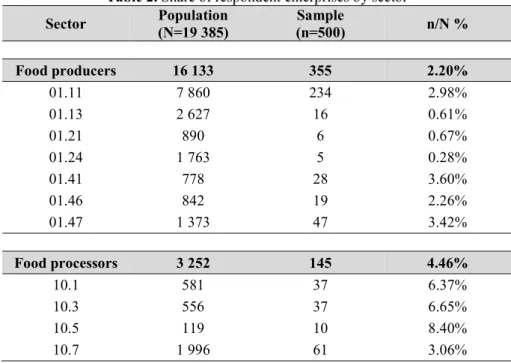
The number of enterprises in the database of HCSO and the sample database; and the percentage of the represented population by sector can be seen in Table 2.
Table 2. Share of respondent enterprises by sector
Sector (N=19 385) Population (n=500) Sample n/N %
Food producers 16 133 355 2.20%
01.11 7 860 234 2.98%
01.13 2 627 16 0.61%
01.21 890 6 0.67%
01.24 1 763 5 0.28%
01.41 778 28 3.60%
01.46 842 19 2.26%
01.47 1 373 47 3.42%
Food processors 3 252 145 4.46%
10.1 581 37 6.37%
10.3 556 37 6.65%
10.5 119 10 8.40%
10.7 1 996 61 3.06%
Source: own editing according to the authors’ survey, 2017 and HCSO database, 2017
The resulting database allowed us to analyze how agri-food companies evaluate the role and importance of ICT solutions in their business processes. Variables were assessed on a 5-Likert scale. Our hypothesis is that food processors evaluate ICTs in business processes higher than food producers and the difference is significant. To prove our hypothesis, in this paper we used the question of “Evaluate the following ICT-based solutions in the business processes of your company” and the variables were:
v1: Fast evaluation of business performance
v2: Use of low-cost solutions
v3: Safe data storage at service providers
v4: Operating high-quality website
v5: Level of IT infrastructure of suppliers
v6: Level of IT infrastructure of purchasers
For survey questions formation we used some Eurostat indicators as a basis, the ones that can be considered relevant for agri-food companies and these are the followings:
v1: Integration of internal processes
v2: Cloud computing services
v3: ICT security
v4: Websites and functionalities
v5 and v6: Integration with customers/suppliers, supply chain management
We made another questionnaire in 2019 to complement our research with consumer attitudes that may take into consideration for developing business processes and the usage level of ICTs in a business to consumer relationship. The survey aimed at young people aged between 18 and 25 and data recording was performed at the University of Debrecen. The participation was voluntary and anonymous and in total 376 replies were received.
3.
Results and discussion
Given that the focus of this article was on the analysis of enterprises, the main part of this section contains our results calculated for the sampled companies. The variables chosen are considered important to analyze as for agri-food companies these may be relevant services in their business activity, and the level of using them has an impact on the cooperation among supply chain stakeholders. An increasing number of studies have published on the relation between performance growth through indirect factors (e.g. customer satisfaction, better partner cooperation) and cost savings reachable by use of ICT in different business processes. Information management, however, plays an indirect role in the operation of a business, its level affects the transparency and continuity of the information flow in every type of supply chain. The lack of information value could place the enterprises operating in a chain at a competitive disadvantage as members could not form the integration of internal processes and create cooperation with suppliers or customers. Effective operation and business development are also crucial for agri-food companies and the whole supply chain. There are many actors (suppliers and producers of raw materials, food and feed processors, distributors, retailers and final consumers) to interact with, so the usage level of the partners has a great impact on the success of the information flow. Our analysis aims to reveal some ICT usage characteristics of businesses from the agri-food sector and to determine differences between two groups operating two different parts of the supply chain. In the end, a few data from our consumer survey were displayed to complement our research of information flow in the supply chain towards the consumer side to initiate potential new supply chain research.
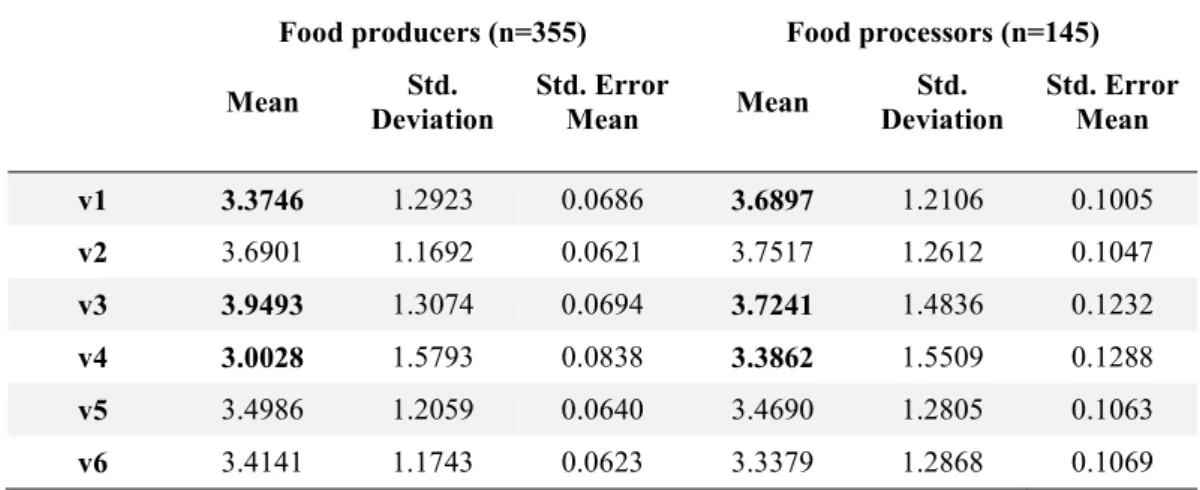
First, we determined the main indicators of the sample using descriptive statistics, subsequently, we analyzed the variables applying the Mann-Whitney test since all the data were measured on ordinal data (5-Likert scale). The result of the descriptive statistics of enterprise data is summarized in Table 3.
Table 3. Group statistics of the scores given by the sample enterprises
Food producers (n=355) Food processors (n=145)
Mean DeviationStd. Std. Error Mean Mean DeviationStd. Std. Error Mean
v1 3.3746 1.2923 0.0686 3.6897 1.2106 0.1005
v2 3.6901 1.1692 0.0621 3.7517 1.2612 0.1047
v3 3.9493 1.3074 0.0694 3.7241 1.4836 0.1232
v4 3.0028 1.5793 0.0838 3.3862 1.5509 0.1288
v5 3.4986 1.2059 0.0640 3.4690 1.2805 0.1063 v6 3.4141 1.1743 0.0623 3.3379 1.2868 0.1069
Source: own calculation based on own survey data
with both retail partners and final consumers. Safe data storage (v3) is more important for the food producer group with a greater difference from processors. The trend towards a comprehensive data collection and processing in the framework of precision agriculture in agricultural farms and enterprises can be a possible explanation for the higher evaluation. In the case of the importance of the level of IT infrastructure of suppliers and purchasers (v5 and v6) the mean values are higher for the producer group; however, this difference is slight.
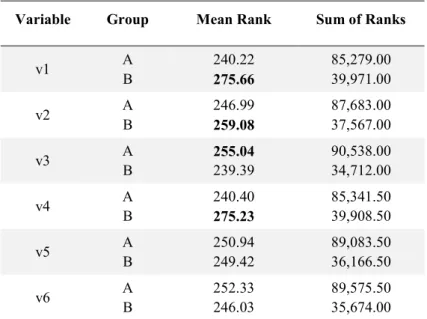
It can thus conceivably hypothesized that food processors do not consider ICT-based business processes more important than enterprises operating in agriculture. Mean values indicate that there is a potential to improve the ICT readiness of enterprises through a better understanding and increased use in order to a more smooth and effective information flow throughout the whole food supply chain. Regarding mean values, it can be seen a greater difference between the two groups in case of v1, v3 and v4. To determine that these differences can be considered statistically significant or not, the Mann-Whitney test was applied to the scores given by the two enterprise groups. Table 4. shows the output table of ranks and Table 5. contains the result of the Mann-Whitney test.
Table 4. Output table of Ranks
Variable Group Mean Rank Sum of Ranks
v1 A 240.22 85,279.00
B 275.66 39,971.00
v2 A B 246.99 87,683.00
259.08 37,567.00
v3 A 255.04 90,538.00
B 239.39 34,712.00
v4 A 240.40 85,341.50
B 275.23 39,908.50
v5 A B 250.94 249.42 89,083.50 36,166.50
v6 A 252.33 89,575.50
B 246.03 35,674.00
Source: own calculation based on own survey data
Table 5. Output table of Mann-Whitney Test Statistics
v1 v2 v3 v4 v5 v6
Mann-Whitney U 22,089.000 24,493.000 24,127.000 22,151.500 25,151.500 25,089.500
Wilcoxon W 85,279.000 87,683.000 34,712.000 85,341.500 36,166.500 35,674.500
Z -2.564 -.884 -1.175 -2.518 -.110 -.457
Asymp. Sig (2-tailed) .010 .377 .240 .012 .912 .647
Source: own calculation based on own survey data
Our test result shows a significant difference in two cases, for v1 and v4 between food producers and food processors in the values given for the importance of the two business processes supportable with ICTs. In both cases, the evaluation of food processors was higher. The value of Asymp. Sig(2-tailed) for the importance of “Fast evaluation of business performance” and “Operating high-quality website” were 0.010 and 0.012, respectively. Our main hypothesis that food processors evaluate higher ICT-based business solutions for corporate activities has been partly proved based on our research findings. Agri-food companies assessed v2, v3, v5 and v6 at roughly the same level, furthermore, the overall average runs at around 3.5 which is below the level authors expected. However, our study provides considerable insight into the analysis of information flow at agri-food companies.
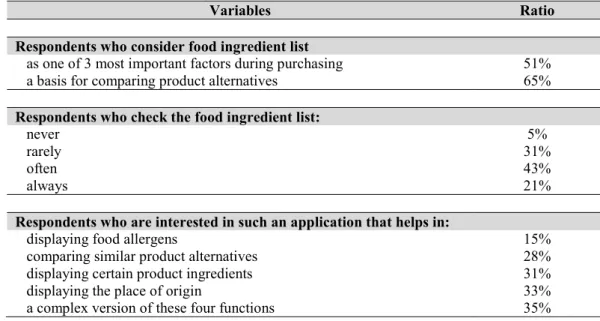
In order to link our enterprise research with the consumer side, we made a questionnaire to analyze their requirements for food information. The following 3 variables were thought suitable connection points with the variables used for measuring some indicators that can have a greater role in the information flow. Our assumption was that to have easy access to information provided by the company side may be important for consumers. Table 6. shows some information on the attitude of consumers regarding the food ingredients as this variable has been considered one of the three most important factors during purchasing with the price and quality/brand.
Table 6. Summarizing table of the main information of the consumer survey
Variables Ratio
Respondents who consider food ingredient list
as one of 3 most important factors during purchasing 51% a basis for comparing product alternatives 65%
Respondents who check the food ingredient list:
never 5%
rarely 31%
often 43%
always 21%
Respondents who are interested in such an application that helps in:
displaying food allergens 15%
comparing similar product alternatives 28% displaying certain product ingredients 31%
displaying the place of origin 33%
a complex version of these four functions 35% Source: own calculation based on own survey data
always read this information on the package. Most respondents indicated a willingness to use such mobile applications that may support easy information access to certain information or a complex application that can help them during purchasing and to compare product alternatives. It could be useful in the development or introduction of related services for consumers as 60% of the age group surveyed buy food mostly or almost always themselves. Thus, their information requirement may be relevant in developing new services, such as mobile applications helping in food purchasing.
4.
Conclusion
Our overall conclusion is at the beginning of the food supply chain there is a potential regarding the development of ICT level and attitude towards the importance of ICT-based business processes. As our result showed, the means calculated for the importance of the variables were around 3.5 which means a rather medium evaluation from respondent enterprises, both from food producers and processors. Our assumption that processors assess higher ICT solutions with the aim to increase time and cost-effectiveness of the companies has been partly proved based on the results of our calculations. Statistically, processors evaluated only two variables significantly higher compared to producers. These were the “Fast evaluation of business performance” (Sig(2-tailed=0,010) and “Operating high-quality website” (Sig(2-tailed)=0.012). Agri-food companies assessed the remained four variables at roughly the same level. However, our research may be contributed to those studies that deal with the information flow within the agri-food supply chain. In our opinion, there is a great opportunity for enterprises to reduce the information gap by promoting new, ICT-enhanced business solutions and changing the approach to use ICT to develop entrepreneurial business activities. A better understanding of the importance of projects aiming the development of intra-corporate ICT-level and use these solutions in B2B2C communication and marketing is also crucial. Our complement research also supports our suggestion as results showed there is a requirement from the consumer side to food information and in a simple way. The majority of respondent students (64%) often or always read food information they also indicated a willingness to use such mobile applications that may support easy information access to certain information or a complex application that can help them during purchasing and to compare product alternatives. Application development as ancillary services, using new technologies such as Augmented Reality or Virtual Reality means the real potential to increase the efficiency of information flow throughout the food supply chain. Our work has some limitations, nevertheless, we believe our work could provide ideas for future research direction to study the ICT attitude of participants in the chain and to highlight the importance of ICT solutions and smooth and continuous information flow in their business relations and overall in the food supply chain.
Acknowledgement
The work/publication is supported by the EFOP-3.6.1-16-2016-00022 project. The project is co-financed by the European Union and the European Social Fund.
References
Ahmedova, S. (2015) Factors for Increasing the Competitiveness of Small and Medium-Sized Enterprises (SMEs) in Bulgaria. Procedia - Social and Behavioral Sciences 195, pp. 1104-1112. doi:
10.1016/j.sbspro.2015.06.155
Ali, J., Kumar, S. (2011) Information and Communication technologies (ICTs) and farmers' decision-making across the agricultural supply chain. International Journal of Information Management 31, pp. 149-159. doi: 10.1016/j.ijinfomgt.2010.07.008
Annosi, M.C., Brunetta, F., Monti, A., Nati, F. (2019) Is the trend your friend? An analysis of technology 4.0 investment decisions in agricultural SMEs. Computers in industry 109, pp. 59-71. doi:
10.1016/j.compind.2019.04.003
Bogner, E., Voelklein, T., Schroedel, O., Franke, J. (2016): Study Based Analysis on the Current Digitalization Degree in the Manufacturing Industry in Germany. Procedia CIRP 57, pp. 14-19. doi:
Bouwman, H., Nikou, S., de Reuver, M. (2019) Digitalization, business models, and SMEs: How do business model innovation practices improve performance of digitalizing SMEs? Telecommunications Policy 43, 101828. doi: 10.1016/j.telpol.2019.101828
Chen, F. (2003) Information Sharing and Supply Chain Coordination. Handbooks in Operations Research and Management Science, Vol. 11, Supply Chain Management: Design, Coordination and Operation, pp. 341-421. Ed. S.C. Graves and A.G. de Kok. Amsterdam: Elsevier, 2003. ISSN 0927-0507. E-ISSN 2212-1323. doi: 10.1016/S0927-0507(03)11007-9.
Consoli, D. (2012) Literature analysis on determinant factors and the impact of ICT in SMEs. Procedia - Social and Behavioral Sciences 62, pp. 93-97. doi: 10.1016/j.sbspro.2012.09.016
Costantino, F., Di Gravio, G., Shaban, A., Tronci, M. (2015) The Impact of Information Sharing on Ordering Policies to Improve Supply Chain Performances. Computer & Industrial Engineering 82, pp. 127-142. doi: 10.1016/j.cie.2015.01.024.
El Bilali, H., Allahyari, M.S. (2018) Transition towards sustainability in agriculture and food systems: Role of information and communication technologies. Information Processing in Agriculture 5, pp. 456-464. doi: 10.1016/j.inpa.2018.06.006
Eurostat database
Fiala, P. (2005) Information sharing in supply chains. Omega 33, pp. 419-423. doi:10.1016/j.omega.2004.07.006 Hungarian Central Statistics Office (HCSO) database
Iankova, S., Davies, I., Archer-Brown, C., Marder, B., Yau, A. (2019) A comparison of social media marketing between B2B, B2C and mixed business models. Industrial Marketing Management 81, pp. 169-179. doi: 10.1016/j.indmarman.2018.01.001
Kaloxylos, A., Wolfert, J., Tim Verwaart, T., Terol, C.M., Brewster, C., Robbemond, R., Sundmaker, H. (2013). The Use of Future Internet Technologies in the Agriculture and Food Sectors: Integrating the Supply Chain. Procedia Technology 8, pp. 51-60. doi: 10.1016/j.protcy.2013.11.009
Kilimis, P., Zou, W., Lehmann, M., Berger, U. (2019) A Survey on Digitalization for SMEs in Brandenburg, Germany. IFAC PapersOnLine, Vol. 52, No. 13 pp. 2140-2145. doi: 10.1016/j.ifacol.2019.11.522
Klerkx, L., Jakku, E., Labarthe, P. (2019) A review of social science on digital agriculture, smart farming and agriculture 4.0: New contributions and a future research agenda. NJAS - Wageningen Journal of Life Sciences 90-91, 100315 doi: 10.1016/j.njas.2019.100315
Kubicová, L., Predanocyová, K., Kádeková, Z. (2019) Factors Affecting the Demand for Milk and Dairy Products in the Slovak Republic. Agris on-line Papers in Economics and Informatics, Vol. 11, No. 4, doi: 10.7160/aol.2019.110404
Látečková, A., Bolek, V., Szabo, L. (2018) Information Systems in Agricultural Enterprises: An Empirical Study in Slovak Republic. Agris on-line Papers in Economics and Informatics, Vol. 10, No 2, pp. 49-60. doi:
10.7160/aol.2018.100105
Lehmann, R.J., Reiche, R., Schiefer, G. (2012): Future internet and the agri-food sector: State-of-the-art in literature and research. Computers and Electronics in Agriculture 89, pp. 158-174. doi:
10.1016/j.compag.2012.09.005
Lezoche, M., Hernandez, J.E., Alemany-Díaz, M.d.M.E., Panetto, H., Kacprzyk, J. (2020) Agri-food 4.0: A suvery of the supply chains and technologies for the future agriculture. Computers in Industry 117, 103187. doi: 10.1016/j.compind.2020.103187
Millán, J.M., Lyalkov, S., Burke, A., Millán, A., van Stel, A. (2019): 'Digital divide' among European entrepreneurs: Which types benefit most from ICT implementation? Journal of Business Research. doi: 10.1016/j.jbusres.2019.10.034
Norman, G. (2010): Likert Scales, Levels of Measurement and The "Laws" of Statistics. Advances in Health Sciences Education. Vol. 15, No. 5, 625-632. doi: 10.1007/s10459-010-9222-y
Pillai, A. (2020): A Comprehensive Guide to B2B2C Marketing. Available at: https://www.lakeb2b.com/blog/guide-to-b2b2c-marketing/
Räisänen, J., Tuovinen, T. (2020) Digital innovations in rural micro-enterprises. Journal of Rural Studies 73, pp. 56-67. doi: 10.1016/j.jrurstud.2019.09.010
Singh, R.K., Luthra, S., Mangla, S.K., Uniyal, S. (2019) Applications of information and communication technology for sustainable growth of SMEs in India food industry. Resources, Conservation & Recycling 147, pp. 10-18. doi: 10.1016/j.resconrec.2019.04.014
Strozzi, F., Colicchia, C., Creazza, A., Noé, C. (2017) Literature review on the 'Smart Factory' concept using bibliometric tools. International Journal of Production Research Vol. 55, No. 22, pp. 1-20. doi:
10.1080/00207543.2017.1326643
Taruté, A., Gatautis, R. (2014) ICT impact on SMEs performance. Procedia - Social and Behavioral Sciences 110, pp. 1218-1225. doi: 10.1016/j.sbspro.2013.12.968
Tóth, Zs., Nieroda, M.E., Koles, B. (2020) Becoming a more attractive supplier by managing references - The case of small and medium-sized enterprises in a digitally enhanced business environment. Industrial Marketing Management 84, pp. 312-327. doi: 10.1016/j.indmarman.2019.07.010
Van Der Vorst, J. (2006). Product traceability in food-supply chains. Accreditation and Quality Assurance, Vol. 11, No. 1, pp. 33-37. doi: 10.1007/s00769-005-0028-1
Verdouw, C., Wolfert, S., Tekinerdogan, B. (2016). Internet of Things in agriculture. CAB Reviews 11, pp. 1-12. doi: 10.1079/PAVSNNR201611035
Viet, N. Q., Behdani, B., Bloemhof, J. (2018) The Value of Information in Supply Chain Decisions: A Review of the Literature and Research Agenda. Computers & Industrial Engineering 120, pp. 68-82. ISSN 0360-8352. E-ISSN 1879-0550. doi: 10.1016/j.cie.2018.04.034.
Web of Science (WoS) database. Available: apps.webofknowledge.com
Wu, Z., Jia, F. (2018) Toward a Theory of Supply Chain Fields - Understanding the Institutional Process of Supply Chain Localization. Journal of Operations Management 58-59, pp. 27-41. doi:
10.1016/j.jom.2018.03.002.
Yunis, M., Abbas, T., Kassar, A. (2017) The role of ICT and innovation in enhancing organizational