Community-‐Centered Health Homes and Other Approaches to
Community-‐Based, Preventive Healthcare
by
Julia H. Katz
A Masters Project submitted to the faculty of the University of North Carolina at Chapel Hill
in partial fulfillment of the requirements for the degree of Master of City and Regional Planning
in the Department of City and Regional Planning
Chapel Hill
2016
Approved by:
Table of Contents
Table of Acronyms ... 1
Executive Summary ... 2
Introduction ... 4
Background ... 4
Current Scene ... 6
Health Equity ... 6
Social Determinants of Health ... 6
The Built Environment ... 7
The Intersection of Health and Planning ... 9
Preventive Healthcare ... 12
Collaboration and Engagement ... 12
Integrative Healthcare (Patient-‐Centered Medical Homes) ... 13
Population and Community Health ... 14
IHI Triple Aim ... 15
Bridging Clinical Work with Communities ... 15
Health Institution as a Unit of Action ... 16
CCHH Model Proposed by Prevention Institute ... 17
Stories ... 19
Approaches to Community-‐Centered Preventive Healthcare ... 21
Health Leads ... 21
ReThink ... 22
Accountable Care Community ... 24
AHEAD: Alignment for Health Equity and Development ... 25
BUILD Health Challenge ... 26
SCALE Initiative ... 28
Comparison between CCHH Models and Alternatives ... 29
Descriptive Chart of Health Systems Reform ... 29
Comparative Chart: The CCHH Model Compared to Other Approaches ... 30
Strengths ... 30
Weaknesses ... 31
Case Studies ... 32
Healthy Life Trails at Yuma District Hospital ... 33
Claremont Healthy Village Initiative at Bronx Lebanon Hospital Center ... 37
Comprehensive CCHH Model ... 42
Financial Feasibility ... 42
General Clinical Processes ... 44
Cultivating Partnerships ... 44
Engaging Community Leaders and Members ... 45
Metrics and Data Collection ... 45
Evaluation ... 46
Revised Conceptual Model: ... 47
Conclusion ... 49
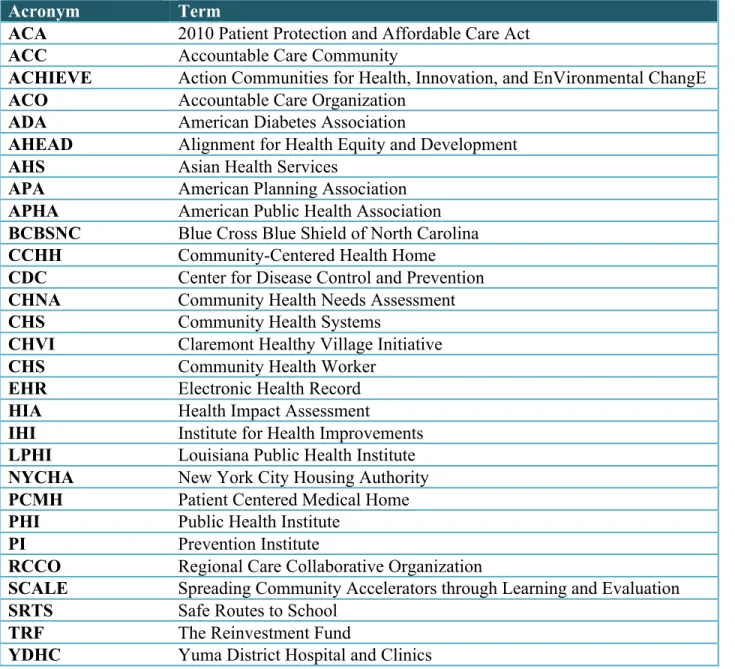
Table of Acronyms
Acronym Term
ACA 2010 Patient Protection and Affordable Care Act
ACC Accountable Care Community
ACHIEVE Action Communities for Health, Innovation, and EnVironmental ChangE
ACO Accountable Care Organization
ADA American Diabetes Association
AHEAD Alignment for Health Equity and Development
AHS Asian Health Services
APA American Planning Association
APHA American Public Health Association
BCBSNC Blue Cross Blue Shield of North Carolina
CCHH Community-Centered Health Home
CDC Center for Disease Control and Prevention
CHNA Community Health Needs Assessment
CHS Community Health Systems
CHVI Claremont Healthy Village Initiative
CHS Community Health Worker
EHR Electronic Health Record
HIA Health Impact Assessment
IHI Institute for Health Improvements
LPHI Louisiana Public Health Institute
NYCHA New York City Housing Authority
PCMH Patient Centered Medical Home
PHI Public Health Institute
PI Prevention Institute
RCCO Regional Care Collaborative Organization
SCALE Spreading Community Accelerators through Learning and Evaluation
SRTS Safe Routes to School
TRF The Reinvestment Fund
YDHC Yuma District Hospital and Clinics
Executive Summary
Given the wealth of the United States, the country fails at providing affordable, equitable care. The high prevalence of chronic disease demonstrates the healthcare system’s focus on patient-centered, treatment-based care and its lack of community-patient-centered, preventive care. Fostered by the 2010 Patient Protection and Affordable Care Act, hospitals and clinics are currently working to achieve the Triple Aim: affordable care, quality care, and population health.1 To improve population health, innovative practices and grants are being established. These new initiatives focus on health equity, social determinants of health, preventive health, multi-sector
collaborations, and community-engagement. At the same time that these projects are emerging, the connection between urban planning and public health is strengthening. By joining forces, planning and public health practitioners as well as public and private organizations can change the built environment and other social determinants to improve health behavior. This is an exciting time to understand and develop techniques that change community conditions to improve community health, and this paper focuses on one new model that does just that: the Community-Centered Health Home (CCHH).2
Developed by the Prevention Institute in 2011, the CCHH model provides a strategy to improve health outcomes through multi-sector collaborative efforts to change social determinants of health.2 By changing social determinants of health, a CCHH can help to improve health
behaviors, and ultimately impact health outcomes. Spurred off of the “patient-centered medical home” (PCMH) model in which practitioners conduct a patient intake, then make a diagnosis, and then provide treatment, the CCHH model advances the PCMH model to focus on the community. It consists of three phases: inquiry, analysis, and action. In the CCHH model, clinicians inquire about a community health issue, analyze the problem and develop a plan, and take action to change the health outcome. Community health clinics and hospitals are at the center of CCHHs because they are often well positioned to collect data on community members and conditions, to engage community members, and be connected to partner organizations. Compared to other approaches to community-centered, prevention-based healthcare, the CCHH model’s strengths revolve around its step-by-step outline and its weaknesses revolve around its current financial dependence on foundational support. While the model distinguishes itself by focusing on the local clinic as an actor of change and focuses on changing social determinants of health, it may be too far ahead of the current payment system to be viable without continuous funding from foundations.
An important strength of the CCHH model is that in PI’s literature, they offer specific tools and techniques to implement the model successful. However, their recommendations can often be vague and are supported by a limited number of real-world examples. For this reason, this paper investigates the sustainability and process of the CCHH model by providing two more case studies, a more thorough conceptual model, and questions about the process of implementing the model.
Two new case studies and a comparison between CCHH and other approaches inform a new in-depth CCHH conceptual model. The new conceptual model includes capacity-building strategies, financing options, evaluation, and partnership cultivation and maintenance. Beyond the
CCHH implementation process and validate its sustainability. This will lead to clinics and hospitals around the country becoming CCHHs.
The current CCHH points to a bright future. In Louisiana, North Carolina, and South Carolina, foundations are supporting CCHHs through large, multi-year grants that include technical support. Other foundations, and health systems and departments are considering the CCHH as the next model of health care. Financial incentives are slowly being established to support preventive health measures, and examples of successful social impact investment projects and wellness funds are offering financial solutions to make CCHH a sustainable model.
Introduction
Progressive healthcare models are increasingly emerging in the United States to promote community-centered preventive care. With the passing of the 2010 Patient Protection and Affordable Care Act (ACA), innovative ideas are being developed to shift the healthcare paradigm from individual-centered and treatment-based to community-centered and prevention-based. These initiatives are challenging past and current systems that are broken. The US healthcare system concentrates too many resources on clinical care and patient-centered treatments and neglects equity, preventive care and population health. Compared to eleven of the world's most wealthy nations, the US consistently ranks last in an overall ranking of quality care, access, efficiency, equity, and healthy lives.3 Though the US healthcare system is the most expensive in the world, life expectancy is below average among other developed countries.4 In 2013, The Institute of Medicine reported that given the spending on healthcare in the US, the country's poorer health outcomes can be attributed to health systems, health behaviors, and social and environmental factors.5 Similarly, McGinnis and colleagues have repeatedly argued that Americans’ behavior and environment account for at least 60% of their health, while healthcare accounts for 10% and genes account for 20-30%.6,7 Therefore, we cannot simply rely on medical
treatment to improve health outcomes. We must also change our behavior and environment. In 2011, the Prevention Institute (PI) published an article describing a "Community-Centered Health Home" (CCHH) model.2 This model bridges local clinicians to the community in order to make environmental, social, and policy changes. The resulting infrastructural and policy shifts can lead to behavioral changes and improved health outcomes. Connecting the medical field to the fields of urban planning, active living, and healthy communities can reframe healthcare and shift our health paradigm. This paper compares the CCHH model to alternative approaches to preventive health, highlights strengths and weaknesses of CCHHs, tells the stories of two CCHHs, and offers a comprehensive conceptual model of CCHHs. By providing these new elements, this paper clarifies how CCHH can address social determinants of health to improve health outcomes and what capacities, funding mechanisms, and partnerships are essential to the model’s success.
Background
This paper evolved from collaboration between the author and Active Living By Design. Active Living By Design is currently working with Blue Cross Blue Shield of North Carolina
(BCBSNC) Foundation to implement the Community-Centered Health Home (CCHH) model in North Carolina.
Developed by PI, CCHH is an approach to healthcare that aims to link community health clinics with community agencies and organizations.2 These collaborations develop preventive measures
in order to improve population health. The CCHH model has also been promoted by researchers and organizations; Annette L. Gardner’s “Maintaining Clinic Financial Stability: Navigating Change, Leveraging Opportunities” briefly discusses CCHH as the future for community health clinics.8 In 2012, the Institute for Alternative Futures began to write about CCHH as a model for
future approaches to healthcare.9 Most recently, CCHHs are promoted in “Introduction to Health
literature and is written by PI staff. There are only slight differences between this new chapter and documents describing CCHH from 2011 and 2012, suggesting that PI’s original CCHH literature is consistent with PI’s current communication about the model.
As environmental impacts on community health gain more attention, institutes and researchers are developing new models to merge clinical efforts with community engagement and multi-sector initiatives. PI has developed the CCHH model as an alternative to traditional clinical care. CCHH strategies will contribute to larger efforts that aim to lower costs, expand coverage, and improve quality of care.2 In the CCHH model, clinicians inquire about a community health issue, analyze the problem and develop a plan, and take action to change the health outcome. The CCHH approach has been informally practiced since the early days of public health when in 1885, Dr. John Snow, known as the father of public health, reduced a cholera outbreak in London.11 First he inquired about the cholera outbreak by interviewing families and community members, then he analyzed the situation by mapping the disease outbreak to identify a specific water pump, and finally he took action by removing the water pump handle, and consequently the cholera outbreak sharply declined within the community.11
As this paper later discusses, the theories and goals of the CCHH model align with the direction that healthcare policy and foundational support are moving. For this reason, a few organizations, including BCBSNC Foundation, have initiated a CCHH grant cycle.
Beginning in the spring of 2014, BCBSNC Foundation partnered with PI to develop a plan for organizing CCHHs in North Carolina (Figure 1). One of the first steps was conducting a
statewide assessment to understand the challenges and opportunities of implementing CCHHs in North Carolina.12 After opening applications for an Action Learning Workshop, they invited 12
groups of community partners from around the state to attend a CCHH two-day workshop.13 Following the workshop, these 12 groups have received $15,000 to work on future programmatic and structural changes. They will consider what capacities they will need to enhance,
partnerships they would want to cultivate, and systems-changes they require in order to
implement the CCHH model in their communities. They will apply for longer-term support and only a few teams will receive planning and implementation grants from BCBSNC Foundation to implement these changes.
Spring/Summer 2014 Fall 2014 Spring/Summer 2015 Summer/Fall 2015
Program Preparation Community Outreach Action Learning CCHH Model
• Developed initiative
• Worked with Prevention
Institute
• Conducted statewide
assessment
• Published Landscape
Analysis with Prevention Insitute12
• Held April convening in
Durham
• Created CCHH Design Team
• Developed logic model
• Held three outreach events in
Greenville, Morgantown & Benson
• Opened applications for
Action Learning Workshop
• Held Action Learning
Workshop for 12
communities in Chapel Hill
• Opened applications
for Action Learning Grants
• Provided technical
assistance and site visits on grants
• Hold CCHH
community of practice webinars • Select partnerships to systematically implement CCHH practices
Current Scene
This section describes the current landscape relevant to CCHH in terms of health equity, social determinants of health, the built environment, population health, and the clinic as a unit of action. It is important to understand these concepts in order to understand the motivations and goals behind CCHHs.
Health Equity
CCHHs work toward achieving health equity. As defined by Active Living By Design, health equity “is the state in which all people have the opportunity to attain their full health potential despite socially determined circumstances.”14 Another definition of healthy equity they offer is “the absence of unjust, unnatural, avoidable, systemic and sustained health status differences in the distribution of disease, illness and mortality rates across population groups.” Health equity encapsulates the movement to eliminate health disparities. Health disparities are differences in health outcomes across groups. Health disparities tend to be determined by race or ethnicity, socioeconomic status, geographic location, age, sex, sexual identity, and disability.
While local health disparities are supposed to be collected by Community Health Needs Assessments (CHNAs), national health disparities are measured annually by the Agency for Healthcare Research and Quality.15 The United States Department of Health and Human
Services has made an effort to increase health equity and reduce health disparities.16 Their
recommendations to eliminate health disparities include “standardizing and collecting data to better identify and address disparities,” “increase the capacity of the prevention workforce to identify and address disparities,” and “support and expand cross-sector activities to enhance access to high-quality education, jobs, economic opportunities, and opportunities for healthy living (e.g. access to parks, grocery stores, safe neighborhoods).”16
These measurements and recommendations closely align to the mission of CCHHs. CCHHs and comparable models strive to eliminate health disparities and increase health equity. While this paper may not continue to reference health equity, it intends to advocate for health equity through the promotion of progressive healthcare and community prevention models.
Social Determinants of Health
Closely related to health disparities are social determinants of health. The World Health
Organization describes social determinants of health as structures and conditions that shape daily life including health behaviors, physical and social environments, working conditions, health care, social protection, gender, social inequities like education and income, and sociopolitical context.17 Social determinants of health have increasingly gained attention in the United States
as the country focuses on uneven distribution of wealth and debates the need for affordable and equitable health insurance through the ACA. It is accepted by the larger public health
The United States Office of Disease Prevention and Health Promotion have developed “Healthy People 2020” a website and series of chapters that outlines
objectives and goals to ensure a healthy nation by 2020. A full chapter is dedicated to social determinants of health. The goal of this chapter is to "create social and physical environments and promote good health for all,"19 and it is divided into five
components: economic stability, education, neighborhood and built environment, health and health care, and social and community context.
The prominent role of social determinants on Americans’ health is further supported by evidence-based research. As previously mentioned, McGinnis attributes 10% of individual’s health to healthcare, 20% to our environment, 40% to our behavior, and 30% to our genes.7 Similarly, according to the
County Health Rankings Model (Figure 2),20 aside from genes, Americans’ population health
can be attributed to health behavior(30%), clinical care (20%), social and economic factors (40%), and physical environment (10%).
In the past ten years, social determinants of health have become more widely understood. Institutions, grants, and policies have been formed and developed to support healthcare that target determinants of health.21 Organizations that deal with jobs, crime and safety, housing, and
education recognize the link between their efforts and health promotion. The link between their work and health broadens opportunities to fundraise and collaborate. This paper will discuss some of these grants and collaborations in more depth.
This movement to change social determinants of health has also had an impact on the built environment. This paper focuses on the neighborhood and built environment component of social determinants of health.
The Built Environment
The “built environment” refers to our physical world – for example - streets, buildings, urban form, infrastructure, and open spaces. The built environment’s impact on health outcomes can be separated into three inter-related categories: access to healthcare, exposure, and health behavior. These three categories are linked to one another, for instance, if there are negative exposures like loud noise in an area, this might reduce the walkability of an area, which in turn could reduce the likelihood someone would walk to a medical facilities, thereby reducing access to healthcare. Or another example has to do with “safety in numbers,” the principle that the number of cyclists and
pedestrians is inversely related to the chance that a motorist will have a collision with a cyclist or pedestrian.22 If many people bicycle in a neighborhood, it impacts social norms, makes places safer for cyclists, and increases the likelihood that someone will begin to bike.
The CCHH model provides a platform for clinics to approach preventive health through these three modes. The CCHH model is becoming more and more relevant as researchers continue to build on the links between the built environment and health outcomes. The first approach, improving access to healthcare through the built environment, refers to improving road quality, public transportation, and reducing the distance from communities to clinics even via mobile clinics or emergency care vehicles. We know that the built environment can enable and facilitate access to healthcare, both primary care and emergency medical services.23 In the United States, the lack of access to healthcare disproportionately burdens rural communities and has been considered the top priority in improving rural health for decades, according to the national survey Rural Healthy People.24,25
The second approach, reducing and eliminating dangerous exposures and increasing positive exposures produced by the built environment, is also strongly linked to health outcomes and preventive health. As described in a systematic review, exposure to toxins, indoor and ambient air pollutants, poor neighborhood conditions, poor housing quality, and dangerous work environments can lead to poor health outcomes ranging from birth abnormalities and cancer to psychological distress and aggression. These exposures can impact a whole community or more localized areas like schools, apartment buildings, or work places. In the United States, low-income communities, especially communities with high proportions of people of color, are more burdened by unhealthy environmental conditions.26 These environment risks mediate the
relationship between socioeconomic status and health.26 Positive exposures include “safety in numbers,” clean air, and social support. Social support can exist in a community through inclusive and integrated cultural patterns and have an impact on health behavior and mental health.27 Social norming can be used to regulate the visibility and acceptance of negative and positive behaviors. For instance, universities have used social norming to reduce alcohol abuse on campus.28 Removing negative exposures and adding positive exposures will lead to reduced health disparities and lead toward health equity.
The Built Environment's Impact on Health
Access to Healthcare
Exposures
While this paper recognizes the importance of all three approaches and to preventive health, it is primarily investigating the third approach and the role of CCHHs in changing the built
environment to impact health behavior. The physical environment can provide space for physical activity, healthy eating, and access to safe green space and nature, all of which have been linked to positive health outcomes. Physical activity can benefit people of all ages by improving mental and physical health and by lowering risks for many chronic illnesses including cardiovascular disease, type 2 diabetes, osteoporosis, depression and cancer.29 Men and women who report high levels of physical activity have reduced relative risk of premature death by 20% to 35%.29
Supermarket access, safety, and places to exercise contribute to obesity-related health disparities.30 Working in community gardens, plays an important role in mental and physical health.31 Neighborhood conditions, which capture both reducing negative exposures and
improving health behavior, can also influence mental health. For instance the proximity to green spaces32 and a neighborhood’s walkability can impact mental health.33 Mental health can be significantly affected by neighborhood qualities that impact social cohesion34,35 as well as perceived social cohesion and safety.36
One basic concept that permeates the effort to change the built environment to improve health behavior is active living. As defined by Active Living By Design, active living “is a way of life that integrates physical activity into daily routine.”37 Peterson and colleagues found that active living is associated with an increase in physical components of health-related quality of life, and the effect size is greater for people of low-income than high-income.38 This suggests that not only does active living positively impact health and quality of life, but also it works to reduce health disparities and increase health equity through changing social determinants of health. Due to the positive community-wide impacts of active living, in 2004, the first annual conference for Active Living Research was held. The purpose of this conference was to join multidisciplinary actors efforts in active living, allow for researchers to present findings, to build the active living network and capacity for research, and to cultivate a plan for the future of active living in policy change.39 Since 2004, this event has expanded, reflecting the progress of research and the
recognition that active living is an effective strategy for health equity and environmental change. A major actor in the active living movement is the Robert Wood Johnson Foundation. Since 2001, Robert Wood Johnson Foundation has funded programs like Active Living Research and Active Living By Design as well as grants and research to stimulate the active living field.40
The Intersection of Health and Planning
Since urban planners develop and mold the built environment, it makes sense that public health practitioners would partner with planners in order to mediate the built environment to improve public health. The relationship between planners and public health practitioners goes back to the Industrial Revolution. Yet throughout the 20th century, the two fields separated. Now that researchers are proving the large impact of the built environment on health and its role in health disparities, planners and public health practitioners are beginning to reunite. The breadth and spectrum of projects, recommendations, and documents highlighting the ways to change the built environment to impact health behavior is incredibly wide and comprehensive. This section will cover a few examples to demonstrate the institutional support and possibilities of this
Many researchers and institutes extend the responsibility of intersectional efforts to improve community health onto city agencies. For instance, Malizia writes how to incorporate public health into urban planning.41 He describes ways that public health practitioners can be involved and how urban planners should consider health issues in decision-making processes. The
Institute of Medicine published a thorough report in 2014 describing how Federal Agencies like the Environmental Protection Agency, Department of Transportation, Housing and Urban Development, and Department of Defense can integrate strategies and policies for preventive healthcare.33 They delve into examples of state and local governments affecting change in
community health through policy. This report highlights the importance of population health and building a movement toward collaborative preventive healthcare. Another example of this
movement comes from the Urban Land Institute; As part of their Building Healthy Places Initiative, in 2015, they published “Building Healthy Places Toolkit,” a report on 21 practical, evidence-based recommendations, related strategies, and best practices for designing and developing healthy places.43
There are various strategies that planners and public health practitioners can integrate to enhance the built environment’s impact on public health. Strategies include policy changes and
development techniques like implementing health-in-all policies, utilizing the comprehensive plans, creating joint use agreements to increase usage of parks and recreational facilities, complete streets, mixed-land use, Safe Routes to School (SRTS), transportation-oriented development, Smart Growth, and possibly new urbanist developments. The American Planning Association (APA) has developed surveys and reports on how to incorporate public health into comprehensive plans. In 2011 and 2012 respectively, APA published “Comprehensive Planning for Public Health” 44 (2011) and “Healthy Planning” 45(2012) that report on how past and current plans address public health in comprehensive plans and sustainability plans. They found that some plans incorporate public health in a stand-alone component of the plan, while other plans fully integrate public health into all of their topics. Most recently, APA published “Healthy Plan Making” which not only reports on successful cases that integrate public health into
comprehensive plans and the planning process, but also provides recommendations and action steps for beginning the process and successfully implementing and evaluating a plan that integrates health.46
Municipalities are integrating the tools and principles that APA promotes. For instance, a plan in Robeson County, a rural part of North Carolina, stricken with some of the worst health outcomes and poverty levels in the state, has integrated public health throughout their “Comprehensive Plan with a Health & Wellness Component.”47 Corburn and colleagues provide a technique to achieve this policy adaption when they describe how the city of Richmond, California integrated health into their planning policies through a health-in-all-policy framework.48 Richmond’s project was a bottom-up initiative, meaning healthy community development was promoted and defined by community-based organizations and residents.48 Local officials worked with the community to update their General Plan and make neighborhood-level changes that have since improved health outcomes. This example reflects the CCHH model because there is local-level and community-based advocacy and collaboration.
In 2004, APA and the National Association of County and City Health Officials held a
partnerships. Topics discussed included expanding the planning process for health officials to participate, focusing on health equity, promoting health impact assessments (HIAs), and
integrating health into land use plans and community design. An HIA is a technique to guide city planning with a health perspective to achieve healthy community conditions. HIAs are becoming increasingly popular. Planners and agencies conduct an HIA by inquiring about community needs and working with community members to modify the local environment so that the community can have healthier surroundings and make healthy behavioral changes.42 Around the same time as the APA symposium in 2004, the National Complete Streets Coalition launched the Complete Streets nationwide movement, another way to change the built environment to
improve public health. The Complete Streets movement works to ensure local and national transportation policies are implemented to develop streets usable by all modes and safe for all people.49
SRTS, sustained by Federal and local funding, is a national program that combines the efforts of planning and public health to increase the walkability and bikability of routes from children’s homes to schools. Initially established in 1997 to reduce to the number of children killed while walking and biking to school,50 SRTS has grown to encompass wider goals. While funds have
fluctuated, the program has achieved substantial success in increasing the opportunity for active living. They collect data on how the changes they make to the built environment impact
behavior, like percent change in students that walk and bike to school. Their impact is not limited to school children’s transportation behavior; The entire community benefits from SRTS because it creates safe public biking and walking infrastructure.50,51
Another example of how land use and development can increase active living comes from Rodriguez and colleagues at the University of North Carolina, Chapel Hill. They explored whether levels of physical activity differ in new urbanist developments compared to traditional suburbs.52 They found that while levels of physical activity did not significantly differ between
neighborhoods, residents of new urbanist communities walked more in their neighborhood than residents of suburbs. New urbanist residents walked to and from their homes and destinations, rather than driving, and so they were more likely to adapt walking as part of their daily routine. This is increased active living. Since people with lower income levels are more likely to have no leisure-time physical activity53 and active living can be more effective in changing low-income
community’s physical components of health related quality of life,38 these findings suggests that
new urbanism can contribute to active living and even be a development technique for health equity.52
In addition to agency-based collaborations and policy changes, the merge between health and planning is being spurred by collaborative grants. Funded by the Center for Disease Control and Prevention (CDC), in 2014 the APA began to partner with American Public Health Association (APHA) to create a funding opportunity for healthy communities.54 The Request for Proposals
states that the purpose of this opportunity is to "improve the capacity of planning and public health professionals to advance community-based strategies providing for equitable access to healthcare and nutritious foods, [and] opportunities for physical activity..."54 CDC writes that the
goal of the collaboration is to "address population health goals by promoting the inclusions of health in non-traditional sectors — specifically, urban and regional planning, but also
is just one example of how CDC fosters change. The CDC also created programs and funding opportunities through their Healthy Communities Program which includes initiatives like ACHIEVE (Action Communities for Health, Innovation, and EnVironmental ChangE), which since 2008 has provided training, technical assistance, and support to 149 communities in the United States.55,56 ACHIEVE works with local health departments and partners to create
community change.
Preventive Healthcare
Changing the built environment to promote active living and positive health behaviors contributes to preventive healthcare. If more people make healthy decisions in their everyday life, then there will be fewer health problems down the road.
The current literature suggests that preventive healthcare is the most cost-effective strategy to improve and support population health.57 Manchanda argues that the future of public health lies in supporting “upstreamists.“58 He writes:
The upstreamists care for patients, but they also redesign the way clinics and hospitals improve health for people and entire neighborhoods. They leverage emerging technologies, build partnerships with patients and the community, draw on skills and approaches outside of medicine, and lead and participate in teams of health care professionals and community-based partners. Together, they demonstrate that medicine can do better when it works to improve health where it begins: in the social and environmental conditions that make people sick or well. 58
This connection between the upstreamist mentality and collaboration between clinicians, community, and environment are essential to the CCHH model.
For preventive healthcare to be prioritized among health departments and other agencies,
hospitals, and clinics, there needs to be financial incentives. Halfon and colleagues argue that the current healthcare system can be labeled a 2.0 health system and the future is a 3.0 health
system.59 While the ACA incentivizes quality of care, unified and efficient care in the 2.0 system, it has more progress to make in terms of incentivizing preventive care. The payment systems need to be reformed to value preventive health in order to move forward and improve community health. This issue is pervasive across providers of preventive health and therefore is a challenge in the CCHH model.
Collaboration and Engagement
One consistent factor in systemic healthcare change is the trend toward interdisciplinary
Embracing Emergence,66 Kania and Kramer define the requirements and components to collective impact:65 common agenda, shared measurement systems, mutually reinforcing, and continuous communication. These conditions, which are elaborated on in Figure 3, are relevant to the capacity building necessary for CCHHs to work.
Integrative Healthcare (Patient-‐Centered Medical Homes)
The US healthcare system has taken a step toward collaborative healthcare through
implementing the patient-centered health homes model. Developed by Calvin Sia, a Hawaiian pediatrician, the patient-centered health
home (also known as the patient-centered medical home or PCMH) brings together different types of practitioners in one location so that they can interact as a team to provide collaborative, holistic, and individualized care to each patient.58 ACA supports PCMHs and has adopted a
flexible definition to ensure different types of communities can implement this
approach.67 Federal support of PCMHs is
supporting progressive changes in the healthcare system. For instance, due to the collaborative nature of the PCMH model, PCMHs need to utilize health information technology in a meaningful way to create a strong and holistic healthcare system.67
The terms Patient-Centered Health Home and Patient-Centered Medical Home (PCMH) can be used interchangeably. To avoid confusion, this paper distinguishes between PCMH and a
Medicaid Health Home. A PCMH is a care model that coordinates an individual's health care to one location with practitioners (mostly physicians, nurses, and nurse practitioners) who communicate with one another to provide comprehensive, accessible primary care. On the other hand, a
Medicaid Health Home targets individuals with chronic illnesses. The providers may be primary care physicians, addiction treatment providers, mental health organizations or other safety net providers. When this paper refers to Community-Centered Health Homes, it is not referring to the Medicaid Health Home. The meaning of health home in the CCHH model is similar to the meaning of the medical home in the PCMH.
With the establishment of the PCMH, our healthcare system moves closer to achieving the Triple Aim, developed by the Institute for Health Improvements (IHI), which will be discussed in detail later in this paper. IHI’s Triple Aim consists of improving population health, improving the experience of care, and improving per capita costs. The PCMH model works toward all three, especially the experience of care, by enhancing and reorganizing primary care. Inherent to the PCMH model is the idea that we can improve our system. The ACA’s promotion of PCMHs affirms that we can make changes to our fragmented healthcare system through a hospital or clinic to improve collaboration, and ultimately, improve health outcomes.
Organizations and states are developing guides on PCMHs to promote the implementation of the model. Oregon Health Authority has created a “Technical Assistance and Reporting Guide,” which can act as a that provides technical specifications and acts as a reporting guide for PCMHs.68 This guide can help drive more clinics and institutions in the direction of the patient-centered primary care home model. Documents that translate difficult language prescribed by ACA into understandable and clear directions, definitions, and “how to” instructions are necessary for the healthcare movement to progress. This document should be replicated and tailored to other states. As the CCHH model becomes more popular, it could benefit from a similar document that outlines steps and explains complicated policies.
Population and Community Health
Population health can be defined as the entire population’s health outcomes or it can refer to the environment and community conditions that influence outcomes.69 This paper will use
“population health” and “community health” interchangeably. The US’s current focus on population health lends itself to changing social determinants of health. By reducing health disparities through changes to social determinants of health, a community can advance toward improved population health. CCHHs consider improved community health as a goal and this exemplifies its upstreamist philosophy. As Figure 4 illustrates, the concepts of social
Figure 4: Image included in webinar “Sustainable Models for Improving Population Health”,70 adapted from “Guide to Measuring the Triple Aim.”71
IHI Triple Aim
IHI developed the Triple Aim framework that identifies three goals and components to optimizing health care and reforming health systems.72 The three dimensions as illustrated in Figure 5 are: improving the population health, reducing per capita cost of care per populations, and improving the individual experience of care.1
IHI’s Triple Aim has been accepted as the approach to health systems by many national organizations and is constantly referred to in academic research as well as practice-based strategies. In “A Guide to Measuring Triple Aim” IHI provides a framework to evaluate a system’s potential and its efforts in each dimension of Triple Aim.71 This guide stresses the importance of data collection and data driven initiatives as well as the importance of understanding a population’s conditions and challenges. By providing an approach and a tool, IHI has increased the ability for organizations to integrate this into their current systems.
Bridging Clinical Work with Communities
Many organizations, including Active Living By Design and CDC, have published reports on engaging the community to participate in active living and preventive healthcare.73,55 These reports recognize that it is imperative for environments to support healthy lifestyle choices and decision-making. They reflect the Healthy Communities Movement described by Norris &
Pittman which was embraced by the US Department of Health and Human Services in the mid-1980s.74 The Healthy Communities Movement strives to build sustainable communities that are capable of addressing health needs through collaboration, community engagement, and
advocacy.
Researchers and clinicians have begun to focus on bridging clinical work with communities and agencies. Kureshi and Bullock encourage clinicians to learn more about the built environment in order to diagnose health issues through the source, not only the symptoms. They also suggest clinicians write testimony and represent their communities to make environmental policy changes.75 DeGuzman and Kulbok make similar points when discussing the role of nurses in community-centered preventive-care.76 They argue that nurses need to be trained to identify and understand pathways from the built environment to poor health outcomes. By training and including a variety of health practitioners, the collaborative process can be more fluid and comprehensive.
Literature from PI and other researchers has identified community health clinics as an ideal location for CCHH models.77 Community health clinics are well positioned to connect with the community and local organizations. They also are often the first place a community member will go to when facing illness and therefore clinics are able to identify community trends better than other practices.78 It is important to note that community health clinics struggle to secure funding that will keep the CCHH model sustainable and have limited staffing or time to engage in new initiatives.77,78 Due to this challenge and the potential for hospitals to build relationships with community agencies, this paper questions whether or not the clinic is always the ideal location for the CCHH.
Health Institution as a Unit of Action
The ACA not only values the importance of community health and environmental determinants of health but also values health clinics and hospitals as units of action. ACA reinforces an IRS requirement by mandating hospitals to write CHNAs every three years.79 By requiring CHNAs, ACA ensures that hospitals are considering community health and evidence of health outcomes in their decision-making. A CHNA also lays out performance measures that help establish accountability in population health improvements and designates shared responsibility to local agencies.79
The emergence of health informatics and electronic health records (EHR) fortifies clinics’ ability to be at the center of community health. The Health Information Technology for Economic and Clinical Health Act legislation, created in 2009, provides financial incentives for healthcare providers to put certified EHRs to “meaningful use.”80 To leverage the efficiency and effectiveness of EHRs, the Institute of Medicine has developed two reports that identify the social determinants of health that should be considered in EHR data collection and to evaluate the measures of these domains.81 The domains include tobacco use and exposure, census tract-median income data, financial resource strain, physical activity, social connections and social isolation, and race and ethnicity.81 EHRs are a tool and may be essential to the capacity-building component of the CCHH model.
CCHH Model Proposed by Prevention Institute
In 2011, PI published “Community-Centered Health Homes: Bridging the gap between health services and community prevention,” introducing the CCHH as an effective model for
preventive, community-based healthcare.2 This PI article describes the CCHH model, its
importance, its elements, and overarching systems change recommendations. Figure 6 illustrates the three components to the CCHH model: inquiry, assessment, and action.
Figure 6: Community-Centered Health Home Model, Prevention Institute, 2011
According to PI, practitioners at a CCHH would inquire to collect data on their patients, assess the data to figure out trends and issues, and take action by making environmental and policy changes. These three steps mirror the patient-centered, treatment-based healthcare structure where practitioners inquire about a patient’s conditions, then assess an issue and make a diagnosis, and then take action by prescribing a treatment. Note that PI uses different terms interchangeably for the second stage including “assessment” and “analysis”. Throughout the CCHH process the health home forms partnerships, develops a strategy, and coordinates with community organizations to develop lasting preventive health changes. PI believes that these steps will lead to improved health, cost savings, and an evidence-base for effective practice.2 As previously mentioned, PI proposes that one venue for a CCHH would be a community health center because it is in an ideal position to advance preventive care. PI’s paper provides health institutions with broad guidelines to identify social determinants of health in the local
community and ultimately advocate changing community conditions.
The introductory paper describing the CCHH model delves into each stage in more depth. Here is a summary of each stage as described by PI.2 Each step is meant to be performed by the clinic. Inquiry
• Collect data on social, economic, and community conditions. • Make an effort to ensure individual privacy.
• Conform metrics to be comparable on a regional, state, and national level.
INQUIRY ASSESSMENT ACTION
ENVIRONMENTAL
& POLICY
CHANGE
COORDINATED
CLINICAL &
COMMUNITY
PREVENTION
ACTIVITY
IDENTIFY
PRIORITY
HEALTH ISSUES
COMPREHENSIVE
STRATEGY
DEVELOPMENT
PARTNERSHIP
FORMATION
•Health Care
•Public Health
•Community
Organizations
DATA
COLLECTION
C
LINICAL/C
OMMUNITYPOPULATION HEALTH INTERVENTION MODEL
OUTCOMES
IMPROVED
HEALTH
COST SAVINGS
EVIDENCE-BASE
FOR EFFECTIVE
• Develop short and diagnostically related questions to be asked during clinical visits to
diversify data collection and opportunities to collect information from patients.
• At regular intervals, share aggregate symptom and diagnosis prevalence data internally
through a report or other information sharing method. Assessment
• Utilize tools like THRIVE, an evidence-based tool created by PI that helps connect health
outcomes to community conditions and prioritize, to analyzes data.82
• Data collection should be a collaborative process if and when other entities are collecting
information from the community.
• Connect with local organizations to create a plan to alleviate problems.
• Strategically evaluate health and safety trends with a team to identify “underlying,
community-level factors that may be shaping health and safety outcomes.”2
• Through regular meetings and communication between community partners, identify
priorities and strategies to improve community health and safety. Action
• Build on evidence and employ partnerships in and out of the health field to coordinate
and develop a comprehensive strategy.
• Working with partners and allies, advocate for community health.
• “Mobilize” patient population to advocate for their community and participate in
decision-making and programming efforts. Hiring or identifying a staff member for community engagement can effectively facilitate this.
• Cultivate and strengthen partnerships with local health organizations and institutions to
share information, delegate responsibilities, create common goals, and ultimately impact a larger population.
• Formalize and institutionalize organizational policies and processes.
PI’s paper also stresses conditions necessary to implement a CCHH model:2
• Train staff on community health and social determinants of health, and continue
supporting professional development.
• Diversify staff to have a variety of skills and excellent communication skills.
• Leadership must be innovative, supportive, and capable of facilitating systems change.
Lastly, this original paper briefly discusses recommendations for systems change:2
• Implement payment options that support CCHHs.
• Engage in opportunities for support from government, foundations, and community
benefits.
• Set metric standards for evaluation and quality improvement. • Solidify and employ relationships with partner organizations.
• Cultivate committed group of staff and supporters that believe in the mission and support
CCHH efforts.
improving public health.83 Secondly, they published a thorough white paper where Pañares, Butler, and Mikkelsen assess the strengths and challenges of employing the CCHH model’s three main components.77 Reflecting on the use of the CCHH model in community health clinics throughout California, the authors determined specific needs and requirements of CCHH. For instance, staffing and leadership determines the extent to which a clinic can form advocacy and policy initiatives. They also found that a wide breadth of partnerships is essential in engaging community members and affecting change. Their general recommendations include dedicating a time and space for discussing preventive practices, developing a process to share information with partners, identifying and training staff, and creating a template tool to comprehensively and systematically identify a process of change. The greatest challenge among these community health clinics was funding a CCHH to be sustainable.
Here are other recommendations they make to successfully implement the CCHH: Prevention Institute Recommendations
On practices for community health centers:77
• “Create dedicated time and space with clinic staff to discuss population health and
deepen understanding of community prevention practices”
• “Have a formal process in place to regularly share information and ideas with community
partners”
• “Start with the most prevalent medical conditions to identify strategies that address
community determinants”
• “Designate staff whose role is to advance community prevention and Community
Centered Health Home practices within the clinic”
On trainings and tools to advance CCHH work at community health centers:77
• “Increase trainings on community prevention for health center leadership and staff,
including board members and other interested partners”
• “Create templates or tools (to be used in multiple settings) that ask questions about a
specific condition or disease in a more comprehensive and systematic way”
• “Develop a menu of strategies for analysis and action, including information about how
clinics have worked alongside partners to advance community change” On policy and funding opportunities to support CCHH:77
• Waivers: new statewide waivers exist like Section 1115 of the Social Security Act, which
allows states to test or pilot demonstration projects promoted by Medicaid and Children’s Health Insurance Program (CHIP). This could mean expanding Medicaid or supporting programs that delivery health in innovative ways that move toward community
prevention.
• The Federal Reimbursement Policy, in effect as of January 2014, allows state Medicaid
agencies to reimburse clinics and practitioners who provide preventive care or prescribe preventive services provided by licensed practitioners like community health workers.
Stories
PI offers real-life examples of clinics and hospitals that mirror the CCHH model. Their
health disparities that are due to social determinants of health. PI provide short descriptions about clinics including East Boston Neighborhood Health Center’s Let’s Get Moving program, Beaufort-Jasper Hampton Comprehensive Health Services Inc. in Ridgeland, South Carolina, Kalihi Valley Nature Park in Hawaii, and St. John’s Well Child and Family Center in Los Angeles, California.2
In addition, BCBSNC Foundation and PI wrote two, two-page comprehensive case studies about St. John’s Well Child and Family Center84 in Los Angeles, California and Asian Health Services (AHS) 85 in Oakland, California. Each document lays out the inquiry, analysis, and action stages, and the strategy and output of the initiatives. At St. John’s health center, after learning about one lead-based illness, the center enhanced their intake forms and expanded their screenings to include housing-related issues.84 Practitioners inquired through screenings that showed high lead levels in 53% of the children. They analyzed the issue, found that the local residential
developments predated a lead ban, and linked housing-related health outcomes to their patients’ health conditions. They took action by forming a collaborative with community organizations like a community housing activist organization that promotes tenants’ rights. They published a report on the housing conditions, developed a strategic plan, advocated for policy changes regarding landlord compliance, worked with the attorney’s office to enforce these policy
changes, and engaged tenants. Since the implementation of new policy and law enforcement, St. John’s has seen fewer asthma-related hospital admissions and has seen a 95% reduction in elevated lead levels. In order for these changes to succeed and sustain, St. John’s built capacity by hiring one key staff member, training staff in screening and referral procedure, and by improving their intake form to include housing related risks. 84
The AHS case study focuses on pedestrian safety.85 After a local pedestrian death in Oakland’s Chinatown, the clinic’s youth advocacy and leadership group inquired about pedestrian safety by mapping accident locations and photographing traffic incidents. They also learned about the timing of the traffic signals and demographics of the neighborhood. AHS then analyzed the situation by collaborating with many local organizations, including the planning department, and creating a community advisory committee of local stakeholders who worked to improve
pedestrian safety through community engagement and transportation planning. As a group they identified three priorities that they needed to tackle. Following these initial efforts, in
conjunction with three local agencies, AHS took action by developing Revive Chinatown!, what ultimately became a $2.6 million project funded by the Metropolitan Transportation Commission and the City of Oakland.86 Revive Chinatown!’s goals were to improve pedestrian safety through changes to transportation infrastructure like sidewalks, streetlights, and streetscapes. After the establishment of Revive Chinatown!, AHS was involved in other initiatives like applying for an Environmental Justice Grant and proposing less development in Oakland to reduce future increases in traffic.85 Revive Chinatown! was ultimately handed over to the City Council. AHS was instrumental in creating community collaboration and collective advocacy resulting in long-term goals that were realized. Their design changes to the pedestrian infrastructure resulted in a 50% decrease in car-pedestrian incidents.
order to better understand the unique needs and actions of a CCHH, this paper will now discuss alternatives to CCHH.
Approaches to Community-‐Centered Preventive Healthcare
Healthy communities are being valued and promoted by policies and credible, well-funded institutions. The ACA encourages PCMHs as well as CHNAs. The CDC promotes active living and healthy communities through their ACHIEVE program.55 The Robert Wood Johnson
Foundation and Kresge Foundation are beginning to invest in and fund programs that implement community-centered preventive care, which helps popularize and sustain these pilot programs. With growing research recognizing the built environment's impact on health outcomes, new healthcare approaches are systematically tackling environmental changes in order to improve population health.
This section describes alternative models to CCHHs that reflect the 3.0 health systems
framework and the Triple Aim. Some of them are guided models for approaches to improving population health through preventive measures, and others are funded opportunities. Some are local or statewide initiatives while others are national. Many of these models and grants follow the progression of health system reform that reflects the 3.0 transformation framework described by Halfon and colleagues in 2014.59 As mentioned previously, Halfon’s distinction between 2.0 and 3.0 health systems frameworks is that 3.0 prioritizes the optimization of community health over patient-health. He also stresses the importance of health centers and health departments collaborating with cross-sectional organizations to make changes to upstream causes of health disparities. Similarly, a goal behind these models is to achieve the Triple Aim of quality care, affordable care, and community health.
Health Leads
Health Leads (formerly Project Health) utilizes electronic medical records to enable practitioners to prescribe basic resources like heat and food to their patients.87 They help clinics and
institutions address social determinants of health by building their capacity as briefly demonstrated in Figure 7. Health Leads requires buy-in from the health center, dedicated university student volunteers, and programmatic staff members. PCMHs are integrating this system into their existing process and infrastructure with the hope of alleviating social determinants of health and increasing health equity.88
Health Leads staff and local college student advocates work alongside practitioners and patients to enhance quality of care and services provided.87 Health Leads has successfully engaged community partners, volunteers, and patients to enhance capacity for hospitals and clinics and increase access to resources for patients in Chicago, Boston, Providence, New York City,
Washington D.C., and the Bay Area. College students play a large role in advocating for patients by surveying them to learn what their non-medical needs are and then referring them to resources for food access, public benefits, transportation, housing, utilities assistance, job training,
Figure 7: Health Leads Model87
Health Leads is successful at connecting low-income patients and their caregivers to community-based resources for their unmet social needs.88 At the Harriet Lane Clinic of the Johns Hopkins Children’s Center, researchers found that over 10% of the families visiting the clinic utilized the Health Leads desk, and over half of those families received referrals that resolved their social needs addressed.88 Health Leads acts as an auxiliary to current primary care, and can be added to a hospital or clinic’s system in order to modify the institution’s agenda to include social
determinants of health. Compared to CCHHs, Health Leads is a financially feasible supplement for short-term solutions rather than a model that makes long-term systemic changes to the healthcare system and to the environment.
ReThink
Established in 2007 by the Fannie E. Rippel Foundation and supported by the Robert Wood Johnson Foundation, ReThink Health helps communities reorganize their health systems to maximize affordable, accessible, quality care and productivity.89 ReThink Health work with community systems leaders to approach systems redesign through three domains: active stewardship, sound strategy, and sustainable investment and financing. The organization facilitates change by conducting research, developing tools and new approaches, working with innovative partners, and informing and coaching communities.
wide range of current conditions and goals including shared assumptions, funding sources, current initiatives, and a community’s demographics. It also gives users the ability to compare different approaches, weigh tradeoffs, and examine hypothetical situations and uncertainties. The model uses local data to determine which methods are the most financially feasible and have the most potential for success in improving the community’s health and lowering long-term costs. It takes into consideration social determinants of health including environmental and neighborhood conditions.
ReThink has created an in-depth conceptual model of the “Pathway to Transforming Regional Health” to depict steps in reforming a health system (Figure 8).91 The document outlining this model describes in detail the characteristics and pitfalls, as well as the role of stewardship, strategy, and financing in each phase. ReThink Health has elaborated on their model by providing case studies of successful interventions.89 Using the Dynamics Modeling tool, they helped Pueblo, Colorado determine financial strategies to move toward the Triple Aim.
In addition, they have worked to transform stewardship in the Upper Connecticut River Valley in Vermont and New Hampshire.
Figure 8: ReThink Health's Pathway for Transforming Regional Health91
Accountable Care Community
The ACA incentivizes practitioners to join an Accountable Care Organization (ACO), and the Austen BioInnovation Institute in Akron is working to modernize the ACO model into an Accountable Care Community (ACC) model.92 An ACO is a group of healthcare providers who partner to provide a continuum of care for their patients, who most likely are covered by the same insurance plan or are patients of the same clinic or hospital. ACCs focus on the larger population in a geographic region. They function as multi-sector partnerships between medical care delivery systems, public health systems, and community-level advocates and organizers. As with most of these models, ACCs are just beginning to develop around the country, and the model itself is in its early stages.
According to a presentation by BioInnovation Institute in 201393, the components of an ACC are
•“Integrated, collaborative, medical and public health models •Inter-professional teams
•Dissemination infrastructure to share best practices •ACC impact measurement
•Policy analysis and advocacy”
They have also outlined six steps to an ACC: 93
1. “Based on Healthy People 2020, develop a system for help promotion and disease prevention
2. Conduct an inventory of community assets and resources, and mapped to the Health Impact Pyramid” (developed by Thomas Frieden in 2010,94 see Figure 9)
3. “Identify and rank health priorities with community stakeholders
4. Realize improved health outcomes for a defined population 5. Utilize benchmark metrics that include short-term process
measures, intermediate outcome measures, and longitudinal measures of impact 6. Demonstrate the economic case for healthcare payment policies that lower the
preventable burden of disease, reward improved health, and deliver cost effective care” Literature on ACCs also include two equations to measure ACC benefits and costs:93
1. ACC Benefits and Costs = (Quality Improvement)*(Population Served) Disease Burden
And from a population perspective:
2. ACC Benefits and Costs = Delay of Progression / Total Cost of Treating Disease
While the outcome of an ACC is similar to a CCHH, there are large differences between the two. In terms of scope, an ACC tends to be described larger than a CCHH, and a CCHH could
actually be a member of an ACC. Organizations within an ACC form similar relationships to those in the CCHH model. The six steps listed above demonstrate a big difference between the models for ACCs and CCHHs. After an ACC identifies and ranks health priorities (step 3), it suddenly can “realize improved health outcomes” in step four. 93 This is a big jump from analysis to change. What happens in between those steps? While the ACC model describes the process of evaluating community conditions and financing in great detail, the CCHH model focuses on how to make health improvements.
AHEAD: Alignment for Health Equity and Development
Established in 2014, AHEAD: Alignment for Health Equity and Development, is an initiative to make communities healthier.95 Funded by the Public Health Institute (PHI) and The
Reinvestment Fund (TRF) with a grant from the Kresge Foundation, the project has chosen five pilot sites: 1. Portland, Oregon, 2. Boston, Massachusetts, 3. Atlanta, Georgia, 4. Dallas, Texas, and 5. Detroit, Michigan. These communities were chosen based on a concentration of poverty and health disparities along with four criteria for current capacity and changeability: 1.
Stakeholder’s ability to collaborate and solicit input, 2. Cross-sectional commitment to data and measurement tools, 3. Community development and financial sectors interested in advanced investment techniques, and 4. Health systems’ and hospitals’ ability and interest in connecting multidisciplinary and healthcare competitors with interventions and investments.95 PHI and TRF
have partnered with the National Network of Public Health Institutes in four out of five of these pilot programs to facilitate collective action and strategize on the local level.95 AHEAD aims to link the healthcare sector with other local agencies, organizations, and private sector companies to “create a sustainable infrastructure “ that improves social determinants of health like access to food, education, child care, quality housing, and safe places to be physically active.96
PHI and TRF will provide technical assistance, data collection tools, and sharing tools to expedite effective collaboration and analysis of local strategies.95 By providing a large
investment into one community with collaborative strategic goals, the funding can be leveraged further than if a project was funded by smaller grants given to individual institutions with disparate goals. To each pilot program, they are providing $60,000 for technical assistance and $20,000 for direct program expenses. In addition they are working to increase grants and matching funds to incentivize more investments. In the near future they hope to expand this program to eight to ten sites with a four to five-year implementation phase.95
AHEAD and CCHH have similar timelines and objectives, yet differ in their inherent approach. While AHEAD and CCHH both rely on multi-sector partnerships and focus on changing social determinants of health, AHEAD is a funding model rather than a process model. AHEAD focuses on financing while the CCHH model does not and almost neglects it completely. Similar to ACCs, an AHEAD pilot program could probably include a CCHH, suggesting a difference in scale between AHEAD and CCHHs.
BUILD Health Challenge
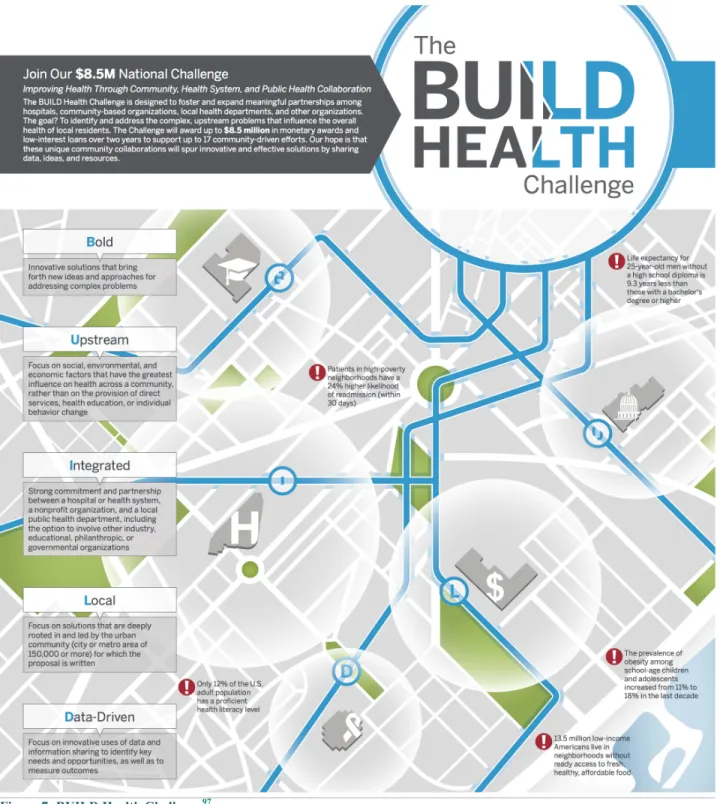
The BUILD Health Challenge is a national initiative that, starting in 2015, will finance up to seventeen communities in their efforts to build cross-sectional partnerships to reduce health disparities rooted in social determinants of health. The Robert Wood Johnson Foundation, the Kresge Foundation, de Beaumont Foundation, the Advisory Board Company, and the Colorado Health Foundation have come together to award up to $8.5 million in funds for over two years. Community initiatives will be supported through grants, low-interest loans, and program-related investments. Communities are eligible if they have at least a three-way partnership between the health institutions, the local health department, and at least one nonprofit organization and if they work within a city of at least 150,000 people who have poor health outcomes. Communities apply to the BUILD Health Challenge in January 2015 and winners will be announced in June 2015.
BUILD’s infographic shown in Figure 10, describes their philosophy and focus. “BUILD” stands for bold, upstream, integrated, local, and data-driven.97 By highlighting these terms and
Figure 7: BUILD Health Challenge97