Running head: EXPLORATION OF OFFICE BEAUTIFICATION 1
An Exploratory Study of the Effects of Office Beauty on Faculty Productivity Morgan Viers
University of North Carolina at Chapel Hill
Approved:
EXPLORATION OF OFFICE BEAUTIFICATION 2 Abstract
With businesses looking towards employee satisfaction and productivity, it may be worthwhile to consider how physical environment impacts faculty productivity at a university setting. The present research presents an exploratory study of the impact of office beauty on faculty
productivity. Thirty-six faculty members from the Department of Psychology and Neuroscience and the Kenan-Flagler School of Business at the University of North Carolina at Chapel Hill completed an online survey measuring office space beauty, effort devoted to beautifying office space, time spent in office, and research, teaching, and service productivity. Although results elucidated no clear pattern of results for aggregate measures, some connections between individual office beauty items and productivity emerged. These exploratory results suggest that future research should consider the nuanced nature of beauty in the workplace.
EXPLORATION OF OFFICE BEAUTIFICATION 3 An Exploratory Study of the Effects of Office Beauty on Faculty Productivity
A business is constructed of important pieces that work together in order to provide a good or service. Components like management, production, marketing, policies and procedures all play a role in determining how businesses run. While each of these aspects remain important to the structure of an organization, the foundation of many business operations remain,
ultimately, in the hands of the employee. In recent years, the business leaders have become increasingly focused on the experience of the employee in creating innovative workplaces (c.f. Loubier, 2017). Employers are particularly interested in creating a workplace in which
employees desire to work rather than a workplace where they feel trapped (Morgan, 2015). This shift in workplace innovation has benefited the health, work experience, and productivity of employees in organizations such as Google, Uber and Pinterest (Morgan, 2015). Physical environment, in particular, impacts the wellbeing, and productivity of an individual in the workplace. By enhancing the appeal of the workplace, organizations are able to increase well-being of the individual employee and therefore, increase rates of organizational productivity (Balch, 2016; Horr, Arif, Kaushik, Mazroei, Katafygiotou, & Elsarrag, 2016; Umstot, Bell, & Mitchell, 1976). Because Americans spend 90,000 hours of their life at work (Pryce, 2010), the work setting aesthetic seems a logical first step in helping employers reach optimal efficiency. Personal Artifacts
EXPLORATION OF OFFICE BEAUTIFICATION 4 productivity, and burnout (Baruch-Feldman, Brondolo, Ben-Dayan, & Schwartz 2002).
Importantly, family and work support are both associated with satisfaction and productivity (Baruch-Feldman, Brondolo, Ben-Dayan, & Schwartz 2002). Researchers define levels of family support based on the number of family pictures and similar artifacts in an employee’s office. Similarly, faculty members may choose to display reminders of work support by displaying student appreciation gifts throughout their office. These influential aspects of an office are something employees encounter every day. Determining which office features motivate
employees in a new type of environment – academia – is a new and innovative way to approach organizational productivity for the future, and the aim of this research.
Scenic Quality
In addition to enrichment through meaningful artifacts, research supports the importance of scenery – the cumulative characteristics that give personality to a setting – in determining a workplace’s aesthetic quality. When studying scenery in urban parking lots, for example, perceptions of attractiveness and safety are positively influenced when the scenic quality increases (Shaffer & Anderson, 1985). Similarly, scientists have investigated participant
EXPLORATION OF OFFICE BEAUTIFICATION 5 investigated further. It seems reasonable that increased levels of workplace aesthetics would be
positively associated with workplace outcomes (Vilnai-Yavetz, Rafaeli, & Yaacov, 2005). Vegetation
Greenery is another key component of a beautiful workplace that may impact
productivity. Research has long supported the idea that nature, greenery and vegetation have positive physical and mental health effects. In a recent study, individuals who completed tasks in a green or natural environment were calmer and more relaxed than those in an industrial setting (Tsunetsugu, Lee, Park, Tyrväinen, Kagawa, & Miyazaki, 2013). Furthermore, Tsunetsugu and colleagues (2013) found that the heart rates, blood pressure and nervous activity of participants in the forest environment were significantly lower than those in the industrial site. An earlier study investigated similar effects when individuals encountered roadside vegetation.
Specifically, individuals who encountered roadside vegetation while driving had a higher tolerance for frustration (Cackowski & Nasar, 2003). Organizations strive to increase productivity by attempting to avoid employee burnout and frustration; adding plants to the workplace could achieve this goal.
EXPLORATION OF OFFICE BEAUTIFICATION 6 have both health benefits and links to increased productivity. By adding plants and greenery to
an office space, an organization can maximize employee satisfaction and organizational efficiency.
Other Factors
While research generally agrees on the effects of both vegetation and scenery, the research on other potential factors in an office that influence employee satisfaction and productivity is minimal. Nevertheless, the research that has been conducted suggests that working in generically pleasant structures can boost productivity. For example, natural light in an office enhances productivity (Edwards & Torcellini, 2002). Windows allow employees to be reminded of a space outside of their work environment and can provide the “green” influences stated previously. Similarly, artwork on the walls of the office can positive impact productivity and employee satisfaction (Wells, 2000; “Business and the Art Make Great Partners, 2004). Personalized artifacts allow employees to be reminded of their individual goals,
accomplishments and life outside of work which encourages employee satisfaction. These positive emotions, from light, artwork and personalized reminders, increase employee satisfaction and productivity in the workplace.
Positive Affect and Productivity
It is evident from previous literature that plants, scenery, and personal artifacts have an important effect on individuals while they are interacting with the workplace. These effects, and others like it, stem from larger psychological theory surrounding positive affect and productivity. Oswald and colleagues found that employees who were experimentally made to be happier were 12% more productive than those who were not (Oswald, Proto & Sgroi, 2013). Similarly,
EXPLORATION OF OFFICE BEAUTIFICATION 7 with productivity (Patterson, Warr & West, 2010). With this lens, it becomes clear that a happy
or satisfied employee is potentially a more productive employee. Businesses should make efforts to increase these positive emotions in order to best optimize their organization for both the intrinsic and extrinsic benefits.
Constructs of Beauty and Productivity
Although it is a subjective construct, beauty can be defined as a detailed arrangement of qualities that pleases the aesthetic senses (Beauty, 2019). For this research, the term
beautification is used to describe the enhancement of a space to make it more pleasant, agreeable, or comfortable to be in. While each person’s style influences their opinion on beautification, there are some aspects that are generally agreed upon by research, experts and majority of the population. Many consider artists to be experts on beauty. When various artists, such as hairdressers, interior designers and painters were asked to quantify beauty, their answers were synonymous. Each artist expressed that beauty is immensely subjective. However, each artist cited at least one of the following aspects during their interview: naturalness, individuality, cleanliness or personalization (Harler, Poppo, Tran, Hughes, & Yassky, personal
communication., 2018). These aspects unmistakably contribute to our societal view of beauty despite personal subjectivity.
EXPLORATION OF OFFICE BEAUTIFICATION 8 less emphasis on workplace aesthetics. On the other hand, it is possible that departments or
academic units with an emphasis on human emotion (i.e., psychology programs) might put more emphasis on situation. The current study seeks to investigate differences across departments for both productivity measures and other workplace features such as office aesthetics.
Previous Research
The numerous pieces of a workplace environment can impact various psychological experiences that can be related back to productivity. The amount of job demands and time worked are related to work-family conflict (Voydanoff, 1988) which can be related to higher levels of productivity loss (Johns, 2011). Individuals with high work-family conflict may not display photos of familial life due to these higher demands that restrain their time. Similarly, Rothbard and Wilk found that employee’s productivity was related to their reported negative affect (Rothbard & Wilk, 2012). Individuals who experience high levels of negative affect may include stress relievers or pleasant artifacts in order to reduce negative affectivity throughout the work day. Well-being and stress levels also contributes to productivity (Gandy, Coberley, Pope, Wells & Rula, 2014; Adaramola, 2012). Physical well-being can be surveyed through exercise equipment in the office space and can potentially be surveyed through other mood improving or stress reducing artifacts, such as greenery. It is clear from previous research that the workplace affects employee performance in many ways (Leblebici, 2012). This exploratory study seeks to investigate those influences and the detailed nuances within the workplace environment. Present Research
EXPLORATION OF OFFICE BEAUTIFICATION 9 that 1) increased amount of beauty and effort in adding personal touches to office space would be
associated with increased time spent in office as well as research teaching and service productivity, 2) this relation would be mediated by increased time spent in the office and 3) individuals would differ based on demographic and department grouping in terms of beauty and productivity levels. If supported, these results would suggest that enhancing the employee experience through office beautification would be beneficial for academic, as well as business settings.
Methods Participants
EXPLORATION OF OFFICE BEAUTIFICATION 10 Procedure
Faculty were surveyed using self-report in an online survey. Because the sequence of self-report questions has an effect on response (Krosnick & Alwin, 1987), the survey was counterbalanced between asking background, productivity or office related questions first. Instructions were provided at the beginning of each sequence urging participants to remain truthful and to consider each question individually.
Measures for the independent and mediating variables – beauty, effort in beautifying the workspace, time spent in office – were adapted from exploratory literature about office space dynamics (Shaffer & Anderson, 1985; Seresinhe, Preis & Moat, 2015; Balch, 2016; Tsunetsugu et. al. 2013; Cackowski & Nasar, 2003; Larsen, Adams, Deal, Kweon, & Tyler, 1998; Allen, et al., 2016; Edwards & Torcellini, 2002; Wells, 2000). The dependent variables assessing research, teaching, and service productivity were adapted from previous research to fit the specific needs of the study (Webber, 2011; Fairweather, 2016; Townsend & Rosser, 2007).
Measures
Beauty. I used the exploratory literature about office beauty (Shaffer & Anderson, 1985; Seresinhe, Preis & Moat, 2015; Balch, 2016; Tsunetsugu et. al. 2013; Cackowski & Nasar, 2003; Larsen, Adams, Deal, Kweon, & Tyler, 1998; Allen et al., 2016; Edwards & Torcellini, 2002; Wells, 2000) to compile yes/no items that could be easily reported by the faculty members via the survey (e.g., chipped paint in office, symmetric blinds, windows, photographs, diplomas, awards, plants). These items are listed in the Appendix.
EXPLORATION OF OFFICE BEAUTIFICATION 11 added no points to the score. The sum scores for beauty ranged from 1 to 24 (M = 11.6, SD =
6.9) with a maximum possible score of 32.
Effort. I used various measures from the exploratory literature (Shaffer & Anderson, 1985; Seresinhe, Preis & Moat, 2015; Balch, 2016; Tsunetsugu et. al. 2013; Cackowski & Nasar, 2003; Larsen, Adams, Deal, Kweon, & Tyler, 1998; Allen et al., 2016; Edwards & Torcellini, 2002; Wells, 2000) to compile questions that examine the beauty of an office space. Items were asked of faculty members in the survey in order to measure items such as monetary and time contribution to the office space. These items were evaluated through open-ended report (e.g., Approximately how much money did you spend on designing or decorating your office?). Specific measures can be seen in the Appendix.
The effort items were based on contributions to the office that could not be scored on a yes/no basis. This score was used to determine the level of work an individual put into their office space. The sums score for effort include items listed in the Appendix.
Time. Time that a faculty member spent in their office was evaluated by one item on the survey. The item was (e.g., Approximately how much time do you spend in your office per week?) and provided an open-ended response option.
EXPLORATION OF OFFICE BEAUTIFICATION 12 you feel students have rated your teaching on course evaluations?). The multiple-choice teaching
questions included appropriate scales for each question, for example, the question above used a 5-point Likert scale with anchors 1 (terrible), 2 (poor), 3 (average), 4 (good), 5 (excellent). Specific measures can be seen in the Appendix.
Measures of productivity were separated into the categories of research, teaching, and service and professional productivity. Because the productivity measures were surveyed on an open-ended basis, the scores varied when totaled together. To compensate for measurement issues, the productivity measures were recoded into yes/no answers that could be summed together to create a grand total for each productivity measure. Items that were coded as Yes added 1 point to the score, while items that were coded No added no points to the score. The sum scores for teaching, research and service/professional productivity ranged from 1 to 17 (M = 12.10, SD = 3.40), 0 to 6 (M = 3.20, SD = 1.90) and 0 to 3 (M = 1.20, SD = 0.80), respectively. Maximum available scores for teaching, research and service/professional productivity were 20, 11 and 3, respectively.
Results
I hypothesized that beauty in the workspace would be associated with higher levels of faculty productivity. Similarly, the increased beauty in the workplace would translate to more time spent in the space. Lastly, I hypothesized that the department faculty members would differ from in levels of productivity and beauty in the workplace. Correlations between study variables are presented in Table 2.
Primary Analyses
EXPLORATION OF OFFICE BEAUTIFICATION 13 the regression analyses indicated that beauty was not a significant predictor of research (b = 0.01,
SE = 0.05, t(31) = 0.25, p = .804, adjusted r2 = .09), teaching (b = 0.019, SE = 0.10, t(31) = 0.20,
p = .845, adjusted r2 = .04) or service and professional productivity, b = 0.001, SE = 0.001, t(31)
= -.34, p = .734, adjusted r2 = .06).
Effort was tested in a predictive model represented by money spent on office, time spent designing office, and time cleaning office. Taken together, these variables were not predictive of research, F(3, 29) = 1.26, p = .308. adjusted r2 = .12, teaching, F(3, 29) = 2.77, p = .061. adjusted
r2 = .15, or service productivity, F(3, 29) = 0.68, p = .570. adjusted r2 = .07.
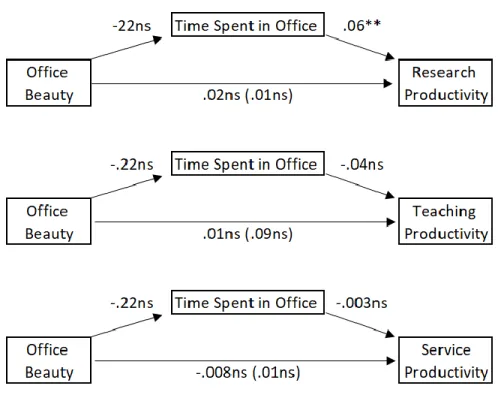
Beauty and Time Spent in Office. To determine if levels of beauty and effort predicted the amount of time spent in office, I conducted regression analyses. Contrary to hypotheses, results of the regression analysis indicated that neither beauty nor the effort model were significant predictors of time spent in office (b = -0.22, SE = 0.34, t(33) = -0.65, p = .523,
adjusted r2 = .01; b = 0.0.002, SE = 0.001, t(33) = 1.64, p =.111, adjusted r2 = .05, respectively).
However, time spent in office was significantly associated with research (b = 0.06, SE = 0.02, t(33) = 2.86, p = .007, adjusted r2 = .17) but not teaching (b = -0.04, SE = 0.05, t(33) = -0.92, p =
.364, adjusted r2 = .00) or service (b = 0.00, SE = 0.01, t(33) = -0.27, p = .786, adjusted r2 = .00)
productivity.
Mediation. As beauty and effort were not significant predictors of either time spent in office or productivity, time spent in office did not mediate the predicted relation between office beauty (see Figure 1). 1
1 As the steps for neither Baron and Kenny’s (1986) steps nor Hayes’ (2013) criteria for mediation were established,
EXPLORATION OF OFFICE BEAUTIFICATION 14 Beauty by Department. To test whether mean levels of beauty differed between the
psychology department faculty and business school faculty, I conducted several independent-samples t-test. Results of the two-tailed t-test indicated that faculty in the Department of
Psychology and Neuroscience had the same levels of beauty (M = 11.41, SD = 8.15) as those in the School of Business (M = 11.33, SD = 6.36), t(31) = 0.33, p > .05.
Productivity by Department. To test whether mean levels of productivity differed between the psychology department faculty and business school faculty, I conducted several independent-samples t-tests. Results of the two-tailed t-test indicated that faculty in the
Department of Psychology and Neuroscience had the same levels of research productivity (M = 3.41, SD = 1.97) as those in the School of Business (M = 3.19, SD = 2.04), t(31) = 0.31, p > .05. Similar results emerged for teaching and service with faculty in the psychology department having the same levels of teaching productivity (M = 12.09, SD = 4.20) as faculty in the business school (M = 12.14, SD = 3.26), t(30) = -0.05, p > .05 and same levels of service and professional productivity (M = 1.08, SD = 0.66) relative to faculty in the business school (M = 1.30, SD = 1.03), t(30) = -0.21, p > .05.
Exploratory Analyses
EXPLORATION OF OFFICE BEAUTIFICATION 15 SD = 11.71), t(24) = -2.25, p < .05. As noted above, increased time in office is positively
associated with research productivity.
Beauty and Productivity. Other physical indicators of office beauty may impact productivity. As previous research demonstrates that personal items that express one’s
personality may be particularly important in creating a positive work environment (Wells, 2000; “Business and the Art Make Great Partners, 2004), I tested for differences in productivity for those with and without personal effects in their offices. Results of the two-tailed t-test indicated that those without personal items have lower levels of research productivity (M = 0.50, SD = 0.70) than those with personal effects (M = 3.39, SD = 1.87), t(33) = 2.15, p < .05. In addition, there were a substantial number of offices (n = 6) with chipped paint, it made intuitive sense to explore whether mean levels of productivity differed between individuals without chipped paint in their office and individuals with chipped paint in their office. Results of the two-tailed t-test indicated that those without chipped paint had significantly lower levels of teaching productivity (M = 11.47, SD = 3.48) than those with chipped paint in their office (M = 14.83, SD = 1.60), t(23) = 2.26, p < .05. However, results also suggested that those without chipped paint had the same levels of research productivity (M = 3.16, SD = 2.48) relative to individuals with chipped paint in their office (M = 3.10, SD = 1.77), t(24) = 0.07, p > .05. A similar patter emerged for service productivity for those with chipped paint (M = 1.50, SD = 0.83) relative to individuals with chipped paint in their office (M = 1.11, SD = 0.90), t(22) = 0.93, p > .05.
Discussion
EXPLORATION OF OFFICE BEAUTIFICATION 16 Moreover, the predicted mediating impact of time spent in office was not supported. These
preliminary findings suggest that office beauty and effort spent at increasing workplace beauty were not associated with either time spent in office or research, teaching and service
productivity. Several exploratory findings indicated that examining individual beauty items produced some effects in the hypothesized direction. This study was largely exploratory in nature and sought to investigate questions that are not well researched. Therefore, further research is needed on these topics in order to draw valid conclusions.
Exploratory analyses demonstrated several interesting findings. For example, individuals with windows in their office spent more time working in their office, on average. These findings are compatible with previous research which claims that natural light has positive effects on employee mood and productivity (Edwards & Torcellini, 2002). Windows afford employees the opportunity to enjoy their work environment, while simultaneously enjoying scenery outside of the office. Importantly, many offices at the University of North Carolina at Chapel Hill have views of vegetation outside. Previous research has found that vegetation and greenery increase employee productivity (Allen et al., 2016). Such associations are important to the functionality of the workspace. However, more research should be conducted in order to improve findings on the topic. Ideally, an experimental manipulation would be able to provide a clearer idea about the relationship of windows and productivity,
Individuals with items that expressed their personality also had higher research productivity scores, on average. Work by Wells and colleagues (2000) indicated that
EXPLORATION OF OFFICE BEAUTIFICATION 17 productive actions. This particular finding may be an important avenue for scholars who wish to
investigate the link between employee satisfaction and productivity.
While the exploratory analyses include several theoretically-aligned findings, one particular result demonstrated individuals with chipped paint in their office had significantly higher levels of teaching productivity than those with intact paint. Speculation around why such results were produced may include a reliance of time outside the classroom for teaching
productivity that is not present for the other two categories of productivity. Accomplishments such as teaching honors and inclusion of the latest teaching techniques may involve dedication to the classroom rather than the office.
Limitations
The most important limitation in the present research was the sample size. In addition to having limited external validity and this, the overall results may come into question. Recruiting faculty from a psychology and neuroscience department and business school also limit the extent to which findings may be generalized. More importantly, the small sample size severely
impacted statistical power. Some of the effects present were small to medium in size. As such, it would take a much larger sample size to adequately detect those effects if they are statistically present. Sample size for the present research consisted of only thirty-six individuals and my next step aims to conduct additional research with a larger sample size to further test the hypotheses. The exploratory nature of the research called for multiple exploratory analyses. In conducting these analyses, I likely increased the prevalence of a Type I error (false positive). This issue further calls into question the findings.
EXPLORATION OF OFFICE BEAUTIFICATION 18 largely un-researched and therefore, the direction of their relationship is merely speculative. The
current research is unable to confirm whether productivity causes a beautiful work environment or a beautiful work environment causes productivity. Having an office with windows, for example, might be the result rather than the cause of research productivity. Similarly, low levels of teaching productivity might relegate faculty to offices with chipped paint. Future research should investigate this relationship further by utilizing an experimental setting in order to determine if there are any causal relationships present between these variables.
The data for this study was collected through self-report in an online survey. Self-report data is susceptible to many biases that could have influenced the data. Social desirability bias is a predominant bias that would influence participants to respond in a way that is favorable and potentially dishonest. The productivity measures are particularly prone to this bias, but the beauty measures that indicate a favorable office may be affected. Similarly, imposter syndrome could have affected the data in this study. Qualitative responses from some faculty members indicated that the information asked in this study was too personal and even made them feel inferior when responding to study questions.
EXPLORATION OF OFFICE BEAUTIFICATION 19 In line with issues with response bias, faculty productivity in an extremely difficult and
complex construct. Whereas businesses often have a clear set of criteria for evaluating the effectiveness of their employees (Anderson, Fornell, & Rust, 1997), those in academia face different challenges. Questions about measuring faculty productivity range from straightforward (e.g., number of publications) to convoluted (e.g., evaluating teaching effectiveness through course evaluations). While these factors relating to faculty productivity have been investigated by previous research (c.f. Webber, 2011; Fairweather, 2016; Townsend & Rosser, 2007), the three types of productivity define such a wide variation in accomplishments that they may not provide a nuanced picture of productivity as a whole. For the purpose of this study, the three types of productivity (research, teaching, and service) allowed me to get a rough overview of the constructs but may require more investigation to improve construct validity. Interestingly, the three groups of productivity were not correlated, suggesting no relationships across different types of faculty productivity. Future research should look into how faculty members are evaluated and should challenge the important pieces needed to be a “productive” faculty member.
EXPLORATION OF OFFICE BEAUTIFICATION 20 Application and Future Directions
While the present research does not present a clear picture with respect to the interrelations between workplace beauty and productivity, it does promote the idea that further research could stimulate important applications within the academic world. Professionals such as interior designers, architects, healthy specialists, school administrators, CEOs and even farmers can theoretically contribute to faculty productivity by fostering interdisciplinary research. Previous research and the exploratory findings within this study indicate windows in the office space may be the closest feature associated with productivity measures. Future research should begin by investigating the important details of how windows may influence individuals in the workplace. Overall, this research sought out exploratory findings that could benefit businesses of myriad industries, as they become increasingly interested in both the satisfaction and productivity of their employees. While still predominantly uninvestigated by research, speculation around office beautification can provide businesses and academia alike with a
compelling avenue that may better the experience of the employee. Though present research does not provide evidence of an explicit pattern between office beauty and productivity, further
EXPLORATION OF OFFICE BEAUTIFICATION 21 References
Anderson, E. W., Fornell, C., & Rust, R. T. (1997). Customer Satisfaction, Productivity, and Profitability: Differences Between Goods and Services. Marketing Science, 16(2), 129-145. doi:10.1287/mksc.16.2.129
Allen, J. G., MacNaughton, P., Satish, U., Santanam, S., Vallarino, J., & Spengler, J. D. (2016). Associations of Cognitive Function Scores with Carbon Dioxide, Ventilation, and
Volatile Organic Compound Exposures in Office Workers: A Controlled Exposure Study of Green and Conventional Office Environments. Environmental Health Perspectives,
124(6), 805–812. https://doi.org/10.1289/ehp.1510037
Balch, O. (2016, February 10). Does a pretty office make a productive workforce? Retrieved from https://www.theguardian.com/sustainable-business/2016/feb/10/office-beautiful-pretty-views-employees-productive
Baron, R. M., & Kenny, D. A. (1986). The moderator-mediator variable distinction in social psychological research: Conceptual, strategic and statistical considerations. Journal of Personality and Social Psychology, 51, 1173-1182.
Baruch-Feldman, C., Brondolo, E., Ben-Dayan, D., & Schwartz, J. (2002). Sources of social support and burnout, job satisfaction, and productivity. Journal of Occupational Health Psychology, 7(1), 84-93.
Beauty. (2019). In Merriam-Webster’s collegiate dictionary. Retrieved from
EXPLORATION OF OFFICE BEAUTIFICATION 22 Bland, C. J., Center, B. A., Finstad, D. A., Risbey, K. R., & Staples, J. G. (2005). A Theoretical,
Practical, Predictive Model of Faculty and Department Research Productivity. Academic Medicine, 80(3), 225-237. doi:10.1097/00001888-200503000-00006
Business and the Arts Make Great Partners. (2004, February). Spotlight. Retrieved from http://www.umass.edu/fac/spotlight/1.9.html
Cackowski, J. M., & Nasar, J. L. (2003). The Restorative Effects of Roadside Vegetation. Environment and Behavior, 35(6), 736–751. https://doi.org/10.1177/0013916503256267 Edwards, L., & Torcellini, P. (2002). A Literature Review of the Effects of Natural Light on
Building Occupants. Retrieved from http://www.osti.gov/bridge
Employee Satisfaction & Engagement in The Workplace. (2017, May 31). Retrieved from https://www.steelcase.com/research/articles/boosting-employee-engagement-place-matters/
Fairweather, J. S. (2002). The Mythologies of Faculty Productivity. The Journal of Higher
Education, 73(1), 26–48. https://doi.org/10.1080/00221546.2002.11777129 Gandy, W. M., Coberley, C., Pope, J. E., Wells, A., & Rula, E. Y. (2014). Comparing the
Contributions of Well-Being and Disease Status to Employee Productivity. Journal of Occupational and Environmental Medicine, 56(3), 252-257.
doi:10.1097/jom.0000000000000109
Harler, K., Poppo, E., Tran, T., Hughes, M., & Yassky, E. (2018, October 1). Quantifying Beauty [Telephone interview].
EXPLORATION OF OFFICE BEAUTIFICATION 23 Horr, Y. A., Arif, M., Kaushik, A., Mazroei, A., Katafygiotou, M., & Elsarrag, E. (2016).
Occupant productivity and office indoor environment quality: A review of the literature. Building and Environment, 105, 369–389.
https://doi.org/10.1016/J.BUILDENV.2016.06.001
Johns, G. (2011). Attendance dynamics at work: The antecedents and correlates of presenteeism, absenteeism, and productivity loss. Journal of Occupational Health Psychology, 16(4), 483-500. http://dx.doi.org/10.1037/a0025153
Krosnick, J. A., & Alwin, D. F. (1987). An Evaluation of a Cognitive Theory of Response-Order Effects in Survey Measurement. Public Opinion Quarterly, 51(2), 201.
doi:10.1086/269029
Larsen, L., Adams, J., Deal, B., Kweon, B. S., & Tyler, E. (1998). Plants in the Workplace. Environment and Behavior, 30(3), 261–281.
https://doi.org/10.1177/001391659803000301
Leblebici, D. (2012). Impact of Workplace Quality on Employee's Productivity: Case Study of a Bank in Turkey. Journal of Business, Economics & Finance, 1(1).
Morgan, J. (2015, June 15). Why The Future Of Work Is All About The Employee Experience. Retrieved from https://www.forbes.com/sites/jacobmorgan/2015/05/27/why-the-future-of-work-is-all-about-the-employee-experience/#448b3a9c6f0a
Oswald, A. J., Proto, E., & Sgroi, D. (2013). Happiness and Productivity. Journal of Labor Economics, 33(4), 789-822. doi:10.1086/681096
Patterson, M., Warr, P., & West, M. (2010). Organizational climate and company productivity: The role of employee affect and employee level. Journal of Occupational and
EXPLORATION OF OFFICE BEAUTIFICATION 24 Pryce-Jones, J. (2010). Happiness at Work: Maximizing Your Psychological Capital for Success.
John Wiley & Sons.
Rothbard, N. P., & Wilk, S. L. (2012). Waking Up on the Right or Wrong Side of the Bed: Start-of-Workday Mood, Work Events, Employee Affect, and Performance. Academy of Management Journal, 54(5), 959-980. doi:10.5465/amj.2007.0056
Samson, A. S. (2012). Job Stress and Productivity Increase. Work, 41(1), 2955-2958. doi:10.3233/WOR-2012-0547-2955
Seresinhe, C. I., Preis, T., & Moat, H. S. (2015). Quantifying the Impact of Scenic Environments on Health. Scientific Reports, 5, 16899. Retrieved from
http://dx.doi.org/10.1038/srep16899
Shaffer, G. S., & Anderson, L. M. (1985). Perceptions of the security and attractiveness of urban parking lots. Journal of Environmental Psychology, 5(4), 311–323.
https://doi.org/10.1016/S0272-4944(85)80001-3
Syverson, Chad. 2011. "What Determines Productivity?" Journal of Economic Literature, 49 (2): 326-65. https://doi.org/10.1257/jel.49.2.326
Townsend, B., & Rosser, V. (2007). THE NEA HIGHER EDUCATION JOURNAL 8. The NEA Higher Education Journal. Retrieved from
http://whp-template.nea.org/assets/img/PubThoughtAndAction/TAA_07_02.pdf
Tsunetsugu, Y., Lee, J., Park, B.-J., Tyrväinen, L., Kagawa, T., & Miyazaki, Y. (2013).
Physiological and psychological effects of viewing urban forest landscapes assessed by multiple measurements. Landscape and Urban Planning, 113, 90–93.
EXPLORATION OF OFFICE BEAUTIFICATION 25 Vilnai-Yavetz, I., Rafaeli, A., & Yaacov, C. S. (2005). Instrumentality, Aesthetics, and
Symbolism of Office Design. Environment and Behavior, 37(4), 533–551. https://doi.org/10.1177/0013916504270695
Voydanoff, P. (1988). Work Role Characteristics, Family Structure Demands, and Work/Family Conflict. Journal of Marriage and Family, 50(3), 749-761. doi:10.2307/352644
Umstot, D. D., Bell, C. H., & Mitchell, T. R. (1976). Effects of job enrichment and task goals on satisfaction and productivity: Implications for job design. Journal of Applied Psychology, 61(4), 379-394. http://dx.doi.org/10.1037/0021-9010.61.4.379
Webber, K. L. (2011). Measuring Faculty Productivity. In University Rankings (pp. 105–121). Dordrecht: Springer Netherlands. https://doi.org/10.1007/978-94-007-1116-7_6
EXPLORATION OF OFFICE BEAUTIFICATION 26 Table 1.
Participant Characteristics
Participants (n=36)
Age* 44.94
Biological Sex§
Female 16 (44.4%)
Male 19 (52.8%)
Prefer to Self-Describe 1 (2.8%)
Race & Ethnicity§
White 31 (86.1%)
Black or African American 0 (0%)
American Indian or Alaskan Native 0 (0%)
Asian 4 (11.1%)
Hispanic 0 (0%)
Native Hawaiian or Pacific Islander 0 (0%)
Other 1 (2.8%)
Political Ideology§
Very Conservative 1 (2.8%)
Somewhat Conservative 5 (13.9%)
Moderate 4 (11.1%)
Somewhat Liberal 9 (25.0%)
Very Liberal 17 (47.2%)
Department at UNC§
Psychology 13 (37.1%)
Business School 22 (62.9%)
EXPLORATION OF OFFICE BEAUTIFICATION 27 Table 2.
EXPLORATION OF OFFICE BEAUTIFICATION 28
EXPLORATION OF OFFICE BEAUTIFICATION 29 Appendix
Measurement Materials
Measure Explanation
Non-Standard Issue Furniture furniture bought outside of what the university provides Personality Materials things that express your personality
Student Appreciation Gifts thank you cards or reminders of student appreciation
Provided Paint
Papers Not Aligned papers not organized or aligned on the desk Crumpled Papers crumpled papers not in the trash can
Broken Appliances or Fixtures no longer serve their function and/or broken Chipping Paint
Asymmetric Blinds
Misc. Items Out of Place (i.e. phone off the line or other misplaced items) Plants
Windows
Inspirational Reminders Photographs
Candles Air Fresheners
Stress Reducers stress balls, zen gardens, etc. Exercise Materials yoga balls, bar bells, etc. Artificial Lights
Diplomas
Separated Meeting Areas devoted areas (conference versus work area)
Measure
EXPLORATION OF OFFICE BEAUTIFICATION 30
Teaching Research Service/Professional
Classes Taught Refereed Articles Committees
Credit Hours Books/Textbooks Honors and Awards
Students Taught Patents Special Projects
Advisees Copyrights Chair Committee
Service Learning Published Citations Member Committee
Thesis and Dissertation Committees Workshops Hours Worked/Week Innovative Pedagogy Conference Presentations
Technology Used Grants
Course Evaluations Contracts
Honors and Awards Honors and Awards