Diabetes & Dance: Empowering Patients Through Movement
By
Maebelle Mathew
Senior Honors Thesis Interdisciplinary Studies
University of North Carolina at Chapel Hill
4/4/2019
Approved:
_______________________ Jordynn Jack, Thesis Advisor Jocelyn Chua, Reader
Introduction
As of 2015, diabetes affected nearly 10% of the American population, impacting over 31 million individuals, and was the 7th leading cause of death in the United States (4). In 2018, the economic cost of diagnosed diabetes in the country was approximately $323 billion (4). Diabetes can lead to numerous physiological issues, including skin, foot and eye complications, and damage to the nervous system, kidneys, and digestive tract (5). Common treatments for individuals with diabetes typically includes medications for controlling blood sugar levels and treating these physical complications (6). However, diabetes affects more than just an
individual’s physical health--it also impacts their mental health. Research has shown that patients with diabetes are at a higher risk of poor mental health, namely depression and diabetes-related distress (7). This is often due to difficulty in coping with their changed daily routine required in order to live with diabetes (7). Despite the high prevalence of poor psychological health among patients with diabetes, the amount of psychological-related care that diabetes patients receive is low. Improving mental health status for patients with diabetes could not only lead to better quality of life, but also greater resilience and self-efficacy, which could lead to better management of the disease (7).
“I had lost several pounds! I was working out a lot at the gym— mainly in some classes with some friends. I felt like things were looking up. ☺
I saw him [my doctor] type “sedentary” into the computer. Normally, I would have let it go, but I said, ‘Sedentary? I’m not sedentary! I’m working my ASS off at the gym!’
He looked at me and slowly let his eyes wander down to my ASS and then back up to my face and then he said, ‘No you’re not.’”
Despite entering the doctor’s appointment feeling confident in her body, her self-image was negatively impacted by the doctor’s pointed comments and lack of faith in her diabetes management efforts.
A second participant chose to write a letter to their younger self, and immediately starts her letter with:
“All your life you worried about being to skinny – all arms and legs. Please be aware your metabolism will change, your body will change and losing your pancreas at age 47 will eventually mean incredible weight gain. Be careful.”
This opening is a warning to the participant’s younger self to not become caught up in their future weight gain, likely speaking of past experiences of having struggled with their changing body. This challenge must have been so great that it was the very first thing that they would go back and warn their younger self of, indicative of the impact struggling with body image must have had on the participant’s life.
leading to the formation of this study. Mindfulness Interventions
Mindfulness has been used as an intervention for chronic illnesses and diabetes,
specifically in relation to emotional distress and self-efficacy. Research has been conducted on two types of mindfulness interventions: mindfulness-based stress reduction (MBSR)
interventions and mindfulness-based cognitive therapy (MBCT) (13, 14). In MBSR, patients are taught mindfulness techniques, such as sitting meditation and gentle yoga, over the course of 8 weeks (13). MBCT interventions combine MBSR with cognitive therapy elements (14).
Dance as Therapy
Dance is less often considered for its psychosocial benefits, but rather its physical
benefits. It has been a form of therapy for a variety of health problems, including, but not limited to, depression, arthritis, Parkinson’s disease, cancer, and aging (2, 3). It is unique due to its multi-dimensional impacts on an individual, all of which can contribute to better health. The physical benefits of dance have been well-researched over the years. Dance has been associated with increased flexibility, muscle strength, and endurance (1). Additionally, dance can improve balance, spatial awareness, cardiovascular health and posture (1).Similar to mindfulness
interventions, dance has also been shown to offer certain emotional and mental health benefits. These include improved coordination and memory, stress reduction, and mood elevation. Dancing allows for emotional expression and provides a creative outlet. Additionally, the social aspect of dance has been shown to encourage sympathy, decrease loneliness and generate a sense of unity (1, 2).
touch--which are integrated by both mind and body. While dancing, one cannot simply watch a dance move or hear music; instead, the body reacts by moving to the rhythm or mimicking the step. Merleau-Ponty describes perception as the idea “that at every instant experience can be
coordinated with that of the previous instant and that of the following” (9, phenomenology, 62). In other words, each moment is an individual experience where the mind and body are fully engaged and reacting to the environment, but these instances can be connected to those that come before and those that follow. This idea of being completely engrossed in a moment is an
especially positive aspect of dance. Both the mind and body are fully engaged, and as a result one can only fully experience dance a single moment at a time. In this way, dance is able to provide a means for individuals to lessen their self-consciousness and become better attuned to their bodies, ultimately leading to greater empowerment and self-esteem.
Due to its numerous benefits, a form of mental health therapy has arose to incorporate dance known as dance/movement therapy, or DMT. DMT attempts to use mind/body integration as a means to provide psychotherapy, based on research that indicates that the division between mind and body is in fact trivial. Three overarching objectives of DMT include increasing the assimilation of mental, physical and affective experiences, increasing expressive competence, and increasing self-awareness (10). When applied to the medical field, DMT does not work to cure a disease, rather, it addresses the overall illness experience, or how a disease affects an individual (10). Similarly, it does not aim to cure a disease, but rather to induce healing, or bettering the illness experience and allowing a patient to function to the level that they desire (10).
coping ability by improving acceptance, which allows an individual to adapt to stressor rather than try to change it. By helping patients become more aware of what their bodies are saying, DMT helps prevent denial of body dysfunction and promote acceptance. DMT can also help with elevating mood and emotion by providing a cathartic release of emotion via the expressive nature of dance; however, studies show that articulating this emotional release is necessary to reap the full benefits of dance for mood and emotion (10). Additionally, the group setting of DMT fosters social networks and increases social support for patients.
Of particular interest are the impacts of DMT on self-efficacy and body image. Self-efficacy, or an individual’s belief in their own ability to carry out an action or reach a goal, can lead to greater compliance to a care regimen, especially important for diabetes patients, who have a fairly strict regimen consisting of diets, medications and exercise (10). DMT increases self-efficacy in two ways. Firstly, the creative nature of the therapy, where the patient begins movement rather than the therapist, allows a patient to increase their confidence in initiating activity (10). Secondly, being better attuned with one’s body allows individuals to feel greater efficacy in anticipating and responding to the needs of their body (10). Similarly,
dance/movement therapy can help treat body image issues because the therapy requires the physical body and emotional, inner self to work together (10). By being able to use the body in a productive manner, and in conjunction with their feeling self, individuals can grow to be more comfortable and in touch with their bodies, lessening insecurities they may have and increasing empowerment.
functioning (10). Additionally, it is a form of moderate exercise, leading to the same physical benefits described earlier in this paper (increased stamina, flexibility, and strength) ().
Research Question and Study Objectives
Through this pilot study, we aimed to begin looking into the following question: can dance have an effect on empowerment and diabetes management efficacy for patients? More specifically, can a certain style of dance be more empowering than another? The study aimed to discover how diabetes patients perceive and experience a variety of dance styles as well as investigate the potential relationship between dance as an alternative mode of therapy and effective diabetes management.
While previous studies have connected dance to emotional and psychosocial well-being, to date fewer studies have explored the emotional benefits of specific styles of dance. One study investigating the perceived benefits of dance noted that the amateur dancers come from various dance backgrounds, but did not further correlate perception with dance background (2). As a result, the dance styles for our workshops were chosen based on the emotions and feelings we perceived to be associated with each type of dance. The styles of dance we chose to investigate through this study are Latin, Modern, Bollywood and Zumba. Latin dance is sensual, eliciting passion and self-confidence, while Modern is free-flowing and allows for controlled
expressiveness. The upbeat songs accompanying Bollywood emphasizes happiness and fun, and the constant movement in Zumba evokes confidence in one’s body and how it moves.
breathwork and relaxation, the inclusion of touch and mirroring, working towards coping both physically and emotionally, and stimulating emotional healing (10, 11). Beyond these first 5 characteristics, DMT also is unique for involving the body in a psychotherapeutic process, creating and growing a positive relationship between an individual and their body, and using creative movement to promote good health (10, 11). The goals we hope to focus on in order to induce empowerment and self-efficacy and decrease body insecurities are (1) mind/body integration, (2) involving the body in therapeutic processes, and (3) forming and promoting a positive relationship between a patient and their body. As a result, during the formation of this study, we borrowed aspects from DMT that seemed to most greatly promote empowerment in patients.
The greatest difference between DMT and the dance workshops offered in this study is the amount of structure provided. DMT aims to use experimentation to explore methods of feeling, emoting and connecting with one’s body (in contrast to aiming to move more freely or perfectly) (12). DMT relies on creativity and improvisation by the patients, the use of props and guided activities such as mirroring, which these workshops did not (10). Instead, the instructors of the workshop emphasized technique and expression, giving patients a genuine dance
Methods:
This study was developed and conducted through a research team of five undergraduate students (including myself) and our faculty advisor. I founded the project, creating the premise and submitting the IRB. The entire team recruited instructors and participants and identified resources we could use (ex. dance space). During the workshops, we switched between being active participants of the dance classes and passive observers outside of the room, allowing the participants to feel more at ease during the workshop. Following the dance session, we would meet and discuss how the classes could be improved for the participants and important observations (examples of which are provided later in this section). Having a research team allowed us to continuously evaluate and improve our study design and provided multiple perspectives towards the study and the resulting observations.
Participants recruited for this study were individuals affected by diabetes over the age of 18. Individuals were recruited through flyers posted around the UNC campus as well as emails sent through campus ListServs. Participants were asked to only respond if they were comfortable in participating in mildly rigorous physical activity and were comfortable discussing and sharing their experiences within the dance workshop in a supportive setting. Additionally, they needed to be available for the duration of the dance workshop, a total of eight weeks. Interested individuals were screened for a recent history of cardiovascular problems (within the previous six months), as well as any significant neuropathy or other issues limiting their daily activity. Screening of participants occurred via an online survey. Before taking any surveys or measurements, a
consequence at any point.
Participants who met the study requirements were then asked to come in to have their Body Mass Index (BMI), weight, and waist/hip circumference measured. Additionally, we
developed a study questionnaire that was electronically distributed to each participant to
complete before their first session. These questionnaires included questions about basic
demographics, experience and opinions on dance, and history with diabetes. Additionally, these
questionnaires included The Diabetes Distress Scale (see Appendix 2), Diabetes Empowerment
Measure (see Appendix 3), and the Duke Social Support and Stress Scale (see Appendix 4). The Diabetes Distress Scale was used in order to measure the level of distress that a participant was experiencing in regards to their diabetes. Statements presented on these survey included “Feeling that I am failing at my diabetes routine” and “Feeling angry, scared, and/or depressed when I think about living with diabetes.” The Diabetes Empowerment Measure was used to determine the psychological and social self-efficacy a participant felt in regards to their diabetes and included statements such as “I believe I can find ways to feel better about having diabetes.” The Duke Social Support and Stress Scale was used to quantify the amount of family and non-family-related stress and support experienced by each participant. The surveys were administered electronically, and they, along with the biomedical measures, were repeated following the end of the dance workshop.
Study participants attended an eight-week dance workshop in a dance studio at a local
senior center. During this workshop, participants were taught four different dance styles: Latin,
Modern, Bollywood and Zumba. All styles were physically intensive, but in different ways.
Bollywood and Zumba were both high energy styles, while Latin and Modern were more
more upper body intensive, while Modern and Zumba engaged the entire body. Classes were
held once a week, lasting for an hour, and each dance style was taught over two consecutive
weeks. Each class began and ended with a warm-up and cool-down activity, in order to prepare
participants’ bodies for dancing. These classes were not simply a cardio-based exercise
class--instead, following the warm-up activity, classes consisted of learning choreography and
practicing technique, in contrast to just copying movements that occurs in many exercise classes.
Different instructors were recruited for each dance style. A few members of the research team
also participated in the classes with the study participants, helping create and maintain a
comfortable environment for them. Instructors were recruited based on experience with their
respective dance style, as well as their ability to work with less experienced individuals with
possible physical complications. After each class, we met with the instructor and provided
suggestions based on what we had observed during the session concerning the needs of the
group, allowing us to create low impact movement sequences that all participants could perform
and practice.
The entire research team monitored the classes; we rotated between engaging in the
dance classes with the participants and observing from an adjacent room. This allowed us to
make both subjective observations via the participating researchers and more objective
observations by those who watched from a different room. We watched for reactions towards
different activities and styles, movement across the room, and general demeanor.
After each weekly class, we gathered and discussed what was observed during the class and how participants’ engagement changed with respect to prior classes and to each other.
reassessing and tweaking allowed us to attempt to make the workshops as effective and beneficial as possible.
Additionally, exit interviews were performed with each participant (see Appendix 1 for interview questions). During these interviews, participants were asked about their experience in the workshop, favorite and least favorite dance styles, as well as the impact that dance had on their lives, both mentally and physically. These interviews were conducted by our faculty advisor, as she was much closer in age to our participants. We decided to conduct the interviews in this manner to create a safe and comfortable environment for the patients to discuss their thoughts and personal growth following the workshop. Interviews were conducted immediately after the eighth workshop meeting. Interviews were recorded and later transcribed.
We analyzed observations using concepts drawn from behavioral analysis and
empowerment studies. I used the biomedical and social scientific assessments (BMI, weight,
hip/waist circumference, Diabetes Distress Scale, Duke Social Support and Stress Scale, and
Diabetes Empowerment Measure) to measure any changes that may have occurred before and
after the workshop in distress, self-efficacy and social support.
I analyzed the interviews using qualitative coding. More specifically, I analyzed them
using a grounded theory approach. Through this approach, I reviewed the qualitative data for
repeated ideas, phrases and concepts, which I then “coded” for with a memo or comment. I
grouped these codes into categories, allowing me to reveal trends in qualitative data. These
trends were compared with the results from the biomedical and social scientific assessments, as
well as the analyzed observations.
Acceptance and Benefits:
Carolina at Chapel Hill. To ensure we complied with IRB protocol, all participants were asked for written informed consent. Additionally, all participants were given videos of the dances learned throughout the study, a playlist of the songs for the various dances, a list of diabetes management resources as well as refreshments during and after each class.
Ethical Considerations and Potential Risks:
Results:
Our study had a small sample size of 3 participants. All three participants were females between the ages of 58 and 59 and were well-educated, having received a Bachelor’s degree. Two of the participants, Jenn and Cheryl, live with a significant partner, have older children, are employed and have annual income of $100,000-$150,000. Both participants have received diabetes education through a course/workshop, as well as through their doctor or healthcare provider. Of these two participants, Jenn has been diabetic for 12 years and manages her diabetes through oral medication, diet and exercise. Cheryl has been diabetic for 10 years, and manages her diabetes through oral and injectable medications, insulin, diet, exercises, and monitoring via a glucose meter. In addition to the sources of diabetes education mentioned above, she also has learned about caring for diabetes through a diabetes educator, books, research online, and a nutritionist. The third participant, Diane, was single and unable to work, with an annual household income of $40,000-$49,000. She has only been diabetic for 8 months, and manages her diabetes through oral medications, diet, exercise and monitoring her blood sugar via a
glucose meter. Her knowledge about diabetes and managing it has come from diabetes education workshops/classes and a diabetes educator. These demographics have been organized in the following chart; pseudonyms are used to protect the identity of the participants.
Participant Gender Age Race Relationship Status
Annual Household Income Highest Education Level Current Employment Status?
Jenn Female 60 Other
Live with a significant partner, have
children over 18 $100,000 - $150,000 Bachelor's degree Employed for wages
Cheryl Female 59 Non-Hispanic White
Live with a significant partner, have
Diane Female 59
Black or African
American Single $40,000 - $49,999 Bachelor's degree Unable to work
Table 1: Demographics for each participant (participants’ identities are protected with pseudonyms).
None of the participants had experience in the four styles investigated during the course of this study. When asked for their thoughts about each style, all three participants responded positively, unless they were unfamiliar with the style of dance. Additionally, their motivation in joining the study was for the physical activity and the related potential benefits for managing diabetes.
All three participants responded to the initial survey, while only one participant
responded to the follow-up survey sent out at the end of the workshop. Because there was only one participant who responded to both sets of surveys, we are unable to conduct any statistical tests to confirm significance. However, I have included the results from these surveys to indicate where our participants fall and what their scores could potentially mean.
Diabetes Distress Scale: This scale aims to quantify the amount of distress a person experiences due to living with diabetes and can be further broken down into four subscales that allow for a more accurate identification of the stressor. A score of 3 or higher is considered “moderate distress” and is considered a level of distress severe enough to warrant clinical attention.
Emotional
Burden Physician-Related Distress Regimen-Related Distress Interpersonal Distress Total Distress Pre-Workshop:
Jenn 1.8 1 3.8* 1.33 2.12
Cheryl 1.8 1 2.2 1.67 1.71
Post-Workshop:
Jenn 1 1 2.2 1 1.35
Table 2: Results of the Diabetes Distress Scale before and after participation in the workshop. Levels of distress greater than 3 (indicating moderate stress or more) have been marked with an asterisk.
As this table indicates, two participants reported greater than moderate distress. Jenn experienced a distress level of 3.8 (out of 5) concerning their diabetes regimen, while Diane reported a
distress level of 4.2 in regards to their emotional burden.
Diabetes Empowerment Measure: This scale aims to measure the self-efficacy of a patient in relation to diabetes and can be broken into 3 sub-scales: management of the psychosocial aspects of diabetes, ability to assess dissatisfaction and readiness to change, and setting/achieving
diabetes-related goals. Scores range from 1 to 5, with 1 indicative of low self-efficacy and 5 indicative of high self-efficacy.
Managing
Psychosocial Assessing Dissatisfaction Goal Setting Total Empowerment Pre-Workshop:
Jenn 2.8 3.4 2.9 3.0
Cheryl 4.1 3.8 4.1 4
Diane 4.4 4.6 4.0 4.3
Post-Workshop:
Jenn 4.2 4.0 4.0 4.1
Based on these results, Cheryl and Diane experienced high levels of self-efficacy, with levels primarily above 4 (out of 5). Jenn appears to have a moderate level of self-efficacy prior to the workshop and high self-efficacy after participation in the workshop.
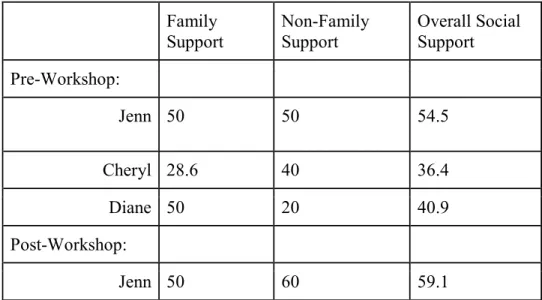
Duke Social Support and Stress Scale: This survey attempts to quantify the amount of social support and social stress that patients experience, with subcategories for family and non-family members. Scores range from 0 to 100, with higher numbers indicating greater social support or greater social stress, depending on which is being measured.
Family
Support Non-Family Support Overall Social Support Pre-Workshop:
Jenn 50 50 54.5
Cheryl 28.6 40 36.4
Diane 50 20 40.9
Post-Workshop:
Jenn 50 60 59.1
Table 4: Results of the Duke Social Support Scale before and after participation in the workshop. Scores closer to 0 correlate with lower social support while scores closer to 100 correlate with higher social support.
Family Stress Non-Family
Stress Overall Social Stress Pre-Workshop:
Jenn 7.1 10 9.1
Cheryl 28.6 0 18.2
Post-Workshop:
Jenn 7.1 10 9.1
Table 5: Results of the Duke Social Stress Scale before and after participation in the workshop. Scores closer to 0 correlate with lower social stress while scores closer to 100 correlate with higher social stress.
All three participants have low to moderate social support (with Cheryl exhibiting the lowest social support). Similarly all three participants have low to moderate social stress, though there is a larger range of scores, with Jenn scoring less than 10 (out of 100) and Diane scoring about 40. Based on the results for Jenn, little change concerning social support or social stress occurred between the start and end of the workshop.
Body Image Measure: This survey was used to gain more information about how the participants perceived their bodies and body weight in general. All three of the respondents believed that they were overweight and had at some point in time felt depressed or upset in some way about their bodies. Two of the three respondents believed that a majority of people do not feel that they need to be the ideal weight to be happy, whereas the third participant felt that a majority of people do hold this belief. When asked what they believed were the healthy weights of an average 5’4” female and 5’9” male, 2 participants responded 110-129 lbs for the female, while the other responded 140-169 lbs. All three respondents believed a health 5’9” male should weigh between 165 lbs and 204 lbs. Responses did not change for Jenn, who completed the surveys both before and after the workshop.
Interviews
example, of the three participants, Diane and Cheryl discussed their A1c scores during the interview:
“Absolutely wonderful. I think it was beneficial, my A1C dropped, it’s now at, um about 2 months ago it was 7.1, it came down from 8.5 to 7.1 in January, from January to about 2 months ago. And they did it today and it was 6.1”
- Diane “So January 3rd, my A1c was 8.3. I just went to see Dr. Paul this morning and it was 7...And I know 1.3 points doesn’t sound like a lot, but in terms of A1c its significant, and you know in that short period of time...”
- Cheryl
These participants claimed a drop of 1.4 points and 1.3 points, respectively. They attributed this drop in A1c to the aerobic exercise aspect of the dance workshop. Jenn did not share their A1c scores, but did express an increase in energy levels after participating in the study, saying:
“It’s benefitted me because it’s gotten me to start moving again. On the nights I do this, it improves my energy levels. When I get home, I’m not tired. Usually when you get home from work, I’m exhausted. When I do this, I get home I actually have energy. So it’s improved my energy levels.”
Despite having no quantitative changes in her blood glucose levels, Jenn experienced greater energy after participating in the dance sessions. This carried over to her time at home, showing that dance had a positive impact on Jenn’s day-to-day life.
Additionally, phrases indicative of self-efficacy, or lack thereof, emotions, social support, and imagery were also identified. When asked if they felt any emotional benefits from the
process on what you can and cannot eat and you enjoy yourself”. Jenn’s description about how dance helped increase her body awareness was particularly impactful:
“One of the things I have to [do], is being aware of my body, I think that [dancing] is really good for that. So like I’m one of those people, I have a therapist I’ve gone to for a years, and...she
touched my foot I couldn’t even feel it. I said “I don’t feel that!” She said “do you feel that?” “No I don’t feel that!” so...you can really not be connected at all with your body. You know, you just go through the motions every day and you’re fine, but doing dancing I think, that’s really key because it helps you to really, gives an awareness of what’s going on with your body...”
Jenn seemed to experience greater integration of her mind and body following
participation in the dance workshop. Before starting the program, she could not register feelings in her lower extremities, making her realize how disconnected she was from her body. For her, dancing increased her awareness of her body because it is different from her typical everyday movements and requires intentional coordination of the mind and body.
Of the four dance styles (modern, Latin, Bollywood, and Zumba), all three participants cited that Bollywood was their favorite style. Cheryl stated that it was because “[the instructor] concentrated on smiling all the time, and happy danc[ing]...[and] it was also very aerobic”. Diane claimed that they enjoyed the style because of its “flowing” nature and “coolness”, while Jenn stated that Bollywood was “high energy...really fun, and it didn’t feel intimidating at all.” For her, it felt the most accessible, as it did not require much lower body or hip movement, unlike other styles in the workshop.
“They [the other participants and research observers] are very friendly, very open, it was very comfortable. Actually I think it was kind of nice, I mean, you know, it’s always nice to have a wide range of ages, because then it’s just, I don’t know. I think it’s just good exposure for probably both ends of the spectrum,
because you just don’t hang out with too many 22 year olds, right, except my daughter.”
- Jenn, discussing the group setting and workshop atmosphere “ I think moving, and getting going, and having—and the nice thing is like there was some “You can do it on YouTube” but its not the same, when you make the commitment to come...[and] when you make the commitment to be somewhere, you’re just more likely to go do it. You know, you’re not gonna go home and turn on YouTube and do it.”
- Jenn, discussing the structured workshop setting
The participants also often went home and shared the dances they had learned with their family and/or co-workers, allowing them to feel a greater sense of social support.
Observations:
Each style of dance seemed to incite different reactions from the participants. In order to better convey these emotions, I will take an ethnographic approach to describe my observations for each style of dance, culminating with a brief summary of the overall physical, emotional and interpersonal observations made over the course of the 8 week workshop.
Latin music, preparing ourselves for the first dance. The participants around me seemed nervous and self-conscious, but would smile at jokes made by the bubbly, friendly instructor. While learning the piece the instructor had choreographed, the main emphasis fell on trying to move our hips. The participants seemed uncomfortable with this at first, but worked hard and remained engaged. We were then instructed to form a circle and dance in the middle, individually--this made the participants’ uncomfortable, and they seemed to move as though to hind behind the researchers in the room with them. The class ended with a cool-down stretch, again to fun Latin music. As we walked out of the room, one of the participant’s said “I give myself a D-, but I’m moving, and that’s all that matters.” Despite being uncomfortable with the style at first, everyone left having both enjoyed themselves and learned something new.
Modern: After two weeks of Latin dancing, we began the Modern dance portion of the
workshop. As I reached the facility, I found two of the participants waiting in the lobby, engaged in conversation. The participants had begun to feel at ease with the people they were dancing with, including the researchers. The session began with a warm-up. Modern was different from Latin, as instead of focusing on hip movements and sensuality, the emphasis for this style was embracing your own individuality. Rather than teaching a choreographed piece, the instructor decided to give a set of loose instructions, such as “Spin”, and allow us dancers to spin however we liked. This was met with apprehension by the participants--most of them were not
comfortable with the type of movements that the instructor asked for, especially because they had just learned them. While they still enjoyed themselves, it appeared to slightly distress them, particularly because of the more complicated and individualized choreography.
and exuding happiness while moving. We began with a warm-up and stretching, then began learning classic Bollywood steps. The music was fun and light, and the dancing itself was more upper body intensive (opposed to lower body intensive), making it more accessible and
enjoyable for our participants. After our cool down stretches nearly every participant had a smile on their face, having thoroughly enjoyed the class.
Zumba: The final two classes of the workshop had a slightly different flow from the first two. Rather learning and piecing together choreography after a warm-up, with Zumba, the music was constantly playing and we were constantly moving. Instead of being taught segments, we were asked to pick up the moves as we danced. It was significantly more cardio-intensive than other styles, and the instructor kept pushing us to keep going. Following the cool-down, the
participants were more tired than that had been in the passed but mentioned their appreciation for the workout.
Overall Observations:
Physical: Major physical observations included significant A1c decreases, increased mobility, increased awareness of physical capabilities. These were not measured during the workshop, but were revealed via conversations with the participants during the workshops and during the final interview.
and self-conscious, especially during the Modern dance classes, during which the dancers were asked to dance individually. However, as the workshops progressed, each participant appeared to increase in comfort, confidence and happiness. This was displayed via increases in in-class participation over the course of the workshop, discussions with both the researchers and other participants, and positive body language.
Interpersonal: Participants bonded with each other as the workshop continued. They shared experiences and concerns regarding their diabetes. Participants gained support from their fellow participants and discussed their experiences with diabetes with both their fellow participants and the researchers.
Discussion
The survey results seem to suggest that the dance workshop had an effect on patient distress. For the patient who provided a response both before and after the workshop, dancing appeared to improve distress caused by emotional burdens and diabetes regimen. However, it did not seem to affect distress in relation to interpersonal relationships or physician-relationships. This is reasonable as the workshops primarily focused on empowerment and bodily comfort, which most closely related to emotional burdens. Because of the physical nature of dance, the workshops also likely positively contributed towards improving distress concerning diabetes regimen. Conversely, because the effects of the workshop were meant to be individually felt, there was no intentional relationship-building aspects of the workshop, explaining the lack of change in distress concerning physician or interpersonal relationships. We did observe
the short timeline of the workshops was not enough time for these relationships to change their social support or distress experienced by each participant.
The surveys also seem to suggest that the dance workshop could have an impact on diabetes empowerment, or how confident a patient feels in their ability to manage their diabetes. For the participant who provided response both before and after the workshop, her diabetes empowerment score increased both overall and in each category (goal setting, assessing
dissatisfaction, and managing the psychosocial effects of diabetes). As the primary goal of these workshops was to increase how empowered the participants felt, particularly by increasing awareness of their bodies and confidence in how it moves and functions, these changes in empowerment match what we expected to see among the participants following the dance workshop.
While changes in distress and empowerment appeared to occur due to the workshop in one participant, there was no apparent change in social support or social stress between the start and end of the workshop. Since the workshop did not impact the relationships between other people in the participants’ lives, changes were not expected; the results support this prediction.
If these changes were observed in a repeated, larger study, it could indicate that a dance workshop with body confidence and empowerment as its focus is most useful for patients who have higher emotional or regimen-related distress and/or experience low self-efficacy. It would likely be less effective for individuals who have poor social support, particularly negative social support. However, we observed increasing conversation between the participants as the
workshop continued, indicating the beginning of new interpersonal relationships; as a result, similar dance workshops could benefit people who have no social support.
The goal of this study was not to observe if dance could increase empowerment and self-efficacy, but rather what style of dance had the greatest impact. By the conclusions described above, it is clear that the dance workshop overall had a positive impact--but was one style of dance more impactful than others? Based on the interviews, each participant most greatly enjoyed Bollywood dancing (in contrast to Modern, Latin and Zumba). They cited a number of reasons for this: the focus on fun and happiness associated with the style, the lack of
intimidation, the limited lower body movement, and the aerobic movement. From these descriptions, it appears that Bollywood was the most appreciated because it was the most accessible and most emotionally positive. Further studies would be required to see if these opinions are translated into measurable improvements in empowerment and distress.
surveys. This makes it very difficult to know if our results are applicable to a larger population. Additionally, the participants primarily fell under the same demographic: they were all women in their late 50s with some sort of income. As a result, our sample was not very diverse, likely due to issues in transportation to reach our space. We also received no interest from men, meaning that we are unable to see the impact the workshop might have on males with diabetes.
Further studies could follow multiple paths. Firstly, the same study could be repeated with a much larger sample size to see how far these results can be extrapolated. Additionally, surveys could be conducted after each dance style to quantitatively measure the impact of each style of dance, rather than the entire workshop as a whole. In all three interviews, physical health benefits of the workshop were emphasized by the participants, so including measures of that (ex. A1c score) in the before and after measures could reveal even more benefits to this form of therapy. Finally, we would like to see if this intervention can be applied to individuals with any form of chronic illness, rather than simply diabetes.
Another direction for research might connect dance with mindfulness. Mindfulness interventions, such as Mindfulness Based Stress Reduction, has been shown to be an effective means to decrease emotional distress in diabetes patients by improving stress management techniques (18). Like the dance workshop, this mindfulness intervention is meant to be a group-based therapy; as a result, it might be possible to combine aspects of the dance workshop with a mindfulness intervention (18). Doing so may provide individuals with diabetes not only a way to become more attuned to their bodies, but also a way to deal with the distress they may
experience due to their illness.
integration, involving the body in therapeutic processes, and forming and promoting a positive relationship between a patient and their body. Interviews with the participant indicate that the workshop intervention was most successful in increasing mind/body integration and forming a relationship between a patient and their body, primarily because it helped participants become attuned to their bodies and how they moved and felt. The dance workshop had little effect on self-perceived body image. Additionally, no part of the instruction was directly therapeutic; rather, in the process of teaching, instructors incorporated feelings and emotions that are emphasized with each style. As a result, the body was not necessarily involved in therapeutic processes.
This pilot study provides offers the effects of a humanistic perspective towards the treatment of diabetes on individuals with diabetes. Currently, treatment is very regimen-related--how are you eating? Are you exercising? Taking insulin? Our proposed dance intervention, while contributing towards following a regimen by being a form of exercise, also provides the
References
1. Alpert PT. The Health Benefits of Dance. Home Health Care Management & Practice. 2011;23(3), 155-157. DOI: 10.1177/1084822310384689. Accessed February 13, 2019. 2. Murcia CQ, Kreutz G, Clift S, et. al. Shall we dance? An exploration of the perceived
benefits of dancing on well-being. Arts & Health: An International Journal for Research, Policy and Practice. 2010; 2(2), 149-163. DOI: 10.1080/17533010903488582. Accessed February 13, 2019.
3. Keogh JW, Kilding A, Pidgeon P, et. al. Physical Benefits of Dancing for Healthy Older Adults: A Review. Journal of Aging and Physical Activity. 2009;17, 479-500. DOI: 10.1123/japa.17.4.479. Accessed February 13, 2019.
4. Statistics About Diabetes. Diabetes.org. http://www.diabetes.org/diabetes-basics/statistics/. Published March 22, 2018. Accessed February 13, 2019.
5. Complications. Diabetes.org.
http://www.diabetes.org/living-with-diabetes/complications/?loc=lwd-slabnav. Published 2019. Accessed February 13, 2019. 6. Treatment & Care. Diabetes.org.
http://www.diabetes.org/living-with-diabetes/treatment-and-care/?loc=lwd-slabnav. Published 2019. Accessed February 13, 2019.
7. Chew B, Shariff-Ghazali S, Fernandez A. Psychological aspects of diabetes care: Effecting behavioral change in patients. World J Diabetes. 2014; 5(6), 796-808. DOI:
10.4239%2Fwjd.v5.i6.796. Accessed February 13, 2019.
8. Edwell J, Singer SA, Jack J. Healing Arts: Rhetorical Techne as Medical (Humanities) Intervention. Technical Communication Quarterly. 2018. DOI:
10.1080/10572252.2018.1425960. Accessed February 13, 2019
9. Merleau-Ponty M. Phenomenology Of Perception. New York, NY: Routledge & K. Paul; Humanities Press; 1974.
http://alfa-omnia.com/resources/Phenomenology+of+Perception.pdf. Accessed October 25, 2019. 10.Goodil SW. An Introduction to Medical Dance/Movement Therapy: Healthcare in Action.
Philadelphia, PA: Jessica Kingsley Publishers; 2005: 16-82.
11.Melsom AM. Dance/movement therapy for psychosocial aspects of heart disease and cancer: An exploratory literature review. Unpublished Master’s thesis. Philadelphia, PA: MCP Hahnemann University; 1999.
12.McCormack DP. Ecologies of Therapeutic Practice. Refrains for Moving Bodies. Durham, NC: Duke University Press; 2013: 91-116.
13.Whitebird RR, Kreitzer MJ, O’Connor PJ. Mindfulness-Based Stress Reduction and
Diabetes. Diabetes Spectr. 2009; 22(4), 226-230. DOI: 10.2337/diaspect.22.4.226. Accessed February 15, 2019.
15.Kian AA, Vahdani B, Noorbala AA, et. al. The Impact of Mindfulness-Based Stress
Reduction on Emotional Wellbeing and Glycemic Control of Patients with Type 2 Diabetes Mellitus. Journal of Diabetes Research. 2018; 2018; Article ID 1986820, 6 pages. DOI: 10.1155/2018/1986820. Accessed February 15, 2019.
16.Loucks EB, Gilman SE, Britton WB, et. al. Associations of Mindfulness with Glucose Regulation and Diabetes. Am J Health Behav. 2016; 40(2), 258-267. DOI:
10.5993/AJHB.40.2.11. Accessed February 15, 2019.
17.Juengst ET, Flatt MA, Settersten RA Jr. Personalized Genomic Medicine and the Rhetoric of Empowerment. Hastings Center Report. 2012; 42(5), 34-40. DOI: 10.1002/hast.65. Accessed April 1, 2019.
Appendix Appendix 1: Workshop Follow-Up Interview Questions Appendix 2: The Diabetes Distress Screening Scale Appendix 3: Diabetes Empowerment Scale
1. How much did you enjoy participating in this study?
2. Which dance style was the most/least enjoyable and why?
3. Rate the difficulty levels of the 3 dance styles. Why were certain styles harder or easier than others?
4. Which dance style, if any, allowed you to express yourself the most?
5. Were there any particular moments where you felt more/less confident as a result of learning these dance styles?
6. Which dance style, if any, impacted the way you view your body?
7. Would you say dance as a form of therapy for diabetes was beneficial for you? If so, how?
8. Would you say your ability to effectively manage your diabetes was impacted as a result of this study? If so, how?
● Follow up: Were there any specific aspects of diabetes management that were positively impacted? Negatively impacted?
9. Which aspect of diabetes management (physician related, social support, individual management, self-esteem) would you say dance has affected the most, if any?
10.Would you consider continuing dance as a permanent form of alternative therapy? Dance and Diabetes Follow-Up Interview Questions
Date: _______________
University of Michigan Diabetes Research and Training Center
DIABETES ATTITUDE QUESTIONNAIRE
PLEASE ANSWER THE FOLLOWING QUESTIONS
Date: ___________________ Attitudes Toward Diabetes – DES
Strongly Agree Neutral Disagree Strongly
Agree Disagree
In general, I believe that I:
1. ...know what part(s) of taking care of my diabetes
that I am satisfied with. ( ) ( ) ( ) ( ) ( )
2. ...know what part(s) of taking care of my diabetes
that I am dissatisfied with. ( ) ( ) ( ) ( ) ( )
3. ...know what part(s) of taking care of my diabetes that I am
ready to change. ( ) ( ) ( ) ( ) ( )
4. ...know what part(s) of taking care of my diabetes that I am
not ready to change. ( ) ( ) ( ) ( ) ( )
5. ...can choose realistic
diabetes goals. ( ) ( ) ( ) ( ) ( )
6. ...know which of my diabetes goals are most
important to me. ( ) ( ) ( ) ( ) ( )
7. ...know the things about myself that either help or prevent me from reaching
my diabetes goals. ( ) ( ) ( ) ( ) ( )
8. ...can come up with good ideas to help me reach my
goals. ( ) ( ) ( ) ( ) ( )
9. ...am able to turn my diabetes goals into a
Date: ___________________
Strongly Agree Neutral Disagree Strongly
Agree Disagree
In general, I believe that I:
10. ...can reach my diabetes goals
once I make up my mind. ( ) ( ) ( ) ( ) ( )
11. ...know which barriers make reaching my diabetes
goals more difficult. ( ) ( ) ( ) ( ) ( )
12. ...can think of different ways to overcome barriers to
my diabetes goals ( ) ( ) ( ) ( ) ( )
13. ...can try out different ways of overcoming barriers
to my diabetes goals. ( ) ( ) ( ) ( ) ( )
14. ...am able to decide which way of overcoming barriers to my diabetes goals works
best for me. ( ) ( ) ( ) ( ) ( )
15. ...can tell how I’m feeling
about having diabetes. ( ) ( ) ( ) ( ) ( )
16. ...can tell how I’m feeling about caring for my
diabetes ( ) ( ) ( ) ( ) ( )
17. ...know the ways that having diabetes causes
stress in my life. ( ) ( ) ( ) ( ) ( )
18. ...know the positive ways I cope with diabetes-related
stress. ( ) ( ) ( ) ( ) ( )
19. ...know the negative ways I cope with diabetes-related
Date: ___________________
Strongly Agree Neutral Disagree Strongly
Agree Disagree
In general, I believe that I:
20. ...can cope well with diabetes-
related stress. ( ) ( ) ( ) ( ) ( )
21. ...know where I can get support for having and
caring for my diabetes. ( ) ( ) ( ) ( ) ( )
22. ...can ask for support for having and caring for my
diabetes when I need it. ( ) ( ) ( ) ( ) ( )
23. ...can support myself in
dealing with my diabetes. ( ) ( ) ( ) ( ) ( )
24. ...know what helps me stay motivated to
care for my diabetes. ( ) ( ) ( ) ( ) ( )
25. ..can motivate myself
to care for my diabetes. ( ) ( ) ( ) ( ) ( )
26. ...know enough about diabetes to make self-care
choices that are right for me. ( ) ( ) ( ) ( ) ( )
27. ...know enough about my- self as a person to make diabetes care choices that
are right for me. ( ) ( ) ( ) ( ) ( )
28. ...am able to figure out if it is worth my while to change how I take care of my
diabetes. ( ) ( ) ( ) ( ) ( )
Robert M. Anderson, Ed.D. University of Michigan Medical School G1116 — Towsley Center — 0201 Ann Arbor, MI 48109-0201
Diabetes Empowerment Scale (DES)
Scoring Key
The DES measures the patient’s
self efficacy related to:
Subscales & ItemsI. Managing the psychosocial (18,20–27)
aspects of diabetes (9 items) .
II. Assessing dissatisfaction and (1-4,15-17,
readiness to change (9 items) 19, and 28)
III. Setting and achieving diabetes (5–14)
goals (10 items)
DUKE SOCIAL SUPPORT AND STRESS SCALE (DUSOCS)
Copyright © 1986-2014 by Department of Community and Family Medicine, Duke University Medical Center, Durham, NC, USA
Date Today:__________ Name: ID#:______________ Date of Birth:__________ Female__ Male__
PAGE 1: SUPPORT
I. People Who Give Personal Support
[A supportive person is one who is helpful, who will listen to you, or who will back you up when you are in trouble.]
INSTRUCTIONS: Please look at the following list and decide how much each person (or group of persons) is supportive for you at this time in your life. Check () your answer.
There is No Such How supportive are these people now: None Some A Lot Person
1. Your wife, husband, or significant
other person ... ______ ______ ______ ______ 2. Your children or grandchildren ... ______ ______ ______ ______ 3. Your parents or grandparents ... ______ ______ ______ ______ 4. Your brothers or sisters ... ______ ______ ______ ______ 5. Your other blood relatives ... ______ ______ ______ ______ 6. Your relatives by marriage
(for example: in-laws, ex-wife
ex-husband) ... ______ ______ ______ ______ 7. Your neighbors ... ______ ______ ______ ______ 8. Your co-workers ... ______ ______ ______ ______ 9. Your church members ... ______ ______ ______ ______ 10. Your other friends ... ______ ______ ______ ______
11. Do you have one particular person whom you
trust and to whom you can go with personal Yes No difficulties? ... _______ _______
12. If you answered "yes", which of the above types of person is he or she? (for example: child, parent, neighbor)__________________________
(Continued on Page 2)
PAGE 2: STRESS
II. People Who Cause Personal Stress
[A person who stresses you is one who causes problems for you or makes your life more difficult.]
INSTRUCTIONS: Please look at the following list and decide how much each person (or group of persons) is a stress for you at this time in your life. Check () your answer.
There is No Such How stressed do you feel by these people now: None Some A Lot Person
1. Your wife, husband, or significant
other person ... ______ ______ ______ ______ 2. Your children or grandchildren ... ______ ______ ______ ______ 3. Your parents or grandparents ... ______ ______ ______ ______ 4. Your brothers or sisters ... ______ ______ ______ ______ 5. Your other blood relatives ... ______ ______ ______ ______ 6. Your relatives by marriage
(for example: in-laws, ex-wife
ex-husband) ... ______ ______ ______ ______ 7. Your neighbors ... ______ ______ ______ ______ 8. Your co-workers ... ______ ______ ______ ______ 9. Your church members ... ______ ______ ______ ______ 10. Your other friends ... ______ ______ ______ ______
11. Is there one particular person who is causing Yes No you the most personal stress now? _______ _______
1
SCORING FOR THE DUKE SOCIAL SUPPORT AND STRESS SCALE
Scoring is done either manually as described below, or by computer as shown in Appendix F of the User's Guide.
DUSOCS Social Support (See example in Figure 16.)
Support Step 1: Assign the following raw scores for each check mark made by the respondent:
"None" = 0 "Yes" = 2
"Some" = 1 "No” = 0
"A Lot" = 2 "There is No Such Person" = 0
Rules for missing values: If all items in the entire "support" section are left blank, then all are considered to be "missing values" and no support scores can be generated. However, if at least one item is checked in the support section, then all the blanks are scored "0" and the check or checks are scored "0" to "2" as noted above.
Support Step 2: Calculate the score for DUSOCS Family Support
a. Sum the raw scores for the six categories of family members under Section IA. b. If the "special supportive person" in Section IC is a family member, add the raw score for “yes” (i.e., 2) to the sum of IA. If not a family member, add the raw score for “no” (i.e., 0).
c. Divide by 14 and multiply by 100 to obtain the Family Support Score on a scale of 0 to 100.
Example: For the patient shown in Figure 16, the score for Family Support is calculated as follows:
a. Sum the raw scores for the six categories of family members under Section IA.
Type of person Raw Score
1. Your wife, husband, or
significant other person = 2
2. Your children or grandchildren = 0
3. Your parents or grandparents = 2
4. Your brothers or sisters = 1
5. Your other blood relatives = 1
6. Your relatives by marriage = 2
Sum = 8
b. If the "special supportive person" in Section IC is a family member, add the raw score for “yes” (i.e., 2) to the sum of IA. If not a family member, add the raw score for “no” (i.e., 0). to the sum of IA.
Special supportive person = wife
2
c. Divide by 14 and multiply by 100 to obtain the Family Support Score on a scale of 0 to 100.
10
÷
14 = 0.7140.714
x
100 = 71.4 = DUSOCS Family Support ScoreSupport Step 3: Calculate the score for DUSOCS Non-Family Support.
a. Sum the raw scores for the four categories of non-family members under Section IB. b. If the "special supportive person" in Section IC is a non-family member, add the raw score for “yes” (i.e., 2) to the sum of IB. If not a non-family member, add the raw
score for “no” (i.e., 0) to the sum of IB.
c. Divide by 10 and multiply by 100 to obtain the Non-Family Support Score on a scale of 0 to 100.
Example: For the patient shown in Figure 16, the score for Non-Family Support is calculated as follows:
a. Sum the raw scores for the four categories of non-family members under Section IB.
Type of Person Raw Score
Your neighbors = 1
Your co-workers = 2
Your church members = 0
Your other friends = 1
Sum = 4
b. If the "special supportive person" in Section IC is a non-family member, add the raw score for “yes” (i.e., 2) to the sum of IB. If not a non-family member, add the raw score for “no” (i.e., 0) to the sum of IB.
Because the special supportive person (i.e., wife) is not a non-family member,
the raw score of 0 is added: 4 + 0 = 4
c. Divide by 10 and multiply by 100 to obtain the Non-Family Support Score on a scale
of 0 to 100: 4
÷
10 = 0.400.40 x 100 = 40.0 = DUSOCS Non-Family Support Score
Support Step 4: Calculate the score for DUSOCS Social Support a. Sum the raw scores for Sections IA, IB, and IC.
b. Divide by 22 and multiply by 100 to obtain the Social Support Score on a scale of 0 to 100.
Example: For the patient shown in Figure 16, the score for Social Support is calculated as follows:
a. Sum the raw scores for Sections IA, IB, and IC: 8 + 4 + 2 = 14
b. Divide by 22 and multiply by 100 to obtain the Social Support score on a scale of 0 to
100: 14
÷
22 = 0.6363
DUSOCS Social Stress (See example in Figure 17.)
Stress Step 1: Assign the following raw scores for each check mark made by the respondent:
"None" = 0 "Yes" = 2
"Some" = 1 "No" = 0
"A Lot" = 2 "There is No Such Person" = 0
Rules for missing values: If all items in the entire "stress" section are left blank, then all are considered to be "missing values" and no stress scores can be generated. However, if at least one item is checked in the stress section, then all the blanks are scored "0" and the check or checks are scored "0" to "2" as noted above.
Stress Step 2: Calculate the score for DUSOCS Family Stress.
a. Sum the raw scores for the six categories of family members under Section IIA.
b. If the "most stressful person" in Section IIC is a family member, add the raw score for “yes” (i.e., 2) to the sum of IIA. If not a family member, add the raw score for “no” (i.e., 0). c. Divide by 14 and multiply by 100 to obtain the Family Stress Score on a scale of 0 to 100.
Example: For the patient shown in Figure 17, the score for Family Stress is calculated as follows:
a. Sum the raw scores for the six categories of family members under Section IIA.
Type of person Raw Score
1. Your wife, husband, or
significant other person = 1
2. Your children or grandchildren = 0
3. Your parents or grandparents = 1
4. Your brothers or sisters = 2
5. Your other blood relatives = 1
6. Your relatives by marriage = 1
Sum = 6
b. If the "most stressful person" in Section IIC is a family member, add the raw score for “yes” (i.e., 2) to the sum of IIA. If not a family member, add the raw score for “no” (i.e., 0). to the sum of IIA.
Most stressful person = brother
Because “brother” is a family member, add the raw score of 2: 6 + 2 = 8
c. Divide by 14 and multiply by 100 to obtain the Family Stress Score on a scale of 0 to 100.
8
÷
14 = 0.5714
Stress Step 3: Calculate the score for DUSOCS Non-Family Stress.
a. Sum the raw scores for the four categories of non-family members under Section IIB. b. If the "most stressful person" in Section IIC is a non-family member, add the raw score for “yes” (i.e., 2) to the sum of IIB. If not a non-family member, add the raw score for “no” (i.e., 0) to the sum of IIB.
c. Divide by 10 and multiply by 100 to obtain the Non-Family Stress Score on a scale of 0 to 100.
Example: For the patient shown in Figure 17, the score for Non-Family Stress is calculated as follows:
a. Sum the raw scores for the four categories of non-family members under Section IIB.
Type of Person Raw Score
Your neighbors = 1
Your co-workers = 1
Your church members = 0
Your other friends = 0
Sum = 2
b. If the "most stressful person" in Section IIC is a non-family member, add the raw score for “yes” (i.e., 2) to the sum of IIB. If not a non-family member, add the raw score for “no” (i.e., 0) to the sum of IIB.
Because the most stressful person (i.e.,brother) is not a non-family member,
the raw score of 0 is added: 2 + 0 = 2
c. Divide by 10 and multiply by 100 to obtain the Non-Family Stress Score on a scale
of 0 to 100: 2
÷
10 = 0.200.20 x 100 = 20.0 = DUSOCS Non-Family Stress Score
Stress Step 4: Calculate the score for DUSOCS Social Stress a. Sum the raw scores for Sections IIA, IIB, and IIC.
b. Divide by 22 and multiply by 100 to obtain the Social Stress Score on a scale of 0 to 100.
Example: For the patient shown in Figure 17, the score for Social Stress is calculated as follows:
a. Sum the raw scores for Sections IIA, IIB, and IIC: 6 + 2 + 2 = 10
b. Divide by 22 and multiply by 100 to obtain the Social Stress score on a scale of 0 to
100: 10
÷
22 = 0.4550.455 x 100 = 45.5 = DUSOCS Social Stress score
5
6
Figure 16. FORM A: FOR SELF-ADMINISTRATION BY THE RESPONDENT (revised 1-99)
DUKE SOCIAL SUPPORT AND STRESS SCALE (DUSOCS)
Copyright © 1986-2014 by Department of Community and Family Medicine, Duke University Medical Center, Durham, NC, USA
Date Today:__9-3-2011_ Name: Jim Williams ID#:__001_____
Date of Birth:_7-2-1966 _ Female__ Male_
PAGE 1: SUPPORT
I. People Who Give Personal Support
[A supportive person is one who is helpful, who will listen to you, or who will back you up when you are in trouble.]
INSTRUCTIONS: Please look at the following list and decide how much each person (or group of persons) is supportive for you at this time in your life. Check () your answer.
There is No Such How supportive are these people now: None Some A Lot Person 1. Your wife, husband, or significant
other person ... ______ ______ __ __ ______
2. Your children or grandchildren ... ______ ______ ______ _____
3. Your parents or grandparents ... ______ ______ _____ ______
4. Your brothers or sisters ... ______ _____ ______ ______
5. Your other blood relatives ... ______ _____ ______ ______
6. Your relatives by marriage
(for example: in-laws, ex-wife,
ex-husband) ... ______ ______ _____ ______
7. Your neighbors ... ______ _____ ______ ______
8. Your co-workers ... ______ ______ _____ ______
9. Your church members... ______ ______ ______ _____
10. Your other friends ... ______ _____ ______ ______
11. Do you have one particular person whom you
trust and to whom you can go with personal Yes No difficulties? ... ______ _______
12. If you answered "yes", which of the above types of person is he or she?
7
Figure 17. PAGE 2: STRESS (DUSOCS FORM A)
II. People Who Cause Personal Stress
[A person who stresses you is one who causes problems for you or makes your life more difficult.]
INSTRUCTIONS: Please look at the following list and decide how much each person (or group of persons) is a stress for you at this time in your life. Check () your answer.
There is No Such How stressed do you feel by these people now: None Some A Lot Person 1. Your wife, husband, or significant
other person... ______ _____ ______ ______
2. Your children or grandchildren ... ______ ______ ______ _____
3. Your parents or grandparents ... ______ _____ ______ ______
4. Your brothers or sisters ... ______ ______ _____ ______
5. Your other blood relatives ... ______ _____ ______ ______
6. Your relatives by marriage
(for example: in-laws, ex-wife,
ex-husband) ... ______ _____ ______ ______
7. Your neighbors ... ______ _____ ______ ______
8. Your co-workers ... ______ _____ ______ ______
9. Your church members... ______ ______ ______ _____
10. Your other friends ... _____ ______ ______ ______
11. Is there one particular person who is causing Yes No you the most personal stress now? ______ _______
12. If you answered "yes", which of the above types of person is he or she?