An ERP Framework Based on Service
Oriented Architecture and Cloud Computing
Environment
Case: IRISL Container Department
Yaghoub Farjami*ICT Department University of Qom
Qom,Iran [email protected] Abbas Asosheh
ICT Department Tarbiat Modares University
Tehran,Iran [email protected]
Arash Afshinfar ICT Department University of Qom
Qom,Iran [email protected]
Received: 10 January 2018 - Accepted: 2 June 2018
Abstract:Nowadays in the business world, all levels of all organizations need a concise planning. Regarding high-speed growth in globalization and competition trend, moving the organizations to the creation of integrated software systems with using latest technologies is a necessity. One of the most significant among the above-mentioned software systems is ERP. Both SOA and cloud deals with delivering services to business with improved agility increased speed and reduced cost that can lead to greater innovation and effective returns on investment. In this paper, after study about functional and nonfunctional requirements of ERP systems, by a framework, It will be study and research about achievement in ERP systems after engaging SOA and cloud computing and their impacts on ERP. Such that these impacts will resolve so many of shortages and needs of conventional ERP as well as reduction of risks and costs of implementation of ERP in organizations. Finally, we used ATAM for evaluating the framework. The idea of the experts in both business and ICT gathered by questionnaire and the data analyzed via TOPSIS method. Similar research for using strength of SOA and cloud computing in traditional ERP in shipping industry is a novelty.
Keywords
-
ERP; SOA; Cloud Computing; IRISL1I. INTRODUCTION
The concept of SOA, as related to cloud computing is simple. It is necessary to understand that when we are dealing with clouds, we are dealing with services, and when we are dealing with services, we should deal with SOA. In SOA world we talk of services and only services, where services are in form of software, live components, and objects (technical things), but when it comes to realization in the real world it is outcome based. It is
* Corresponding Author
1 Islamic Republic of Iran Shipping Lines
generally found people saying 'we are doing SOA so we are ready for the cloud', but the difference between SOA services and the cloud context is huge. Typically, Cloud focuses only towards the outcome, not the technology. “In the cloud, the service terminology you are focusing on is a relationship between service provider and consumer, not technology provider and consumer”[3]. SOA based design involves in defining sets of services that may exist physically within the data center, on a public cloud, or
perhaps in both places (hybrid cloud) and we need to consider the quality of the services design, the granularity, or how well the services approach a "functional primitive," and thus providing more value. In ERP SOA-Cloud Integrated environment, all the services are not hosted but are owned by the ERPs only. In order to achieve the business objective using such integrated architecture service governance is needed which includes the location of services, service security, services dependencies, service monitoring, service compliances etc. According to D.S. Linthicum “Governance places a layer of processes and technology around the services so that anything occurring will be quickly known”[7].
II. ERP SYSTEM REQUIREMENTS
The goal of requirements engineering process in ERP is providing the required documents. This process has four parts include the Feasibility study, Requirements elicitation, and analysis, Requirements specifications, Requirements validation.
Generally, ERP system requirements divided into two categories. Functional and nonfunctional. In systems engineering and requirements engineering, Nonfunctional requirements (NFR) are requirements that specify criteria that can be used to judge the operation of a system, rather than specific behaviors. They are on the opposite of functional requirements that define specific behaviors or functions.
Functional Requirements should be consistent, Complete, Feasible, Required, Accurate, Traceable and verifiable.
On the other hand, nonfunctional requirements have not direct relation with the special functions of the software system and the main nonfunctional requirements are product requirements. Nevertheless, there are so many defections in conventional ERP systems such as: -High cost for primary implementation of ERP for purchasing hardware, Software, providing appropriate high speed and secure infrastructure.
-Time-consuming while implementation
-The necessity of engaging too many ICT experts for maintenance and development of ERP system
-Dependency to a unique hardware and software platform
-Difficult development -Lack of mobility
Besides too many other defections. Therefore integrating ERP system with SOA and cloud computing architecture can compensate above defections and makes ERP in aligned with new technology and services.
III.
SOA
Service-oriented architectures are typically highly dynamic and flexible: Components and services are not only loosely coupled and communicate according to standardized protocols but also interface specifications are exchanged at run-time. Thus, clients can replace services at run-time.
The basic features of SOA: a) Separate functional entity.
b) Access to large amounts of data under a low frequency. c) The way to transmit the message based on the text. The key features of SOA [3]:
a) Providing application development and integrated architecture, strategy on the level of thought way, and no longer only focusing on the technical level.
b) Providing a model of the component that is a functional unit that can be used.
c) Providing the way to integrate the functional units and make them interact with each other.
d) Providing the standardized interfaces, which are independent of the operating systems, hardware platforms, and programming languages
This might be advantageous if a new service provides a better alternative to the former one concerning functionality or quality of service. Alternatively, it might become necessary for self- healing purposes, e.g., if a service is not reachable any longer because of network problems. [4]
Table 1: Compares conventional ERP with ERP based on SOA
ERP Based on SOA Architecture Conventional ERP
Value creator communications Costly communications
Based on process Based on performance
Build for change Build for survive
Gradual Development One tome development
Various software collection Non interoperable
software
Platform independent Single platform
Loosely connection Sever connection
Massage orient Component orient
A. SOA in ERP
SOA is a commonly used term these days in describing where software is going as it has relation to enterprise management systems. SOA refers to a flexible set of design principles used in integrating various computer applications. Essentially, SOA provides a way for a “consumer” of services, such as web-based applications and services, to be aware of services available to it. In ERP, it implies that the software landscape is shifting from technology based on specific business services to a “messaging infrastructure” that translates and routes information from system to system, or application to application, without those systems needing to connect directly. You can add or change or update with a link, than by having to tear apart systems or build complex new code.[5]
Simple examples of business services that can be easily understood are actions like “find a customer record” or “get credit rating.” Messaging enables one code unit to seek the requested information from another, even if they haven’t spoken to each other before, by extracting pieces of data and business logic that the consumer requests. The overall logic is the logical extension of object-oriented programming principles first developed in the 80’s and 90’s. [6]
What we see today is ERP vendors increasingly embracing the SOA concept to enable connectivity to other ERP components, as well as to outside services. Frequently the ERP vendors develop their own “middleware” to handle the software part of a service SOA using their own homegrown integration software. Thus, the key architecture is kept in-house Most major ERP vendors have announced strategies to rebuild their ERP applications with integration with set of services. [5]
IV. CLOUD COMPUTING
A. Essential Characteristics of Cloud Computing
Cloud computing (or called utility computing) refers to an ICT service model and platform that provides on-demand based IT services over the Internet. Although there are a variety of definitions of cloud computing, the NIST1 definition (version 15) considered as the most
accurate and comprehensive. According to NIST’s definition, cloud computing is composed of five essential characteristics, three service models, and four deployment models. The five essential characteristics are on-demand self-service, broad network access, resource pooling, rapid elasticity, and measured Service [7].
B. Cloud Service Models
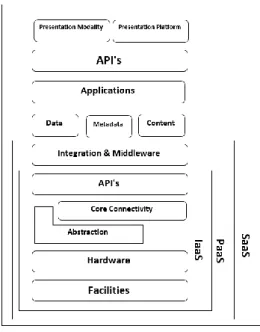
Cloud Computing integrates all the technical advantages of Parallel Computing, Distributed Computing, Grid Computing, Utility Computing and so on. It is a kind of business model called "all resources are services"[5]. According to the type of service, Cloud Computing can be divided into three different service levels [6]: SaaS, PaaS and IaaS. The three levels of Cloud Computing services as Figure 1[6]:
a) SaaS2: The SaaS’s service providers have deployed a
variety of application software or systems in their own servers. The application software or systems are managed and maintained by the service providers. Meanwhile, the service providers also provide the hardware facilities which the software need to run the system. What it provides is an application framework.
b) PaaS3: The direct customers of PaaS are system
developers The PaaS’s providers provide users with the required system development environment, hardware resources, server platforms, databases, application
1 National Institute of Standards and Technology 2 Software as a Service
servers, and other services. The users can just simply develop the software application on the platforms provided by the service providers. What it provides is an integrated environment.
c) IaaS4: The IaaS is also known as the hardware platform.
It is mainly to provide users with virtualized computing resources, communication resources, storage resources and network resources. It includes all the hardware facilities such as CPU, memories, servers, etc. What it provides is a software application environment [12].
Fig. 1: Cloud Reference Model Diagram
According to the researches, Cloud computing services have 25 impacts in organizations performance [11]:
Table 2: Comparison of ERP systems before and after moving on to cloud [11]
After Moving to Clouds Before Moving
to Clouds ERP Characteristics
Need for technical IT support for fail over environments
Need for ERP Development team
Need for extra hardware and software resources and licenses
Need to configure latest technology updates
Need to arrange own extra and cooling
Lack of competition and accuracy trust
Lack of confidentiality
3 Platform as a Service 4 Infrastructure as a Service
Lack of trust on security policies and access control rules
Daily storage and backup burden
Huge cost
High speed internet connection
Subscription and registration charges
Need for requirements gathering and elicitation
Need for project management
Need for coding
Need for testing
Need for deployment
More loss of control of and application or resources risks
Conflicts between opposing goals of different clients, either play it together if not need to separate them
Higher risks of resource availability and failure
Lack of trust in data alteration before storing
Denial of denial service attack in critical server health situations
Higher risks of stress load and congestions
Difficult to audit
Monitoring of clients logs and information by third party
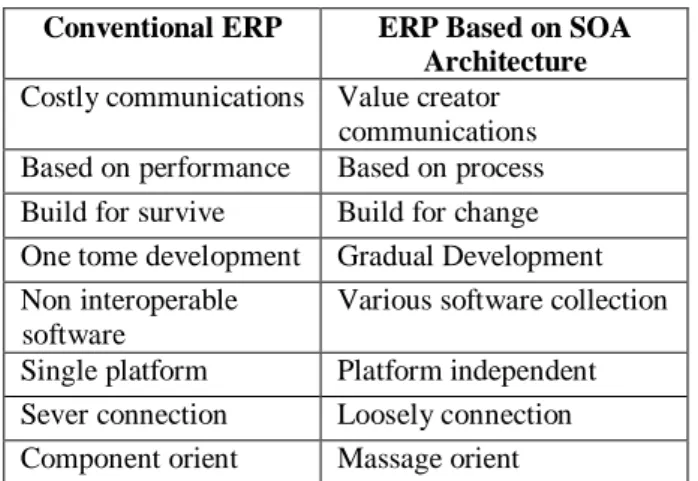
On the other hand, there are 6-cost reduction in organizations after implementation of Could ERP as below [11]:
Table 3: Cost reduction when moving ERP on to cloud [11]
C.
Cloud SOASOA and cloud computing are related completely, specifically, SOA is an architectural pattern that guides business solutions to create, organize and reuse its computing components, while cloud computing is a set of enabling technology that services a bigger, more flexible platform for enterprise to build their SOA solutions[11].
In other words, SOA and cloud computing will coexist, complement, and support each other. Enterprises believe that the two greatest challenges that they have experienced in managing their profitability are threat from competitors and cost of managing changing demands of the business e.g. agility. As the market, demand changes there will a change in enterprise solution. This evolution converted the single tier application to distributed cloud application. To understand the SOA and Cloud together, we can take an analogy of library. The books in a library represents services that the customer can access, here library is analogous to cloud, which comprises on number of books (services). Books (services) are reusable and several books might make up a complete topic (application). Series of books to be used in order and a sort of link (interface) to connect to one book to other in order to complete one topic (application) requires a defined process or architecture SOA related requirements are to provide improved governance and management of services within the cloud environment where they may not be under direct control. Governance is a word that monitors prominence within the SOA environment; it is applicable at two phases of SOA development e.g. design time and run time. Design time governance relates to defining policies for services and run time governance monitors actually applying those design time policies to real time traffic [8].
For successful cloud computing application, the solid architecture is required e.g. SOA is required .SOA provides an architecture necessary to integrate your existing enterprise IT assets with the emerging world of cloud computing. The lack of proper SOA architecture leads to failure in cloud computing world. Service Oriented Architecture and the cloud; today, the popular cloud platform services are running mostly at the operating systems and programming languages rather than at the level of SOA platform. They support standards such as Linux and Java, rather than WS- Messaging and WSDL. To be useful for SOA, Cloud platforms should include enterprise service buses, service registries and other SOA platform components in other words SOA- as a service [3]. We proposed architecture in our study that uses SOA principles to create an overall strategic plan and architectural framework, There are important overlaps between cloud computing and SOA, The key benefit of SOA –cloud integrated enterprise solution is the ability to make system to system interface consistent in the enterprise architecture. This also facilitates the “on demand” access to virtualized IT resources that are hosted outside of your own data center. Cloud computing itself is a deploying architecture not an architectural approach. SOA provides a backbone to allow both the enterprise back-end servers and front-end applications to easily access cloud services. The integrated SOA cloud architecture for SME moves successfully the existing SOA architecture to support new cloud capabilities [2, 3].
V. PROPOSING FRAMEWORK
Reductions Factors
25% Requirement Elicitation and
gathering cost
10% Testing efforts
50% IT labor and development team
cost
75% Capital utilization improvements
40% Technical IT support cost
(30-40)% Overall project cost
The approach to the Combination of SOA and Cloud computing in ERP should be organizational. Because SOA can help the flexibility between ERP and Cloud computing so that any modification in the types of interaction among organizations can be managed by SOA protocols. As it has been illustrated in table 1 there are some capabilities in SOA and cloud computing which can cover the defections of conventional ERP. SOA and its standards , protocols and services are used for interoperability between web applications in ERP while cloud computing architecture services the users for accessing to the modules of ERP systems via cloud., Elaboration between Cloud computing and SOA can make the organization and its ERP system a very effective, Efficient and dynamic
. Table 4: Elaboration between SOA and cloud computing
[9]
Factors Cloud Computing SOA
Security Regarding to the assesments ,its security degree is not acceptable
SOA with its key protocols and concepts has high degree security Reliability Environment can be
safe but risks are evident
Has safe environment and data are moved safely
Integrity Is integrated Easy in integration
and orchestration Interoperability Difficult movement
of big volume of data, which makes the system unsafe and slow. Non interoperable
This is the main feature of SOA that facilitates
movement of data
Reusability Service ineffeciency Creating of services with more
efficiency and code reusability
CRM Better accessing to
the resources
Cost Saving in accessing to the resources Enterprise
Resource Planning
More productivity in facilities and change management
More security and accessibility
Message exchange
Connection is sever and message exchange is costly
Loosely coupled in connections and message exchange is cost effective
Agility Quick Development Platforms
improvments
Therefore SOA with the factors in table 4 can improve cloud computing services .These factors can improve all sections of cloud computing architecture such as infrastructure, operators, implementation. Data movement in the cloud environment, may cause some errors , inconsistency or resource misallocation which can be resolved by SOA [9].
A. Opportunities of integration between Conventional ERP System and Cloud Services
By employing cloud services, enterprises gain many benefits. Some known benefits are reducing initial investment [9], extending existing business process, short implementation period compare with make a new one by themselves and maximum flexibility of payment and easy to perform system upgrading [5]. These opportunities are also mentioned by each interviewee. However, whether these benefits can be fully gained depends on the integration between conventional ERP systems and cloud services. In this section, opportunities brought by integrating are analyzed at three different cloud service levels.
1)Integration between ERP and SaaS
As discussion in previous sections, SaaS brings new functions and the integration between conventional ERP systems and SaaS enables business process automation, data synchronized and seamless user interfaces. Two opportunities should be paid attention to. The first one is that business productivities are enhanced because automated business process requires less manual efforts, and data synchronizing mechanism reduces data inconsistence. In this case processing duration could be shortened and occasional errors caused by manual work could be eliminated. For example, by transferring sales order records from SaaS application back to ERP financing module automatically, the billing process will not be interrupted by waiting for manually entering the data. Moreover, seamlessly integrated user interface will help to improve user experiences which could also contribute to business productivity enhancement. A typical integration case is integrating logon and authorization features, so that users don’t need to enter username and password when switching from ERP to SaaS application. The second one is, the value of SaaS purchase is maximized because SaaS functionalities could be better utilized up to the service contract limitation. For example, service contract may give a limitation on requesting frequency of 100 times per hour which is far beyond human being’s capability, while requests initiated by the ERP system could easily reach this threshold.
2) Integration between ERP and PaaS
The nature of PaaS is all about development lifecycle but not business process. This point is commonly confirmed by interviewee1, 2 and 4. It then leads to a fact that enterprise users may not gain benefits from integrating directly related to business performance. However, integration between ERP system development environment and PaaS truly affect all aspects of technical management including programing, testing, deploying and maintaining. If looking into how integrated development platforms works, it’s easy to understand that the major opportunity here is to make deploying process more efficient and reliable. For example, a pair of new
applications can be automatically distributed to both ERP and PaaS sides respectively. This automated process is helpful to reduce manual work for developers and also eliminate human being’s mistakes.
3) Integration between ERP and IaaS
Hardware resources are runtime environment of ERP systems. Although IaaS is not directly related to ERP systems, it does affect many aspects of ERP systems such as the IT personnel and the performance. Therefore, integrating with IaaS brings the following opportunities. The first one is that
extra hardware resources are brought into existing infrastructure but not need to maintain self-hosting servers. This enhances the capability of ERP systems so that performance can be upgraded. The second one is that IaaS provider takes the responsibility of maintaining resources outside the enterprise, so in-house maintenance work will be simplified. As a result, integration with IaaS decreases the demand on local IT personnel.However, like every coin has two sides; integration between conventional ERP systems and cloud services brings challenges as well [13] .
B. Proposed framework
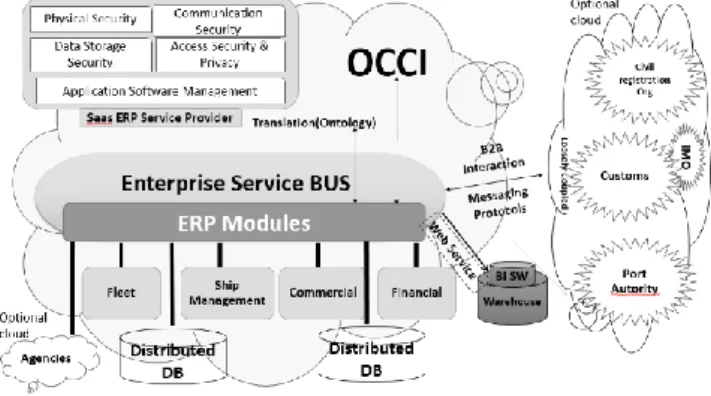
Most of the enterprises run their business processes via a single or heterogeneous systems which act similar as separate Iceland. Among all these enterprises , IRISL has also such defections in the structure of its traditional ERP and needs a model to resolve most the mentioned defections.. Business processes of such enterprises can not migrate to the cloud environment easily. According to the researches (forrester research), one of the most importnant obstacles and challenges for migrating the SAP ERP to the cloud environment is that SAP as an ERP has not optimized for cloud computing yet . Enterprises are moving to the cloud environment gradually.Therefore until then a strong framework is required in order to the integration of current software modules and ERP with the cloud environment. Afterward, the framework should be able to be connected to the other cloud environments. For achieving the mentioned result, we get help from ESB. According to Figure 2 which is our proposed framework and has been designed according to the current software modules of IRISL container department, we designed a framework by which , some external organizations such as port authority, customs, IMO,… are intended to make a bidirectional communications with some internal modules of the ERP of the mentioned department such as financial, ship management ,… via a cloud environment. In this case, the resources should be allocated to the best manner in the cloud environment .
1 Open Cloud Computing Interface
Fig. 2: Proposed Framework
In this framework , ESB is in charge of management and method of the communication between ERP modules and cloud environement with external software systems. The real value of ESB is preperation of an infrastructure for SOA in compliance with organization needs.
These needs are providing appropriate service level, centralizized managability and integration in heterogeneous environment.
One of the most important sections of ESB in this framework is OCCI1 whose main responsibility is
assesment and management of primary input communications from external software systems to ERP modules or conversely.At the first step , this layer checks that this is the first time connection with ERP modules via cloud environment or not. If the communicastion request to be for the first time, some parameters such as TOE2(type of the organizations that are intended to make
inside or outside commuinication ) , connection ID ,conection time, source & destination , ….. will be gathered. According to the SOA features(HDDI,WSDL and SOAP) , Inside this layer some information about the allowed organizations and allowed connection type for communication will be resided. This will accelerate the communication speed between organizations as well as improving the security and risk level of that communication.
After stablishing connection between both ends , requested information will be received ( or sent) from the destination. As there may be some inconsistency between data model of the destination system with the source system, the received information will be sent to Ontology layer. This layer will match the received information with the ERP data model from 3 aspects: communication,data and storage .After standardization of the data in accordance with ERP and cloud standards , the information will be delivered to the ESB. Moreover ESB as its natural task, will guarantee security of this communication session.With use of above mentioned advantages , an ESB based on cloud computing architecture , will allow the organizations to reply to the integration in cloud environment efficiently and
2 Type of Enterprise
independent of software infrastructure , database and software language.One of the achievements of using cloud computing services in this model is taking advantae of its security services and embedding this type of service to ERP. Therfore security concerns such as physical, data and communication security which is based on AAA(Authentication, Authorization and accounting ) model , will be fulfilled by using Saas in this model.The security issues that has been considered in this model are as table 5:
Table 5: Security issues of the model
Security issue Concerns Physical security Rules & Guidelines Communication Security Transmission Security
Network Security
Access Security IDS,Firewall
Data Storage Security Backup
Disaster Recovery Encryption` Privacy Application Software
Management
Data Security Data Integrity Identity Management
IRISL has to many agents in all over the world which needs to connect to the central database as well as external software systems such as port authority, customs , ….The main part of IRISL in Container department which carries more than 9 millions container per year by 31 ocean going vessels. .This framework has been designed as the agencies are connected or not to the cloud services.. In addition the received data can be used by othe ERP software modules in case of need.In addition one of the achivements of this framework is ability of better management and distributing databases as well as obtaining the infrastructure of an OLAP1 system in order
to proving BI2. [15]
VI. FRAMEWORK EVALUATION
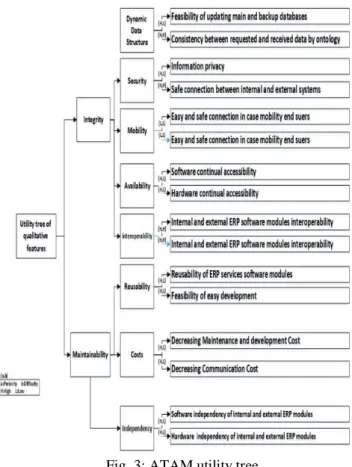
In order to evaluating this model we use ATAM method in the container department of IRISL3 Company. The Software Engineering Institute concurs: “The most important results are improved architectures. The ATAM aids in eliciting sets of quality requirements along multiple dimensions, analyzing the effects of each requirement in isolation, and then understanding the interactions of these requirements".[14]In this allignment we depicted the utility tree of IRISL container dept as below:
1 Online Analytical Processing 2 Business Intelligence
Fig. 3: ATAM utility tree
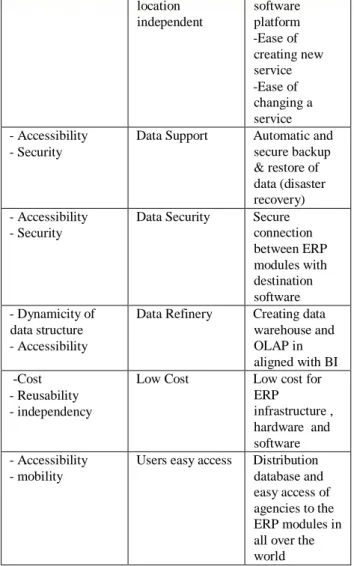
The items in above tree extracted from the idea of the domain experts in container shipping industry and the model recnciled with the tree. At the next step the output of the studies and interview with domain experts summaraized in table 6. In that table main and compulsar ERP requirements are compared with utilty tree scenarios and each rowe of the table is compared with proposed framework.
Table 6: comparing ERP requirements with utility tree
Compulsory requirements Main
Requirement Analysis in
utility tree
- Communication with civil registration ,customs ,port authority and IMO systems - Easy
communication with other modules of adjacent ERP or in other clouds Communication
with survival software - Dynamicity in
data Structure - interoperability
No need to changing the hardware and Software
,Hardware &
Independency - Cost
- Reusability
3 Islamic Republic of Iran Shipping Lines
software platform -Ease of creating new service -Ease of changing a service location
independent
Automatic and secure backup & restore of data (disaster recovery) Data Support
- Accessibility - Security
Secure connection between ERP modules with destination software Data Security
- Accessibility - Security
Creating data warehouse and OLAP in aligned with BI Data Refinery
- Dynamicity of data structure - Accessibility
Low cost for ERP
infrastructure , hardware and software Low Cost
Cost - Reusability - independency
Distribution database and easy access of agencies to the ERP modules in all over the world Users easy access
- Accessibility - mobility
The covering all the requests in utility tree with the model asked by a questionare and its data analysed by TOPSIS1
method.The average table of the experts according to liket scale is as figure 4.
Fig. 4: Average table of experts The findings in this evaluation illustrates that implemantion of the proposed model can have huge impact in increasing of the speed for data
interoperability between IRISL conevntional ERP
1 Technique for Order of Preference by Similarity to Ideal
Solution
with the software systems which are independent to IRISL with lower cost , more availabilty and higher security.
VII
-
CONCLUSIONIn this research that the same has not been done in IRISL so far, we explained that conventional ERP has so many defects which prevent pervasing and fulfilling all needs of modern companies. Therefore we have to engage in some new services and technologies in order to update ERP features as well as the answer to the new needs. In this paper, After study about the functional and nonfunctional requirements of ERP systems, we proposed a framework for combining SOA and cloud computing architecture with ERP.For evaluating this framework, we used ATAM technology in container department of IRISL. By study about the needs of the mentioned department, The framework evaluated by domain experts and after analyzing the received, fulfilling all the above needs by the framework was approved.
REFERENCES
[1] M.K. Chang, W. Cheung, C.H. Cheng, J.H.Y. Yeung, "Understanding ERP system adoption from the user’s perspective", in conference on Int. J. Prod. Econ ,2015,pp. 928–942.
[2] Christian Vecchiola, Xingchen Chu, and Rajkumar Buyya, "Aneka: A Software Platform for.NET-based Cloud Computing," in High Speed and Large Scale Scientific Computing, 2014.
[3] Rajkumar Buyya and Chee Shin Yeo, "Cloud Computing and Emerging IT Platforms: Vision, Hype, and Reality for Delivering Computing as the 5th Utility," Future Generation Computer Systems, 2016, pp. 599-616.
[4] Ying Huang et al., "A Framework for Building a Low Cost, Scalable and Secured Platform for Web-Delivered Business Services," ,Information management systems, 2017.
[5] Qihong Shao et al., "Ranking Mortgage Origination Applications using Customer, Product, Environment and Workflow
Attributes.," in IEEE Proceedings of Congress on Services, 2015.
[6] Youssef, A. ," Exploring Cloud Computing Services and Applications", Journal of Emerging Trends in computing and Information Sciences ,2015,pp.838-847.
[7] W.T. Tsai, Bingnan Xiao, Ray A Paul, and Yinong Chen, "Consumer-Centric
Service-1 2 3 4 5
Dynamicity of… Security Mobilability Availability Operability Re-usability Cost Independency
Second Criteria First Criteria
Oriented Architecture: A New Approach," in SEUSWCCIA,2016,pp. 175-180.
[8] Mark Chang, Jackson He, W.T. Tsai, Bingnan Xiao, and Yinong Chen,"UCSOA: User-Centric Service-Oriented Architecture," in IEEE International Conference on e-Business Engineering,2016, pp. 48-255
[9] Wei-Tek Tsai, Bingnan Xiao, Ray Paul, Qian Huang, and Yinong Chen,"Global Software Enterprise: A New Software Constructing Architecture," in International Conference on E-Commerce,2016, pp. 55-55.
[10]W.T. Tsai et al., "Modeling and Simulation in Service-Oriented Software Development," Journal of Simulation, vol. 83, no. 1,2017, pp. 7-32.
[11] Regina Bento," How fast are enterprise resource planning (ERP) systems moving to the
cloud?,Journal of Information Technology Management",2014
[12]Sun, Y., Harmer, T., and Stewart, A. ," Mapping High-Level Application Requirements onto Low-Level Cloud Resources.", Journal of Software Engineering and Applications, 2014,pp. 894-902. [13]Mladenow, A., Kryvinska, N. and Strauss, C. ,"
Towards Cloud-Centric Service Environments. The Society of Service Science", Journal of
Service Science Research, Springer, 2012, pp.213-234.
[14] M.A. Babar , I. Gorton ," Comparison of scenario-based software architecture evaluation methods",in IEEE conference , Busan,South Korea,2014,
[15] A.Afshinfar,"ICOSAT Vancouver", in International conference of engineering science and technology,2018
AUTHORS INFORAMATION
Abbas Asosheh, received his B.Sc. in Communication Systems in 1987 from Isfahan University of Technology, in 1991 M.Sc. in High Frequency Communications system from Sharif University of Technology, Tehran and Ph.D. in Electrical and Electronics Engineering from King’s College, London. His research interests include, Intelligent Transportation System, Next Generation Networks , …
Yaghoub Farjami, received his B.Sc. in Mathematics in 1991 M.Sc. in Mathematics in 1994 and then Ph.D. in Mathematics from Sharif
University of Technology
respectively. His research interests include: Mathematics and ICT affairs.
Arash Afshinfar, received his B.Sc. in Software Engineering in 1996 from Elmo Sanaat University, M.Sc. in ICT Engineering from Tarbiat Modarres University of Tehran in 1994 and then accepted as Ph.D. student in ICT Engineering.
![Table 3: Cost reduction when moving ERP on to cloud [11]](https://thumb-us.123doks.com/thumbv2/123dok_us/8369501.2222833/4.892.73.434.104.714/table-cost-reduction-moving-erp-cloud.webp)