ORIGINAL ARTICLE
Implementing Relationship Banking Strategies and Techniques and
Improving Customer Value
Yongsheng Guo
Teesside University Business School, Middlesbrough UK TS17 5BX.
Abstract: This paper identifies strategic concepts and practical techniques in relationship-banking and explores how customer value was improved and how relationship-banking performance was measured and linked to relationship managers’ compensation. Grounded theory was adopted to collect and analyse data. 25 interviews have been conducted with relationship managers and corporate banking directors in 11 case banks and case banks’ quantitative data was used to support the propositions. It was found that customer relationship was seen as a valuable asset. Relationship Orientation and Customer Focus were evaluated by undertaking internal surveys and relationship management objectives were formulated and actions were proposed to improve Customer Value to the case banks. In the case banks Customer Information was collected through multiple customer touch points and integrated and analyzed. Customer Knowledge was accumulated and sustainable Competitive Advantages were built. Customer Perception and Customer Loyalty were measured externally. Customer Value and Risk Adjusted Return on Asset (RAROA) were employed to measure relationship banking performance and reward relationship managers accordingly. The interviewees perceived that relationship-banking performance could be improved in this dynamic learning process.
Keywords: Relationship Banking and Customer Value
1. Introduction
Recently, banks are facing more and more competition from domestic and foreign banks as well as non-bank financial institutions. For example, online payment and lending are provided by online shops and platforms. It is difficult to build a competitive advantage on products and prices. More and more banks believe that customer relationships are a source of competitive advantages[1]. Relationship banking is a business strategy to establish long-term relationships and build
competitive advantages. Banks take advantage of information and knowledge advantages and co-create value with
customers by managing credit risks[2]. However, the business strategy needs to have effective aims, and resources and
the ways in which resources are employed [3]. Little is known how banks implement relationship banking strategy
therefore this study investigates the value creation process and in particular, the techniques employed in practice. Section 2 briefly reviews relevant literature and discusses the importance of implementing relationship banking strategy in corporate banking. Section 3 discussed the research methodology and methods adopted in this study. Findings are presented in section 4 and a conclusion chapter is followed to provide some empirical implications and suggestions for future research.
Copyright © 2017 Yongsheng Guo doi: 10.18686/fm.v2i2.980
This is an open-access article distributed under the terms of the Creative Commons Attribution Unported License
(http://creativecommons.org/licenses/by-nc/4.0/), which permits unrestricted use, distribution, and reproduction in any medium, provided the original work is properly cited.
2. Literature review
2.1 Bank-corporate relationships
Hodgman[4] investigates customer relationships in banking but focuses on deposit relationships. He hypothesizes that
the value of a deposit relationship arises in response to competition between banks. Wood [5] recognizes lending
relationships and finds that a bank may offer easy or low-cost credit in one period in hopes of charging higher rates to a
customer in the future. Holland[6]argues that the bank-corporate relationship contains two-way flows of information in
the context of multiple relationships.
Relationship types between an individual firm and bank can vary in character over a range from “close” relations to
“transaction” relations [7]. Close relationships generally involve rich information flows, regular flow of low
margin business, and privileged access to big fee deals. Transaction relations involve relatively poorer information flows, ad hoc price-oriented commodity deals[7].
When bankers speak of building a relationship with a business customer, they usually mean selling the customer a whole range of financial products. When financial economists speak of relationships between banks and firms, they mean a close relationship between a firm and its banker, in which a single banker has intimate knowledge about the firm’s affairs, built up over years of trading[8].
As some have argued, the information that banks obtain by offering multiple services to the same customer maybe of
value in other transactions [9]. Ongena and Smith[10] define a bank-corporate relationship as the connection between
a bank and customer that goes beyond the execution of simple, anonymous, financial transactions. Moreover, bank-corporate relationships are seen in this study as consisting of a set of social, managerial and technological links between the two enterprises[6].
This study defines bank-corporate relationship as a set of cross-hierarchical trust-based personal
communications between banks and corporate customers [11]. This definition emphasizes that the nature
of bank-corporate relationships is trust-based personal communications and the structure of bank-corporate relationships is multi-level and multi-channel exchange of information.
2.2 Customer relationship management (CRM)
The purpose of CRM is to create and maintain relationships with customers, and to build loyalty[12]. CRM is a way for
companies to identify and capture new value throughout the supply chain [13]. Galbreath [14] defines CRM as the
activities that an enterprise performs to identify, select, acquire, develop, and retain loyal and profitable customers. CRM integrates a series of functions and maximizes value from each customer contact. CRM facilitates relationships among enterprises, their customers, business suppliers and employees.
Recently, the internet and Big Data provide insights into the needs and preferences of customers and therefore a better
way of finding and obtaining customers[15]. Some scholars focus on these specific tasks and define CRM as a way of
using customer information and of controlling further data as it accumulates over time[16]. In many organizations, CRM
Ryals[17]argues that CRM is about how organizations use IT to manage their relationships with customers in order to
maximize value creation both for the customer and the company. Many people think CRM means companies buying expensive technology such as a call centre, sales automation software, or even Internet-based customer service.
However, CRM is concerned with the creation, development and enhancement of customer relationships with carefully
targeted customers and maximizing their total customer lifetime value [18]. CRM is not something you can buy, and
technology is not necessarily required. Rather, CRM is a business strategy that applies to every organization[19].
This study treats CRM as a business strategy to improve customer value in a customer-centric organization with a customer orientation, trust-based communications, customer-related performance measurement and employee incentive systems[20].
2.3 The rationale for relationship banking
Financial institutions such as banks can improve the allocation of resources by offering financial products and services
and by providing monitoring services [21]. Financial intermediaries play such an important role in the financial
system because they reduce transaction costs [22] and solve agency problems[23] such as adverse selection and moral
hazard created by information asymmetry[24].
However, traditional theories have limitations in understanding the phenomena in corporate banking. It is hard to get a competitive advantage in products and prices. A new product becomes obsolete quickly because of the rapid environmental changes or will be duplicated by other financial institutions. Moreover, the profit margin in banking has been squeezed in the competitive markets. Therefore it is difficult to get a competitive advantage by reducing price.
This study argues that resource based view[25]and customer-value based theory[3]maybe helpful in understanding the
importance of customer relationships in corporate banking. Banks cooperate with customers to co-create value and
allocated value among shareholders, customers and employees[11].
If banks want to compete more effectively, they have to focus themselves to meet the needs of the customer more
efficiently [26]. In order to maintain customer loyalty, they have to develop long-term relationships with their
customers—which suggests learning the preferences of customers and continually meeting their needs over time[27].
And therefore creating customer value is increasingly seen as the next source of competitive advantage[1]. Banks create
value by managing risks and customer relationships are a good way of managing credit risks and improving customer value.
Drucker[28]points out that to satisfy the customer is the mission and purpose of every business. Superior performance is
the result of providing superior customer value. The customer value creation strategy of a firm substantially influences the scale, scope, and types of activities in which it engages. The superior performance accrued to firms that have a customer value-based organisational culture, complemented by being skilled at learning about customer and their changing needs and at managing the innovation process, and that organise themselves around customer value delivery processes[3].
Nevertheless, little is known how banks use customer relationships as a source of competitive advantages. An in-depth study is needed to investigate how banks build customer value-based culture, organise the communication with
CRM is implemented in corporate banking practice.
3. Research methodology and methods
The present research attempts to explore customer relationship management from bank managers’ perspective to obtain a better understanding about the phenomenon. This study adopted a qualitative methodology -- an inductive logic aims to derive a theory from qualitative data[30]. A grounded theory approach[31]is a unique form of theory construction[32].
In the grounded theory investigation data is systematically collected and processed and a grounded theory model of relationship banking is derived from primary data.
This study employs semi-structured interviews as a main method to collect qualitative data and secondary data is collected to complement the primary data. The concept of theoretical sampling is pursued to extend the general applicability or analytic generalizability of the theory[33]. The number of sample cases is based on theoretical saturation
that no additional data can be found in developing the properties of the conceptual categories.
The researcher conducted 4 pilot studies during the beginning of the study. As categories emerge from the data, the sample was added to further increase diversity in order to strengthen the emerging theory by defining the properties of the categories. In total 25 interviews were conducted with 11 case banks and the case interview data was used as the basis for developing a grounded theory. This study used open, axial and selective coding to analyze data and develop themes and relationships between them. The research findings were presented as a set of interrelated themes and interview data was used to instance them[33].
This study employed questionnaires to collect quantitative data and a simple hypothesis testing method to verify the proposed relationships in the theoretical framework. Questionnaires were sent to bank managers to measure customer orientation and customer focus. Questionnaires were completed by corporate customers to measure customer satisfaction. A good return rate of 85% from bank managers and 75% from their customers were achieved. Some banks kindly provided their customer information and future plans as examples to support this study.
The interviewees perceived that customer relationships were a resource of building competitive advantages. Figure 1 shows that the case banks had a Relationship Orientation and organised resources around customer relationships. The interviewees believed that better performance comes from better Customer Focus. Relationship Orientation and Customer Focus were measured internally by sending questionnaires to bank managers. Therefore, problems were identified and different actions were proposed to improve customer relationship management. Customers were categorized into groups according to their industry and revenue to the case banks. Relationship managers were appointed to communicate with a group of customers. Customer Perception and Customer Loyalty were measured by sending questionnaires to customers. Customer Information was collected through relationship managers and other contact points. The case banks accumulated Customer Knowledge and provided tailored products and financial services to their customers. The relationship managers were rewarded according to their performance. A sustainable competitive advantage was built in this dynamic learning process.
4. Findings
4.1 Relationship Strategies
Relationship orientation and customer focus
The case banks believed that customer relationship was a fundamental asset and a source of competitive advantages. The corporate banking director at headquarters of UK based multinational Bank H conveyed that:
“In banking, it is difficult to have a competitive advantage on price because it depends on risk and the profit margin is very low in the competitive corporate banking market. It is also very hard to have a product advantage because the competitors are able to duplicate the new product soon. Moreover, the customer needs are ever changing and therefore product innovation is hard to be used as a sustainable competitive advantage. Furthermore, the long-term character of corporate banking activity makes transactional banking strategy difficult in practice. Therefore, customer relationship was chosen as a source of competitive strategy.”
The interviewees argued that better performance always comes from better customer focus. For example, a corporate banking director in a geographical division in a UK based multinational bank R argued that:
“The logic of our customer relationship management model is that if you can improve your relationship orientation and customer focus you will improve CRM performance. And if your customers are very satisfied, they will behave very nicely, giving you a large part of their business, often without any major marketing and sales effort or squeezing every cent off the price. This positive customer behavior will lead to higher customer value and therefore more operational profit.”
The interviewees believed that customer performance was to a large extent determined by customer focus factors inside the bank. The case bank identified customer focus factors and utilized these factors to assess their relationship orientation. The interviewees perceived that in a customer-focused organization, managers should be committed to customer focus and budgeted time and money for customer value improvement. Managers should have a customer care attitude and work in teams with others who have customer contacts. Relationship managers should possess the necessary customer care skills and experiences. Customer communications should be well planned and the appropriate methods should be applied to each customer. Communications should be interactive stressing customer benefits rather than product features. Customer information should be relevant, complete, and up to date. Customer information
systems should be integrated and effective.
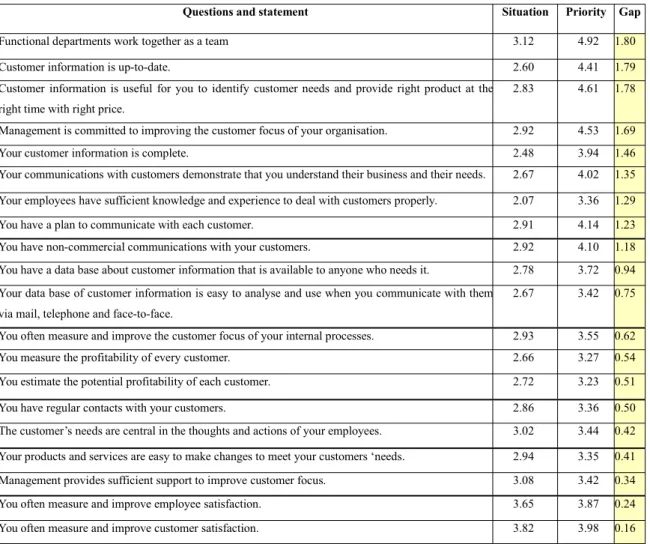
The case banks accessed their relationship orientation and customer focus by sending questionnaire to internal managers. For example, in the case bank C, an Australia based multinational bank, questionnaires were answered by the managers in a geographical division in order to assess the customer focus. The managers were required to answer the questions and score the statements, on a scale of 1 to 5, at to the degree it applies to the managers and the degree this subject should be a priority for improvement. Table 1 shows an example survey and identifies the problems that they need to improve
Table 1 the relationship orientation and customer focus report in bank C
Questions and statement Situation Priority Gap
Functional departments work together as a team 3.12 4.92 1.80 Customer information is up-to-date. 2.60 4.41 1.79 Customer information is useful for you to identify customer needs and provide right product at the
right time with right price.
2.83 4.61 1.78 Management is committed to improving the customer focus of your organisation. 2.92 4.53 1.69 Your customer information is complete. 2.48 3.94 1.46 Your communications with customers demonstrate that you understand their business and their needs. 2.67 4.02 1.35 Your employees have sufficient knowledge and experience to deal with customers properly. 2.07 3.36 1.29 You have a plan to communicate with each customer. 2.91 4.14 1.23 You have non-commercial communications with your customers. 2.92 4.10 1.18 You have a data base about customer information that is available to anyone who needs it. 2.78 3.72 0.94 Your data base of customer information is easy to analyse and use when you communicate with them
via mail, telephone and face-to-face.
2.67 3.42 0.75
You often measure and improve the customer focus of your internal processes. 2.93 3.55 0.62 You measure the profitability of every customer. 2.66 3.27 0.54 You estimate the potential profitability of each customer. 2.72 3.23 0.51 You have regular contacts with your customers. 2.86 3.36 0.50 The customer’s needs are central in the thoughts and actions of your employees. 3.02 3.44 0.42 Your products and services are easy to make changes to meet your customers ‘needs. 2.94 3.35 0.41 Management provides sufficient support to improve customer focus. 3.08 3.42 0.34 You often measure and improve employee satisfaction. 3.65 3.87 0.24 You often measure and improve customer satisfaction. 3.82 3.98 0.16
The corporate banking director of this division explained that.
“From this assessment we find that we need to improve our cooperation between functional departments and customer information management. It is impossible for any individual manager to deliver all products and services and implement the complicated solutions. Teamwork is a major character of customer relationship management. Moreover, we need to have accurate and comprehensive information about each customer’s background history, current business and anticipated needs. We need to keep a view toward overall customer profitability rather than in discrete segments of the business. It is critical to have a single customer view — the ability to understand and leverage every interaction a
customer has with the institution.”
Internal measures and actions
The surveys identified problems and the case bank took actions to improve the CRM system. For example, a relationship manager in a China based multinational bank C introduced that:
“We check the problems of customer focus in our bank and generate a list of priorities. We take actions to improve customer relationship management according to the result of questionnaire research. We set a number of customer-related targets with the aim of enhancing revenues. These include targets for customer acquisition and retention, increase in income in terms of up-selling and cross-selling, reduction of cost and decrease of risks.”
A corporate banking director in a UK based multinational bank H said.
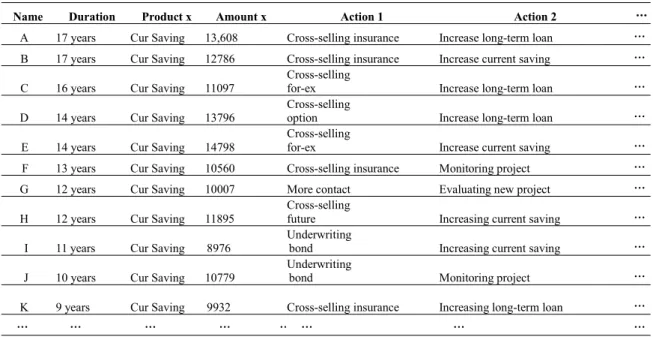
“However, customers are unique. We analyse our individual customers and have specific targets for the specific customers and we propose some plans for the specific customers. For example, as showing in the following table, we have some plans based on our customer portfolio at the beginning of year 2016.”
Table 2 A Relationship Management Planer in 2016
Name Duration Product x Amount x Action 1 Action 2 …
A 17 years Cur Saving 13,608 Cross-selling insurance Increase long-term loan … B 17 years Cur Saving 12786 Cross-selling insurance Increase current saving … C 16 years Cur Saving 11097 Cross-sellingfor-ex Increase long-term loan … D 14 years Cur Saving 13796 Cross-sellingoption Increase long-term loan … E 14 years Cur Saving 14798 Cross-sellingfor-ex Increase current saving … F 13 years Cur Saving 10560 Cross-selling insurance Monitoring project … G 12 years Cur Saving 10007 More contact Evaluating new project … H 12 years Cur Saving 11895 Cross-sellingfuture Increasing current saving … I 11 years Cur Saving 8976 Underwritingbond Increasing current saving … J 10 years Cur Saving 10779 Underwritingbond Monitoring project … K 9 years Cur Saving 9932 Cross-selling insurance Increasing long-term loan …
… … … …
The interviewees perceived that actions were taken to meet customers’ specific needs. The case banks provided tailored financial products and services and reduced banking cost and improved service quality. For example, a corporate banking director in a UK based multinational bank S said that:
“We designed tailored financial products and services for our customers. We have introduced the flexible business loan, which enables borrowers to save considerable amounts of interest through a variety of flexible repayment arrangements. We have invested in systems to enable faster turnaround of simple borrowing requests. We are committed to continually improving our service. Our aim is to ensure the solutions are the best for each customer's particular needs.”
Customer perception and customer loyalty
depended on customer perceptions. Customer perception was measured by customer satisfaction and customer behavior was measured by customer loyalty indicators in the case banks. One of the common customer loyalty indicators was the length of time as measured in months or years. Another customer loyalty indicator used by the case banks was customer share, or share of wallet, the percentage that a customer spent on financial products and services with the bank. One more indicator often used was world of mouth -- the customer recommends the bank to their business partners. A senior relationship manager in the UK base large bank A said that:
“Happy and satisfied customers behave in a positive manner. They will buy a lot from you and will give you a large share of their business. Customer satisfaction is derived largely from the quality and reliability of your products and services. The major goal of customer satisfaction program should be to achieve "preferred supplier" status with as many customers as possible.”
The interviewees perceived that it is important to know customers’ perception. The case bank identified customer needs by undertaking regular customer surveys. Customer loyalty indicators were used as one of the means to measure CRM performance and rewarding employees accordingly. A relationship manager in an Australia based multinational bank K explained that:
“We want to know their perceived benefits including both tangible and intangible factors. We ask them what they think is important and what products and services they want next year. Moreover, we ask them what they want us to do to improve their experience. We ask our customer if they will stay with us next year and want to recommend us to their business partners, friends and relatives.”
Customer surveys were conducted and problems and opportunities were identified. For example, an Australia based multinational bank K conducted a customer survey at the end of 2015 and the results were presented below.
(1). To what extent do you think the following elements were achieved by your relationship bank? Score 0-10
Fund availability 7.1
Product availability 7.8
Prices 6.9
Service quality 8.2
In time help 5.9
Financial advice 5.7
(2). To what extent do you think the following elements were achieved by your relationship manager? Score 0-10
Understand your business’ needs 7.5
Be reliable 7.9
Be helpful 7.1
Be accurate 8.6
(3) . How would you rate the overall service from your relationship manager? Score 0-10
7.8
(4). Would you recommend us to your business partners and friends?
Definitely would 42%
Probably would 47%
The case banks used customer survey to measure customer satisfaction and identify opportunities to adjust the system and improve their service. The relationship manager in bank K explained that:
“You can see from this survey. The majority of customers are satisfied with the service they receive from their relationship managers. Most of our customers would recommend us to business partners, associates or friends. Moreover, we know where we can improve our service. For example, the survey told us that customers wanted more financial advice etc.”
4.2 Relationship management techniques
Customer segments and pyramid
The interviewees argued that the case banks separated customers into different groups. For example, a corporate banking director in a US based multinational bank M presented that:
“We believe that operational profit is generating from profitable customers. Because customer relationship management requires much human resource, time and financial expenditure and we need to focus on targeted customers, typically profitable companies.”
A relationship manager in a UK based multinational bank H introduced that:
“We measure customer profitability in terms of revenue and separate customers into 4 groups, top, up level, media level and low level. The table shows our customer segments and our customer pyramid, in which we monitor their movements.”
Table 3 Customer segments and pyramid in terms of total revenue from the customer base of a regional corporate banking sector Customer Pyramid Summary
Pyramid Customers in Revenue per % % Revenue per Segment Segment Segment £ Customers Revenues Customer £
Top 4 39040 0.96% 8.14% 9760
Up level 16 75215 3.84% 17.69% 4701 Medium level 58 122023 14.11% 23.44% 2104 Low level 333 243206 81.09% 50.73% 730 Customers 411 479484 100.00% 100.00% 1167
Performance measurement
The interviewees perceived that some measures were utilized to measure customer value to the case banks. For example, a corporate banking director in a UK based multinational bank S explained.
“We use financial measures including interest and fees incomes from each customer. We also adopt non-financial measures such as the number of products and services the customer used, the number of years the customer stayed with the bank. We measure each customer in terms of return on assets (ROA). Risk management is critical in banking and therefore we measure risk-adjusted return on asset (RAROA). We also measure risk based on cost of capital, which we called COCA.”
the banks. A new method should be developed and adopted in the future. For example, a corporate banking director in a UK based multinational bank L remarked.
“We are developing a model of measuring customer value. Customer value is the total, long-term financial value that a customer delivers to our bank and, therefore, is a reflection of all income streams, from all products and services throughout the length of the customer’s relationship with the bank, and of course all directly variable costs associated with managing the customer. The resulting value is then discounted, at an appropriate rate, to calculate the net present value.”
The following formula could be used to show the customer value (CV) to banks.
CV=
n k tjvf
e
i
1 1 1
)
1
/(
)
(
t
n: the number of corporate customers
k: the number of financial products and services used by the customers
t: the year of a customer relationship
j: the interest rate or commission rate
v: the volume of a transaction
f: the frequency of business transaction
e: the extra benefits from this customer’s recommendation and influence. i: risk discount rate or cost of capital
However, the development of a model of measuring customer relationship value is only at theoretical stage and further improvement in practice is needed, for example, the determination of discount rate.
Customer information and knowledge
It is very important to collect detailed customer information. The case banks collected customer information through multi-level personal communications. The exchange of information through regular contacts with corporate customers allowed the case banks to react quickly and constructively to new opportunities arising in the firms.
The relationship between banks and corporate customers were seen as a set of cross-hierarchical communications between two organizations. Information was exchanged through multi-channel communications. Figure 2 shows that there are many levels of interfaces between a relationship bank and a corporate customer from the top-level executives to lower level managers. There were many ways that the case banks exchanged information with their corporate customers. For example, a corporate banking director in an Ireland based multinational bank I said that: “The most frequent contacts happen through relationship managers from the banks and financial directors from the corporations. The communications also happen between the senior bank managers and corporate board at the top level of the two organizations. This level of relationship also enhances the possibilities for the development of relationships further down both hierarchies.”
Figure 2 Customer communications and information
Social events Bank H Senior Bank Managers Relationship Manager Associate Directors Product Specialists Analyst
s
Customer G Board Members Executives Financial Director Associate Directors Financial ControllersFace-to-face meetings Phone Internet banking
Email ATM
“Moreover, customer data is assembled from every contact channel — call centres, mail, person-to-person, fax, the Internet and others — to construct an accurate, consistent view of customers across all available channels. Corporate customers prefer more social and relaxed environment. The personal relationships are well developed and some transactions are easily agreed. We also emphasized the importance of face-to-face meetings although the development of technology helped the relationship managers to use more and more other channels to communicate with the corporate customers.”
Customer information was stored at a bank-wide platform and analysed by specialists using CRM technology. Because the case banks organised and allocated human resource and other resources around customer groups instead of products or channels, customer information from all of products the customer used was integrated in a single information platform. The managers were able to obtain a full picture of customer. A corporate banking director at a regional division of bank R explained that.
“A single customer view represents the integration of all customer information, regardless of contact points and channels. It is critical to have a single, enterprise-wide view of the customer, spanning all touch points and systems. The concept of a single customer view — the ability to understand and leverage every interaction a customer has with the institution — is moving to front and centre in banks’ long-term business strategies.”
The interviewees perceived that it was important to transfer customer information to customer knowledge. The case banks improved customer knowledge over time and created competitive advantages. A relationship manager in a UK based multinational bank B explained that:
“We separate customers into some industry groups. The relationship managers with specific knowledge and experience in the particular industry are assigned to look after this customer group. The bank managers accumulated specialised knowledge in this industry area over time. This also helps the relationship managers to understand customers’ business and identify customers’ needs. Therefore, by organising bank resources around customer groups we can explore the information and knowledge advantages.”
4.3 Problems and difficulties in relationship banking
The interviewees perceived there could be some problems and difficulties in relationship banking. First, the traditional cultural norms might hinder the implementation of effective relationship orientation and customer focus. When there
was a widespread belief among bank staff that managers were evaluated only on the basis of their own profit contributions, the relationship manager's ability to organize and coordinate could be impaired. Corporate customers always require a range of financial products and services and therefore it was impossible for a single manager to provide all of these products and services. Teamwork is the nature of customer relationship management.
Secondly, problems might arise from the inherent conflict between performance measurement systems and the nature of banking relationships. Relationship managers were usually evaluated annually on the profitability to the bank of the relationships they managed. But the establishment of a successful relationship might take many years of persistent effort before profit objectives could be attained. How could the efforts of the relationship manager be measured and evaluated during the interim period when customer penetration was not yet significant?
The interviewees perceived that performance measures and employee compensation should reflect individual contribution and teamwork, short-term performance and long-term achievement, financial and non-financial indicators. For example, a corporate banking director at the headquarters of a UK based multinational bank R expressed that: “We organise the employees in some teams around customer groups. They cooperate within the team and along with other divisions. We improve the teamwork by measuring their performance in team. We also recognized the role of employees in providing services and contribution to the organization.”
“We recognized that reward systems have impact on employee behavior. It suggests that employees should be rewarded for the achievement of customer satisfaction and building customer relationships. Therefore, we developed customer-based performance measurement and incentive based compensation system.”
However, it was difficult to balance individual compensation and teamwork reward. For example, the current debate on the payment system is that on one hand the managers should not be rewarded as the banks failed to achieve the profit targets. On the other hand, teamwork should be motivated but it was unfair to deprive an individual reward because of the failure of whole organization.
5. Conclusion
This study investigated the implementation of relationship banking and identified the strategic actions and tactical techniques. Customer relationship was seen as a source of competitive advantages. The case banks separated customers into industrial groups and appointed suitable relationship managers to take care of them. Customer information was collected from different contact points and channels and integrated into customer database. The case banks analysed customer information and accumulated customer knowledge overtime. Internal surveys were utilised to measure Customer focus and external customer perception and loyalty were measured and employees were rewarded accordingly. Opportunities and problems were identified and actions were conducted to improve the system in a dynamic learning process.
It implies that resource based view (RBV) [25] and customer-value based theory [3] may be helpful to understand the
value creation process in relationship banking. This study may have implications for the Enlightened Stakeholder
Theory [21]where the stakeholders may have conflicts of interest in the short run but in the long run they have a
collective interest. Therefore, it is possible that the employees and customers co-operate each other and maintain long-term relationships.
The findings in this study maybe have managerial implications for other relationship managers. The interviewees have a number of years’ experience in corporate banking and this study collected their perceptions and experiences. This study may be of value for less experienced managers to improve their performance. The findings maybe have implications for other banks as the case banks have good practice in relationship and therefore other banks could critically evaluate their performance by comparing with the case banks’ experience.
Future research could be conducted to test the relationship between relationship management performance and bank profitability and the relationship between value added to customers and value added to managers and shareholders
References
1. Woodruff RB, 1997, Customer Value: The Next Source for Competitive Advantage, Journal of the Academy of Marketing Science, Vol. 25 (2):139-153.
2. Guo Y, Holland JB and Kreander N, 2013, Establishing bank-corporate relationships and building competitive advantages, Journal of Financial Services Marketing, Vol. 18 (1): 27- 29.
3. Slater SF, 1997, Developing a Customer Value-Based Theory of the Firm, Journal of the Academy of Marketing Science, Vol. 25 (2): 162-167.
4. Hodgman DR, 1963, The Deposit and Commercial Bank Investment Behaviour, Review of Economics and Statistics, Vol. 41: 257-261.
5. Wood JH, 1975, Commercial Bank Loan and Investment Behaviour, Wiley, New York.
6. Holland JB, 1993, Relationships Between Multinational Enterprises and Banks, Institute of Chartered Accountants England and Wales.
7. Gawler D, 1984, The Treasurers View, Banking Relations Seminar, The Treasurer, October: 9-10.
8. Berlin M, 1996, For better and for worse: Three lending relationships, Business Review Federal Reserve Bank Philadelphia, December: 3–12.
9. Degryse H and Van Cayseele P, 2000, Relationship lending within a bank-based system: Evidence from European small business data, Journal of Financial Intermediation, Vol 9 (1): 90–109.
10. Ongena S and Smith DC, 1998, Bank Relationships: A Review, Working Paper, the University of Florida.
11. Guo Y, Holland JB and Kreander N, 2014, An exploration of value creation process in bank-corporate communications, Journal of Communication management, Vol. 18 (3): 254-270.
12. Scanell T, 1999, CRM looms on the horizon, Computer Reseller News, Vol. 850: 59-60.
13. Shaw R, 1999, CRM Definitions — Defining customer relationship marketing and management, in Customer Relationship Management --The Ultimate Guide to the Efficient Use of CRM, SCN Education B.V.
14. Galbreath J, 1998, Relationship management environment, Credit World, Vol. 87 (2): 14-21.
15. Reiling JP, 2017, Using CRM to Target and Acquire the Right Customers, Brighthubpm, Resource-management, No. 129451. 16. Fletcher K, 1999, Data focus on customers, Marketing, March 11: 52-53.
17. Ryals L, 2005, Making customer relationship management work: The measurement and profitable management of customer relationships, Journal of Marketing, Vol. 69: 252-261.
18. Payne A, Holt S and Frow P, 2001, Relationship value management, Journal of Marketing Management, Vol. 17 (7): 785-817. 19. Thompson, 2008, CRM guru, www.crmguru.com.
20. Guo Y, 2005, CRM – success beyond software, International CRM conference GCCRM, Shanghai.
21. Diamond D, 1984, Financial intermediation and delegated monitoring, Review of Economic Study, Vol. 51: 393–414. 22. Williamson OE, 1975, Markets and Hierarchies, Free Press, New York.
23. Jensen MC, 2001, Value Maximization, Stakeholder Theory, and the Corporate Objective Function, Journal of Applied Corporate Finance, Vol. 14 (3): 2 – 21.
24. Stiglitz JE and Weiss A, 1981, Credit rationing in markets with imperfect information, American Economic Review, Vol. 71 (3): 393-410.
25. Barney JB, 1991, Firm resources and sustained competitive advantage, Journal of Management, Vol. 17 (1): 99-120.
26. Kohli AK and Jaworski BJ, 1990, Market Orientation: the Construct, Research Propositions, and Managerial Implications, Journal of Marketing, Vol. 54 (April): 1-18.
27. Kahn BE, 1998, Dynamic relationships with customers: high-variety strategies, Journal of the Academy of Marketing Science, Vol. 26 (1): 45-53.
28. Drucker PF, 1973, Management: Tasks, Responsibilities, Practices, Harper & Row, New York.
29. Boot AWA., 2000, Relationship Banking: What Do We Know? Journal of Financial Intermediation, Vol. 9 (1): 7–25.
30. Creswell JW, 2017, Qualitative inquiry and research design: Choosing among five traditions, 3 Ed, Thousand Oaks, CA: Sage. 31. Corbin J and Strauss AL, 2015, Basics of qualitative research: Techniques and procedures for developing grounded theory (4th
ed.), Newbury Park, Sage Publications.
32. Miller SI and Fredericks M, 1999, How Does Grounded Theory Explain? Qualitative Health Research, Vol. 9 (4): 538 - 551. 33. Locke K, 2001, Grounded Theory in Management Research, SAGA Publication.