Collaboration in Context:
Tracing Conversation in Web-Based Peer Review
By
Abby Jean Gerdes
Honors Thesis
Department of English and Comparative Literature University of North Carolina-Chapel Hill
2014
Approved:
Introduction
In the years immediately following World War II and up until the mid-1960s, English courses at American colleges relied on a model of learning known as the “Yale tripod,” a curricular framework which emphasized the multilateral study of language, literature, and composition (Gere 28). However, as enrollments doubled at American colleges in the decade of the 1960s and a number of public universities and colleges such as the City University of New York began to implement new open admissions policies (Bazerman 30), the face of secondary English studies began to change and the content-centered tripod model of the post-Sputnik era began to fall out of use. Larger, more diverse student bodies necessitated a new kind of writing curriculum, one which focused not only on improving first year students’ literacy skills but also one which favored more student-centered learning (31).
emulate the British approach, emphasizing students’ personal and linguistic development rather than content-specific learning goals (Gere 28).
It was at this juncture that American college teachers first began to look specifically to collaborative pedagogy as a potentially viable alternative to what were quickly becoming outdated modes of instruction. As James Moffett, Ken Macrorie, Donald Murray, John Bremer and Peter Elbow each published important scholarship advocating for the implementation of collaborative learning practices in English classrooms (Gere 29), more and more colleges began to explore the possibility that this new kind of pedagogy might resonate with incoming classes of students who had become disillusioned with the somewhat hierarchical social structures of traditional classrooms (Bruffee 649). Collaborative learning, they argued, challenges students to think about their coursework in new ways. Collaboration, they said, allows students to begin to move beyond a basic cursory understanding of a course’s materials and to begin questioning and critiquing those materials through dialogues with peers (637). In short, these writers and others posited that collaborative learning “harnessed the powerful educative force of peer influence that had been—and still is—largely ignored” (638).
This burgeoning pedagogy continued to gain traction in the 1970s and 1980s, and is today considered a best practice in English education (Thomas 131). As a number of
contemporary researchers have argued, collaborative learning particularly benefits culturally and linguistically diverse classrooms which, according to the American Council on Education’s most recent Status Report, are becoming more and more commonplace each year (Kim 9-10).
competition and stressing cooperation, collaborative learning practices help generate classroom environments which privilege collective, community-based learning over more individualized success (Lindemann 204).
In contemporary scholarship, collaborative learning is known by a number of different names. Cooperative learning, the partner method, helping circles, editing sessions, workshops, and peer tutoring are just a few of the terms sometimes used to describe the process by which students convene to discuss or debate their coursework (Gere 1). This wide range of terminology is indicative of the fact that collaborative learning comes in a variety of different flavors and is, at present day, employed as a learning strategy for students across a number of different
disciplines. Yet while collaborative learning can take a number of different forms, one important feature underpins many interactions which might be labeled “collaborative.” That is, many forms of collaborative learning involve, or have roots in, spoken conversation.
between students, larger extrinsic forces not necessarily inherent to the digital space also likely shape the way students engage with one another online.
Theoretical Support for Conversational Learning
There is a long history of philosophers and educators suggesting that conversation is foundational to both thinking and learning (Thomas 131). Indeed, one need only look to the dialogical nature of Plato’s dialectic method for evidence of the important role conversation played in ancient approaches to education. In the last century, research concerning the efficacy of conversational learning has advanced significantly thanks to the work of sociolinguist Lev Vygotsky and American education reformer John Dewey. Making arguments for the cognitive value of conversation and the inclusion of conversational learning practices in classrooms respectively, Vygotsky and Dewey gave a new impetus to the value of conversation as an educative and learning tool, and in many ways spawned something of an educational movement in the direction of conversational pedagogy (Emig 9).
engage in with other people (236). Thus, the human ability to think in broad, varied, and
complex ways is a direct consequence of practiced public and social conversation (252); in short, we can think because we can converse, or, as Kenneth Bruffee later described it, “thought is internalized conversation” (639).
Around this same time, John Dewey became an important voice within the field of education and began to make a case for the ways in which conversation might contribute to the quality of student learning (261). Building on the work of Jean-Jacques Rousseau and Johann Heinrich Pestalozzi, Dewey argued that an ideal education should do more than equip students with academic knowledge; it should help students to develop the kinds of social and
interpersonal skills a well-functioning democratic society necessitates. Ideally, Dewey argued, schools should function as places for students to grow as socially responsible members of society and to develop the ability to take charge of their own learning (262). Dewey maintained that schooling and learning should themselves be social and interactive processes, allowing students to practice the very kinds of cooperation and conversation a well-functioning democratic society calls for. Thus, positing conversation as a tool for cultivating social-mindedness in students, Dewey’s work brought new attention to the ways in which conversation might contribute to the quality of a student’s learning (263).
Today, the theories of Vygotsky and Dewey remain foundational to our contemporary understanding of collaborative, conversational learning. Additionally, since their theories were first published in the early part of the 20th century, a number of researchers have extended their claims and given nuance to the basic idea that conversation may be a viable learning and educative strategy. English philosopher Michael Oakeshott entered into this ever evolving
of Mankind.” Building off of Vygotsky’s and Dewey’s claims, Oakeshott contended that conversation demonstrates not only cognitive and social value, but also value to the humanist tradition (199). Oakeshott argued, not unlike Vygotsky, that conversations are always occurring both within us and among us—that mankind [sic] is constantly engaged in an extended, ongoing conversation about the human condition. Oakeshott posited that this “conversation of mankind” has been ongoing since human beings first inhabited “primeval forests” and that our ability to write and talk about ourselves and others places us within a longstanding tradition of human beings conversing about what it means to be human. Thus, Oakeshott suggested that conversing not only gives us the ability to think or the ability to interact responsibly within our present-day society but also offers us a way of thinking which unites us, across time and space, to the rest of humanity (199).
In these ways, Vygotsky, Dewey, and Oakeshott’s cognitive, pedagogical, and
humanistic arguments have all contributed to the increasing use of conversational pedagogy in modern classrooms. Indeed, if our ability to think clearly and complexly hinges upon our understanding of how human beings typically converse with one another, if the principle responsibility of schools is to prepare students to know how to socially engage in their communities, and if our ability to converse allows us to figuratively engage with writers and thinkers who have come before us, it follows that conversation should play a particularly important role in composition instruction.
Conversation as a Framework for Writing
we may see conversation as influencing not only our ability to think and learn in social settings, but as also offering us a framework by which to understand the social and recursive processes of writing. In his seminal essay, “Collaborative Learning and the ‘Conversation of Mankind,’” Bruffee outlines the relationship, as he sees it, between conversation and writing:
Like thought, writing is related to conversation in both time and function. Writing is a technologically displaced form of conversation. When we write, having already internalized the “skill and partnership” of conversation, we displace it once more onto the written page. But because thought is already one step away from conversation, the position of writing relative to conversation is more complex than the position of thought relative to conversation. Writing is at once two steps away from conversation and a return to conversation. We
converse; we internalize conversation as thought; and then by writing we re-immerse conversation in its external social medium. (641)
For Bruffee, our knowledge of and ability to engage in conversation actually seems to spur our ability to write, offering us a means by which to process and express our internal ideas in textual forms. Writing, then, is an inherently social process, simultaneously influenced by and imitative of spoken conversation (642). Indeed, the two processes are intimately interwoven; that is, we may actually view writing as a textual form of conversation—as an instrument through which writers and thinkers might figuratively come together and exchange ideas with one another.
is based on an assumption that invention is neither a purely individual nor an interpersonal act or process; rather, it is encouraged or constrained by social collectives whose views are transmitted through such things as institutions, societal prohibitions, and cultural expectations. (50)
In this sense, even writing done alone is never really isolated; rather all writing is pervasively influenced by other writers and other pieces of writing (Lunsford 8).
According to this line of thinking it seems, logically, that writing classes should themselves be social and conversational. Bruffee makes this very argument:
The inference writing teachers should make from this line of reasoning is that our task must involve engaging students in conversation among themselves at as many points in the writing and the reading process as possible, and that we should contrive to ensure that students’ conversation about what they read and write is similar in as many ways as possible to the way we would like them eventually to read and write. The way they talk to each other determines the way they will think and the way they will write. (642).
Peer Review as a Means of Conversation
Yet, while traditional student-to-teacher writing assignments may restrict students’ abilities to see writing as a conversational endeavor, less traditional peer-to-peer writing contexts may restore this sense of conversation (Cho 3). Indeed, peer-to-peer writing or “peer review” is one pedagogical strategy often used to encourage students to practice this kind of conversational academic writing. Though “peer review” is often used as an umbrella term and can take a number of different forms, traditionally speaking, peer review is seen as a kind of one-to-one, peer interaction in which students generally comment directly on one another’s papers before reconvening to discuss their feedback in a face-to-face, spoken context (Barker and Kemp 6).
While peer review provides a host of different learning benefits for students, it
particularly foregrounds this notion of writing as conversation by focalizing writing as a social, conversational process. By asking students to act as real responders to their peers’ papers, peer review, by definition, puts student writers in dialogue with one another. By creating
opportunities for students to confer and respond to one another’s writing, this process gives emphasis to the idea that writing is meant to be read and discussed and to facilitate the sharing of ideas (Lindemann 204).
In addition to eliciting conversation between writers, peer review also creates a particular learning context in which conversations take place through written feedback and shared
643). In this sense, peer review actually enables students to write for one another in much the same ways that scholars write for their respective academic communities. Thus, as Bruffee points out, the conversational nature of peer review actually prepares students to produce the kind of writing college teachers value; it encourages students to produce texts which do not exist in a vacuum but rather carefully consider the codes, customs, and values of a particular scholarly audience (642). Because one of the goals of higher education is to familiarize students with the way scholars converse in writing within in their academic communities, it is important that students themselves are given the opportunity to practice conversing, in written forms (643). In this sense, peer review presents a valuable learning context which encourages students to write for one another.
In addition to honoring current writing models which give emphasis to the social, recursive nature of composition (Faigley 17), peer review may create student-centered learning environments for writers. As Bruffee points out, the equality of status among students engaged in peer review breaks down learning hierarchies and places students in a rhetorical situation which deemphasizes a teacher’s expectations and instead stresses student engagement (649). Indeed, the collective and collaborative nature of peer review challenges the assumption that knowledge must be passed down from an authority figure to a learning pupil, and thus gives students a greater sense of ownership over their own learning (Pharo and De Salas 204).
Finally, peer review may additionally aid students in developing what Anne Ruggles Gere has termed a “writing vernacular” (Gere 90). Through the process of reviewing one another’s writing, students “generate language about language” as they are forced to both recognize and evaluate various aspects of their peers’ work. Thus, in the process, students begin to develop a “vernacular to be internalized for the members’ future use” (92). As students learn to talk about writing, they become better equipped to make clear and critical value judgments about their own and others’ writing (Gillam 98). And, as Gere points out, having language to talk about writing allows writers and reviewers to communicate about a piece of writing’s strengths and weaknesses in more nuanced and detail-oriented ways (90). Additionally, a writing
vernacular not only aids students in talking about writing in more precise ways, but also in
thinking about writing more clearly. This phenomenon, referred to by cognitive psychologists as metacognition, has often been cited as a hallmark of critical thought. As Keith Topping
describes it, “[peer] assessment involves interrogating the product or output, evaluating it in relation to intelligent questions at a macro and micro level. Training in [peer review] seeks to develop this capability of asking intelligent, adaptive questions” (254). Thus, in helping students develop the language to speak and think more clearly about writing, peer review not only equips students with the knowledge necessary to make thoughtful improvements to their own and others’ writing, but also engages students in the higher order thinking skills so often valued by college teachers and necessary for ultimately making revisions to their own writing (Bruffee 643).
student engagement and critical thinking. Indeed, this particular kind of learning context, in its inherently social nature, challenges students to move away from one-way exchanges or a strictly binary view of spoken and written language and to, as Lee-Anne Breuch says, “embrace a broader understanding of [communication] that involves reading, writing, and interacting” (75).
Conversation and Web-based Peer Review
Increasingly, this traditionally in-person exercise of peer review is taking place online. Online peer review programs have grown popular in undergraduate writing classes for a number of reasons. Perhaps most obviously, online peer review tends to be much more efficient than traditional forms of peer review, as it allows students to review one another’s work outside of class, freeing up class-time for other coursework (Lin 246). Online systems also allow teachers to track student participation and potentially enable teachers to more closely monitor students’ progress (248). However, translating what has traditionally been an in-person exercise into the digital realm presents some challenges. In particular, online peer review systems raise questions about how the kinds of communication and conversation which take place in traditional peer review may be influenced, altered, or complicated by the online environment.
become increasingly standardized, more critics have begun interrogating how specifically online peer review might influence the ways in which student interactions play out.
A research study conducted by Beth Hewett lends credence to the notion that online peer review may facilitate different types of peer interaction than traditional peer review. Her study, which compared the kinds of peer responses given in in-person peer groups to those given on an online peer review forum, found the two contexts provided for different kinds of peer “talk” (1). In-person reviewers, she found, often relied on “gestures and body language” and other
intertextual forms of sharing, whereas online reviewers communicated in what she has described as a kind of hybridization of written and spoken language. She explains: “With oral talk, gestures and body language supply cues that signal the particular receiver of the exchange . . . However, such intertextual sharing is complicated by [Web-based peer review systems]” (18). Hewett’s study points to what other critics have similarly identified as a key tension inherent within online peer review spaces: they ask students to rely on written communication to engage in a process which has traditional been speech-based. Breuch in particular echoes this concern that transposing a traditionally oral learning exercise into a written platform may create some challenges regarding peer-to-peer conversation. “On the one hand,” she notes “there is a desire to ground virtual peer review in the tradition of peer review as we know it and have practiced it (which is to say, within orality); yet the reality is that . . . computer mediated communication shapes peer review differently” (19).
question specifically, a relatively sizeable body of literature suggests that it is both possible and useful for students (and teachers) to respond to one another’s texts in written, “conversational” ways. In “Responding—Really Responding—to Other Students’ Writing,” Richard Straub offers suggestions as to what an effective written conversational response to student writing might look like. He recommends that students use writing to engage in “ongoing discussion[s]” with
writers, to “talk to writer[s]” and to act as “readers, helpers, [and] colleagues” (139). Similarly, in “Teacher Response as Conversation” he notes that using a relaxed tone, avoiding technical jargon, and resisting the urge to “simply label errors and mark problems” all aid a responder in creating a written sense of conversation in his or her peer review (347). As Straub imagines it, conversational interaction can occur in written contexts when responders act, first and foremost, as thoughtful readers (“Responding” 136). Making similar claims, Nancy Sommers has
suggested that readers particularly should use questions to evoke a sense of conversation in their written reviews, simply responding inquiringly to papers in the same way they have been trained to read and respond to literary texts (154). She suggests that questions allow a written exchange to take a form which closely resembles a face-to-face conversation, positing that responding in this way allows the reader to authentically express what “questions [he or she] has about the meaning of the text” (153). In these ways, Straub and Sommers posit writing as a viable means of conversation, suggesting that, the ideal of conversational learning may indeed be upheld in text-based (and by perhaps by extension, Web-based) interactions.
spaces promote conversational learning, albeit in different ways than more traditional peer review paradigms. In the hopes of exploring this possibility more concretely, the following section, which takes the form of a case study, explores one example of how conversational learning may play out in online peer review.
A Case Study in Conversational Web-Based Peer Review
In 2009, the University of North Carolina’s English Department witnessed the birth of a new learning opportunity which made online, conversational peer review more readily available to undergraduate researchers. To give students the opportunity to participate in the same kinds of dialogical peer review academics themselves engage in, Daniel Anderson and Ashley Hall began building an online, interdisciplinary, undergraduate research journal which offered students a platform though which to read, review, and engage with one another’s research. Its creators deemed the initiative The People, Ideas, and Things (PIT) Journal, anticipating that the journal would function as a social, academic setting for undergraduates to come together to publish research essays.
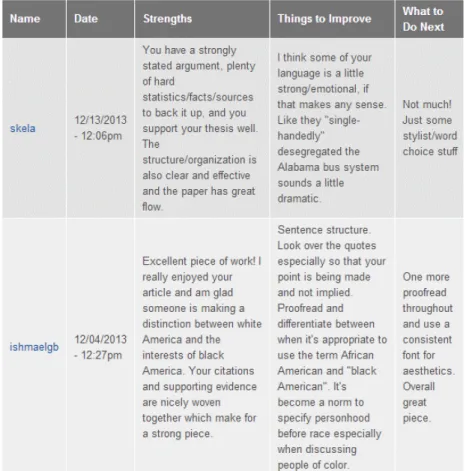
feedback for a writer. Figure 1 illustrates how students’ feedback appears within the PIT Journal:
As the figure shows, students write reviews for their peers using a Web-name. Reviewers are asked to respond to three separate prompts when giving feedback: “Strengths,” “Things to Improve,” and “What to Do Next.” While these prompts have changed slightly since the PIT Journal’s creation, these current prompts can be seen as encouraging students to first comment on a draft’s strengths, then consider weaknesses, then recommend a focus for revision. Tonally, the prompts themselves are somewhat conversational: “What to do Next.” Thus, they seek to elicit students’ authentic, readerly impressions, while guiding (hopefully) reviewers toward productive response. In this way, both the form of the journal’s peer review platform and its
peer review prompts seek to create a public, academic space which will allow students to respond to one another’s writing through conversational, written exchanges.
As an open space for readers and writers to interact with one another about their writing, the PIT Journal platform demonstrates both the benefits and challenges of online review spaces. That is, as Lee-Ann Breuch says in Virtual Peer Review: Teaching Learning About Writing, online spaces both limit and open up possibilities lacking in face-to-face conversations,
providing for different forms of student-student interaction than do more traditional peer review paradigms (72). This case study seeks to interrogate how written conversation is occurring within the PIT Journal platform and to assess its affordances and limitations. Particularly because these kinds of online peer review platforms have become increasingly popular
throughout college English departments over the course of the past decade (Cho 2), examining the PIT Journal, and Web-based peer review platforms like it, can illuminate how, in practice, collaboration and conversation actually take place within online educational spaces.
Methodology
To measure how students communicated with one another within this peer review platform, all of the peer feedback given during the closing stages of the PIT Journal’s fall 2013 article submission cycle was coded for conversationalities. Two types of conversational
to pinpoint how and where it broke down, creating a holistic illustration of the ways in which conversation occurred within the Web-based platform.
Measuring Conversation amongst Reviewers
In Crowdsourcing: Why the Power of the Crowd is Driving the Future of Business, Jeff Howe argues that internet technology, and specifically open source internet software, has brought about a new age of cooperative innovation (3). As Howe says, these new technologies allow individuals to come together in a kind of cyber meeting space to discuss ideas and solve problems through collaboration (6). While this idea of crowdsourcing is most frequently
regarded as a kind of entrepreneurial business model, the creators of the PIT Journal recognized this concept as a potential way of constructing a social, peer review platform built on mass participation. Using open source software and Web 2.0 technologies, the journal seeks to
capitalize on this concept of crowdsourcing and to operate as a kind of public, open forum. That is, it seeks to encourage students to come together and self-organize to create collective and collaborative systems of peer review for writers. Ideally, according to Howe’s concept of crowdsourcing, the journal’s open forum format should allow responders to build off of and extend one another’s comments to create collective, dialogical responses to writers’ papers. Theoretically, this kind of peer review platform should allow for a kind of cooperative and democratic system of review not possible in more traditional one-to-one peer review
arrangements. But to what extent did these kinds of conversational exchanges actually take place between reviewers?
agree with Bethany. . . ” in her review was said to have demonstrated acknowledgement. This assessment was used as a baseline measure to gauge the extent to which reviewers
communicated with one another. Of the 48 total comments given on articles submitted during closing stages of the fall of 2013 PIT Journal peer review cycle, only two (4 percent) were judged as having met this criteria. Thus, by this assessment, it appears that students generally used the platform as a space for communicating discrete feedback directly to writers rather than as a space for conversing and communicating openly with one another. Indeed, for the most part, rather than responding to or building off of one another’s comments, reviewers tended to leave feedback which did not engage with other students’ reviews. In this sense, despite the journal’s open forum format, students tended toward the familiar one-to-one kind of
communication typically employed in more traditional peer review cycles (Barker and Kemp 6). Yet, while reviewers do not appear to have acknowledged or interacting with one another within the PIT Journal’s peer review platform, reviewers may have engaged in conversational reading. That is, it seems clear that many reviewers may have read their peers’ comments before submitting their own. This is perhaps illustrated by the fact that reverberations of the same ideas and phrases tended to appear across papers’ comments, suggesting that students at least skimmed their peers’ feedback before writing their own. For example, three reviewers make very similar comments about a single paper’s “Strengths”:
Reviewer A: The argument is clearly presented and is concise, a positive for the reader. There is an abundance of evidence and I personally was a fan of the
incorporation of Bandura’s theory, expanding on your argument. The inclusion of counterarguments helps to strengthen your points.
Reviewer C: Your argument is concise and clear and the map of the article is very useful to the reader.
The observation that the paper’s argument is “clear” and “concise” is reiterated in all three reviews, exhibiting only minor differences in phrasing. In a similar example, three readers responded with reiterative comments about a paper’s “phenomenal” introduction and opening use of a “hook”:
Reviewer A: This paper is well organized and opens with an amazing hook, capturing the reader’s attention. It is also exercises good word choice, it is not too verbose but the wording is not too limited either. The essay flows easily and is not hard to read at all.
Reviewer B: Your opening paragraph was phenomenal. I was completely hooked and wanted to keep reading to find out the conclusion and research you did. I thought you presented the facts very well and the entire thing was well written. Reviewer C: The organization of the paper was phenomenal. I especially liked how in the opening you told the reader what information they would be presented with and why that information was important. The paper was very easy to follow and I was glad you provided background on the system.
While it is to be expected that multiple students might share similar reactions to a single paper, here, again, reviewers reiterate strikingly similar ideas: “I was completely hooked;” “opens with an amazing hook;” “your opening paragraph was phenomenal;” “the paper was phenomenal;” “the paper was easy to follow;” “the essay flows easily.” It seems clear, based on these parallels, that some students may have read or at least referenced their peers’ comments before composing their own. What is less clear are the kinds of conclusions to be drawn from these repetitions.
that their peers’ feedback is visible, and using it to help write feedback of their own relatively quickly and effortlessly. This may, of course, have been the case for some students; as Cazden points out “there is ample evidence that people do not learn anything well unless they are both motivated to learn and believe that they will be able to use and function with what they are learning in some way that is in their interest” (33). In this vein, it is possible that some students were not “motivated to learn” peer review or did not view offering feedback to other people as being an exercise which “[was] in their interest” (33). It is possible that, for lack of motivation or interest, some students may have indeed used their peers’ feedback as crutch to completing their own.
There is, however, another more encouraging possibility. According to Bryan Warnick’s influential Imitation and Education, this kind of recursive pattern of comments may suggest that a particular kind of imitation-based learning is taking place—that, in the context of this kind of nonstandard writing and reviewing assignment, students began looking to one another for direction. As Warnick argues, imitation is perhaps one of the most fundamental and automatic ways we learn new social and cognitive skills; through a somewhat reflexive process of reading, internalizing and replicating a behavior, we begin to learn that behavior, to understand it and to make it our own (412). Michel Couzijn has made similar claims specifically in reference to the ways in which students learn writing skills. He, like Warnick, recognizes the value of “learning-by-observation,” positing that one of the quickest ways for students to learn a particular writing habit is through “observation of peers” (112). In this sense, in reiterating praise for a paper’s hook or offering parallel feedback about a paper’s “clarity,” it seems possible that students may have observed and then mimicked one another’s comments in an effort to navigate this
The fact that students may potentially be looking to their peers’ comments for guidance before composing their own is significant for a number of reasons. First, it suggests that the journal’s open forum format may be providing for a slightly different kind of learning
opportunity than was initially intended, but a potentially valuable learning opportunity
nonetheless. Indeed, while students do not appear to be using the platform’s open online format to work together and provide collective responses to individual papers, they may be reading one another’s peer feedback to navigate an unfamiliar writing situation, and, by extension, looking to one another as models for composing peer reviews. In this sense, by affording students the opportunity to read one another’s peer feedback before composing their own, the journal’s open peer review platform may potentially be encouraging students to engage in what might be called meta-review, allowing students to read, review, and evaluate their peers’ comments as a means of interrogating and assessing for themselves what it means to respond to a written text in useful, productive ways. Indeed, it seems, intuitively, that this kind of exercise might prove useful not only in helping students improve as peer reviewers, but also in improving their own writing projects.
Measuring Conversation amongst Reviewers and Writers: Assessment One
Considering that reviewers were rarely witnessed interacting with one another within the PIT Journal’s peer review platform, it seems clear that most of the conversational exchange taking place within the platform must be occurring between reviewers and writers. However, exploring this possibility means considering to what extent these interactions might be
acting as “readers, helper[s], [and] colleague[s]” rather than critical editors (“Responding” 139). Recall that, in “Responding—Really Responding—to Other Students’ Writing,” Straub defines “conversational [written] response” in this way, distinguishing conversational feedback from “directive feedback,” which, as Straub says, does more in the way of “marking, editing, or correcting” (374).
While Straub has claimed that we “can tell pretty easily when a set of comments is
conversational” more standard measures are needed to actually assess and be able to quantify the extent to which conversational responses took place within the PIT Journal’s peer review
platform (“Teacher Response” 375). But finding a way to actually measure this somewhat ambiguous idea of “conversational response” presents something of a challenge. For the most part, scholarship characterizes conversational responses in vague, euphemistic terms, saying that conversational responses should “create a kind of dialogue,” “keep lines of communication open” (Lindemann 216), “engag[e] in a writerly conversation” (Elbow, “Principles” 10) and operate like a “good talk with a friend” (Danis 19). The challenge here, it seems, is finding a set of criteria to measure a concept which has traditionally functioned as more of a metaphor than an applied pedagogical tool.
Yet, as elusive as this concept of response as conversation tends be, Richard Straub offers a particularly practical set of guidelines for how this kind of review might work in practice. Indeed, of all the ways critics describe and classify conversational response, Straub’s set of guidelines are perhaps the most concrete. He recommends the following:
1. Reviewers should “tie their commentary back to the student’s own language on the page, in text-specific comments.”
By responding in this way, Straub argues, reviewers focus less on “label[ing] errors and mark[ing] problems” and are actually able to “bring the meaning a reader creates from the text back out … into the arena of social exchange, where meaning may be refined, redirected, and developed” (392). In this sense, while Straub remains somewhat theoretical in his articulations of why this kind of response might be beneficial, his recommendations themselves constitute a set of useful, concrete criteria for identifying and evaluating conversation in the context of peer review.
Straub’s recommendations were used as a basis for measuring the frequency with which “conversational responses” took place within the PIT Journal’s peer review platform.
Accordingly, to roughly assess how and where conversational response occurred throughout the peer review process, a record was taken of the number of times a review met the following parameters:
The review uses the “[writer’s] own language on the page,” quoting the writer or using “text-specific” language to “play back [the reviewer’s] way of
understanding the text” (380).
Of the 723 total sentences offering peer feedback during the fall of 2013 PIT Journal peer review cycle, 101 instances of this kind of conversational response were recorded. Thus, according to these measures, conversational remarks constituted about 14 percent of the sentences written. Hence, by this assessment it seems that this kind of conversational interaction, while occurring rather infrequently, did occur.
Interestingly, the comments which most closely aligned with these parameters for
and “played back” their interpretations of a text but also avoided using the kinds of “vague
directives” both Sommers and Straub caution against (Sommers 153; Straub, “Responding” 137). Conversely, comments which were judged as being less conversational tended to rely more on these kinds of “vague” “non-text specific” directives. Take for example this less conversational review which was typical in its reliance on vague commands:
So, I really like what you have and really have no complaints. I think it has relevance and has a wide spread influence. You're research does a great job of backing up your thesis and ideas. The only issue I have is that a lot of your paragraphs don't have flow. They have strong content, but need a better transition to help the flow of the journal. A little bit of tweaking will make this paper stronger.
Indeed, this rather non-conversational review can be seen as offering generalized, non-text-specific advice: “Your paragraphs don’t have flow; they … need a better transition; a little bit of tweaking will make this paper stronger.” This pattern of comments can be seen as deviating rather sharply from the ideal kind of conversational response. But notably, this reviewer was not alone in providing this kind of feedback. In point of fact, as the assessment shows, these kinds of non-specific comments were more common than not.
[M]ost teachers’ comments are not text-specific and could be interchanged, rubber-stamped from text to text. The comments are not anchored in the
particulars of the students’ texts, but rather are a series of vague directives that are not text-specific (149).
It seems possible then, according to Sommers’s research findings, that the main experience many students may have for responding to texts is this very model of vague directives .1 Thus, in much the same way that PIT Journal interactions suggest that students may be mimicking one another’s comments, the online commentary also potentially illustrates mimicry of the kinds of “vague non-text-specific” feedback that inhibits successful review. Indeed, if students have received this kind of feedback from instructors, it makes sense that they might imitate these kinds of responses, particularly if, as Hovardas Tasos has argued, they view the process of peer reviewing as an exercise in enacting a teacherly role teacher and “judging the performance of a peer” (Tasos, 135).
In this sense, while conversational response does not, according to Straub’s criteria, appear to be taking place at high levels within the journal’s peer review platform, it still seems reasonable to think that this kind of conversational response is possible within this context. Considering that students may be using the platform as a space to test out and practice giving the same kinds of feedback they are accustomed to receiving, it stands to reason that students might
1
In defense of teachers, as Sommers has pointed out, teacher training rarely emphasizes pedagogy in responding to student writing: “Student writing [is] rarely stressed in their teacher-training or in writing workshops; [teachers are often] trained in various prewriting techniques, in constructing assignments, and in evaluating papers for grades, but rarely in the process of
just as readily use the platform to test out and practice conversational peer response instead. Thus, as online platforms evolve to better model conversational feedback, they can incorporate this kind of “text-specific” dialogical response; indeed, something as simple as giving students more exposure to this metaphor of response as conversation might prove useful in helping to develop an appreciation for this potentially unfamiliar form of review.
Measuring Conversation amongst Reviewers and Writers: Assessment Two
While the recommendations Straub provides offer one applicable framework for identifying and measuring conversational peer response, Nancy Sommers offers a second, equally useful set of guidelines for how conversational peer review might function in real practice. In “Responding to Student Writing,” Sommers proposes that conversational responses take the form of questions, specifying that they should “rais[e] questions from a reader’s point of view” (148). She is quick to acknowledge that this notion of responding to writing with questions may at first seem counterintuitive; however, she argues, by responding in questions rather than “directives,” reviewers are able to simulate in their writing the same kind of dialogical reviewer-writer interface possible in face-to-face peer interactions (153).
Sommers’s recommendation that conversational responses “raise questions” is, much like Straub’s advice, fairly concrete and quantifiable (148). It is reasonably simple to evaluate
than querying authors about their intentions or writing processes, this assessment demonstrates that this kind of questioning response did occur even if on a relatively small scale.
Again, the comments which most closely aligned with Sommers’s ideal of “raising questions from a reader’s point of view” additionally tended to meet Straub’s aforementioned criteria for conversational response by actually using “text specific” questions to “playback” their reading of a paper (“Teacher Response” 380). Take for example the following review:
I'm not sure if you were hoping to just do a survey over Shakespeare adaptations or if you were trying to make a strong argument. You use a quote in the beginning that says adaptations will help us understand Shakespeare's words. Adaptations certainly help us understand Shakespeare themes and plots, but do they help us understand his words?
This comment, which was judged as being one of the most conversational according to Straub’s and Sommers’s parameters, can be seen as using questioning rhetoric to encourage a writer to think more carefully about her intentions for her paper. Using an inquisitive tone, the reviewer admits that he is “not sure” what the writer aims to accomplish with the paper, and in doing so plays back his interpretation of the text, positing that the paper might either be a survey paper or an argumentative paper. Further, the review uses questions to point out specific places in the text which warrant more clarification, probing the writer about what may be a weak spot in her
More commonly, though, even reviewers who succeeded in using questions in their reviews could be seen as offering rather directive feedback for revision. Take for example the following review which was typical in its use of directives:
“With such a tech-savvy generation, the inclusion of audiovisual cues such as movie clips or pictures would improve standard lecture learning." This is the thesis, right? I would make it a bit easier to find and write "I argue. . ." "This interpretation immediately got the attention of our entire class because the opening duel between Montague and Capulet boys is a gun shootout in a gas station ending in an explosion." I am sure that it did haha. And how did it facilitate learning?
Ultimately though, while some reviews did utilize questions as a strategy for
communicating with writers about their papers, the majority of reviews tended to take a mostly directive tone, offering writers specific suggestions about how to improve their drafts. The following review was typical of these kinds of mostly directive responses:
Fix your diction, first and foremost. Fix your evidence: change to Newtown and remove anecdotal evidence, and take out any references that may be outdated. Provide more detail about the counterargument so that the article seems less biased and is able to stand on its own.
This review clearly takes on a very different tone than those which relied more heavily on the use of questions. Its language is much more direct and authoritative, relying heavily on commanding verbs: “fix,” “change,” “remove,” “take out,” “provide.” Many of the reviews given within the peer review platform took on this kind of directive voice, again raising question about how the journal’s Web-based format may be playing a role in eliciting these kinds of responses which, to use Anderson’s language, “diverge sharply from a conversational ideal” (191).
themselves more guiding and questioning might help encourage more conversational online response.
Additionally, the PIT Journal’s Web-based nature may also play a role in encouraging directive rather than questioning, conversational peer response. As a study conducted by Sproull and Kiesler has pointed out, students participating in online or “networked” contexts tend to be more “critical” and “directive” in responding to peer texts than they may be in face-to-face contexts (212). Anderson has similarly suggested that online contexts may indeed influence the way conversation plays out, arguing that the inability for students to comment directly on their peers’ papers as they generally can in more traditional peer review, may alter the kind of tone they take and the kind of feedback they provide (192). In these ways, the fact that students cannot comment directly on one another’s papers coupled with the fact that, as Breuch reminds us, they cannot see or interact synchronously with the students whose papers they are reviewing, may predispose students toward directive critical response.
Conclusions: Online Conversational Reviews in Context
As Bruffee has argued, there is a longstanding historical tradition of writing being viewed and treated as an independent, isolated process; as he says, “behind our enthusiasm for
[collaboration] lies a fundamental distrust of it” (645). He points out that “collaboration and community activity” are often viewed as “inappropriate and foreign to work in humanistic
disciplines such as English,” suggesting that, for many writers, this idea of writing being a social act may seem counterintuitive and even uncomfortable. Gere has similarly pointed out that many writers tend to view writing as an isolated endeavor. She theorizes that the “eighteenth century legal-economic arguments and aesthetic prospects that spawned ‘authorship’” may still influence the way we understand the process of writing today and propagate what she calls the “solo-performer view of writing” (58). Indeed, while social conceptualizations of writing have gained much traction throughout the past fifty years, these historically rooted views of writing as an individual act still tend to dominate popular perception (55). In that sense, these
deeply-ingrained perceptions may be part of the context of online peer review.
instead to compose feedback for their peers using “focused questions that might guide the author toward revisions.” Students typically responded to this exercise with a sense of confusion:
I'm sorry if I'm not following instructions well, but it was very awkward to reword my comments as questions and I imagine it'd be at least as awkward (and slightly confusing) to read. I wanted to provide as helpful a review as possible without completely dismissing your instructions, so I included the normally written review and the same review in the form of questions.
This student in particular openly questioned the efficacy of this kind of feedback. Indeed, this student’s response is clearly hesitant, seeking to follow instructions yet wary of the instructions themselves. The student’s decision to include a “normally written review” along with the assigned inquiry-based review suggests that she did not have total confidence that the questioning review would be helpful to the writer. In writing two separate responses, she indicates that she does not feel she could write a “helpful review” while remaining within the assignment’s parameters. Implicit in this student’s response is the belief that “normal,” “helpful” feedback should be directive, not questioning—that directive comments, identifying and
correcting errors, would be more useful. In this way, the student’s reporting that writing a review in the form of questions was “very awkward” points toward the prevailing trend of critical response Straub describes, suggesting that such ingrained views may indeed be part of the PIT Journal’s larger context.
validates the ways that online educational spaces have influence on learning activities; they are not neutral; rather, their construction and operation impacts the kinds of interactions students have with one another. Recalling the ways in which the review prompts may be predisposing students toward more directive responses and the ways in which the visibility of students’ responses may allow for both imitation-based learning and copying behaviors, it is clear that environmental features such as these may ultimately have large impacts on student interactions and engagement. No doubt, as an online platform, the PIT Journal may be altered or improved to better these kinds of interactions. Indeed, as Breuch points out in Virtual Peer Review: Teaching and learning about Writing, online learning spaces are not interchangeable with (or even evolved forms of) more traditional learning spaces; rather, one of their key differences—and indeed, key strengths—resides in the fact that they may be molded in accordance with particular learning goals, and shaped (and reshaped) to elicit particular kinds learning outcomes (73). Thus, having a knowledge of the platform’s affordances and limitations and a knowledge of extrinsic factors which may additionally influence online behavior ultimately makes developing the journal’s conversational potentials more possible. Indeed, the limited conversation which occurred within the journal may actually lead us toward a larger point: Web-based educational spaces do in fact have influence and do matter; indeed, they may shape (but also be remolded) to develop
collaboration and conversation online.
Anderson, Daniel. "Web-based peer review: An opportunity for conversation." Teaching/Writing in the Late Age of Print. Cresskill, N.J.: Hampton Press, 2003. 185-198.
Barker, Thomas T., and Fred O. Kemp. “Network Theory: A Postmodern Pedagogy for the Writing Classroom.” Computers and Community: Teaching Composition in the Twenty-First Century. Portsmouth, NH: Boynton/Cook Publishers, 1990. 1-27. Print.
Bereiter, Carl, and Marlene Scardamalia. The Psychology of Written Composition. Hillsdale, NJ: L. Elbaum Associates, 1987. Print.
Breuch, Lee-Ann Kastman. Virtual Peer Review ; Teaching and Learning About Writing in Online Environments. Albany: State University of New York Press, 2004. Print. Bruffee, Kenneth A. "Collaborative Learning and the" Conversation of Mankind"." College
English 46.7 (1984): 635-652. Web
Cazden, C. A Pedagogy of Multiliteracies: Designing Social Futures. Harvard educational review 66.1 (1996): 60-92. Web.
Cho, Kwangsu, and Christian D. Schunn. “Scaffolded Writing and Rewriting in the Dicipline: A Web-based Reciprocal Peer Review System.” Computers & Education. 48.3 (2007): 409-426. Web. Learning and Instruction.
Couzjin, Michel. “Learning to write by observation of writing and reading processes: effects on learning and transfer” Learning and Instruction. 9 (1999): 109-142. Web.
Danis, M. Francis. “The Voice in the Margins: Paper-Making as Conversation.” Freshman English News 15 (1987): 18-20. Web.
Hewett, Beth L. “Characteristics of Interactive Oral and Computer-mediated peer Group Talk and Its Influence on Revision.” Computers and Composition. 17.3 (2000): 265-88. Web. Emig, Janet. “Writing as a Mode of Learning.” Cross-talk in Comp Theory: A Reader. Urbana,
IL: National Council on Teachers of English, 1997. Print.
Elbow, Peter and Pat Belanoff. A Community of Writers: A Workshop Course in Writing. Random House/McGraw Hill, 1989. 2nd edition 1994. Web.
Elbow, Peter. “Principles That Underlie My Teaching.” Responding to College Student Writing. Cresskill, NJ: Hampton, 1995. Print.
Faigley, Lester, Roger D. Cherry, David A. Jolliffe, and Anne M. Skinner. Assessing Writers Knowledge and Process of Composing. Norwood, NC: Ablex, 1985. Print.
Howe, Jeff. Crowdsourcing: Why the Power of the Crowd Is Driving the Future of Business. New York: Crown Business, 2008. Print.
Warnick, Bryan R. Imitation and Education: A Philosophical Inquiry into Learning by Example. Albany: Statue University of New York, 2008. Print
Kim, Youmg. “Minorities in Higher Education: Twenty-Fourth Status Report 2011 Supplement.” American Council on Education. 2011. Web.
LeFevre, Karen Burke. Invention as a Social Act. Carbondale: Southern Illinois, UP. 1987. Print.
Lin, E.Z-F., S.S. J Lin, Chi-Huang Chiu, and Shyan-Ming Yuan. “Web-based peer review: an effective web-learning strategy with the learner as both adapter and reviewer.”
Education, IEEE Transactions 44.3 (2001): 246-251. Web.
Lindemann, Erika. A Rhetoric for Writing Teachers. 4th ed. New York: Oxford University Press, 2001. Print.
Oakeshott, Michael. The Voice of Poetry in the Conversation of Mankind, an Essay. London: Bowes & Bowes, 1959. Print.
People, Ideas, and Things (PIT) Journal, The. “Fall 2013 Submission Stream.” 2013. Web. Pharo, Emma. “Implementing Student Peer Review: Opportunity versus Change Management.
Journal of geography in higher education 33.2. (2009): 199-207. Web.
Gere, Anne Ruggles. Writing Groups: History, Theory and Implications. Carbondale: Southern Illinois UP, 1987. Print.
Gillam, Alice M. “Reseach in the Classroom: Learning through Response” The English Journal 79.1 (1990): 98-99. Web.
Sommers, Nancy. “Responding to Student Writing.” College Composition and Communication. 33.2 (1982): 148-156. Web.
Sproull, Lee and Sara Kiesler. Connections: New ways of working in the networked organization. Cambridge, MA: MIT Press. Web.
Straub, Richard. “Responding—Really Responding—To Other Students’ Writing” The Subject is Writing. Wendy Bishop. Portsmouth, NH: Boynton/Cook Publishers, 1999. 136-146. Web.
Straub, Richard. "Teacher response as conversation: More than casual talk, an exploration." Rhetoric Review 14.2 (1996): 374-399. Web.
Tasos, Hovardas, Olia E. Tsivitanidou, Zacharias C. Zacharia. “Peer versus expert feedback: An investigation of the quality of peer feedback among secondary school students.”
Thomas, Alan. “Conversational Learning.” Oxford Review of Education. 20.1 (1994): 131-142 Web.
Topping, Keith. “Peer Assessment between Students in Colleges and Universities.” Review of Educational Research. 68.3 (1998): 249-276. Web.