An Analysis of the Rise in Medical Malpractice
Premiums and Alternative Solutions within the
Current Political Environment.
April 1, 2004 Jennifer D. Pender, MD
I
i
An Analysis of the Rise in Medical Malpractice
Premiums and Alternative Solutions within the
Current Political Environment.
April I, 2004 Jennifer D. Pender, MD
Introduction
Medical malpractice premiums have increased for doctors in the last several years and reforming this situation has become a top priority for many physicians and physician groups including the American
Medical Association.14 The purpose of this paper is to analyze the issue of
rising medical malpractice premiums in the context of the current political environment and possible solutions based on the effectiveness, political viability and cost/benefit ratio of each possible solution.
The first half of the paper will address all sides of the issue including the state of medical malpractice in the U.S. and the key
populations involved. An evaluation of the current political context will also be included in this section. The second half of the paper will address possible solutions to the issue. In the end, it should be apparent that medical malpractice reform is a complicated issue that will not be easily solved in the current political environment.
Medical Malpractice Premiums as a Health Care Issue
Current Opinions
Many physicians have become vocal on the issue of malpractice reform 2.3 and the American Medical Association (AMA), a powerful lobbying force in Washington, DC, has made the issue its top priority4
2
Introduction
Medical malpractice premiums have increased for doctors in the last several years and reforming this situation has become a top priority for many physicians and physician groups including the American
Medical Associationl-4 The purpose of this paper is to analyze the issue of rising medical malpractice premiums in the context of the current political environment and possible solutions based on the effectiveness, political viability and cost/benefit ratio of each possible solution.
The first half of the paper will address all sides of the issue including the state of medical malpractice in the U.S. and the key
populations involved. An evaluation of the current political context will also be included in this section. The second half of the paper will address possible solutions to the issue. In the end, it should be apparent that medical malpractice reform is a complicated issue that will not be easily solved in the current political environment.
Medical Malpractice Premiums as a Health Care Issue
Current Opinions
Many physicians have become vocal on the issue of malpractice reform 2.3 and the American Medical Association (AMA), a powerful lobbying force in Washington, DC, has made the issue its top priority.4
3
premiums are more stable4 The AMA feel that it has reached a crisis
situation and is threatening access to health care.4
Some insurance companies, the current Bush Administration, as
well as certain other physician groups are lobbying for policies that would
cap non-economic liability claims as a solution to this rise in premiums5•6•7
Non-economic liability claims compensate injured consumers for
intangible injuries, like infertility, permanent disability, disfigurement,
pain and suffering, loss of a limb or other physical impairment. However,
public watch groups and consumer organizations like Public Citizen feel
this solution will cause harm to patients and do little for reducing
malpractice premiums for doctors8
The root difference between the two groups is what they believe
caused medical malpractice premiums to increase. Some physicians,
consumer groups and professional attorney societies believe that
insurance companies have raised premiums to make up for losses from
stock market investments8 The groups lobbying for caps in
non-economic losses believe that the rise has been do to an increase in
litigation and large jury rewards. 7
History of Medical Malpractice
The current debate over the rise in malpractice premiums is not a
new phenomenon. Like many health care issues, this problem has a
dramatic increases twice before: the mid-1970's and the mid-1980' s.9 At
these two times in history, total premiums doubled within a three-year
period.44 Because the changes were so swift, physicians felt they were in a
"crisis" situation and many state level reforms were implemented. 44
The most notable of these reforms was in the state of California.
The legislators in the California State House introduced strict caps on
non-economic damaged awards in 1975. These changes were known as the
Medical Injury Compensation Reform Act (MICRA). 28 In 1988, California
established more regulations on the malpractice insurance rates.
Proposition 103 ,as it was called, established legislation that entailed
rolling back causality and property insurers rates, freezing them at that
rate for one year and requiring prior approval from malpractice insurers
before any changes in premiums could occur. 28 The legislation also
tightened anti-trust exemptions for insurance companies. These changes
were used as models for subsequent changes made to state as well as
federal laws. The actual benefit of these solutions will be discussed in a
later section.
Current Cost of Medical Malpractice Premiums
The amount physicians pay for their malpractice insurance differs
by state, city, doctor and medical specialty.l For example, an internal
medicine physician can pay $3,803/ year in Minnesota and in Florida pay
5
higher risk specialties, pay more for their premiums. For example, a doctor who practices obstetrics/ gynecology (OB/GYN) would pay $201,376/year in Florida instead of the $56,153/year paid by the internal medicine doctor. 43 Over the last couple of years, the average increase in
premiums has been 30% with a range of 24%-65%.1 These figures may seem staggering but malpractice premiums as a whole represent only about 1 percent of the country's total medical care bill.44
Key Stakeholders
Stakeholders are persons or groups, who are affected by an action. In this section, four groups will be analyzed in terms of their ability to affect change in the issue of medical malpractice and how they might be affected by a solution. The four groups are physicians, insurance companies, lawyers and patients.
Physicians
Physicians are major stakeholders for this issue because it affects their business directly. However, changes in medical malpractice do not affect all physicians equally and not all physicians agree on the solution. As stated earlier, physicians in higher risk specialties like surgery and OB/GYN have disproportionately higher malpractice premium than other physiciansi Physicians in these specialties have a vested interest in
seeing the issue resolved and their specific medical societies have focused their lobbying abilities on this issue. For example, the American College
I
r
T--of Obstetricians and Gynecologists (ACOG) is the national medical organization that represents over 40,000 physicians, who provide health care for women and on April 1st, 2003, they initiated a two-month
lobbying campaign entitled, "Who Will Deliver My Baby?" to advocate for capping liability rewards as a solution to the increase in malpractice
premiums_18,19
The American Medical Association (AMA) has made this issue its number one priority.4 This medical association is a powerful lobbying
entity spending 2.4 millions dollars in political contributions in the year
200020 Their lobbying has focused on solutions that include limiting
non-economic damages .4
Not all physicians share the opinions of the American Medical Association. Physicians at the Institutes of Medicine (IOM) who
conducted research into medical error, medical student organizations like the American Medical Students Association (AMSA) and Dr. Sidney Wolfe, a health research leader at Public Citizen are just a few that do not support caps on non-economic losses37 They question whether
7
share in the vision that elimination of preventable medical errors should be at the forefront of the debate.
Lawyers
Because of the focus among legislators concerning non-economic damages and its role in malpractice premiums, lawyers are also key stakeholders because of the direct economic threat to their profession combined with perceived blame for a problem many are not willing to accept. Similar to physicians, the issue is not the same for all lawyers; the focus is on the lawyers who try malpractice cases also known as "trial lawyers". The phase "trial lawyer" has been used with a negative connotation to evoke images of greed and frivolous lawsuits.
Insurance Companies
Being the owners of the medical malpractice policies, insurance companies have a vested interest in this issue and have been lobbying for their cause. The main goal of a for-profit company is to maximize profits and minimize losses. Insurance companies are no different from any other for-profit business. Representing their positions are two highly effective lobbying forces, the American Association of Health Plans (AAHP) and the Health Insurance Association of America (HIAA). The HIAA even has the distinction of making Fortune's list of top 25lobbying associations of
America? The view of insurance companies are similar to the beliefs held by the Bush Administration as well as the American Medical
t
Association. In short, they believe capping jury awards will ultimately bring down medical insurance premiums. These conclusions are based largely on data from the reforms in California in the 1990's, which will be discussed further in a later section of this analysis.
Patients
The most vulnerable stakeholders in this debate are patients.
Consumer protection groups like Public Citizen have been at the forefront of the debate on behalf of patient's rights. However, patients themselves don't have an organized voice nor do they have the lobbying power or dollars presented by the insurance companies or the medical associations. Consumer groups that have more of a lobbying force like the America Association of Retired Persons (AARP) or Common Cause have not specifically addressed the issue of medical malpractice.37,38
Current Political Environment
Understanding the current political environment is critical when addressing possible solutions for health care issues. A solution can be the best solution if the benefits outweigh the harms to all those involved. However, if there is no support for it among the people or by the
9 L
'
National Activity concerning Medical Malpractice
The President discussed medical malpractice reform in his State of the Union speech in January 2003 but it was not mentioned in the January 2004 speech. He stated within the 2003 address that "to improve our health care, we must address on of the prime causes of higher cost ... many parts of America are losing fine doctors .. .I urge the Congress to pass medical liability reform."5
Following this call by the President, the House leadership introduced bill H.R. 5, "Help Efficient, Accessible, Low-Cost, Timely Healthcare (HEALTH) Act of 2003" in February 200310 The core of this legislation was to limit or cap non-economic damage awards from medical liability lawsuits to 250,000 dollars. A cap is simply a ceiling placed on the dollar amount that can be awarded by a jury or judge in specific cases irregardless of the evidence presented9 Non-economic damages are injuries that are hard to quantify such as infertility, disfigurement, pain and suffering, loss of a limb, permanent disability9 A bill similar to H.R. 5 was passed in the House in 2002 but was defeated in the Senate because of uncertainty surrounding the actual usefulness of the bill for addressing
the problem of high malpractice premiumss To gather more facts and
i
establish a more informed opinion on the issue, the Senate HealthAfter the hearing, there continued to be legislative activity
surrounding this issue. On March 13, 2003, the House passed HR 5 with a few modificationsW The vote was split along party lines with the
Democrats voting no and the Republicans voting yes.1° After the vote in the House, Senate Majority Leader Dr. Bill Frisk expected talks to begin in the Senate in early April/May with bipartisan support.3D However, this plan was foiled when Sen. Dianne Feinstein (D-CA) removed her support of a compromise bill that would have capped non-economic losses to 500,000 dollars and a cloture vote was called on July 9, 2003 which stopped debate and defeated the bill at a vote of 49-48.30,31 The issue has not been on the House or Senate agenda since that time.
Salience
Salience is a measure of how pertinent a particular issue is among a chosen population. It is important to identify the salience of medical malpractice to fully appreciate the current political environment.
However, measuring salience objectively can be difficult. In this analysis, salience will be a relative measure based on public opinion polls, news media coverage and the length of time it was discussed among the 2004 Presidential candidates. These measures will show that medical
11
News Media
The salience of an issue can be judged on how often it appears in
the news media. A search of the Lexis Nexis Academic Universe general
news database in major newspaper sources from January 1, 2003 to
August 1, 2003 for medical malpractice recovered 630 articles12 During
this time, medical malpractice reform was second only to the War in Iraq,
which had more than 1,000 articles. In contrast, a search for Medicare
reform retrieved 208 articles_13,14 The news coverage was increased during
this time because of the activity on Capitol Hill, the President's State of the
Union address in 2003, an increase in physician advocacy and the high
profile case involving Duke University Hospital.
In January 2003, physicians sponsored "strikes" in West Virginia
(WV) to increase attention to the medical malpractice issue. Some
surgeons in Wheeling, WV stopped all elective surgeries for two weeks
but were available if emergent procedures were required. In part as a
result of their action, a new medical malpractice reform law passed in the
West Virginia legislature, limiting non-economic losses to $250,000.
Physicians in Pennsylvania staged a similar demonstration the first week
in May 2003. It was entitled Code Blue week and physicians were
encouraged by the Pennsylvania Medical Society to close their practices
physicians participated but there were no reports of significant declines in
available medical care during this time.
During this time, Duke University Medical Center was under
intense scrutiny because of a major medical error that caused the death of
a little girl named Jesica Santillan. She received an incompatible heart and
lung transplantP The mistake was discovered and she had a re-transplant
only to die soon thereafter of severe brain swelling.16 This incident as
well as the case of John McCormack, a Massachusetts man who lost his
13 month old daughter because of a medical error, gives more weight to a
solution that would entail decreased preventable medical errors34
However, by the end of 2003 and the beginning of 2004 the news
I
coverage had declined. A search of Lexis Nexis Academic Universe
general news after August 15' , 2003 to February 15' , 2004 recovered only
266 articles concerning medical malpractice.45 The War in Iraq was still a
highly salient issue during this time with over 1,000 articles retrieved46
Using news coverage as a marker for salience, it appears that medical
malpractice had been a highly salient issue in the media during the
beginning of 2003 but has become a much less salient issue in the year
13
Public Opinion and Salience
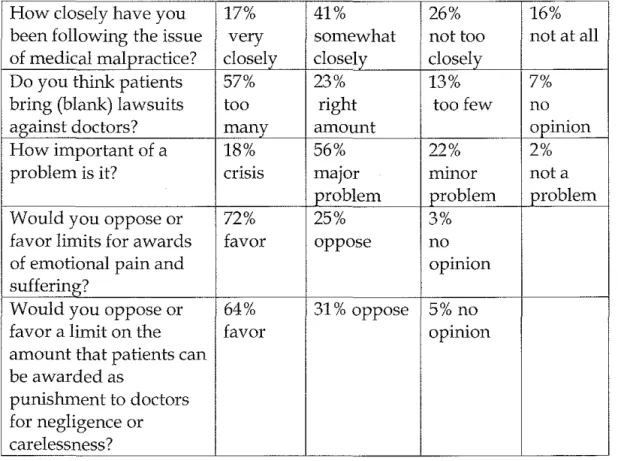
Media salience is often correlated to public salience. However, "public opinion" polls are conducted to gauge the importance of issues to the American people. Several research groups question a sampling of Americans at various times about various subjects. The data from three opinion polls collected in January 2003, April 2003, and December 2003 are summarized in the following tables.
Table 1: Summary of Findings in Gallup Poll January 200317
How closely have you 17% 41% 26% 16%
been following the issue very somewhat not too not at all of medical malpractice? closely closely closely
Do you think patients 57% 23% 13% 7%
bring (blank) lawsuits too right too few no
against doctors? many amount opinion
How important of a 18% 56% 22% 2%
problem is it? CflSlS major mmor nota
problem problem problem
Would you oppose or 72% 25% 3%
favor limits for awards favor oppose no
of emotional pain and opinion
suffering?
Would you oppose or 64% 31% oppose 5% no
favor a limit on the favor opinion
amount that patients can be awarded as
a e : ea 0 1 ence
T bl 2 H lth C nf" d
s
urvey A ~cpn "1200348Do you think there should be a 69% yes 25% no 6%
limit to damage awards for don't know
medical injuries?
Do you think the amount 72% yes 22%no 6%
doctors pay in medical don't know
malpractice insurance makes it difficult for them to stay in business?
T a bl 3 S e : ummaryo fH lthN ea ews n ex I d P II A 0 •pn "1200347
How 53% 30% 8% 6% 3% don't
important very somewhat not too not at all know is lowering important important important important
the cost of medical malpractice insurance for
physicians?
Which 27% 27% 18% 11% 8%
issues are prescriptions increasing making lowering helping
very for the medical Medicare cost of states
important? elderly coverage financial! y medical with sound malpractice Medicaid How 17% 26% fairly 22% not 34% not at 1% don't closely very closely closely too all closely know
have you closely
15
T bl 4 S a e : ummaryo fH lthP llR ea 0 epor tD ecem er b 200349
How 49% 34% 6% 6% 4% don't
important very somewhat not too not at all know is lowering important important important important
the cost of .
medical malpractice insurance?
Which 24% 19% 15% 13% 5%
issue is lowering . mcreasmg
.
lowering helping loweringvery cost of number cost of families the cost of
important? health of people prescription with long medical insurance with drugs term care malpractice
health expenses insurance
insurance
The trends to these data sets are similar to data collected from the news media and from the activity of the legislators. It appears that among the "public" medical malpractice was a more salient issue at the beginning of 2003 and than at the end of 2003. This fact is most telling when
comparing the Health Index Poll in April2003 and the Health Report in December 2003. In April, 11% of the people polled thought that medical malpractice was a very important issue but by December only 5% of the people polled thought that it was a very important issue.
It is important to also look at this data in context. First, the public are only a sample of about 1000 people. Although the surveyors do their best to get a representative sample of Americans, it is still a weakness to public opinion polls. Also, it is unclear whether opinions changed because there was less news coverage or whether there was less news
i
"
coverage because of the lack of interest in the subject. Even with these
weaknesses, the trend of the data still supports that interest in the issue of
medical malpractice decreased during the year 2003.
Presidential Election 2004
Many important issues come to the forefront during election
seasons, especially during a Presidential election. The candidates for
President make national news coverage, and the issues that are most
important to the public become clear because it becomes the focus of their
campa1gn.
The issues that have been at the front of this election are national
security including the war in Iraq, job creation, current national debt and
health care insurance. The reform of medical malpractice has not been at
the cornerstone of current debate. However, the focus may change now
that the Democratic Primary race has come down to Sen. John Edwards
(D-NC) and Sen. John Kerry (D-MA). Senator Edwards was a "trial"
lawyer before becoming U.S. Senator of North Carolina. His political
opponents could attempt to highlight the issue of medical malpractice in
order to damage his image and campaign for President.
This tactic may have lasting effects on the Democratic Party if Americans
are lead to believe that the Party sides too closely with lawyers and not
with the wishes of patients and their doctors.
I
ll
17
The previous "frontrunner" in the Democratic race, Dr. Howard Dean, had stated that he wanted reforms that identified unjust lawsuits without hindering compensation for patients who are injured. He also opposed the capping legislation.42 However, these opinions were not the cornerstone of his campaign and medical malpractice issues were not key to the debate among the other candidates. In this way, medical
malpractice was a low salience issue in terms of the presidential election.
Summary of Salience
Overall, the issue of medical malpractice reform was an important issue in the United States in the year of 2003. However, the salience of the
I
issue among the public and among national legislative leaders changed over the course of the year. It was a highly salient issue at the beginning of the year with high amounts of news media coverage and legislative activity. By the end of 2003 and the beginning of 2004, the issue was of lower salience among the public and legislators alike.
Evaluation of Possible Solutions
In this analysis, possible solutions will be evaluated on three criteria. The first criteria will be the ability of the solution to reduce medical malpractice premiums. The second criteria will evaluate the political plausibility of the solution in the current political environment as analyzed above and finally each solution will be evaluated on the
Solution 1: Do Nothing
In the last couple of years, malpractice premiums have been increasing. As Graph 1 shows, insurance premiums appear to increase and decrease by a cyclical pattern.
Graph 1: Reproduction of the Rise and Fall of the Insurance Premium Following the Rise and Fall of the Economys
INSURANCE CYCLE
15
;11
"'
10"':E ww 5 :E ..
00.
u ...
:so
0..
·50
·10
YEAR
No evidence shows that this recent upturn will be any different than previous changes. Therefore, we would expect malpractice premiums to continue to follow the same cyclical pattern. Doing nothing could be an effective solution if those involved were able to wait for the natural pattern of insurance premiums.
In terms of political plausibility, strong lobbying forces had made it a priority issue, leading to legislation introductions in over twenty states as well as Congress.45 Therefore, doing nothing did not appear
politically viable. While the issue was of high salience, legislators appeared to be active on the issue even if the solution had not proven to lower malpractice.
L
19
In terms of the key stakeholders, doing nothing could be beneficial
to lawyers, insurance companies, and physicians. However, the lack of
focus on medical errors would be detrimental to the welfare of patients in
this situation. As stated earlier, the cyclical nature of this issue ensures
that premiums will most likely go down and the media attention will go
away. The insurance companies will have the most benefit without any
intervention because they could continue to raise premiums to overcome
any lost. The lawyers involved would also benefit if the issue were tabled
because it would most likely decrease the attack on their profession.
Patients have the most to lose if nothing is done during this time of
increased attention to medical malpractice. A study by the Institutes of
Medicine in 2000 showed that 44,000 to 98,000 Americans die each year to
preventable medical errors in a hospital setting and that medical errors
cost 17 to 29 billion dollars.40 This value is three times more than what
might be saved in capping non-economic losses40,41 For patients,
improving safety would be of much more benefit than passing any
legislation that would reduce malpractice premiums for physicians.
However, the center of the malpractice debate isn't on safety, even though,
L
several organizations are trying to shed light on this issue.Solution 2: Capping Damages in Medical Liability Cases
This solution is currently the preferred solution by the Bush
solution would entail limiting non-economic damages in medical injury cases, which in turn would decrease medical malpractice premiums. However, it is unclear whether this solution would be effective because there is evidence that jury awards are not the reason insurance premiums are going up.
In October 2002, the Americans for Insurance Reform (AIR), which represents 100 consumer groups in America, completed a full analysis of medical malpractice insurance with the help of
J.
Robert Hunter, the former Texas Insurance Commissioner and Federal InsuranceAdministrator8 In the study, they compiled the amount insurance
companies paid in jury awards and other settlements from 1965-2001 and compared those changes to the amount of premiums that the insurers were charging doctors over the same time frame. The review found that the amount of jury awards and settlements paid out since 1965 by
21
Graph 2: Reproduction of Raise in Insurance Premiums and the Steady Change in Jury Award Pay OutsB
PER DOCTOR PREMIUM AND LOSSES
I
DPW per doctor 2001 s ru~~~ Pak:! loss per doctor 2001 sI
~ 8000
.,
Q 6000 N 4000 2000D ....••• • . •.c ' ·'··
,_-.-"'"'
,ot ~ ~ ~ ~ ~ ..,.~ ~ ... <:!} {'1 .._,q* ,
\. .,.~ ~ ~ ~ ~ .... ~ "\.0} ...,.q· ... A ~- ~,.-'V ~V<AR
'ioun:e:s::
·\.M. Best ar1d Co. -,;pcx:ial data compilation for .J.\IR, rr:p:;rting data for .!tS many years as scparatdy ani bblc: U.S. 3uremt of the CctHl!:5, 1975 COOl [.,.;timate:d)~: I ntlation Index: Bureau of L'lbor 'Statistics, 197) d 985 c::tim•ltC:(l).
The HEALTH Act (HR 5) introduced in February 2003 had bipartisan support but the final vote was completely along party lineslD Diane Feinstein (D-CA) was the only Democrat to support non-economic caps but she changed her position in March 200330 In a surprising move, the Democrats in the Senate were able to hold a cloture vote and dismiss the legislation passed in the House31 With the decrease in the salience of the issue among political leaders and the public in 2004, the issue most likely will not be voted on again in the near future.
If this legislation had passed, it would have been of some benefit to insurances companies but would have been little to no benefit to doctors, lawyers or patients. As the data has shown, there was no guarantee that insurance premiums would be lowered for physicians once the caps were
I
,__
\-put into place.8,26 The major cost to lawyers would have been the decline in recoverable fees for service. The legislation also supported the idea that lawyers are to blame for the current situation which contributes to the negative image of the law profession in our society.
If the legislation had passed, the biggest cost to patients would have been the lack of avenues to seek retribution in medical mistakes that don't directly affect economic losses. This event would benefit insurance companies because of the decrease in liability payouts.
Solution 3: Regulation of Malpractice Insurance Rates
The regulation of malpractice insurance rates was done in California in 1988.28 The legislation would entail rolling back causality and property insurers rates to a earlier timeframe, freezing these rates for one year, request prior approval from malpractice insurers before any changes in premiums could occur, and tightening the anti-trust
exemptions for insurance companies28 When these changes were enacted in California in 1988, it was shown to be highly effective in reducing medical malpractice premiums. Graphs 3 and 4 illustrate the stable nature of California premiums as compared to national averages after the
introduction of Proposition 130, which regulated the insurance
(MICRA), which capped non-economic damage awards but only after
insurance regulation was implemented.
Graph 3: Medical Malpractice Premiums2B
- CA v. US 19Y5-2001
9COJOO , - - - , - - - . : : . : . . : . _ _ _ _ _ _ _ _ _ _ _ _ _ <01
0
!.1~.
3(0JI)J
JCOJOO
;;:; 5(0)1))
E " 23 WJOOOO EOOC•JI)J 40000((1
~ 4C(•JOO
5: Y.I.IOOOO 3[0000 2COOOO 10000[1) 1COJOO
•J +-+-+-+-+-+-+-+--+--+--+--+--+-... -+--+--+--+--+--+--+--+--+--+--+--+--+--+ 0
t~~;;r C/>.Prerriurns ~;:JTIS!d($ COO} -t-US Frfflllums Earned, excL C.'\ ($000) I
.set..,;,:;~;: tbli~M .<i:m:z:i."lion d ln~ur.1noo Camrnfs-st.-n:;rs- R:p:rls oo Pro!t±ill:f 8y Lin 'I 9y '::tillw. 19713--:2((11 3CoJOOO
8C(i000
0
i
5CoJ(oJ0g 400000 ~ ~ 31))000
j
200000
10JOJO
Graph 4: Total Premiums Earned28
Californin v. Rat~ of Inflation (1976-2001)
~~ ,!0 ~~ ~ <& '?:>' <t;.. <P ~ >:>...f? ~ -~ ~ <{} -~ ~' ~~ ~i;> .,-~ {l ~ ,'Y ,.g. ,_p ,.p <:)'
{) ...;) ~) {) {J .._'3' {) ~ ..._Q "-"-' .._'-1 ,:.-. '\)' {) ..,_'.::! ..._'-1 .,_'.) ..,_<;) {'l ,L) ,'4 .._.".1 ~~ ~ •f' •.P (-1EJ-. CA Premiums Eai"E<I ($COJ) Rate olln!!al.:o!
.5£:URCIO :NJit:!n~IA=x:Uli::fl of ln-"Uii-'fT-" Cammi-.6ictt~· Report~ en PmlbbiityBy lineH·r Slate, 19i\'L2!)J1 :1nd Ccn:illfn<'f Pric., lml~x. AIIU!UnC:wsumers (Bure;:~u ol L±.a- SMiol i::~l
31)1))00
i5' 25COCQ 8
"-~ 20C•JC(J ~
.,
E
0
"
150000 ;r,
Extrapolating from this example, it would appear that regulation of insurance companies would be effective in reducing malpractice
premiums for physicians. However, this solution has no current political backing.
The lobbying abilities of the insurance companies as well as the medical associations were focused on the injury compensation reform6·7
The White House was also focused on this solution but recent focus has been placed on the War on Terror. 5,29
While the regulation of insurance premiums could benefit
physicians and patients, and have some benefit to lawyers, it would entail a large cost to insurance companies. If the regulation of insurance
premiums was passed, insurance companies would have to immediately decrease their premium charges. Insurance companies would also have to file papers before making any premium changes. These regulations may seem harsh, but the insurance companies in California were still able to make a profit even after such changes28
Physicians would notice immediate relief with the rollback of malpractice premiums. They would also be able to feel secure that
25
change. Their image might improve if it was made clear by the legislation that lack of insurance regulation was the primary problem instead of "frivolous" lawsuits.
Solution 4: Decreasing the Number of Medical Errors
As stated above, the Institutes of Medicine showed that 44,000 to 98,000 Americans die each year to preventable medical errors and the cost that could be saved by targeting medical errors would be 17 to 29 billion dollars.4D It is estimated that the savings made by capping non-economic losses would only be a third of this value. 40Al However, it is unclear if this reduction will directly effect malpractice premiums.
The groups focused on decreasing the number of medical errors do not have the same level of money or political clout as the companies who are lobbing for caps in non-economic losses. Legislators also are no longer focused on this issue. Therefore, the political plausibility of the solution is low.
The group most likely to benefit from this solution would be the patients. Reducing medical errors would improve the quality of medical care received by all Americans because people chances of adverse events would be decreased. The reduction of medical errors could also
potentially decrease the cost of health care in this country, which could lead to a decrease in insurance premiums. However, it is unclear if these savings would benefit physicians or insurance companies. The savings
I
~
would not directly affect the malpractice system because most of these
errors are never brought to litigation. For lawyers, this solution could
potentially decrease some of their earning potential and be a cost to their
business.
Summary of Evaluation
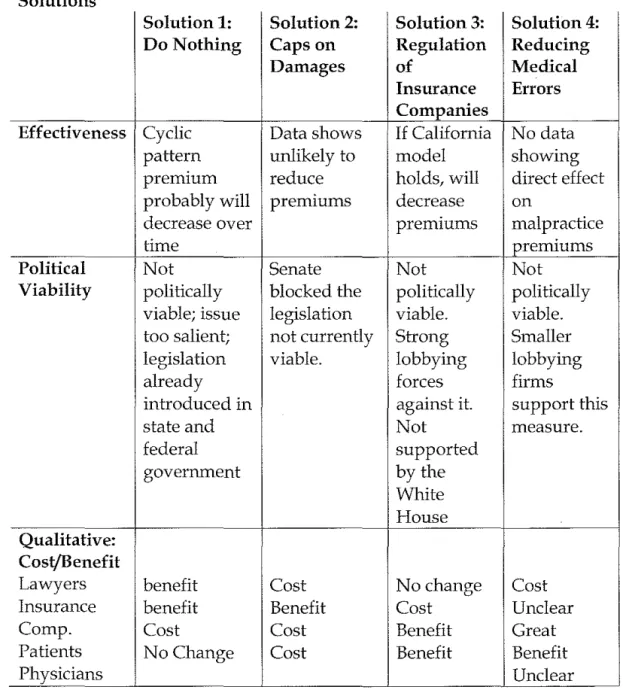
Table 5 is a summation of the four solutions identified in this
analysis. From this table, the only solution that has the ability to directly
decrease medical malpractice premiums would be solution 3, the
regulation of the insurance industry. However, this solution would be
politically unachievable in the current political environment. The
majority of the House and Senate and the current Presidential leadership
are in favor of legislation that would cap non-economic damages and they
have been adverse to amendments that regulate insurance rates.
Conclusions
Medical malpractice insurance reform is an important health care
issue because physicians, a central part to health care delivery in this
country, are feeling the crunch and many of them have increased their
advocacy around this issue.l-4 The high salience around this issue in the
beginning of 2003 made it an important issue for the American public and
had been a part of the domestic agenda of the current Bush
27
Table 5: Summation of the Evaluation of Cost Benefit Among the Four Solutions
Solution 1: Solution 2: Solution 3: Solution4:
Do Nothing Caps on Regulation Reducing
Damages of Medical
Insurance Errors
Companies
Effectiveness Cyclic Data shows If California No data
pattern unlikely to model showing
premmm reduce holds, will direct effect probably will premiums decrease on
decrease over premmms malpractice
time premiums
Political Not Senate Not Not
Viability politically blocked the politically politically
viable; issue legislation viable. viable. too salient; not currently Strong Smaller legislation viable. lobbying lobbying
already forces firms
introduced in against it. support this
state and Not measure.
federal supported
government by the
White House
Qualitative: Cost/Benefit
Lawyers benefit Cost No change Cost
Insurance benefit Benefit Cost Unclear
Comp. Cost Cost Benefit Great
Patients No Change Cost Benefit Benefit
Physicians Unclear
However, the salience of the issue has faded and it is unlikely that legislative changes will be made in the near future. The most effective solution to reducing the amount of malpractice premiums paid by physicians and improving the quality of care given to patients would probably be a combination of non-economic caps, regulation of insurance
companies and reduction of medical errors. Unfortunately, this option is
not politically desirable and would be almost impossible to pass in the
current political environment.
l
References
1. "Medical Malpractice Premium Hikes Add to Overall Rise in Health Costs. "
New York Times 10 September 2001. Retrieved February 14,2003
www .kaisernetwork.org/dailv reports.
2. "West Virginia Surgeons Protest High Malpractice Insurance Rates;
Pennsylvania Governor-Elect Offers Proposal." Daily Health Policy Report 02 January 2003. Retrieved February 14, 2003
www .kaisernetwork.org/dailv reports.
29
3. "Physicians' Malpractice Premiums Have Reached 'Crisis' Levels in 12
States." Daily Reproductive Health Report 18 June 2002. Retrieved February 14, 2003 www .kaisernetwork.org/dailv reports.
4. "Spotlight on Issues" Retrieved February 14, 2003 http://,vww.ama-assn.org/
5. Bush, George W. "The State of the Union Speech." U.S. Congress. Washington, DC, 28 January 2003.
6. "Lobbying Efforts by Doctors To Enact Caps on Medical Malpractice Awards." Wall Street Journa/13 January 2003. Retrieved February 14, 2003 www.kaisernetwork.org/dailv reports.
7. "About HIAA." Health Insurance Association of American (HIAA) website. Retrieved April21, 2003. http://www.hiaa.org/about/whowcare.cfin
8. "Medical Malpractice Insurance: Stable Losses/Unstable Rates." Report by the Americans for Insurance Reform. October 10,2002
9. "Glossary of Tort Reforms" Information provided by the Center for Justice and Democracy. Retrieved March 15, 2003
http://www.centerjd.org/free/myihbusters-free/MB glossary.htm
10. "Help Efficient, Accessible, Low-Cost, Timely Healthcare (HEALTH) Act of2003 (Introduced in House)." Thomas: Legislative Information on the Internet. Retrieved February 14, 2003 thomas.loc.gov
11. Schedule for the Senate Health, Education, Labor and Pensions Committee Hearings. Retrieved February 14,2003 http://health.senate.gov/hea.html
13. Lexis-Nexis Database searched April2l, 2003 Search terms: guided news search, general news, major papers, Medicare reform, January 1, 2003-August 1, 2003.
14. Lexis-Nexis Database searched April21, 2003 Search terms: guided news search, general news, major papers, War in Iraq, January 1, 2003-August l, 2003.
15. "Girl Has Second Transplant After Error." Washington Post 21 Febmary 2003 Retrieved Febmary 21 2003 www.washingtonpost.com
16. Grady, Denise "Transplant Tragedy" New York Times. 23 Febmary 2003. Retrieved Lexis-Nexis Database April21, 2003.
17. Gallup Poll. January 23, 2003. Conducted by Gallup Organization and data provided by The Roper Center for Public Opinion Research, University of Connecticut. Retrieved March 15, 2003 www.kasiernetwork.org
18. Wilbourn, Shelby L MD, F ACOG Physician, on behalf of the American College of Obstetrics and Gynecology. "Who will deliver America's babies?" Transcript of Senate Committee Hearing 11 Febmary 2003 Retrieved Febmary 14,2003 http://hcalth.senate.gov/jh001 04 tes.html
19. "Ob-Gyns and Patients Urge US Senate to Enact Medical Liability Reform." April1, 2003 Release by ACOG. Retrieved April21, 2003.
http://www .acog.org/from home/publications/press releases/nr04-0 1-03 .cfm
20. Mebane, Felicia. Lecture on "Interest Groups" in HP AA 260 Spring Semester 2003. March 31,2003.
21. "Tort Trials and Verdicts in Large Counties, 1996," U.S Department of Justice, Office ofJustice Programs, Bureau of Justice Statistics, NCJ-179769 (August 2000), 9.
22. "Examining the Work of State Courts: A National Perspective from the Court Statistics Project" National State Courts. 2001.
23. "Patients, Doctors, and Lawyers: Medical Injury, Malpractice Litigation, and Patient Compensation." Harvard Medical Practice Study. New York. 1990.
24. Hunter, J Robert and Joanne Doroshow. "Premium Deceit: The Failure of "Tort Reform" to Cut Insurance Prices. Center for Justice and Democracy. 1999
26. "How Insurance Reform Lowered Doctors' Medical Malpractice Rates in California And How Malpractice Caps." The Foundation for Taxpayer and Consumer Rights, a nonprofit, nonpartisan organization March 7, 2003. Retrieved June 20, 2003
http://www .consumerwatchdog.org/healthcare/rp/rp0031 03 .pdf
27. "This Week on Capitol Hill" The Citizens for a Sound Economy. Week of
March 151h Retrieved June 20, 2003.
http://www.cse.org/informed/issues template.php/1337.htm
28. "How Insurance Reform Lowered Doctors' Medical Malpractice Rates in California." The Foundation for Taxpayer and Consumer Rights: a nonprofit, nonpartisan organization. March 7, 2003. Retrieved June 20, 2003
www.consnmerwatchdog.org
29. "George W. Bush Approval Ratings-weekly Gallup Polls" Gallup Poll
Analyses March 141h. Retrieved June 20, 2003.
http://www.gallup.com/poll/releases/pr030620.asp
30. "Frist Says Senate Will Address Medical Malpractice Issue After Spring Recess" Capitol Hill Watch. April2, 2003. Retrieved July 31,2003.
http://www.kaisernetwork.org/daily reports/rep index.cfin
31
31. Patients First Act of2003 S. 11 Bill Summary and Status. Retrieved July 31, 2003 http://thomas.loc.gov/cgi-binlbdguerv/z?dl 08:s.00011:
32. "Lobbying Efforts For and Against Limits on Malpractice Suit Awards Increasing" New York Times May 28, 2003 Retrieved July 31,
2003 http://www.kaisernetwork.org/daily reports/rep index.cfin?hint=3&DR I D=17954
33. Florida Governor Signs Medical Malpractice Bill Aimed at Reducing High Cost of Insurance Premiums Orlando Sentinel August 15, 2003 Retrieved August 30,2003
http://www.kaisernetwork.org/daily reports/rep index.cfm?hint=2&DR ID=l93 81
34. Barnard, Arme "Grieving Father Targets Medical Malpractice Lobbies Against Bill Cappping Pain and Suffering Damages." Boston Globe July 14, 2003.
35. Tuohy, Lynee Boy Wins Huge Malpractice Award; Hartford hospital loses 12.5 million verdict to patient who became quadriplegic July 30, 2003 Hartford Courant.
L
36. Snowbeck, Christopher. "Malpractice Cost Protest is Spotty; Many solutions debated to high cost to doctors of insurance premiums." May 5, 2003 Pittsburgh Post-Gazette.
37. DeMystifing Medical Malpractice: America's #1 Health Crisis or Misguided Activism? http://www.amsa.org/hp/medmalpractice.cfm
38. Policies Homepage AARP. http://www.aarp.org/
39. Issue Agenda. Common Cause. http://www.commoncause.org/agenda/
40. Institute of Medicine, "To Err Is Human: Building a Safer Health System", 2000.
41. "Statistical Compilation of Annual Statement Information for
Property/Casualty Insurance Companies" in 2000. www.publiccitizen.org
42. "Medical Malpractice Reform: Supporting Doctors and Their Patients." www. DeanF orAmerica.com.
43. "Medical Malpractice: Implications of Rising Premiums on Access to Health Case." GAO Highlights. August 2003.
http://www. gao. gov /new. items/ d03 836. pdf
44. Newhouse, Joseph and Paul Weiler. "Reforming Medical Malpractice and Insurance." The Cato Review of Business and Government. Retrieved Feb. 1, 2004 www.cato.org/pubs/regulation/regv 14n4/rcg 14n4-ncwhousc.html
45. Lexis-Nexis Database searched February 15, 2003. Search terms: guided news search, general news, major papers, medical malpractice, August 1, 2003-February 1, 2004.
46. Lexis-Nexis Database searched February 15, 2003. Search terms :guided news search, general news, major papers, war in Iraq, August 1, 2003- February 1, 2004.
47. Health News Index Poll. April3-6, 2003. Conducted by Princeton Survey Research and survey by Henry J. Kaiser Family Foundation Harvard School of Public Health. Retrieved February 15,2004 www.kasiernetwork.org
48. Health Confidence Survey. April24- May 24, 2003. Conducted by Matthew
Greenwald & Associates and survey by Employee Benefit Research Institute.
33