Electronic Medical Record and Adherence to Guidelines for the
Prevention of Group B Beta-hemolytic Streptococcus Disease in Neonates
By
Carmen Strickland, MD
A Master's Paper submitted to the faculty of The University of North Carolina at Chapel Hill
In partial fulfillment of the requirements for The degree of Master of Public Health in
The Public Health Leadership Program.
Chapel Hill
Abstract
Background:
Group B beta-hemolytic streptococcal (GBS) disease causes significant neonatal morbidity and mortality in the United States. Universal screening and use of intrapartum prophylaxis for women identified to be at risk has been promoted through recent Centers for Disease Control (CDC) national guidelines. Despite the recommendation for universal screening, many women present in labor with unknown GBS status. Interventions that decrease rates of unknown GBS status may improve providers' ability to effectively implement the GBS prevention guideline.
Research Question:
r
Does electronic access to GBS screening results reduce the rates of both unknown GBS status and subsequent delivery of inappropriate care for the prevention of GBS disease?
Study Design:
A retrospective cohort study using data from an extensive perinatal database is described. Included subjects are women delivering babies at
who received care at a university managed or affiliated prenatal care site. Rates of delivery of appropriate care based on GBS status are assessed and the effect of access to an electronic medical record on rates of inappropriate care is examined.
Results:
A total of 7102 births were eligible for assessment of adherence to GBS prevention guidelines. 28.3% of women had unknown GBS status and 24.8% of the entire sample received inappropriate care. Lack of an electronic medical record (EMR) was significantly associated with both a higher rates of both unknown GBS status (OR 1.54. 95%CI 1.34-1.71) and inappropriate care (OR 1.12, 95% CI 1.11-1.13).
Conclusions:
Background:
Group B Streptococcal disease (GBS)
Group B beta streptococcal (GBS) disease is the leading cause of preventable neonatal sepsis in developed countries, causing approximately 1600 illnesses and 80 deaths annually.[l] In 2002, the nationally projected rate of early-onset disease was 0.4/1,000 persons< 1 year of age.[2] Though the number of surviving infants is increasing, devastating neurologic damage often results in lifelong care needs.[3, 4] Ten to thirty percent of the population of child-bearing women are colonized with GBS in either the gastrointestinal or genitourinary tract.[5] Exposure to GBS occurs during labor as the neonate passes through the birth canal.[6] Early onset GBS disease typically manifests in the first 24-48 hours of life, presenting as pneumonia and, less frequently, as meningitis.[!]
GBS prevention guidelines
L
L
The CDC subsequently revised the guideline in 2002 to recommend that prenatal care providers screen all pregnant women at 35-37 weeks of pregnancy and administer prophylactic antibiotics during labor to all women with evidence of GBS colonization.[S]
Implementation of guidelines
Guidelines such as these published by the CDC are playing an increasingly important role in attempts to improve the quality of health care delivery in the U.S. ([9]) Implementation of guidelines is challenging, however, in the context of complex and varied care delivery systems. Research has identified a number of barriers to full implementation of guidelines. These include lack of provider knowledge or acceptance, lack of data required to follow the recommended algorithms, lack of access to diagnostic or treatment modalities, and inaccessibility. [10, 11). In the absence of full adherence to
recommendations, clinical practice often falls short of reaching desired goals; the case of GBS prevention provides a striking example.
then, requires evaluation of the degree to which each of these components is accomplished.
Assessment of GBS prevention guideline
The ultimate outcome of interest, rate of affected neonates, has been closely followed in the wake of the CDC guidelines, largely through the Active Bacterial Core Surveillance (ABCs) program.[1) Rates of intrapartum antibiotic prophylaxis to GBS +women, [12-15) rates of anaphylaxis and other maternal medical outcomes, [16-19]and effect of the new guidelines on length of hospital stay and rate of laboratory testing for neonates[?, 17, 20-24) have all been assessed. In addition, the CDC has followed the rates of adoption of the guidelines at both the provider and hospitallevel.[25) [26)
Fewer studies have rigorously assessed the specific processes associated with adherence to the guideline; the available data suggests that several
Potential of electronic medical record system to improve care
The methods by which GBS culture results are made available in the inpatient setting and rates of availability of this data have not been assessed, despite their importance in allowing for full guideline implementation. Clinical care of pregnant women is often shared between distinct prenatal and delivery care providers. Given the unpredictable timing of onset of labor, and fact that much of labor care is delivered during after hours, the systems in place for transferring updated prenatal information are often complex and time-intensive. Common strategies include repeated photocopying and faxing of prenatal records at weekly intervals during the last month of pregnancy. Under these
circumstances, the potential for missing or lost data is significant, with implications for both overuse and underuse of lAP.
Shared Care
In the case of a patient admitted in labor, the presence of an electronic medical record system linking outpatient records with inpatient clinical care allows immediate access to accurate GBS results, thus reducing the likelihood of error in adhering to guidelines for GBS prevention. This study will test whether EMR access to GBS results is associated with a decreased number of women with an unknown GBS status at entry to labor and delivery and will look at the
relationship between EMR access and rates of appropriate care. Implications regarding quality of care will be discussed.
(Addendum A: EMR and Improved Clinical Outcomes in Shared Care Settings: Review of the Literature)
Research Setting
The University of North Carolina Women's Hospital provides primary, secondary and tertiary obstetric services to pregnant women in eastern and central North Carolina. This large system comprises a number of outpatient prenatal care sites managed by the Departments of Obstetrics and Gynecology (OBGYN) or Family Medicine (FM). In addition, a number of independent sites providing prenatal care services are affiliated with UNC Hospitals (UNCH). These sites contract with the above departments for obstetric services for their patients and, as such, are subject to UNCH policies and procedures relating to pregnancy care. In all, 7 prenatal care sites are managed by the FM department, 16 by the OBGYN department, and 1 site has care delivered by both departments. The hospital
l
f
I
averaged approximately 2,600 deliveries/year between May 1996 and September 2003.
UNC Electronic Medical Record History
All outpatient sites providing prenatal care for patients delivering at UNC Women's Hospital use a paper medical record for prenatal care. Beginning in 1991, the University of North Carolina Hospitals adopted an electronic medical record known as the Clinical Information System (CIS). This system was used on Labor and Delivery from its inception. A subsequent transition to a web-based medical record system (WebCIS) occurred in April 2002. Results of laboratory tests performed at the UNC McLendon Laboratory have been available to clinicians via the electronic medical record since 1991 with the original CIS system. Through these systems, providers on the labor and delivery unit have had electronic access to any clinical data generated by the McLendon Laboratory since 1991.[32]
History of UNC GBS Prevention Policies
history of a previously affected newborn. All policies have advocated empiric treatment of women with unknown GBS status.[15, 33-35]
Suggested regimens for lAP at UNCH have shifted in accordance with changes in the CDC guidelines between 1996 and 2002. The 1998 UNCH report recommends penicillin G and ampicillin for lAP, and suggests clindamycin, or erythromycin for penicillin-allergic patients. The revised 2001 UNCH policy includes the above except erythromycin, and adds cefazolin for patients with mild penicillin allergies. In addition, vancomycin is listed for use in the setting of identified resistance to clindamycin for penicillin-allergic patients.
Methods
We developed a retrospective cohort study using the University of North Carolina (UNC) Department of OBGYN perinatal database. Since 1996, one to two full time employees have abstracted data from perinatal charts and
Study participants
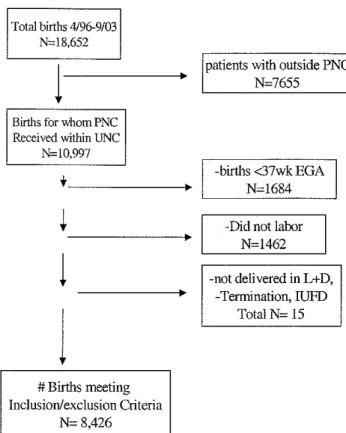
The population studied included all women receiving care at prenatal care (PNC) sites either operated by or affiliated with UNC Hospitals who delivered at UNCH from Aprill996 through September 2003. These PNC sites are all subject to UNCH policies and procedures regarding GBS prevention. Women referred from outside sites were excluded. Women were also excluded if they delivered at a gestational age of <37 weeks as they may not yet have been screened. Women delivered by elective or otherwise planned cesarean section were excluded as the CDC guideline for intrapartum antibiotic prophylaxis (lAP) use applies only to women who experience labor. Finally, women with an
intrauterine fetal demise (IUFD) or terminating pregnancy for anomalies were
also excluded, as were women whose deliveries occurred prior to admission.
I
These exclusion criteria were applied to limit participants to women who wereDemographic and Clinical Characteristic
The following demographic information was obtained: age, race, marital status, type of prenatal care site, and specialty management of prenatal care site (OBGYN or FM). Clinical data included parity (dichotomized into primiparous, multiparous), estimated gestational age at delivery (in weeks), APGAR scores at 1 and 5 minutes, neonatal death, type of delivery (vaginal, cesarean) and
birthweight. Results of GBS screening were coded as positive or negative and cases with missing values were coded as unknown. Use of an antibiotic during labor was treated as a categorical variable (none, a specific lAP antibiotic) and subsequently dichotomized into GBS intrapartum antibiotic prophylaxis administered or not.
Independent variables
Access to lab result via electronic record was used as the primary independent variable. For each prenatal care site, laboratory services have been provided by either UNC McLendon Laboratory or by an independent commercial laboratory.[38] McLendon laboratory results have been automatically available in the UNC electronic medical record since 1991.[39] For each birth, based on prenatal care site, access to laboratory results via the electronic record was dichotomized.
Outcome measures
School of Medicine GBS prevention guideline (approved 5/30/01, revised 10/02). Intrapartum antibiotic prophylaxis was defined as use of a single lAP antibiotic during labor. Appropriate care included use of lAP for women who had a GBS positive screen, met criteria for automatic prophylaxis or had unknown GBS status. Appropriate care also included withholding lAP for women with negative GBS screening tests. Women for whom these conditions were met were
combined into the appropriate care category.
Inappropriate care included non-use of lAP for women who had a GBS positive screen, met criteria for automatic prophylaxis, or had unknown GBS status. Use of lAP in women with negative GBS screening tests was also considered inappropriate care.
Statistical analysis
Descriptive statistics were used to characterize the study sample.
Categorical variables were compared using the chi-square statistic. T -tests were used to test for differences in the means for continuous variables. Odds ratios were calculated to assess the strength of significant associations. For all statistical tests, significance was set at 0.05 using two-tailed tests. All analyses were
performed using SPSS statistical software. (SPSS 11.5 for Windows)
Study Approval
Results:
Study Population
Data were available for 18,652 births. Application of all exclusion criteria reduced eligible births to 8,426. (Figure 1) Of these, a further 1,324 were
excluded for missing drug data or multiple antibiotic administration, leaving 7,102 cases for the final analysis. (Figure 2)
The mean age of the sample was 26 years. Women in the sample were white (40.1 %), Hispanic (35.3% ), or black (20.5%) with 4.2% identified as other/unspecified for racial or ethnic group. Just under half of the women in the sample were married and 43.7% were primiparous. Vaginal delivery was
I
documented for 90% of the sample. Most of the prenatal care was provided in the UNC OB sites, community health centers, or local health departments. Mean birthweight for this sample of women with term deliveries was 3407 grams. Electronic laboratory record access was available to providers of 48.4% (n= 3436) of women in the sample. (Table 1)
Rates ofGBS status and inappropriate care
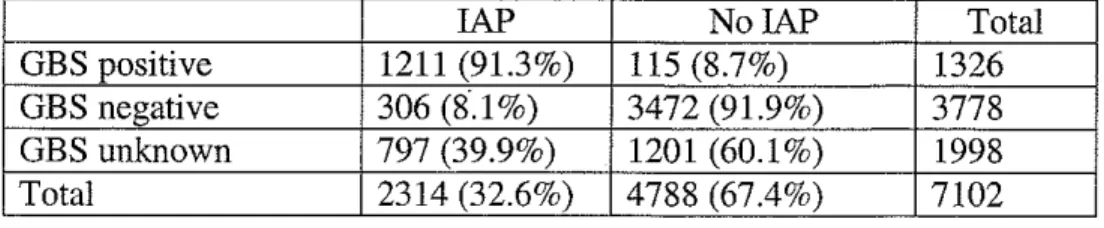
negative women had low rates of inappropriate care (8.7% and 8.1 %, respectively). (Figure 2)
Factors associated with rates ofGBS status and inappropriate care Lack of electronic laboratory record access was associated with an increased rate of inappropriate care (OR=l.12, 95% CI 1.11-1.13). Bivariate analysis demonstrated a significantly increased risk for unknown GBS status in the setting of no EMR access (OR= 1.54, 95%CI 1.34-1.71). Relative to women with known positive GBS results, OR for inappropriate care in women with unknown GBS status was 8.70 (95% CI 7.14-10.00).
Discussion:
Rate of unknown GBS status
Explanations for an unknown GBS status on admission to labor and delivery include lack of screening and lack of available results to the inpatient provider. The data did not allow for a direct assessment of these subsets. In this population of women at gestational age >37 weeks, the likelihood of prenatal screening is optimized. We believe that poor availability of GBS screening results on labor and delivery explains the high rate of unknown GBS status.
In practice, labor and delivery providers' access to patients' GBS results is limited under two circumstances. First, prenatal care providers may not clearly and accurately document the result in the prenatal chart. Second, hospital providers may not have access to a copy of the prenatal chart. For patients with laboratory data directly entered into an EMR, a backup system exists to overcome both of these obstacles. The fact that EMR access was associated with a lower rate of unknown status supports our clinical experience that unknown GBS status results primarily from limitations in data availability rather than from lack of screening.
Rate of inappropriate care
Unknown GBS status was strongly associated with receipt of
The 1996 CDC guideline and subsequent 2002 revision promote treatment of women with unknown GBS status based on an assessment of risk factors at the time of labor. Risk factors include maternal temperature greater than or equal to 100.4, rupture of membranes greater than 18 hours, and fetal prematurity. The presence of risk factors was not analyzed for this project since UNCH GBS prevention policies have promoted a more conservative approach, recommending empiric treatment of all GBS unknown women.
Effect of EMR access on delivery of care
Our hypothesis, that access to GBS results in an EMR would decrease the rate of women receiving inappropriate care was supported in this analysis. The
strong relationship between EMR access and lower rates of unknown GBS status
I
suggests a primary mechanism through which EMR access affects the rate ofinappropriate care. Information on specific systems of prenatal record data transfer from the included PNC sites to the hospital was not available for this project. It is possible that site-specific systems play a similarly large role in determining the rate of women with unknown GBS status.
Strengths
6-year study period, using a standarclized protocol.[40] Data collection occurs at the point of service on an ongoing basis, decreasing chances for error or missing data. The large number of cases increases the power to detect clifferences. The use of data from a single institution decreases error due to heterogeneous clinical protocols and practices for GBS prevention. Last, the nature of the fixed
relationships between practices and laboratory services is such that the presence or absence of access to electronic laboratory results is clear.
In addition, the number of conservative assumptions made in case
selection and subsequent analysis strengthens results. The likelihood for bias has been greatly reduced by eliminating cases not eligible for full implementation of screening and treatment according to the guideline.
Considerations GBS status
In the process of data abstraction, GBS status was not derived clirectly from or checked against actual laboratory results. Instead, GBS status was determined from either the prenatal record laboratory results section, or from inpatient admission notes in which GBS status is almost universally noted.[36] In cases where the prenatal record had no documented GBS result but laboratory results are electronically available, (prenatal care source is affiliated with the UNC McLendon Laboratory), providers are able to access the result and
results of screening as well as undocumented, but electronically available results. This specific aspect of data collection allows for an accurate assessment of the effect of EMR access on rate of unknown GBS status.
One further note relating to GBS status is that the coding for this variable does not allow a separate category for women meeting predefined criteria for lAP prophylaxis (GBS bacteruria, previous GBS-affected neonate). Women meeting these criteria automatically receive lAP and do not require GBS cultures in the third trimester. When documentation in the prenatal and inpatient records for these women clearly indicates the anticipated need for GBS prophylaxis, even in the absence of GBS cultures, they are classified as GBS positive in the
dataset.(36] Since these women are ultimately classified as either positive or unknown, with the same recommendation of lAP, final analysis of appropriate care is unaffected.
Bias may have been introduced in the delineation of medication regimens consistent with intrapartum antibiotic prophylaxis. Medication administration is well documented in the database but indications for medical therapy are left to interpretation. Both the CDC and UNCH guidelines have advocated only single antibiotic regimens for the prophylaxis of GBS disease. As such, women receiving multiple antibiotics during labor were excluded.
intrapartum infectious process routinely treated with a single agent, and the fact that differential misclassification of these women based on EMR access is unlikely, the risk of serious confounding is low.
Last, further analysis of any significant differences between patients with EMR access and those without would allow an understanding of any additional factors that could confound our results.
Conclusion
This study adds to our understanding of the need to assess processes associated with the implementation of guidelines. One goal of any GBS
prevention effort is to minimize the number of women with unknown GBS status at the time of labor in order to maximize benefit and limit risk for both women and their newborns. Maternity care systems characterized by high rates of unknown GBS status face important challenges to both the quality and cost of care.
examined in this study at individual PNC sites before and after instituting EMR access is recommended to further our understanding of the effect of this
intervention.
A growing body of research seeks to demonstrate clinical benefit
associated with technologies such as electronically available clinical data. Shared care settings in which multiple providers require access to the same clinical data are uniquely suited to demonstrate the potential benefit of EMR access. Rigorous assessment of such technologies faces substantial challenges given the
tremendous resources involved in developing such systems, and the difficulty in creating settings for randomized, controlled trials.[41] Settings such as that described for this study may provide practical opportunities to better understand the impact of EMRs. Future prospective study should consider the even greater potential effect of computerized decision support in which electronic clinical data is linked in real time with recommendations for care from accepted guidelines.
Acknowledgements
The author would like to thank Carol Porter for her assistance with the
database, Chris Bowes and Kris Silver for their clarification of the data
L
abstraction process, Dennis Rodriguez for his work in managing the database,Figure
1.
Total births 4/96-9/03N~l8,652
1
Births for whom PNC Received within UNCN~10,997
·~---+
~----l
1
#Births meeting
Inclusion/exclusion Criteria
N= 8,426
patients with outside PNC N=7655
-births <37wk EGA N=l684
-Did not labor
I
N=l462-not delivered in L+D, -Termination, IUFD
Figure2.
~
05+
~
8+
~
28Appropriate Care N=5341 (75.2%)
#Births meting Inclusion/exclus
N=84
ion Criteria 26
l
Births receJ VlD g either
Single antibiotic or none
N=71()2
/~
Births receiving Multiple antibiotics
N=J()21
Births with missing data
N=303
~
I+
~
0 L~
+
~I.
~
0I
Inappropriate Care N=1761 (24.8%)
Table 1. Demographics
Appropriate Care N= 5341 (75.2%)
Age (years) 26.15
<20 802 (74.5)
20-35 4152 (74.5)
> 35 386 (73.8) Race
White 2110 (74.1)
Black 1068 (73.5)
Hispanic* 1931 (76.9)
Other 232 (78.6)
Marital Status (%single)'# 2350 (73.7) Parity(% primiparous)* 2375 (76.4) Type of Delivery
Total vaginal deliveries 4887 (76.2) Total Cesarean section 454 (65.8) Specialty of PNC site *
FM 556 (69.1)
OB 4785 (75.9)
Gestational Age at Deli very 39.36 (mean weeks)**
Birthweight (grams)* 3419.02
APGAR! 7.99
APGAR5 8.84
Neonatal Death/Stillborn- 6 (75) combined (%)
* Indicates statistically significant at the 0.05 level ** sample includes GA;:>: 37 weeks
#N= 7087
Inappropriate Care N=1761 (24.8%) 26.06
274 (25.5)
1350 (25.5)
137 (26.2)
735 (25.9)
386 (26.5)
577 (23.1)
63 (21.4)
838 (26.3)
730 (23.6)
1525 (23.8)
236 (34.2)
249 (30.9)
1512 (24.1) 39.13
3372.35 8.03 8.85
2 (25)
Table 2. GBS status by EMR access GBS known(+ or-)
EMR access 2622
No EMR access 2482
OR for unknown GBS (no EMR/EMR) 1184/814
=
1.54 (CI 1.34-1.71)2482/2622
GBS unknown 814
1184
L
'
T bl 3 T a e . 1ypeo f C are y b GBS tat s us
Appropriate Inappropriate Total
Care Care
GBS positive 1105 (83.3) 221 (16.7) 1326 GBS negative 3508 (92.9) 270 (7.1) 3778 GBS unknown 728 (36.4) 1270 (63.6) 1998 Total 5341 (75.2) 1761 (24.8) 7102
Appropriate care for GBS unknown relative to positive: OR= 0.115, 95% CI0.10-0.14
Inappropriate care for GBS unknown relative to positive: OR= 8.69, 95% CI 7.14-10.00
OR for
appropriate care (95% CI)
1
2.60 (2.15- 3.14) 0.12 (0.10-0.14)
L
i
Lr
I
i!
+---Table 4. lAP use bv GBS status
lAP No lAP Total
GBS positive 1211 (91.3%) 115 (8.7%) 1326 GBS negative 306 (8.1 %) 3472 (91.9%) 3778 GBS unknown 797 (39.9%) 1201 (60.1%) 1998
T bl 5 T a e . ypeo f care >y b EMR access Appropriate Care
EMR access 2621
No EMR access 2720
Total 5341 (75.2%)
OR for inappropriate care (no EMR!EMR) 946/2720 X 2621/815
=
1.12, 95% CI=
1.11-1.13Inappropriate Care 815
946
1761 (24.8%)
Addendum
EMR and Improved Clinical Outcomes in Shared Care Settings: Review of Literature
Information technology has been touted as one means by which error in the U.S. health care system can be dramatically reduced. The potential for wider dissemination and use of evidence-based guidelines and the associated impact on clinical outcomes has received increasing attention in recent years with mixed results.[42] At the level of individual patient care, improving the accuracy of and access to data in the medical record are important goals. Limitations of paper medical records have been demonstrated.[43, 44] Electronic medical records (EMRs) may enhance patient care by putting more organized, easy to access clinical data in the hands of providers. [44, 45] To date, however, evidence of actual clinical benefit linked to the use of an EMR is limited.
The potential added utility of an EMR in directly linking providers sharing the care of an individual patient has been explored in several areas of medical practice. Given the increasingly fragmented nature of medical care in the U.S., this potential for benefit deserves rigorous assessment. A review of the literature yielded a limited number of studies attempting to assess the value of an electronic record system to patients and providers in the setting of shared medical care.
Shared Care: Diabetes
In 1999, Branger, eta! reported results of a non-randomized controlled trial conducted in the Netherlands over a one year period assessing the impact
of improved communication between general practitioners (GPs) and
specialists in the care of diabetic patients [30]. The intervention consisted of an inter-physician communication feature added to a pre-existing electronic medical record system. Control GPs communicated with specialists by the traditional paper-based manner. The primary outcome of interest was the number of messages exchanged by the providers. In addition, documentation of a number of diabetes parameters in the medical record was measured and hemoglobin A 1 C levels were compared as a clinical outcome measure.
Results of this study showed a significant increase in messages between providers (in both directions), over the study period. They also showed significantly more data in the patient record for 6 of 10 diabetes parameters. Comparison of the mean differences in HgbAlC did not yield a significant difference between intervention and control groups. Several features of the study design limit interpretation of results. Most notably, the non-random selection of intervention and control groups introduces bias that may lead to an overestimate of effect since intervention GPs were identified by higher numbers of referred diabetics and may have provided care
differently. The authors, however, used an analysis of covariance allowing for a distinction to be made between effects due to baseline differences and those due to exposure to the intervention.
difference in mean HbgAlC levels. Despite the lack of benefit in clinical outcomes, this study is important in demonstrating improved process
outcomes as a result of an electronic system for sharing data among providers.
Shared Care: Emergency Departments
The emergency room provides an example of another care system in which access to important clinical data is often limited. Two papers have originated from Wishard Memorial Hospital and Health Services (Wishard) at Indiana University using the Regenstrief Medical Record System (RMRS) to assess the impact of electronic access to patient data on both processes and outcomes of care. The first, in 1982, demonstrated that internists caring for patients in an inner-city hospital emergency department (ED) order fewer laboratory tests when given a printed summary of clinical data from that hospital compared with when they did not receive this summary.[46].
Recently, Overhage, et a! completed a randomized controlled trial to
r
more rigorously assess the hypothesis that improving emergency physician's access to clinical information from another institution would result in less expensive evaluations and improved quality and efficiency of care. This pilot study is part of the larger Indianapolis Network for Patient Care (INPC)
project whose goal is to link 12 of 14 EDs and hospitals in Indianapolis via
L
the RMRS to improve access to patients' clinical data. [31]From 1995-1996, data from the RMRS was made available to
;
L
L
L
in the ED, an electronic copy of the face sheet was sent to the RMRS and the presence of a match in the database was determined. Patients identified as matches were randomized (by random number generator) to intervention or control, notification of eligibility for the study was sent back to the ED, and the patient was consented for entry into the trial.
For intervention patients at either ED, physicians had access to RMRS data by two means. A printed clinical abstract generated from the most recent data in the RMRS was attached to the patient's chart in the ED for review. Direct online access for 24 hours was also available for physicians caring for intervention patients. For control patients, the computer generated an "empty" clinical abstract to signal that the patient's registration had been received.
The primary outcome of interest was mean ED charge for a single encounter. In addition, researchers measured the ordering rates for several specific laboratory tests and assessed the frequency of hospital admission. Last, a physician survey questionnaire was administered to assess perceptions of the system.
were associated with online access. Almost half of respondents cited forgetting their password and the time required to search for information as the top two barriers to use of the online system.
That this well-conceived study of the effect of electronic access to clinical data did not yield notable differences between intervention and control patients is disappointing. A number of limitations in study processes may explain the absence of effect; they provide valuable examples of difficulties that need to be overcome in future studies.
First. and most significant, is the context in which the study was performed. The authors note that the primary medical record at both hospitals is a traditional paper chart and that this was rarely retrieved in either location for ED care. Limited online resources for clinical data were available to physicians at the two hospitals and few physicians made use of them. Use of an electronic system for access to patient data in this setting would represent a striking change in work practice for these physicians. The short time frame for this project further limits physician familiarity and comfort with such a new and different system.
In addition to contextual issues, the exact processes comprising the study protocol were not fully implemented, particularly at one of the two hospital sites. Printed abstracts were not available to physicians in 39% of cases at Methodist for a variety of reasons including difficulty using the printer and human error in attaching to the chart.
The potential utility of shared electronic clinical data for patients receiving care across institutions is highlighted by data collected during the course of this study. Researchers report that more than 32,000 patients seen at the two study sites had data available in the RMRS system for more than 50,000 encounters during the study year. Moreover, 6% of these patients visited more than one ED during that single year.
Shared Care: GBS Prevention
Implementation of GBS prevention guidelines in most settings requires shared care between an outpatient prenatal care site and an inpatient labor and delivery setting. Even if a single provider is involved across the two settings, access to the patient's clinical data is often compromised in the setting of a paper record system by time and labor intensive processes required to transfer paper records. The use of an electronic record with shared access across sites may improve the accuracy of GBS status awareness with subsequent
A report from a large West Coast HMO, in which an automated system is likely to link outpatient and inpatient components of care, could provide an example of an efficacy trial of guideline implementation. Unfortunately, the goals in this paper were to assess the rates of
implementation and important data (GBS unknown/negative rate and numbers associated with lAP use in all GBS categories) are not provided. [17)
!
+-Bibliography
1. From the Centers for Disease Control and Prevention: early-onset group B streptococcal disease--United States, 1998-1999. Jama, 2000. 284(12): p. 1508-10.
2. Schuchat, A., et al., Active bacterial core surveillance of the emerging infections program network. Emerg Infect Dis, 2001. 7(1): p. 92-9. 3. Prevention of perinatal group B streptococcal disease: a public health
perspective. Centers for Disease Control and Prevention. MMWR Recomm Rep, 1996. 45(RR-7): p. 1-24.
4. Logsdon, B.A. and D.T. Casto, Prevention of group B Streptococcus infection in neonates. Ann Pharmacother, 1997. 31(7-8): p. 897-906. 5. Regan, J.A., M.A. Klebanoff, and R.P. Nugent, The epidemiology of group
B streptococcal colonization in pregnancy. Vaginal1nfections and Prematurity Study Group. Obstet Gynecol, 1991. 77(4): p. 604-10. 6. Regan, J.A., et a!., Colonization with group B streptococci in pregnancy
and adverse outcome. VIP Study Group. Am J Obstet Gynecol, 1996. 174(4): p. 1354-60.
7. Schrag, S.J., eta!., A population-based comparison of strategies to prevent early-onset group B streptococcal disease in neonates. N Eng! J Med, 2002.347(4): p. 233-9.
8. Schrag, S., eta!., Prevention of perinatal group B streptococcal disease. Revised guidelines from CDC. MMWR Recomm Rep, 2002. 51(RR-11): p. 1-22.
9. Woolf, S.H., Practice guidelines: a new reality in medicine. I. Recent developments. Arch Intern Med, 1990. 150(9): p. 1811-8.
10. Wolff, M., eta!., US family physicians' experiences with practice guidelines. Pam Med, 1998. 30(2): p. 117-21.
11. Keffer, J.H., Guidelines and algorithms: perceptions of why and when they are successfUl and how to improve them. Clin Chern, 2001. 47(8): p. 1563-72.
12. Cheon-Lee, E. and M.S. Amstey, Compliance with the Centers for
Disease Control and Prevention antenatal culture protocol for preventing group B streptococcal neonatal sepsis. Am J Obstet Gynecol, 1998. 179(1): p. 77-9.
13. Hafner, E., eta!., Group B streptococci during pregnancy: a comparison of two screening and treatment protocols. Am J Obstet Gynecol, 1998. 179(3 Pt 1): p. 677-81.
14. Schuchat, A., eta!., Integrated monitoring of a new group B streptococcal disease prevention program and other perinatal infections. Matern Child Health J, 2002. 6(2): p. 107-14.
15. Katz, V.L., et al., Group B streptococci: results of a protocol of
16. Gilson, G.J., eta!., Prevention of group B streptococcus early-onset neonatal sepsis: comparison of the Center for Disease Control and prevention screening-based protocol to a risk-based protocol in infants at greater than 37 weeks' gestation. J Perinatal, 2000. 20(8 Pt 1): p. 491-5. 17. Davis, R.L., eta!., Introduction of the new Centers for Disease Control
and Prevention group B streptococcal prevention guideline at a large West Coast health maintenance organization. Am J Obstet Gynecol, 2001. 184(4): p. 603-10.
18.
19.
20.
21.
22.
Dunn, A.B., J. Blomquist, and V. Khouzami, Anaphylaxis in labor secondary to prophylaxis against group B Streptococcus. A case report. J Reprod Med, 1999. 44(4): p. 381-4.
Locksmith, G.J., P. Clark, and P. Duff, Maternal and neonatal infection rates with three different protocols for prevention of group B
streptococcal disease. Am J Obstet Gynecol, 1999. 180(2 Pt 1): p. 416-22. Pylipow, M., M. Gaddis, and J.S. Kinney, Selective intrapartum
prophylaxis for group B streptococcus colonization: management and outcome of newborns. Pediatrics, 1994. 93(4): p. 631-5.
Wiswell, T.E., B.J. Stoll, and J.M. Tuggle, Management of asymptomatic, term gestation neonates born to mothers treated with intrapartum
antibiotics. Pediatr Infect Dis J, 1990. 9(11): p. 826-31.
Mercer, B.M., R.D. Ramsey, and B.M. Sibai, Prenatal screening for group B Streptococcus. II. Impact of antepartum screening and
prophylaxis on neonatal care. Am J Obstet Gynecol, 1995. 173(3 Pt 1): p. 842-6.
23. Peralta-Carcelen, M., eta!., Impact of maternal group B streptococcal screening on pediatric management in fUll-term newborns. Arch Pediatr Adolesc Med, 1996. 150(8): p. 802-8.
24. Fargason, C.A., Jr., et a!., The pediatric costs of strategies for minimizing the risk of early-onset group B streptococcal disease. Obstet Gynecol, 1997. 90(3): p. 347-52.
25. From the Centers for Disease Control and Prevention. Adoption of perinatal group B streptococcal disease prevention recommendations by prenatal-care providers--Connecticut and Minnesota, 1998. Jama, 2000. 283(18): p. 2384-5.
26. From the Centers for Disease Control and Prevention. Adoption of hospital policies for prevention of perinatal group B streptococcal disease--United States, 1997. Jama, 1998. 280(11): p. 958-9.
27. Nemunaitis-Keller, J. and P. Gill, Limitations of the obstetric group B Streptococcus protocol. J Reprod Med, 2003. 48(2): p. 107-11.
28. Brozanski, B.S., eta!., Effect of a screening-based prevention policy on prevalence of early-onset group B streptococcal sepsis. Obstet Gynecol, 2000. 95(4): p. 496-501.
30. Branger, P.J., eta!., Shared care for diabetes: supporting communication between primary and secondary care. Int J Med Inf, 1999. 53(2-3): p. 133-42.
31. Overhage, J.M., eta!., A randomized, controlled trial of clinical information shared from another institution. Ann Emerg Med, 2002. 39(1): p. 14-23.
32. Thompson, K., History of electronic medical record at UNC. 2004: Chapel Hill, NC. p. Information Systems Department.
33. UNC Group B Beta Strep Ambulatory Protocol. 1994, University of North Carolina Hospital: Chapel Hill, NC.
34. McMahon MJ, M., MK, Reducing the Risk of Early-Onset Neonatal Group B Streptococcal Infection. 1998, University of North Carolina Hospital: Chapel Hill, NC.
35. GBS Algorithm. 2001, University of North Carolina at Chapel Hill School of Medicine: Chapel Hill, NC.
36. Bowes, C., Department of OBGYN, UNCH. 2004: Chapel Hill, NC. p. Abstraction of perinatal data.
37. Silver, K., Department of OBGYN, UN C. 2004: Chapel Hill, NC. p. Perinatal database data entry.
38. Learning, L., Information Systems Department, UNCH. 2004: Chapel Hill, NC. p. Access to McLendon Laboratory results.
39. Morris, D., Information Systems Department, UNCH. 2004: Chapel Hill, NC. p. Availability of McLendon Laboratory results in WebCIS.
40. OB Database Procedure Manual. 1996.
41. Tierney, W.M., J.M. Overhage, and C.J. McDonald, Demonstrating the effects of an !AIMS on health care quality and cost. J Am Med Inform Assoc, 1997. 4(2 Suppl): p. S41-6.
42. Sintchenko, V., eta!., Comparative impact of guidelines, clinical data, and decision support on prescribing decisions: an interactive web
experiment with simulated cases. JAmMed Inform Assoc, 2004. 11(1): p. 71-7.
43. Deeb, L.C., et a!., Interventions among primary-care practitioners to improve care for preventable complications of diabetes. Diabetes Care, 1988. 11(3): p. 275-80.
44. Tang, P.C., M.P. LaRosa, and S.M. Gorden, Use of computer-based records, completeness of documentation, and appropriateness of documented clinical decisions. JAmMed Inform Assoc, 1999. 6(3): p. 245-51.
45. Hippisley-Cox, J., et a!., The electronic patient record in primary care--regression or progression? A cross sectional study. BMJ, 2003.
326(7404): p. 1439-43.