Inpatient complications and hospital characteristics for
conventional and robotic-assisted laparoscopic hysterectomy for
benign neoplasm of the uterus
By
Sarah Ruth Hoffman
A Master’s Paper submitted to the faculty of the University of North Carolina at Chapel Hill
in partial fulfillment of the requirements for the degree of Master of Public Health in
the Public Health Leadership Program
Chapel Hill Spring 2014
Date
ii ABSTRACT
Introduction: Robotic-assisted laparoscopic hysterectomy (RALH) for benign uterine conditions has been on the
rise in the U.S. since the da Vinci system received regulatory clearance in 2005. There are currently no uniform
standards for determining operating privileges with the device, and requirements vary by hospital. The present
study examines how inpatient complications relate to hospital characteristics for robotic and non-robotic
laparoscopic hysterectomies, using the largest public source of all-payer inpatient data in the U.S.
Methods: All patients undergoing laparoscopic hysterectomy for benign neoplasm of the uterus were selected from
the 2009-2011 Nationwide Inpatient Sample (NIS) core files. Patient and hospital characteristics were assessed for
robotic and non-robotic procedures. Hospitals with complication rates in the top quartile were compared to hospitals
with complication rates below the 75th percentile. Results were analyzed by chi-square and Fisher's exact tests in
SAS 9.3 (SAS Institute, Inc., Cary, NC).
Results: During the three year period, 5,079 women received robotic assisted laparoscopic hysterectomy for uterine
fibroids while 13,587 underwent conventional laparoscopic hysterectomy. After restricting analysis to hospitals
with 5 or more procedures, the 75th percentile for hospital complication rate was 12.5% for RALH (n=226
hospitals) and 11.1% for non-robotic procedures (n=633 hospitals). For RALH, there was a significant association
between location (urban/rural) and complication rate, with more rural hospitals than expected falling into the higher
complication group (chi-square = 7.99, p < 0.01). For non-robotic procedures, there was a significant association
between teaching status and complication rate, with more teaching hospitals than expected falling into the high
complication rate group (chi-square = 8.34, p < 0.01).
Conclusion: This is the first study that we are aware of that examines hospital characteristics as they relate to
complication rates for RALH. Data were analyzed without exploring patient characteristics that could relate to
hospital selection as well as patient outcome. This study offers tentative evidence that hospital complication rate
could be related to rural location and/or positive teaching status, leaving the question open for further investigation
iii
ACKNOWLEDGMENTS
iv FOREWORD
The present manuscript is a Master’s paper for the Public Health Leadership Program (PHLP) at UNC Gillings School of Global Public Health. When I first arrived at Gillings, like any student, I was unaware of what the coming years would bring. I approached the situation with a steady openness that allowed me to explore my interests in an interdisciplinary way. This led me to become involved with a variety of students and professionals from outside of my program.
One challenge that I constantly faced was explaining to others what the Public Health Leadership Program is and is about. How can I succinctly describe the unique challenges faced by public health professionals and how they necessitate an adaptive leadership strategy?
I quickly realized that simply being in the program represents a certain privilege, a certain knowledge that places one in a leadership role. Wherever I go, chances are I will be the only person in the room with an understanding of two key things: 1) My own leadership style and motivations (MBTI, FIRO-B, etc.) and how they interact with others’ leadership styles and motivations, and 2) Adaptive leadership problems versus technical leadership problems
(Fernandez & Steffen).
I spent the past year involved in medical device research at the U.S. Food and Drug Administration (FDA) where I couldn’t help but notice that many of the regulatory agency’s challenges are adaptive. When to take action and which action to take is not always immediately clear or comfortable. Solutions require an interdisciplinary dialogue, learning on the part of all parties, the creation of something new, and paradigm shifts (Fernandez & Steffen).
v
surgeons operating remotely from consoles. Building new capabilities in post-market
surveillance of medical devices is also an adaptive challenge. Part of this is learning to leverage novel types of data that not all people are familiar with yet.
vi
TABLE OF CONTENTS
Page
ABSTRACT ... ii
AKNOWLEDGMENTS ... iii
FOREWORD ... iv
LIST OF TABLES AND ILLUSTRATIONS ... vii
CHAPTER I. INTRODUCTION ...1
Background ...1
Description of Device ...1
Learning Curve ...2
Safety of RALH ...3
Relation to Present Study ...4
II. METHODOLOGY ...6
The Nationwide Inpatient Sample (NIS) ...6
Variables ...6
Data Management ...8
Analysis...9
III. RESULTS ...11
Patient Characteristics ...11
Hospital Characteristics ...13
Complications ...13
Complications and Hospital Characteristics ...14
Variable Correlations ...15
IV. DISCUSSION ...18
Complications ...18
Learning Curve ...19
Limitations ...20
Conclusions ...21
vii
LIST OF TABLES AND ILLUSTRATIONS
Page TABLES
Table 1 – Patient and Hospitalization Characteristics ...12
Table 2 - Hospital Characteristics ...13
Table 3 - 'Top Ten' Complications ...14
Table 4 - Characteristics for Hospitals [...] RALH ...16
Table 5 - Characteristics for Hospitals [...] Non-robotic ...17
ILLUSTRATIONS Figure 1 – Data Management Process ...9
CHAPTER I INTRODUCTION
Background
Uterine fibroids (leiomyomas) affect 70% of U.S. women and often result in hysterectomy (Baird, 2003). In 2007, 43% of hysterectomies performed in U.S. hospitals involved a diagnosis of uterine fibroids (Wechter, 2011). U.S. hospitalizations for leiomyomas are expected to increase from 355,135 in 2007 to 437,874 in 2050, a 23% increase, with
leiomyoma associated hysterectomies rising by 20% over the same time period (Wechter, 2011). In 2005, FDA cleared the da Vinci surgical system (Intuitive Surgical Inc., Sunnyvale, CA, USA), a robotic surgical assistant, and in October of 2008 International Classification of Diseases, Ninth Revision, Clinical Modification (ICD-9-CM) code 17.42 was created for robotic assisted laparoscopy (Wright, 2013). By 2010, 9.5% of U.S. hysterectomies were robotically assisted (Wright, 2013).
Description of the Device
The da Vinci system is composed of a robotic surgical tower and a surgical console (Chen, 2009). The tower contains a camera arm, and two to three interactive arms (Chen, 2009). From within the console, the camera arm is controlled by a foot pedal while the interactive arms are manipulated by fingertip hand controls (Chen, 2009). During surgery, the surgeon sits inside the console while directing the arms of the robot and interpreting a three dimensional display of the operative field (Chen, 2009).
From the operator perspective the device offers several clear advantages over
2
2009 as “the ‘chopstick’ approach”) and fewer degrees of freedom (i.e., fewer possible types of motion; Chen, 2009). The da Vinci system offers surgeons the opportunity to remain seated while working with two additional degrees of freedom and with more “intuitive” movements (Chen, 2009). Furthermore, experience operating through the robot appears to attenuate the steep learning curve for laparoscopic skills among novice practitioners (Chen, 2009). Finally, the device is able to remove the effect of surgeon hand tremors, scaling down motions and enabling surgeons to work at microvascular or even microscopic levels (Chen, 2009).
Despite the benefits of the da Vinci system, robotic surgery presents its own learning curve and disadvantages (Chen, 2009). Drawbacks of the da Vinci system include complete loss of tactile feedback, inability to simultaneously operate in the lower and upper abdomen, and reduced vaginal access (Chen, 2009). The precision and power offered by the machine may be problematic when controlled by inexperienced hands.
Learning Curve
The learning curve for da Vinci surgery is widely recognized and described by published findings. Lenihan et al. (2008) documented 113 consecutive da Vinci gynecological surgical procedures over a 22-month period beginning in 2005, at least 100 of which were
hysterectomies. Total operative times stabilized after 50 cases (Lenihan, 2008). Schreuder et al. (2010) reported that total operating time for robot-assisted laparoscopic radical hysterectomy fell from 9 hours to less than 4 hours in the first 14 cases performed by the same surgical team in 2006-2008. Woelk et al. (2013) included 325 cases in their study of Mayo Clinic robotic
Currently the burden is on consumers to investigate surgeons’ training and experience with the robot before selecting and committing to a practitioner. There are no uniform
requirements for operating with the da Vinci system (Schwartz, 2009). Guidelines differ from hospital to hospital and vary widely (Schwartz, 2009).
Safety of Robotic Assisted Laparoscopic Hysterectomy (RALH)
There were 280 cases reported for da Vinci gynecologic procedures in 2006-2012 in the Food and Drug Administration (FDA)’s Manufacturer and User Facility Device Experience (MAUDE) database, an adverse event reporting system (Manoucheri, 2014). Hysterectomy was the most common procedure. Twenty-six percent of reports involved injury, and 8.5% death. Planned hysterectomies were the setting for 15 fatalities. Of the 15 hysterectomy fatalities, three involved iliac injury, one involved system shut down and aortic injury, and 11 resulted from bowel injury. Overall, injury was attributed to user-related error (21%), technical system failure (14%), or was not directly related to the device (65%) (Manoucheri, 2014).
Overall, patients undergoing any type of robotic assisted laparoscopic surgery are less likely to die, and experience shorter hospital stays than patients undergoing open surgery (Anderson, 2012). However, no benefit is seen when comparing robotic-assisted laparoscopic surgery to non-robotic assisted laparoscopic procedures (Anderson, 2012). This holds true for hysterectomy.
4
da Vinci Surgical System may benefit patients with larger uteruses as well as patients with pelvic adhesions from former surgeries (Ayala-Yanez, 2013).
A Cochrane review published in 2012 examining two randomized controlled trials (RCTs) did not support robotic-assisted laparoscopic hysterectomy (RALH) in women with benign gynecological conditions, citing increased postoperative complications, operating times, and cost as concerns (Liu, 2012). The reviewers also found that robotic assisted gynecological surgery is comparable to laparoscopic surgery with similar rates of conversions to open surgery (Liu, 2012).
An earlier review of four observational studies found that RALH results in improved recovery, decreased blood loss and fewer conversions to open surgery when compared to conventional laparoscopic surgery (Weinberg, 2011). It is suggested by the authors that the longer operating times seen in RALH (and reported in the Cochrane review) may be related to the learning curve for the device as well as uterine size and patient BMI (Weinberg, 2011). The authors recommend DRS for hysterectomies involving larger uteruses and for surgeries of anticipated difficulty that may require conversion (Weinberg, 2011).
In the 2010 and 2011 Nationwide Inpatient Sample (NIS), 5.1% of hysterectomies for benign conditions were robotically assisted (Rosero, 2013). An analysis using propensity scores to match robotic to non-robotic cases based on patient characteristics revealed similar
complication rates for conventional laparoscopic hysterectomies and RALH (Rosero, 2013). RALH patients required fewer blood transfusions but experienced more frequent postoperative pneumonia (Rosero, 2013).
Relation to Present Study
6
CHAPTER II METHODS
The Nationwide Inpatient Sample (NIS)
This study examines complications for laparoscopic hysterectomy using discharge data from the 2009-2011 Nationwide Inpatient Sample (NIS), Healthcare Cost and Utilization Project (HCUP), Agency for Healthcare Research and Quality. For each year, the NIS contains
approximately 8 million discharge records from 1,000 hospitals in 46 states, representing a 20 percent stratified sample of U.S. community hospitals. The NIS includes hospitalizations regardless of payer, capturing uninsured patient stays (HCUP Nationwide Inpatient Sample).
Each NIS record represents a hospital stay. Because records represent hospital stays and not individual patients, and there is no patient ID to match records upon, it is normally
impossible to ensure that records represent unique patients. Since this study examines
hysterectomies and it is unlikely that a woman would receive more than one hysterectomy, the present study assumes that records represent individual patients. Discharge records from women with a principal diagnosis of uterine fibroids and a primary procedure code for laparoscopic hysterectomy are included in this investigation.
Variables
or non-robotic. Inpatient death is given by the variable DIED. The percentage of patients who died for each procedure type was calculated.
We assessed patient characteristics using variables for race (RACE), income quartile for patient zip code (ZIPINC_QRTL; classifies median household income for patient’s zip code for the corresponding year), primary expected payer (PAY1; public, private, other), admission type (ATYPE; emergency, elective, urgent), admission source (ASOURCE; emergency, other facility, routine, other), age (AGE; continuous), number of chronic conditions (NCHRON; continuous) and length of stay (LOS; continuous). Detailed information for each variable can be found online (HCUP NIS, 2012). Percentages were calculated for all variables except for continuous variables. Means were calculated for continuous variables.
The HOSPID variable was used to link observations to a separate table containing hospital data (e.g., bed size, name, and location). Characteristics were taken from the most recent data available for each hospital. Hospital characteristics assessed included bed size (HOSP_BEDSIZE), teaching status (HOSP_TEACH), control/ownership of hospital
(HOSP_CONTRL; government, private), location (HOSP_LOCATION; rural, urban), location combined with teaching status (HOSP_LOCTEACH; rural, urban teaching, urban non-teaching), multi-hospital system membership (HOSP_MHSMEMBER), and region (HOSP_REGION; Northeast, Midwest, South, West). Percentages were calculated for all hospital related variables and compared with chi-square and Fisher’s exact tests.
8
Classification of hospitals as urban or rural is based upon Core Based Statistical Area (CBSA) codes as described in the NIS Description of Data Elements for HOSP_LOCATION (HCUP NIS, 2012).
Data Management
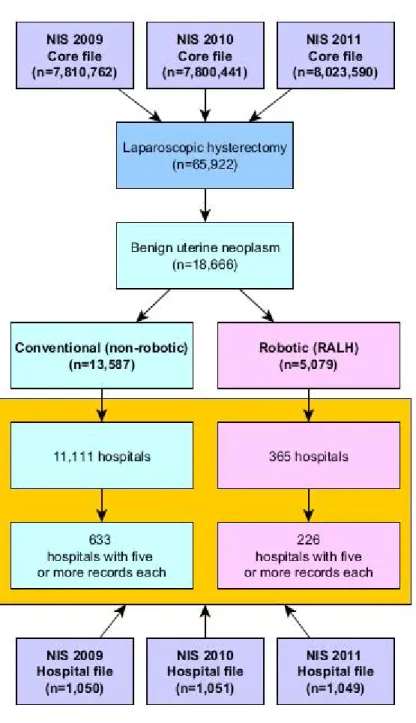
Data management and analysis were conducted in JMP and SAS 9.3 (SAS Institute Inc., Cary, NC, USA) using a combination of data steps and PROC SQL in the process displayed in figure 1. Discharge records with a primary procedure code for laparoscopic hysterectomy (ICD-9-CM 68.31, 68.41, 68.51, 68.61, or 68.71) were drawn from the NIS (2009-2011). Records with a primary diagnosis Clinical Classification Software (CCS; Elixhauser, 2014) code of benign neoplasm of the uterus (CCS 46) were retained. A dichotomous variable was created to identify records containing at least one robotic-assisted laparoscopy code (ICD-9-CM 17.42) and this variable was used to create two data sets – one for robotic procedures and the other for non-robotic procedures.
In each data set, records with a CCS code of 238 ("Complications of surgical procedures or medical care") were flagged as having one or more complications. Total number of
complications falling under CCS 238 was calculated for each discharge, as well as complication rate (total number of complications divided by the total number of discharges) for each hospital.
Figure 1 – Data management process
Analysis
10
complication rates below the 75th percentile using PROC FREQ with the CHISQ option. This analysis was conducted separately for robotic and non-robotic procedures. Additionally, PROC CORR was carried out separately for robotic and non-robotic procedures to investigate the relationships between complication rate, total procedures, total complications, share of procedures, and share of complications.
CHAPTER III RESULTS
Of 65,922 laparoscopic hysterectomies in the 2009-2011 NIS, 19,196 (29.12%) were robotically assisted. Benign neoplasm of uterus (CCS 46) was the principal diagnosis for 18,666 of patients: 5,079 receiving robotic assisted laparoscopic hysterectomy and 13,587 undergoing conventional laparoscopic hysterectomy over the three year period.
Half of RALH records included in the present study came from the 2011 NIS. Number of RALH procedures for benign neoplasms of the uterus appearing in the NIS increased between 2009 and 2011 (Figure 2). Meanwhile the number of non-robotic laparoscopic hysterectomies for benign uterine neoplasms declined over the three year period (Figure 2).
Figure 2 – Laparoscopic hysterectomies for uterine fibroids
Nationwide Inpatient Sample (NIS), 2009-2011, Unweighted
Patient Characteristics
12
patients and 45.67 for non-robotic patients. Length of stay was 1.44 and 1.49 days for RALH and non-robotic patients, respectively. Number of chronic conditions per patient was 2.34 (RALH) and 2.30 (non-robotic).
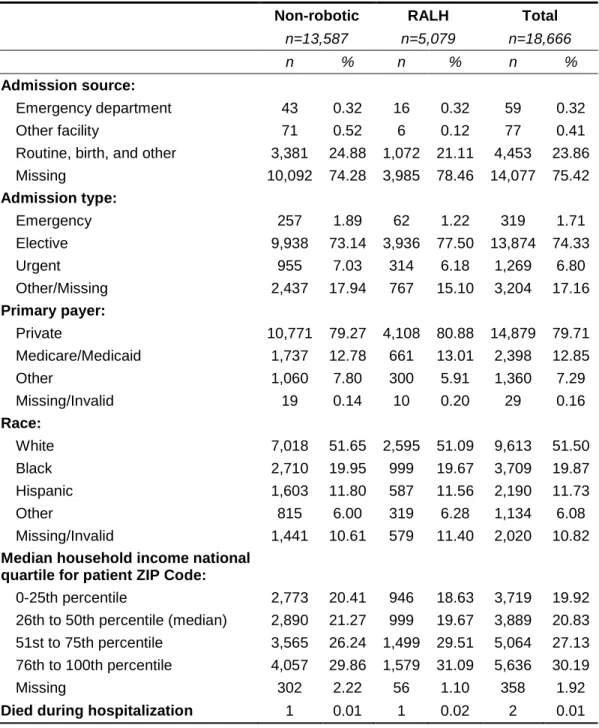
Table 1 – Patient and hospitalization characteristics
For women undergoing laparoscopic hysterectomy for uterine fibroids (NIS 2009-2011)
Non-robotic RALH Total
n=13,587 n=5,079 n=18,666
n % n % n %
Admission source:
Emergency department 43 0.32 16 0.32 59 0.32
Other facility 71 0.52 6 0.12 77 0.41
Routine, birth, and other 3,381 24.88 1,072 21.11 4,453 23.86
Missing 10,092 74.28 3,985 78.46 14,077 75.42
Admission type:
Emergency 257 1.89 62 1.22 319 1.71
Elective 9,938 73.14 3,936 77.50 13,874 74.33
Urgent 955 7.03 314 6.18 1,269 6.80
Other/Missing 2,437 17.94 767 15.10 3,204 17.16
Primary payer:
Private 10,771 79.27 4,108 80.88 14,879 79.71
Medicare/Medicaid 1,737 12.78 661 13.01 2,398 12.85
Other 1,060 7.80 300 5.91 1,360 7.29
Missing/Invalid 19 0.14 10 0.20 29 0.16
Race:
White 7,018 51.65 2,595 51.09 9,613 51.50
Black 2,710 19.95 999 19.67 3,709 19.87
Hispanic 1,603 11.80 587 11.56 2,190 11.73
Other 815 6.00 319 6.28 1,134 6.08
Missing/Invalid 1,441 10.61 579 11.40 2,020 10.82
Median household income national quartile for patient ZIP Code:
0-25th percentile 2,773 20.41 946 18.63 3,719 19.92
26th to 50th percentile (median) 2,890 21.27 999 19.67 3,889 20.83
51st to 75th percentile 3,565 26.24 1,499 29.51 5,064 27.13
76th to 100th percentile 4,057 29.86 1,579 31.09 5,636 30.19
Missing 302 2.22 56 1.10 358 1.92
Hospital Characteristics
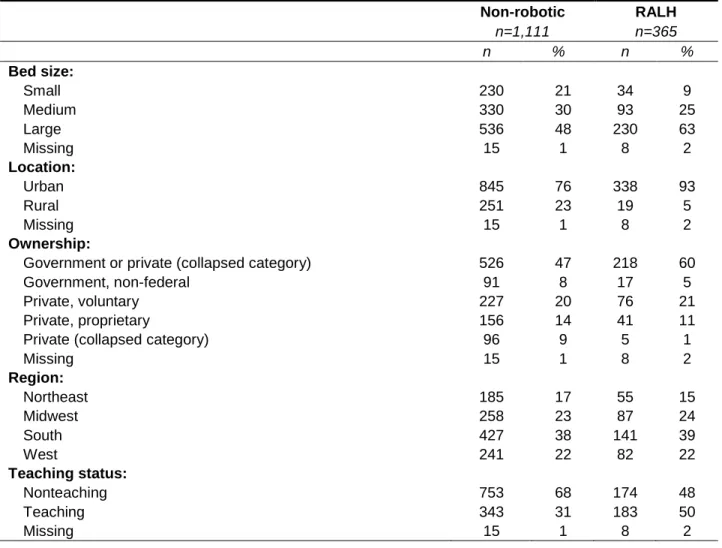
Hospital characteristics for 5,079 discharges from 365 hospitals for RALH, and 13,587 discharges from 1,111 hospitals for conventional laparoscopic hysterectomy are presented in Table 2. RALH procedures were less likely to occur in small, rural, or non-teaching hospitals.
Table 2 – Hospital characteristics
Laparoscopic hysterectomies for uterine fibroids (NIS 2009-2011)
Non-robotic RALH
n=1,111 n=365
n % n %
Bed size:
Small 230 21 34 9
Medium 330 30 93 25
Large 536 48 230 63
Missing 15 1 8 2
Location:
Urban 845 76 338 93
Rural 251 23 19 5
Missing 15 1 8 2
Ownership:
Government or private (collapsed category) 526 47 218 60
Government, non-federal 91 8 17 5
Private, voluntary 227 20 76 21
Private, proprietary 156 14 41 11
Private (collapsed category) 96 9 5 1
Missing 15 1 8 2
Region:
Northeast 185 17 55 15
Midwest 258 23 87 24
South 427 38 141 39
West 241 22 82 22
Teaching status:
Nonteaching 753 68 174 48
Teaching 343 31 183 50
Missing 15 1 8 2
Complications
14
stay. Of these, 35 (0.69%) experienced two or more of such complications. Of 13,587 non-robotic laparoscopic hysterectomy patients with the same diagnosis, 796 (5.86%) experienced complications, with 98 (0.72%) experiencing two or more complications.
Complications are presented in Table 3. Accidental laceration was the most common complication for both robotic and non-robotic procedures. ‘Top ten’ complications did not differ between robotic and non-robotic cases, though order varied slightly.
Table 3 - ‘Top ten’ complications1
Laparoscopic hysterectomy for benign neoplasm of the uterus
ICD-9-CM Diagnosis n (%) Robotic n=5,079 Non-robotic n=13,587
9982 : ACCIDENTAL OP LACERATION 154 ( 3.03% ) 335 ( 2.47% )
99811: HEMORR AS PROC CX (Begin 1996) 27 ( 0.53% ) 139 ( 1.02% )
9974 : SURG COMPLIC-GI TRACT (end 2011) 51 ( 1.00% ) 73 ( 0.54% )
78062: POSTPROCEDURAL FEVER (Begin 2008) 33 ( 0.65% ) 63 ( 0.46% )
9975 : SURG COMPL-URINARY TRACT 18 ( 0.35% ) 56 ( 0.41% )
99812: HEMATOMA PROC CX (Begin 1996) 18 ( 0.35% ) 53 ( 0.39% )
45829: OTHER IATROGENIC HYPOTENSION (Begin 2003) 12 ( 0.24% ) 39 ( 0.29% )
9971 : SURG COMPL-HEART 14 ( 0.28% ) 33 ( 0.24% )
99739: RESPIRATORY COMP NEC (Begin 2008) 15 ( 0.30% ) 31 ( 0.23% )
99859: OTH POSTOP INFECTION (Begin 1996) 11 ( 0.22% ) 18 ( 0.13% )
1
Limited to 145 ICD-9-CM codes falling under clinical classification software (CCS) code 238 - Complications of surgical procedures or medical care
Complications and Hospital Characteristics
RALH discharges with complications (CCS 238; n=338) represented 169 (46%)
For RALH (table 4), there was a significant association between location (urban/rural) and whether or not a hospital fell into the higher complication group or lower complication group (Fisher's Exact two-sided p < .05). Most rural hospitals fell into the highest quartile for hospital complication rate. This was also observed for the variable location/teaching variable which combines location (urban/rural) and teaching status (chi-square = 8.60, p < 0.05). For non-robotic procedures (table 5), there was a significant association between teaching status and high/low complication rate (chi-square = 8.34, p < 0.01), and the combined location/teaching status variable and high/low complication rate (chi-square = 6.8167, p < 0.05). More teaching hospitals than expected fell into the highest quartile for hospital complication rate.
Both hospitals with patient deaths (n=2) had complication rates below the 75th percentile and at least 30 procedures. One patient experienced a cardiac complication that was included in CCS 238 and thus included in this analysis.
Variable correlations
Before restricting the analysis to hospitals with 5 or more procedures, complication rate for non-robotic laparoscopic hysterectomy was related to total number of procedures performed (r= -.08, r2=.01, p<.01, n=1,111). Total number of procedures performed was not significantly related to hospital complication rate for robotic surgery (r= -.08, r2=.01, p=.15, n=365). This held true after restricting the analysis to hospitals with 5 or more procedures (robotic: r= -.09657, r2=.00933, p=.1479, n=226; non-robotic: r= -.08096, r2=.00655, p=.0417, n=633). When
16
Table 4 - Characteristics for hospitals with at least 5 procedures
Robotic assisted laparoscopic hysterectomy (RALH) (n=226)
Complication Rate
Variable n (%)
Lowest 75% n = 169
Highest 25% n = 57
Bed size of hospital1 Missing 3 ( 1.8)
1: Small 15 ( 8.9) 4 ( 7.0)
2: Medium 45 (26.6) 15 (26.3)
3: Large 106 (62.7) 38 (66.7)
Control/ownership of hospital Missing 3 ( 1.8)
1: Government, non-federal (public) 12 ( 7.1) 4 ( 7.0)
2: Private, not-for-profit (voluntary) 124 (73.4) 45 (78.9)
3: Private, investor-owned (proprietary) 30 (17.8) 8 (14.0)
Location (urban/rural) of hospital** Missing 3 ( 1.8)
0: Rural 2 ( 1.2) 5 ( 8.8)
1: Urban 164 (97.0) 52 (91.2)
Location/teaching status of hospital***
Missing 3 ( 1.8)
1: Rural 2 ( 1.2) 5 ( 8.8)
2: Urban nonteaching 83 (49.1) 23 (40.4)
3: Urban teaching 81 (47.9) 29 (50.9)
Multi-hospital system membership Missing 16 ( 9.5) 6 (10.5)
0: Hospital is not a member of a multi-hospital system
39 (23.1) 14 (24.6)
1: Hospital is a member of a multi-hospital system 114 (67.5) 37 (64.9)
Region of hospital 1: Northeast 22 (13.0) 11 (19.3)
2: Midwest 37 (21.9) 14 (24.6)
3: South 69 (40.8) 17 (29.8)
4: West 41 (24.3) 15 (26.3)
Teaching status of hospital Missing 3 ( 1.8)
0: Nonteaching 85 (50.3) 28 (49.1)
1: Teaching 81 (47.9) 29 (50.9)
1
Bedsize is a function of region, location (rural vs urban), and teaching status. For more information: https://www.hcup-us.ahrq.gov/db/vars/hosp_bedsize/nisnote.jsp
Table 5 - Characteristics for hospitals with at least 5 procedures Conventional (non-robotic) laparoscopic hysterectomy (n=633)
Complication Rate
Variable n (%)
Lowest 75% n = 472
Highest 25% n = 161
Bed size of hospital1 Missing 4 ( 0.8) 3 ( 1.9)
1: Small 70 (14.8) 23 (14.3)
2: Medium 132 (28.0) 56 (34.8)
3: Large 266 (56.4) 79 (49.1)
Control/ownership of hospital Missing 4 ( 0.8) 3 ( 1.9)
1: Government, non-federal (public) 51 (10.8) 23 (14.3)
2: Private, not-for-profit (voluntary) 347 (73.5) 110 (68.3)
3: Private, investor-owned (proprietary) 70 (14.8) 25 (15.5)
Location (urban/rural) of hospital Missing 4 ( 0.8) 3 ( 1.9)
0: Rural 59 (12.5) 20 (12.4)
1: Urban 409 (86.7) 138 (85.7)
Location/teaching status of hospital***
Missing 4 ( 0.8) 3 ( 1.9)
1: Rural 59 (12.5) 20 (12.4)
2: Urban nonteaching 239 (50.6) 63 (39.1)
3: Urban teaching 170 (36.0) 75 (46.6)
Multi-hospital system membership Missing 47 (10.0) 20 (12.4)
0: Hospital is not a member of a multi-hospital system
123 (26.1) 43 (26.7)
1: Hospital is a member of a multi-hospital system 302 (64.0) 98 (60.9)
Region of hospital 1: Northeast 76 (16.1) 30 (18.6)
2: Midwest 89 (18.9) 36 (22.4)
3: South 184 (39.0) 59 (36.6)
4: West 123 (26.1) 36 (22.4)
Teaching status of hospital*** Missing 4 ( 0.8) 3 ( 1.9)
0: Nonteaching 295 (62.5) 79 (49.1)
1: Teaching 173 (36.7) 79 (49.1)
1
Bedsize is a function of region, location (rural vs urban), and teaching status. For more information: https://www.hcup-us.ahrq.gov/db/vars/hosp_bedsize/nisnote.jsp
18
CHAPTER IV DISCUSSION
This is the first study that we are aware of that examines hospital characteristics as they relate to complication rates for RALH. It includes three years of data from the largest source of all-payer inpatient data in the U.S. (HCUP NIS, 2012).
In the United States, robotic-assisted laparoscopic hysterectomy (RALH) has been on the rise for benign uterine conditions since the da Vinci system received regulatory clearance in 2005 (Rosero, 2013; Wright, 2013). Number of RALH procedures for benign neoplasms of the uterus appearing in the NIS increased between 2009 and 2011 while the number of non-robotic laparoscopic hysterectomies declined and the total number of hysterectomies increased,
suggesting that RALH may be in the process of replacing conventional laparoscopic hysterectomy (Figure 2).
Complications
Accidental laceration was the most common complication for RALH, followed by
gastrointestinal tract complications, perhaps supporting Manoucheri’s (2014) MAUDE finding of iliac, aortic, and bowel injuries. Blood loss is consistently lower for RALH patients (Ayala-Yanez, 2013; Weinberg, 2011; Rosero, 2013) and the present study found that hemorrhage was lower for robotic procedures compared to non-robotic procedures.
removed and the analysis was repeated with the same results. Perhaps rural hospitals are simply less experienced with robotic surgery due to lack of resources or lower number of eligible patients. Lower number of patients undergoing RALH might also be indicative of lower socio-economic status since the surgery is known to be more expensive than conventional laparoscopic surgery.
For non-robotic procedures, there was a significant association between teaching status and high/low complication rate, with more teaching hospitals than expected falling into the high complication rate group. The chi-square for teaching status and high/low complication rate for robotic surgery was not significant. Perhaps teaching status is less relevant for robotic surgery because most practitioners are new to it since it is a fairly recent development. However, due to the nature of the chi-square test, we are unable to tell whether or not the significant result for the location/teaching status variable is simply due to the urban/rural breakdown, or whether dividing urban hospitals into teaching and non-teaching revealed something that the
teaching/non-teaching variable did not. A next step would be to repeat the test for teaching/non-teaching status and high/low complication rate, excluding rural hospitals.
Learning Curve
In general, it appears that the more laparoscopic hysterectomies a hospital performed, the lower its complication rate, as demonstrated by a negative Pearson’s r in all scenarios that we analyzed. When analysis was restricted to hospitals with 10 or more procedures, the relationship between complication rate and total procedures performed was strengthened for robotic surgery. However, for RALH, Pearson’s r was always low, and non-significant.
20
months of experience (Lenihan, 2008; Woelk, 2013). Only five of the hospitals included in the RALH analysis totaled at least 90 procedures during the 36 month period included in this study. All five hospitals totaling at least 90 procedures had complication rates below the 75th percentile, and were large, private, urban hospitals, three teaching and two non-teaching. Four were
members of a multi-hospital system and one was missing this information in the database. Twenty of 365 hospitals totaled 50 or more RALH procedures, the learning curve suggested by Lenihan (2008). After additional years of NIS data are released and hospitals become more experienced with RALH, further analysis may be possible.
Limitations
The present analysis only includes a three year period and we are unable to assess when each hospital first began operating with the da Vinci. The learning curve for surgical proficiency is thought to require as many as 91 procedures and 36 months of experience (Woelk, 2013). Only five of the 365 hospitals totaled at least 90 procedures during the 36 month period included in this study.
Data were analyzed without controlling for patient characteristics, such as primary payer, income, or admission source, which may be related to hospital selection and patient outcome. It is unknown whether exploring such factors would reveal or dispel any pattern (i.e., confounding or effect modification). Furthermore, only women with a principal diagnosis of uterine fibroids were included in this study, and results may not be generalizable to all RALH surgeries.
Finally, hospitals served as the unit of analysis for our comparisons. A hospital’s
experience with RALH may actually be a marker of an individual surgeon’s experience with the procedure. In this case our results could be interpreted as “rural surgeons” and “surgeons operating in teaching hospitals” may have higher than expected complication rates for RALH compared to conventional laparoscopic hysterectomy. The NIS includes a variable that identifies unique physicians. Assessing complication rate by physician ID might reveal a stronger
correlation between number of procedures performed and complication rate. However, physician ID may not necessarily represent the operating surgeon.
Conclusion
22
REFERENCES
Anderson JE, Chang DC, Parsons JK, Talamini MA. The first national examination of outcomes and trends in robotic surgery in the United States. J Am Coll Surg. 2012 Jul;215(1):107-14; discussion 114-6. doi: 10.1016/j.jamcollsurg.2012.02.005. Epub 2012 May 4. PubMed PMID: 22560318.
Ayala-Yáñez R, Olaya-Guzmán EJ, Haghenbeck-Altamirano J. Robotics in
Gynecology: Why is this Technology Worth Pursuing? Clin Med Insights Reprod Health. 2013 Jul 24;7:71-77. eCollection 2013 Jul 24. Review. PubMed PMID: 24453521; PubMed Central PMCID: PMC3888078.
Baird DD, Dunson DB, Hill MC, Cousins D, Schectman JM. High cumulative
incidence of uterine leiomyoma in black and white women: ultrasound evidence. Am J Obstet Gynecol. 2003 Jan;188(1):100-7. PubMed PMID: 12548202.
Chen CC, Falcone T. Robotic gynecologic surgery: past, present, and future.
Clin Obstet Gynecol. 2009 Sep;52(3):335-43. doi: 10.1097/GRF.0b013e3181b08adf. Review. PubMed PMID: 19661749.
Elixhauser A, Steiner C, Palmer L. Clinical Classifications Software (CCS), 2014. U.S. Agency for Healthcare Research and Quality. Available: http://www.hcup-us.ahrq.gov/toolssoftware/ccs/ccs.jsp
HCUP NIS Description of Data Elements. Healthcare Cost and Utilization Project (HCUP). December 2012. Agency for Healthcare Research and Quality, Rockville, MD. www.hcup-us.ahrq.gov/db/nation/nis/nisdde.jsp.
HCUP Nationwide Inpatient Sample (NIS). Healthcare Cost and Utilization Project (HCUP). 2007-2009. Agency for Healthcare Research and Quality, Rockville, MD. www.hcup-us.ahrq.gov/nisoverview.jsp
Lenihan JP Jr, Kovanda C, Seshadri-Kreaden U. What is the learning curve for robotic assisted gynecologic surgery? J Minim Invasive Gynecol. 2008
Sep-Oct;15(5):589-94. doi: 10.1016/j.jmig.2008.06.015. PubMed PMID: 18722971. Liu H, Lu D, Wang L, Shi G, Song H, Clarke J. Robotic surgery for benign
gynaecological disease. Cochrane Database Syst Rev. 2012 Feb 15;2:CD008978. doi: 10.1002/14651858.CD008978.pub2. Review. PubMed PMID: 22336855.
Manoucheri E, Fuchs-Weizman N, Cohen SL, Wang KC, Einarsson JI. MAUDE -
Analysis of Robotic-Assisted Gynecologic Surgery. J Minim Invasive Gynecol. 2014 Jan 28. pii: S1553-4650(14)00027-2. doi: 10.1016/j.jmig.2013.12.122. [Epub ahead of print] PubMed PMID: 24486535.
Rosero EB, Kho KA, Joshi GP, Giesecke M, Schaffer JI. Comparison of robotic
and laparoscopic hysterectomy for benign gynecologic disease. Obstet Gynecol. 2013 Oct;122(4):778-86. doi: 10.1097/AOG.0b013e3182a4ee4d. PubMed PMID: 24084534.
24
learning curve. Gynecol Surg. 2010 Sep;7(3):253-258. Epub 2010 Apr 13. PubMed PMID: 20700514; PubMed Central PMCID: PMC2914863.
Schwartz BF. Training requirements and credentialing for laparoscopic and
robotic surgery--what are our responsibilities? J Urol. 2009 Sep;182(3):828-9. doi: 10.1016/j.juro.2009.06.074. Epub 2009 Jul 17. PubMed PMID: 19616251. Wechter ME, Stewart EA, Myers ER, Kho RM, Wu JM. Leiomyoma-related
hospitalization and surgery: prevalence and predicted growth based on population trends. Am J Obstet Gynecol. 2011 Nov;205(5):492.e1-5. doi:
10.1016/j.ajog.2011.07.008. Epub 2011 Jul 20. PubMed PMID: 22035951; PubMed Central PMCID: PMC3746963.
Weinberg L, Rao S, Escobar PF. Robotic surgery in gynecology: an updated systematic review. Obstet Gynecol Int. 2011;2011:852061. doi:
10.1155/2011/852061. Epub 2011 Nov 28. PubMed PMID: 22190948; PubMed Central PMCID: PMC3236390.
Woelk JL, Casiano ER, Weaver AL, Gostout BS, Trabuco EC, Gebhart JB. The
learning curve of robotic hysterectomy. Obstet Gynecol. 2013 Jan;121(1):87-95. doi: http://10.1097/AOG.0b013e31827a029e. PubMed PMID: 23262932.