Andy
Raubeson
The
SRO
Housing
Corporationwas formed
bytheCommunity
Redevelopment
Agency
(CRA)
ofthe CityofLos Angeles
in February 1984.The new
non-profitcorporationwas
givenamission ofimproving
thequality oflife in the Central City East, or Skid
Row,
neighborhood
ofLos
Angeles.The
main
objectivewas
then,
and
remains today, the acquisition, renovation,management
and maintenance
oftheexistinghousingstock.In 1984, there
were
63 operatingSRO
hotelswithover 6,000 rooms,constitutingvirtuallythe entire
hous-ingstock ofthis55-squareblockarea.
The
Corporationunder
itsgovernmental
sponsor,the
Community
Redevelopment Agency
ofthe CityofLos Angeles
(CRA),
realized thattheCentralCityEastarea
was
so bereft of any sense ofcommunity
thatupgrading the housing
was
notenough
to assure adecentqualityoflifeforthose
who
live,work,and
shop
in the neighborhood.
From
its inceptionSRO
Hous-ing'srole
was
seento be broader than theprovisionofdecent,safe,
and
sanitaryhousingataffordablerents.At
thetimethispaper
was
writtenbaserentsrangedfrom
$195
permonth
forthoseon
General
RelieftoS235 permonth
forthoseon
SupplementalSecurityIncome
(SSI).General
ReliefinLos Angeles
County
iscurrently$341 permonth
plus$105
infoodstamps
and $42
buspassfor those assignedtoWorkfare
ortoapproved
education ortraining programs; SSI ranges
from $630
to$718
permonth.
1CRA
adopted
a strategyforSRO
Housing
todevelop parks in the areaand
to purchase hotels in clustersaround
those parks.CRA
then gaveSRO
Housing
themission ofdevelopingthe capacityto
manage
and
main-Andy
Raubeson hasbeen ExecutiveDirectorofSRO
Housing inLos
Angelessince1984.He
serveson
theboards oftheNationalCoalition fortheHomeless,theNational
Low-Income Housing
Coalition,and
theLow-Income
Housing
InformationService.
taintheseparks sothey
would
benefittheneighborhood
and
the tenantsofsingle-roomoccupance
hotels.As
such, the strategyofgroupinghotelpurchasesinclusters
was
alsobasedon
theconcept of extendingthe area of controlfromthehotelstothesurroundingstreets,thereby creating "islandsofsanity."No
one
who
iscaptive in hisor her living unit,no
matter
how
wellitismanaged
and
maintained,canlead adecentlife.The
tenantsofSRO
Housing'shotelsmust
befreetoleavetheirbuildings toshop, seekrecreation,
socializewithfriends
who
liveelsewhere,and
toconductthe ordinary businessoflife. In short,
SRO
Housing
Corporation cannot build a sense of
community
by concentratingsolelyon
physical,housingqualityissues.The
Corporation recognizedearlyinitshistorythatits tenant needs exceeded basic housing needs.
The
development
and
management
of parkswas
the firstresponsetothoseneeds.
However,
ademographic
sur-veyconducted
inmid-1984highlighted arange ofprob-lems withinthepopulation:a largeproportion ofhotel
residentsinthearea
had
a historyof alcoholand
drugabuse; a smaller but significant portion of the hotel
population
had
a historyof mental illness;elderlyten-ants
were
often victimizedby predatorsand had
limitedaccess to servicesdesignedtohelpthem;
and
homeless,indigent
men
were housed
inhotels thatwere
indeplor-able physicalcondition
and
inwhich
drug useand
crimewas
rampant.SRO's
strategy to deal with thisproblem was
toacquire, renovate,
and
professionallymanage
thesingleroom
occupancy
hotels thatcomprised
virtually 100 percentofthehousing stockintheneighborhood.SRO
Housing
felt thatgood
management
practices,espe-ciallycarefultenantselection,
would
reducethenumber
of drug-usingand
criminally inclined tenantsand
createa
more
stable tenant base thatwould
result in saferFrontFacade oflheAngelusInn,a 31-unitspecialneedshotel servingrecoveringsubstanceabusers.
The
Challenges of
Resident
Management
The
roleof theresidentmanager
inan
SRO
Housing
Corporation
managed
housingfacilityisbroader thananarrowly defined housing
management
function.Al-though
residentmanagers
arenotexpectedtobesocial workers, they are expected to care for their tenants'welfare
and
toidentifytenantneeds.They
help provideforthose needs by
making knowledgeable
referrals toserviceproviders includingthose
employed
by theSRO
Housing
CorporationinitsSocialServices Division.To
maintainsafebuildingsand
promote
a safeenvi-ronment
overall,residentmanagers
must
act asateam, observe each other'sbuildings,and
develop theirown
strategies for assuring thesafety oftenants outside aswell as inside the buildings. Since cleaner
neighbor-hoods
are usually saferneighborhoods,managers
must
be surethat thefacadesoftheirbuildings
and
the side-walksand
streets infrontand
around
theirbuildings areclean, freeoftrash,
and
freeofgraffiti.SRO
hasstreetcleaning capabilityinitsParksDivision,
and
managers
havea responsibilitytorequest services
from
thisunitinthe
same way
theyhavea responsibility to request serv-icesfrom
theMaintenance
Division.Initially, resident
managers
were
expected to carry fullresponsibility for identificationoftenantswho
needed socialservice referrals. Informationand
referralserv-ices,caseplanning
and
monitoringrequire intense per-sonalinvolvement,as wellastime.This provedtobe toodemanding
foreventhemost
skillfulresidentmanagers.As
a result,SRO
Housing
created six special needshotels
and
a SocialServices Division.The
SocialServ-ices Divisionadministers, supervises
and
developstheservices in these special needs hotels. It also advises
resident
managers
on
socialservicesand
providesdirectservicesfor ten-antswho
arenotlocatedina specialneeds hotel or
whose
problems
are too complicatedforresidentmanag-ers.This has helpedalleviatethe
de-mand
on
residentmanagers.Special
Needs
Hotels
The
1984demographic
surveyand tenant profileshelped identifysev-eralspecialneeds populations
resid-inginthehotels.
SRO
Housing
has developed seven general populationhotels
and
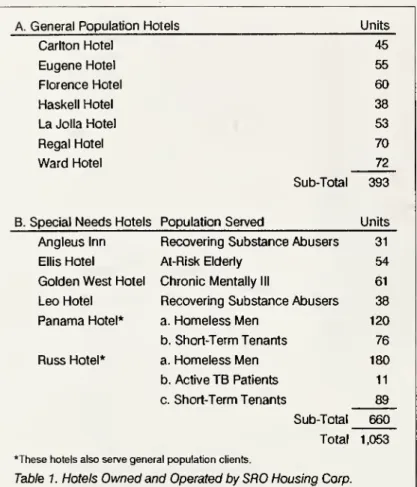
sixhotelsfordesignatedspecialneedsgroups(see table 1).
The
Russ and
thePanama
Hotelshouse
generalpopulationaswellas short-term tenantsand
homeless,indigent
men.
The
Russ
alsohousesnon-contagious,active tuberculosis
patientsincooperation with the
Los
Angeles
County
Department
ofHealth Services.SRO
Housing
feltthesetwo
properties(290and 230
unitsre-spectively)
were
toolargeto fosterthesense ofcommu-nity
found
inotherCorporation-owned
hotels,which
rangeinsize31to72units.
When
theywere
purchased inJanuary1985,theRuss and
thePanama
were
largely populated by "voucherclients."Because
of thesizeofthese hotels
and
theneed
of thevoucher
client fordecent, safe,
and
sanitary short-term housing, itwas
decidedtocontinuetoprovide short-term housing,for homeless,indigent
men
inthesetwo
properties.2Eight otherhotelspurchased bytheSRO
Housing
Corpora-tion
were
formerlyvoucher hotelsandwereconverted
topermanent
housing.In
Los Angeles
County, any indigent person has arighttoshelter
on
thesame
day he or sheapplies totheDepartment
of PublicSocial Services(DPSS)
forwel-fare.
Voucher
clientsarehoused
inresidential hotelsforshortperiodswhilethey waitfor theirfirstcheck.
There
are 115such hotels throughoutthe county.
The
Russ
and
thePanama
aretwo
ofthefourremaininghotelsintheCentralCity
East-Skid
Row-neighborhood.
Voucher
clients are referred toSRO
Housing
byDPSS
foraperiodfrom one
tofourteendays.Vouchers
are
renewed
inrare instances, usuallywhen
aperson's mobilityisrestrictedbyaninjury.The
averagelengthofstay
on
avoucher
is3.3 days.Voucher
clientsare issuedkeys
and
haveaccessto theirrooms
on
a24-hourbasis.They
receivelaundrytokenstowash and
drytheirclotheson-site. Playing cards, games,
newspapers
and movies
are available in the lobby. In addition,
SRO
Housing
provides
grooming
kitsand
willmake
wake-up
callsviaA. GeneralPopulation Hotels Units Carlton Hotel 45
EugeneHotel 55
FlorenceHotel 60
Haskell Hotel 38
LaJollaHotel 53
RegalHotel 70
Ward
Hotel 72Sub-Total 393
B. SpecialNeedsHotels PopulationServed Units AngleusInn RecoveringSubstanceAbusers 31
EllisHotel At-RiskElderly 54
Golden WestHotel ChronicMentallyIII 61
LeoHotel RecoveringSubstance Abusers 38
Panama
Hotel* a.HomelessMen
120b. Short-TermTenants 76
RussHotel* a.Homeless
Men
180 b. ActiveTB
Patients 11c.Short-Term Tenants 89
Sub-Total 660 Total 1,053 •Thesehotelsalsoserve generalpopulationclients.
Table 1.Hotels
Owned
andOperatedbySRO
HousingCorp.voucher
clienttomeet
hisneeds.SRO
Housing'scostforthese services is $13.50 per person per night. This rate is negotiatedbetween
theSRO
Housing
Corporationand
DPSS.
Itcompares
fa-vorablywiththelatest
US
Department
ofHousing and
Urban Development
(HUD)
report,which
places theaveragecostat$22.00perperson pernightin
govern-ment-supported
emergency
shelters. Inmost
ofthese sheltersapersonsleepson
apad
on
the floororacotand
must
leave the shelter a 7:00AM.
and
cannotreturnuntil6:00
P.M.
Two
otherspecial needs hotelsprovide housing for recovering substanceabusers.The Leo
Hotel(38units)and Angelus
Inn(31units)areboth operatedas alcohol-freelivingenvironments. Residents ofthese hotelsmust
havea
minimum
ofsix-monthsverifiablesobrietyupon
admissionand
sign a leasewhich
prohibittheir use of alcohol or drugsand
restricts their visitors to personswho
haveno
alcoholintheirsystemand
do
not useillegaldrugs.
The
usualway
to verify sixmonths
sobriety is thecompletion of a residential treatment
program
ofat leastsixmonths
duration.Sinceopening
theLeo
Hotelin1987,
SRO
Housing
hasdevelopedcloseworking
re-lationshipswith area treatmentprograms.
The Leo
Hoteland Angelus
Innare theonlytwo permanent
housing fa-cilitieswith soberlivingenvironmentsindowntown
Los
Angeles
and
areimportantforthe treatmentcommu-nity.
SRO
Housing
isalsoable to gain access totreat-ment
for tenants oremployees
with alcohol or drugabuse problems.
A
third specialneeds categoryisthe chronicallyand
severelymentallyill,
who
arehoused
intheGolden West
Hotel(61units).Thishotel requiresitstenantstobe
on
thecaseload oftheSkid
Row
Mental Health
Project of theLos
AngelesCounty
Department
ofMental
Health.It isa transitionalhousing
program
funded bytheHUD
under
theStewartB.McKinney
Act.Afterthetransition period oftwo
years, tenants oftheGolden West
aretransferred to
permanent
housing hotels operated bythe
SRO
Housing
Corporationor,insome
cases,theyare relocatedoffSkid
Row.
Finally,
SRO
Housing
operates theEllis Hotel (54units)as
permanent
housingfor at-risk elderly.To
be eligiblefortenancy,men
and
women
must
be 55years orolder.
The
EllisHotelisowned
bya limited partnership,with the
SRO
Housing
Corporation as the generalmanaging
partner.Under
the terms of the 1986Tax
Reform
Act
asamended,
tenantsoftheEllismust
haveincome
notinexcess of60
percent ofthearea median. SinceSRO
Housing's tenantsaverage 22.1 percent of theareamedian,thisrestrictionhaslittlerelevance.The
Ellis Hotel is located adjacent to Gladys Parkwhich
isoperated bySRO
Housing under
contractwith the City.The
Ellis serves a congregatemeal
for the elderlyinitslobbydaily.Thismeal
isopen
toallelderlyresidentsintheneighborhood, notjusttoEllistenants.
One
of thecommercial
spaces in the hotel hasbeen
convertedintoa
community
room
forAlcoholicsAnony-mous,
NarcoticsAnonymous
and Cocaine
Anonymous
meetings,aswell ascommunity
forums and
avarietyofeducational
and
outreach programs.A
secondcommer-cialspace has
been
converted to acommunity
fitnesscenter thatisoperatedjointlyby
SRO
Housing and
theDowntown
YMCA.
Social
Services
Resident
managers havea
responsibility tohelpmeet
a
broad
range of tenant needs.To
facilitate thiseffortSRO
Housing
has developedand
published theSRO
Housing
Corporation'sSocial Services ReferralManual.Managers must
become
familiarwith thismanual
and use it as a tool to obtain necessary services for theirtenants.
Only
agencies that regularly serviceSkidRow
clients are listed.
Managers
have the responsibilityto update their individualmanuals
by noting staff andprogram
changesand
byadding informationthatwillbeuseful for future referrals.
Such manuals
quicklybe-come
datedand remain
usefulonlyifthey are constantlyupdated.
SRO
Housing
also provides other toolsmanagers
may
relyon
tohelpmeet
theneeds oftheirtenants.The
train-ing sessionsforresident
managers
that includediscus-sions ofsocial
and
support services.SRO
Housing'sSocial Services Division provides the following
addi-tional
programs
and
services:ProjectHotelAlert
(PHA)
PHA
isaprogram
fortheelderly operated
under
contract with the City ofLos
Angeles'
Department
of Aging. Persons60
yearsofageand
older are eligible for services that include dailycongregatemealsatthe
Russ and
EllisHotels.3 Partici-pationinthecongregatemeal
program
isnotrestrictedtotenants of
SRO
Housings'hotels, butisopen
to allelderlypersons
from
theSkidRow
Area.Disabledper-sons
who
are residents of thesetwo
hotels are alsoeligible toparticipateinthecongregate meal,regardless
ofage.
Tenants
who
are shut-inbecause ofpermanent
or temporarylossofmobility receivehome-delivered meals through theMeals
on
Heels program.Both
congregateand
home-delivered mealsmust
provide at least 50 percent ofthe nutritional needs ofelderly persons as establishedbythe U.S.Department
of Health andHuman
Services.There
isalsoanurseavailable forhealthscreen-ing
and
referralaswellasroutine medicalcaresuchas changingdressings.Case
management
servicesprovideprofessionalneeds assessment,case planning,referrals,
money
management,
transportation, recreation,educa-tion
and
more.Mental
HealthManagers
inSRO
Housing's otherhotels
who
suspect that tenants arementallyillcancallon
thesenior casemanager
attheGolden West
Hotelfor assistancein diagnosis
and
adviceon
meeting theneeds ofsuch tenants. In
some
cases, tenants will betransferred to the
Golden West
from
other hotels. Inothercases,
ongoing
supportwillbe providedtomanag-ers inotherhotels todealwith mentallyill ten-ants. In cases
where
tenants are transferredfrom
theGolden
West
tootherSRO-managed
hotels, a planshould be
worked
outbetween
the
manager and
the caseworker from
theGolden
West
beforetransfer,and
regular con-tactismaintainedafterthetenantismoved.
Emergency
ShelterProgram
The
Russ and
Panama
Hotels are recognized asemergency
sheltersbythe StateofCalifornia
Department
of
Housing and
Community
Development
(HCD).
SRO
operatestheEmergency
ShelterProgram under
agrantfrom
the StateHCD
toprovide case
management
services toover 14,000homeless
men
eachyear.Case managers
oper-ateout ofthe lobbiesofthe
Russ and
Panama
Hotelsand
providearange ofservices, includ-ingreferrals, transportation, assistanceinob-tainingidentification,
and
militaryrecords.Homeless
AssistanceProgram
(HAP)
HAP
serves the
same
populationastheEmergency
Shelter Program. It isoperated cooperatively
withasisterSkid
Row
serviceagency,Chrysa-lis.Chrysalisprovides
employment
programs
and
serv-ices.
The
purpose
ofthisjointprogram
istoprovide jobreadiness
workshops and placement
into jobs and/orvocationaltraining.
Food
DistributionSRO
Housing
isamember
oftheLos Angeles
RegionalFood
Bank, throughwhich
ithasaccesssurplusfoods
from
theU.S.Department
ofAgri-culture as wellas locally
donated
food.SRO
Housing
makes
weekly deliveries to hotels.Managers
are thenresponsiblefordistributionoffoodtotenants.
Alcohol
and
Drug
ServicesThe
two
alcohol-freelivingcommunities
aremanaged
by recoveringalcoholicswith long periods of sobrietyand
acommitment
to help others achieveand
maintainasoberlife.These
buildingshave Alcoholics
Anonymous
(AA)
meetingsfortenantson
a regular basis.Some
meetings areopen
tonon-tenants ofthese hotels. In addition, the Drifters
AA
meeting,
which meets
sevennights aweek
and
Sunday
mornings,is
housed
inthecommunity
room
attheEllisHotel.
The
Harbor
Lightand
SafeHarbor
alcoholtreat-ment
programs
oftheSalvationArmy
operateafter-careservices forgraduatesoftheir
program
who move
intoSRO
Housing
Corporation'sbuildings.It isthe policyofSRO
Housing
tohelp recoveringalcoholicsand
addictsto maintain their sobriety in all its buildings. If an
alcoholicoraddicthasaslips/heiscounseledtore-enter
treatment.
The
first time a tenant slips, s/he will beaccepted back into the
SRO
housingnetwork
upon
satisfactory completion of the residential treatment program.
Subsequent
relapsesaretreated case-by-case,but reacceptanceaftertreatmentisnot automatic. Recreation In addition to the parks,
SRO
Housing
offers a range of other recreational opportunities for
SanJulian Park,aone-thirdacremini-parkindowntownLA,openedJuly19,1986.
tenants.
The
Downtown
YMCA
operatesaprofession-ally-staffed fitness center with high quality exercise
equipment
attheEllisHotel.Thiscenterisopen
tothecommunity.
SRO
Housing
provides trips to sportingevents,theaters,
and
movies.Residentmanagers
informtenantsofthese opportunities,
make
arrangements,and
encourage
participation.Tenant Amenities In addition to the activities
de-scribedabove,
managers
areexpectedtoarrangemini-mum
ofone
congregatemeal
and one
birthday celebra-tioneachmonth.
The
meal
shouldbe scheduledlate inthe
month
when
tenantstendtobelow
on
cash.Manag-ersshould review tenant records tobesure thatevery tenantwithabirthdayinagiven
month
isrecognizedatthe birthday party.
Managers
show
two movies
each night.Coffeeisavailableinthelobbyon
a regularbasis.SRO
Housing
continuestoseekresources toprovideservice toitstenants.Ithas Federal
Emergency
Manage-ment Agency
(FEMA)
vouchers tohouse homeless
persons
who
have not obtained aDPSS
voucher. Itmaintains
an agreement
withtheDowntown
LionsClub
toprovidevisioncare,includingexaminations, prescrip-tion glasses, cataract operations,
glaucoma
screeningand
care.SRO
Housing
has also obtained motorized wheelchairsfrom
theRotary
Club.SRO
Housing
also sponsors special events to im-provethe qualityoflifeinCentralCity East.Concertsintheparkarepartiallyfunded byagrant
from
the CityofLos Angeles
Cultural AffairsDepartment;
jobfairsand
health fairs are sponsored in conjunction with other
service agencies.
Regular
neighborhood
clean-upcam-paigns include street
and
sidewalkcleaning, trashand
weed
removal from
vacantlots,and
graffitiremoval.SRO
Housing
hassubmitted grant applications for fundingto provide advocacy for persons seeking Sup-plementalSecurityIncome
benefits.It isalsopursuingpossibilitiesforspecialneeds housingforpersons
who
areHIV-positive,
and
transitionalhousingfor recover-ingalcoholicsand
addicts.Conclusions
The
SRO
Housing
Corporation hasan
advantageinowning and
operatingalargenumber
ofhotels within arelativelysmallgeographicarea.
Because
ofitssize(cur-rently14hotelswith1,174housingunits),
SRO
Housing
isable to
meet
a varietyofspecialneeds.The
variousprograms
tend to support each other: for instance,placement
oftenantsfrom
transitionalfacilitiescan be guaranteedwhen
the service provider also controlspermanent
housing.Supportivehousing does notrequireplacementina
largeordiverseorganizationinorderto
be
successful; however,there aremany
examples
ofsuch housing being operatedasastand-alonefacility.There
areevencasesin
which
onlyone
floorinabuildingisdesignatedforusebya specialneeds population.
For
example,the EstateHotelinPortland,
Oregon,
a four-story buildingwith156 units,houses recovering alcoholics in
an
alcohol-free livingenvironment
on
its top floor. This area isclosed off
from
therestofthe building.Clearly, single-room
occupancy
facilities arewell-suited toprovidea
combination
ofhousingand
supportservices.
These
buildingscaninclude traditionaldown-town
residential hotels,motelson
the outskirtsof town,and
rooming
houses. Less obvious structuressuch as warehouses, convents, schoolsand
hospitals are alsooften creativelyadaptedforuseas
an
SRO
hotel.There
isagrowing tendencytouseSROs
assitesfor housing special needs populations. This trend can be expected to continue to gainmomentum
form
new
HUD
policies thatencourage
supportiveservices asaconditionfor receiving federalhousingsubsidies.
The
experiencegained by theSRO
Housing
Corporationcan
be
ausefulmodel
for thisexpansion of supportivehousingthroughoutthe
United
States,cp
Notes
1
Supplemental Security Income(SSI) isa Federal program,with considerable Stateenhancements in the caseof California, that
provides benefitstopersonswhoare disabledor over age 62who
havenot qualified for Social Security benefitsorwhosebenefitsfall belowestablishedminimums.GeneralRelief, insomejurisdictions
calledGeneralAssistance,isprovidedforpersonsawaitinganSSI
eligibilitydeterminationorwhoareable-bodiedand underage62 andthusineligibleforSSI.
2The RussandPanamahouseonlymen. Forthepurposesofthis
article,thereisnodifferencebetweentheterms "voucherclients"
and "homeless,indigentmen."
3 Federalregulationsallowpersons overage55whoaremembersofa
SeniorCitizenorganizationtoparticipateinthemeal program.All