Analysis of the Impact of Participation in a Summer Bridge Program on
Mathematics Course Performance by First-Semester
Engineering Students
Abstract
As part of an NSF-supported project, a summer bridge program for incoming engineering and computer science freshmen was conducted each summer between 2009 and 2012. The primary purpose of this program was to improve the mathematics course placement for incoming students whose initial placement as determined by a math placement examination was below Calculus I. The students retake the university’s math placement examination at the end of the bridge program to determine if they may enroll into a more advanced mathematics course. The immediate goal of the program is to improve the math placement of the students. However, it is just as important in evaluating the success of the program to consider the performance of the students in their Fall semester math courses.
The mathematics portion of the bridge program centers on using the ALEKS software package for targeted, self-guided learning. The program took place exclusively in an on-campus format, and also featured a required residential component and additional engineering activities for the students. The program’s duration was 4 weeks, and students were expected to improve their math placement by at least one semester. It is expected that improving their math placement will reduce the student’s
time-to-graduation, which should in turn improve retention rates and eventually graduation rates. Data from the four cohorts have been collected and analyzed to judge the effectiveness of the program with respect to both improving the students’ math placement and the
students’ performance in future math courses. A lower percentage of students (69%) improved their math course placement in the 2009 cohort, but all categories of bridge program students performed as well as the class average in the Fall 2009 semester. For the 2010-2012 cohorts, students succeeded at improving their math placement at a higher rate (83%-88%). Students who have placed into Calculus I through the bridge program have successfully completed Calculus I at a rate similar to all students in the course in the Fall semester. However, the results for students who placed into College Algebra after the bridge program are more mixed. As a result, while the bridge program is clearly beneficial to many students, it is likely that additional interventions are needed to further help students who do not place into Calculus I even with a bridge program.
Introduction
In recent years, there has been a push in the United States to increase the number of students pursuing and completing studies in the Science, Technology, Engineering, and Mathematics (STEM) disciplines.1,2 There are two primary tasks that are needed for this goal to be accomplished. First, more students need to be attracted to pursue college-level studies in the STEM fields. Second, once those students are attracted to a STEM field,
the colleges and universities must provide an attractive, nurturing environment designed to allow a wide range of students to succeed, while still providing a rigorous technical education.
The College of Engineering and Applied Science (CEAS) at the University of Wisconsin-Milwaukee (UWM) has generally been able to attract as many students into its
engineering and computer science programs as for whom it can provide quality
educations. But historically the graduation rates have been much lower than desired. For example, the 6-year graduation rate for Fall 2004 incoming freshmen for the college was 26.3%. Recognizing that this type of rate is undesirably low in that it indicates that students who have shown interest in engineering and computer science are not receiving degrees and achieving their goals in these STEM fields, CEAS has sought to improve this by utilizing a bridge program for incoming freshmen who may not be academically prepared for engineering and computer science studies in college.
The bridge program has two components. A secondary focus of the program is providing students with activities in engineering and computer science in order to excite them about their future studies so that they have increased motivation to continue with their studies through the often difficult first year of college studies. But the primary focus of the bridge program is the improvement of the students’ math course placement. Such bridge programs have become rather common.3-7 At UWM, all incoming students must take a math placement examination to determine which math course they will enroll in. Faculty and staff in CEAS have determined that one of the best predictors of the eventual
graduation of incoming freshmen from CEAS is the students’ original math placement. Based on studies of students over several years that occurred before several interventions to aid math performance were introduced, it was found that students who place below Intermediate Algebra very rarely graduated from CEAS, students who place into
Intermediate Algebra (Math 105) graduated at a (6-year) rate of about 13%, students who place into College Algebra/Trigonometry (Math 116/117) graduated at a rate of about 43%, and students who place into Calculus (Math 231) graduated at about a 44% rate. These numbers do vary from year-to-year, but are fairly typical. While none of these graduation rates were impressive, there was clear improvement which can be made by improving the math placement of students to at least the College Algebra/Trigonometry level. One thing that should be noted is that nearly all of the incoming freshmen students have completed high school math courses through at least Intermediate Algebra, and most through at least College Algebra; some have taken Calculus courses in high school. If math course placement was based solely on their high school studies, i.e., without a placement test, these students would likely be placed into either College Algebra or Calculus I. However, the placement test has noted deficiencies in their mastery of the lower-level material which then calls for the students to begin at a lower level than is sometimes necessary. Therefore, the purpose of the math component of the bridge program is not to teach the students completely new material, but rather to reinforce familiar concepts through additional practice and tutorial instruction.
While some students who have low math placements eventually do not graduate because they simply did not have the mathematical aptitude to succeed in math-intensive
disciplines, another important factor is that low math placement delays a student’s ability to take engineering and computer science courses. The curricula in the college have been designed with most courses expecting a Calculus background, and that students should begin their freshman year by taking Calculus I. If the students have to wait a year or more to take Calculus I, it is more difficult to maintain the students’ interest in
engineering or computer science, as they quickly run out of courses from their intended discipline that they can take. Furthermore, by starting at a lower math level, the expected time to graduation for incoming students increases by a semester, year, or more. This will mean that the students are looking at needing to pay additional tuition to graduate. The lack of technical courses of interest to the students that are available for them to take in their early years coupled with this extended time required in college produces enough discouragement to drive some students from STEM disciplines. By improving the
students’ math placement, we expect that the overall graduation rates will be improved by keeping the students engaged in engineering and computer science studies and by
decreasing their time to graduation.
To facilitate the math instruction in the bridge program, CEAS has used the ALEKS8 software program. As will be seen below, the success of CEAS students in the bridge program as implemented has been good with regards to improving math course placement. However, the benefits of improving math course placement may be jeopardized if the students then struggle in their subsequent math course and fail to advance through Calculus in a timely fashion. Therefore, performance in the bridge program is only one component of evaluating the utility of the bridge program; subsequent math course success needs to be accounted for in any evaluation. In this paper, we analyze the performance of the bridge program students from the 2009-2012 cohorts in their respective Fall semester math courses. Furthermore, we concentrate the analysis on students who were taking College Algebra (Math 116) or Calculus I (Math 231), as had the majority of the bridge program students placed into these courses at the end of the bridge program. While some bridge program students did subsequently take Intermediate Algebra, the number of students in that course has become very small through the success of the bridge program improving math course placement. In
addition, the number of bridge program students taking Trigonometry in the Fall semester also tends to be low. In this paper, we have chosen to not formally analyze their
performance in the Spring semester courses, as this performance may be more influenced by their Fall courses than the summer bridge program.
Description of the Program
As mentioned above, the four-week summer bridge program instituted in 2009 at CEAS involves two parts. In the morning session, students use the ALEKS software package designed to provide them with individualized instruction on mathematical topics most needed by them to improve their mastery of the material necessary for them to succeed in college-level math courses (College Algebra or Calculus). The afternoon sessions
concentrate on engineering activities to provide the students with practical examples to help them understand why they need the mathematics courses. The focus of this paper is the mathematics instruction and results.
The bridge program was a residential program, with all students living in an on-campus dormitory and participating in supervised and structured programs during the day while being given free-time in the evenings. The mornings of the program were devoted to 2.5 hours of structured work on mathematics, with students working in a computer lab on the ALEKS software. Instructors were available to provide more hands-on explanations and assistance as needed. Before beginning the program, students had taken the university’s math placement exam, and their individualized programs were set up to best help the students master the material which they most needed in order to place into a higher course. The students’ progress was continually monitored, and students were encouraged to work more on the material in the evenings if necessary. Occasionally, additional work was provided to the students to be worked on during the evenings and weekends. The students retook the math placement exam on the second-to-last day of the bridge
program. If they improved their math placement as a result of the program, the students received a $1,000 scholarship. Beginning in 2010, additional scholarship money was available for the students who excelled in the afternoon engineering activities. The
program was designed based on lessons learned from running non-residential programs in previous years.9,10
ALEKS is a web-based assessment and teaching system.8 ALEKS uses adaptive
questioning to learn the extent of a student’s knowledge of a subject, and then designs its instruction to address the topics for which the student is ready. ALEKS does not rely on multiple choice questions, but rather has the students enter answers using math symbols for each problem. Further details on the usage of ALEKS in this program can be found in Reisel, et al.11
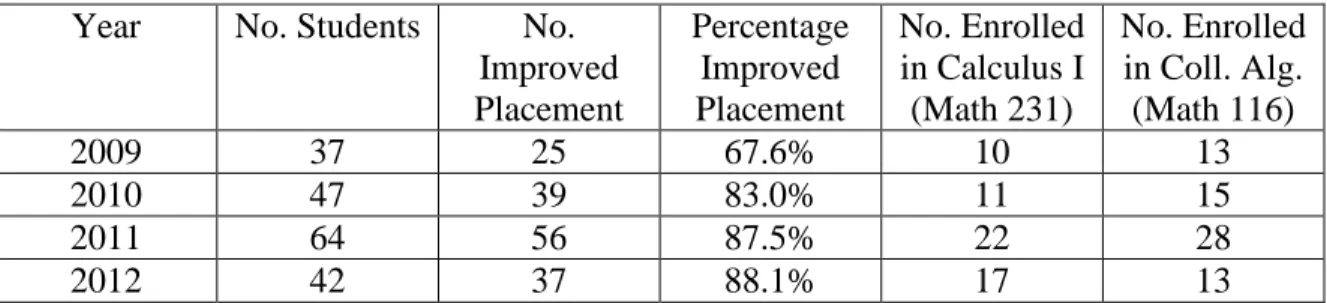
Table 1 provides a summary of the number of students in each cohort, the number of students who improved their math placement through the bridge program, and the number of students who participated in the bridge program who then enrolled in Math 116 and Math 231 in the Fall semester. Note that all the students who enrolled in Math 231 had placed up into Calculus I through the bridge program, and the vast majority (89%) of students who enrolled in Math 116 over the four years had placed up into Math 116, with only 11% of the students taking Math 116 having not improved their math placement through the program. Bridge program students who did not take either Math 116 or Math 231 were either (a) not enrolled in a math course in the Fall semester, (b)
Table 1: Summary Data for the Four Bridge Program Cohorts Considered in this Study.
Year No. Students No.
Improved Placement
Percentage Improved Placement
No. Enrolled in Calculus I (Math 231)
No. Enrolled in Coll. Alg. (Math 116)
2009 37 25 67.6% 10 13
2010 47 39 83.0% 11 15
2011 64 56 87.5% 22 28
taking only Math 117 (Trigonometry), or (c) taking Math 105 (Intermediate Algebra). Most of the students who improve their math placement advance one level (such as from Intermediate Algebra to College Algebra), but some (approximately 20%) improve two levels (such as from Intermediate Algebra to Calculus I).
Student Performance in Subsequent Math Courses
While improving the math placement of students is the primary immediate goal of the bridge program, the overriding goal is to help CEAS increase the number of students who graduate with STEM degrees. As mentioned, historically students in CEAS who have started in math courses at the level of Intermediate Algebra or below have graduated at a very low rate from the college. The bridge program seeks to address this initially through reinforcing math concepts that the students have already seen so that they can achieve an improvement in their math course placement to at least a level of College Algebra and Trigonometry. Historically, such an improvement suggests an increased likelihood of graduating from CEAS by a factor of 3. However, one must also consider if improving the students’ math course placement is harming the students by placing them into a course that they are not yet ready for. In other words, if a student has initially placed into College Algebra, improves their math course placement to Calculus I through the bridge program, but still lacks the math skills needed to succeed, they may be set up to fail Calculus I and be discouraged in their studies.
Conversely typically between 55-66% of the students taking Math 116 or Math 231 receive a grade of C- or less, while a grade of C or better is necessary to advance to the next math course. Therefore, even students who do not improve their math placement are somewhat likely to need to repeat their math course; therefore, improving a math
placement but not advancing through the next course on their first attempt is not
necessarily a bad result, and does result in the student being at a spot no worse than they would have been without the bridge program. For the students, the only truly negative impact of the bridge program in the short term is for those students who did not improve their math placement in the bridge program and also did not get a C or better in their Fall semester math course. For these students, there is no discernible benefit from
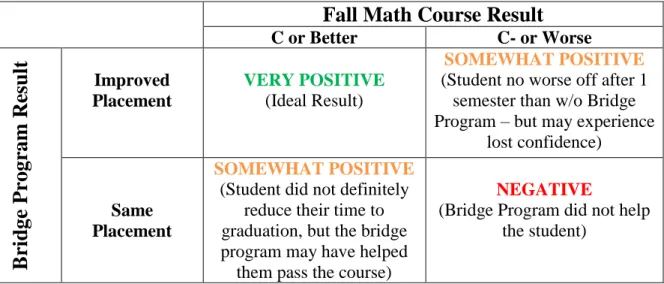
participating in the bridge program. Figure 1 provides a matrix of possible scenarios with respect to students improving their math placement and their subsequent Fall math
performance.
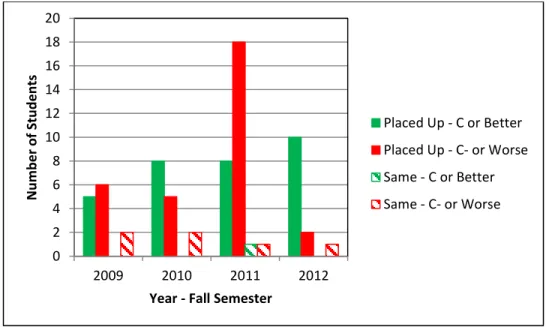
With these thoughts in mind, we do want to determine if the bridge program is adversely affecting the students in their Fall semester math courses. To do this, we will compare the percentage of students in the bridge program who received a grade of C or better in their Fall semester math course with the overall percentage of students in that course in that semester, as well as an aggregate of the data over the four cohorts. Figures 2 and 3 contain the number of bridge program students in each cohort who received a C or better in Math 231 (Figure 2) and Math 116 (Figure 3), as well as the number of students who received a grade of C- or worse. Figure 3 further separates the data by considering
Fall Math Course Result
C or Better C- or Worse
Bri
d
g
e P
ro
g
ra
m
R
es
ul
t
Improved Placement
VERY POSITIVE (Ideal Result)
SOMEWHAT POSITIVE (Student no worse off after 1
semester than w/o Bridge Program – but may experience
lost confidence)
Same Placement
SOMEWHAT POSITIVE (Student did not definitely
reduce their time to graduation, but the bridge program may have helped
them pass the course)
NEGATIVE
(Bridge Program did not help the student)
Figure 1: Matrix of possible results for the combination of the student’s performance in
the bridge program and their fall math course performance.
whether or not the student had taken Math 116 after improving their math placement in the bridge program or whether their math placement remained the same. The data is also tabulated in Tables 2 and 3.
As can be seen in Figure 2, the majority of bridge program students who placed up into Calculus I achieved a high enough grade to advance in their studies. For those students, the bridge program successfully advanced their math education by at least a semester. From Figure 3, the results for the bridge program students in College Algebra are much more varied. First, it is clear that bridge program students who did not improve their original math placement tend to not get a grade of C or better in their first attempt in College Algebra, as over the four years only 1 of 7 students accomplished that. As such, there may be a problem with the work ethic of students who did not improve their math placement, or these students have fundamentally reached their mathematical abilities and cannot complete the work in Math 116 successfully. Participation in the bridge program appears to be of no use to these students; however, there is no good method for
determining distinguishing characteristics of these students before they attend the bridge program.
As for the students who did improve their math placement to enroll in College Algebra, more than half of the students in the cohort achieved a grade of C or better in 2010 and 2012, and in the 2009 cohort the results were evenly split. However, in 2011, most of the students did not earn a C or better in College Algebra. As the only major difference in the bridge program that year was that there were more students, it is difficult to explain this anomaly, and it may have been a result of conduct of Math 116 that semester.
Figure 2: Grading results for the bridge program students taking Calculus I (Math 231) in the Fall semester immediately following their time in the bridge program. A grade of C or better is required to advance to Calculus II.
Figure 3: Grading results for the bridge program students taking College Algebra (Math 116) in the Fall semester immediately following their time in the bridge program. A grade of C or better (along with successful completion of Trigonometry (Math 117)) is required to advance to Calculus I.
0 2 4 6 8 10 12 14 16 18 20
2009 2010 2011 2012
N
u
m
b
e
r
o
f Stu
d
e
n
ts
Year - Fall Semester
C or Better C- or Worse
0 2 4 6 8 10 12 14 16 18 20
2009 2010 2011 2012
N
u
m
b
e
r
o
f Stu
d
e
n
ts
Year - Fall Semester
Placed Up - C or Better Placed Up - C- or Worse Same - C or Better Same - C- or Worse
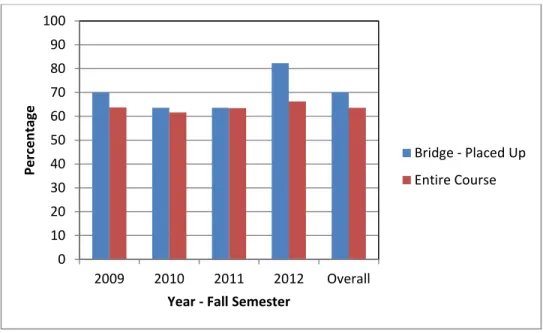
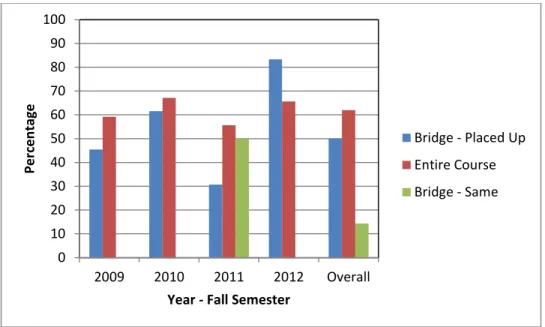
Figure 4 presents a comparison for each cohort between the percentages of students from the bridge program who received a C or better in Math 231 and the course as a whole. An overall percentage comparison for the four years is also presented. Figure 5 contains the same comparison for Math 116; note that the bridge program students are again divided into those who placed up into Math 116 and those whose placement remained unchanged. Also, at UWM, most of the students who take Math 116 and Math 231 are in math-intensive fields, primarily STEM disciplines, and so the comparison of the
performance of the bridge program students with the students in the course as a whole is reasonable. (In contrast, Intermediate Algebra is the terminal math course for most students at UWM, and so comparison of the performance of engineering and computer science students with the students in the Math 105 course as a whole is not reasonable, as one would expect the engineering students to naturally do better than students from non-math intensive disciplines.) The comparisons with the students in the course as a whole are important as it provides a picture as to whether or not the students from the bridge program are achieving success in their courses as a similar rate to the students who did not participate in a bridge program. This will help us determine if the bridge program is inappropriately advancing the students into courses that they are not ready for, which is something we want to avoid.
Figure 4: Comparison of the percentages of bridge program students in each cohort and combined who received a grade of C or better in Calculus I (Math 231) to the percentages of all the students in the course who received such a grade.
0 10 20 30 40 50 60 70 80 90 100
2009 2010 2011 2012 Overall
Per
ce
n
tage
Year - Fall Semester
Bridge - Placed Up Entire Course
Figure 5: Comparison of the percentages of bridge program students in each cohort and combined who received a grade of C or better in College Algebra (Math 116) to the percentages of all the students in the course who received such a grade.
Table 2: The numbers of students from the bridge program and in the course as a whole receiving grades in the designated ranges for Calculus I (Math 231).
Bridge Students (All Placed Up) Entire Course
Year C or Better C- or Worse C or Better C- or Worse
2009 7 3 219 125
2010 7 4 210 131
2011 14 8 218 126
2012 14 3 200 102
Total 42 18 847 484
Table 3: The numbers of students from the bridge program and in the course as a whole receiving grades in the designated ranges for College Algebra (Math 116). For the bridge program students, the data for both the bridge program students who placed up and the students who did not place up are listed.
Bridge Students (Placed Up/Same) Entire Course
Year C or Better C- or Worse C or Better C- or Worse
2009 5 / 0 6 / 2 148 102
2010 8 / 0 5 / 2 173 85
2011 8 / 1 18 / 1 135 108
2012 10 / 0 2 / 1 181 95
Total 31 / 1 31 / 6 637 390
0 10 20 30 40 50 60 70 80 90 100
2009 2010 2011 2012 Overall
Per
ce
n
tage
Year - Fall Semester
Bridge - Placed Up Entire Course Bridge - Same
As the number of bridge program students in each course is small in comparison to the number of students in the course overall, we are mostly concerned with large differences between the percentage of students receiving a grade of C or better in the bridge program students versus the course as a whole. From Fig. 4, it can be seen that the percentage of bridge program students successfully completing Calculus I in the Fall semester is consistently very similar to the students in the course as a whole. Therefore, for students who are able to use the bridge program to place into Calculus I, the program appears generally successful at speeding their math curriculum and potentially reducing time to graduation.
The results are not as positive for the students in College Algebra (Math 116), as seen in Figure 5. In some cohorts, the students from the bridge program do similarly well to the students in the course as a whole, but in other years, particularly 2011, the students do worse. Again, there is no clear reason for that anomaly in 2011. If we look at the students in Math 116 who placed up from the bridge program overall, the students receive a C or better at rate about 14% lower than the students overall in the course. However, almost all of that was a result of the poor performance of the 2011 bridge program students in Math 116 – the combined results for the other three years has a rate of students receiving a C or better (among those who placed up in the bridge program) of 63.9% which is essentially the same as the course as a whole in those years. So, in evaluating the success of the bridge program for the level of students who place up into Math 116 (meaning that they likely originally placed into Intermediate Algebra), it is necessary to track results for more cohorts to determine if the 2011 cohort was an anomaly, or if it is a result that is often repeated. As for students who did not improve their placement in the bridge program, their performance is considerably worse than the students in the course as a whole, although the number of such students is very limited.
Conclusions
In this paper, we have explored the performance of students from a summer bridge program in their first semester math courses. The immediate primary goal of the bridge program is to improve the math course placement of the students, and the program has become very successful at achieving that goal. However, if the bridge program students subsequently fail their first math class, much of the benefit of improving the math placement is lost. Therefore, we have attempted to determine if the students from the bridge program pass (grades of C or better) their first math class at a rate similar to the students in the course as a whole. Four cohorts have been studied.
From the results, bridge program students who place into Calculus I successfully complete Calculus I at a rate very similar to that of the entire student population in the course. Therefore, the bridge program should be considered successful for most students at this level. (Even the students who do not pass Calculus I are no worse off in their math sequence than they would have been without the bridge program.)
The results for the bridge program students in College Algebra are not as clear. The passing rate for students from the bridge program is generally lower than the entire
population of students in College Algebra, but again the relative number of the bridge program students is very small. However, the results do suggest that the bridge students who take College Algebra could benefit from more assistance in their math course to bring their pass rate to the level of the entire population. In addition, the results for one cohort (2011) were considerably worse, while the results for the following cohort were noticeably better; as a result, a more definitive conclusion on the benefits of the bridge program for this level of students may need more cohorts to determine if any of the cohorts are anomalies. It should be noted that the bridge program was clearly beneficial to the 31 students who placed into College Algebra and then received a grade of C or better in the course.
Finally, it should be noted that there is a small group of students, those who did not place out of College Algebra and then subsequently did not receive a C or better in their first attempt at College Algebra, for whom the bridge program was of little use. In fact, for these students, the bridge program may be most useful in suggesting to them that they may not be ready for, or have the dedication to be successful in, engineering studies in college.
Acknowledgements
Partial support for this work was provided by the National Science Foundation's Science, Technology, Engineering, and Mathematics Talent Expansion Program (STEP) under Award No. 0757055. Any opinions, findings, and conclusions or recommendations expressed in this material are those of the authors and do not necessarily reflect the views of the National Science Foundation. The authors would also like to thank Leah Rineck, Shuwen Tang, Cindy Walker, Todd Johnson, Tina Current, Sharon Kaempfer, and Jennie Klumpp (all at UWM) for their assistance with this project.
Bibliography
1. National Science Board. 2003. The Science and Engineering Workforce: Realizing America’s Potential. Publication NSB 03-69. (www.nsf.gov/nsb/documents/2003/nsb0369/nsb0369.pdf)
2. Augustine, N. “Rising Above the Gathering Storm: Energizing and Employing America for a Brighter Economic Future”, Committee on Science, Engineering, and Public Policy (COSEPUP), 2007.
3. Bochis, C., Hsia, S., Johnson, P., Boykin, K., Wood, S., Bowen, L, and Whitaker, K. “Integrated Engineering Math-Based Summer Bridge Program for Student Retention”, Proceedings of the 2007 American Society for Engineering Education Annual Conference & Exposition.
4. Fletcher, S. L., Newell, D.C., Newton, L.D., and Anderson-Rowland, M. “The WISE Summer Bridge Program: Assessing Student Attrition, Retention, and Program Effectiveness”, Proceedings of the
American Society for Engineering Education Annual Conference & Exposition, 2001.
5. Varde, K. S. “Effects of Pre-Freshman Program for Minority Students in Engineering”, Proceedings of the 2004 American Society for Engineering Education Annual Conference & Exposition.
6. White, C., Curtis, M.W., and Martin, C.S. “Pre-Freshman Accelerated Curriculum in Engineering (PACE) Summer Bridge Program”, Proceedings of the 2001 American Society for Engineering Education Annual Conference & Exposition.
7. Papadopoulos, C., and Reisel, J. “Do Students in Summer Bridge Programs Successfully Improve Math Placement and Persist? A Meta-Analysis.”, Proceedings of the 2008 American Society for Engineering Education Annual Conference & Exposition.
8. www.aleks.com, 2013
9. Reisel, J.R., Jablonski, M., Hosseini, H., and Munson E. “Assessment of factors impacting success for incoming college engineering students in a summer bridge program.” Int. J. of Mathematical Education in Science & Technology, 43: 421-433. 2012.
10. Reisel, J.R., Jablonski, M., Hosseini, H., and Munson, E. “Evaluation of Factors Affecting the Success of Improving Math Course Placement for Incoming Freshmen in a Summer Bridge Program”, Proceedings of the 2010 American Society for Engineering Education Annual Conference & Exposition, Paper No. AC 2010-231.
11. Reisel, J.R., Jablonski, M., Rineck, L., Munson, E., and Hosseini, H., “Analysis of Math Course Placement Improvement and Sustainability Achieved through a Summer Bridge Program.” Proceedings of the 2012 American Society for Engineering Education Annual Conference & Exposition. Paper No. AC 2012-2984.