METHOD STATEMENT
AND
RISK ASSESSMENT
PROJECT:
SITE:
Author Name Position Contact number
Fax : +352 26 55 20 46 [email protected]
RISK ASSESSMENT REPORT
The following pages contain the Risk Assessment Report for the work performed by IMERGON G.P. in this project.
The Risk Assessment consists of the following:
Installation risk assessment by Mission and Work. It includes: I.Identification of the various Missions undertaken in each Work.
II. Missions Safety analysis consisting of a description of the series of basic steps that are followed for the completion of missions, identifying possible risks (if any) and their analysis and the implementation of proposed actions or Processes to prevent such risks.
III. . An analysis prepared for the execution of the mission on the basis of previous Directives.
IV. Create a table that lists the Missions and the respective Work Instructions for each task in the project. As a result, the following pages present the above information as follows:
o Installation risk assessment Methodology. o Table of works - Work Instructions
o Missions Risk Assessment o Work Instructions
[3]
RISK ASSESSMENT METHODOLOGY
The identification and analysis of risks at work is based on monitoring the plant and machinery used and the work processes that are followed, taking into account information received from employees.
1.1RISK ASSESSMENT
The risk is assessed for every danger observed, indicating the possible severity of damage (consequences) and the probability of this to happen.
1.1.1Severity of damage.
The following factors should be taken into account to determine the severity of the damage: a) body parts that are affected.
(b) the kind of harm, from small damage to severe damage. Small damage examples:
-Superficial damage: minor cuts and bruises, irritation to eyes from dust. -Annoyance and irritation, for example: headache, discomfort.
Examples of moderate injury:
-Wounds, Burns, concussion, severe sprain, slight cracking. Generally, whatever causes absence from work. - Deafness, Dermatitis, asthma, musculoskeletal disorders, diseases malfunctions leading to temporary disability
Examples of serious harm:
-Amputations, severe fractures, poisoning, multiple injuries, deadly injuries -Cancer and other chronic diseases that dramatically shorten life
1.1.2Possibility for a damage to happen.
The possibility of some harm to happen can be classified from small to large, based on the following criteria: Great probability
The damage happens always or almost always. Is it absolutely possible? It would not be at all surprising if it happened. A variety of similar accidents occur each year on the premises.
Moderate probability
The damage happens in some cases. It would be a strange result or coincidence, it is not usual to happen although a variety of similar accidents have occurred in recent years on the premises.
Small probability
The damage happens rarely. It is not usual to happen, although that has happened in the past in similar facilities.
When the probability of injury is determined, it is necessary to take into account whether existing controls are sufficient. Legal requirements and codes of good practice for specific control measures also have an important role. In addition to information for running tasks, the following should be considered:
[5]
a) Workers who are particularly vulnerable to certain hazards (personal characteristics, physiological condition).
b)Frequency of exposure to risk.
c)Damage to services (electricity and water).
d)Defects in plant and machinery accessories and protection devices. e)Exposure to the elements of nature.
f)Protection of the personal protective equipment (PPE) and the duration of use.
g)Dangerous acts of people (unintentional mistakes and unintentional violation of procedures):
Table 1 shows a simple method for the calculation of the degree of risk, on the basis of the estimated probability and expected consequences
1.2 DECISION TO ACCEPT A RISK
The risk degrees which are indicated in Table 1 are the basis for deciding whether the inspections must be increased or new ones to be adopted as well as application duration.
Table 2 shows a proposed criterion as a starting point for decision-making. The table also indicates that the effort needed to control risks and the strength with which the control measures are applied, should be proportional to the risk.
Table 1. RATING HAZARDS
CONSEQUENCES
SMALL DAMAGE MODERATE DAMAGE SERIOUS DAMAGE
P R O B A B IL IT Y SMALL
Small Risk Tolerable Risk Moderate Risk
MODERATE
Tolerable Risk Moderate Risk Great Risk
GREAT
Moderate Risk Great Risk Intolerable risk
Table 2.
RISK ACTIONS
SMALL No specific action needed
TOLERABLE The corrective action does not need improvement. However, more profitable solutions or improvements that do not require much larger costs, should be studied. Frequent checks are necessary to ensure the effectiveness of the measures.
MODERATE Efforts must be made to reduce the hazards, estimating the investments required. Measures for risk reduction should be implemented within a given time.
During the risk reduction associated with consequences of serious damages, additional actions are needed in order to determine with greater accuracy the probability of harm, as a basis for the need to improve the control measures.
GREAT Works will not be executed until the degree of risk is reduced. It is likely that serious resources are needed to achieve this. When the risk concerns works that are being executed, the problem must be solved sooner than moderate risk.
INTOLERABLE Works will not be executed until the degree of risk is reduced. If this is not possible, even with reduced resources, the work will be forbidden.
[7]
1.3. RISK TYPE
To identify the risks, it is useful to categorize them in various ways, e.g. by kind: mechanical, electrical, radiation, substances, fire and explosions. As a reminder, the following pages contain a list (not complete) of different kinds of risk, using the form of a standard evaluation form.
INDICATIVE LIST OF RISKS
• Fall on same level.
• Fall in/from a different level. • Falling objects.
• Slips.
• Transported Falling objects. • Trapping.
• Crushing. • Dust. • Loud noise.
• Direct contact with live wires.
• Indirect contact with grounding of an electrical appliance. • Pain in waist from lifting heavy weights.
• Injuries to bones and joints from vibration. • Injuries to hands and feet.
• Fire and explosions. • Inhaling toxic substances. • Hit by a moving machine. • Hits on objects and machines. • Machinery and truck rollovers.
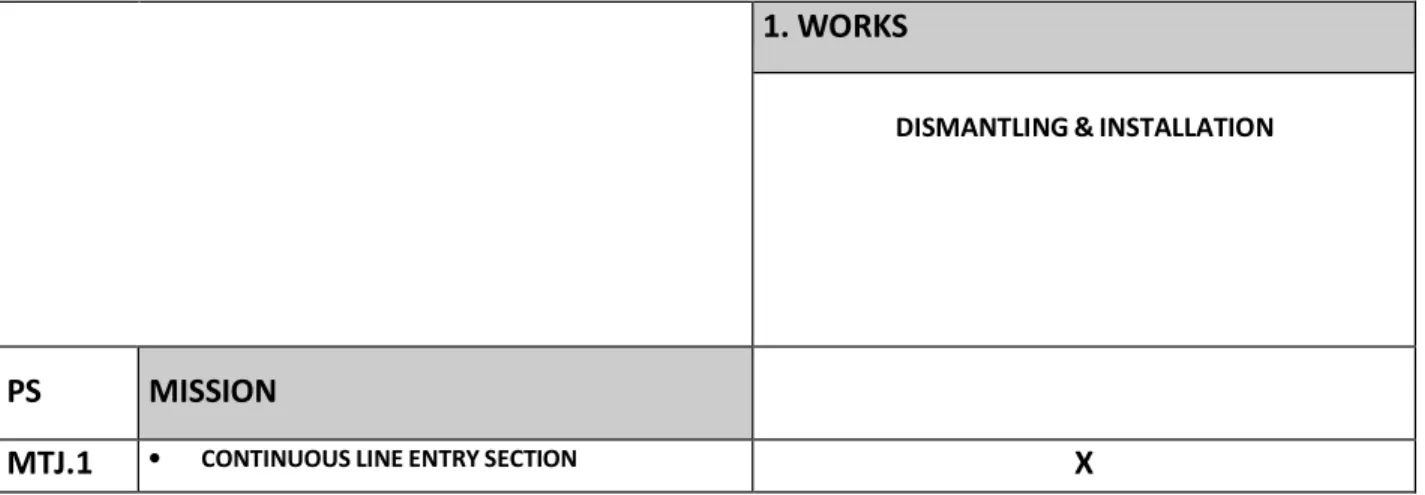
TABLE OF WORKS - INSTRUCTIONS
1. WORKS
DISMANTLING & INSTALLATION
PS MISSION
[9]
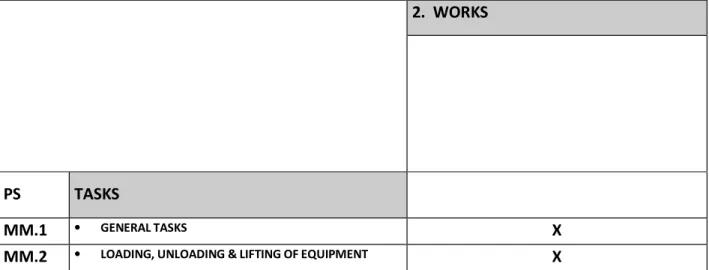
TABLE OF WORKS - INSTRUCTIONS
2. WORKS
PS TASKS
MM.1 • GENERAL TASKS X
MISSIONS RISK ASSESSMENT
[11]
MISSION RISK ASSESSMENT
CONTINUOUS LINE ENTRY SECTION (ART – MTJ.1)
Dpt: SERVICES
Work: DISMANTLING & INSTALLATION
Revision: 1 Date:
SERIES OF BASIC STEPS POTENTIAL HAZARDS PROBABILITY CONSEQUENCE RISK PREVENTIVE ACTION OR PROCEDURE
1. Axis marking Accident from nearby activities M D TΟ Ensure the isolation & marking of the
working area
Clearly identify the passage for vehicles.
Ensure that no cargo will be lifted over or near the working area
2. Electrical connection Electrocution M D MΟ When using the cutter, wear
protective gloves
when handling electric tables, use
insulated gloves for protection
against electric shock.
It is forbidden to wear earrings, loose clothing and have long loose hair
SERIES OF BASIC STEPS POTENTIAL HAZARDS PROBABILITY CONSEQUENCE RISK PREVENTIVE ACTION OR PROCEDURE
3. Dismantling the conveyors over the uncoilers Fall of hanging loads M ΕD ΙΜ Control lifting equipment
Do not stand under hanging loads.
Do not put your hands between or beneath loads
Stand in safe distance away from moving loads.
Hits
Fall in different level
M M D ED MO IM
• check that the lifting equipment is in
good condition.
• It is forbidden to stand under hanging
loads.
• Stand in a safe distance away from
loads.
• keep tools, screws etc. tightly. • wear safety shoes.
• Wear protection gloves.
• Use a ladder at a max height of 2m. A
ladder is used for access and is not a working position
• For a working height of >2m, wear a
safety harness and use scaffolding or platforms or similar certified equipment Fall on same level
Great effort, body position.
M A D LD MO MO
• wear safety shoes.
• Be very careful when you move
around the machine
• take breaks during work requiring
[13]
SERIES OF BASIC STEPS POTENTIAL HAZARDS PROBABILITY CONSEQUENCE RISK PREVENTIVE ACTION OR PROCEDURE
4. Dismantling the uncoilers (additional to [2])
Hits M D MO • Ensure that the sets of plates to be
joined on the laminator are secured to a point not allowing them to move. The bearings on the plates allow them to move very easily.
• It is forbidden to stand between the plates to be joined.
• Stand always at the sides of the
laminator, never at the 2 edges (front-back).
• keep tools, screws etc. tightly. • wear safety shoes.
• Wear protection gloves.
Fall on same level
Great effort, body position.
M
A
D
LD
MO
MO
• If you have to work inside the
structure of the side blocks guiding system, always duck to exit, do not climb over it.
• Be very careful when you move
around the machine
• take breaks during work requiring
SERIES OF BASIC STEPS POTENTIAL HAZARDS PROBABILITY CONSEQUENCE RISK PREVENTIVE ACTION OR PROCEDURE 5. Temporary positioning and storage of the
equipment
Fall of hanging loads M ΕD ΙΜ Control lifting equipment
Do not stand under hanging loads.
Do not put your hands between or beneath loads
stand away from moving loads.
Hits
Great effort, body position.
M A D LD MO MO
• check that the lifting equipment is in
good condition.
• It is forbidden to stand under hanging
loads.
• stand away from loads. • keep tools, screws etc. tight. • wear safety shoes.
• Wear protection gloves.
• take breaks during work requiring
greater physical effort
PPE OTHER CONTROL EQUIPMENT CORRECTIVE ACTION
CODE DESCRIPTION
Safety helmet Safety boots Working uniform Gloves
Safety harness (when working on heights)
Lifting equipment: Label, Inspection Safety harness: Label, Inspection Scaffolding, platforms etc: Certificates Cranes, forklifts: Certificates
Operators, drivers: License
See Work Instruction: Laminator (ART- MTJ.2) General Tasks (MM.1)
Loading, unloading and lifting of equipment (MM.2)
[15]
MISSION RISK ASSESSMENT
GENERAL TASKS (ART – MM.1)
Dpt: SERVICES
Work: DISMANTLING & INSTALLATION
Revision: Date:
SERIES OF BASIC STEPS POTENTIAL HAZARDS PROBABILITY CONSEQUENCE RISK PREVENTIVE ACTION OR PROCEDURE
1. Access site by vehicle Car accident M ED IM It is forbidden to work or to drive
under the influence of alcohol, drugs or other drugs that cause drowsiness.
Respect the signs and traffic rules.
2. Working in confined spaces Fall on same level, hits on/from
objects
M D ΜO Wear safety shoes
Keep space clean of tools etc.
Notify your supervisor of your presence in this area
If needed place signs to notify others of your existence in this area.
Wear a safety helmet.
Body position M LD TO • take breaks during work requiring
SERIES OF BASIC STEPS POTENTIAL HAZARDS PROBABILITY CONSEQUENCE RISK PREVENTIVE ACTION OR PROCEDURE
3. Use of tools and equipment Electrocution EM ΕD ΙΜ • The use of machinery by unqualified
personnel is prohibited.
• The electrical equipment will be
protected with double insulation.
• The use of machinery that is not in good
working condition will be interrupted and the machine will be repaired by qualified personnel
From high pressure systems
Noise, vibration M A D LD MO MO
• Frequent controls will be at hoses,
casings etc, and will be replaced if damaged or defective.
• Check that the pressure circuit
connections are tightly tied.
• Tools that work with a compressor, will
be used 10 meters away from the compressor.
• Wear earplugs. • Use low vibration tools
PPE OTHER CONTROL EQUIPMENT CORRECTIVE ACTION
CODE DESCRIPTION
1, 2, 3 Safety helmet 1, 2, 3 Safety boots 1, 2, 3 Working uniform 1, 2, 3 Gloves
3 Earplugs
3 Limit the use of mechanical tools to trained technicians
See Work Instruction:
[17]
MISSION RISK ASSESSMENT
LOADING, UNLOADING & LIFTING OF EQUIPMENT (ART – MM.2)
Dpt: SERVICES
Work: DISMANTLING & INSTALLATION
Revision: Date:
SERIES OF BASIC STEPS POTENTIAL HAZARDS PROBABILITY CONSEQUENCE RISK PREVENTIVE ACTION OR PROCEDURE
1. Handling of equipment Fall of hanging loads
Subversion B M ED ED IM IM
The hooks will have shutter.
Do not exceed the permissible load.
Transfer one load each time.
Make sure that the sling, tackle etc is not defective or worn out.
During each maneuver, stability jacks
must be used.
The loads will not be posted sideways
when the flatbed truck tilts toward the load.
Vehicles must not be stationed on unstable ground.
Hits
Trapping
Fall from different level
Μ M Μ D D ΕD ΜΟ MΟ IM
The crane operator must always have
visual contact with the load.
The loads will be guided with cords.
People must not stand around the
crane or under hanging loads.
Make sure that the boom of the crane
is secured before you move.
Use PPE.
Do not come in contact with the telescopic boom as it moves.
Do not hold the chain with your hands.
Do not climb on the load and do not
Fall on same level
Contact with electrical power
Μ
M
D
ΕD
ΜΟ
IM
Use the correct entry and exit points
of the vehicles.
Don't jump off from the vehicle.
Wear safety shoes.
Areas with hanging wires must be
marked, so that vehicles don’t pass underneath.
PPE OTHER CONTROL EQUIPMENT CORRECTIVE ACTION
CODE DESCRIPTION
1 Safety helmet 1 Safety boots 1 Working uniform 1 Gloves
See Work Instruction:
[19]
WORK INSTRUCTION
CONTINUOUS LINE ENTRY SECTION
(ART- MTJ.1)
Dpt: SERVICES
Work: DISMANTLING & INSTALLATION
Revision: 0 Date:
PROCEDURE:
• Before dismantling any part of the machine, check that all tools and lifting equipment are in good state. • Make sure the electrical power is disconnected before proceeding with any electrical work.
• Do not stand under hanging loads or close to loads being carried. Guide with ropes if needed from a safe distance.
• Use gloves and safety shoes. Wear working clothes.
• Hold tools, bolts etc tight because the personnel is working in a close range.
• Do not stand between any two parts of the machine (one lifted – one standing) to avoid trapping and crushing.
• Do not stand between any two parts of the machine when the parts are being positioned.
• When it is necessary to disconnect or join pieces of the conveyors, work on the sides, never on top. • Take breaks during works that demand greater physical effort.
• During positioning, guide the sections with a rope if needed, from a safe distance. • In case of hydraulic oil leakage, use appropriate means to contain the leak (spill-dry). • At all times, do not wear earrings, loose clothing and do not have long loose hair.
• See ‘Work instruction ΜΜ.1, General tasks.
• See ‘Work instruction ΜΜ.2, Loading, unloading & lifting of equipment.
NECESSARY PPE
• Working uniform • Safety helmet • Safety boots • Gloves
• Safety harness (if needed) • Gloves against electrical shock
[21]
WORK INSTRUCTION
GENERAL TASKS
(ART- MM.1)
Dpt: SERVICES
Work: DISMANTLING & INSTALLATION – START UP
Revision: Date:
PROCEDURE:
• It is forbidden to work or to drive under the influence of alcohol, drugs or other medications that cause drowsiness.
• Respect the safety rules of the plant you are working in.
• When using scaffolding, use safety harness, secured in a fixed point.
• When on a ladder, only one person is allowed each time, without holding a heavy load. • The use of power tools is allowed only to trained personnel.
• Power tools will have double insulation protection.
• The use of machinery that is not in a good condition will be interrupted and the machine will be repaired by qualified personnel.
• Frequent controls will be done at hoses, casings etc, and they will be replaced if found damaged or defective.
• Tools that work with a compressor, will be used 10 meters away from the compressor. Check that the connections are tightly tied.
NECESSARY PPE
• Working uniform • Safety helmet • Safety boots • Gloves
• Safety harness
• Gloves against electrical shock • Earplugs
WORK INSTRUCTION
LOADING, UNLOADING &
LIFTING OF EQUIPMENT
(ART- MM.2)
Dpt: SERVICES
Work: DISMANTLING & INSTALLATION
Revision: Date:
PROCEDURE:
• Before the transfer of a material, make sure it is properly fastened in the vehicle before the start of the transport of the material to its destination.
• The transfer must comply with all traffic and safety regulations. • The transfer should be coordinated by someone responsible on site.
• Unauthorized staff should not be located around machinery and loads during movement. • Machinery or vehicles that exceed safety height should not pass underneath power cables. • As a general rule, access ramps will not have an inclination greater than 15%.
• During unloading and lifting of equipment, check that the hooks have a safety lock and that the weight of the load does not exceed the rated lifting weight of the lifting machine and hook.
• All lifting equipment must handle one load each time. The cargo suspension systems and tools will be checked for defects or damage.
• The crane operator will always have visual contact with the load. If this is impossible, another operator will guide him.
• The presence of people around trucks or under suspended loads, is forbidden.
• Do not hold the chain winch with your hands. Do not hang or climb on the load or the hook. • Use safety boots.
NECESSARY PPE
• Working uniform • Safety helmet • Safety boots • Gloves