3GPP2 C.S0015-0
Short Message Service
COPYRIGHT
3GPP2 and its Organizational Partners claim copyright in this document and individual Organizational Partners may copyright and issue documents or standards publications in individual Organizational Partner's name based on this document. Requests for reproduction of this document should be directed to the 3GPP2 Secretariat at [email protected]. Requests to reproduce individual Organizational Partner's documents should be directed to that
PREFACE 1
These technical requirements form a standard for a Short Message Service (SMS), 2
providing delivery of text and numeric information for paging, messaging, and voice mail 3
notification. This standard includes Service Option 6 and Service Option 14 (as assigned 4
in TSB58-A), which support delivery of short messages on CDMA Traffic Channels. Service 5
Option 6 and Service Option 14 conform to the general requirements for service options 6
specified in TIA/EIA-95-B, Mobile Station-Base Station Compatibility Standard for Dual-7
Mode Spread Spectrum Systems, TSB74, Support for 14.4 kbps Data Rate and PCS 8
Interaction for Spread Spectrum Cellular Systems, and ANSI J-STD-008, Personal Station-9
Base Station Compatibility Requirements for 1.8 to 2.0 GHz Code Division Multiple Access 10
(CDMA) Personal Communications Systems. 11
A mobile station can obtain Short Message Service operating in either the analog or the 12
spread spectrum (CDMA) mode when it conforms to this standard and any of the following 13
standards: 14
• TIA/EIA-95-B.
15
• TIA/EIA/IS-95-A (inclusive of text adopted by TSB74).
16
• ANSI J-STD-008.
17
This standard does not address the quality or reliability of Short Message Service, nor does 18
it cover equipment performance or measurement procedures. 19
20
SECTION SUMMARY 21
1. Introduction. This section defines the terms, references, protocols and network 22
reference model used in this document. 23
2. SMS Relay Layer. This section defines the requirements for the lower layer of the 24
SMS bearer service protocols. The SMS Relay Layer provides the interface between 25
the Transport Layer and the Link Layer used for message transmission. 26
3. SMS Transport Layer. This section defines the requirements for the upper layer 27
of the SMS bearer service protocols. The SMS Transport Layer manages the end-28
to-end delivery of messages. 29
4. SMS Teleservice Layer. This section defines the requirements for the SMS 30
Teleservice Layer, which provides application-level data formats and procedures. 31
NOTES 32
1. The following verbal forms are used: “Shall” and “shall not” identify requirements
33
to be followed strictly to conform to the standard and from which no deviation is 34
permitted. “Should” and “should not” indicate that one of several possibilities is 35
recommended as particularly suitable, without mentioning or excluding others; 36
that a certain course of action is preferred but not necessarily required; or that (in 37
the negative form) a certain possibility or course of action is discouraged but not 38
prohibited. “May” and “need not” indicate a course of action permissible within 39
the limits of the standard. “Can” and “cannot” are used for statements of 1
possibility and capability, whether material, physical, or causal. 2
2. Footnotes appear at various points in this specification to elaborate and to further
3
clarify items discussed in the body of the specification. 4
3. Unless indicated otherwise, this document presents numbers in decimal form.
5
Binary numbers are distinguished in the text by the use of single quotation marks. 6
In some tables, binary values may appear without single quotation marks if table 7
notation clearly specifies that values are binary. The character ‘x’ is used to 8
represent a bit of unspecified value. For example ‘xxx00010’ represents any 8-bit 9
binary value such that the least significant five bits equal ‘00010’. 10
Hexadecimal numbers (base 16) are distinguished in the text by use of the form 11
0xh…h where h…h represents a string of hexadecimal digits. For example, 0x2fa1
12
represents a number whose binary value is ‘0010111110100001’ and whose 13
decimal value is 12193. Note that the exact number of bits in the binary 14
representation of a hexadecimal number strictly depends upon the implementation 15
requirements for the variable being represented. 16
4. “Base station” refers to the functions performed on the land side, which are
17
typically distributed among a cell, a sector of a cell, and a mobile communications 18
switching center. 19
SECTION SUMMARY ... i NOTES... i 1 Introduction...1-1 1.1 General Description ...1-1 1.2 Terms ...1-2 1.3 References...1-4 1.4 Network Reference Model...1-6 1.5 SMS Protocols...1-7 2 SMS Relay Layer...2-1 2.1 Introduction...2-1 2.2 Overview ...2-1 2.2.1 Model of Operation...2-1 2.2.1.1 Um Interface ...2-1 2.2.1.2 N (Intersystem) Interface...2-2 2.2.2 Relay Layer Functions...2-2 2.2.3 Service Description ...2-3 2.2.3.1 Service Primitives ...2-3 2.2.3.1.1 Um Interface Primitives...2-5 2.2.3.1.2 N Interface Primitives...2-6 2.2.3.2 Services Provided by the Relay Layer...2-7 2.2.3.2.1 Point-to-Point ...2-7 2.2.3.2.2 Broadcast...2-7 2.2.3.3 Services Required from TIA/EIA-95-B Protocol Layers ...2-7 2.2.3.4 Services Required from Intersystem Links...2-8 2.3 Elements of Procedures ...2-8 2.3.1 Formats of Fields ...2-8 2.3.2 Error Codes ...2-8 2.4 Definition of Procedures ...2-8 2.4.1 Mobile Station Procedures ...2-8 2.4.1.1 Point-to-point Procedures...2-8 2.4.1.1.1 Paging Channel Procedures ...2-9
2.4.1.1.1.1 Mobile SMS Message Termination ... 2-9 2.4.1.1.1.2 Mobile SMS Message Origination... 2-9 2.4.1.1.2 Mobile Station Traffic Channel Procedures ... 2-10 2.4.1.1.2.1 Negotiation for the SMS Service Option ... 2-10 2.4.1.1.2.1.1 Procedures Using Service Option Negotiation ... 2-11 2.4.1.1.2.1.2 Procedures Using Service Negotiation ... 2-11 2.4.1.1.2.2 Mobile SMS Message Termination ... 2-12 2.4.1.1.2.3 Traffic Channel Setup ... 2-13 2.4.1.1.2.4 Mobile Station Message Origination in the Conversation Substate2-13 2.4.1.2 Broadcast Procedures... 2-14 2.4.1.2.1 Paging Channel Procedures for Broadcast SMS ... 2-15 2.4.1.2.2 Traffic Channel Procedures ... 2-15 2.4.2 Base Station Procedures, Um Interface... 2-16 2.4.2.1 Point-to-point Procedures ... 2-16 2.4.2.1.1 Paging Channel Procedures ... 2-16 2.4.2.1.1.1 Mobile SMS Message Origination... 2-16 2.4.2.1.1.2 Mobile SMS Message Termination ... 2-16 2.4.2.1.2 Base Station Traffic Channel Procedures ... 2-17 2.4.2.1.2.1 Negotiation for the SMS Service Option ... 2-17 2.4.2.1.2.1.1 Procedures Using Service Option Negotiation ... 2-18 2.4.2.1.2.1.2 Procedures Using Service Negotiation ... 2-18 2.4.2.1.2.2 Mobile SMS Message Origination... 2-18 2.4.2.1.2.3 Traffic Channel Setup ... 2-19 2.4.2.1.2.4 Mobile Station Message Termination in the Conversation Substate2-19 2.4.2.2 Broadcast Procedures... 2-20 2.4.3 Base Station Procedures, N Interface... 2-21 3 SMS Transport Layer... 3-1 3.1 Introduction... 3-1 3.2 Overview ... 3-1 3.2.1 Model of Operation ... 3-1 3.2.2 Transport Layer Functions ... 3-1 3.2.2.1 Bearer Service End Points ... 3-1
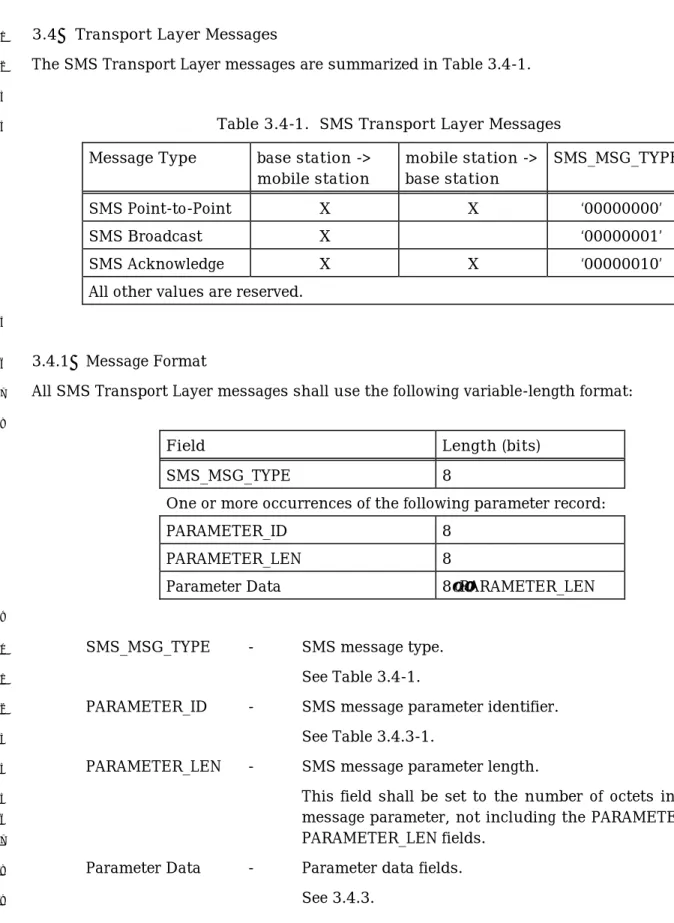
3.2.2.2 Bearer Service Relay Points ...3-1 3.2.3 Service Description ...3-2 3.2.3.1 Teleservice Interface ...3-2 3.2.3.2 Services Required from the Relay Layer...3-2 3.3 Definition of Procedures ...3-2 3.3.1 Relay Point Procedures, Base Station ...3-2 3.3.2 End Point Procedures, Mobile Station...3-4 3.3.3 Authentication Procedures...3-6 3.3.3.1 Mobile Station Procedures...3-6 3.3.3.2 Base Station Procedures...3-6 3.4 Transport Layer Messages ...3-7 3.4.1 Message Format ...3-7 3.4.2 Message Definitions ...3-8 3.4.2.1 SMS Point-to-Point Message ...3-8 3.4.2.2 SMS Broadcast Message...3-8 3.4.2.3 SMS Acknowledge Message ...3-9 3.4.3 Parameter Definitions ...3-9 3.4.3.1 Teleservice Identifier...3-10 3.4.3.2 Service Category ...3-11 3.4.3.3 Address Parameters...3-14 3.4.3.4 Subaddress...3-17 3.4.3.5 Bearer Reply Option ...3-19 3.4.3.6 Cause Codes ...3-20 3.4.3.7 Bearer Data ...3-21 4 SMS Teleservice Layer ...4-1 4.1 Introduction...4-1 4.2 Overview ...4-1 4.3 Teleservice Procedures...4-1 4.3.1 General ...4-1 4.3.1.1 Mobile Station Message Termination...4-1 4.3.1.2 Mobile Station Message Origination ...4-2 4.3.1.3 Broadcast Messaging Service ...4-2
4.3.1.4 Analog Mode SMS Services ... 4-2 4.3.1.4.1 Extended Protocol SMS Services ... 4-3 4.3.1.4.2 Alert With Info SMS Services ... 4-4 4.3.1.5 Setting of Message Identifier Field... 4-5 4.3.1.6 Unique Message Identification ... 4-5
4.3.2 IS-91 Extended Protocol Enhanced Services ... 4-6
4.3.3 Wireless Paging Teleservice (WPT)... 4-6 4.3.4 Wireless Messaging Teleservice (WMT) ... 4-8 4.3.5 Voice Mail Notification (VMN) ... 4-10 4.3.6 Wireless Application Protocol (WAP) ... 4-10 4.4 Teleservice Message Contents ... 4-12 4.4.1 SMS Deliver Message ... 4-12 4.4.2 SMS Submit Message ... 4-13 4.4.3 SMS Cancellation Message ... 4-14
4.4.4 SMS User Acknowledgment Message... 4-15
4.4.5 SMS Delivery Acknowledgment Message ... 4-16
4.5 Bearer Data Subparameters ... 4-17 4.5.1 Message Identifier ... 4-18 4.5.2 User Data... 4-20 4.5.3 User Response Code ... 4-22 4.5.4 Message Center Time Stamp... 4-23 4.5.5 Validity Period - Absolute ... 4-25 4.5.6 Validity Period - Relative ... 4-27 4.5.7 Deferred Delivery Time - Absolute ... 4-29 4.5.8 Deferred Delivery Time - Relative ... 4-31 4.5.9 Priority Indicator... 4-32 4.5.10 Privacy Indicator... 4-33 4.5.11 Reply Option... 4-34 4.5.12 Number of Messages... 4-35 4.5.13 Alert on Message Delivery ... 4-36 4.5.14 Language Indicator... 4-37 4.5.15 Call-Back Number ... 4-38
4.5.16 Message Display Mode...4-40 4.5.17 Multiple Encoding User Data ...4-42
Figure 1.4-1. Simplified SMS Reference Model ... 1-6 Figure 1.5-1. SMS Protocol Stack ... 1-7 Figure 2.2.3.1-1. Primitive Types ... 2-3 Table 2.2.3.1-1. Um Interface Primitive Types...2-4 Table 2.2.3.1-2. Um Interface Primitives... 2-4 Table 2.2.3.1.1-1. Relay Layer Service Primitives, Um Interface... 2-5 Table 2.2.3.1.1-2. RL-DATA Primitive Parameters, Um Interface ... 2-5 Table 2.2.3.1.2-1. Relay Layer Service Primitives, N Interface... 2-6 Table 3.4-1. SMS Transport Layer Messages... 3-7 Table 3.4.2.1-1. SMS Point-to-Point Message Parameters ... 3-8 Table 3.4.2.2-1. SMS Broadcast Message Parameters... 3-8 Table 3.4.2.3-1. SMS Acknowledge Message Parameters ... 3-9 Table 3.4.3-1. Parameter Identifiers ... 3-9 Table 3.4.3.3-1. Data Network Address Number Types ... 3-15 Table 3.4.3.4-1. Subaddress Type Values ... 3-18 Table 4.3.1.3-1. SMS Deliver Message Subparameters, Broadcast Messaging Service .... 4-2 Table 4.3.1.4.1-1. Bearer Data Subparameters for IS-91 Extended Protocol Messages ... 4-3 Table 4.3.2-1. SMS Deliver Message Subparameters, IS-91... 4-6 Table 4.3.3-1. SMS Deliver Message Subparameters, WPT ... 4-7 Table 4.3.3-2. SMS Submit Message Subparameters, WPT... 4-7 Table 4.3.4-1. SMS Deliver Message Subparameters, WMT ... 4-9 Table 4.3.5-1. SMS Deliver Message Subparameters, VMN... 4-10 Table 4.3.6-1. SMS Deliver Message Subparameters, WAP... 4-11 Table 4.3.6-2. SMS Submit Message Subparameters, WAP ... 4-11 Table 4.4.1-1. SMS Deliver Message Subparameters ... 4-12 Table 4.4.2-1. SMS Submit Message Subparameters... 4-13 Table 4.4.3-1. SMS Cancellation Message Subparameters ... 4-14 Table 4.4.4-1. SMS User Acknowledgment Message Subparameters ... 4-15 Table 4.4.5-1. SMS Delivery Acknowledgment Message Subparameters ... 4-16 Table 4.5-1. Bearer Data Subparameter Identifiers... 4-17 Table 4.5.1-1. Message Types... 4-18
Table 4.5.6-1. Coding of Relative Time Fields...4-28 Table 4.5.9-1. Priority Indicator Values...4-32 Table 4.5.10-1. Privacy Indicator Values ...4-33 Table 4.5.10-1. Privacy Indicator Values ...4-36 Table 4.5.10-1. Privacy Indicator Values ...4-40
1 INTRODUCTION 1
1.1 General Description 2
The Short Message Service (SMS) allows the exchange of short messages between a mobile 3
station and the wireless system, and between the wireless system and an external device 4
capable of transmitting and optionally receiving short messages. The external device may 5
be a voice telephone, a data terminal or a short message entry system. 6
The Short Message Service consists of message entry features, administration features, 7
and message transmission capabilities. These features are distributed between a wireless 8
system and the SMS message center (MC) that together make up the SMS system. The MC 9
may be either separate from or physically integrated into the wireless system. 10
Short message entry features are provided through interfaces to the MC and the mobile 11
station. Senders use these interfaces to enter short messages, intended destination 12
addresses, and various delivery options. 13
MC interfaces may include features such as audio response prompts and DTMF reception 14
for dial-in access from voice telephones, as well as appropriate menus and message entry 15
protocols for dial-in or dedicated data terminal access. Mobile station interfaces may 16
include keyboard and display features to support message entry. Additionally, a wireless 17
voice service subscriber can use normal voice or data features of the mobile station to call 18
an SMS system to enter a message. 19
An SMS Teleservice can provide the option of specifying priority level, future delivery time, 20
message expiration interval, or one or more of a series of short, pre-defined messages. 21
If supported by the Teleservice, the sender can request acknowledgment that the message 22
was received by the mobile station. An SMS recipient, after receiving a short message, can 23
manually acknowledge the message. Optionally, the recipient can specify one of a number 24
of pre-defined messages to be returned with the acknowledgment to the sender. 25
SMS administration features include message storage, profile editing, verification of 26
receipt, and status inquiry capabilities. SMS administration is not within the scope of this 27
standard. 28
The SMS transmission capabilities provide for the transmission of short messages to or 29
from an intended mobile station, and the return of acknowledgments and error messages. 30
These messages and acknowledgments are transmitted to or from the mobile station 31
whether it is idle or engaged in a voice or data call. 32
The wireless service provider may offer SMS transmission to its wireless voice and data 33
customers only, or may provide an SMS-only service without additional voice or data 34
transmission capabilities. 35
This standard also provides for the broadcast of messages. All available mobile stations on 36
a CDMA Paging Channel can receive a broadcast message. A broadcast message is not 37
acknowledged by the mobile station. Broadcast Messaging Services may be made available 38
to mobile stations on a CDMA Paging Channel as well as mobile stations in a call on a 39
CDMA Traffic Channel. 40
1.2 Terms 1
Base Station. A fixed station that is used for communicating with mobile stations. 2
Depending upon the context, the term base station may refer to a cell, a sector, an MSC, or 3
another part of the wireless system. See also MSC. 4
Bearer Service. The portion of the SMS system responsible for delivery of messages 5
between the MC and mobile user equipment. In this standard, the bearer service protocol 6
is divided into a Transport Layer and a Relay Layer. 7
Broadcast. The bearer layer mechanism that is used to deliver SMS messages on the 8
CDMA Paging Channel or on the CDMA Forward Traffic Channel to all available mobile 9
stations. 10
Broadcast Messaging Service. A teleservice that allows an SMS message to be sent to all 11
mobile stations. 12
CMT. Cellular Messaging Teleservice. See also Wireless Messaging Teleservice. 13
CPT. Cellular Paging Teleservice. See also Wireless Paging Teleservice. 14
End Point. An element of the SMS delivery system that can originate or terminate SMS 15
messages. 16
IWF. An interworking function provides information conversion. A data service IWF 17
provides functions needed for a mobile station to communicate with data terminal 18
equipment connected to the network. 19
MC. SMS Message Center. 20
Mobile Switching Center (MSC). A configuration of equipment that provides wireless 21
radio telephone service. Also called Mobile Telephone Switching Office (MTSO). 22
Mobile-Originated. Submitted to an SMS service provider by a mobile station. 23
Mobile Station. A station, fixed or mobile, which serves as the end user’s wireless 24
communication link with the base station. Mobile stations include portable units (e.g., 25
hand-held mobile units) and units installed in vehicles. 26
Mobile-Terminated. Delivered to a mobile station by an SMS service provider. 27
Relay Layer. The layer of the bearer service protocol responsible for the interface between 28
the Transport Layer and the Link Layer used for message transmission. 29
Relay Point. An element of the SMS delivery system that forwards SMS messages. 30
SMS. Short Message Service. 31
STX. One of several allowable character sets allowed in IS-91 for CHAR. An STX (‘111100’) 32
may be placed in the message to link this message to the previous message sent. All 33
values other than STX in the 15th character position indicate end of message and are not 34
displayed. The STX character is only valid for Short Messages. 35
TE. Terminal Equipment. 36
Teleservice Layer. The protocol layer providing the end-to-end SMS application. 37
Transport Layer. The layer of the bearer service protocol responsible for the end-to-end 1
delivery of messages. 2
Universal Coordinated Time (UTC). An internationally agreed-upon time scale 3
maintained by the Bureau International de l’Heure (BIH) used as the time reference by 4
nearly all commonly available time and frequency distribution systems (i.e., WWV, WWVH, 5
LORAN-C, Transit, Omega, and GPS). 6
VMN. Voice Mail Notification. VMN is a teleservice supported by TIA/EIA-41-D. This 7
teleservice is an extension of the TIA/EIA/IS-91 Voice Mail Status capability. For details 8
see 4.3.5. 9
WAP. Wireless Application Protocol. 10
WMT. Wireless Messaging Teleservice. This teleservice is further described in 6.3 of 11
TIA/EIA-664. WMT is a point-to-point service only. See also 4.3.4. 12
WPT. Wireless Paging Teleservice. This teleservice is further described in 6.2 of TIA/EIA-13
664. WPT is a point-to-point service only. See also 4.3.3. 14
1.3 References 1
The following standards are referenced in this text. At the time of publication, the editions 2
indicated were valid. All standards are subject to revision, and parties to agreements 3
based on this standard are encouraged to investigate the possibility of applying the most 4
recent editions of the standards indicated below. ANSI and TIA maintain registers of 5
currently valid national standards published by them. 6
ISO 646:1983 Information Processing - Seven Byte Character Set for 7
Information Processing Character Interchange 8
ISO 8348:1987 AD2 Information Processing Systems Data Communications -9
Network Service Definition, Addendum 2: Network Layer 10
Addressing 11
CCITT Recommendation T.50 International Alphabet No. 5 12
CCITT Recommendation X.213 Network Service Definition for Open Systems 13
Interconnection (OSI) for CCITT Applications 14
CCITT Recommendation X.25 Interface Between Data Terminal Equipment (DTE) and 15
Data Circuit-Terminating Equipment (DCE) for Terminals 16
Operating in the Packet-Mode and Connected to Public 17
Data Networks by Dedicated Circuit 18
19
ANSI T1.607-1990 Integrated Services Digital Network (ISDN) - Layer 3 20
Signaling Specification for Circuit Switched Bearer 21
Service for Digital Subscriber Signaling System Number 1 22
(DSS1) 23
ANSI X3.4-1986 Code for Information Interchange 24
ANSI/TIA/EIA-41-D Cellular Radio-Telecommunications Intersystem 25
Operations, December 1997. 26
TIA/EIA-95-B Mobile Station-Base Station Compatibility Standard for 27
Dual-Mode Spread Spectrum Systems 28
ANSI/TIA/EIA-664 Cellular Features Description. ANSI version of IS-53-A 29
ANSI/TIA/EIA-691 ANSI Enhanced Analog IS-691 30
TIA/EIA-553-A Core Analog Standard 800 MHz Mobile Station – Land 31
Station Compatibility Specification with Authentication 32
TIA/EIA/IS-91 Mobile Station - Base Station Compatibility Standard for 33
800 MHz Analog Cellular, Auxiliary and Residential 34
Services. November, 1995. 35
TSB58-A Administration of Parameter Value Assignments for
36
TIA/EIA Spread Spectrum Standards 37
RFC 791 Internet Protocol
RFC 822 Standard for the Format of ARPA Internet Text Messages 1
WAP Arch Wireless Application Protocol Architecture Specification; 2
Wireless Application Protocol Forum, April 30, 1998 3
1.4 Network Reference Model 1
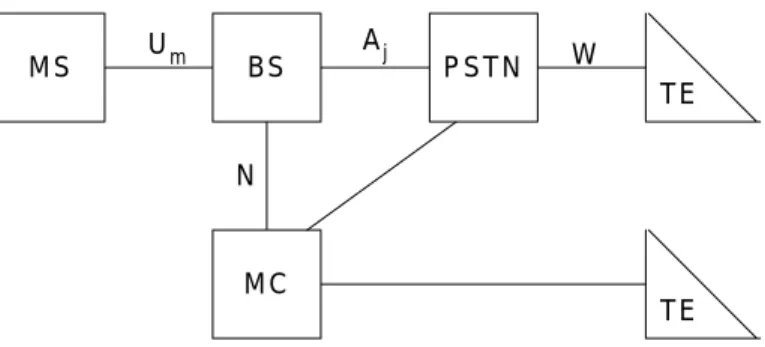
Figure 1.4-1 contains the network reference model for SMS. This model presents 2
functional entities and associated interface reference points that may logically comprise a 3
wireless network. Interface reference points Um, Aj, W, N are defined in Section 5.2 of 4
TIA/EIA-41.1-D. The model is intended to provide a level of abstraction that facilitates the 5
specification of messages within TIA/EIA-637-A. As such, implementations may vary with 6
respect to how the functional entities are distributed among physical units. 7
Figure 1.4-1. Simplified SMS Reference Model 8
9
The base station (BS) in this model contains the transceiver equipment, Mobile Switching 10
Center (MSC) and any Inter-Working Function (IWF) required for network connection. 11
These elements are grouped together because there is no need to distinguish them in this 12
standard. 13
The MC element in this model represents a generic SMS Message Center function. The N 14
reference point represents one or more standardized interfaces between an SMS message 15
center and a BS. The Terminal Equipment (TE) is voice or data equipment connected 16
either directly or indirectly to the MC. 17
It is possible for the MC to be included in, or co-located with, a base station. In this case, 18
the N Interface is internal to the base station. For purposes of this standard, the 19
procedures defined for the N Interface should be followed for such internal interfaces. 20
M S B S P ST N
M C
T E
T E
Um Aj
N
1.5 SMS Protocols 1
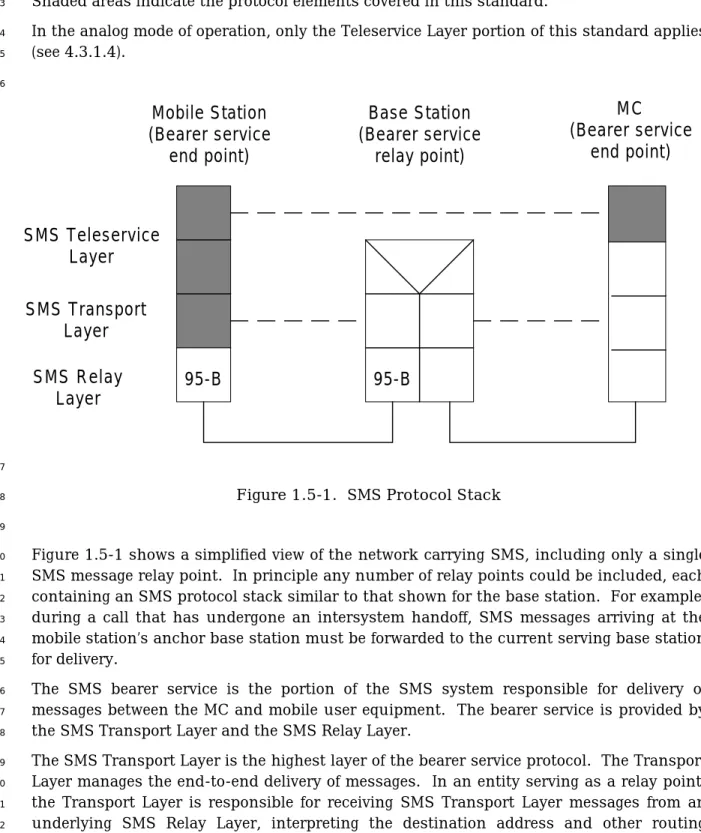
The SMS protocol stack for the CDMA mode of operation is illustrated in Figure 1.5-1. 2
Shaded areas indicate the protocol elements covered in this standard. 3
In the analog mode of operation, only the Teleservice Layer portion of this standard applies 4
(see 4.3.1.4). 5
6
7
Figure 1.5-1. SMS Protocol Stack 8
9
Figure 1.5-1 shows a simplified view of the network carrying SMS, including only a single 10
SMS message relay point. In principle any number of relay points could be included, each 11
containing an SMS protocol stack similar to that shown for the base station. For example, 12
during a call that has undergone an intersystem handoff, SMS messages arriving at the 13
mobile station’s anchor base station must be forwarded to the current serving base station 14
for delivery. 15
The SMS bearer service is the portion of the SMS system responsible for delivery of 16
messages between the MC and mobile user equipment. The bearer service is provided by 17
the SMS Transport Layer and the SMS Relay Layer. 18
The SMS Transport Layer is the highest layer of the bearer service protocol. The Transport 19
Layer manages the end-to-end delivery of messages. In an entity serving as a relay point, 20
the Transport Layer is responsible for receiving SMS Transport Layer messages from an 21
underlying SMS Relay Layer, interpreting the destination address and other routing 22
information, and forwarding the message via an underlying SMS Relay Layer. In entities 23
serving as end points, the Transport Layer provides the interface between the SMS Bearer 24
Service and the SMS Teleservice. 25
Mobile Station
(Bearer service
end point)
Base Station
(Bearer service
relay point)
M C
(Bearer service
end point)
S M S T e l e s e r v i c e
L a y e r
S M S T r a n s p o r t
L a y e r
S M S R e l a y
L a y e r
The SMS Relay Layer provides the interface between the Transport Layer and the Link 1
Layer used for message transmission. 2
2 SMS RELAY LAYER 1
2.1 Introduction 2
The SMS Relay Layer provides the interface between the SMS Transport Layer and the Link 3
Layer used to carry short message traffic. This standard addresses the SMS Relay Layer in 4
mobile stations and base stations and their interfaces to the Link Layers for the Um and N
5
reference points. 6
On the Um Interface, the SMS Relay Layer supports the SMS Transport Layer by providing
7
the interface to the TIA/EIA-95-B transmission protocols needed to carry SMS data 8
between CDMA mobile stations and base stations. 9
On the N Interface, the SMS Relay Layer supports the SMS Transport Layer by providing 10
the interface to the network protocols needed to carry SMS data between the MC and 11
TIA/EIA-95-B base stations. For the general N Interface, the SMS Relay Layer 12
requirements in this standard are limited to the requirements for the Relay Layer interface 13
to the Transport Layer. Specific requirements are given for operation with an N Interface 14
that is a TIA/EIA-41-D network. 15
2.2 Overview 16
2.2.1 Model of Operation
17
2.2.1.1 Um Interface
18
In this standard, the Um reference point is the CDMA wireless system as described in
19
TIA/EIA-95-B. The dual-mode CDMA wireless system provides analog and digital mobile 20
telephone service using the wireless mobile telephone frequency bands. Requirements for 21
SMS message delivery in the analog mode are found in TIA/EIA-95-B. 22
The CDMA system provides the functions necessary for a mobile station to acquire CDMA 23
system timing and the overhead information needed for access to system functions. A 24
CDMA mobile station that is fully initialized and is capable of providing access to system 25
functions can operate in any of the following three states that are defined in TIA/EIA-95-B: 26
• In the Mobile Station Idle State, the mobile station has limited access to system
27
functions. In this state the mobile station monitors a Paging Channel on which 28
overhead information, paging messages, and SMS messages can be sent to the mobile 29
station. The mobile station can also send SMS messages by means of an Access 30
Channel, though the message size and rate are limited. The Access Channel can also 31
be used to gain access to CDMA Traffic Channels, which offer greater data bandwidth. 32
• In the System Access State, the mobile station attempts to send a TIA/EIA-95-B
33
message on the CDMA Access Channel. While in this state, the mobile station can 34
receive SMS messages but does not send SMS acknowledgments or new SMS messages 35
until the access attempt is complete. 36
• In the Mobile Station Control on the Traffic Channel State, a mobile station has full
37
access to system functions. In this state a mobile station has an assigned Traffic 38
Channel, which can be used for voice, data or other services. The data flow is full-1
duplex, and in that regard may be compared to a 4-wire telephone connection. 2
The SMS Relay Layer can deliver messages to mobile stations in any of these states. The 3
Relay Layer is also capable of using TIA/EIA-95-B call control signaling to direct mobile 4
stations to change states as necessary in order to deliver SMS messages. 5
2.2.1.2 N (Intersystem) Interface
6
In this standard, the N reference point is assumed to be an intersystem network link with 7
connectivity to the MC. Intersystem links can use a variety of public and private protocols, 8
one example of which is defined in TIA/EIA-41-D. 9
SMS protocols and message formats on intersystem links may differ from those used on 10
the CDMA air interface. The N Interface Relay Layer is responsible for formatting and 11
parsing SMS messages as necessary when transmitting and receiving messages on the 12
intersystem links. 13
2.2.2 Relay Layer Functions
14
The Relay Layer performs the following functions: 15
• Accepting Transport Layer messages and delivering them to the next indicated relay
16
point or end point. 17
• Providing error indications to the Transport Layer when messages cannot be
18
delivered to the next relay point or end point. 19
• Receiving messages and forwarding them to the Transport Layer.
20
• Interfacing to and controlling the Link Layer used for message relay.
21
• Formatting messages according to the SMS standards and/or other message
22
standards, as required by the Link Layer and/or peer SMS layers. 23
2.2.3 Service Description 1
2.2.3.1 Service Primitives
2
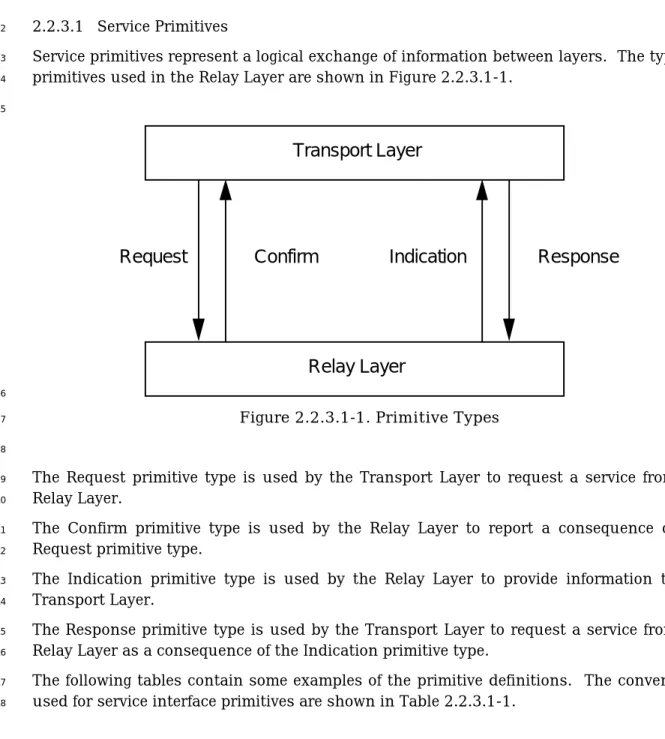
Service primitives represent a logical exchange of information between layers. The types of 3
primitives used in the Relay Layer are shown in Figure 2.2.3.1-1. 4
5
Request
Confirm
Indication
Response
Transport Layer
Relay Layer
6Figure 2.2.3.1-1. Primitive Types 7
8
The Request primitive type is used by the Transport Layer to request a service from the 9
Relay Layer. 10
The Confirm primitive type is used by the Relay Layer to report a consequence of the 11
Request primitive type. 12
The Indication primitive type is used by the Relay Layer to provide information to the 13
Transport Layer. 14
The Response primitive type is used by the Transport Layer to request a service from the 15
Relay Layer as a consequence of the Indication primitive type. 16
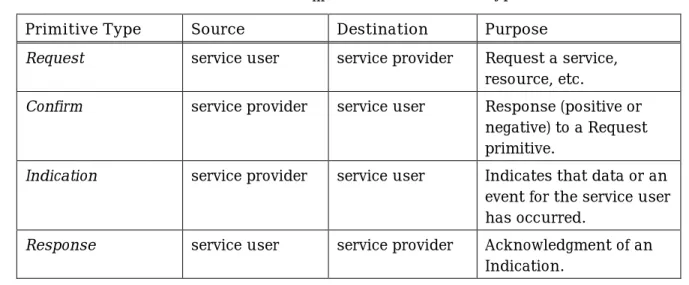
The following tables contain some examples of the primitive definitions. The conventions 17
used for service interface primitives are shown in Table 2.2.3.1-1. 18
Table 2.2.3.1-1. Um Interface Primitive Types 1
Primitive Type Source Destination Purpose
Request service user service provider Request a service, resource, etc.
Confirm service provider service user Response (positive or negative) to a Request primitive.
Indication service provider service user Indicates that data or an event for the service user has occurred.
Response service user service provider Acknowledgment of an Indication.
2
Note that every Request primitive has a corresponding Confirm primitive, and every 3
Indication has a corresponding Response primitive. The invocation of service primitives is 4
noted as follows: 5
RX.Primitive_Type(parameters) 6
where RX, Primitive_Type and parameters are defined in Table 2.2.3.1-2. 7
Table 2.2.3.1-2. Um Interface Primitives 8
RX An abbreviation for the service provider entity (e.g., RL-BCDATA
for Relay Layer Broadcast Data).
Primitive_Type The specific Primitive Type as defined in Table 2.2.3.1-1 (e.g., Request)
parameters An (optional) list of parameters for the primitive (e.g., Address) 9
For example, a request to transfer broadcast SMS messages between the Transport Layer 10
and the Relay Layer uses the RL-BCDATA primitive. The Relay Layer passes the Transport 11
Layer Message text, and the destination broadcast address parameters as follows: 12
RL-BCDATA.Request(Transport Layer Message, Broadcast Address) 13
Primitives and parameters for the Um Interface Relay Layer are summarized in Table
14
2.2.3.1-2. 15
2.2.3.1.1 Um Interface Primitives
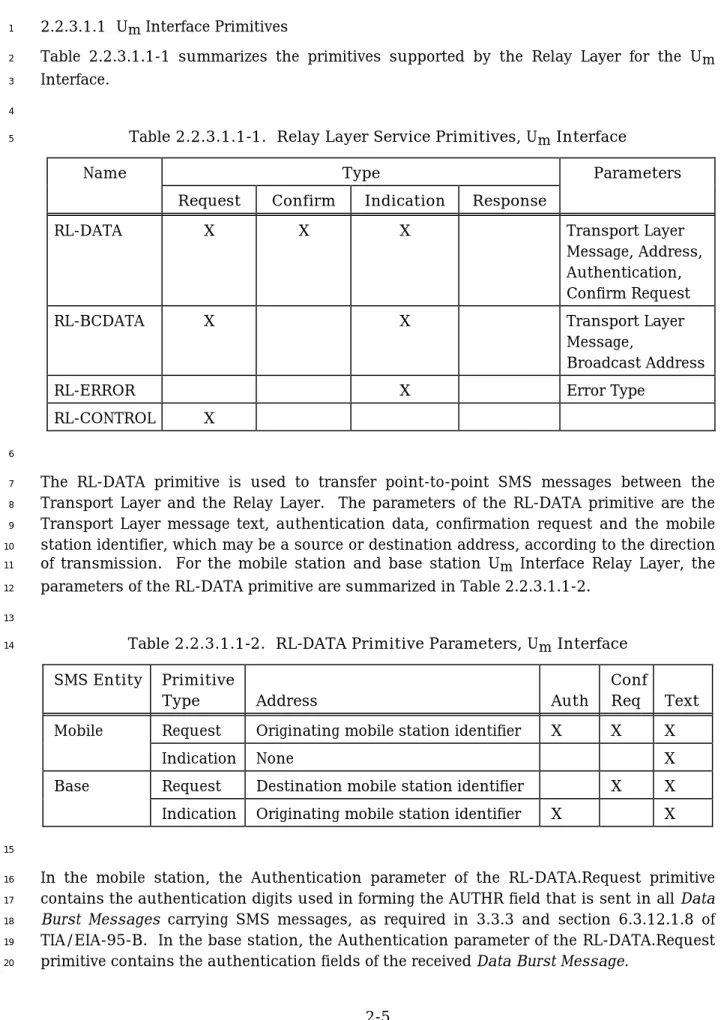
1
Table 2.2.3.1.1-1 summarizes the primitives supported by the Relay Layer for the Um
2
Interface. 3
4
Table 2.2.3.1.1-1. Relay Layer Service Primitives, Um Interface 5
Name Type Parameters
Request Confirm Indication Response
RL-DATA X X X Transport Layer
Message, Address, Authentication, Confirm Request
RL-BCDATA X X Transport Layer
Message,
Broadcast Address
RL-ERROR X Error Type
RL-CONTROL X
6
The RL-DATA primitive is used to transfer point-to-point SMS messages between the 7
Transport Layer and the Relay Layer. The parameters of the RL-DATA primitive are the 8
Transport Layer message text, authentication data, confirmation request and the mobile 9
station identifier, which may be a source or destination address, according to the direction 10
of transmission. For the mobile station and base station Um Interface Relay Layer, the
11
parameters of the RL-DATA primitive are summarized in Table 2.2.3.1.1-2. 12
13
Table 2.2.3.1.1-2. RL-DATA Primitive Parameters, Um Interface 14
SMS Entity Primitive
Type Address Auth
Conf
Req Text
Mobile Request Originating mobile station identifier X X X
Indication None X
Base Request Destination mobile station identifier X X
Indication Originating mobile station identifier X X
15
In the mobile station, the Authentication parameter of the RL-DATA.Request primitive 16
contains the authentication digits used in forming the AUTHR field that is sent in all Data 17
Burst Messages carrying SMS messages, as required in 3.3.3 and section 6.3.12.1.8 of 18
TIA/EIA-95-B. In the base station, the Authentication parameter of the RL-DATA.Request 19
primitive contains the authentication fields of the received Data Burst Message. 20
The RL-BCDATA primitive is used to transfer broadcast SMS messages between the 1
Transport Layer and the Relay Layer. For the Um Interface Relay Layer, the parameters of
2
the RL-BCDATA.Request and RL-BCDATA.Indication primitives are the Transport Layer 3
message text and the destination broadcast address. 4
The RL-ERROR primitive is used to report Relay Layer errors to the Transport Layer. 5
The RL-CONTROL primitive is used by the Transport Layer to indicate to the Relay Layer 6
that a TIA/EIA-95-B Traffic Channel, established solely for carrying SMS data, may be 7
released. 8
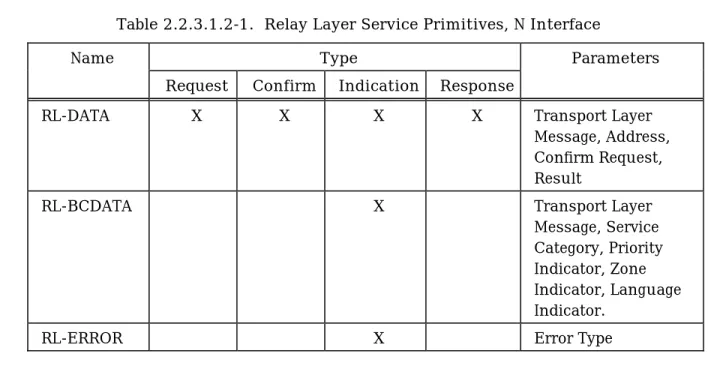
2.2.3.1.2 N Interface Primitives
9
Table 2.2.3.1.2-1 summarizes the primitives supported by the Relay Layer for the N 10
Interface. 11
12
Table 2.2.3.1.2-1. Relay Layer Service Primitives, N Interface 13
Name Type Parameters
Request Confirm Indication Response
RL-DATA X X X X Transport Layer
Message, Address, Confirm Request, Result
RL-BCDATA X Transport Layer
Message, Service Category, Priority Indicator, Zone Indicator, Language Indicator.
RL-ERROR X Error Type
14
The RL-DATA primitive is used to transfer point-to-point SMS messages between the 15
Transport Layer and the Relay Layer. The parameters of the RL-DATA primitive are the 16
Transport Layer message text, the destination address, confirmation request and result. 17
The RL-BCDATA primitive is used to transfer broadcast SMS messages from the Relay 18
Layer to the Transport Layer. The parameters of the RL-BCDATA primitive are the 19
Transport Layer message text, the Service Category, the Priority Indicator, the Zone 20
Indicator, and the Language Indicator. 21
The RL-ERROR primitive is used to report Relay Layer errors to the Transport Layer. See 22
2.4.3. 23
2.2.3.2 Services Provided by the Relay Layer 1
The Um Interface Relay Layer provides Transport Layer message delivery between mobile
2
station and base station. The service is provided as a point-to-point service and as a 3
broadcast service. 4
The N Interface Relay Layer provides message delivery between the base station and the 5
MC. This service is provided as a point-to-point service only. 6
2.2.3.2.1 Point-to-Point
7
The point-to-point Relay Layer service provides for the transmission and reception of 8
Transport Layer messages destined for or received from individual mobile stations. When 9
requested, this service provides a confirmation to the Transport Layer that a message sent 10
on the Um or N Interface was received, based on Link Layer acknowledgment procedures. 11
The primitives used for this service are RL-DATA, RL-ERROR and RL-CONTROL. 12
For mobile-terminated SMS messages received from the N Interface Link Layer, the base 13
station Relay Layer determines the destination mobile station address and passes the 14
address to the Transport Layer. The Relay Layer may request confirmation of delivery to 15
the mobile station as required by the N Interface Link Layer. For mobile-originated SMS 16
messages received from the Transport Layer, the base station N Interface Relay Layer 17
formats the originating mobile station address, the destination MC address and other 18
information as required by the N Interface Link Layer and passes the message to the N 19
Interface Link Layer. 20
For mobile-terminated SMS messages received from the Transport Layer, the base station 21
Um Interface Relay Layer formats the mobile station address and other information as
22
required by the Um Interface Link Layer and passes the message to the Um Interface Link
23
Layer. For mobile-originated SMS messages received from the Um Interface Link Layer, the
24
base station Relay Layer determines the originating mobile station address and passes the 25
address to the Transport Layer. 26
2.2.3.2.2 Broadcast
27
The broadcast Relay Layer service provides for the broadcast of Transport Layer messages. 28
For the Um and N Interfaces, the primitive used for this service is RL-BCDATA.
29
2.2.3.3 Services Required from TIA/EIA-95-B Protocol Layers
30
The Relay Layer for the Um Interface requires the following services from the TIA/EIA-95-B
31
protocol layers: 32
• Transmission of Data Burst Messages containing SMS data on the Access, Paging
33
and Traffic Channels to/from specific mobile stations.1 This service includes
34
provision of the location function necessary to deliver messages to a mobile station 35
not on a Traffic Channel. 36
• Transmission of Data Burst Messages containing SMS data on the Paging Channels 1
to a broadcast address. 2
• Reception of Data Burst Messages containing SMS data on the Access, Paging and
3
Traffic Channels. 4
• Notification to mobile stations operating in the slotted mode that broadcast messages
5
will be transmitted. 6
• Determination of the current call state of mobile stations.
7
• Selection of the type of TIA/EIA-95-B channel to be used for message delivery.
8
• Determination of the maximum message size permitted on the Access, Paging and
9
Traffic channels. 10
• Selection of the TIA/EIA-95-B layer 2 acknowledgment option for message delivery.
11
• Report of the success/failure of TIA/EIA-95-B layer 2 acknowledgment.
12
• Report of the success/failure of mobile station paging.
13
• Generation of authentication information elements included in the Data Burst
14
Message according to the requirements of 6.3.12.1.8 and 7.3.1 of TIA/EIA-95-B. 15
2.2.3.4 Services Required from Intersystem Links
16
The Relay Layer for the N Interface requires the following services from the intersystem 17
link: 18
• Delivery of SMS messages to an MC.
19
• Reception of SMS messages from an MC.
20
• Report of the success/failure of message delivery.
21
2.3 Elements of Procedures 22
2.3.1 Formats of Fields
23
The formats of the parameters passed in Relay Layer service primitives are 24
implementation-dependent. 25
2.3.2 Error Codes
26
The error codes used in the RL-ERROR primitive shall be SMS_CauseCode values as 27
defined in the SMS_CauseCode Table in TIA/EIA-41-D. 28
2.4 Definition of Procedures 29
2.4.1 Mobile Station Procedures
30
2.4.1.1 Point-to-point Procedures
31
This section defines the procedures for processing of mobile-terminated SMS messages 32
that are addressed to individual mobile stations, and processing of all mobile-originated 33
SMS messages. For mobile-originated SMS messages, the Um Interface Relay Layer
1
considers all messages to be addressed to the current serving base station. The Transport 2
Layer in the base station is responsible for providing the N Interface address for routing of 3
a mobile-originated message to its final destination. 4
2.4.1.1.1 Paging Channel Procedures
5
2.4.1.1.1.1 Mobile SMS Message Termination
6
A mobile station supporting SMS shall accept and process Data Burst Messages received 7
while the mobile station is monitoring the CDMA Paging Channel (see 7.7.2.3.2.9 of 8
TIA/EIA-95-B) that are addressed to the mobile station. Processing of TIA/EIA-95-B layer 9
2 fields shall be in accordance with TIA/EIA-95-B. 10
The SMS Relay Layer shall process all Data Burst Messages addressed to the mobile 11
station on the Paging Channel and having the BURST_TYPE field set to ‘000011’ (as 12
assigned in TSB58-A). The SMS Relay Layer shall discard the message without further 13
processing if any of the following is true: 14
• MSG_NUMBER field is set to a value other than 1.
15
• NUM_MSGS field is set to a value other than 1.
16
• NUM_FIELDS field is set to zero.
17
Otherwise, the SMS Relay Layer shall send the Transport Layer an RL-DATA.Indication 18
containing the CHARi fields of the received Data Burst Message. 19
2.4.1.1.1.2 Mobile SMS Message Origination
20
Mobile-originated SMS messages are received by the mobile station SMS Relay Layer as 21
RL-DATA.Request primitives from the Transport Layer. The requirements of this section 22
apply when an RL-DATA.Request primitive is received from the Transport Layer and the 23
mobile station is in the TIA/EIA-95-B Mobile Station Idle State or System Access State. 24
Mobile stations supporting SMS shall support the Mobile Station Message Transmission 25
Operation, as defined in TIA/EIA-95-B section 6.6.2.6. Mobile stations may allow the user 26
to restrict SMS message origination to Traffic Channels for enhanced message privacy. 27
When the Relay Layer receives an RL-DATA.Request primitive from the Transport Layer, 28
and the mobile station is in the TIA/EIA-95-B Mobile Station Idle State, the Relay Layer 29
shall determine whether the SMS message can be sent on the Access Channel. As part of 30
this determination, the mobile station should determine whether the SMS message length 31
is such that the message can be sent on the Access Channel.2 If the SMS message can be
32
sent on the Access Channel, the mobile station may form a Data Burst Message (see 33
6.7.1.3.2.3 of TIA/EIA-95-B), setting BURST_TYPE to ‘000011’, and transmit it on the 34
Access Channel, following the procedures specified in 6.6.2.6 and 6.6.3 of TIA/EIA-95-B. 35
2The maximum size depends on the current Access Channel capsule size, as determined from the
Access Parameters Message broadcast by the base station, and on the mobile station identifier type that would be used in forming the Data Burst Message carrying the SMS message.
The mobile station shall set the MSG_NUMBER and NUM_MSGS fields to 1, and shall set 1
the NUM_FIELDS field to the number of octets in the SMS Transport Layer message. The 2
mobile station address fields shall be set using the address parameter supplied by the 3
Transport Layer in the RL-DATA.Request. The authentication fields shall be set as 4
described in 3.3.3.1 using the authentication parameter supplied by the Transport Layer 5
in the RL-DATA.Request. 6
When the Relay Layer receives an RL-DATA.Request primitive from the Transport Layer, 7
and the mobile station is in the TIA/EIA-95-B System Access State, the Relay Layer should 8
store the RL-DATA.Request until the mobile station exits the System Access State. If the 9
mobile station enters the Mobile Station Idle State, the Relay Layer should process the 10
RL-DATA.Request as if it had been received while in the Mobile Station Idle State (see 11
above). If the mobile station enters the Mobile Station Control on the Traffic Channel State, 12
the Relay Layer should process the RL-DATA.Request in accordance with the procedures 13
defined in 2.4.1.1.2.4. If the mobile station enters any other state the Relay Layer may 14
discard the RL-DATA.Request. If the mobile station enters an analog mode task, the 15
mobile station shall return an RL-ERROR.Indication to the Transport Layer. The error 16
code value shall be as defined by the implementation. 17
If an SMS message cannot be sent on the Access Channel because it is too long (see 18
above), or because of other implementation-dependent criteria,3 the mobile station shall
19
transmit the SMS messages on the CDMA Traffic Channel, following the procedures 20
defined in 2.4.1.1.2.3. 21
Messages transmitted on the Access Channel always require a TIA/EIA-95-B layer 2 22
acknowledgment. If the access attempt is acknowledged (see 6.6.3.1.2 of TIA/EIA-95-B), 23
the Relay Layer shall send an RL-DATA.Confirm primitive to the Transport Layer. If the 24
access attempt fails (see 6.6.3.1.1.2 of TIA/EIA-95-B), the Relay Layer should send an 25
RL-ERROR.Indication to the Transport Layer. The error code value shall be as defined by 26
the implementation. 27
2.4.1.1.2 Mobile Station Traffic Channel Procedures
28
2.4.1.1.2.1 Negotiation for the SMS Service Option
29
Negotiation for the SMS Service Option is only required when no other service option is 30
connected. 31
The SMS Service Option described by this standard shall use service option number 6 and 32
is called Service Option 6 when using Multiplex Option 1. The SMS Service Option shall 33
use service option number 14 and is called Service Option 14 when using Multiplex 34
Option 2. 35
The mobile station shall negotiate for Service Option 6 using either service option 36
negotiation (see 2.4.1.1.2.1.1) or service negotiation (see 2.4.1.1.2.1.2). 37
3For example, the choice to use the Access Channel or a Reverse Traffic Channel when multiple SMS
The mobile station shall negotiate for Service Option 14 using service negotiation (see 1
2.4.1.1.2.1.2). 2
2.4.1.1.2.1.1 Procedures Using Service Option Negotiation
3
In the context of this section, a service option is active when the service option is agreed 4
upon by both mobile station and base station (see 6.6.4.1.2 and 7.6.4.1.2 of TIA/EIA-95-5
B). A service option is connected when primary traffic data are being processed in 6
accordance with the requirements of the service option. It is possible for a service option 7
to be active without having been connected, but a service option that is not active cannot 8
be connected. 9
The mobile station shall connect Service Option 6 as follows: 10
• If Service Option 6 is active when the mobile station enters the Waiting for Mobile
11
Station Answer Substate, or if Service Option 6 becomes active when the mobile 12
station is already in the Waiting for Mobile Station Answer Substate, then the 13
mobile station shall send a Connect Order to the base station as a message 14
requiring acknowledgment without waiting for the user to explicitly command the 15
call to be answered. The mobile station shall enter the Conversation Substate. 16
• If Service Option 6 becomes active when the mobile station is not in the
17
Conversation Substate, then it shall connect Service Option 6 immediately upon 18
entering the Conversation Substate. Otherwise, the mobile station shall connect 19
Service Option 6 at the time it becomes active. The mobile station shall complete 20
connection of Service Option 6 within 200 ms of starting connection. 21
When Service Option 6 is connected, the Service Option shall discard all primary traffic 22
data bits received from the multiplex sublayer, and the mobile station shall transmit null 23
traffic channel data (see 6.1.3.3.2.4 of TIA/EIA-95-B). 24
The mobile station shall disconnect Service Option 6 if it exits the Mobile Station Control on 25
the Traffic Channel State or if any other service option is connected as primary traffic. 26
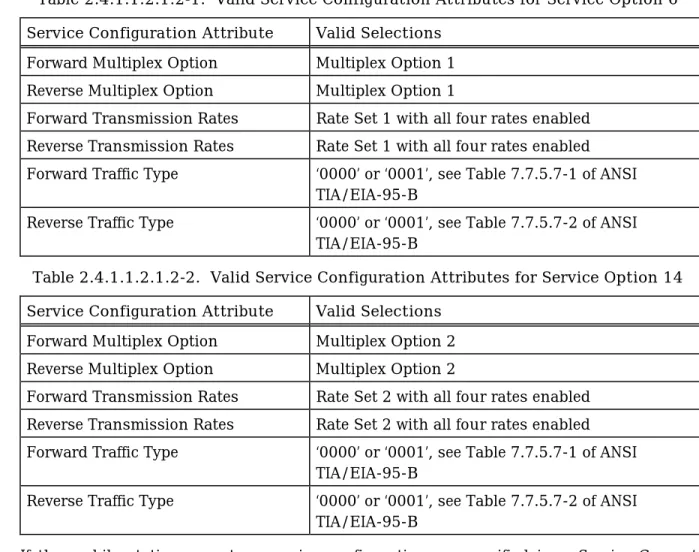
2.4.1.1.2.1.2 Procedures Using Service Negotiation
27
The mobile station shall perform service negotiation for Service Option 6 or Service Option 28
14 as described in TIA/EIA-95-B. The negotiated service configuration shall include only 29
valid attributes for the negotiated service option consistent with those specified in Tables 30
2.4.1.1.2.1.2-1 and 2.4.1.1.2.1.2-2. 31
Table 2.4.1.1.2.1.2-1. Valid Service Configuration Attributes for Service Option 6 1
Service Configuration Attribute Valid Selections
Forward Multiplex Option Multiplex Option 1
Reverse Multiplex Option Multiplex Option 1
Forward Transmission Rates Rate Set 1 with all four rates enabled
Reverse Transmission Rates Rate Set 1 with all four rates enabled
Forward Traffic Type ‘0000’ or ‘0001’, see Table 7.7.5.7-1 of ANSI
TIA/EIA-95-B
Reverse Traffic Type ‘0000’ or ‘0001’, see Table 7.7.5.7-2 of ANSI
TIA/EIA-95-B
Table 2.4.1.1.2.1.2-2. Valid Service Configuration Attributes for Service Option 14 2
Service Configuration Attribute Valid Selections
Forward Multiplex Option Multiplex Option 2
Reverse Multiplex Option Multiplex Option 2
Forward Transmission Rates Rate Set 2 with all four rates enabled
Reverse Transmission Rates Rate Set 2 with all four rates enabled
Forward Traffic Type ‘0000’ or ‘0001’, see Table 7.7.5.7-1 of ANSI
TIA/EIA-95-B
Reverse Traffic Type ‘0000’ or ‘0001’, see Table 7.7.5.7-2 of ANSI
TIA/EIA-95-B
If the mobile station accepts a service configuration, as specified in a Service Connect 3
Message, that includes a service option connection using Service Option 6 or Service 4
Option 14, then the service option connection shall become part of the current service 5
configuration at the action time associated with the Service Connect Message. Service 6
Option 6 or Service Option 14 is considered to be connected when the current service 7
configuration includes a service option connection for it. 8
If Service Option 6 or Service Option 14 is connected when the mobile station enters the 9
Waiting for Mobile Station Answer Substate, or Service Option 6 or Service Option 14 10
becomes connected while the mobile station is in the Waiting for Mobile Station Answer 11
Substate, the mobile station shall send a Connect Order to the base station as a message 12
requiring acknowledgment without waiting for the user to explicitly command the call to 13
be answered. The mobile station shall enter the Conversation Substate. 14
The mobile station shall not send a Service Option Control Message for Service Option 6 or 15
Service Option 14. 16
2.4.1.1.2.2 Mobile SMS Message Termination
17
A mobile station supporting SMS shall accept and process Data Burst Messages received 18
on the CDMA Forward Traffic Channel (see 7.7.3.3.2.4 of TIA/EIA-95-B). Processing of 19
TIA/EIA-95-B layer 2 fields shall be in accordance with TIA/EIA-95-B. If requested in the 1
ACK_REQ field, TIA/EIA-95-B layer 2 acknowledgments shall be returned whether or not 2
message errors are detected by the SMS Relay Layer. 3
The SMS Relay Layer shall process all Data Burst Messages addressed to the mobile 4
station on the Forward Traffic Channel and having the BURST_TYPE field set to ‘000011’. 5
The SMS Relay Layer shall discard the message without further processing if any of the 6
following is true: 7
• MSG_NUMBER field is set to a value other than 1.
8
• NUM_MSGS field is set to a value other than 1.
9
• NUM_FIELDS field is set to zero.
10
Otherwise, the SMS Relay Layer shall send the Transport Layer an RL-DATA.Indication 11
containing the CHARi fields of the received Data Burst Message. 12
2.4.1.1.2.3 Traffic Channel Setup
13
When a mobile station in the TIA/EIA-95-B Mobile Station Idle State sends SMS data on a 14
Traffic Channel, the following procedures apply: 15
The mobile station shall send an Origination Message (see 6.7.1.3.2.4 of TIA/EIA-95-B) 16
containing no dialed digits and requesting Service Option 6 or Service Option 14. 17
Authentication of the Origination Message shall be conducted according to the procedure 18
described in 6.3.12.1.6 of TIA/EIA-95-B. The mobile station address fields shall be set 19
using the originating address parameter supplied by the Transport Layer in the 20
RL-DATA.Request. 21
Call processing following the transmission of the Origination Message shall follow the 22
procedures defined in 6.6 of TIA/EIA-95-B. When the mobile station enters the 23
Conversation Substate, the mobile station may transmit the SMS messages in accordance 24
with the procedures defined in 2.4.1.1.2.4. 25
2.4.1.1.2.4 Mobile Station Message Origination in the Conversation Substate
26
Mobile-originated SMS messages are received by the mobile station SMS Relay Layer as 27
RL-DATA.Request primitives from the Transport Layer. The requirements of this section 28
apply when an RL-DATA.Request primitive is received from the Transport Layer and the 29
mobile station is in the TIA/EIA-95-B Conversation Substate of the Mobile Station Control 30
on the Traffic Channel State. 31
The mobile station shall compare the originating address parameter, supplied by the 32
Transport Layer in the RL-DATA.Request, to the mobile station address used to establish 33
the Traffic Channel. If the addresses are not the same, the mobile station shall not 34
transmit the SMS message and shall return an RL-ERROR.Indication to the Transport 35
Layer. The error code value shall be as defined by the implementation. If the addresses 36
are the same, the mobile station shall send the message using the following procedures: 37
The mobile station shall form a Data Burst Message (see 6.7.2.3.2.4 of TIA/EIA-95-B), 38
setting BURST_TYPE to ‘000011’ and transmit it on the Reverse Traffic Channel. The 39
mobile station shall set the MSG_NUMBER and NUM_MSGS fields to ‘1’, and shall set the 1
NUM_FIELDS field to the number of octets in the SMS Transport Layer message. 2
If the RL-DATA.Request contains the confirmation request parameter, the mobile station 3
shall set the ACK_REQ layer 2 field to ‘1’. If the message is acknowledged (see 6.6.4.1.3 of 4
TIA/EIA-95-B), the Relay Layer shall send an RL-DATA.Confirm primitive to the Transport 5
Layer. If the mobile station declares acknowledgment failure (see 6.6.4.1.3.1.1 of TIA/EIA-6
95-B), the Relay Layer shall send an RL-ERROR.Indication to the Transport Layer. The 7
error code value shall be as defined by the implementation. 8
If the RL-DATA.Request does not contain the confirmation request parameter, the mobile 9
station may send the Data Burst Message either with or without layer 2 acknowledgment. 10
The Relay Layer should not return the RL-DATA.Confirm nor the RL-ERROR.Indication for 11
layer 2 acknowledgment failure. 12
If the only connected service option is Service Option 6 or Service Option 14, the mobile 13
station shall enter the Release Substate with a mobile station release indication (see 14
6.6.4.5 of TIA/EIA-95-B) if the Relay Layer receives an RL-CONTROL.Request primitive 15
from the Transport Layer.4
16
If any service option other than Service Option 6 or Service Option 14 is connected, the 17
mobile station shall remain in the Conversation Substate after acknowledgment of the Data 18
Burst Message. 19
2.4.1.2 Broadcast Procedures
20
This section defines the procedures for the processing of mobile-terminated SMS messages 21
that are addressed to broadcast addresses. SMS messages that are addressed to broadcast 22
addresses can be sent on the Paging Channel, and these messages can also be sent to 23
individual mobile stations on the Forward Traffic Channel. 24
4The RL-CONTROL primitive is used by the Transport Layer to inform the Relay Layer that all
anticipated replies from the peer Transport Layer have been received, and the Traffic Channel may therefore be released.
2.4.1.2.1 Paging Channel Procedures for Broadcast SMS 1
A mobile station supporting broadcast SMS shall accept and process Data Burst Messages 2
received on the CDMA Paging Channel (see 7.7.2.3.2.9 of TIA/EIA-95-B) addressed to any 3
broadcast address that the mobile station is configured to receive. 4
Broadcast addresses are contained in the BC_ADDR field of the broadcast address or page 5
record. Broadcast addresses and page records for burst type ‘000011’ are formatted as 6
specified in 3.3.1. The mobile station may be configured to selectively receive broadcast 7
addresses according to the following rules: 8
• If the PRIORITY field is set to ‘11’, the mobile station shall receive and process the
9
broadcast message or page; otherwise, the mobile station should receive and process 10
the broadcast message or page if configured to receive broadcast messages and 11
pages of the priority level given by the PRIORITY field. 12
• The mobile station should receive and process the broadcast message or page if the
13
SERVICE field contains a service category that the mobile station has been 14
configured to receive, and if the LANGUAGE field contains a language indicator that 15
the mobile station has been configured to receive; otherwise, the mobile station may 16
discard the broadcast message or page record. 17
The SMS Relay Layer shall process all Data Burst Messages on the Paging Channel that 18
are addressed to a broadcast address that the mobile station is configured to receive and 19
that have the BURST_TYPE field set to ‘000011’. The SMS Relay Layer shall discard the 20
message without further processing if any of the following is true: 21
• MSG_NUMBER field is set to a value other than 1.
22
• NUM_MSGS field is set to a value other than 1.
23
• NUM_FIELDS field is set to zero.
24
Otherwise, the SMS Relay Layer shall send the Transport Layer an RL-BCDATA.Indication 25
containing the CHARi fields of the received Data Burst Message. 26
2.4.1.2.2 Traffic Channel Procedures
27
Since there is no address field in messages sent on the Forward Traffic Channel, broadcast 28
SMS messages are indistinguishable from other SMS messages at the SMS Relay Layer. 29
Mobile station processing of all SMS messages received on the Forward Traffic Channel is 30
as defined in 2.4.1.1.2.2.5
31
5The Transport Layer and the Teleservice Layer determine the broadcast nature of the message from
2.4.2 Base Station Procedures, Um Interface
1
2.4.2.1 Point-to-point Procedures
2
This section defines the procedures for the processing of mobile-terminated SMS messages 3
that are addressed to individual mobile stations, and processing of all mobile-originated 4
SMS messages. For mobile-originated SMS messages, the Relay Layer considers all 5
messages to be addressed to the base station. The Transport Layer in the base station is 6
responsible for providing the N Interface address for the routing of a mobile-originated 7
message to its final destination. 8
2.4.2.1.1 Paging Channel Procedures
9
2.4.2.1.1.1 Mobile SMS Message Origination
10
A base station supporting SMS shall accept and process Data Burst Messages received on 11
the CDMA Access Channel (see 6.7.1.3.2.3 of 95-B). The processing of TIA/EIA-12
95-B layer 2 fields shall be in accordance with TIA/EIA-95-B. TIA/EIA-95-B layer 2 13
acknowledgments shall be returned whether or not message errors are detected by the 14
SMS Relay Layer. 15
The SMS Relay Layer shall process all Data Burst Messages received on the Access 16
Channel and having the BURST_TYPE field set to ‘000011’. The SMS Relay Layer shall 17
discard the message without further processing if any of the following is true: 18
• MSG_NUMBER field is set to a value other than 1.
19
• NUM_MSGS field is set to a value other than 1.
20
• NUM_FIELDS field is set to zero.
21
Otherwise, the SMS Relay Layer shall send the Transport Layer an RL-DATA.Indication 22
containing the CHARi fields of the received Data Burst Message and the address of the 23
mobile station from which the Data Burst Message was received. The mobile station 24
address shall be determined from the MSID field of the Data Burst Message. If the 25
AUTH_MODE field of the Data Burst Message is not zero, the RL-DATA.Indication shall 26
also contain the authentication parameter, which shall include the authentication fields of 27
the message. 28
2.4.2.1.1.2 Mobile SMS Message Termination
29
SMS messages addressed to individual mobile stations are received by the base station 30
SMS Relay Layer as RL-DATA.Request primitives from the Transport Layer. The 31
requirements of this section apply when an RL-DATA.Request primitive is received from 32
the Transport Layer and the destination mobile station is not on a Traffic Channel. 33
When the base station Relay Layer receives an RL-DATA.Request primitive from the 34
Transport Layer, and the addressed mobile station is not on a Traffic Channel, the Relay 35
Layer shall determine whether the SMS message data length is such that the message can 36
be sent on the Paging Channel.6 If the SMS message length is suitable, the base station
1
may form a Paging Channel Data Burst Message (see 7.7.2.3.2.9 of TIA/EIA-95-B), setting 2
BURST_TYPE to ‘000011’. The base station shall set the MSG_NUMBER and NUM_MSGS 3
fields to 1, and shall set the NUM_FIELDS field to the number of characters in the SMS 4
Transport Layer message. The mobile station address fields shall be set using the address 5
parameter supplied by the Transport Layer in the RL-DATA.Request. 6
When an SMS message is to be transmitted on the Paging Channel, the base station shall 7
transmit the message following the procedures specified in 7.6.2 of TIA/EIA-95-B. The 8
base station may transmit the SMS message throughout the area where the mobile is 9
registered. Alternatively, the base station may page the mobile station to determine its 10
location, send the message on the Paging Channel corresponding to the Access Channel 11
on which the mobile responds, and then send a Release Order to the mobile station. The 12
latter procedure may be more efficient for messages sent to mobile stations operating in 13
the slotted mode. 14
If the SMS message length is unsuitable for transmission on the Paging Channel because 15
it is too long, or because of other implementation-dependent criteria,7 the base station
16
shall transmit the SMS messages on the CDMA Traffic Channel, following the procedures 17
defined in 2.4.2.1.2.3. 18
If the RL-DATA.Request contains the confirmation request parameter, the base station 19
should set the ACK_REQ layer 2 field to ‘1’. If the message is acknowledged (see 7.6.2.1.4 20
of TIA/EIA-95-B), the Relay Layer shall send an RL-DATA.Confirm primitive to the 21
Transport Layer. If the ACK_REQ field is set to ‘1’ and the message is not acknowledged, 22
or cannot be transmitted, the Relay Layer shall send an RL-ERROR.Indication to the 23
Transport Layer with the error code set to the appropriate SMS_CauseCode value as 24
defined in the SMS_CauseCode Table of TIA/EIA-41-D. 25
If the RL-DATA.Request does not contain the confirmation request parameter, the base 26
station may send the Data Burst Message either with or without layer 2 acknowledgment. 27
The Relay Layer should not return the RL-DATA.Confirm nor the RL-ERROR.Indication for 28
layer 2 acknowledgment failure. 29
2.4.2.1.2 Base Station Traffic Channel Procedures
30
2.4.2.1.2.1 Negotiation for the SMS Service Option
31
Negotiation for the SMS Service Option is only required when no other service option is 32
connected. 33
The SMS Service Option described by this standard shall use service option number 6 and 34
is called Service Option 6 when using Multiplex Option 1. The SMS Service Option shall 35
use service option number 14 and is called Service Option 14 when using Multiplex 36
Option 2. 37
6The maximum size is implementation-dependent.
7For example, the choice to use the Paging Channel or a Forward Traffic Channel when multiple
The base station shall negotiate for Service Option 6 using either service option 1
negotiation (see 2.4.2.1.2.1.1) or service negotiation (see 2.4.2.1.2.1.2). 2
The base station shall negotiate for Service Option 14 using service negotiation (see 3
2.4.2.1.2.1.2). 4
2.4.2.1.2.1.1 Procedures Using Service Option Negotiation
5
The base station should wait until the action time associated with the most recently 6
transmitted Service Option Response Order or Service Option Request Order before
7
initializing and connecting Service Option 6. 8
When Service Option 6 is connected, the Service Option shall discard all primary traffic 9
data bits received from the multiplex sublayer, and the base station should transmit null 10
traffic channel data (see 7.1.3.5.2.4 of TIA/EIA-95-B). 11
The base station should disconnect Service Option 6 when it enters the Release Substate, 12
when it connects any other service option as primary traffic, or when it performs a handoff 13
to analog. 14
2.4.2.1.2.1.2 Procedures Using Service Negotiation
15
The base station shall perform service negotiation for Service Option 6 or Service Option 16
14 as described in TIA/EIA-95-B. The negotiated service configuration shall include only 17
valid attributes for the negotiated service option consistent with those specified in Tables 18
2.4.1.1.2.1.2-1 and 2.4.1.1.2.1.2-2. 19
If the base station establishes a service configuration, as specified in a Service Connect 20
Message, that includes a service option connection using Service Option 6 or Service 21
Option 14, then the service option connection shall become part of the current service 22
configuration at the action time associated with the Service Connect Message. Service 23
Option 6 or Service Option 14 is considered to be connected when the current service 24
configuration includes a service option connection for it. 25
The base station shall not send a Service Option Control Message for Service Option 6 or 26
Service Option 14. 27
2.4.2.1.2.2 Mobile SMS Message Origination
28
For mobile-originated calls with no dialed digits in the Origination Message, the base 29
station should complete an authentication Unique Challenge-Response Procedure (see 30
6.3.12.1.5 of TIA/EIA-95-B) immediately after assigning the traffic channel. The Unique 31
Challenge-Response Procedure should be completed successfully before SMS messages are 32
sent to the mobile station and before any mobile-originated SMS messages are forwarded 33
to the MC. 34
A base station supporting SMS shall accept and process Data Burst Messages received on 35
the CDMA Reverse Traffic Channel (see 6.7.2.3.2.4 of TIA/EIA-95-B). Processing of 36
TIA/EIA-95-B layer 2 fields shall be in accordance with TIA/EIA-95-B. If requested in the 37
ACK_REQ field, TIA/EIA-95-B layer 2 acknowledgments shall be returned whether or not 38
message errors are detected by the SMS Relay Layer. 39