Address for correspondence Dr Munir Alam
46 University Town, Millat Road, Faisalabad, Pakistan.
Ph: +92 321 7711 360
Email: [email protected]
Original Article
Facial wrinkles and its treatment
Introduction
With maturity skin gradually presents lines, wrinkles, and folds that become more pronounced with time. The main etiological factors are ageing, environmental effect, smoking.1,16,17
The patient present with various types of facial wrinkles, mainly dynamic wrinkles also known
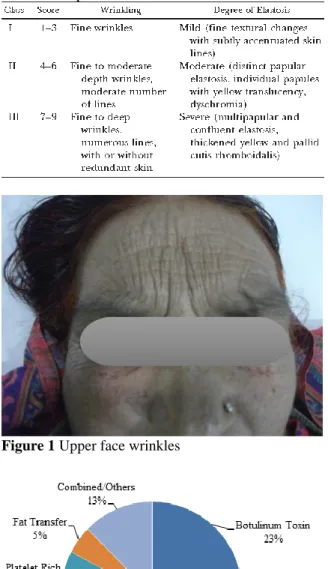
as active wrinkles, static wrinkles also known as passive wrinkles. Coarse (deep) wrinkles, fine (superficial) wrinkles also classified by Fitzpatrick in 1988, according to location of the wrinkles on the face i.e. periorbital, perinasal, perioral wrinkles, whether superficial or deep
(Table 1).
Clients presenting for the first time seeking facial wrinkles treatment after the age of 40 have mixture of dynamic and static component
(Figure 1). Single treatment modality to treat facial wrinkles may not provide satisfactory results, the combination of treatment modality may provide optimal facial rejuvenation.
Munir Alam
Consultant Plastic Surgeon, Faisal Hospital, Faisalabad, Pakistan.
Abstract
Objective Ageing process and gravity are the mainstay of etiological factor resulting in facial wrinkles. There are two types of wrinkles on the face; dynamic and static. Most of the wrinkles are distributed on the frontal view of the face and neck and treatment options depends on location and types of wrinkles. The face is divided into three parts; upper, middle and lower third. Invariably, the client desire is to treat these wrinkles non surgically, moreover the surgical procedures do not address these frontal, periorbital and particularly glabellar facial wrinkles. This study aim for various types facial wrinkles distributed on the upper face are dynamic i.e. forehead area, glabellar or frown winkles and periorbital wrinkles including crow's feet, nose (bunny lines) etc. The static wrinkles are distributed over the lower part of face includes nasolabial folds, marionette lines, perioral wrinkles etc.1 The present study therefore aims to evaluate the efficacy and safety and topresent results with new innovative office based non surgical cosmetic surgery procedures.
Material and Methods We have treated 155 clients in Faisal Hospital, Faisalabad with facial wrinkles during three years period from Jan 2015 to Dec 2017. This is a prospective cross sectional randomized observational study. The treatment modalities applied on these clients includes botulinum toxin, hyaluronic acid dermal fillers. It is quite common in our practice using techniques of platelet rich plasma (PRP), RF microdermabrasion, chemical peelings and photoepilation (LASER/ IPL) etc. for the facial rejuvenation.
Results The results achieved with these innovative office based techniques are highly satisfactory in the range of 80-100%, assessed by visual analogue scoring system by client and doctor.
Conclusion We recommend these techniques for all age group clients either alone or in combination for the treatment of facial wrinkles.
Key words
Table 1 Fitzpatrick classification of facial wrinkles
Figure 1 Upper face wrinkles
Figure 2 Treatment modality
The most commonly used procedures for facial wrinkles includes botulinum toxins, dermal hyaluronic acid fillers, chemical peel, photoepilation (IPL & LASER), PRP, fat transfer and combined procedures. The results for these treatment modalities are temporary in nature either 4-6 months or upto one year. To maintain the desired results, the sessions of these procedures required to be continue life long and
sun protection with replenishing creams.
Material and methods
This is a prospective descriptive study of three years from Jan 2015 to Dec 2017 and this study was conducted at Faisal Hospital, Faisalabad, Pakistan. The inclusion criteria was compliant clients with all kind of facial wrinkles of either gender male or female presented in the clinic for facial rejuvenation. The exclusion criteria include non compliance, allergic reaction, pregnancy & breast feeding, neuromuscular disorder, certian medication (aminoglycosides antibiotics, spectinomycin, muscle relaxant, anticoagulant) etc.
This study include total no of patients 184 and total no of 578 consecutive sessions performed with various treatment modalities (Figure 2). Age distribution ranges from 17 years to 63 Years. There were 39 (19.6 %) male and 148 (80.4%) female. The written informed consent was obtained and pre/ post procedures photographs were obtained where indicated. All the patients were assessed by using visual analogue scoring system by client and doctor to check post procedure satisfaction level at one week interval.
Results
With the treatment modalities used botulinum toxins, hyluronic acid dermal fillers, photoepilation (IPL and LASER), chemical peel etc. (Table 2). The satisfaction level of client and doctor achieved in the range of 80–100% by using visual analogue scoring system.
Table 2 Treatment Modalities Treatment
Modality
Number of Patients
Total 2015 2016 2017
Botulinum Toxin 7 18 17 42 (23%) Dermal
Hyaluronic Acid Fillers
8 11 14 33 (18%)
Chemical Peel 5 6 8 23 (12%)
Photoepilation
(LASER/IPL) 20 10 15 45 (24%)
Platelet Rich
Plasma (PRP) 2 3 4 9 (5%)
Fat Transfer 2 3 4 9 (5%)
Combined/Others 4 10 9 23 (13%)
Discussion
Aging is a process that is inevitable. As people get older, their skin gets thinner, drier, and less elastic, and less able to protect itself from
damage. This leads to wrinkles, creases, and lines on the skin. The skin lose its elasticity with age and gravity effect and facial skin present with variety of wrinkles.1,18,19
A number of avoidable, environmental factors also contribute. Exposure to ultraviolet (UV) light, for example, through sunbathing, tanning booths, and outdoor sports increases the chance of developing wrinkles earlier. UV light breaks down the collagen and elastin fibers in the skin. These fibers form the skin's connective tissue. They are located under the surface of the skin and support the skin.1,2 Breaking down this layer causes the skin to become weaker and less flexible. The skin starts to droop, and wrinkles appear. Glogau classified facial wrinkles into four groups (Table 3).3
Table 3 Glogau Classification of Photoaging
People who work in the sunlight have a higher chance of early wrinkles. Jobs that involve this type of exposure include fishing and farming. Sailors, golfers, beach lifeguards, and gardeners may also be more prone to skin aging.
Regular smoking accelerates the aging process of skin, because of the reduced blood supply to the skin. Alcohol dehydrates the skin, and dry skin is more likely to wrinkle.
The Botulinum toxin derived from Clostridium Botulinum Type A, B, C. Botulinum toxin type A, commonly known as Botox, Permanently degenerate nerve ending in the muscle ,thereby inhibiting the release of acetylcholine that cause muscles to contract. It is used to treat a number of medical conditions including migraine/ headache, as well as wrinkles.4,14,15
It is injected in small doses into the targeted muscles. If the muscles can no longer tighten, the skin flattens, giving a less wrinkled and smoother appearance.
Botox can decrease the dynamic wrinkles on the forehead, the frown lines between the eyes, and "crow's feet," around the corners of the eyes. It start to have effect after 2–3 days of injecting botulinum toxin into the muscle and full effect appears after one week. The effect generally last for 4–6 months, so life long repeated injections required to maintain the desired effect of botox.
In most areas of the body, the layers from outside to inside are: epidermis, dermis, fat, fascia, muscle, periosteum, bone. Thus, in most sites, one needs to pass the injection needle through skin, fat, and fascia to reach the muscle. However, the Orbicularis oculi has a unique anatomy. The arrangement from outside to inside is: epidermis, dermis, muscle (orbicularis oculi), fascia (septum), fat. Thus the target muscle in the periocular area is just under the
skin, and a very thin skin at that area. Therefore, injections into the orbicularis oculi should be very superficial.4
The Wrinkle severity rating scale (WSRS) was validated in 2004 by Day et al. as a new clinical outcome instrument for quantitative assessment of facial skin folds, in particular the nasolabial folds.3,4
The treatment for static (passive) facial wrinkles most commonly with the most safe agent hyaluronic acid (HA) dermal filler. The HA is normally present in the skin, loss of this substance give rise to initially fine wrinkles, ultimately with the ageing and gravity result into deep coarse static wrinkles.
The HA is derived from the natural source streptococcal fermentation process. It is safe as compared to other filler i.e; Collagen, Ca hydroxylapatite. The injected hyaluronic acid gradually reabsorb and is effective for nine months to one year. The viscosity of hyaluronic acid depends upon the crosslinking system
(Figure 4).
The superficial wrinkles, may be treated more safely with a less viscous hyaluronic acid with lower G-prime properties hence reducing the risk of the Tyndall effect or the filler being visible or lumpy after injection.5,6,21,22
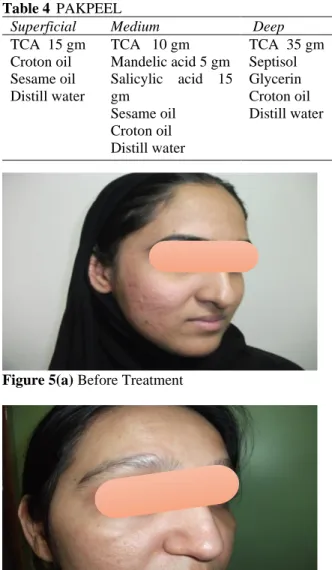
Chemical peel is a chemical solution is applied to the skin to peel away the dead cells on the surface of the skin. The author have introduced newer formula into the world of chemical peeling according to the depth of peeling agent penetration (Table 3).
Figure 4 Hyaluronic acid crosslinking system Table 4 PAKPEEL
Superficial Medium Deep
TCA 15 gm Croton oil Sesame oil Distill water
TCA 10 gm Mandelic acid 5 gm Salicylic acid 15 gm
Sesame oil Croton oil Distill water
TCA 35 gm Septisol Glycerin Croton oil Distill water
Figure 5(a) Before Treatment
Figure 5(b) 3 months after treatment
combination with other cosmetic procedures and results are enhanced if the correct pre-treatment and post-treatment products are used.7,8
Platelet rich plasma (PRP) is defined as a volume of autologous plasma that has a platelet concentration above baseline.9,12 As such, PRP
contains not only a high concentration of platelets but also the full complement of clotting factors, cytokines and platelet derived growth factors.10,12
From last few years, PRP is successfully used in numerous skin care applications including skin rejuvenation (overall improvement in skin texture and firmness) superficial and deep wrinkles of the face. It may be used in association with other treatment modalities such as laser, radiofrequency or fat grafting to improve clinical outcomes.11
Photoepilation (LASER & IPL) resurface the skin by removing the superficial layers of skin, hence removing fine lines and wrinkles. The nonablative laser is a novel photoepilation system designed to alleviate facial rhytids without injuring the epidermis.12
The combined treatment of radiofrequency (RF) mecrodermabrasion, chemical peel and hyaluronic acid filler provide superior result in selected group of patients (Figure 5a&b) as compared to single treatment modality.12,20-22
Judicious use of medication, topical retinoids are derived from vitamin A, and they are said to reduce fine wrinkles, some pigmentations, and skin roughness. Home care products help to stimulate skin renewal and sun protection is recommended.
Conclusion
These non surgical office based cosmetic surgical techniques help lowering biological age to keep younger and fresh looking face by reducing facial wrinkles. These techniques are excellent for all age group clients either alone or in combination for the treatment of facial wrinkles making healthier and happier life, maintaining the younger beautiful face life long and improve the psychology of the client.
References
1. Diana C Calderone, Neil AFenske; The clinical spectrum of actinic elastosis. J Am Acad Dermatol 1995; 32(6): 1016-1024. 2. Oakley A. Facial lines and wrinkles,
Waikato Hospital, Hamilton, New Zealand, 2004.
<https://www.dermnetnz.org/topics/facial-lines-and-wrinkles/>
3. Glogau R.G. Aesthetic and anatomic analysis of the aging skin. Semin. Cutan Med Surg 1996; 15: 134.
4. Anthony V Benedetto. Botulinum toxin in Clinical Dermatology, Edition 2005, p 43. 5. Day DJ1, Littler CM, Swift RW, Gottlieb S.
The wrinkle severity rating scale: a validation study. Am J Clin Dermatol 2004; 5(1): 49-52.
6. Muhn C, Rosen N, Solish N, Bertucci V, Lupin M, Dansereau A, Weksberg F, Remington BK, Swift A. The evolving role of hyaluronic acid fillers for facial volume restoration and contouring: a Canadian overview. Clin Cosmet Investig Dermatol
2012; 5: 147-58. doi:
10.2147/CCID.S30794. Epub 2012 Oct 5. 7. Inja Bogdan Allemann, Leslie Baumann.
Hyaluronic acid gel (Juvéderm) preparations in the treatment of facial wrinkles and folds. Clin Interv Aging 2008; 3(4): 629–634. 8. Brian P M, Brad M, Gary M, Gaylon M.
The Etiology of Prolonged Erythema after Chemical Peel. Dermatol Surg 1998; 24(3): 337–341.
9. Alam M, Iqbal MJ, Akhtar R. Chemical Peels: What to Treat and Expect? J Dermatol Plast Surg 2017; 2(2): 1013.
10. Marx R E, Platelet-Rich Plasma (PRP): What is PRP and What Is Not PRP? Implant Dentistry 2001; 10(4): 225.
11. Eppley BL, Pietrzak WS, Blanton M. Platelet-rich plasma: a review of biology and applications in plastic surgery. Plast Reconstr Surg 2006; 118(6):147e-159e. 12. Turzi A & Regan Lab team, PRP
standardisation & cells therapies, 2017, 11. 13. Gregg M et al; Treatment of Facial Rhytids
with a Nonablative Laser: A Clinical and Histologic Study 1999; 25(6): 440-444. 14. Carruthers A et al; Improvement of
Tension‐Type Headache When Treating Wrinkles With Botulinum Toxin A Injections; HEADACHE J Headache Pain 1999; 39(9): 662-665.
15. Garcia A, Fulton JE Jr. Cosmetic denervation of the muscles of facial expression with botulinum toxin: a dose-response study. Dermatol Surg 1996; 22:39 16. Morita A. Tobacco smoke causes premature
skin aging. J Dermatol Sc 2007; 48(3): 169-175.
17. Leea J Y, Kim Y Kb, Seo J Y et al. Loss of elastic fibers causes skin wrinkles in sun-damaged Loss of elastic fibers causes skin wrinkles in sun-damaged human skin. J Dermatol Sc 2008; 50(2): 99-107. 18. Lemperle G, Holmes R E, Cohen S R et al.
A Classification of Facial Wrinkles; Plast Reconstr Surg 2001: 1736.
19. Fitzpatrick TB. The validity and particularity of sun-reactive skin types I through VI. Arch Dermatol 1988; 124(6): 869–871.
20. Kulick M. Evaluation of a combined laser‐ radio frequency device (Polaris WR) for the nonablative treatment of facial wrinkles. J Cosmet Laser Ther 2005; 7(2): 87-92. 21. Eung Jung Ko, Hyuk Kim, won-Seok Park
et al; Correction of midface volume deficiency using hyaluronic acid filler and intradermal radiofrequency. J Cosmet Laser Ther 2015; 17(1): 46-8.
22. Artzi O, Loizides C, Verner I, Landau M. Resistant and Recurrent Late Reaction to Hyaluronic Acid-Based Gel. Dermatol Surg 2016; 42: 31.