Does
High Anxiety Decrease Motivation for Learning English as a Foreign Language?
Huda M. Almurshed*, Wafa Aljuaythin
Department of English Language and Literature, King Saud University, Riyadh, Saudi Arabia Corresponding Author: Huda M. Almurshed, E-mail: [email protected]
“The authors thank the Deanship of Scientific Research and RSSU at King Saud University for their technical support.”
ABSTRACT
This study investigates the relationship between the level of foreign language anxiety experienced by Saudi female English learners at a Saudi university and the level of their motivation in learning English as a foreign language. The participants were 40 female second-year university students. The instruments the researchers used to gather the data were two questionnaires: Horwitz, Horwitz, and Cope’s (1986) Foreign Language Classroom Anxiety Scale (FLCAS) and Gardner’s (2006) Attitude/Motivation Test Battery (AMTB). The data were analyzed by
calculating the percentages of students’ responses to each item. The findings revealed that Saudi
female English learners at King Saud University experienced high levels of foreign language
anxiety. The findings also revealed that the learners were highly motivated to learn English. This
demonstrates that a high level of motivation to learn English does not prevent the occurrence of
a significant level of anxiety. That is, motivation can control foreign language anxiety and assist
anxious learners in their determination to learn English.
Key words: Foreign Language Motivation, Foreign Language Anxiety, FLCAS, AMTB, Saudi Female Learners
INTRODUCTION
The English language was first introduced in the Saudi edu -cational system in the late 1920s (Al-Shabbi 1989; Baghdadi 1985; Niblock 2006). Even though most Saudis recognize the importance of English in modern life, few master the language. In fact, Saudis are the second lowest achievers on the Test of English as a Foreign Language (TOEFL) in the Middle East. According to the latest statistics, released in the third edition of The Official Guide to the TOEFL Test (ETS 2009, 435), the average TOEFL result in Saudi Arabia is 57
out of 120. Khan (2011, 3) claimed that Saudis’ low profi -ciency of English can be attributed to several psychological factors, among which is anxiety. Research on anxiety indi-cates that Saudi students experience high levels of anxiety in English classes; accordingly, these levels of anxiety hinder the effective acquisition of English (e.g. Al Saraj 2014; Balla 2017).
The aim of the present study was to explore the role of motivation in controlling foreign language anxiety (FLA) experienced by Saudi females learning English as a foreign language (EFL) at a Saudi In other words, the study sought to explore whether high levels of anxiety discouraged the students from learning English. First, the study examined the learners’ levels of FLA using the Foreign Language Class-room Anxiety Scale (FLCAS), developed by Horwitz et al. (1986), then it examined the students’ level of motivation
Published by Australian International Academic Centre PTY.LTD.
Copyright (c) the author(s). This is an open access article under CC BY license (https://creativecommons.org/licenses/by/4.0/) http://dx.doi.org/10.7575/aiac.ijalel.v.8n.2p.113
to learn English using the Attitude/Motivation Test Battery (AMTB), developed by Robert Gardner (2006). Finally, the study investigated the relationship between learners’ levels of anxiety and the levels of their motivation to learn English. In the Saudi context, little research, to our knowledge, has been conducted on the role of motivation in controlling EFL anxiety among Saudi female learners of English.
LITERATURE REVIEW Foreign Language Anxiety
Language learning anxiety is one of the affective factors that has been claimed to hinder the learning of a foreign or second language (Dewaele and Thirtle 2009; Horwitz et al. 1986; Horwitz 2001; Liu 2016; MacIntyre 1995). Gardner
and MacIntyre (1993, 284) defined it as the “feeling of ten
-sion and apprehen-sion specifically associated with second
language contexts, including speaking, listening, and
learn-ing.” Horwitz et al. (1986, 128) specified this unique type
of anxiety experienced in language classes as Foreign
Lan-guage Anxiety (FLA); they defined it as “a distinct complex
of self-perceptions, beliefs, feelings, and behaviors related to classroom language learning process.”
A great number of empirical studies have shown the neg-ative effect of anxiety on language learning performance. Horwitz et al. (1986), for example, conducted a study to
ARTICLE INFO
Article history
Received: November 04, 2018 Accepted: January 08, 2019 Published: March 31, 2019 Volume: 8 Issue: 2
Advance access: February 2019
Conflicts of interest: None
identify anxious students in foreign language classes. They
identified three components of FLA: apprehension in com -munication, anxiety related to testing, and fear of negative evaluation by classmates and teachers. They then developed
a standardized instrument that reflects the three components
mentioned above, the Foreign Language Classroom Anxi-ety Scale (FLCAS), to precisely measure FLA. Employing this instrument, they discovered that many foreign language
learners experienced significant levels of FLA that negative -ly affected their performance in the foreign language.
Dewaele and Thirtle (2009) conducted a study of ado-lescent English students enrolled in foreign language class-es in a school in London who had the choice to pursue or abandon the study of foreign languages. Their study revealed that those who chose to abandon the further study of foreign
languages were those who suffered significantly high levels
of FLA.
Similar results were also obtained by Doğan and Tuncer
(2016), who conducted a correlational survey study, one of the aims of which was to investigate the correlation between foreign language classroom anxiety and foreign language achievement. The participants were Turkish university en-gineering majors taking compulsory English classes. The in-strument they used was the FLCAS. The results of the study revealed a negative correlation between foreign language classroom anxiety and foreign language achievement.
Liu (2016) also investigated foreign language anxiety in
listening and its association with strategy use. Specifically,
the study aimed to explore the predictive effects of foreign language listening anxiety and strategy use on test
perfor-mance. The participants were high- and low-proficiency
Chinese university EFL learners. The researcher found that
in English listening, the low-proficiency group were more anxious than the high-proficiency group and less confident in their English listening proficiency. These findings are in line with Krashen’s (1985) view that difficulty in processing
meaningful input and producing responsive output are wide-ly found among anxious students.
Motivation
Motivation is another affective factor that has an impact on
L2 learning. Harmer (2007, 51) defined motivation as “some
kind of internal drive which pushes someone to do things in order to achieve something.” In L2 learning, Dörnyei (2005,
65) defined motivation as the “primary impetus to initiate
FL learning and later the driving force to sustain [the] lan-guage … learning process.” The positive impact of motiva-tion on foreign language learning is undeniable. Success-ful foreign language learning is enhanced in those learners who possess the right level of motivation. Gardner (2006,
241) noted that “students with higher levels of motivation
will do better than students with lower levels.” A number of
empirical studies have confirmed this positive relation be -tween language learning and motivation. For instance, Ab-dul Samad, Etemadzadeh, and Far (2012) investigated the
relationship between motivation and language proficiency
among Iranian EFL learners. The two aspects of motivation, instrumental (learning L2 for one’s career) and integrative
(learning L2 to integrate into the L2 community), were taken into consideration in their study. The participants were
clas-sified as high achievers if their International English Lan -guage Test System (IELTS) scores were above 6 and low achievers if their IELTS scores were below that. To examine the two aspects of motivation, Gardner’s (2006) AMTB was used. The results revealed that high achievers in language
proficiency were correlated with high levels of motivation,
especially integrative motivation.
Another study that confirmed the positive relation be -tween language learning and motivation was conducted by Busse and Walter (2013). The study investigated potential changes in levels of students’ intrinsic motivation, i.e., in-ternal reward, in learning another language. The
partici-pants were British first-year university students studying
German as a foreign language in two U.K. universities. The students started the German course with a high level of intrinsic motivation because of their strong desire to
be-come proficient in that language. When the students started
engaging with language learning tasks in the different lan-guage skills, they found it less enjoyable and became less
confident in their ability to communicate in German. As the
year went on, the students’ levels of intrinsic motivation declined, which paralleled a decline in their efforts to learn the language.
Motivation and FLA
Several studies have investigated the relationship between motivation and anxiety within the foreign language learning context. For instance, Liu (2012) investigated the relation-ship between foreign language anxiety, learning motivation,
autonomy, and language proficiency. The participants of the study were first-year, non-English major undergraduates,
who were placed in different levels based on their English
proficiency. The FLCAS showed that foreign language anxiety was prevalent among the students. The findings
also revealed that foreign language anxiety was negatively
correlated with learning motivation, listening proficiency, reading proficiency, and learner autonomy. A similar con -clusion was reached by Tahernezhad, Behjat, and Kargar (2014), who investigated the relation between anxiety and motivation among Iranian EFL learners. The two question-naires they employed were the FLCAS and the AMTB. The
findings of their study indicated that participants with lower
levels of anxiety were more motivated to learn English than those with higher levels of anxiety.
Conversely, a few studies have indicated that anxiety does not play either a major or a direct role in language learning. Trang, Moni, and Baldauf (2012), for instance, examined the effect of anxiety on students’ determination to learn English.
The findings of their study suggested that anxiety did not
Tóth (2007) and Khodadady and Khajav(2013)obtained similar results in their investigation of the relationship be-tween FLA and motivation. Tóth examined the relationship between FLA experienced by Hungarian advanced EFL learners and six individual differences, among which was strength of motivation. He found that strength of motivation, along with FL aptitude and perfectionism, was not a predic-tor of FLA. Khodadady and Khajavconducted their study in an Iranian EFL context. The participants were EFL learners
at a private English institute whose proficiency levels were
lower intermediate and intermediate. The questionnaires they used were the FLCAS and Language Learning Orien-tations Scale (LLOS). The results showed that the learners’ reasons for learning English determined the students’ levels and types of anxiety.
Since not enough research has explored the relation-ship between motivation and foreign language anxiety in the Saudi female context, the present study aimed to in-vestigate this relationship among Saudi female students majoring in English Language and Literature. Two stan-dardized questionnaires, the FLCAS and the AMTB, were employed. The participants of the study were limited to females because the institution where the authors work is for women only.
Research Questions
(1) To what extent do Saudi female EFL learners experi-ence FLA in language classrooms?
(2) Are Saudi female EFL learners motivated to learn En-glish?
(3) Is there any relationship between Saudi female learners’ levels of anxiety and motivation?
METHODOLOGY Participants
The participants of the study were 40 Saudi female sec-ond-year undergraduate students majoring in English Lan-guage and Literature. They were admitted to the department
after finishing their preparatory year with a C or B level
in English, which indicates advanced to intermediate EFL learners, respectively. All the participants speak Arabic as their native language and are studying English as a foreign language. They all attended standardized English classes at intermediate and high schools before entering university, and on average they had eight years of formal English learn-ing experience. Their ages ranged from 20 to 24, and they were attending linguistics and literature classes, in addition to language classes. The participants were selected through random sampling from two sections of the same language class, and all the participants gave their consent to partici-pate in the study.
Instruments
The researchers employed two questionnaires to gather the research data: Horwitz et al.’s (1986) FLCAS and
Gard-ner’s (2006) AMTB. The first questionnaire included 33
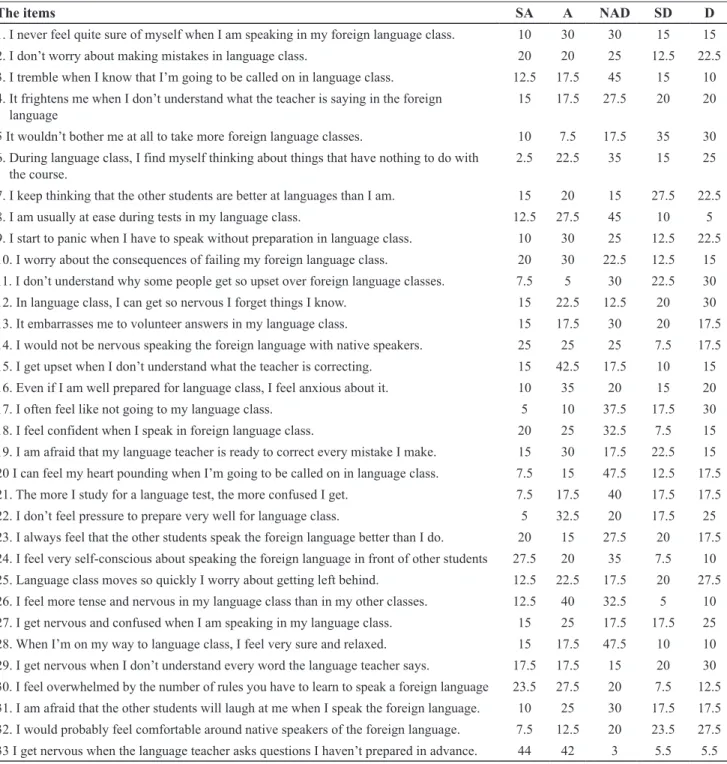
statements to be answered by the participants on a 5-point Likert scale (see Appendix, Table 1). The statements de-scribed language learning situations where students might experience anxiety. Nine statements indicated low levels of anxiety, whereas the rest of the statements indicated high levels of anxiety. The original version of the second ques-tionnaire, the AMTB, contained 26 items, each with six
responses; however, this questionnaire was modified to in
-clude only five responses and allow for adequate correlation
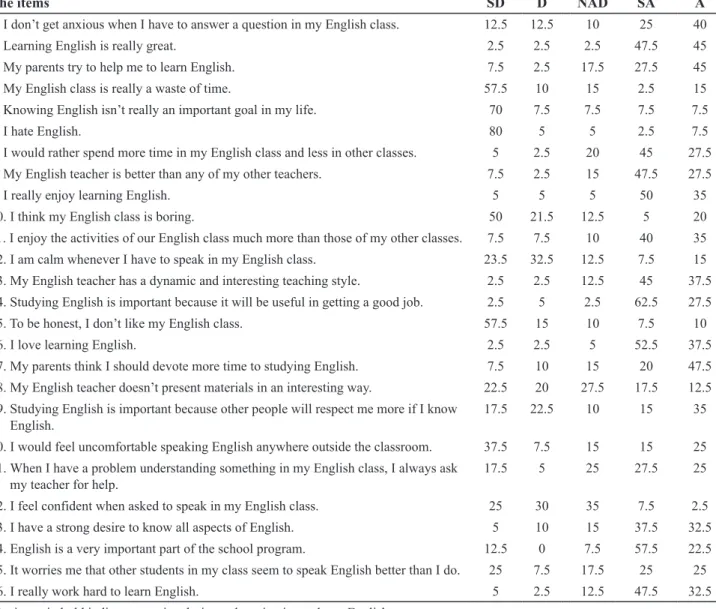
between the two instruments (see Appendix, Table 2). Eight items indicated no level of motivation to learn English, whereas the rest of the items expressed a positive desire and motivation to learn English.
Procedure
The FLCAS was administered to examine the degree of anx-iety among the participants. The researcher made sure that the participants took their time to answer the questions ad-equately. The researcher assured the participants that their answers would not affect their language class performance at all and that they were only to be used for research
pur-poses. Once they had finished answering the FLCAS, the
other questionnaire, the AMTB, was then distributed to the participants to measure their motivation. The participants were asked to provide adequate answers to the items. After excluding incomplete questionnaires, the collected data was
codified and analyzed by calculating the percentages of stu -dents’ responses to each item.
RESULTS AND DISCUSSION Foreign Language Anxiety (FLA)
The total percentages of students’ responses to each item on the FLCAS are reported in Table 1 (see Appendix). The find -ings reveal that a strikingly high proportion of participants showed varying degrees of anxiety about learning English.
Nearly half of the items, 16 out of 33, reflected the existence
of a considerable level of anxiety among the participants. The total percentages on eight of the items that are indicative of anxiety were 50% and above and between 40 and 49% on the other eight. For instance, 40% of the participants selected agree and strongly agree on Item 9, “I start to panic when
I have to speak without preparation in language class.” Al-most 50% of the participants chose agree and strongly agree when asked whether they worry about failing their language course, Item 10. Additionally, 45% of the participants indi-cated high anxiety in language classes, even when they had prepared well, Item 16. More than half of the participants
expressed their agreement with Item 26, “I feel more tense
and nervous in my language class than I do in my other classes.” This item has been considered by Horwitz et al.
(1986, 130) as “the single best discriminator of anxiety.” For the last item, “I get nervous when the language teacher asks
On the other hand, almost two thirds of the participants
disagreed with Item 5, “It wouldn’t bother me at all to take
more foreign language classes.” In addition, almost 43% of the participants selected disagree and strongly disagree
when answering Item 22, “I don’t feel pressure to prepare very well for language class.” Thus, the answer to the first research question, “Do Saudi female EFL learners experi -ence FLA in language classrooms?” is that most Saudi fe-male EFL learners in this study possess high levels of foreign language anxiety. As shown in Table 1, they are nervous, stressed, and overwhelmed in language classes.
Motivation
The results of the AMTB questionnaire revealed that the participants possessed a positive desire to learn English. As Table 2 shows (see Appendix), the results on more than two thirds of the items that are indicative of positive motivation were above 70%, indicating that the learners were highly motivated to learn English. For instance, 90% of the par-ticipants selected agree and strongly agree when answering
Item 2, “Learning English is really great.” and 92% did the same on Item 16, “I love learning English.” Additionally, 80% of them recognized the significant role of English in
the school program, Item 24, and 70% of them expressed a strong desire to learn all aspects of English, Item 23. Also, more than half of the participants were motivated enough to
rely on themselves to find solutions to their language ques -tions, Item 21. On the last item, 80% of the participants in-dicated that they work hard to learn English. A great number of the participants also claimed that they were extrinsically motivated to learn English, i.e., their parents pushed them to learn it, Items 3 and 17, amounting to about 73% and 67%, respectively. The percentages of answers indicating motiva-tion on the rest of the items ranged between 40 and 68%, which is still a good indication of motivation. Therefore, the
answer to the second research question, “Are Saudi female
EFL learners motived to learn English?” is that the learners
are definitely highly motivated to learn English.
The Relationship between Motivation and Foreign Language Anxiety (FLA)
The findings of the present study revealed that although the
participants were highly anxious about learning English, they persisted in learning it. As shown in Table 3 (see Appen-dix), on the measure of anxiety, the FLCAS, the participants were found to be more tense and nervous in language classes compared to other classes, yet, as the measure of motivation, the AMTB, shows, they would rather spend more time in English classes because they like English. So, the answer
to Research Question 3, “Is there any relationship between
Saudi female learners’ levels of anxiety and motivation?” is that there is a positive relationship between motivation and anxiety, indicating that motivation can control foreign language anxiety, i.e., learners who possess a high desire to learn English do not let anxiety prevent them from doing so.
To this end, the present study supports Trang et al.’s
(2012, 6) findings that “anxious students would be more
likely to abandon EFL learning if they didn’t perceive its importance.” In fact, the highly anxious learners in the pres-ent study selected agree and strongly agree on Item 14 of the
AMTB, “Studying English is important because it will be
useful in getting a good job,” amounting to 90%. They also chose agree and strongly agree on Item 19 of the AMTB,
“Studying English is important because other people will
respect me more if I know English,” amounting to 50%. In other words, because they recognized its importance, the anxious learners in the present study did not abandon learn-ing English.
It is clear from these results that a high level of motiva-tion to learn English does not prevent the occurrence of a
significant level of anxiety. Whereas other studies (i.e., Liu
2012; Tahernezhad et al. 2014) found that a high level of anxiety predicted a low level of motivation and vice versa among EFL learners, the present study contradicts this claim, as the participants were both highly anxious and yet highly motivated to learn English.
CONCLUSION AND LIMITATIONS
This study investigated the role of motivation in controlling foreign language anxiety among 40 Saudi female EFL
learners. It first examined the level of anxiety with Horwitz
et al.’s (1986) FLCAS, and then examined the level of mo-tivation among participants using Gardner’s (2006) AMTB. Lastly, it examined the relationship between the participants’ level of anxiety and the level of their motivation to learn
En-glish. The findings indicate that the participants experienced
high levels of FLA; nevertheless, those learners were highly motivated to learn English. Thus, it can be said that FLA is not a negative predictor of learning motivation. In fact, both anxiety and motivation coexisted among the participants. This paper also suggests that motivation can manage FLA. Whereas highly anxious learners are expected to stop learn-ing the foreign language, the present study suggests that if they are highly motivated to learn English, their anxiety will not prevent them from pursuing their goal.
Pedagogically, the findings of this study can help teach -ers and students of English by raising their awareness of the importance of English. In turn, FLA can be managed by a strong desire to learn English. In other words, anxiety will not hinder the learning of a foreign language if motivation is high among EFL learners.
However, it might be premature to claim the
generalizability of such findings, given the limited number
of participants. A large-scale study is needed to enhance
these findings. Future research is also needed to assess the
relationship between motivation and anxiety among non-En-glish major students or among Ennon-En-glish major students at
lower English proficiency levels. In addition, future research
should also focus on how to motivate language learners, giv-en the importance of motivation in managing FLA.
REFERENCES
AbdulSamad, A. A., A. Etemadzadeh, and H. R. Far.
-mental and Integrative Aspects. Procedia—Social and Behavioral Sciences, 66, 432–440. doi:10.1016/j.sb-spro.2012.11.287
Al Saraj, T. (2014). Revisiting the Foreign Language Class-room Anxiety Scale (FLCAS): The Anxiety of Female English Language Learners in Saudi Arabia. L2 Jour-nal, 4, 50–76. Retrieved From https://escholarship.org/ uc/item/62n6x6jm
Al-Shabbi, A. (1989). An investigation study of the practical preparation in EFL teacher preparation programs in col-leges of education in the Saudi Arabia. PhD diss., Uni-versity of Wales, Cardiff, UK.
Baghdadi, A. (1985). The educational start in the Kingdom of Saudi Arabia. Jeddah: Ashuruq Publishing House. Balla, A. A. (2017). Foreign Language Anxiety in Saudi
Classroom: A Case Study of Saudi Tertiary Female Stu-dents in Prince Sattam University. English Language Teaching, 5. doi:10.5539/elt.v10n5p28
Busse, V., and Walter, C. (2013). Foreign Language Learning Motivation in Higher Education: A Longitudinal Study of Motivational Changes and Their Causes. The Modern Language Journal, 97, 435–456. doi:10.1111/j.1540-4781.2013.12004.x
Dewaele, J., and Thirtle. H. (2009). Why Do Some Young Learners Drop Foreign Languages? A Focus on Learn-er-internal Variables. International Journal of Bi-lingual Education and BiBi-lingualism12: 635–649. doi:10.1080/13670050802549656
Doğan, Y., and Tuncer, M. (2016). Examination of Foreign
Language Classroom Anxiety and Achievement in For-eign Language in Turkish University Students in Terms of Various Variables. Journal of Education and Training Studies 4: 18–29. doi:10.11114/jets.v4i5.1337
Dörnyei, Z. (2005). The psychology of the language learner: Individual differences in second language acquisition. Mahwah, NJ: Lawrence Erlbaum. Educational Testing Service [ETS]. 2009. The Official Guide to the TOEFL Test.3rd ed. New York: McGraw-Hill.
Gardner, R. (2006). The Socio-educational Model of Sec-ond Language Acquisition: A Research Paradigm. EUROSLA Yearbook 6: 237–260. doi:10.1075/euros-la.6.14gar
Gardner, R. C., and MacIntyre, P.D. (1993). On the Mea-surement of Affective Variables in Second Lan-guage Learning. LanLan-guage Learning, 43, 157–194. doi:10.1111/j.1467-1770.1992.tb00714.x
Harmer, J. (2007). The practice of English language teach-ing. 4th ed. Essex: Longman.
Horwitz, E. K. (2001). Language Anxiety and Achievement. Annual Review of Applied Linguistics, 21, 112–126. doi:10.1017/S0267190501000071
Horwitz, E. K., M. B. Horwitz, and J. Cope. (1986). Foreign Language Classroom Anxiety. The Modern Language Journal, 70, 125–132. doi:10.1111/j.1540-4781.1986. tb05256.x
Krashen, S. D. (1985). The input hypothesis: Issues and im-plications. New York: Longman.
Khan, I. A. (2011). An Analysis of Learning Barriers: The Saudi Arabian Context. International Education Stud-ies, 4, 242–247. doi:10.5539/ies.v4n1p242
Khodadady, I., and Hassan, G. (2013). Exploring the Role of Anxiety and Motivation in Foreign Language Achieve-ment: A structural Equation Modeling Approach. Kha-jav Porta Linguarum, 10: 269–286.
Liu, H. (2012). Understanding EFL Undergraduate Anxi-ety in Relation to Motivation Autonomy, and Language
Proficiency. Electronic Journal of Foreign Language Teaching, 9(1), 123–139. Retrieved from http://e-flt.nus.
edu.sg/v9n12012/liu.pdf
Liu, M. (2016). Interrelations Between Foreign Language Listening Anxiety and Strategy Use and Their Predicting
Effects on Test Performance of High- and Low-profi -cient Chinese University EFL learners. The Asia-Pa-cific Education Researcher, 25, 647–655. doi:10.1007/ s40299-016-0294-1
MacIntyre, P. D. (1995). How Does Anxiety Affect Sec-ond Language Learning? A Reply to Sparks and Gan-schow. The Modern Language Journal, 79, 90–99. doi:10.1111/j.1540- 4781.1995.tb05418.x
Niblock, T. 2006. Saudi Arabia: Power, legitimacy and sur-vival. New York: Routledge.
Tahernezhad, E., Behjat, F. and Kargar, A. (2014). The Relationship Between Language Learning Anxiety and Language Learning Motivation Among Iranian Intermediate EFL Learners. International Journal of Language and Linguistics, 2, 35–48. doi: 10.11648/j. ijll.s.2014020601.16
Tóth, Z. (2007). Predictors of Foreign-language Anxiety: Examining the Relationship Between Anxiety and Other Individual Learner Variables. In J. Horváth & M. Ni-kolov (Eds.), Empirical studies in English applied lin-guistics (123–148). Pécs: Lingua Franca Csopor Trang, T., K. Moni, and Baldauf, R. (2012). Foreign
APPENDIX
Table 1. Total percentages of students’ responses to individual items about learner anxiety
The items SA A NAD SD D
1. I never feel quite sure of myself when I am speaking in my foreign language class. 10 30 30 15 15
2. I don’t worry about making mistakes in language class. 20 20 25 12.5 22.5
3. I tremble when I know that I’m going to be called on in language class. 12.5 17.5 45 15 10 4. It frightens me when I don’t understand what the teacher is saying in the foreign
language 15 17.5 27.5 20 20
5 It wouldn’t bother me at all to take more foreign language classes. 10 7.5 17.5 35 30 6. During language class, I find myself thinking about things that have nothing to do with
the course. 2.5 22.5 35 15 25
7. I keep thinking that the other students are better at languages than I am. 15 20 15 27.5 22.5
8. I am usually at ease during tests in my language class. 12.5 27.5 45 10 5
9. I start to panic when I have to speak without preparation in language class. 10 30 25 12.5 22.5 10. I worry about the consequences of failing my foreign language class. 20 30 22.5 12.5 15 11. I don’t understand why some people get so upset over foreign language classes. 7.5 5 30 22.5 30 12. In language class, I can get so nervous I forget things I know. 15 22.5 12.5 20 30 13. It embarrasses me to volunteer answers in my language class. 15 17.5 30 20 17.5 14. I would not be nervous speaking the foreign language with native speakers. 25 25 25 7.5 17.5 15. I get upset when I don’t understand what the teacher is correcting. 15 42.5 17.5 10 15 16. Even if I am well prepared for language class, I feel anxious about it. 10 35 20 15 20
17. I often feel like not going to my language class. 5 10 37.5 17.5 30
18. I feel confident when I speak in foreign language class. 20 25 32.5 7.5 15 19. I am afraid that my language teacher is ready to correct every mistake I make. 15 30 17.5 22.5 15 20 I can feel my heart pounding when I’m going to be called on in language class. 7.5 15 47.5 12.5 17.5 21. The more I study for a language test, the more confused I get. 7.5 17.5 40 17.5 17.5 22. I don’t feel pressure to prepare very well for language class. 5 32.5 20 17.5 25 23. I always feel that the other students speak the foreign language better than I do. 20 15 27.5 20 17.5 24. I feel very self-conscious about speaking the foreign language in front of other students 27.5 20 35 7.5 10 25. Language class moves so quickly I worry about getting left behind. 12.5 22.5 17.5 20 27.5 26. I feel more tense and nervous in my language class than in my other classes. 12.5 40 32.5 5 10 27. I get nervous and confused when I am speaking in my language class. 15 25 17.5 17.5 25 28. When I’m on my way to language class, I feel very sure and relaxed. 15 17.5 47.5 10 10 29. I get nervous when I don’t understand every word the language teacher says. 17.5 17.5 15 20 30 30. I feel overwhelmed by the number of rules you have to learn to speak a foreign language 23.5 27.5 20 7.5 12.5 31. I am afraid that the other students will laugh at me when I speak the foreign language. 10 25 30 17.5 17.5 32. I would probably feel comfortable around native speakers of the foreign language. 7.5 12.5 20 23.5 27.5 33 I get nervous when the language teacher asks questions I haven’t prepared in advance. 44 42 3 5.5 5.5 The items in bold indicate low levels of anxiety.
Table 2. Total percentages of students’ responses to individual items about learner motivation
The items SD D NAD SA A
1. I don’t get anxious when I have to answer a question in my English class. 12.5 12.5 10 25 40
2. Learning English is really great. 2.5 2.5 2.5 47.5 45
3. My parents try to help me to learn English. 7.5 2.5 17.5 27.5 45
4. My English class is really a waste of time. 57.5 10 15 2.5 15
5. Knowing English isn’t really an important goal in my life. 70 7.5 7.5 7.5 7.5
6. I hate English. 80 5 5 2.5 7.5
7. I would rather spend more time in my English class and less in other classes. 5 2.5 20 45 27.5 8. My English teacher is better than any of my other teachers. 7.5 2.5 15 47.5 27.5
9. I really enjoy learning English. 5 5 5 50 35
10. I think my English class is boring. 50 21.5 12.5 5 20
11. I enjoy the activities of our English class much more than those of my other classes. 7.5 7.5 10 40 35 12. I am calm whenever I have to speak in my English class. 23.5 32.5 12.5 7.5 15 13. My English teacher has a dynamic and interesting teaching style. 2.5 2.5 12.5 45 37.5 14. Studying English is important because it will be useful in getting a good job. 2.5 5 2.5 62.5 27.5
15. To be honest, I don’t like my English class. 57.5 15 10 7.5 10
16. I love learning English. 2.5 2.5 5 52.5 37.5
17. My parents think I should devote more time to studying English. 7.5 10 15 20 47.5 18. My English teacher doesn’t present materials in an interesting way. 22.5 20 27.5 17.5 12.5 19. Studying English is important because other people will respect me more if I know
English. 17.5 22.5 10 15 35
20. I would feel uncomfortable speaking English anywhere outside the classroom. 37.5 7.5 15 15 25 21. When I have a problem understanding something in my English class, I always ask
my teacher for help. 17.5 5 25 27.5 25
22. I feel confident when asked to speak in my English class. 25 30 35 7.5 2.5
23. I have a strong desire to know all aspects of English. 5 10 15 37.5 32.5
24. English is a very important part of the school program. 12.5 0 7.5 57.5 22.5 25. It worries me that other students in my class seem to speak English better than I do. 25 7.5 17.5 25 25
26. I really work hard to learn English. 5 2.5 12.5 47.5 32.5
The items in bold indicate negative desire and motivation to learn English.
SD – strongly disagree; D – disagree; NAD – neither agree or disagree; SA – strongly agree; A – agree.
Table 3. Relationship between FLA and motivation
The items SA A NA/D SD D
Anxiety (FLCAS)
1. I never feel quite sure of myself when I am speaking in my foreign language class. 10 30 30 15 15
17. I often feel like not going to my language class. 5 10 37.5 17.5 30
26. I feel more tense and nervous in my language class than in my other classes. 23.5 27.5 20 7.5 12.5 Motivation (AMTB)
7. I would rather spend more time in my English class and less in other classes. 45 27.5 20 5 2.5 14. Studying English is important because it will be useful in getting a good job. 62.5 27.5 2.5 2.5 5
15. To be honest, I don’t like my English class. 7.5 10 10 57.5 15