Address for correspondence Dr. Mahin Aflatoonian Department of Dermatology,
Afzalipour Hospital, Kerman Medical University, Kerman, Iran
Email: [email protected]
Original Article
Assessment of serum level of 25-hydroxy-vitamin D in
Iranian children with atopic dermatitis, in Kerman
city, an area with high sun exposure
Saeedeh Farajzadeh*, Leila Reghabatpour*, Mahin Aflatoonian*, Saman Mohammadi*, Rezvan Amiri*
* Dermatology department, Afzalipour Hospital, Kerman Medical University, Kerman, Iran Abstract Objective To determine the association between the severity of AD and serum level of 25(OH)
vitamin D in Kerman, a desert area in southeast of Iran, that was performed for the first time in Iran. Methods In this cross-sectional study 57 AD subjects and 19 healthy children under the age of 18 years old were enrolled. The serum levels of 25(OH) vitamin D were measured in the both groups. The severity of AD was evaluated according to SCORAD.
Results According to our study, there was a significant association between serum level of vitamin D and severity of AD especially in moderate and severe forms of AD (p<0.001).
Conclusion Our study revealed vitamin D deficiency in AD patients, thus, it is recommended to take vitamin D supplementation in AD patient. Additional research is needed in order to evaluate dysfunction of vitamin D receptor in AD patients.
Keywords
Atopic dermatitis, serum 25 hydroxy-vitamin D.
Introduction
Atopic dermatitis (AD) is a chronic and recurrent inflammatory disease.1 To date, it is
clear that vitamin D has a role in calcium homeostasis and immune regulation in some diseases such as AD, psoriasis and cancers especially cutaneous malignancy. 2-3
Precursor of vitamin D (Vit-D) is provided by effects of UVB on skin from
7-dehydroxycholesterol and then it is hydroxylated to 25-(OH)-Vit-D and lastly it is converted to active metabolites of Vit-D, [1,25(OH)2Vit-D].4-5
Although, there is controversy about the role of Vit-D in prevalence of allergic disease, most of studies have showed that the increase of Vit-D absorption in pregnancy has negative effects on the risk of development of atopic dermatitis in children.6-12
Back et al.13 confirmed the evidence that an
increase in absorption of Vit-D in the first year of the life leads to decrease of atopic appearance in the first six years of life.
studies support the beneficial effects of Vit. D intake in the patients with atopic dermatitis.14-17
In one study by Hata et al.18 in USA, the efficacy
of Vit. D intake (4000 IU/day) was evaluated, and it was concluded that Vit. D can induce the production of cathelicidin in AD patients and normal individuals. Also, studies have shown that rate of cutaneous infection such as staphylococcus aureus has increased in AD patients due to immune system failure in production of antimicrobial peptide, cathelicidin.18 Other studies have demonstrated
that there is correlation between low serum Vit-D and the severity of AVit-D.19-22
Regarding the role of Vit D in immune system function in allergic diseases such as AD, and absence of such investigations in Iran, we decided to determine serum Vit D level in AD patients in Iran.
Methods
This cross-sectional study was conducted in Afzalipour hospital - Dermatology clinic in Kerman, Iran. This study was approved by the ethics committee of Kerman University of Medical sciences by approval code K/91/103. Written informed consent was obtained from all parents of participants.
Inclusion criteria were diagnosis of AD by a dermatologist according to the UK working party criteria and patients less than 18 years old. Exclusion criteria included subjects who had taken oral Vit-D or topical Vit-D in the last 6 months and topical steroids in the last 4 weeks or had history of hyperparathyroidism in the last 6 months.
AD severity was assessed according to SCORAD, as follows: mild (less than 25), moderate (25-50), severe (more than 50). Serum
level of 25-(OH)-Vit.D measured using ELISA method (CAL-BIOTECK KIT, USA).
Statistical analysis
Data analyzed by SPSS software, version 17 and groups were compared by ANOVA and Spearman’s correlation test. P-value less than 0.05 was regarded statistically significant.
Results
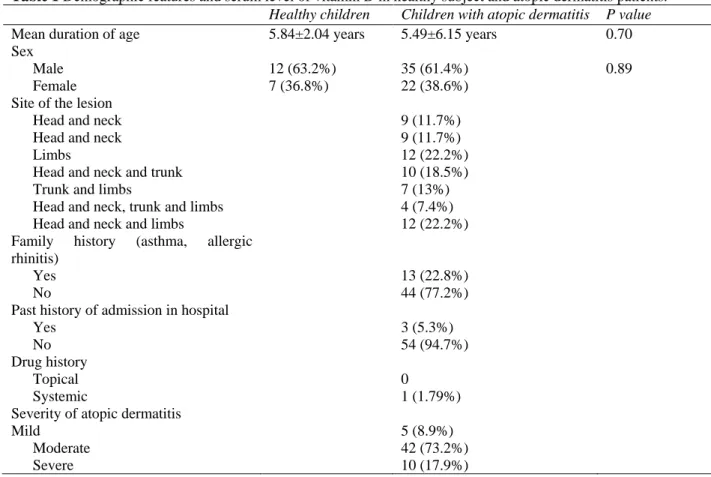
A total of 76 children under the age of 18 were enrolled in this study (including 57 AD subjects and 19 healthy children). There were no statistical differences in age and sex between these two groups (Table 1). Forty seven were male (12 vs. 35, in control and case group, respectively) and 29 were female (7 vs. 22, in control and case group, respectively). The mean ages in control and case groups were 5.84±2.04 years and 5.49±6.15 years, respectively. Participant’s ages ranged between 2 and 12 years.
Table 1 also shows clinical features and history
of patients with atopic dermatitis and data regarding site of involvement. The severity of AD in study population was defined as follows: 8.9% mild, 73.2% moderate and 17.9% severe.
Mean serum levels of 25-(OH)-Vit D in case and control group were 24.62± 6.71 ng/ml and 29.97± 4.86 ng/ml, respectively (Table 2).
Table 2 shows that, there was a significant
Table 1 Demographic features and serum level of vitamin D in healthy subject and atopic dermatitis patients. Healthy children Children with atopic dermatitis P value
Mean duration of age 5.84±2.04 years 5.49±6.15 years 0.70
Sex
Male 12 (63.2%) 35 (61.4%) 0.89
Female 7 (36.8%) 22 (38.6%)
Site of the lesion
Head and neck 9 (11.7%)
Head and neck 9 (11.7%)
Limbs 12 (22.2%)
Head and neck and trunk 10 (18.5%)
Trunk and limbs 7 (13%)
Head and neck, trunk and limbs 4 (7.4%)
Head and neck and limbs 12 (22.2%)
Family history (asthma, allergic rhinitis)
Yes 13 (22.8%)
No 44 (77.2%)
Past history of admission in hospital
Yes 3 (5.3%)
No 54 (94.7%)
Drug history
Topical 0
Systemic 1 (1.79%)
Severity of atopic dermatitis
Mild 5 (8.9%)
Moderate 42 (73.2%)
Severe 10 (17.9%)
Table 2 Demographic features and serum level of vitamin D in healthy subject and atopic dermatitis patients. Healthy children Children with atopic dermatitis P value
Mean serum 25(OH)-vitamin D level 29.97±4.86 24.62±6.71 0.002
Mean serum 25(OH)-vitamin D level according to AD severity
Mild - 31.20 ±1.41 <0.001
Moderate - 25.18 ±6.32
Severe - 18.97 ±6.01
Table 3 Level of serum vitamin D according to site of involvement.
Site of lesions Mean serum level of vitamin D
Head and neck 26.088±5.27*
Limbs 24.88±7.19
Head and neck and trunk 24.30±7.74
Trunk and limbs 22.92±8.76
Head and neck and trunk 26.65±7.73 Head and neck and limbs 24. 86±5.96 P=0.949
Table 4 Serum level of vitamin D according to sex and past history
Mean serum vitamin D level
P value Sex
Female 24.00±7.52 0.587
Male 25.01±6.23 Past history of atopic disease
Yes 23.80±6.83 0.623
No 24.86±6.73
history of asthma and allergic rhinitis (Table 3,
4).
Discussion
Vit-D has an important role in regulation of immune system and induced production of cathelicidin antimicrobial peptide through activation of toll like receptor.2 Also, it has
anti-inflammatory effects by conversion of T helper 1 response to T helper 2, and by inhibition of Langerhans cell function and a decrease in maturation of dendritic cells.23
Different studies about impairment of immune system function and failure in barrier effect of skin in the pathogenesis of AD have demonstrated relationship between level of serum Vit-D and appearance of allergic disorders such as asthma and AD. These studies have shown contradictory results. 6-12
Our study showed an inverse relationship between serum level of 25-(OH)-Vit D with the severity of AD, which is compatible with the study done by Lee et al. 19
In another study, although there was no meaningful correlation between serum level of 25-(OH)-Vit D with control group, significant decrease in SCORAD achieved after taking Vit-D supplements.16 Also, in one study in Hong
Kong,22 there was an inverse relationship
between AD severity in short and long-term follow-up and the serum level of 25-(OH)-Vit D.
In our study, there was no significant association between sex and site of involvement and serum level of 25-(OH)-Vit D. Some studies report that there is a correlation between gender and serum level of 25-(OH)-Vit D so that male patients had lower serum level of it. These results are in contrast to the study by Javanbakht
et al.24 in Iran that females had lower serum
level of 25-(OH)-VitD. This can be due to different cultural issues between Islamic
countries and other countries, as female in Islamic countries should cover total body except hand and face and this results in less exposure to sun.24 Furthermore, in present study there was no
correlation between age and serum level of 25-(OH)-Vit D due to less oral intake or less exposure to sun.26,27
Our study was performed in Kerman, a city located next to Loot desert with sunny weather in almost all year around, and despite our expectation, the serum level of Vit-D in the patients was lower than control group, especially those with moderate to severe forms of AD (defined based on SCORAD). So it seems that such patients with AD have an impairment in production of active form of Vit-D in epidermis. It can be recommended that administration of supplemental oral Vit-D has an important role in such patients.
Control group in our study makes it possible to compare the results between AD patients and healthy subjects. The main limitation of our study is being a cross-sectional one and lack of assessment of changes in the severity of AD after vitamin D administration. In fact, larger clinical trials are necessary to clarify the role of vitamin D supplementation in prevention and decrease in the severity of AD.
Conclusion
In summary, we found out that the serum level of Vit-D in the patients group with AD was lower than control group, especially those with moderate to severe forms of AD (defined based on SCORAD).
References
1. Turner JD, Schwartz RA. Atopic dermatitis. A clinical challenge. Acta Dermatovenerol Alp Panonica Adriat. 2006;15:59-68. 2. White JH, Vitamin D. Signalling, infectious
3. Miller J, Gallo RL. Vitamin D and innate immunity. Dermatol Ther. 2010;23:13-22. 4. Holick MF. The cutaneous photosynthesis of
previtamin D3: a unique photoendocrine system. J Invest Dermatol. 1981;77:51-8. 5. Holick MF. Sunlight and vitamin D for bone
health and prevention of autoimmune diseases, cancers, and cardiovascular disease. Am J Clin Nutr. 2004;80:S1678-88. 6. Camargo CA, Ingham T, Wickens K et al.
Cord-blood 25-hydroxyvitamin D levels and risk of respiratory infection, wheezing, and asthma. Pediatrics. 2011;127:e180-7. 7. Miyake Y, Sasaki S, Tanaka K, Hirota Y.
Dairy food, calcium and vitamin D intake in pregnancy, and wheeze and eczema in infants. Eur Respir J. 2010;35:1228-34. 8. Erkkola M, Kaila M, Nwaru BI et al.
Maternal vitamin D intake during pregnancy is inversely associated with asthma and allergic rhinitis in 5-year-old children. Clin Exp Allergy. 2009;39:875-82.
9. Camargo CA Jr, Litonjua AA, Rich-Edwards JW et al. Prospective study of maternal intake of vitamin D during pregnancy and risk of wheezing illness in children at age 2 years. J Allergy Clin Immunol. 2006;117:721-2.
10. Camargo CA, Rifas-Shiman SL, Litonjua AA et al. Maternal intake of vitamin D during pregnancy and risk of recurrent wheeze in children at 3 y of age. Am J Clin Nutr. 2007;85:788-95.
11. Hypponen E, Sovio U, Wjst M et al. Infant vitamin D supplementation and allergic conditions in adulthood: Northern Finland birth cohort 1966. Ann N Y Acad Sci. 2004;1037:84-95.
12. Gale CR, Robinson SM, Harvey NC et al. Maternal vitamin D status during pregnancy and child outcomes. Eur J Clin Nutr. 2008;62:68-77.
13. Yosef AA, Elsaied M, El-Ghany S. Vitamin D and atopic dermatitis severity: is there a correlation? ZUMJ. 2012;18:898-12. 14. Oren E, Banerji A, Camargo CA Jr. Vitamin
D and atopic disorders in an obese population screened for vitamin D deficiency. J Allergy Clin Immunol. 2008;121:533-4.
15. Peroni DG, Piacentini GL, Cametti E et al. Correlation between serum 25-hydroxyvitamin D levels and severity of
atopic dermatitis in children. Br J Dermatol. 2011;164:1078-82.
16. Samochocki Z, Bogaczewicz J, Jeziorkowska R. Vitamin D effects in atopic dermatitis. J Am Acad Dermatol. 2013;69:238-44.
17. Amestejani M, Salehi BS, Vasigh M et al. Vitamin D supplementation in the treatment of atopic dermatitis: a clinical study. J Drugs Dermatol. 2012;11:327-30.
18. Hata TR, Audish D, Kotol P et al. A randomized controlled double-blind investigation of the effects of vitamin D dietary supplementation in subjects with atopic dermatitis. J Eur Acad Dermatol Venereol. 2014;28:781-9.
19. Lee S, Hong S, Kim H et al. Correlation between serum vitamin D level and the severity of atopic dermatitis associated with food sensitization. J Allergy Asthma Immunol Res. 2013;5:207-10.
20. Shim J, Kim M, Kim Y et al. Relationship of serum 25-hydroxyvitamin D Levels with the severity of atopic dermatitis in children. J Allergy Clin Immunol. 2012;2:AB39. 21. Wang S, Hon K, Kong A et al. Vitamin D
deficiency is associated with diagnosis and severity of childhood atopic dermatitis. J Pediatr Allergy Immunol. 2014:25:30-5. 22. Peroni DG, Piacentini GL, Cametti E et al.
correlation between serum 25 (OH) vitamin level and severity of atopic dermatitis in children. B J Dermatol. 2010;11:1051-2. 23. Miller J, Gallo R. Vitamin D and innate
immunity. J Dermatolog Ther. 2010;23:13-22.
24. Javanbakht MH, Keshavarz SA, Djalali M et al. Randomized controlled trial using vitamins E and D supplementation in atopic dermatitis. J Dermatolog Treat. 2010;22:144-50.
25. Absoud M, Cummins C, Lim MJ et al. Prevalence and predictors of vitamin D insufficiency in children: a Great Britain population based study. PLOS One. 2011;6:e22179.
26. Weng FL, Shults J, Leonard MB et al. Risk factors for low serum 25-hydroxyvitamin D concentrations in otherwise healthy children and adolescents. Am J Clin Nutr. 2007;86:150-8.