Address for correspondence Dr. Majid Rostami Mogaddam Assistant Professor of Dermatology Emam Khomeini Hospital,
Ardabil University of Medical Sciences, Ardabil - Iran
Email: [email protected]
Original Article
Comparison of the therapeutic efficacy of
cimetidine and cryotherapy with placebo and
cryotherapy in treatment of warts
Nastaran Safavi Ardabili*, Rostami Mogaddam Majid**
*Department of Midwifery Ardabil Branch, Islamic Azad University, Ardabil-Iran ** Department of Dermatology, Ardabil University of Medical Sciences, Ardabil, Iran
Abstract Objective To compare the therapeutic efficacy of cimetidine and cryotherapy versus placebo and cryotherapy for treatment of warts.
Methods This randomized, double-blind clinical trial was conducted on subjects with warts between 2008 and 2009. Exclusion criteria of this study were Raynaud’s phenomenon, peripheral vascular disease, previous wart treatment and cold urticaria. Subjects were randomly allocated in two groups. In the first group cimetidine was administered, 40 mg/kg daily for three months, also, their warts were frozen monthly for three months. In the second group placebo was administered and their warts were frozen monthly for three month. Recurrence and cure rates for each group were recorded and data were statically analyzed.
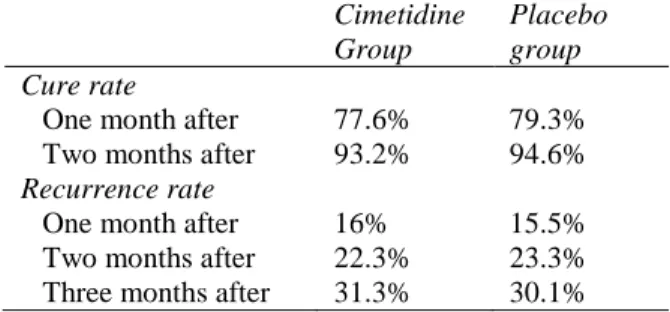
Results 81 subjects were recruited in this study. The mean cure rate obtained one month after treatment was 77.6% in cimetidine-treated group versus 79.3% in placebo-treated group, and the mean cure rate two month after treatment was 93.2% in cimetidine-treated group and 94.6% in placebo-treated group. The mean recurrence rate one month after treatment was 16% in cimetidine-treated group and 15.5% in placebo-cimetidine-treated group, the mean recurrence rate two month after treatment was 22.3% in cimetidine-treated group and 23.3% in placebo-treated group, the mean recurrence rate three month after treatment was 31.7% in cimetidine-treated group and 30.1% in placebo-treated group.
Conclusion This study showed that cimetidine is not more effective than placebo in treatment of warts.
Key words
Wart, cimetidine, cryotherapy, placebo.
Introduction
A wart is generally a small, rough growth, typically on a human’s hands or feet but often other locations, that can resemble a cauliflower or a solid blister. They are caused by a viral
infection, specifically by one of the many types of human papillomavirus.1 There are as many as
10 varieties of warts, the most common considered to be mostly harmless. It is possible to get warts from others; they are contagious and usually enter the body in an area of broken skin.2
They typically disappear after a few months but can last for years and can recur. A range of types of warts have been identified, varying in shape and site affected, as well as the type of human
papillomavirus involved. These include:
(verruca plana), filiform or digitate warts, genital warts (venereal warts, condyloma acuminatum, verruca acuminata), mosaic warts, plantar warts, periungual warts, plantar warts (verruca plantaris).
Warts are caused by the human papillomavirus (HPV). There are about 130 known types of human papilloma viruses.5 HPV infects the squamous epithelium, usually of the skin or genitals, but each HPV type is typically only able to infect a few specific areas on the body. Many HPV types can produce a benign growth, often called a "wart" or "papilloma", in the area they infect.
Wart treatments require patience. How well wart treatments work is another matter. Warts can appear and disappear without an identifiable cause and may disappear on their own without treatment. Some warts sprout offshoots near the main wart, and others don't.. Some hurt, and others are painless. There are many treatments and procedures associated with wart removal like: salicylic acid, placebo, podophyllin resin paint, benzoin, aloes, isopropyl alcohol, imiquimod, dinitrochlorobenzene, bleomycin, cantharidin, cryosurgery or cryotherapy, electrodesiccation, medication, cimetidine.
Methods
This randomized, double-blind clinical trial was conducted on subjects with warts between 2008 and 2009. Exclusion criteria of this study were Raynaud’s phenomenon, peripheral vascular disease, previous wart treatment and cold urticaria. Subjects were randomly allocated into two groups. In the first group, cimetidine was administered, 40 mg/kg daily for three months; also, their warts were frozen monthly for three months. In the second group placebo was administered and their warts were frozen
monthly for three month. Cryotherapy was performed by liquid nitrogen spray for 5-10 seconds for each lesion.
Recurrence and cure rates for each subject were recorded monthly and data were statically analyzed.
Results
Total number of 81 subjects were recruited in this study, 41 in the cimetidine group and 40 in the placebo group (Table 1). The mean age in cimetidine-treated group was 19.2 and in placebo-treated group was 21.3 (p=0.24). In total, 34 patients were females (41.9%), and 47 were males (58.1%). In cimetidine-treated group, 25 patients were males (60.9%) and 16 patients were females (29.1%) and in placebo-treated group 22 (55%) patients were males and 18 (45%) patients were females (p=0.38).
The mean number of warts in cimetidine-group was 20.8 and in placebo-treated group was 21 (p=0.94). The kinds of lesions in two groups were similar (p=0.83). The mean size of lesions in cimetidine-treated group was 8.1mm and in placebo-treated group was 10mm (p=0.17). The
Table 1 Demographic and clinical profile of two groups.
Parameter Cimetidine
Group (n=41)
Placebo Group (n=40)
Mean age (years) 19.2 21.3
Male 25 (60.9%) 22 (55%)
Female 16 (29.1%) 18 (45%)
Mean number of warts 20.8 21 Mean size of lesions 8.1mm 10mm Mean duration 12 months 9 months Site of lesions
Face 4 (9.8%) 5 (12.5%)
Neck 4 (9.7%) 3 (7.5%)
Face and neck 1 (2.4%) 2 (5%)
Hands 19 (46.3%) 14 (35%)
Feet 5 (12.2%) 7 (17.5%)
Table 2 Cure rate and relapse rate in the two treatment groups.
Cimetidine Group
Placebo group Cure rate
One month after 77.6% 79.3% Two months after 93.2% 94.6% Recurrence rate
One month after 16% 15.5%
Two months after 22.3% 23.3% Three months after 31.3% 30.1%
mean duration of lesions in cimetidine-treated group was 12 months, and in placebo-treated group was 9 months (p=0.18).
The mean cure rate obtained one month after treatment was 77.6% in cimetidine-treated group versus 79.3% in placebo-treated group (Table 2), (p=0.53). After 2 months it rose to 93.2% in cimetidine-treated group and 94.6% in placebo-treated group, (p= 0.61).
The mean recurrence rate one month after treatment was 16% in cimetidine-treated group and in placebo-treated group was 15.5%, (p=0.92). The mean recurrence rate two month after treatment was 22.3% in cimetidine-treated group and 23.3% in placebo-treated group (p=0.83). Mean recurrence rate three month after treatment was 31.7% in cimetidine-treated group and 30.1% in placebo-treated group (p=0.76).
Discussion
Various type of treatment are available for warts.3 Recently cimetidine has been shown to
be effective in treating warts but therapeutic results are controversial. Because of this controversy, we decided to compare the
therapeutic efficacy of cimetidine and
cryotherapy vs placebo and cryotherapy for treatment of warts.
Total number of 81 subjects were recruited in this study. Subjects were randomly allocated in two groups. In the first group cimetidine was administered, 40 mg/kg daily for three months, also, their warts were frozen monthly for three months. In the second group placebo was administered and their warts were frozen monthly for three month. Recurrence and cure rates for each subject were recorded and data were statically analyzed. The two groups were well-matched in terms of age, number of warts and size of lesions
The mean cure rate obtained one month after treatment was 77.6% in cimetidine-treated group and 79.3% in placebo-treated group and there was no any significant difference between two groups (p=0.53). The mean cure rate two month after treatment was 93.2% in cimetidine-treated group and 94.6% in placebo-treated group, and there was no any significant difference between two groups (p= 0.61).
The mean recurrence rate one month after treatment was 16% in cimetidine-treated group, and in placebo-treated group was 15.5%, and there was no any significant difference between two groups (p=0.92). The recurrence rate was similar after two months i.e. 22.3% in cimetidine-treated group and 23.3% in placebo-treated group (p=0.83).
The mean recurrence rate three month after treatment was 31.7% in cimetidine-treated group and 30.1% in placebo-treated group, and there was no any significant difference between two groups(p=0.76).
This study showed that cimetidine is not more effective than placebo in treatment of warts.
warts. In a retrospective assessment of 216 patients who were administered oral cimetidine therapy for verrucae plantaris, it was concluded that cimetidine is a safe, effective lone treatment modality for verrucae in all age groups.3
Similarly, Kharfi et al.5 assessed therapeutic
efficacy of cimetidine in warts in children and showed that the cure rate in cimetidine-treated group was 60% and in placebo-treated group was 33%. All the cases of this study were children and it was concluded that cimetidine in treatment of children warts is more effective than adults.
However, there are many studies which suggest that cimetidine lacks an active role in the treatment of warts. A randomized, placebo-controlled, double-blind study by Yilmaz et al.56
patients received cimetidine, 25 to 40 mg/kg daily, or placebo for 3 months. Patients were examined at monthly intervals.At the end of the therapy, cure rates obtained were 32% (9 of 28) in the cimetidine-treated group and 30.7% (8 of 26) in the placebo-treated group. No significant difference was found between cimetidine and placebo in effectiveness.5
In another study by Glass and Solmon,67 18 adult
patients were treated with oral cimetidine (30mg/kg) for three months, 84% of patients cured completely but in this study, there was no control group and also the number of patients was small. As some of the warts might have disappeared themselves, we cannot say that the cure rates in these patients is because of cimetidine.67
In a randomized, placebo-controlled, double-blind study of treating recalcitrant warts in adults with a 12 week course of cimetidine at 2400 mg/day (22-46 mg/kg daily) or placebo, the clearance rate of warts with cimetidine and
placebo was 26% and 5%, respectively (not significant; P=0.085).78
Another double-blind, placebo-controlled study compared 12 weeks of treatment with cimetidine at 400 mg 3 times per day versus placebo in patients over 12-years-old. Wart clearance for the cimetidine group was 27% and 22% for placebo, which was not a statistically significant difference. The study investigators proposed a placebo effect for cimetidine.8
In Tsuyoshi’s study,9 one group was treated with
15.3 mg/kg cimetidine and the other group was treated with 33.2 mg/kg cimetidine for four months. In group A, 26.9% were cured completely and 15.3% were cured partially. In group B, 41.3% were cured completely and 31% were cured partially. This study showed that high dose of cimetidine had effective role in treatment of warts but there was no control group and the period of treatment was long.9
In the study by Karabulut et al.10 one group was
treated with 15-30 mg/kg cimetidine and the other group was treated with placebo for three months. Results did not show any significant difference between two groups (p=0.21).
The majority of existing evidence supports our results that oral cimetidine has no significant therapeutic effect in the treatment of warts.
Conclusion
This study showed that cimetidine is not more effective than placebo in treatment of warts.
References
2. Lipke MM. An armamentarium of wart treatments. Clin Med Res. 2006;4:273-93. 3. Fit KE. Use of histamine2-antagonists for
the treatment of verruca vulgaris. Ann Pharmacother. 2007;41:1222-6.
4. Mullen BR, Guiliana JV, Nesheiwat F. Cimetidine as a first-line therapy for pedal verruca: eight-year retrospective analysis. J Am Podiatr Med Assoc. 2005;95:229-34.
5. Kharfi M, Chtourou O, Kamoun F et al. Cimetidine therapy for multiple warts in children. Tunis Med. 2002;80:214-6.
6. Yilmaz E, Alpsoy E, Basaran E. Cimetidine therapy for warts: a placebo-controlled, double-blind study. J Am Acad Dermatol. 1996;34:1005-7.
7. Glass AT, Solomon BA. Cimetidine therapy for recalcitrant warts in adults. Arch Dermatol. 1996;132:680-2.
8. Rogers CJ, Gibney MD, Siegfried EC, Harrison BR, Glaser DA. Cimetidine therapy for recalcitrant warts in adults: is it any better than placebo? J Am Acad Dermatol. 1999;41:123-7.
9. Tsuyoshi M, Kasumi T, Seiji, K. Cimetidine treatment for viral warts enhances IL-2 and IFN- expression but not IL-18 expression in lesional skin. Eur J Dermatol. 2003;13;445-8.