ISSN: 2147-611X
www.ijemst.com
How Do Learner-Directed Scientific
Investigations
Influence
Students’
Questioning and Their Nature of Science
Conceptions?
Banu Avsar Erumit1, Khadija E. Fouad2, Valarie L. Akerson3
1 Recep Tayyip Erdogan University 2
Appalachian State University 3 Indiana University
To cite this article:
Avsar Erumit, B., Fouad, K.E. & Akerson, V.L. (2019). How do learner-directed scientific
investigations influence students’ questioning and their nature of science conceptions?
International Journal of Education in Mathematics, Science and Technology (IJEMST),
7(1), 20-31. DOI:10.18404/ijemst.509246
This article may be used for research, teaching, and private study purposes.
Any substantial or systematic reproduction, redistribution, reselling, loan, sub-licensing,
systematic supply, or distribution in any form to anyone is expressly forbidden.
Authors alone are responsible for the contents of their articles. The journal owns the
copyright of the articles.
Volume 7, Number 1, 2019
DOI:10.18404/ijemst.509246
How Do Learner-Directed Scientific Investigations Influence Students’
Questioning and Their Nature of Science Conceptions?
Banu Avsar Erumit, Khadija E. Fouad & Valarie L. Akerson
Article Info
Abstract
Article History
Received:
10 September 2017
Action research was conducted in two sections of a scientific inquiry class in a Midwestern U.S. university to identify the types of questions that students ask for their investigations, identify emerging patterns regarding students’ questioning, and determine students’ ability to transfer their nature of science (NOS) understanding to a new scientific phenomenon. Participants included 28 non-science major freshmen and sophomores. Data sources included the Earthworm Activity Field Guide, the post-reflection sheet, The Views of Nature of Science Version B Questionnaire (VNOS-B), and audio recordings of small group discussions when students were creating and selecting questions for the first and the second investigations when they were in the field. Findings showed that students improved their ability to ask more investigable and more specific questions after conducting an investigation. Also, students asked fewer descriptive and more cause-and-effect or pattern-seeking questions after the first investigation. The results showed that students were able to apply their understandings of NOS aspects to a new concept. However, some aspects were addressed more than the others. Results suggest that giving students opportunities to ask their own questions following their own interests improves their ability to generate good investigable questions. The results also suggest that reflecting on NOS aspects during content-related inquiry activities enhances students’ NOS understandings.
Accepted: 28 June 2018
Keywords
Investigable questions Non-investigable questions
Typology of questions NOS
Introduction
The ability to ask scientific questions and defining engineering problems is one of the eight practices as emphasized by the Next Generation Science Standards (NGSS) (Practice 1, Appendix F, p. 1). This study aligns with the recommendations of the NGSS that emphasize the importance of providing students opportunities in to ask their own questions that lead to other science practices such as planning and carrying out investigations, analyzing data, and constructing explanations (NGSS Lead States, 2013).
Testable questions that can be answered by designing and carrying out investigations are needed to be able to successfully conduct investigations. If students do not start with an appropriate question, they will have difficulty during the rest of their investigation unless they modify their questions and restart their investigations. However, asking a new question and designing a new investigation can be a waste of time for students and teachers. Also, an investigable question is not always a “good” investigable question. In other words, if an investigable question is either too broad or lacks details, students are not able to take action on the question right away.
The purpose of this study was to determine whether or not students asked more investigable and more specific and detailed questions about earthworms after they were given opportunities to observe and investigate these creatures in an environmentally based science unit. We also looked for evidence that they connected Nature of Science (NOS) aspects to their scientific inquiry to see if they were able to transfer their NOS understanding to a new scientific phenomenon. The research questions with regards to the purposes of the study were:
1. What types of questions do students in an introductory inquiry course generate for their first and second earthworm-related investigations?
1.b What roles do their first investigations play in the process of generating questions for their second investigations?
2. What are the differences between students’ questions that they generated for their first investigations, for their second investigations, and for their future investigations?
3. How well are students able to identify and apply their NOS understanding in a new science context?
Literature Review
Scientific questions are important in guiding investigations and enabling students to experience inquiry. In addition to the ability to raise scientific questions, students also need to be able to target and identify aspects of nature of science (NOS). Additionally, the types of questions that students raise are important to consider. We will explore background in these areas in the sections below.
Importance of Integrating NOS into Scientific Inquiry Activities
Although scientific inquiry and nature of science are related, they are not the same. Scientific inquiry refers to the science processes including making observations, collecting and analyzing data, and constructing explanations. On the other hand, NOS is related to the epistemology of science (Lederman, 2007). Literature shows that integrating NOS into inquiry lessons is effective in developing students’ NOS views (Schwartz et al., 2004).
Although there is not one single definition of NOS, philosophers, historians, and science educators agree on common aspects of NOS. These aspects include: (1) scientific knowledge is tentative (subject to change in light of new evidence), (2) scientific knowledge is empirically based (comes from observations of natural world), (3) scientific knowledge is subjective (is theory-laden and influenced by personal experiences/biases, etc.), (4) scientific knowledge involves human inference, creativity, and imagination, (5) scientific knowledge is socially and culturally embedded (scientific knowledge is influenced from the cultures in which it is generated), (6) there is a distinction between observations and inferences (observations are based on five senses; however, inferences are not accessible to our five senses- inferences are explanations based on observations), (7) theories and laws are different types of scientific knowledge; one does not become another and there is no hierarchy between them (Lederman, 2007, p. 833-834). These aspects are still tentative, just like any other scientific knowledge. Perceptions of NOS might also change in light of new scientific knowledge or new explanations of existing knowledge (Lederman, 2007).
There are a variety of assessment tools that have been used to measure NOS understandings. Regardless of the assessment tools used, the results of NOS studies show that students’ and teachers’ NOS views are not generally at the adequate level (Lederman, 2007). Various approaches have been taken to help students develop their NOS views. These approaches include historical, implicit, and explicit and reflective. The historical approach uses history of science for enhancing students’ NOS views. The implicit approach employs inquiry- based hands-on science activities to enhance students’ NOS views without explicitly discussing NOS. The explicit and reflective approach aims to explicitly refer to NOS aspects and reflect on these aspects in science lessons. In the explicit and reflective approach, students are introduced to NOS aspects in science activities and they cognitively reflect on the NOS aspects that they have used/experienced (Khishfe & Abd-El-Khalick, 2002). In the explicit and reflective approach, NOS activities might be either integrated in science content (contextualized) or separate NOS activities might be used to teach NOS aspects before integrating them in science content (decontextualized) (Akerson et al., 2013, p.2).
In another study, Akerson, Abd-El-Khalick, and Lederman (2000) examined the effectiveness of the explicit and reflective approach in developing NOS views of pre-service elementary teachers enrolled in two sections of a science-methods course (one undergraduate, one graduate course). The post-instruction data analysis showed that the explicit and reflective approach was effective for enhancing students’ NOS views. Both undergraduate and graduate students held more informed views of tentative NOS, observation and inference, creative and imaginative NOS, and the difference and relationship between theories and laws. However, less improvement was seen for subjective (theory-laden) NOS and social and cultural NOS aspects. The study showed that some students still held naïve views of some aspects of NOS after completing the course. The study supports the idea that using a conceptual framework along with the explicit and reflective approach could help students to be conscious of their own views and gain more desired understandings of NOS. Because the explicit-reflective approach was shown to be an effective approach for developing students’ NOS views, we aimed to utilize this approach in our unit. We contextualized NOS in an inquiry unit to assess students’ ability to apply their NOS understanding in another context.
Students’ Questions in Science
Human beings are active learners and they start learning from their infancy. What they learn helps them make sense of their environments. However, much of their learning is informal, which is quite different than intentional or formal learning. Students begin school with prior conceptions about the natural world (Donovan & Bransford, 2005). Some of these ideas are non-scientific (Harlen, 2001). Although preconceptions might be a good foundation to grasp new knowledge, some of these prior conceptions (misconceptions) hinder learning (Donovan & Bransford, 2005) and influence students’ attitudes toward science (Harlen, 2001). School science should provide opportunities for students to test their ideas and revise or reject their prior non-scientific ideas (Harlen, 2001).
Students’ questions either reveal a gap in knowledge or a desire to enhance their existing knowledge. Students become conscious of their understanding when they ask questions (Chin & Osborne, 2008). Student questions not only enable them to understand their knowledge but also enable science teachers to recognize where their students stand on their understandings of scientific concepts being taught (Chin & Brown, 2002; Chin & Chia, 2002; Chin & Osborne, 2008).
Questions whose answers are unknown to the students and are practical to investigate are considered as investigable questions (Chin, 2002). In other words, investigable questions enable students to collect and analyze data and construct explanations. Scientists identify two major types of questions: “why” and “how” questions. Although many students ask “why” questions, these questions cannot be answered through scientific investigations (NRC, 2000) or should not be answered through scientific investigations (Harlen, 2001). “Why” questions often require information that can be answered through outside resources. An investigable question should be also appropriate in terms of availability of materials and time, and could be investigated now or in the near future (Institute of Inquiry, 2006).
Chin (2002) identifies non-investigable questions as: “(a) basic information, (b) complex information, and (c) philosophical or religious” questions. Basic information questions require very simple knowledge that might be found in outside resources. For example, “What is a mirror made of?” is considered a basic question as it can be answered through a textbook or Internet search. Complex questions require complex responses that cannot be answered through scientific investigations. “Why” questions are typically considered as complex information questions. For example, “Why are there rain and lightening, and what causes them?” is a complex question and it goes beyond students’ ability to investigate. Philosophical questions cannot be even answered with science. “Are there really ghosts on earth?” is an example of a philosophical question (Chin, 2002, p. 158).
used overhead transparencies as efficiently as possible?” is an example of a design-and-make question. Exploratory questions require exploring correlations between cause and effect. However, the variables in exploratory questions are not determined yet, unlike cause-and-effect questions. “What are some factors that affect the growth of plants?” is an example of an exploratory question (Chin, 2002, p. 158-160).
Descriptive questions require students to monitor an organism, event, or an item carefully and generate a description of that. Asking about the life cycle of an animal is a good example of a descriptive question. Pattern seeking questions require students to investigate a natural biological phenomenon that cannot be investigated through manipulating or controlling variables. “What is the relationship between the type of plants and where they are found in the forest?” is an example of this type of questioning. The category of problem-solving questions requires students to find a way to solve a problem. “Can you find a way…?” is an appropriate frame for this kind of question. Validation of mental models questions require students to test whether their mental models fit with evidence. “How can the transformation of energy be modeled using a series of concrete materials?” is an example from this category (Chin, 2002, p. 160-161).
The literature shows that students do not always ask investigable questions (Chin, 2002; Chin & Kayalvizhi, 2002). However, researchers have found evidence that with proper guidance with a focus on how to ask investigable questions, students are able to ask more investigable and less non-investigable questions. Schirripa and Steiner (1999) examined the role of instruction on 8th grade students’ questioning skills. The instruction included the definition and importance of investigable questions, and examples of such questions. The study showed that students who received instruction on asking investigable questions and were provided with examples were better able to ask such questions. The study of Chin and Kayalvizhi (2002) examined the types of student questions in a 6th grade science class, which were written individually and as a group after the students were shown examples of investigable questions. The results showed that students asked less non-investigable and more non-investigable questions after this treatment. Other instruction methods are effective in improving student questioning skills. Hofstein, Navon, Kipnis, and Mamlok‐Naaman (2004) showed the effectiveness of inquiry-based laboratory practices over traditional laboratory practices for improving 12th grade high school students’ questioning skills. The students in the inquiry laboratory group asked more high-level questions than students in the traditional-laboratory group. The study of Harris, Philips, and Penuel (2010) showed that classroom discourse patterns between teachers and students are effective for the development of students’ questions.
These studies demonstrate that there are teaching strategies that are effective in improving students’ questioning skills. However, none of these studies has focused on the effect of a field trip consisting of going outside and observing creatures in their natural setting on the quality of student questions. Considering this goal, this study primarily focused on how going outside and investigating the density of earthworms in their natural setting was effective in improving students’ subsequent questions about these creatures along with a discussion of emerging patterns regarding students’ questioning. Another focus was to examine how this affected students’ nature of science conceptions.
Methods
The study was conducted in two sections of a scientific inquiry class in a Midwestern university. The course provided preservice elementary teachers with a background in the science process skills needed to complete required science courses. The first author was the instructor of one of the sections, and the second author in another. The participants of the study included 28 non-science major freshmen and sophomores: 15 students from the first section and 13 students from the second section. Although there were about 40 students in both sections, only 28 consented to participate in the study. Out of 28 students, 27 students were white and one student was African-American. Age range of students was from 18-21, except for one female student who was in her 40s. Four students were male while the rest of the students were female. The two sections received all the same instruction but only differed in terms of instructor. Regardless of their decision for participation, all students from the both sections engaged in the same activities throughout the semester. However, students who declined to participate were excluded from the analysis.
discussions when students were creating and selecting questions for the first and the second investigation and when they were in the field.
The data were collected during two-weeks of an environmental inquiry unit which was created by the first author. The study was conducted near the end of the semester before students started to work on their final inquiry projects. Before the unit began, students participated in various scientific inquiry activities, which involved making observations, raising inquiry questions, collecting data, analyzing and interpreting data, and communicating the results. In a previous lesson adopted from the Institute for Inquiry (2006), students engaged in an activity that specifically focused on how to generate and refine questions for scientific investigations. In that particular lesson, students interacted with ice balls and some other materials to generate questions. The aim of the activity was to provide students an interesting phenomenon (ice balls) and have them generate questions on this phenomenon. After generating questions, they sorted their questions and selected one question to investigate. Reflecting on their experiences and examining prior questions enabled them to create criteria to identify investigable questions and non-investigable questions. Then, they engaged in a whole class discussion to finalize their thoughts on these two groups of questions.
After the discussions, students from both sections agreed that investigable questions lead them take action on their investigations while non-investigable questions were either requesting more information or requiring different kinds of materials to be able to investigate. From there, students developed criteria for investigable questions in light of instructors’ facilitation. The criteria included availability of materials, availability of time to investigate the question, questions being age appropriate and they lead one to take action. Also, instructors discussed that some question types such as “why” questions requested more information or explanation so that those questions did not lead to taking action for the investigations (Chin, 2002). Although the instructors did not discuss all types of investigable questions that are discussed in the literature, they still discussed typical phrases of investigable questions that can lead to action. Then, they discussed how students would turn their non- investigable questions into investigable questions using a method called “turning questions” using a “variable scan” (Institute for Inquiry, 2006).
Additionally, students were involved in NOS activities during the first two weeks of the course and discussed NOS aspects after each inquiry activity. So, the investigators expected students to know aspects of NOS and to be able to discuss them in the context of inquiry activities. Also, the investigators expected most students to be able to ask investigable questions and to perform scientific inquiry to answer such questions. Thus, our aim in this unit was not to teach them how to ask investigable questions and understand NOS aspects. Rather, we aimed to understand how these students’ questions developed (or not) in an environmentally based inquiry unit.
Before the unit, the participants were asked to fill out the VNOS-B. On the first day, the instructors gave general information about earthworms and their role in the environment. After the introduction, the participants were told to ask individual investigable questions on the density of earthworms. There was no limit to the number of questions they could generate. Then the participants were told to compile their questions with their group members. They were directed to choose a question that they would like to investigate as a group. Before they went outside, they were asked to plan out their investigation, which involved writing hypothesis, variables (if applicable), constant, etc. Then, they went outside and chose a spot to investigate their questions. They were asked to write down their observations about and sketch the area using the Smartphone applications Picture with Words or PicSay, which allowed them to take a photo of the area and write down their observations and findings on the picture. When they came back to the classroom, they were asked to analyze their data. They were told to use either “Excel” or a smartphone application “Graph” to graph their data. As homework, they were asked to read at least one resource on earthworms to use for writing up their investigation. When they came back on the second day, they were given a chance to discuss their findings from the first investigation.
Data Analysis
The questions written by the students from two sections were compiled and analyzed by the first and the second author separately. Coding categories for the initial analysis were adopted from Chin (2002) and Institute for Inquiry (2006). Based on this initial analysis, questions of the 1st day, 2nd day, and future investigations were sorted as non-investigable and investigable. After the initial analysis, the first author identified and developed two main categories for students’ investigable questions. These categories were (a) general (broad) and (b) specific (detailed). Although some questions met the criteria for being investigable questions, these questions were still broad and needed to be narrowed down in order to start the investigation.
Questions that were too broad and not time-, location-, or task-specific were categorized as general questions. Questions which were more detailed, ready for action, and time, location, or task specific were categorized as specific questions. In other words, specific questions enabled investigators to start the investigation without narrowing down the question. During the second round of the analysis, investigable questions were also labeled as general (broad) and specific (detailed). There was less than 5% difference between the first and the second authors’ analyses of the type of the questions. During the third round of the analysis, the typology of investigable questions were determined by the first and the second author. Types of investigable questions were categorized by using the typology created by Chin (2002) that included “(a) comparison (make-a-choice and classification), (b) cause-and-effect, (c) prediction, (d) design-and-make, (e) exploratory, (f) descriptive, (g) pattern-seeking, (h) problem-solving, and (i) validation of mental model” questions. Examples of student questions coded into categories we found are displayed in Table 3. Two investigators compared coding and discrepancies were resolved through discussion and consultation with the data. After discussion, 100% agreement was reached.
The rest of the post reflection questions were also analyzed and coded by the first author. After the analysis, common themes were determined for each question based on the students’ responses. Appendix B shows questions that we asked on the post-reflection. For example, question five asked if students modified their initial question for the second day, and then to explain their reasoning. First, the percentages were taken for yes and no responses. Then, common themes were identified for reasons why they did or did not change their questions (See appendix B for all questions).
The pre and post VNOS-B were also analyzed and coded by the first author. We did not interview a subset of the students about the questionnaire results as suggested by the VNOS developers. Instead, we asked an open-ended question on the post-reflection sheet that asked about students’ reflections of NOS aspects that were displayed in the unit. Students’ responses on that question were used to support VNOS-B results. That final question asked students to name the NOS aspects displayed in the unit. Numbers were assigned to each aspect to show how many students in total properly addressed each one.
Audio records of the groups’ brainstorming on possible investigation questions for the first and the second day investigation were analyzed. Any noticeable pattern was recorded. Also, students’ audio records from the first and the second field experiences were analyzed. Any pattern regarding questioning was recorded.
Results
Although the number of non-investigable questions decreased for the second and future investigations, there were still a few non-investigable questions. In the first section, out of a total of 28 questions for the first investigation 26 (93%) of these questions were investigable and 2 (7%) were non-investigable. In the second section, out of a total of 34 questions for the first investigation 26 (93%) were investigable and 2 (7%) were non-investigable. Although, the first and the second day results had similar trends in both sections, they differed for the future investigation questions. Although there were still two non-investigable questions in the first section (5%), all of the future investigation questions were investigable in the second section.
Table 1. Number and percentages of students’ investigable and non-investigable questions from the first, second and future investigations
Types of questions 1stsection (n=15) 2nd section (n=13) Day 1 Day 2 Future
investigation
Day 1 Day 2 Future
investigation No. of investigable
questions (%)
35 26 41 49 32 38
(80%) (93%) (95 %) (84%) (94%) (100 %)
No. of non-investigable questions (%)
9 2 2 9 2 0
(20%) (7%) (5 %) (16%) (6%) (0 %)
Total 44 28 43 58 34 38
The second step of the analysis was to look at the typology of the questions. The numbers and the percentages for the types of questions asked in the first and the second sections are shown in table 2. In both sections, comparison, descriptive, and cause-and-effect were commonly asked among investigable questions. Although pattern-seeking questions are also asked commonly in the first section, this type of question is less common in the second section.
Table 2. Number and percentages of different types of investigable questions for the 1st, 2nd, and future investigations
Note: Students in the first and the second sections did not use design-and-make, problem solving, and validation of mental model questions.
Additionally, prediction and exploratory questions were never used in the first section. Although not commonly used, these two types still appeared in the students’ questions in the second section. None of the students in sections 1 or 2 asked design-and-make, problem solving, or validation of mental model questions. In both sections, descriptive questions were asked more often on the first investigation as compared to the second and future investigation questions. For section 2, descriptive questions were the most common type of questions on the first day (67%). In the same section, the percentages of descriptive questions gradually decreased from the first investigation through the end. In contrast, in both sections, the number of cause-and- effect questions gradually increased from the beginning through the end of the unit. For the other types of questions, there was not any noticeable difference among the three days. Examples of the types of questions asked in the first and the second sections and post reflection (future investigation) are shown in table 3.
Typology of investigable questions
1st section (n=15) No. of questions (%)
2nd section (n=13) No. of questions (%)
Day 1 Day 2 Future
investigation
Day 1 Day 2 Future
investigation
Descriptive 9 (26%) 3 (7%) 33 (67%) 15 (47%) 15 (39%)
Comparison 12 (34%) 6 (23%) 9 (22%) 6 (12%) 10 (31%) 11 (29%)
Cause-and-effect
5 (14%) 9 (35%) 22 (54%) 4 (8%) 3 (9%) 9 (24%)
Pattern-seeking
9 (26%) 11 (42%) 7 (17%) 3 (6%) 1 (3%) 1 (3%)
Prediction 2 (6%) 1 (3%)
Table 3. Examples of different types of investigable and non-investigable questions
Examples of Questions
Types of Questions Non-investigable
questions
Investigable questions Why are there more earthworms in this place? Complex information
How does the amount of grass affect the density of earthworms?
Cause-and-effect Does the number of earthworms seem to correlate with the
amount of plant life in the area investigated?
Pattern seeking
What is found in the soil other than earthworms? Descriptive
Does there need to be a certain amount of soil for the worm to live healthy in?
Exploratory Is the density of earthworms greater near water or away from
water?
Comparison Does the density of earthworms change if you go deeper into
the soil?
Prediction
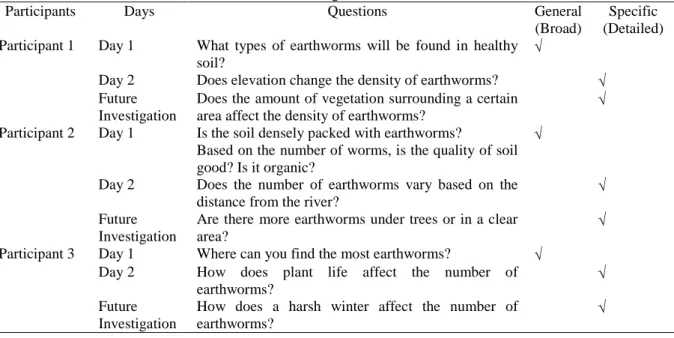
The next step of the analysis was to determine whether the investigable questions were general or specific. The number of general and specific questions asked by students is shown in table 4. In both sections, the percentages of general questions decreased from the first investigation through the end, while the number of specific questions increased. Examples of general and specific questions are shown in table 5. Questions asked on the first day were broader as compared to questions on the second and the third days. Students started to ask more time-, location-, and task-specific questions for the second investigations. There was not much difference between the questions asked for the second investigation and possible future investigation.
Table 4. Number and percentages of students’ general (broad) and specific (detailed) questions for the first, second, and future investigations
Types of investigable questions
1st section (n=15) 2nd section (n=13) Day 1 Day 2 Future
investigation
Day 1 Day 2 Future
investigation No. of general
questions
13 4 3 32 10 11
(37%) (15%) (7 %) (65%) (31%) (29%)
No. of specific questions
22 22 38 17 22 27
(63%) (85%) (93%) (35%) (69%) (71%)
Total 35 26 41 49 32 38
The next step of the analysis was to look at the students’ answers to the post-reflection questions and VNOS-B results. On the post reflection sheet (see Appendix B), 12 students (80% of the whole class) from the first section and 11 students (85% of the whole class) from the second section reported that the first investigation influenced their way of thinking about designing another investigation on the same topic (See question 4 on the post reflection). Four students from the first section and 4 students from the second section reported that their initial question was either too broad, or non-realistic, or lacked detail and therefore they needed to modify their questions for the second investigation. “Getting familiar with the area or finding reasonable places to dig” and “having experience digging a hole and collecting earthworms, knowing what to do for the second time” were other common explanations for how the first investigation affected the way of their thinking for the second design.
Table 5. Examples of students’ general (broad) and specific (detailed) questions for the first, second, and future investigations
Participants Days Questions General
(Broad)
Specific (Detailed) Participant 1 Day 1 What types of earthworms will be found in healthy
soil?
Day 2 Does elevation change the density of earthworms? Future
Investigation
Does the amount of vegetation surrounding a certain area affect the density of earthworms?
Participant 2 Day 1 Is the soil densely packed with earthworms?
Based on the number of worms, is the quality of soil good? Is it organic?
Day 2 Does the number of earthworms vary based on the distance from the river?
Future Investigation
Are there more earthworms under trees or in a clear area?
Participant 3 Day 1 Where can you find the most earthworms? Day 2 How does plant life affect the number of
earthworms?
Future Investigation
How does a harsh winter affect the number of earthworms?
Audio records showed some patterns about how students generated their initial questions and modified their questions for the second investigation. The following conversation shows how a group was brainstorming on a possible question for the first investigation. They did not specify what location to dig. They just referred to “certain areas.”
Student 1: We can just keep it as our question and we can actually figure out is earthworm denser in certain areas?
Student 2: Yeah, it makes sense. I do not know.
The example below shows why one group from the first section changed their initial question. This conversation took place when students were brainstorming for their second investigation.
Instructor: Did you decide your question?
Student 1: Yes. We want to say, does the number of earthworms vary depending on the distance from the river?
Instructor: So, you changed your initial question.
Student 1: Yes, our first one was real bad. It was; “Based on the amount of earthworms was soil quality good?” This is what we did not tell because we did not find enough.
Student 2: That is not the total indicator. There is healthy soil but there are no earthworms according to the article I have read.
The above excerpt shows that this group was not able to answer their initial question because it was too broad. “Based on the amount of earthworms was soil quality good?” was a broad question and it was not possible to answer it by just finding out the density of earthworms. Students’ conversation in the field also showed they were still brainstorming the question. One group in the first section was trying to decide a location to dig. They were also having a conversation on what an earthworm looks like.
Student 1: Where would you like to go? Closer to the tree? Oh, there is a little guy. Student 2: It is really small. Is this a worm?
Student 3: I think so. It looks like one in the pictures.
Student 1: So, did we find eight?
Student 2: So, three spots, and how many?
Student 1: Three spots, we found eight. Five here, three on the other spot, and no earthworms on the first spot. We can make generalizations based on the number of earthworms we found, but it is not proven yet. We should think about what kind of question we will ask for Wednesday though.
Because the unit was covered near the end of the semester and we were discussing NOS aspects within each unit throughout the semester, pre-unit and post-unit VNOS-B results did not differ much in terms of the number of naïve and informed aspects. Nevertheless, students were still able to reflect their experiences from the unit into their post-unit VNOS-B answers. For example, some students indicated on the post-VNOS-B that scientists use creativity when they generate or modify their investigation questions in response to the question five of the questionnaire. One female student from the first section, for example answered; “Yes, they are also creative in the sense that they have to come up with questions that would be appropriate for the investigation that could potentially lead to new ideas.” Another female student from the second section answered; “Yes. Scientists use creativity to modify their questions. An example of this is found in our earthworm project. We modified our question after our first field study.”
The final question on the post reflection asked which aspects of the nature of science (NOS) the students displayed in this activity and how these aspects were used. The responses on that question were a better indicator to show how students held informed NOS views such that they could successfully interpret the post-reflection prompts. Observation and inference (87%), creativity and imagination (67%), and empirical evidence (47%) were the most commonly discussed NOS aspects in the first section. Observation and inference (46%), creativity and imagination (69%), and that no universal scientific method exists (46%) were the most commonly discussed NOS aspects in the second section. The aspects of observation and inference, creativity, empirical evidence, imagination, and no universal scientific method were the most cited aspects in both sections as compared to the NOS aspects of tentativeness of science, objectivity and subjectivity, and distinctions between hypotheses, theories and laws, which were cited less often.
Students not only named the aspects displayed in the unit in their responses to the final question on the post reflection sheet, they also explained how they thought these aspects were displayed in the unit. For example, one female student from the first section named creativity and imaginative, tentativeness of science, observation and inference as aspects displayed in the unit. Then she explained that they used creativity as a group when they were trying to come up with an investigable question for their investigation, experienced tentativeness when they were not sure if their questions were going to be investigable and used observation and inference about the surroundings that they were investigating.
Another female student from the first section named creativity, observation and inference and empirical evidence as aspects that she found out displayed in the unit. She said that they as a group observed the ground to see if there were earthworms in different locations and then inferred which areas had greater numbers, used creativity to come up with an investigable question, and collected empirical evidence when they noted the amount of earthworms in each area. One male student from the second section named empirical evidence and observation and inference aspects. He said that they as a group observed two different soils and inferred why there was a difference in earthworm species of these soils, and collected empirical evidence when they collected data about the total number earthworm species.
Discussion and Future Implications
In this paper we described a study in which we provided students with opportunities to generate and improve their questions as a result of designing and carrying out environmentally based inquiry investigations. Findings showed that students improved their ability to ask more investigable questions after conducting an investigation. As shown in Table 1 the number of students’ investigable questions gradually increased while the number of their non-investigable questions gradually decreased from the beginning to the end of the unit. Although we expected almost all students to ask investigable questions for the first investigation, some students still had non-investigable questions. Having limited experience for asking a question and designing an investigation might be the reason students initially posed non-investigable questions.
students engaged in various inquiry activities before this unit, they did not engage in any activities specifically designed for soil quality. Another reason might be related to being unfamiliar with the location. Although students had been in that location for other investigations, they did not dig the soil prior to this unit. For example, one student asked, “Where can you find the most earthworms?” while they were generating questions for the first investigation. This question did not specify the location they were going to dig. Similarly, another student asked, “Is the density of earthworms different based on the location investigated?” This student used the term “location” without specifying it (See Table 5 for other general question examples). Although students tended to ask general questions before they carried out the first investigation, their questions became more specific (detailed) for the second and possible future investigations. For example, the student who asked, “Is the density of earthworms different based on the location investigated?” asked more specific questions after the first day. For example, “Does the distance from the river affect the density of earthworms?” is one question that she asked for possible future investigation. In this question, the student specified the location where she would work.
Typology of students’ questions also revealed interesting results. Students had a tendency to ask fewer descriptive questions and more cause-and-effect or pattern-seeking questions after the first investigation. The results show that students should become more familiar with the different variables to be able to ask these kinds of questions. Although results of the two sections were mostly similar, there were small differences in the types of students’ questions. Although prediction and exploratory types of questions were not used in the first section, a few students in the second section used these types of questions. Also, cause-and-effect and pattern seeking questions were used more often in the first section than the second section. The purpose of this study was not to compare the two sections. We collected data from two sections to have a larger sample. Nonetheless, the different results suggest how different contexts (students and instructors) influenced students’ questions. The results showed that students were able to apply their understanding of NOS aspects to a new concept. However, some aspects were addressed more than the others. Only a few students in each section addressed the aspects of tentativeness of science and the distinction between hypothesis and theories. While only two students from the first section addressed the objectivity and subjectivity aspect, none of the students from the second section addressed this aspect. This finding is consistent with the findings of Akerson, Abd-El-Khalick, and Lederman (2000) and Akerson, Nargund- Joshi, Weiland, Pongsanon, and Avsar (2013).
Akerson et al. (2000) used an explicit-reflective approach in a science methods course to enhance graduate and undergraduate pre-service elementary teachers’ NOS understandings. At the end of the course, both undergraduate and graduate students held more informed views of tentative, observation and inference, creative and imaginative, and theories and law NOS aspects. However, less improvement was seen for subjective (theory-laden) and social and cultural NOS aspects. Akerson et al. (2013) also found out that students were able to grasp concrete aspects of NOS first and abstract aspects of NOS later. Abstract aspects of NOS included tentativeness, of science, creativity, and subjectivity (Akerson et al., 2013). Although tentativeness and subjectivity aspects were less often addressed, the creativity aspect was addressed by most students (67% from the first section, 75% from the second section) in our study. Students’ adequate understanding of the creativity aspect might be attributed to previous course content. We incorporated NOS discussions into each science investigation. Students were asked to discuss NOS aspects displayed in the earthworm unit that were similar to the previous units.
The findings from our study contribute to the field of teaching and learning science in three ways. First, we assert that giving students opportunities to observe creatures in natural habitats, as well as prompting them to ask their own questions following their own interests and modifying these questions as needed, improves their ability to generate good investigable questions. We recommend that teachers should introduce students to interesting scientific phenomena that stimulate a variety of questions (Institute of Inquiry, 2006). Second, integrating NOS into a scientific inquiry context improves students’ ability to connect NOS aspects to real science activities. Khishfe and Abd-El- Khalick (2002) suggest implementing NOS aspects into content-related inquiry activities to enhance the effectiveness of the explicit and reflective approach for teaching NOS.
References
Abd-El-Khalick, F., Bell, R. L., & Lederman, N. G. (1998). The nature of science and instructional practice: Making the unnatural natural. Science Education, 82(4), 417-436.
Akerson, V., Nargund-Joshi, V., Weiland, I., Pongsanon, K., & Avsar, B. (2014). What third- grade students of differing ability levels learn about nature of science after a year of instruction. International Journal of Science Education, 36(2), 244-276.
Chin, C. (2002). Open investigations in science: Posing problems and asking investigable questions. Teaching & Learning, 23(2), 155-166.
Chin, C., & Brown, D. E. (2002). Student-generated questions: A meaningful aspect of learning in science. International Journal of Science Education, 24(5), 521-549.
Chin, C., & Kayalvizhi, G. (2002). Posing problems for open investigations: What questions do pupils ask?. Research in Science & Technological Education, 20(2), 269-287.
Chin, C., & Chia, L. G. (2004). Problem‐based learning: Using students' questions to drive knowledge construction. Science Education, 88(5), 707-727.
Cuccio‐Schirripa, S., & Steiner, H. E. (2000). Enhancement and analysis of science question level for middle school students. Journal of Research in Science Teaching, 37(2), 210- 224.
Donovan, M. & Bransford, J. (2005, Eds.), How Students Learn: History, Mathematics, and Science in the Classroom. Washington, D.C.: National Academy Press.
Harlen, W. (2001). Primary Science: Taking the Plunge. How To Teach Science More Effectively for Ages 5 to 12. Heinemann, 361 Hanover Street, Portsmouth, NH 03801-3912.
Harris, C. J., Phillips, R. S., & Penuel, W. R. (2010, June). Eliciting and developing students' ideas and questions in a learner-centered environmental biology unit. In Proceedings of the 9th International Conference of the Learning Sciences-Volume 1 (pp. 261-268). International Society of the Learning Sciences.
Hofstein, A., Navon, O., Kipnis, M., & Mamlok‐Naaman, R. (2005). Developing students' ability to ask more and better questions resulting from inquiry‐type chemistry laboratories. Journal of research in science teaching, 42(7), 791-806.
Institute for Inquiry. (2006). Fundamentals of inquiry facilitators guide: Workshop 3: Comparing approaches to hands-on science. Exploratorium: San Fransciso, CA
Khishfe, R., & Abd-El-Khalick, F. (2002). Influence of explicit and reflective versus implicit inquiry-oriented instruction on sixth-graders’ views of nature of science. Journal of Research in Science Teaching, 39, 551-578.
Lederman, N.G., & O’Malley, M. (1990). Students’ perceptions of tentativeness in science: Development, use, and sources of change. Science Education, 74, 225–239.
Lederman, N. G., Abd‐El‐Khalick, F., Bell, R. L., & Schwartz, R. S. (2002). Views of nature of science questionnaire: Toward valid and meaningful assessment of learners' conceptions of nature of science. Journal of research in science teaching, 39(6), 497- 521.
Minner, D., Levy, A. J., & Century, J. (2010). Inquiry-based science instruction - what is it and does it matter? Results from a research synthesis years 1984 to 2002. Journal of Research in Science Teaching, 47(4), 474-496.
National Research Council. (2000). Inquiry and the National Science Education Standards. Washington, DC. The National Academies Press.
NGSS, Lead States (2013). Next generation science standards: For states, by states (Vol. 1 and 2). Washington, DC: The National Academies Press.
Notion, Inc. (Mar 31, 2010) popplet lite (1.5.1) [Mobile Application Software]. retrieved from http://itunes.apple.com/us/app/popplet-lite/id364738549?mt=8; http://popplet.com/app/#/492530
VVI. (Aug 03,2010). Graph. (10.8.3) [Mobile application software]. Retrieved from http://itunes.apple.com/us/app/graph/id381953671?mt=8
Schwartz, R. S., Lederman, N. G., & Crawford, B. A. (2004). Developing views of nature of science in an authentic context: An explicit approach to bridging the gap between nature of science and scientific inquiry. Science education, 88(4), 610-645.
Author Information
Banu Avşar ErümitRecep Tayyip Erdoğan University, Rize/TURKEY
Yenipazar Mah. 53200 Çayeli/Rize
Contact e-mail: [email protected]
Khadija E. Fouad Appalachian State University
572 Rivers Street, Boone, NC, USA 28608
Valarie L. Akerson
Indiana University, Bloomington