ISSN: 2147-611X
www.ijemst.com
Determination
of
Conceptual
Understanding Levels Related to Optics
Concepts: The Case of Opticianry
Erdogan Ozdemir1, Mustafa Coramik2, Handan Urek2
1
Istanbul Okan University
2Balikesir University
To cite this article:
Ozdemir, E., Coramik, M., & Urek, H. (2020). Determination of conceptual understanding
levels related to optics concepts: The case of opticianry.
International Journal of Education
in Mathematics, Science and Technology (IJEMST), 8
(1), 53-64.
This article may be used for research, teaching, and private study purposes.
Any substantial or systematic reproduction, redistribution, reselling, loan, sub-licensing,
systematic supply, or distribution in any form to anyone is expressly forbidden.
Authors alone are responsible for the contents of their articles. The journal owns the
copyright of the articles.
Volume 8, Number 1, 2020
Determination of Conceptual Understanding Levels Related to Optics
Concepts: The Case of Opticianry
Erdogan Ozdemir, Mustafa Coramik, Handan Urek
Article Info
Abstract
Article History
Received: 21 May 2019
Physics is directly related to various professions since it is a fundamental science. Opticianry is one of such physics related professions. In this study, it was aimed to determine the conceptual understanding levels of opticians related to the concepts of light and optics which are directly related to their professions. In the study, which was conducted via mixed method, the participants were determined with the convenient sampling method. A total of 203 opticians attended the study. Data were collected with the help of Light and Optics Conceptual Evaluation Test in addition to the Open-Ended Questions and Concept Cartoons selected from the literature. As a result of the study, it was reached that the conceptual understanding levels of opticians were low with several misconceptions and insufficiencies related to the light and optics concepts. In the light of the findings, the importance of physics education for opticianry was implied.
Accepted: 04 November 2019
Keywords
Light Optics Image
Introduction
Students have difficulty in learning science courses (Johnstone, 1991). One of the reasons of students’ low level of achievement in science course when compared to the other courses is the fact that it involves a number of abstract concepts and the students experience difficulty while learning these concepts (Duit & Rhöneck, 1997). Therefore, various science education studies focus on students’ concept learning (Ausubel, 1968; Novak, 1993; Novak & Gowin, 1984; Strauss, 1981). Another reason of students’ low level of achievement in science course is students’ possession of misconceptions instead of scientific concepts (Halim et al., 2018; Tanner et al., 2018). Misconceptions are incorrect conceptions which are accepted correct by the learner and utilized as the source of several abilities’ performance (Gilbert, 1977; Gilbert, Osborne & Fensham, 1982; Palmer, 1999). Incorrect knowledge possessed by the students might induce the formation of misconceptions (Hewson & Hewson, 1983; Palmer, 1999; Skelly & Hall, 1993). Numerous researches have been carried out in terms of physics teaching in the literature beginning from 1980s in which the first misconception study appeared. With these researches, misconceptions of the students and the effects of several teaching strategies, methods and techniques on those misconceptions have been investigated (Akpınar & Çite, 2015; Brown, 1992; Çökelez & Yaşar, 2015; Istanda et al., 2012; Mann & Treagust, 2010; Rankhumise & Imenda, 2014). A particular section of misconception studies in physics teaching is comprised of the subjects related to the light and optics (Anderson & Smith, 1986; Goldberg & McDermott, 1987; Epik, Kalem, Kavcar & Çallıca, 2002; Şen, 2003; Blizak et al. 2009; Galili & Hazan 2000; Ahçı, 2012; Uzoğlu et al., 2013; Djanette & Fouad, 2014; Thapa & Lakshminarayanan, 2013; Taşlıdere & Eryılmaz, 2015). Various misconceptions determined in those studies are explained below.
makes the objects darker; light rays do not spread in the space; the sun is not enough to enlighten the space. In addition, the students expressed that the image on plane mirror formed inside the mirror or on the mirror. Anderson and Smith (1986) researched the conceptual understandings of the students about light and vision. A total of 227 fifth grade level students were involved in the study. As a result, it was found that students perceived the color of an object as a characteristic possessed by the object; they could not construct the relationship between the color of the object and the light rays reflected from the object. In the study, it was highlighted that students mostly held the opinion that during image formation, light made an area brighter, thus it could be seen. The students who had this opinion thought that light rays did not move. Instead light rays formed image by brightening. In the study, the students were asked the following question: “How can the image of a tree be seen in a sunny day?” The featured student responses were as follows: “Incident light rays on the tree are enough for image formation”. “The light rays travelling from the eye to the tree make the image”. Also, the students thought that light rays which came to the normal line of a reflective plane and a wooden plane with the same angle were reflected with different angles from those planes.
Blizak et al. (2009) conducted a research with the attendance of a total of 246 high school students. In this study, misconceptions of the students related to the concepts of optics were determined. In the study, it was reported that the students thought the image of an object formed with the help of the light rays travelling from the eye to the object. Besides, the students failed to explain the relationship between the eye and observed object during image formation. Additionally, they thought that it was enough to keep an object under light to get the image of the object. In the study, it was also found that the students thought light rays could not spread in space. Moreover, the students expressed that all of light emission of a point size light source was blocked by a ball placed in front of the light source; a screen positioned in that experiment set up (a screen, a ball and light source) was totally seen black. For the same experiment set up, the students thought that the screen would be totally bright when a wider light source was used. In the same study, it was also reached that the students thought the image of an object on a plane mirror would form on the surface of the mirror. Galili and Hazan (2006) made a study with the attendance of 166 high school students. In this study, the students explained the image formation of an object without making any physical connections between the eye and the object observed. For instance, looking at the object carefully by focusing on it was sufficient for the students in order to see that object. Also, lightening of eye or lightening of the object observed was enough for image formation. Besides, the students thought that light rays spread only in one direction in every part of the light source just like it spread from one point in the center of a spherical light source. When the students made the drawing of light rays travelling to a convex lens emitted from a source, they only drew the part of the light rays which reached the lens. Furthermore, the students supposed that half of the image disappeared when half of the convex lens was covered with black tape.
making a drawing related to shadow formation. Additionally, the students were found to draw all light rays as if they were emitted from a point located in the center of spherical light source.
In another study conducted with 252 university students, the students were determined to hold various misconceptions about the subjects of light and optics (Ahçı, 2012). The students were determined to have misconceptions related to the motion of light rays in different refractive index environments and they thought light rays could move on the normal line after being refracted. Also, it was reached that the students had difficulty in determining the size and the place of the image in concave and convex lenses. Several students thought that image could be inverse or larger than the object in concave lens; the image of an object could be inverse or smaller than the object when it was located at a point between the focal point and lens in a convex lens. Also, the study indicated that the students thought that an object placed beyond the twice the focal length of a convex lens would give a straight image or an image larger than the object; an object placed between the twice the focal length and focal point of a convex lens would give a straight image or an image smaller than the object. Several students stated that half of the image would disappear when half of the lens was covered by an object or they indicated that the image would totally disappear when the center of the lens was covered.
Physics is one of the fundamental sciences. Therefore, it is related to various professions. Opticianry is one of such physics related professions. Opticians prepare and apply optics instruments (spectacles, contact lenses etc.) for the patients according to the doctors’ prescription (Özdemir & Yarar, 2016). Opticians generally prepare spectacle for the patients. Spectacles are tools made of a pair of lenses fitted in a frame which improve the vision of a patient or they protect the eyes from the harmful effects of sun light (Özdemir & Kabak, 2018). The spectacles can be used as the tools to support the sight of patients who have the refractive errors such as myopia, astigmatism, hypermetropia or presbyopia.
Additionally, some special spectacles can be utilized for poor vision, vision lose and strabismus (Mccleary, 2009). Therefore, opticianry is a profession that is directly related to optical lenses. Spectacles have physical properties that eliminate the negative effects of diseases related to refractive errors, strabismus and vision loss. The features of the spectacle lenses have been improved with various applications to the lenses. For instance, scratches resistance and hydrophobic property of the lenses are increased and light reflections are decreased by coatings on the lens surface (Essilor, 1997; Özmumcu, 2011). In addition, spectacle lenses are given the ability to block ultraviolet rays (Irie, 2000) and polarizing filter feature (Büyükyıldız, 2012; Chevallier et al., 2011; Chen et al., 2016). Since the profession of opticianry is directly related to the physics, opticians are required to have a comprehensive knowledge of the concepts related to the light and optics in order to perform their profession in a way to keep the eye health of the society.
The literature indicates various problems related to the understanding of optics concepts by all age group students. Hence, the present study aims to approach this issue from a different perspective, namely from the perspective of opticians. This paper focuses on the conceptual understandings of the opticians related to light and optics concepts. The research questions are as follows:
i) What are the conceptual understanding levels of opticians about the concepts related to the optics? ii) What are the widespread misconceptions of opticians about the concepts related to the optics?
The study is expected to contribute to the literature by presenting opticians’ knowledge level because examination of their understandings is believed to be important as they take place in the application part of this field.
Method
In the present study, the conceptual understanding levels and misconceptions of opticians about Light and Optics were researched. A mixed method which was carried out by using the qualitative and quantitative data collection instruments together was utilized in the study. The qualitative part of the study is more dominant than the quantitative part. Hence, the study is also in qualitative dominant status. Details of the participants, data collection instruments and data analysis were explained below.
Participants
The sample of the study was comprised of 203 opticians working at various optical stores located in a metropolis in the west part of Turkey. The sample of the study was determined via convenient sampling method (Teddlie & Yu, 2007). It was considered that the sample could be easily accessed by the participants during the study. The participants had a diploma proving their two-year degree. All of the participants took Fundamental Physics and Optic Physics courses during their university education period. 36% of the participants were females whereas 64% of them were males. Working period of the participants as opticians were determined as 1-4 years for 42% of them; 5-9 years for 19% of them; 10-14 years for 12% of them; 15 years and above for 27% of them. Also, 64% of the participants were aged 20-29 years whereas 26% of them were aged 30-39 years and 10% of them were aged 40 and above.
Data Collection Instruments
Qualitative Data Collection Instrument: Open Ended Questions (Light and Image Formation) and Concept Cartoons
Seven open ended questions and two concept cartoons related to light and image formation constituted the qualitative data collection instrument of the study. Five of the open-ended questions in this instrument were taken from the literature. The adaptation studies of those questions to Turkish language were carried out by Uzoğlu et al. (2013). Those questions were related to the subjects of light and image formation (questions 1, 7, 8, 9) and light and lighting (question 4). The rest of the open-ended questions (two open ended questions) were developed by Anderson and Smith (1986). Those questions were related to the subjects of reflection of light (questions 6) and light and image formation (question 3). Besides, two concept cartoons were also utilized in the qualitative data collection instrument. One of those concept cartoons (question 2) was developed by Keogh and Naylor (2004). Its adaptation study was also carried out by Uzoğlu et al. (2013). The other concept cartoon (question 5) was organized in the form of a concept cartoon by the researchers from a two-tier diagnostic multiple-choice test question (Anderson & Smith, 1986).
The questions in the qualitative data collection instrument were examined by two experts in physics education area. Several necessary changes were made on the questions in the light of the experts’ opinions. Also, 20 opticians’ opinions were asked in order to check the intelligibility of the questions. Data obtained from the open-ended questions and concept cartoons were examined by one of the researchers and categorized. The categories constructed for each question were presented with respect to their frequencies. The reliability of the data analysis was calculated by examining the inter-rater consistency obtained from the analysis of the data by the other two researchers. As a result, the inter-rater consistency was calculated to be 72%. The results of the analysis were presented in the form of tables.
Quantitative Data Collection Instrument: Light and Optics Conceptual Evaluation Test
Light and Optics Conceptual Evaluation Test developed by Sokoloff (2006) was utilized as the quantitative data collection instrument in the study. The test was developed in terms of a project - Learning in Optics and Photonics which aimed to improve the quality of optics teaching in developing countries (Sokoloff, 2006). A total of 51 questions took place in the test. Fifty of the questions were in the form of multiple test questions whereas one of them was related to image drawing. The questions in the test were related to image formation, reflection, refraction, lenses, polarization, diffraction, interference and shadow formation. The adaptation studies of the test to Turkish language were carried out by Ahçı (2012). In this adaptation study, the Cronbach Alpha value was found to be .630. The difficulty index of the questions in the test varied between .14 - .77. Only four of the questions in the test were determined to have a difficulty level .50 and above whereas the rest of the questions’ difficulty index stayed below .50. The questions in Light and Optics Conceptual Evaluation Test were categorized according to the subjects. The percentages of average correct were presented in the form of a table.
Findings
Analyses of the data obtained from the qualitative and quantitative data collection are presented separately and the findings are interpreted below.
Findings Obtained from Qualitative Data Collection Instrument
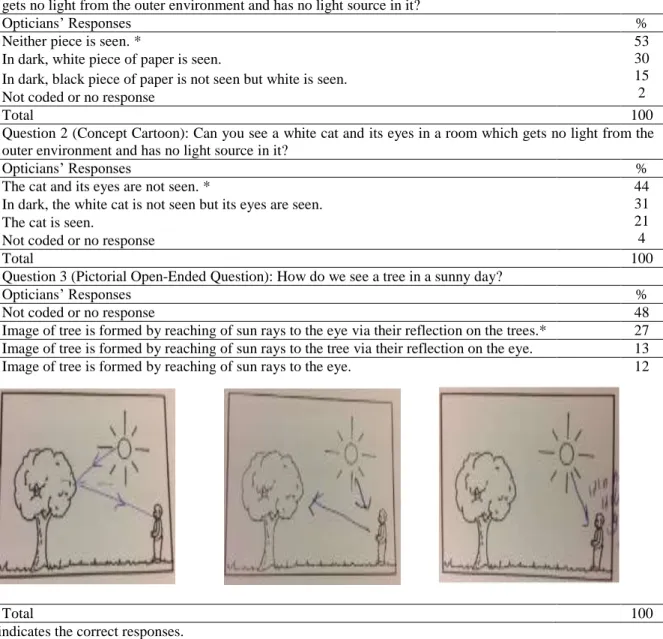
Table 1. Findings related to the image concept
Question 1 (Pictorial Open-Ended Question): Can we see a piece of white and black paper in a room which gets no light from the outer environment and has no light source in it?
Opticians’ Responses %
Neither piece is seen. * 53
30 15 2 In dark, white piece of paper is seen.
In dark, black piece of paper is not seen but white is seen. Not coded or no response
Total 100
Question 2 (Concept Cartoon): Can you see a white cat and its eyes in a room which gets no light from the outer environment and has no light source in it?
Opticians’ Responses %
The cat and its eyes are not seen. * 44
31 21 4 In dark, the white cat is not seen but its eyes are seen.
The cat is seen.
Not coded or no response
Total 100
Question 3 (Pictorial Open-Ended Question): How do we see a tree in a sunny day?
Opticians’ Responses %
Not coded or no response 48
Image of tree is formed by reaching of sun rays to the eye via their reflection on the trees.* 27 Image of tree is formed by reaching of sun rays to the tree via their reflection on the eye. 13
Image of tree is formed by reaching of sun rays to the eye. 12
Total 100
*indicates the correct responses.
Table 2 demonstrates the percentage distribution of the opticians’ responses to the open-ended questions and concept cartoon related to the light concept. Table 2 signifies that question 4 is responded correctly or partially correctly by very few opticians who attend the study. From the responses, it is figured out that various opticians hold the following misconceptions and deficiencies related to the concept of light: (i) Light rays reach more distant points as the surface of light source becomes smaller. (ii) Light rays reach more distant points as the surface of light source becomes larger. Besides, question 5 is responded correctly by less than half of the participants. Responses obtained demonstrate the following misconception and deficiencies among the opticians: (i) Light rays make objects visible by brightening them. (ii) Light rays allow image formation by filling up an environment.
Table 2. Findings related to the light concept
Question 4 (Pictorial Open-Ended Question): What can you say about the lighting distance and lighting width of two different size torches with identical bulbs?
Opticians’ Responses %
Bigger torch lights greater area, smaller torch lights more distant place. 50
Not coded or no response 18
Bigger torch lights wider area than the smaller torch. ** 14
Bigger torch reaches more distant points than the smaller torch. 10
Smaller torch reaches more distant points than the bigger torch. 7
Both torches light the same distance but bigger torch lights a wider area. * 1
Total 100
Question 5 (Concept Cartoon): A girl switches on a lamp in a dark room. What happens?
Opticians’ Responses %
Light released from the lamp hits on the objects in the room and the images of the objects are
formed. * 39
The lamp lights the room (brightens). 26
Not coded or no response 26
Light continues to be released from the lamp until it fills in the room totally. It does not move
after it has filled in the room. 9
Total 100
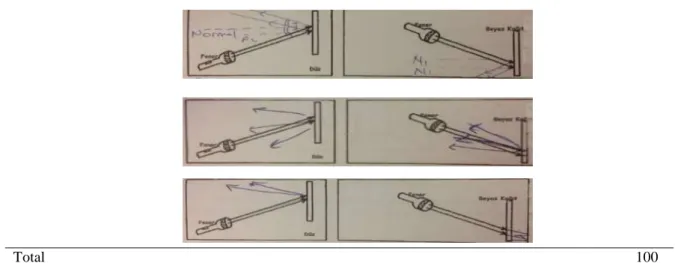
Question 6 (Pictorial Open-Ended Question): What happens to a beam of parallel light rays which fall with the same angle on a smooth and reflective plane and on a thick piece of paper?
Opticians’ Responses %
Not coded or no response 49
Light rays are reflected in a scattered way from the surface of smooth plane and white paper. 15 Incident and reflected rays on both surfaces make the same angles with normal. * 13 Light rays are reflected on the smooth plane. They pass through the white paper. 14 Light rays are reflected on the smooth plane. They are not reflected on white paper (absorbed).
9
Total 100
*indicates the correct responses. **indicates the partial correct responses.
Table 3 shows the percentage distribution of the opticians’ responses to the open-ended questions related to Sun, star and space concepts. When Table 3 is examined, it is seen that about half of the opticians give correct responses to the question 7. On the other hand, about an equal percentage to correct responses is found not to respond to that question or the responses cannot be collected under a category.
Table 3. Findings related to the concepts of light resources (Sun and stars) and space Question 7 (Pictorial Open-Ended Question): How do we see the Sun?
Opticians’ Responses %
Sun is a light source. The image of Sun is formed by reaching of Sun light to our eyes.* 45
Not coded or no response 40
We can see thanks to the reflection of the Sun rays. 9
We can see it because it lights its surrounding. 6
Total 100
Question 8 (Pictorial Open-Ended Question): How do we see the stars?
Opticians’ Responses %
Stars are light sources. The images of stars are formed by reaching of star light to our eyes.* 51
Stars reflect the light which falls on them. 28
Stars do not emit light. 16
Not coded or no response 5
Total 100
Question 9 (Pictorial Open-Ended Question): How is space seen?
Opticians’ Responses %
Not coded or no response 49
Space is dark. 18
Light emitted by the stars and the Sun is not sufficient to light the space and so the space is dark. 13
Space is black. 12
Reflection of the light emitted by the light sources, Sun and stars does not take place in the space since there is no matter in space. Hence the image of space is not formed. * 8
Total 100
*indicates the correct responses.
Findings Obtained from Light and Optics Conceptual Evaluation Test
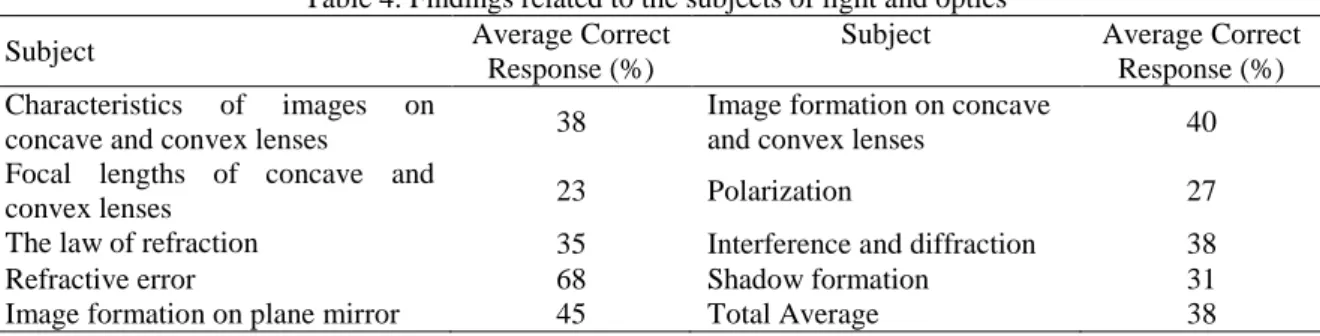
Table 4 shows the distribution of average correct responses of the opticians to Light and Optics Conceptual Evaluation Test.
Table 4. Findings related to the subjects of light and optics
Subject Average Correct
Response (%)
Subject Average Correct
Response (%) Characteristics of images on
concave and convex lenses 38
Image formation on concave
and convex lenses 40
Focal lengths of concave and
convex lenses 23 Polarization 27
The law of refraction 35 Interference and diffraction 38
Refractive error 68 Shadow formation 31
Image formation on plane mirror 45 Total Average 38
According to Table 4, it is seen that the ratio of correct responses of the opticians related to the subjects of Light and Optics were low. The ratio of correct responses is under 50% except from one subject (refractive error). The subjects with the least correct responses related to the Light and Optics subjects are as follows: The focal lengths of concave and convex lenses, polarization. The subjects with the highest correct responses belong to the subjects of refractive error and image formation on plane mirrors. When the responses of the opticians are examined in detail, the following findings which indicate several problems are reached.
Image Formation on Plane Mirror: Opticians experience difficulty in drawing the place of the image on plane
mirrors with the help of rays sent to the mirror. They think of the following points at this respect (i) The image on plane mirror forms in front of the mirror. (ii) The image is smaller than the object (iii) The place of the image changes due to the change of the position of the observer. (iv)The image of the object gets smaller as the object moves away from the mirror.
Focal Lengths of Concave and Convex Lenses: Opticians experience difficulty in comprehending the
biconvex/biconcave lenses. (ii) The focal length of plano-convex/plano-concave lenses is shorter than biconvex/biconcave lenses. iii) The optical power of concave lenses increases as the edge thickness decreases. (iv) The focal length of concave lenses decreases as the edge thickness decreases. (v) A plano-convex lens is used for the refractive error of myopia.
The Law of Refraction: Opticians do not consider Snell’s Law for explaining the transition of the rays from one
medium to another with different refractive indices. They think of the following points at this respect (i) The rays coming from a medium with a larger refractive index passes to a medium with a smaller index by approaching to the normal or they pass without refraction (ii) The light rays refract by moving away from the normal in the media with the same refractive indices. (iii) Light rays which travel from one medium to another with the same refractive indices make total internal reflection.
Refractive Error: Refractive error constitutes the subject with the highest ratio of correct responses obtained
from the opticians. Despite this finding, several opticians think that convex lenses are used for the improvement of the refractive error of myopia and concave lenses are used for the improvement of the refractive error of hypermetropia.
Characteristics of Images on Concave and Convex Lenses: The opticians do not consider the lenses equations in
solving the questions related to image formation in concave and convex lenses. They think of the following points at this respect (i) A reverse image is formed in a concave lens (ii) A reverse image is formed when an object is located between the focal point and center of a convex lens (iii) An image which is bigger than the object is formed when an object is located beyond 2F of a convex lens.
Image Formation on Concave and Convex Lenses: It is realized that opticians do not possess sufficient
experimental experience related to the images in concave and convex lenses. The following aspects are determined from the responses of the opticians to the questions related to reverse image formation in convex lenses: (i) A brighter and smaller image is formed as the screen on which the image fell is moved away from the lens. (ii) The image totally disappears when the optics center of the lens is covered with an opaque circular tape. (iii) When the object is moved away from the lens and the image on the screen is clarified, a new image which has the same height with the previous image is obtained.
Polarization: It was realized that opticians have insufficient knowledge related to the ideal polarized filters.
Low levels of correct responses are obtained especially from the question related to the polarization of light in blurred liquid. The opticians think that (i) three quarters of a beam of un-polarized light passes from the polarized filter. (ii) the total amount of vertical polarized light passes from a horizontal polarized filter.
Interference and Diffraction: The principle of superposition and the concept of phase are not fully
comprehended by the opticians. The study shows the following aspects (i) the opticians cannot determine the constructive and destructive interferences formed by two wave sources correctly. (ii) They think that central bright band will decrease as the slot width decreases in the diffraction experiment.
Shadow Formation: The opticians give correct responses to the question which is related to image formation by
a point light source passing through a triangular gap. On the other hand they are found to give incorrect responses to a similar question related to a thin and long light source. It is thought that the image formed by a thin and long light source when it passes through a triangular gap is trapezoid and reverse.
Discussion and Conclusions
sources with the help of reflection of light (Uzoğlu et al., 2013). Additionally, the opticians think that light is reflected in a diffused way on plane reflective surfaces. According to that view, a beam of incident rays coming to a smooth surface with a definite angle are totally reflected from that surface. On the other hand, they are not reflected from a white piece of sheet and they pass through the sheet (Anderson & Smith, 1986). The fact that opticians do not comprehend the concepts of reflection and image formation stem from the misinterpretations on image formation. They explain the cause of image formation with the help of rays emitted from the objects which reach eye; brightening or shining of eye by light (Şen, 2003; Anderson & Smith, 1986).
As well as the misconceptions and insufficiencies in learning, the study also indicates that opticians have high levels of learning related to refractive errors which are directly related to their profession. However, it is seen that their learning related to focal length of concave and convex lenses and polarization which are also directly related to their profession is not in sufficient level (Thapa & Lakshminarayanan, 2013). It is astonishing that the opticians know the applications of lenses despite the fact that they do not know those instruments and their characteristics. The reason of that fact can be interpreted as follows. They have learnt about the lenses which they use for refractive errors with the help of memorization of knowledge due to the experience in their profession. Also, the opticians have low levels of learning related to the polarization of light (Thapa & Lakshminarayanan, 2013). When the questions related to that subject are examined, it is seen that the ratio of giving correct responses is high for polarized glasses question. The reason of those responses might be the memorization of the polarization of the sun glasses which results from their professional experiences. Besides, they do not fully comprehend the electromagnetic wave structure of light and the function of polarized filters.
Another result obtained from the study is that the opticians have difficulty in understanding the relationship between the optical power of the lens and its geometric shape. Accordingly, it is realized that the opticians think that a thin lens has more optical power than a thick lens. The reason of that response can be explained as follows: The surface of glass lenses which is more distant to the eye is smooth. The optical power of a pair of glasses is supplied with the help of sphericity brought to the surface which is closer to the eye. Thus, the opticians respond to the questions related to the optical power of the lenses by marking the lens which looks like the glasses’ lenses most in shape. Opticians think that optical power increases as the edge thickness of a concave lens decreases. Besides, it is found out that opticians think that myopia can be eliminated via convex lenses. Those incorrect responses might stem from the effect of memorization knowledge related to refractive errors and the use of lenses at this respect. Moreover, it is determined that the opticians have incorrect views related to image formation in concave and convex lenses. The opticians cannot explain the change in image when the location of the lens or object is changed after an image is obtained from the lens. That situation might be related to not having sufficient experimental experience on image formation in concave and convex lenses (Goldberg & McDermott, 1987).
In the study, it is realized that conceptual understanding levels of opticians related to image formation on plane mirror is better than various other subjects similar to the results of Ahçı’s (2012) study. On the other hand, it is determined that the opticians cannot make correct drawings related to reflection of light rays from a smooth reflective surface similar to the results of Anderson and Smith’s study (1986). The reason of the fact that the opticians solve the questions related to drawing of image on plane mirrors correctly despite not drawing image on smooth plane surfaces might stem from the effect of their daily life experiences and intuitive responses (Goldberg & McDermott, 1987). Also, their inability to draw image on plane mirror results in experiencing difficulty for determining the shape and magnitude of the image on plane mirror and giving incorrect responses to the multiple-choice test (Epik et al., 2002). In sum, when the results obtained from the study are considered in a general manner, it can be concluded that the conceptual understanding levels of the opticians related to optics which are directly related to their professions are low. They are required to reach a better conceptual understanding level on the aforementioned subjects in order to adapt their profession’s future status which consider eye health and gain a specific structure with the recent innovations in the technology (Thapa & Lakshminarayanan, 2013).
References
Ahçı, M. (2012). Üniversite öğrencilerinin ışık ve optik konuları ile ilgili kavramsal anlamaları. (Unpublished master dissertation). Balikesir University, Balikesir.
Akpınar, E., & Çite, D. E. (2015). Açık uçlu deney tekniğine dayalı yapılan öğretimin 6. sınıf öğrencilerinin bazı temel fen kavramlarını öğrenmelerine etkisi. Mehmet Akif Ersoy Üniversitesi Eğitim Fakültesi
Anderson, C. W. & Smith, E.S. (1986). Children's conceptions of light and color understanding the role of unseen rays. Research Series, 166, 1-31.
Ausubel, D. (1968). Educational Psychology: A Cognitive View. New York: Holt, Rinehart, & Winston.
Büyükyıldız, H. Z. (2012). Gözlük camı kaplamaları ve renkli camlar. Türk Oftalmoloji Dergisi, 42(5), 359-369. Blizak, D., Chafiqi, F., & Kendil, D. (2009). Students misconceptions about light in Algeria. Eleventh
International Topical Meeting on Education & Training in Optics and Photonics (ETOP 2009).
Brown, D. E. (1992). Using examples and analogies to remediate misconceptions in physics: factor influencing conceptual change. Journal of Research in Science Teaching, 29(1), 17-34.
Chen, D., Huang, K., Lee, S. & Wang, J. (2016). Blue light blocking lenses measuring device. Procedia
Engineering, 140(2016), 17-29.
Chevallier, P., Turgeon, S., Sarra-Bournet, C., Turcotte, R., & Laroche, G. (2011). Characterization of multilayer anti-fog coatings. Applied Materials and Interfaces, 3(3), 750-758.
Çökelez, A., & Yaşar, S. Ç. (2015). 6. sınıf öğrencilerinin görüntü kavramı ile ilgili kavramsal öğrenmelerinin incelenmesi. Electronic Turkish Studies, 10(14), 159-180.
Dervić, D., Đapo. N., Mešić, V. & Đokić, R. (2019). Cognitive load in multimedia learning: An example from teaching about lenses. Journal of Education in Science, Environment and Health (JESEH), 5(1), 102-118. DOI:10.21891/jeseh.481698
Djanette, B. and Fouad, C. (2014). Determination of university students’ misconceptions about light using concept maps. Social and Behavioral Sciences, 52(2014), 582-589.
Duit, R. & Von Rhöneck, C. (1997) Learning and understanding key concepts of electricity. In A. Tiberghien,, E. L. Jossem & J. Barajos (Ed.), Connecting research in physics education with teacher education (pp. 50– 55). The International Commission on Physics Education (ICPE).
Epik, Ö., Kalem, R., Kavcar, N. & Çallıca, H., (2002). Işık görüntü oluşumu ve görüntü gözlenmesi kavramları hakkında öğrenci görüşlerinin incelenmesi. Buca Eğitim Fakültesi Dergisi 14, 64-73.
Essilor, (1997). Essilor Group Ophthalmic Optictic Files (Coatings),
http://www.essiloracademy.eu/sites/default/files/10.Coatings.pdf.
Galili, I. & Hazan, A. (2010). Learners’ knowledge in optics: interpretation, structure and analysis. International
Journal of Science Education, 22 (1). 57-88.
Gilbert, J. K. (1977). The study of student misunderstandings in the physical sciences. Research in Science
Education, 7, 165–171.
Gilbert, J. K., Osborne, R. J. & Fensham, P. J. (1982). Children's science and its consequences for teaching.
Science Education, 66(4), 623-633.
Goldberg, F. M. & McDermott, L. C. (1987). An investigation of student understanding of the real image formed by a converging lens or concave mirror. American Journal of Physics, 55(2), 108-119.
Halim, A. S., Finkenstaedt-Quinn, S. A., Olsen, L. J., Gere, A. R. & Shultz, Ginger V. (2018). Identifying and remediating student misconceptions in introductory biology via writing-to-learn assignments and peer review. CBE- Life Science Education, 17(2), 1-13.
Hewson, M. G. & Hewson, P. W. (1983). Effect of instruction using students’ prior knowledge and conceptual change strategies on science learning. Journal of Research in Science Teaching, 20(8), 731-743.
Irie, M. (2000).Photochromism: memories and switches –introduction. Chemical Reviews, 100(5), 1683-1684. Istanda, V., Chang, C. Y., Lee, W. C., Liua,Y. C. & Wang, S. R. (2012). Concept cartoons based two-tier online
testing system for magnetism conception. Applied Mechanics and Materials, 148(149), 891-894.
Johnstone, A. H. (1991). Why is science difficult to learn? Things are seldom what they seem. Journal of
Computer Assisted Learning, 7(2), 75-83.
Keogh, B. & Naylor, S. (2004). Concept Cartoons in Science Education. Cheshire: Millgate House Publishing. Leech, N. L., & Onwuegbuzie, A. J. (2007). An array of qualitative data analysis tools: a call for qualitative data
analysis triangulation. School Psychology Quarterly, 22, 557–584.
Mann, M. & Treagust, F. D.(2010). Students’ conceptions about energy and the human body. Science Education
International, 21(3), 144-159.
Mccleary, D. S. (2009). The optician training manual. Temecula: Santa Rosa Publishing.
Novak, J. D. (1993). How do we learn our lesson? Taking students through the process. The Science Teacher, 60(3), 50-55.
Novak, J. D. & Gowin, D. B. (1984). Learning How to Learn. UK: Cambridge University Press.
Özdemir, E. & Kabak, S. (2018). Gözlükçülüğün tarihsel gelişimi ve türkiye’de gözlükçülük sektörü. İstanbul: İTO/IDA Yayınları.
Özdemir, E. & Yarar.O. (2016). Temel optisyenlik bilgisi. Ankara: Güneş Tıp Kitabevi.
Özmumcu, M. (2011). Özel bir TVA tekniği kullanarak organik gözlük camlarının çeşitli kaplamaların
yapılması ve bazı fiziksel özelliklerinin incelenmesi. (Unpublished doctoral dissertation), Eskişehir
Palmer, D.H. (1999). Exploring the between students’ scientific and nonscientific conceptions. Science
Education, 83, 639-653.
Rankhumise, M. P. & Imenda, S. N. (2014). Using a bicycle analogy to alleviate students’ alternative conceptions and conceptual difficulties in electric circuits. Mediterranean Journal of Social Sciences, 5(15), 297-302.
Skelly, K. M. & Hall, D. (1993). The development and validation of a categorization of sources of
misconceptions in chemistry. Paper presented at the Third International Seminar on Misconceptions and
Educational Strategies in science and Mathematics, Ithaca, NY.
http://www.mlrg.org/proc3pdfs/Skelly_Chemistry.pdf
Sokoloff, D. (2006). Active learning in optics and photonics manual, Paris: UNESCO. Strauss. S. (1981). Cognitive development in school and out. Cognition, 30, 295-300.
Şen, A. İ. (2003). İlköğretim öğrencilerinin ışık, görme ve aynalar konusundaki kavram yanılgılarının ve öğrenme zorluklarının incelenmesi. Hacettepe Üniversitesi Eğitim Fakültesi Dergisi, 25, 176-185. Taşlıdere, E. & Eryılmaz, A. (2015). Assessment of pre-service teachers’ misconceptions in geometrical optics
via a three-tier misconception. Bartın University Journal of Faculty of Education,4 (1), 269-289. Tanner, P. A, Zhou, L., Duan, C. & Wong, K-L. (2018). Misconceptions in electronic energy transfer: Bridging
the gap between chemistry and physics. Chemical Society Reviews, 47, 5234-5265.
Thapa, D. & Lakshminarayanan, V. (2013). Light & optics conceptual evaluation findings from first year optometry students. ETOP 2013 Proceedings.
Teddlie, C., & Yu, F. (2007). Mixed methods sampling: a typology with examples. Journal of Mixed Methods
Research, 1(1), 77-100.
Uzoğlu, M., Yıldız, A., Demir, Y. & Büyükkasap, E. (2013). Comparison of the effectiveness of concept caricature and open-ended questions in the determination of science teachers' misconceptions about light.
Ahi Evran University Journal of Kırşehir Faculty of Education, 14(1), 367-388.
Author Information
Erdoğan Özdemir
Istanbul Okan University
Vocational School of Health Services, Opticianry Program, Istanbul/Turkey Contact e-mail: [email protected]
Mustafa Coramik
Balikesir University,
Necatibey Education Faculty, Mathematics and Science Education Department, Physics Education Branch Balikesir/Turkey
Handan Ürek
Balikesir University,