FINAL REPORT
March 17, 2006
The Changing Nature of the Catalog and its Integration
with Other Discovery Tools
Prepared for the Library of Congress By
Karen Calhoun Cornell University Library
Ithaca, NY 14853 [email protected]
Table of Contents
The Changing Nature of the Catalog and its Integration with Other Discovery Tools ... 1
Table of Contents... 3
Executive Summary ... 5
Highlights... 5
Notes to the Reader... 5
Chapter 1: Introduction ... 7
Background ... 7
Objectives ... 8
Methodology: Research Process and Starting Points... 8
Structured Interviews ... 8
Chapter 2: The Catalog’s Future... 9
Where We Are ... 9
What to Do About It ... 10
Thirty-Two Options and Three Strategies ... 12
Implementation Issues ... 13
A Blueprint for Phased Implementation—Two Year Plan ... 16
Vision for Change ... 16
Blueprint ... 16
Acknowledgements... 21
Appendix A: Current Situation ... 23
Market Analysis ... 23
The Scholarly Information Universe ... 24
Information Seeking Behavior... 24
The Catalog and Information Seekers... 25
Prospects for the Research Library Catalog... 26
The Catalog and Research Library Collections ... 26
Appendix B: Interview List and Questions... 29
Appendix C: Key Findings from the Interviews and Literature Review ... 31
The Catalog’s Unique Advantages ... 31
Discovery and management in one package... 31
Support for browsing; consistency and collocation ... 31
Identification and inventory control... 31
Delivery of local holdings... 32
Cataloging Tradition and Catalog Data ... 32
MARC... 32
Alternatives to cataloging records ... 32
Cataloging practice ... 33
Library of Congress Subject Headings (LCSH) and traditional subject access.... 33
Authority control... 34
Cataloging content rules, RDA and FRBR ... 34
The Scope of the Research Library Catalog ... 35
No consensus ... 35
User expectations ... 35
The trouble with metasearch... 36
Integration with Other Discovery Tools ... 36
The issue of surrogates and full text ... 36
Google and Google Book Search... 36
Local vs. shared catalogs ... 37
Revitalizing Catalogs for the Communities They Serve... 38
Discovering, requesting, and getting ... 38
The long tail. ... 38
Web services and interoperability... 39
Usability... 39
Communities of users ... 40
Revitalizing the Catalog for Internal Operations ... 40
Inventory control... 40
Automated metadata production ... 40
External sources of metadata; data ingest and extraction ... 41
Collection level records ... 41
Reporting functions and management data... 41
We’re (not) special... 41
Integrated Library System (ILS) Vendors ... 41
The ILS market. ... 41
Decoupling discovery and the ILS... 42
Modularity, the ERMS and the ILS ... 42
Challenges and Obstacles ... 42
The fault is not in our stars but in ourselves ... 42
The catalog and its boundaries... 43
Standards development and implementation ... 43
Copyright ... 44
Who pays? How to build it?... 44
The Changing Nature of the Catalog and its Integration
with Other Discovery Tools
Executive Summary
Highlights
The destabilizing influences of the Web, widespread ownership of personal computers, and rising computer literacy have created an era of discontinuous change in research libraries—a time when the cumulated assets of the past do not guarantee future success. The library catalog is such an asset. Today, a large and growing number of students and scholars routinely bypass library catalogs in favor of other discovery tools, and the catalog represents a shrinking proportion of the universe of scholarly information. The catalog is in decline, its processes and structures are unsustainable, and change needs to be swift. At the same time, books and serials are not dead, and they are not yet digital. Notwithstanding widespread expansion of digitization projects, ubiquitous e-journals, and a market that seems poised to move to e-books, the role of catalog records in discovery and retrieval of the world’s library collections seems likely to continue for at least a couple of decades and probably longer.
This report, commissioned by the Library of Congress (LC), offers an analysis of the current situation, options for revitalizing research library catalogs, a feasibility assessment, a vision for change, and a blueprint for action. Library decision makers are the primary audience for this report, whose aim is to elicit support, dialogue,
collaboration, and movement toward solutions. Readers from the business community, particularly those that directly serve libraries, may find the report helpful for defining research and development efforts. The same is true for readers from membership organizations such as OCLC Online Computer Library Center, the Research Libraries Group, the Association for Research Libraries, the Council on Library and Information Resources, the Coalition for Networked Information, and the Digital Library Federation. Library managers and practitioners from all functional groups are likely to take an interest in the interview findings and in specific actions laid out in the blueprint.
Notes to the Reader
The report has two chapters and three appendixes. Chapter 1 describes the background, methodology, and objectives of the investigation. Chapter 2 describes what to do about the catalog. Readers on a fast track should look quickly at chapter 1, which is short, then peruse chapter 2. Appendixes A to C, which provide context and evidence for chapter 2, offer a detailed analysis of the current situation and key findings from the literature and a set of structured interviews. Readers who prefer a full analysis and elucidation of the topic will want to glance through chapter 1, examine the appendixes, then return to chapter 2.
The Changing Nature of the Catalog and its Integration
with Other Discovery Tools
Chapter 1: Introduction
Background
The library catalog has long been the keystone supporting the mission of
libraries—to save readers’ time and advance the state of knowledge within the library’s community. By directly connecting users and information, the library catalog (not Google or one of the other popular search engines) was the first service to support unmediated information discovery and access, and it has been doing so for over a hundred years.
Today, the catalog operates against a backdrop of flat or declining use of library collections, flashy and powerful alternatives for information discovery, rapid changes in information technology, rising expectations of library patrons, a rapid increase in new kinds of digital assets, mass digitization projects, and an incipient revolution in scholarly information exchange. If one accepts the premise that library collections have value, then library leaders must move swiftly to establish the catalog within the framework of online information discovery systems of all kinds. Because it is catalog data that has made collections accessible over time, to fail to define a strategic future for library catalogs places in jeopardy the legacy of the world’s library collections themselves. For this reason, the option of rejecting library catalogs is not considered in this report.
As part of the celebration of its bicentennial year, from November 15–17, 2000 the Library of Congress (LC) hosted a conference of approximately 125 invited participants [1]. The theme of the conference was bibliographic control in the 21st century. One objective of the conference was to begin defining strategic issues related to the future of catalogs. Conference speakers and participants posed many questions, among them: • What is the current state of standards and technologies to support unified access to
multiple repositories, including catalogs?
• What are the future roles of MARC and cataloging content rules?
• What are the challenges to the economic sustainability of the current model of the catalog?
• What do 21st century information seekers need from catalogs? • In what ways might libraries leverage catalog data for new uses?
• What partnerships are worthy of pursuing with the publishing, systems, scholarly, and information technology communities?
Since the bicentennial conference, library leaders at LC and elsewhere have pushed beyond the questions posed at that conference to challenge the value of the catalog itself. At a seminar held at the American Library Association 2005 Midwinter Conference, Deanna Marcum, LC’s Associate Librarian for Library Services, asked, in light of the
high cost of cataloging and swift changes in information seeking behavior and tools, “just how much do we need to continue to spend on carefully constructed catalogs?” [2]
Objectives
In spring 2005, the director for Acquisitions and Bibliographic Access at the Library of Congress authorized a research project to carry out LC’s Bicentennial Conference on Bibliographic Control Action Item 6.4, “support research and development on the changing nature of the catalog to include consideration of a
framework for its integration with other discovery tools.” [3] Action item 6.4 was one of many action items that LC leaders defined following the bicentennial conference. For action item 6.4, LC engaged the author as principal investigator.
Acting on the advice of LC’s research project sponsors, the author defined the research objectives broadly, from the perspective of major research libraries in general, rather than focusing on the issues as they relate to LC specifically. This report contains recommendations for the future of research library catalogs, a preliminary assessment of the technical and organizational feasibility of next steps, and a vision and blueprint for change. The content is intended to elicit support, dialogue, collaboration, and movement toward solutions and a phased approach to change at LC and in the library community at large.
Methodology: Research Process and Starting Points
The investigation began with gathering and reviewing a range of literature, mainly from the last five years (2000-2005), on the nature of the scholarly information universe; information seeking behavior and the role of search engines, particularly Google;
markets, market positions, and competitive strategy; the economics of information services; federated access methods and tools for digital libraries; and of course the future of catalogs and cataloging.
Structured Interviews
The literature review served as the basis for selecting six questions to use in structured interviews. Each question was intended to elicit the kind of information that an investor might want to know about any product or service (in this case, the catalog) whose market position is eroding. Ample evidence documents the declining market position of the library catalog (see Appendix A). The next step, choosing interviewees, was done in collaboration with John Byrum and Judy Mansfield of LC plus members of the ALCTS (Association of Library Collections and Technical Services) Task Force on the LC Action Plan, which served in an advisory capacity for all aspects of this study. The desire to gather a range of perspectives guided the choice of interviewees, who are listed in Appendix B. Martin Kurth, a colleague at Cornell and the head of the library’s metadata services group, assisted the author with the interviews. Appendix C lays out the key findings of the structured interviews and literature review.
Chapter 2: The Catalog’s Future
Where We Are
This investigation has taken place in a time when it is more important than ever to position the research library catalog successfully within a rapidly evolving information universe for scholarly research, teaching, and learning, and to adapt to sea changes in information seeking behavior. As discussed in Appendix A, the legacy of the world’s library collections is for the time being tied to the future of catalogs. At the same time, a large and growing number of students and scholars routinely bypass library catalogs in favor of other discovery tools, and the catalog represents a shrinking proportion of the scholarly information universe.
Findings from the structured interviews and literature analysis (Appendix C) suggest that today’s library catalogs are long on problems and short on unique benefits for users. The cost-effectiveness of cataloging tradition and practice is under fire. The typical research library catalog’s strongest suit is its support for inventory control and as “last mile” technology to enable delivery of the library’s assets into the hands of local users. A new technology for expanding the service model of the catalog to cover more of the scholarly information universe—metasearch—has generated much hope but is not meeting early expectations for tying together the fragmented landscape of scholarly information resources.
There are a number of prevailing strategies for integrating the catalog with other discovery tools and one huge opportunity. First the strategies. All feature some degree of data consolidation (mainly for discovery) paired with distribution of the functions of discovering, requesting, and getting information among multiple services. Initiatives like Google Book Search, Open WorldCat, and RedLightGreen hold promise, but so far finding and obtaining items from library collections on the open Web is not a practical alternative for students and scholars. Nevertheless there is an expectation that such initiatives will eventually make research library collections more visible to a worldwide audience. Some influential library and information science professionals are beginning to suggest relying more on state-wide, national or global aggregations of catalog data for discovery, and using library ILSes as a middle “switching” layer to enable delivery. The huge opportunity of integrating catalogs with open Web discovery tools is the long tail— surfacing research libraries’ rich collections in ways that will substantially enhance scholarly productivity worldwide.
Taking advantage of research libraries’ opportunities for leveraging their investments in their catalogs and collections requires overcoming some daunting obstacles (Appendix C). Many research library leaders, most staff members, and some university faculty are not ready for change of this magnitude. Progress toward reliable and easy interoperability is painfully slow. Precedents for large scale collaboration
among research libraries are few. Copyright law has not caught up with the digital world. It’s unclear whether research libraries and library service firms are sufficiently
What to Do About It
The online library catalog has been a successful product. Like other products, it has passed through a life cycle. In the late 1970s, online catalogs were a rarity and adoption crept along. By the late 1980s, online catalogs had taken off, and any self-respecting research library had to have one. By the mid 1990s, online catalogs were mature. A new cycle of replacement had begun and is now nearly complete. Product replacement took the form of migrations from character-based catalogs to systems based on client-server technologies and relational databases. Today, the online catalog is losing appeal for students and many scholars. Catalog usage, drifting downward compared to other discovery tools, may soon plummet. Fortunately, there are ways to use the
knowledge that today’s catalog has reached the end of its life cycle. Theodore Levitt [4] and his successors in the business world offer a number of strategies for revitalizing products:
1. Promote more frequent use among existing users 2. Develop new uses among existing users
3. Find new users for the existing product 4. Find new uses and new users
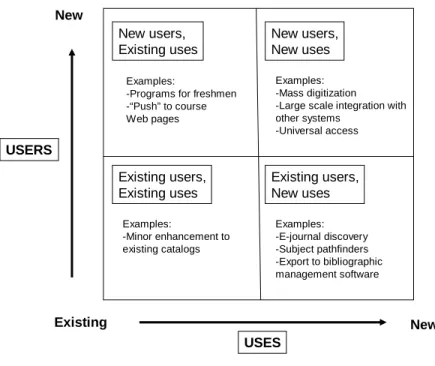
Figure 1 applies these concepts to extending the life cycle of the research library catalog. The examples in the figure are merely aids to understanding how to use the model; readers may agree or disagree with their choice or placement. The quadrant on the lower left combines existing uses and existing users and is the least promising as a long term strategy, because the existing local catalog’s market position has eroded to the point where there is real concern for its ability to weather the competition for information seekers’ attention. One can speculate that the quadrant on the lower right, which
combines existing users with new uses, will revitalize the catalog to a degree. Strategies like enhancing discovery and delivery for e-resources within the catalog, updating the local catalog’s public interface, adding new functionality for browsing, producing new accession lists or subject-specific pathfinders, or adding tools to export citations to bibliographic management software (e.g., RefWorks) belong in the lower right quadrant.
Above the middle horizontal line, the quadrant on the upper left is characterized by more ambitious strategies such as intensive marketing or library instruction campaigns to capture the attention of non-users, especially new freshmen; pushing library data out to university portals and course Web pages; and (to capture new users outside the library community) the regional combination of collections and/or catalogs or the introduction of state-wide or regional unmediated interlibrary lending programs (like Borrow Direct). The quadrant on the upper right is the place where transformative, higher risk, long-term, and typically costly strategies reside. Such strategies might include creating more
coherent and comprehensive scholarly information systems, perhaps by discipline; building the necessary infrastructure to permit global discovery and delivery of information among open, loosely-coupled systems (e.g., find it on Google, get it from your library); enabling universal, unmediated access to research library collections; or leveraging catalog data to support mass digitization projects and/or to produce long-tail effects for research library collections. Naturally, blended strategies are also possible.
Existing New New
USERS
USES Existing users,
Existing uses
Existing users, New uses New users,
Existing uses
New users, New uses
Examples:
-Programs for freshmen -“Push” to course Web pages
Examples: -Mass digitization -Large scale integration with other systems
-Universal access
Examples:
-Minor enhancement to existing catalogs
Examples: -E-journal discovery -Subject pathfinders -Export to bibliographic management software
Figure 1. Revitalizing the Research Library Catalog
Michael Porter is a leading authority on competitive strategy. Kathryn Rudie Harrigan writes often on the strategic management of maturing businesses. In their joint article Harrigan and Porter offer options for responding to the problems that declining demand poses [5]. The key problem of declining industries is the effect wrought by falling
demand—that is, excess supply and capacity. For example when new technologies began to replace vacuum tubes in televisions, vacuum tube manufacturers had to shut down excess plant capacity as people replaced their old televisions with new ones. In healthy businesses, the capacity to produce a product matches the demand for the product.
Research libraries have invested and continue to invest millions to develop and maintain the capacity to produce local catalogs—in 2004, ARL libraries spent an estimated $239 million on technical services labor alone. As information seekers increasingly turn to search engines, research library leaders need to examine ways to bring the capacity to produce local online catalogs back into line with the demand for them. Carrying out this responsibility is a subtle, rigorous, and complex task, fraught with peril, but as Harrigan and Porter point out, many companies have successfully coped with declining products. As is suggested by the strategies offered by Levitt and laid out in Figure 1, innovations, cost reductions, and changing circumstances can slow or reverse a decline. If however declining demand is pervasive, Harrigan and Porter offer four strategic alternatives: leadership, niche, harvest, or quick divestment.
A library or library service organization pursuing a leadership strategy would seek a prominent position in the market and reduce exit barriers for other organizations—in this
case, one might expect such an organization to offer an alternative that will help others retire their own catalogs. The niche strategy would be characterized by specialization; the research library or service organization would choose one or more segments of users— say, humanists or area studies specialists—in which demand is expected to be reasonably stable and move to serve those segments exclusively. The harvest strategy would involve controlled, gradual disinvestment in existing local catalogs. Harrigan and Porter note the difficulties of the harvest strategy for businesses, due to the risks of maintaining
customers’ confidence and employees’ motivation as investment and service levels are curtailed. In a research library, pursuing the quick divestment strategy would most likely involve getting out of the business of producing a local online public access catalog (OPAC) entirely by outsourcing the work or relying on an alternative service.
Different research libraries and the organizations that serve them will choose different strategies for revitalizing their catalogs. An organization’s strategic choice will depend on the organization’s position with respect to others who supply or produce catalogs, its financial position, its perception of the likelihood and rate of revitalization or decline of the catalog, the actual strength and nature of remaining demand for the existing catalog, the availability of practical alternatives, and the level of difficulty the organization will have diverting its capacity to new uses. In addition, an individual library or library service organization might blend strategies or pursue different strategies over a period of time. Harrigan and Porter’s research suggests that companies that weather declining demand tend to be participants in the substitute industry (in this case, open Web discovery tools).
Thirty-Two Options and Three Strategies
Libraries are unlikely to divest themselves of their catalogs. Most library leaders and scholars would deem such a course of action unthinkable. It is more practical to think about research libraries’ divesting themselves of the status quo—that is, the situation in which the research library community would continue offering their existing local online public access catalogs for existing users and uses. In effect, a choice to continue with the status quo is a harvest strategy, complete with its downsides of eroding user satisfaction and deeply frustrated library staff members. At a minimum, research libraries need first to explore extending the life of the catalog through innovation and cost reduction and second, to develop new uses for catalog data for existing catalog users. At the far end of the range of strategic choices open to research libraries, they and the organizations that serve them could develop systems for discovering and delivering library collections and other scholarly information that would advance the progress of knowledge in ways that no one could have imagined a decade ago.
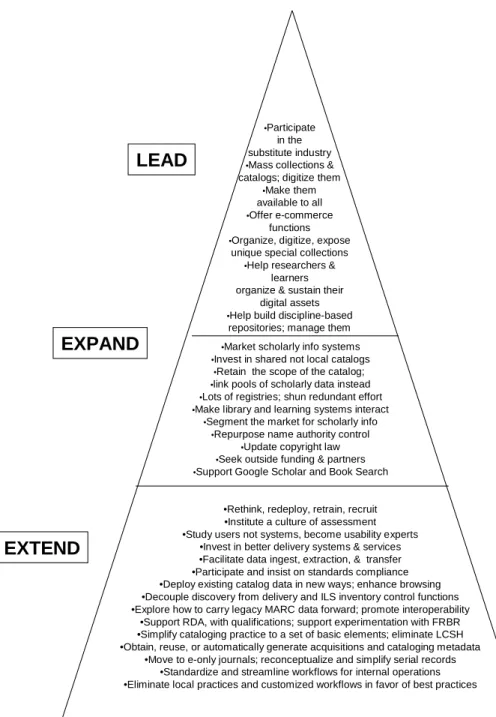
Figure 2 offers thirty-two possible remedies organized by the type of underlying strategy—extend, expand, and lead. The time frame is assumed to be five years.
Extending the research library catalog involves innovations and cost reductions; these strategies are the building blocks for the next two strategic choices. An example of innovation in the context of the “extend” strategy is the new Endeca-powered catalog at North Carolina State University [6]. Expanding involves attracting new users for catalog data and the research library collections they describe. An example of the collaborative
aspect of the “expand” strategy is the new “CalCat,” an IMLS-supported initiative to build a “super-sized catalog” for Californians [7]. Leading involves significantly expanding the research library’s role in developing information systems that support teaching, learning and research on a global scale. To date, there is no fully realized, practical example of the leadership strategy among research libraries, although some library leaders appear to be at the perimeter of this unexplored country. Readers may reach different conclusions about the choice and placement of these possible actions. The figure is offered as a starting point for sparking dialogue, collaboration, and movement toward revitalization of research library catalogs.
Implementation Issues
This section provides a preliminary assessment of the organizational and technical feasibility of the options for next steps. For the next couple of years, most research
libraries will be best positioned to pursue innovation and cost reduction as their principal strategies (i.e., the “extend” strategy). There are already examples of libraries on this path and a number of active writers and consultants providing direction, documentation, and leadership. The challenges to feasibility include:
• Difficulty achieving consensus on standardized, simplified, more automated workflows
• Unwillingness or inability to dispense with highly customized acquisitions and cataloging operations
• Overcoming the “not invented here” mindset preventing ready acceptance of cataloging copy from other libraries or external sources
• Resistance to simplifying cataloging
• Inability to find and successfully collaborate with necessary partners (e.g., ILS vendors)
• Difficulty achieving basic levels of system interoperability • Slow development and implementation of necessary standards
• Library-centric decision making; inability to base priorities on how users behave and what they want
• Limited availability of data to support management decisions
• Inadequate skill set among library staff; unwillingness or inability to retrain • Resistance to change from faculty members, deans or administrators
In summary, the implementation issues associated with the innovation and cost reduction strategy include some technical but mostly organizational hurdles. To succeed at this strategy, research libraries will need to master organizational change management and achieve unprecedented levels of collaboration with peers and external partners. The challenges of integrating research library catalogs with other discovery tools will not be solved by individual libraries working alone.
EXTEND
EXPAND LEAD
•Rethink, redeploy, retrain, recruit •Institute a culture of assessment •Study users not systems, become usability experts
•Invest in better delivery systems & services •Facilitate data ingest, extraction, & transfer •Participate and insist on standards compliance •Deploy existing catalog data in new ways; enhance browsing •Decouple discovery from delivery and ILS inventory control functions •Explore how to carry legacy MARC data forward; promote interoperability
•Support RDA, with qualifications; support experimentation with FRBR •Simplify cataloging practice to a set of basic elements; eliminate LCSH •Obtain, reuse, or automatically generate acquisitions and cataloging metadata
•Move to e-only journals; reconceptualize and simplify serial records •Standardize and streamline workflows for internal operations •Eliminate local practices and customized workflows in favor of best practices
•Market scholarly info systems
•Invest in shared not local catalogs
•Retain the scope of the catalog;
•link pools of scholarly data instead
•Lots of registries; shun redundant effort
•Make library and learning systems interact
•Segment the market for scholarly info
•Repurpose name authority control
•Update copyright law
•Seek outside funding & partners
•Support Google Scholar and Book Search
•Participate in the substitute industry
•Mass collections & catalogs; digitize them
•Make them available to all
•Offer e-commerce functions
•Organize, digitize, expose unique special collections
•Help researchers & learners organize & sustain their
digital assets
•Help build discipline-based repositories; manage them
The “expand” strategy has organizational issues associated with it, but also many more technical, legal and financial challenges. The decision regarding local vs. shared catalogs will be hotly debated. The financial and organizational challenges of sharing catalogs could be complex. The fates of metasearch and Web services as viable
technologies for research library information systems will be determined in the context of this strategy. It is difficult to tell if it will be technically possible for library and learning management systems to easily interoperate. There may be legal barriers associated with this strategy; if collections and catalogs begin to be shared, how should a library’s user community be defined for the purpose of licensing e-resources and making reproductions of copyrighted works?
For understanding the implementation issues associated with the leadership strategy, it is important to be clear about what is meant by the “excess capacity” of catalogs. Most catalogers would deny there is excess capacity in today’s cataloging departments, and they are correct. Library materials continue to flood into acquisitions and cataloging departments and the staff can barely keep up. Yet the key problem of today’s online catalog is the effect of declining demand. In healthy businesses, the demand for a product and the capacity to produce it are in balance. Research libraries invest huge sums in the infrastructure that produces their local catalogs, but search engines are students and scholars’ favorite place to begin a search. More users bypass catalogs for search engines, but research libraries’ investment in catalogs—and in the collections they describe—does not reflect the shift in user demand.
The capacity required to produce a local library catalog today is directly related to the amount spent on printed books and serials—in ARL libraries, the lion’s share of $665 million a year. The structure of most ARL budgets privileges the purchase of printed books and serials for locally-housed, locally-circulated collections. Research libraries continue to be ranked primarily by how many things they have in locally-housed, locally-circulated collections [8]. Due to the continuing large annual investment in published materials that need cataloging, the remedies of innovative methods and cataloging cost reduction can only go so far. The declining demand for today’s catalogs reflects diminishing interest in already low-use research library collections, at least as they are currently housed, managed, and delivered.
The leadership strategy cannot succeed without investment in new, global information systems that make research library collections more visible and that cover more of the scholarly information universe. Investing in cataloging of unique special collections (which could be quite a costly enterprise) may eventually have equal importance. All this will require large sums of money. A lot of funds are currently locked up in building many parallel, redundant research library collections. Therefore, a first step in implementing the leadership strategy must be helping libraries pool their collection efforts, freeing up materials budget funds for reinvestment [9]. A competing priority—preserving the cultural record for future generations—will make this a difficult, but not impossible task.
Reallocating substantial portions of library funding to building bigger scholarly information environments will probably not be enough; outside funding and many new professional and business partnerships will be required. Pursuing the leadership strategy carries considerable financial, organizational, technical, and legal demands, uncertainties, and risks, but the potential to serve the public good is high. Successful implementation could radically democratize access to scholarly information and boost scholarly
productivity to new levels.
A Blueprint for Phased Implementation—Two Year Plan
This concluding section offers a vision for change and a blueprint for revitalizing the research library catalog. The vision looks five years or more out, while the blueprint suggests a set of practical steps to be carried out over the next two years. Libraries can use this blueprint for implementing either individual or shared catalogs and for
positioning themselves to pursue any of the three strategic options—extension, expansion, or leadership.
Vision for Change
• Information seekers will have a range of options for discovering, requesting, and obtaining materials from research library collections
• The model for producing and maintaining acquisitions and catalog data will be financially sustainable
• The scope of the catalog will continue to be primarily books, serials, and their electronic counterparts
• Legacy catalog data will be important for supporting mass digitization projects • The catalog will evolve toward full integration with other discovery tools and with
the larger scholarly information universe
• Public and private partners will collaborate with libraries to revitalize the research library catalog
• Support for shared catalogs will grow
• Research libraries and their partners will deploy shared catalogs as a key component of providing affordable global access to larger, richer collections than any single institution could house locally
Blueprint
The author offers the following ten-step planning process with the hope that implementers will further refine each step and develop concrete action plans. While all steps are important, within the context of the catalog’s future, the choice of a strategic option (2), preparing for linkages in and out of the catalog (3), innovation/cost reduction (4), improving the user experience (5), managing change (8), and building partnerships (10) may offer the greatest rewards to implement.
1. Define the Community to Be Served
1.1.Describe precisely the population potentially served by the catalog, including size, geographic location, fields of study, demographics, catalog users/non-users
1.2.Understand the work practices and information seeking behaviors of each segment of this population [10]. (Take advantage of information and statistics already available, undertake new studies, or both)
1.3.Choose a focus: select which segments of the population the catalog will serve 1.4.Choose a strategy: retain existing users, or attract new users while retaining
existing ones
1.5.Prepare user requirements
1.6.Evaluate the existing catalog’s ability to satisfy the needs of the selected user population
1.7.Describe the desired changes to the catalog [11] 2. Choose a Strategic Option
2.1Study available products
2.2Choose an approach: local or shared catalog?
2.3Choose a strategy: continue with discovery and management in one integrated system or decouple discovery from delivery and inventory control functions? What level of integration into larger scholarly research and learning environment? What level of integration in Web search engines?
3. Prepare for Linkages In and Out of the Catalog and/or ILS
3.1 Define requirements for catalog data ingest, conversion, extraction and transfer 3.2Identify systems with which catalog data and the ILS must interoperate; define
interoperability requirements
3.3Work with library vendors and other organizations to implement requirements (this task is best done through cooperative programs and standards organizations) 4. Innovate and Reduce Costs
4.1 Obtain Metadata
4.1.1 Simplify catalog records to a set of basic elements to support discovery, browsing, identification, delivery, resource sharing, linking, and inventory control [12]
4.1.2 As much as possible, obtain or reuse data available at the point of selection, or automatically generate this data
4.1.3 Reserve manual data creation for ordering, receiving, claiming, and cataloging for those situations in which it is the only viable approach
4.1.4 Manage acquisitions and catalog data through batch processes; as much as possible, avoid working on one record at a time
4.1.5 Identify local customization (e.g., for call numbers) and record editing practices and eliminate them in favor of accepting as much cataloging copy as possible without review or modification
4.1.6 Monitor RDA, keeping in mind the need for simplicity and the larger role that automated metadata creation, batch processing, linking, and Web services will play
4.2 Support Browsing and Collocation
4.2.2 Explore automatic classification
4.2.3 Abandon the attempt to do comprehensive subject analysis manually with LCSH in favor of subject keywords; urge LC to dismantle LCSH [14]
4.2.4 Encourage research and development in automatic subject analysis, including ways to reuse legacy data containing LCSH headings to support automatic subject analysis
4.2.5 Explore new ways to manage vocabulary for the names of places
4.2.6 Support experimentation with FRBR and urge vendors and library service organizations to implement clustering based on FRBR concepts
4.2.7 Encourage the review of developments in other disciplines on ontologies and taxonomies and their application to library catalogs
4.2.8 Encourage research and development on deploying catalog data in new ways to support discovery and browsing
4.2.9 Continue and expand participation in name authority control cooperative programs
4.2.10 Encourage research and development to align library name authority control methods and data with the requirements of modern machine processing 4.2.11 Encourage a collaborative cost-benefit analysis of series authority control; determine who needs controlled vocabulary for series headings and how/where to provide it at substantially less cost
4.2.12 Encourage research and development for new visualization tools and techniques
4.3Streamline Workflows
4.3.1 Encourage collaborative development of community-wide best practices or standards for acquisitions and cataloging workflows, then implement them [15]
4.3.2 Ask vendors and library service organizations to support workflow best practices and standards; do not ask them to customize their systems to support non-standard workflows
4.3.3 When designing workflows, consider the entire flow of activity, from selection to access or shelving; streamline the workflows to eliminate unnecessary or redundant effort
4.3.4 Shun workflows that create or perpetuate processing backlogs
4.3.5 Define fast turnaround and delivery of library materials to users as the standard of quality service, not the fullness of catalog data
4.3.6 To the extent possible, support workflows with automated techniques and tools
4.3.7 On campuses with multiple technical processing centers, integrate operations to achieve consistent practices, clear direction, and savings
4.3.8 Mainstream, adequately support, and give high priority to e-resource licensing, discovery, linking, access and management
4.3.9 Support the re-use of catalog data and cooperative development of new workflows and/or data elements to support mass digitization projects
4.4 Adopt Standards and Best Practices
4.4.1 Participate, and ask vendors and library service organizations to participate, in standards development/compliance in support of linking, metasearch,
metadata harvesting, registry development, and Web services
4.4.2 Comply with these standards in in-house development projects; ensure that every new repository or digital collection that is built can be successfully integrated into the larger scholarly information universe, both locally and globally
5. Improve the User Experience
5.1 Enrich the catalog with services (e.g., “more like this,” “get it” options, new book lists, etc.), and data (cover art, reviews, TOCs)
5.2 Enable much better browsing and organization of large retrieval sets 5.3 Enable best-match retrieval (no search dead ends)
5.4 Provide relevancy ranking of search results
5.5 Continue working with available technologies (but look for better ones) to federate discovery and delivery of books, journals, and journal articles
5.6 Link the user to full text whenever possible
5.7 For items that cannot be delivered instantly, offer a range of unmediated, quick delivery options
5.8 Provide and market extended-hour hotlines, rush, and troubleshooting services to help users quickly solve delivery or connection problems
5.9 Push library metadata and links out to course Web pages and portals
5.10 Take advantage of e-commerce functions to serve non-members of the library community
6. Make Good Decisions
6.1 Institute a “culture of assessment” [16]
6.2 Train library staff to conduct and apply work practice and usability studies to service development or enhancement
6.3 Capture and maintain usage data; support queries and report generation 6.4 Track and maintain other data to support evidence-based decisions about user services and internal operations
7. Market the Library
7.1 Within the context of the library’s entire marketing plan, institute annual library publicity campaigns that promote the catalog and collections, both in and outside the library building, and on Web pages that students and faculty view frequently
7.2 Promote the catalog and collections differently to different segments of users 7.3 Set and track annual objectives to increase or maintain awareness of the catalog and collections
7.4 Emphasize the unique benefits of the catalog and collections and the services built on top of them
8. Manage Change
8.1 Complete stakeholder analyses; prepare and carry out two-way communication plans customized for each stakeholder group
8.2 Train managers and staff to understand and cope with the dynamics of personal and organizational transition [17]
8.3 Recruit and train change agents 8.4 Reward flexibility and openness 8.5 Create transitional roles
8.6 Involve stakeholders, managers and staff in transition planning and execution 9. Develop, Retrain, and Recruit
9.1 Offer staff development services 9.2 Identify future skill requirements 9.3 Complete a skills gap analysis
9.4 Prepare training programs and necessary documentation 9.5 Retrain or recruit to address skill gaps
9.6 Modify job descriptions and expectations as needed 9.7 Manage performance
10. Find Funding and Partners
The financial and organizational challenges of revitalizing and integrating research library catalogs with other discovery tools will not be solved by individual libraries working alone. A new era of unprecedented levels of collaboration and partnerships is about to begin. Librarians will need a great deal more business acumen than in the past. Some specific steps include:
10.1 Expand the number of staff members who can write effective grant proposals, including preparing realistic cost estimates and budgets
10.2 Expand the number of staff members who are familiar with funding agencies and foundations
10.3 Teach managers how to evaluate market opportunities, make capital budgeting decisions, and prepare business plans and related documents
10.4 Teach managers how to seek out, establish, and manage partnerships and joint ventures
10.5 Enhance managers’ negotiation and conflict management skills 10.6 Introduce a new product/service innovation program and process 10.7 Encourage and reward an entrepreneurial spirit
Acknowledgements
I am grateful to John Byrum, Judy Mansfield, and Beacher Wiggins of the Library of Congress for the opportunity to undertake this research. Sarah Thomas, Cornell’s university librarian and my boss, generously supported and advised me during the project, patiently reviewing several drafts. Marty Kurth, Cornell’s head of metadata services, shared the work of conducting and transcribing the interviews. Carlen Rushoff of the University of Maryland and a member of the ALCTS Task Force on the LC Action Plan, also provided helpful guidance and support. Finally, without the twenty-three library and information science professionals who gave their time, experience and insights during the interviews, there would have been no report to write.
Appendix A: Current Situation
Market Analysis
The number of Association of Research Libraries members (123) may be taken as an approximation of the number of online research library catalogs in use today in North America. Of the 123 ARL members, 113 are university libraries and 10 are public, governmental, and nonprofit research libraries [18]. In 2004 total expenditures of these libraries came to more than $3.4 billion. All use the shared cataloging systems of OCLC and/or the Research Libraries’ Group to obtain cataloging copy. LC plays a central role as the most important supplier of catalog data, setting the bar for cataloging standards and contributing over six million records to the OCLC database over the life of the shared cataloging service [19].
The prevailing model for catalog creation and maintenance is for libraries to contribute original cataloging records to the shared systems (RLG’s or OCLC’s) and to download copies of records for all their holdings. Each library maintains its own local catalog. Thus data that is stored centrally is replicated, with certain extensions, locally. This model for cataloging began in 1971, when the first shared cataloging program using a central computer system came into being at OCLC (then the Ohio College Library Center). Since the founding of OCLC (and before that), individual libraries have been concerned about loss of control and autonomy in their cataloging practices, and while the benefit of standardized practices is widely recognized, research libraries continue to maintain local practices.
Online catalogs serve a segment of the global online information industry. For most of the last thirty-five years, university students, faculty, researchers and staff have been well served by research library catalogs and their complements, abstracting and indexing services. Until perhaps the mid-1980s, the catalogs and information services provided by academic research libraries and A&I firms had few substitutes. At that time, the emergence of a variety of online information services began to change the landscape for scholarly information discovery and retrieval. Since then, dramatic impacts on the demand, supply, and exchange of online information have been wrought by the emergence of the Internet and World Wide Web, widespread ownership of personal computers, and increasing computer literacy. These developments have lowered the opportunity costs of obtaining information, increased self-sufficiency, and kicked off an accelerating decline in information seeking methods based on printed sources. During this process, which is in keeping with the operation of a free market, numerous
organizations have been shaken out of the online information industry, primarily due to intense competition or failure to keep pace with innovations.
Viewed from a microeconomic perspective, the raw material of research library online catalogs is scholarly output and other publications deemed to have value for teaching, study, or research. Scholars, authors, governments, and the wide array of individuals and organizations that participate in the creation and dissemination of
knowledge serve as manufacturers, and until the last fifteen years or so, libraries, archives, scholarly publishers and societies, other content providers, and A&I services provided the primary distribution services. New entrants—both suppliers and
distributors—now crowd this space.
The Scholarly Information Universe
Today’s research library catalogs—even those that include records for thousands of scholarly e-journals and databases—reflect only a small portion of the expanding universe of scholarly information. Library catalogs manage description and access for mostly published resources—tangible materials such as books, serials, and audiovisual media, plus licensed materials such as abstracting and indexing services, full text databases, and electronic journals and books [20]. The abstracting and indexing
community has long covered the domain of description and access for individual journal articles [21].
In contrast, the stuff of cultural heritage collections, digital assets, pre-print services and the open Web, research labs, and learning management systems remain for the most part outside the scope of the catalog. Scholarly information objects now include digitized rare and historical materials, textual primary source materials, graphical images, materials described in institutional and disciplinary repositories, conference Web sites, scholarly Web sites such as those identified by services such as INFOMINE [22], data sets, software, simulations, a rising array of multimedia resources, learning objects and courses—the list goes on.
In his article on the multi-type, multi-format information objects that make up the academic internet, Norbert Lossau promotes “a concerted initiative of the library
community to pick up state-of-the-art search technology and build reliable, high quality search services for the research and teaching community” [23]. Herbert Van de Sompel provides another perspective, promoting a highly collaborative, data-intensive and networked scholarly communication system that supports many types of “units of scholarly communication” including not only documents but also data sets, simulations, software and multi-type or compound information objects [24]. In a joint white paper created on behalf of the IMS Global Learning Consortium and the Coalition for
Networked Information, Neil McLean and Clifford Lynch discuss the challenges of greater interaction between library information services and instructional management system (e-learning) environments [25]. Lorcan Dempsey and his colleagues offer a schematic for thinking about the wide-ranging categories of scholarly information objects. They argue that libraries will become more engaged with research and learning materials produced by faculty and note that such materials involve higher levels of digital content management expertise. Metadata management and knowledge organization approaches will need to mature in order to handle multiple metadata and repository environments [26].
Information Seeking Behavior
One frequently hears librarians claim there is a dearth of understanding of library users and their behavior. On the contrary, a great deal (perhaps too much!) is known
about information seeking behavior from the fields of communications, learning theory, sociology, psychology, consumer research, human-computer interaction, and elsewhere. As Donald Case points out in his book on information seeking, “there is no shortage of theory from various disciplines that might be applied to the search for, and use of, information” [27].
Social science researchers have employed many paradigms in information seeking research [28]. The Principle of Least Effort, attributed to philologist George Zipf, is probably the best known in libraries. Marcia Bates’ report to LC on action item 2.3 (improving user access to catalogs and portals) contains a helpful review of information seeking literature. Speaking about the Principle of Least Effort, Bates notes “people do not just use information that is easy to find; they even use information that they know to be of poor quality and less reliable—so long as it requires little effort to find—rather than using information they know to be of high quality and reliable, though harder to find.” She concludes “despite heroic efforts on the part of librarians, students seldom have sufficiently sustained exposure to and practice with library skills to reach the point where they feel real ease with and mastery of library information systems” [29].
Case points out that much information seeking research focuses on information sources (e.g., books or newspapers) and systems (e.g., catalogs) rather than on the needs, motivations, and behavior of information users [30]. In other words, much research has emphasized information systems over people. In contrast, usability experts have
recognized the importance of designing systems contextually—that is, conducting “work practice” studies and using that information to drive information system design [31].
The Catalog and Information Seekers
The recent library literature contains numerous articles on the need for change in online catalogs to better satisfy the expectations of information seekers who are
accustomed to easy-to-use Web search engines, online bookstores, and seamless linking to full text. In his August 2005 paper for the International Federation of Library
Associations (IFLA), LC’s John Byrum wrote of the need for library catalogs to provide access to more content and to offer significantly enhanced functionality based on the features of popular search engines [32]. Speaking of the limited scope of the catalog and its emphasis on print, Norm Medeiros wrote “more and more, users want, expect, and pursue full text. In increasing numbers they look past the catalog when searching for e-journals, databases and Web sites” [33]. In a January 2005 presentation at ALA, Dale Flecker asked the audience “How often have you heard ‘Why can’t I find journal articles along with books in the catalog?’” [34].
Although it is eleven years old now, Charles Hildreth’s 1995 report to the then Council on Library Resources [35] continues to provide an authoritative analysis of the shortcomings of Boolean online catalogs and the problems users have with them: • Many failed searches
• Frustrating navigation
• Confusing search and retrieval methods (e.g., pre-coordinate phrase searching, post-coordinate keyword/Boolean searching)
• Poorly organized search result sets (e.g., little or no relevance ranking)
Hildreth concluded his report with an outline for a new kind of library retrieval system based on actual information seeking behaviors. Major functional improvements he proposed include natural language searching, automatic term conversion and matching aids (like “did you mean?”), best-match retrieval (no search dead ends), ranked output of search results, relevance feedback (like “more like this”), linking to related information, clustering tools, and expanded coverage and scope.
Unfortunately, the next generation online catalogs that Hildreth envisioned have been built, but not by libraries. In 2004, Holly Yu and Margo Young, in their introduction to a new online catalog transaction log analysis, noted “in spite of many studies and articles … over the last twenty-five years, many of the original ideas about improving user success in searching library catalogs have yet to be implemented. Ironically, many of these techniques are now found in Web search engines” [36]. Yu and Young conclude their paper with recommendations for future OPACs including federated access to the OPAC and scholarly databases, more effective interfaces, enhanced browsing and display of search results, relevance ranking, and tools like “did you mean?” [37] Their list agrees in principle with Hildreth’s older one, even the recommendation for federated access to the catalog and databases.
Prospects for the Research Library Catalog
In summary, research library online catalogs reflect a small portion of the
universe of scholarly information. Information seeking studies in libraries have tended to focus on information sources and systems rather than the people who use them. Useful research has been done to identify catalog improvements, but they have not been
implemented. Catalogs are hard to use and their interfaces seem increasingly out of date. Stated in business terms, the library catalog can be said to be in a declining stage of the product life cycle [38]. Newer and more appealing products (like Google or Amazon) have entered the information market and while loyal library catalog users remain so, other users have begun to shift partly or completely to the products they find more appealing. For example, the ARL’s 2004 LibQual+™ results suggest that more than two-thirds of undergraduates, graduate students, and faculty get information daily from popular search engines, compared to less than two-fifths of any group (and for
undergraduates, slightly over a tenth) using library Web pages daily [39]. Library online catalog use would account for only a subset of the use of library Web pages. Similarly, OCLC research on perceptions of libraries and information resources confirmed “the library is not the first or only stop for many information seekers. Search engines are the favorite place to begin a search …” [40]
The Catalog and Research Library Collections
It is easy to understand why some dispute the claim that library catalogs (or rather, the records they contain) will remain important for supporting discovery and
delivery of the world’s library collections. Indeed, as early as 2003, OCLC forecasters predicted widespread expansion of digitization projects—commercial, national, state and local [41]. Since that time, not only have large-scale projects like Google Book Search, the Million Book Project, the Open Content Alliance, and a project funded by the European Commission entered the field or continued to ramp up, but also e-book
publishing continues to evolve [42, 43, 44, 45]. E-journals, e-books and the full-text and image files produced through digitization projects give users new options besides catalog data for discovery and retrieval. Yet barring a technological miracle (and certainly they have occurred in the past twenty years), it will take some time for the world’s library collections to be fully converted to digital forms.
The following scenario contains many flaws and unexamined issues but it can serve as a crude guide to what would need to be accomplished. Considering only books, OCLC researchers estimated the January 2005 size of the “system-wide library print book collection” at 32 million books [46]. Assuming an average of 300 pages per book, and that digitization could occur at the speed of the fastest robotic scanners available today (about 1,000 pages per hour), and given 10 of these scanners operating 24 hours a day for 365 days a year, it would take 110 years to digitize 32 million books [47]. Digitization projects of course do not achieve speeds of one thousand pages per hour per scanner (scanning is only one of the activities that must take place). While the scale of current mass digitization projects is impressive, even if digitization occurs at many times the speed calculated here, it may be safe to say that catalog records will have a role to play in discovery and retrieval of the world’s library collections for at least a couple of decades and probably longer.
In addition, research libraries continue to invest heavily in printed library materials. In 2004, the ARL libraries spent more than one billion dollars on library materials [48]. Subtracting the average 32% the ARLs expended on e-resources, ARL libraries expended an estimated $665 million on traditional materials in 2004, mainly printed books and serials. While A&I and full text services provide access at the article level to many serial titles, and experimentation with ONIX or publisher-supplied data shows promise for providing for discovery for some of the books, the most reliable method for providing for discovery for printed materials continues to be to catalog them.
One may predict, then, that the legacy of the world’s library collections is for the time being tied to the future of catalogs. The declining market position of the research library catalog puts research libraries on the horns of a dilemma. The problem of the catalog is acute and cannot be ignored. The ARL libraries have invested and continue to invest huge amounts in their catalogs’ creation and maintenance—in 2004, an estimated $239 million on technical services labor alone [49]. On the one hand, this investment seems justified; catalogs enhance the value of the world’s library collections, and it can be predicted that catalog data will fill this role for years to come. On the other hand, a large and growing proportion of students and scholars are bypassing the catalog in favor of other information sources, and the catalog represents a shrinking percentage of the scholarly information universe.
Appendix B: Interview List and Questions
Name Title Affiliation
Bill Arms Professor, Computer
Science
Cornell University Christine Borgman Professor, Information
Studies
UCLA Peter Brantley
Laine Farley Daniel Greenstein
Director, Digital Library Technologies;
Director, Digital Library Services;
University Librarian and Executive Director
California Digital Library
Beth Picknally Camden Director, Goldstein Information Processing Center
Van Pelt-Dietrich Library Center, University of Pennsylvania
Lorcan Dempsey Vice President and Chief Strategist
OCLC Office of Research Carol Diedrichs Dean of Libraries University of Kentucky Dale Flecker Associate Director for
Planning and Systems
Harvard University Library
Carl Grant President and COO VTLS Inc
Sandy Hurd Director of Strategic Markets
Innovative Interfaces, Inc. Bruce Kingma Professor and Associate
Dean
School of Information Studies, Syracuse University
Amos Lakos Librarian Rosenfeld Management
Library, UCLA David Lindahl Director, Digital Library
Initiatives
University of Rochester Libraries
Judy Luther President Informed Strategies, Inc.
Clifford Lynch Executive Director Coalition for Networked Information
Norm Medeiros Coordinator for
Bibliographic and Digital Services
Haverford College Libraries
John Miller Senior Special Projects Librarian
University of Kansas Enterprise Academic Systems
Information Services John Price Wilkin Associate University
Librarian for Library
Name Title Affiliation Information Technology
and for Technical and Access Services
Roy Tennant User Services Architect California Digital Library Sherry Vellucci Assistant Professor SCILS, Rutgers University
Ann Wolpert Director MIT Libraries
Bob Wolven Director of Library Systems and Bibliographic Control
Columbia University Libraries
1. How should the library online catalog change over the next five years to maximize its utility for the communities served by major research libraries? How should the library online catalog change over the next five years to maximize its utility for managing internal library operations?
2. How should library management system (a.k.a. ILS) vendors be positioning
themselves and their products for the future? In the future, what will be the role of the library catalog database in a library management system?
3. By tradition, the library catalog has focused on one particular level of description— for books, the edition; and for serials, the title. In the future, what should be the scope of the library online catalog—that is, what kinds of information objects should it contain, and why?
4. What are the future roles of MARC, MARC cataloging data, and cataloging content rules for description and access, including subject access?
5. What if any are the library online catalog’s unique benefits to information seekers, compared to other types of discovery systems?
6. What are the one or two most important challenges to the successful integration of the library online catalog with other discovery tools available to information seekers?
Appendix C: Key Findings from the Interviews and Literature
Review
The author and Martin Kurth conducted the interviews between October and December 2005. Twenty-three individuals responded and were interviewed. Nearly all interviews took place in hour-long phone conversations; three were completed via e-mail. The interviewers transcribed the notes from each phone interview and e-mailed the
transcript to the interviewee for approval or changes. Once complete, the transcripts became the basis for the analysis that follows. The appendix lists the interview questions and the names of those interviewed. The following sections offer highlights of the
findings and also discuss various issues gleaned from the literature review.
The Catalog’s Unique Advantages
Discovery and management in one package. When asked to identify the catalog’s unique benefits to information seekers, many interviewees pointed to the classical functions of bibliographic control—both its retrieval functions (to enable a person to find, identify, and select an item of interest, then use the data to obtain the item) and its management functions (recording identifying information for each item, inventory control). The notion of bibliographic control is centered on surrogates—that is, catalogs work best as they were designed, with online metadata pointing to offline materials. Since bibliographic data is purposely chosen for collocation (by author, title, subject, etc.), retrieval and evaluation, the catalog is consistent and precise; it offers ways to search that are impractical in other settings. As one interviewee put it, “A user who knows how to search the catalog gets excellent results.”
Support for browsing; consistency and collocation. The catalog’s support for browsing was another oft-mentioned advantage. The predictable and consistent structure of catalog records can facilitate serendipitous discovery and offer a wide variety of ways to browse. The catalog contains good metadata, in the sense that it uses authority control, classification, and content standards to describe and collocate related materials. The catalog can play a role in structuring the research library communities’ deepest collections (e.g., five thousand versions of Hamlet). One interviewee noted that
AACR/MARC catalog records “are a unique benefit of the catalog; they are a huge asset that libraries are not taking advantage of.” Along these lines, it is worth mentioning the unveiling in early January 2006 of the new Endeca-powered online catalog at North Carolina State University. The press release notes the new catalog “provides the speed and flexibility of popular online search engines while capitalizing on existing catalog records. As a result, students, faculty, and researchers can now search and browse the NCSU Libraries’ collection as quickly and easily as searching and browsing the Web, while taking advantage of rich content and cutting-edge capabilities that no Web search engine can match” [50].
Identification and inventory control. This was another characteristic response to the question about the catalog’s advantages for information seekers. The catalog gives
detail about what and where items are, their status (on shelf, checked out, etc.) and how to get them. The catalog is uniquely useful for managing large collections (an internal function) and for supporting delivery of those collections to users for free (or close to it). Finally, for some users, it is important to be able to identify a manifestation (for example, a particular edition of Hamlet); the catalog has a unique advantage in this respect.
Delivery of local holdings. One interviewee captured this notion by saying “the catalog has a unique benefit when it provides access to information not available via search engines, that is, information available only inside libraries.” The catalog provides the link to materials owned locally; in this sense the catalog may be viewed as “last-mile technology,” carrying signals from the broader network along the last mile to a home or office, and providing infrastructure at the “neighborhood” level to complete the discovery to delivery value chain.
Cataloging Tradition and Catalog Data
MARC. Interviewees found little to be satisfied with but the consensus was that MARC is not going anywhere. Many recognize that the MARC communications format created much that was unique but is now out of date, and that the future lies in the convergence of MARC data within the global information network. Only two interviewees fell into what might be deemed a “MARC must die” camp. Other interviewees were more sanguine about MARC encoded data, noting that data
transformations between structures are routine matters. It may be necessary to change how MARC data is packaged (e.g., in XML) to more easily pass data around with the rest of the information world. It will be important to consider how MARC data can be
reused. Since libraries have such a large base of MARC data, library system migrations will remain a big deal and libraries will need to figure out how to take their stores of MARC data forward.
Two additional insights about MARC encoded data are worth reporting here: one interviewee argued that “libraries should be using their cataloging data more aggressively than in the past, processing it more, passing it around more.” Another mused “it is
difficult to imagine the costs of converting millions and millions of MARC records in thousands of databases around the world to new metadata structures.” Along these lines, Roy Tennant’s article on a bibliographic metadata structure for the 21st century describes a collaborative approach that will enable libraries to absorb their legacy data while also supporting interoperability. He writes “what must die is not MARC and AACR2 specifically … but our exclusive reliance on those components as the only requirements for library metadata.” Speaking of system migration, Tennant notes “the changes
proposed here must clearly be fostered by cooperation at a national, and perhaps international level and carefully staged” [51].
Alternatives to cataloging records. Interviewees would generally agree that there must be good accepted ways to rely on or reuse metadata from outside the library and having this metadata co-exist with manually created records. Some interviewees favored starting over with a core package of metadata elements.