Understanding
and Writing
Compilers
A do-it-yourself guide
Richard Bornat
Middlesex University, London. [email protected]
First published—1979.
Internet edition—2007; corrected 2008.
Copyright c1979, 2007, 2008 Richard Bornat.
Permission to copy without fee all or part of this material is granted provided that the copies are not made or distributed for direct commercial advantage, the copyright notice above and the title of the book appear, and notice is given that copying is by permission of Richard Bornat.
Original edition published by Macmillan Press Ltd., Basingstoke, UK.
Internet edition published by Richard Bornat, 28 Albany Road, LONDON N4 4RL, UK. [email protected]
Preface to the online
edition
I wrote this book on compiling in the late 1970s. It was a success. I still meet people who learnt about compiling from it. I get three or four requests a year from people who’d like a copy. I used to tell them to use Abebooks.com, but now there aren’t any copies even there. Since I own the copyright (thanks to Macmillan), I can publish it again, for free.
For a while I tried to reproduce the original book from the original nroff source, but Unix version 6 nroff is long dead, and the printer-driver hacks that made bold and underlining work are even deader. So I hacked it into LATEX, and here
it is. I fixed the errors that I knew about, changed a very few infelicities, and otherwise tried to change as little as possible.
Why isn’t it in C?
When I began to write this book I was heavily into BCPL. By the time it was finished I was a C programmer. The display editorded that I developed to write the book was written in C. C is in many respects a direct descendant of BCPL. I was pressed, even before the book came out, to rewrite all the examples in C. I didn’t do that for various reasons, some good and some bad. It would be an enormous effort to do it now, because C is now so far from its origins.
Old-fashioned opinions
I agree with quite a lot of this book, but by no means all of it. I’ve decided to change nothing. For better or worse, here it is.
Preface
In the past compiler writers and designers seemed to form an elite group within computing science, set apart by their esoteric knowledge and their ability to produce large, important system programs which really worked. The admiration of the computing public, whether it was once deserved or not, is no longer merited now that the principles of programming-language implementation are so well understood. Compiler-writing is no longer a mystery.
This book attempts to explain and demystify the principles of compiler writing so that you can go out and build a working compiler of your own. There is enough detail in this book for you to build a compiler for quite a complicated language – certainly PASCAL, perhaps ALGOL 68 or SIMULA 67 – but it doesn’t attempt an encyclopaedic coverage of the field. It is intended more as an introduction to compiler-writing and a do-it-yourself kit for the compiler-writer, giving enough detail for you to understand the principles of the subject, than as a survey of past history or present horizons. The principles of interpretation are close enough to those of compilation for chapter 19 to give a simple introduction to interpreter writing.
The method of treatment and the relative amount of attention given to various topics in this book reflects my own views about the relative importance of those topics. There is a separate section on run-time support, less attention is paid than is perhaps usual to the topic of parsing or syntax analysis and the discussion of translation is totally oriented to tree-walking. I have presented the subject in this way for both practical and educational reasons. First, the object code instruction sequences which implement run-time support are more important in practice than is usually recognised. It is differences in run-time mechanisms, as much as or more than anything else, which distinguish one language from another – say SIMULA 67 from ALGOL 68, POP-2 from ALGOL 60 – and the efficiency of run-time support code fragments is crucial to the efficiency of the object program. Second, I believe it is more important to give a practical description of syntax analysis in a book which is intended for the practical compiler-writer than to give a more formal and complete introduction to the topic. The syntax analysis mechanisms chosen for illustration in section IV] are selected for their practical relevance. Of the three mechanisms presented, the ‘one-track’ and ‘operator-precedence’ mechanisms are now rather old-fashioned but are still quite adequate to the task of parsing popular modern languages.
iv
Finally, my insistence on tree-walking as the best means of translation is both because it makes explanation of translation algorithms much easier and enables me to bring out the topic of ‘crucial code fragments’ which forms so much of the life of the professional compiler writer; also in my experience it is a practical way in which both novice and expert can quickly build a working translator containing the minimum number of errors.
Throughout the book I have emphasised the fact that the task of compilation can be divided into separatemodularsub-tasks. It is largely the identification of and emphasis on this essential modularity that has clarified the subject. Emphasis on modular design also helps me to avoid discussing every known technique for each of the tasks – if you know what the task is, one or two good ways to accomplish it and how to recognise another good way if somebody shows you one, then you are on the way to becoming a capable compiler writer.
Throughout the book I have emphasised the need for the compiler to provide a service to its users. It seems to me that the demands of system or compiler efficiency are too often given precedence over the justifiable demands of the user who wants understandable error reports, accurate and reliable object code or strict adherence to an industry standard. The same goes, I believe, for the demands of small compiler size or simplicity of construction. A good compiler can be acceptably efficient and reasonably small yet still provide a good user service. Indeed I believe that the well-designed compiler will out-perform the ‘efficient’ special-purpose construction, but even if it isn’t so the compiler writer should stand by the principle that machines are provided to save human time and effort. A few seconds of machine time which saves minutes (or more often hours) of human time is machine time well spent!
Host, Object and Source Language in Examples
In the examples throughout the book most algorithms are written in a version of the language BCPL, details of which are briefly explained in appendix A. Some example algorithms are in PASCAL: I would have used PASCAL more extensively were it not for the fact that its lack of block structure, lack of conditional expressions and lack of a simple ‘union-type’ convention forces an obscure programming style. BCPL’s advantage is that it is untyped and that therefore the examples can show the bare bones of an algorithm without too much unnecessary hedging round of type declarations. At the same time this is a drawback: BCPL’s lack of data structure declarations makes it difficult to explain some fairly simple algorithms. Early examples give some explanation of the data structures which are manipulated by the algorithms: it is worth pointing out that in every case the values which are manipulated are pointers to record-structures rather than the structures themselves.
Appendix B explains the assembly code which is used to illustrate the oper-ation of the transloper-ation algorithms in sections II and III. It is the code of a single-address, multi-register single-segment-addressing machine. Throughout
v the book there is an emphasis on the machine-independence of compiler design and the fact that details of the object machine’s instruction set don’t affect the design of the compiler. Nevertheless it is useful, when discussing translation al-gorithms, to illustrate the code of an example object machine in order to show the advantages of good design of code fragments.
With the present explosion in the use of microprocessors interest in compil-ing has re-emerged, particularly interest in compilcompil-ing system-programmcompil-ing lan-guages. The problems of compiler-writing for small machines are mainly to do with producing compact object code: the examples presented in this book are not directly oriented towards this purpose but may be readily adapted to it. The desire to produce a very small compiler, as opposed to a small object pro-gram, should be curbed until you properly understand the principles of compiler design (when perhaps the desire will go away!)
The source language which is used to illustrate syntax analysis and translation algorithms has a variable syntax and semantics, floating somewhere in the space between BCPL, ALGOL 60, ALGOL 68 and PASCAL. Some attention is given to the detailed difficulties which arise in writing a compiler for each of these languages. I didn’t wish to limit the discussion to those features displayed by any particular language, however, nor to get bogged down in the details of that language. Most examples therefore relate to the general difficulties of compiling any language which includes recursive procedures, block-structuring, dynamic arrays, pointer variables, and so on.
Acknowledgements
I’m enormously indebted to all the people who have argued with me about compilers and compiling over the years, lectured to me, listened to me, corrected me and generally helped me develop the ideas I present in this book. Many of the good ideas are those of my mentors. Thanks especially to Jeff Rohl for helping me in my first steps and encouraging me to develop my ideas as far as they have gone: thanks also to Bernard Sufrin for so many invaluable discussions about the best way to build and to explain compilers. Thanks to my colleagues at the University of Essex – Bruce Anderson, Mike Brady, Tony Brooker, Mike Foster, Pete Gardner, Pat Hayes, John Laski, Bob Wielinga and all the students who listened to earlier versions of this book in the form of lectures.
This book was type-set on a DEC PDP-11/40 and printed using a Diablo printer. Thanks to the denizens of the Queen Mary College Computer Systems Labo-ratory for allowing me to use the machine so heavily and especially to George Coulouris, Jon Rowson, Ben Salama and Harold Thimbleby for leading me through the intricacies of the local software.
Contents
Preface to the online edition i
Preface iii
I
Modular Organisation of Compilers
1
1 Phases and Passes 5
1.1 Tasks and Sub-tasks . . . 6
1.2 Translation and Optimisation . . . 9
1.3 Object Descriptions in the Symbol Table . . . 10
1.4 Run-time Support . . . 11
1.5 Source Program Errors . . . 12
1.6 Two-pass Compilation . . . 14
1.7 An Example of Compilation . . . 17
2 Introduction to Translation 19 2.1 Phrases and Trees . . . 20
2.2 Tree Walking . . . 22
2.3 Linear Tree Representations . . . 25
2.4 Improving the Tree Walker . . . 27
2.5 Using the Symbol Table Descriptors . . . 32
2.6 Translation Error Handling . . . 32
3 Introduction to Syntax Analysis 37 3.1 Language Descriptions (Grammars) . . . 39
3.2 Bottom-up Analysis of Expressions . . . 41
3.3 Top-down Analysis of Statements . . . 47 vii
viii CONTENTS
3.4 Building a Node of the Tree . . . 50
3.5 Syntax Error Handling . . . 52
4 Lexical Analysis and Loading 57 4.1 Reading the Source Program . . . 58
4.1.1 Characters to items . . . 59
4.1.2 Efficiency of the input phases . . . 63
4.1.3 Representing an item . . . 63
4.1.4 Identifiers and keywords . . . 64
4.1.5 Detecting lexical errors . . . 65
4.1.6 Tricks of implementation . . . 66
4.2 Output for a Loader . . . 67
4.2.1 Linking program sections . . . 67
4.2.2 Relocating a program section . . . 68
4.2.3 Fixup of label values . . . 69
4.2.4 Run-time debugging and the loader . . . 71
4.2.5 Loaders and system efficiency . . . 71
4.2.6 Error detection in the loader . . . 72
4.3 After the Loader . . . 72
II
Translation and Crucial Code Fragments
75
5 Translating Arithmetic Expressions 81 5.1 Reverse Operations . . . 845.2 Register Dumping . . . 85
5.3 Tree Weighting . . . 88
5.4 Avoiding Reverse Operations . . . 92
5.5 Function Calls and Register Dumping . . . 94
5.6 Other Forms of the Tree . . . 95
5.7 Combinations of Arithmetic Types . . . 96
6 Translating Boolean Expressions 101 6.1 Evaluating a Relational Expression . . . 101
6.2 Boolean or Conditional Operators? . . . 103
6.3 Jumping Code for Boolean Expressions . . . 104
6.3.1 Relational expressions . . . 107
CONTENTS ix
6.3.3 Boolean variables and constants . . . 109
6.3.4 Conditional expressions . . . 109
7 Translating Statements and Declarations 113 7.1 Assignment Statement . . . 113
7.2 ‘While’ Statement . . . 116
7.3 BCPL ‘for’ Statement . . . 118
7.4 FORTRAN ‘DO’ Statement . . . 122
7.5 Compound Statements . . . 124
7.6 ALGOL-60-like Blocks . . . 126
7.7 Procedure Declarations . . . 126
8 Creating and Using the Symbol Table 129 8.1 Table Lookup . . . 130
8.1.1 Sequential lookup . . . 131
8.1.2 Binary chop . . . 131
8.1.3 Name tree . . . 132
8.2 Hash Addressing . . . 134
8.2.1 Re-hashing after a collision . . . 135
8.2.2 Chaining to avoid clustering . . . 138
8.2.3 Keywords in the symbol table . . . 138
8.2.4 Tables of constants . . . 139
8.3 Object Descriptions in the Symbol Table . . . 139
8.3.1 Assigning addresses to data objects . . . 140
8.3.2 Assigning addresses to labels and procedures . . . 141
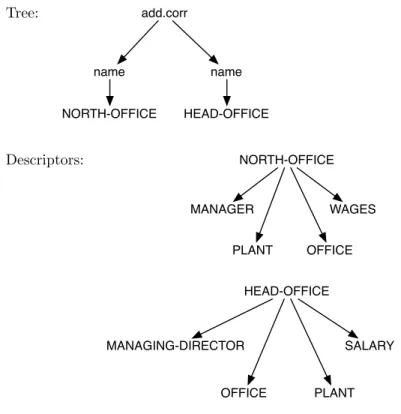
8.4 Single Names with Multiple Descriptors . . . 142
8.4.1 Hierarchical qualification in COBOL . . . 142
8.4.2 Block-structuring and scope . . . 144
9 Accessing an Element of a Data Structure 147 9.1 Accessing an Element of a Vector . . . 148
9.1.1 Fixed-size vectors . . . 150
9.1.2 Run-time checks on vector access . . . 151
9.1.3 Vectors as arguments in a procedure call . . . 152
9.2 Accessing an Element of an Array . . . 152
9.2.1 Multiplicative subscript calculation . . . 153
x CONTENTS
9.3 Record Data Structures . . . 158
9.3.1 Record-type declarations . . . 160
9.3.2 Accessing an element of a record . . . 160
9.3.3 Union types and variant records . . . 163
10 Code Optimisation 165 10.0.4 Language restrictions and accurate optimisation . . . 167
10.0.5 Is optimisation cost-effective? . . . 169
10.1 Net Effect and Order of Computation . . . 170
10.1.1 Basic blocks, regions and structured statements . . . 172
10.2 Optimisation within a Basic Block . . . 174
10.2.1 Constant folding . . . 175
10.2.2 Deferred storage . . . 177
10.2.3 Global register allocation . . . 177
10.2.4 Redundant code elimination . . . 178
10.2.5 Peephole optimisation . . . 180
10.3 Loops and Code Motion . . . 180
10.3.1 Loop-invariant code . . . 181
10.3.2 Strength reduction . . . 182
10.4 Hardware Design and Optimisation . . . 184
10.5 Language Design and Optimisation . . . 185
III
Run-time Support
189
11 Procedure Call and Return 193 11.1 The Tasks of Procedure Call and Return Fragments . . . 19311.2 Layout of Procedure Call and Return Fragments . . . 196
11.3 Recursion and the ‘Efficiency’ of FORTRAN . . . 199
11.4 Simple Stack Handling . . . 201
11.4.1 Allocating space for vectors and arrays . . . 204
12 Arguments and Parameters 209 12.1 Different Kinds of Argument Information . . . 209
12.2 Passing Argument Information . . . 211
12.3 Generating Code for a Single Argument . . . 215
12.4 Checking Stack Limits . . . 217
CONTENTS xi
12.5.1 Mutually recursive procedures . . . 219
12.5.2 Separately compiled sections of program . . . 221
12.5.3 Incompletely specified parameters . . . 222
13 Environments and Closures 225 13.1 An Explicit Representation of the Environment . . . 228
13.2 The Environment Link Mechanism . . . 231
13.3 The Display Vector Mechanism . . . 234
13.4 ALGOL 60’s ‘call by name’ . . . 237
13.5 Block Structure and Data Frames . . . 239
13.6 Non-local ‘goto’ Statements . . . 243
14 Efficiency, Heaps and Lifetimes 245 14.1 Procedure Call with PUSH and POP Instructions . . . 246
14.2 Addressing the Stack with a Single Register . . . 248
14.3 Heap Storage . . . 252
14.4 ALGOL 68, Lifetimes and Pointers . . . 258
14.4.1 Multi-word results . . . 261
14.5 SIMULA 67 ‘classes’ . . . 262
IV
Parsing Algorithms
267
14.6 The Dangers of Backtracking . . . 27015 Notation and Formal Language Theory 273 15.1 Languages and Sentences . . . 274
15.2 Generating a Sentence . . . 275
15.3 Grammars and Productions . . . 278
15.4 The Chomsky Hierarchy . . . 280
15.5 The Parsing Problem . . . 282
15.6 Derivations and Sentential Forms . . . 283
15.7 Equivalence and Ambiguity . . . 284
15.7.1 When is a grammar ambiguous? . . . 288
15.8 Lexical Analysis and type 3 grammars . . . 288
15.9 Warshall’s Closure Algorithm . . . 292
15.10Context Dependency and Two-level Grammars . . . 294
xii CONTENTS
16 Top-down Syntax Analysis 297
16.1 Factoring to Reduce Backtracking . . . 299
16.2 Removing Left Recursion . . . 301
16.3 One-symbol-look-ahead and One-track Analysers . . . 305
16.4 Context Clashes and Null Symbols . . . 309
16.5 A One-track Grammar is Unambiguous . . . 315
16.6 Error Detection and Processing . . . 316
16.6.1 Reporting a syntax error . . . 320
16.7 Pragmatics and Tricks . . . 320
16.8 Interpretive Top-down Analysis . . . 323
16.9 Automatic Generation of Top-down Analysers . . . 327
17 Operator-Precedence Analysis of Expressions 329 17.1 Determining the Precedence of Operators . . . 331
17.2 Numerical Operator Priorities . . . 334
17.3 Reducing a Phrase-pattern to a Single Symbol . . . 337
17.4 An Operator-precedence Grammar is Unambiguous . . . 340
17.5 Input States, Error Detection and Unary Operators . . . 340
17.5.1 Unary expression operators . . . 342
17.5.2 Implementing the input-state mechanism . . . 342
17.6 Recursive operator-precedence analysis . . . 343
18 LR(1) Syntax Analysis 347 18.0.1 Notation and etymology . . . 348
18.0.2 LR(1) languages . . . 350
18.1 Analyser States and the Stack . . . 350
18.2 Why It Works: Non-deterministic Syntax Analysis . . . 353
18.2.1 Efficient implementation . . . 357
18.3 Building an SLR(1) Analyser . . . 358
18.4 Constructing an LALR(1) Analyser . . . 363
18.4.1 Encoding the state table . . . 366
18.4.2 It doesn’t always work! . . . 366
18.5 Error Detection and Tree-building Actions . . . 367
18.6 Error Recovery . . . 368
CONTENTS xiii
V
Interpreting and Debugging
373
19 Interpreters and Interpretation 377
19.1 Interpreting the parse tree . . . 378
19.1.1 The costs of interpretation . . . 378
19.2 Imitative Interpretation . . . 380
19.3 Linearising or Virtual-machine Interpreters . . . 382
19.3.1 Linearising the program . . . 382
19.3.2 Representing the environment . . . 385
19.3.3 Setting up the environment . . . 387
19.4 The Design of Languages for Interpretation . . . 388
19.4.1 ‘Deep’ and ‘shallow’ dynamic binding . . . 388
19.5 Debugging with an Interpreter . . . 389
19.5.1 Run-time editing . . . 391
19.6 Combining Interpretation and Compilation . . . 392
20 Run-time Debugging Aids 395 20.0.1 Assembly Code Debuggers . . . 396
20.0.2 Source Language Debugging . . . 397
20.1 Off-line debugging and the panic dump . . . 397
20.2 Interactive debugging . . . 399
20.3 Run-time event tracing . . . 399
20.4 Break points . . . 400
20.5 Producing Debuggable Code . . . 401
20.6 Doing Without the Debugger . . . 401
A The BCPL language 403
B Assembly code used in examples 407
Section I
Modular Organisation of
Compilers
3 Compilers, at first appearance, seem to display a bewildering variety of organisa-tion: there are single-pass compilers, multi-pass compilers, optimising compilers, load-and-go compilers, interactive compilers and so on and on. Luckily for the compiler-writer, all these apparently different forms can be seen as variations on a simple theme. All compilers perform the same collection of tasks and apparent variations come about because the tasks are put together in slightly different ways or because certain of the tasks are given more emphasis than others in some variations. Below the surface the theme is constant – all compilers per-form the same sequence of essential tasks in the same order and by and large the optional tasks which they may perform have a fixed position in the sequence as well.
It’s this underlying regularity of organisation which makes it possible to describe the principles of compiler writing in a space as small as this book, because the question of the organisation of the compiler as a whole can be separated from the questions of the design of its sub-sections. Each of the sub-tasks, and the various algorithms for carrying it out, can then be studied in relative isolation. In addition the regularity makes compiler writing largely source-language inde-pendent: though to the novice it might seem that a COBOL compiler would differ enormously from a PASCAL compiler I shall show that it isn’t so. Per-haps even more surprising is that the problems of compiler writing are largely object-machine independent as well. Both source language and object machine affect only details of compiler construction, whilst the overall organisation re-mains fixed. Once you have understood the principles of compiler design, most of the details fall naturally into place.
Of the chapters in this section, chapter 1 discusses the organisation of compi-lation as a sequence of phases, each carried out by a separate module of the compiler, and gives brief examples of the operation of each phase. Chapter 2 gives a more detailed introduction to the principles of translation and justifies the use of a tree-walking translation mechanism. Chapter 3 gives an introduc-tion to the principles of syntax analysis. Chapter 4 discusses lexical analysis and loading: apart from a discussion of lexical analysis grammars in chapter 15 and a discussion of symbol-table building algorithms in chapter 8, both of these rather simple topics are then ignored for the rest of the book.
Later sections expand the treatment. Section II concentrates on translation and code optimisation, section III on the code which performs run-time sup-port functions such as stack handling during a procedure call, section IV deals with syntax analysis and section V treats the allied topics of interpretation (as distinct from compilation) of source programs and the run-time debugging of compiled programs.
I discuss these topics in this order because I believe that it is useful to un-derstand mechanisms of translation before mechanisms of syntax analysis, even though syntax analysis occurs before translation when a program is compiled. Translation, with code optimisation, is probably the most interesting phase of compilation to the active compiler-writer. The novice needs some instruction in the mechanisms of syntax analysis – but it comes much easier if you’ve seen the
4
requirements of a translator first. In that way you can see why a syntax analyser is necessary and why it must produce the kind of output that it does. Also, having seen the powers and limitations of simple translation, you’re in a better position to assess the importance (or unimportance) of code optimisation.
Chapter 1
Phases and Passes
The most obvious overall task of a compiler is to read a program in one language – the ‘source’ program in the ‘source’ language – and to translate it to produce an equivalent program in another language – the ‘object’ program in the ‘object’ language. The object language is usually the machine language of a computer, or something close to it, and the source program is usually in a ‘high-level’ language such as FORTRAN, PASCAL, ALGOL 68, SIMULA 67 or BCPL, because translation from high-level language to machine language is the practical problem which compilers exist to solve. Compilers can be written to translate from any kind of programming language into any other, however, with varying degrees of efficiency of the resulting object program.
Another part of the compiler’s overall task, just as important but too often neglected, is that the compiler must check that the source program makes some kind of sense and, when it doesn’t seem to make sense, must produce a descrip-tion of the problem (an error report) so that the programmer can correct the program. I’ll return to discuss the tasks of error detection and reporting later in this chapter.
Before describing how the overall tasks are split up into sub-tasks it’s worth discussing the ways in which the sub-sections of a compiler can be combined to make a complete compiler. The overall activity of compilation can be divided into a sequence of phases, during each of which one of the sub-tasks is carried out. As emphasised in the introduction to this section, all compilers perform the same sub-tasks in the same sequence, and therefore all compilers consist of the same sequence of phases. Conceptually each phase transforms the pro-gram fragment-by-fragment, taking as input a fragment of some representation of the source program and producing as output a fragment of some other, trans-formed, representation. Because the transformation is fragment-by-fragment it is possible to choose how the phases are linked. If each separate fragment goes through all the phases before compilation of the next fragment starts we have
asingle-passcompiler, because all of the source program is compiled in a single
pass over the source text. Conversely, if the entire program goes through each 5
6 CHAPTER 1. PHASES AND PASSES one of the phases before any of it is presented to the next phase we have a multi-passcompiler, because each phase performs a separate pass over the program. Clearly if there areNphases, you can organise the compiler into anything from 1 toNpasses.
Thus every compiler must be multi-phase, but it may or may not be multi-pass. Logically the phases must be joined together in the same order no matter how many passes are employed, so that it might not seem to matter whether this book concentrates on multi-pass or single-pass organisation. In practice, however, the multi-pass organisation is simpler to describe and to understand because the interface between the phases is so much more straightforward. Indeed for some languages – ALGOL 60 is a prominent example – it is difficult to construct an effective single-pass compiler at all and therefore the multi-pass organisation is also more generally useful.
It is often believed that multi-pass compilation is inherently less efficient than single-pass. This is simply untrue: since in any compiler each fragment must be processed by the same sequence of phases, a single-pass compiler must perform the same amount of work as a multi-pass compiler. Suppose, however, that each pass of a multi-pass compiler were to write its output into a disc file (or any backing store file) from which the next pass had to read it in again. Such a multi-pass compiler would indeed be less efficient than a single-multi-pass compiler which didn’t use backing store but the inefficiency would be caused by the overhead of input and output between passes.
A multi-pass compiler which stores the output of each pass in the main computer memory will certainly be no slower than a single-pass compiler. On a modern computer the only disadvantage of multi-pass compilation is that it may use quite a lot of space to store the output of the various passes. Nowadays com-puter memories (for everything but the smallest micro-processors!) are large enough for this minor drawback to be overwhelmed by the enormous advan-tages of clarity of design, and consequent ease of construction, of a multi-pass compiler. For most of the rest of this book I describe a compiler organised in two passes, which is an effective compromise between economy of space and clarity of organisation. In the discussion of compilation algorithms, however, it is usually simplest to imagine that each of the phases in a compiler always performs a separate pass over the program.
1.1
Tasks and Sub-tasks
Figure 1.1 shows a coarse breakdown of the overall compilation task (I deal with the parallel task of error processing separately below). A compiler must first
analysea program to see what its intended effect is. The result of this analysis
will be a representation of the program which is adequate for later translation into the object language. As I show below and in chapter 2, this representation is a structure which shows how the separate fragments of program inter-relate. It splits naturally into two parts:
1.1. TASKS AND SUB-TASKS 7
source program
analysed program
object program ANALYSE TRANSLATE
Figure 1.1: Coarse structure of compilation
(i) the ‘parse tree’ which shows the structure of the program text – how the fragments of program join together to make up larger fragments, how those join to make still larger fragments and so on.
(ii) the ‘symbol table’ which provides a correlation between all the different occurrences of each name throughout the program and hence provides a link between each name and its declaration, whether implicit or explicit, in the source text.
These two information structures are the most important milestones in the compilation process. Compilation as a whole is an activity which first builds up information structures which describe how the program may be broken into frag-ments and how these fragfrag-ments inter-relate, then extracts from these structures the information which is required in order to translate the program.
Neither analysis nor translation is yet a simple enough sub-task to describe individually. Figure 1.2 shows a more detailed breakdown into sub-tasks. The figure shows clearly the hierarchical-sequential nature of the compiling process: each of the sub-tasks is entrusted to a particular phase and the phases don’t overlap at all.1 Capital letters (e.g. LEXICAL ANALYSIS) indicate a phase or sub-task, lower case letters (e.g. parse tree) an information structure or an intermediate program representation.
The arrangement of phases in figure 1.2 is partly determined by the nature of the compiling task but is also partly conventional. In particular the LEXICAL ANALYSIS phase is present for convenience’ sake and the fact that the com-piler’s output is most commonly presented to a LOAD phase before execution is equally a matter of convenience.
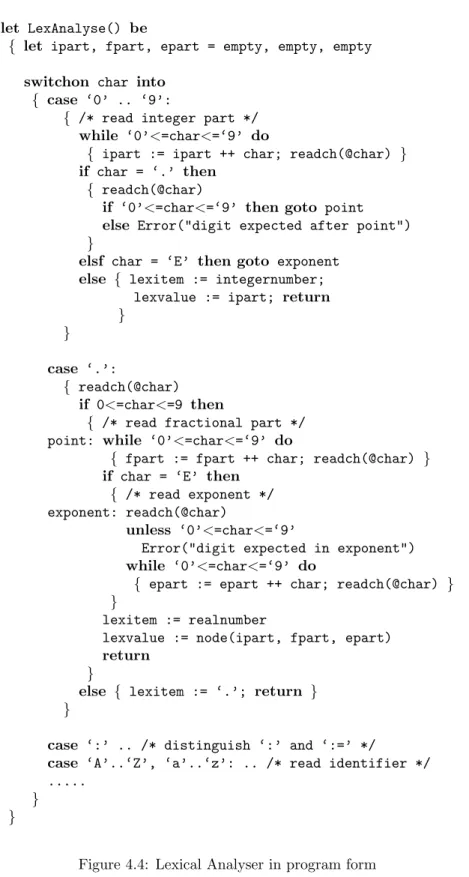
Consider the LEXICAL ANALYSIS phase: it has been found convenient to in-clude a phase, immediately before SYNTAX ANALYSIS, which partitions the characters of the source program into ‘items’, roughly analogous to words and punctuation marks in natural languages. This not only makes the design of the syntax analyser easier, but also it happens that almost all of those sections of the compiler whose speed of operation is important fall into the READ and LEXICAL ANALYSIS phases. Thus the task of improving the compiler’s op-erating efficiency can be reduced to the task of improving the efficiency of the relatively simple input phases and in the rest of the compiler it is possible to
1 There are some minor exceptions to this rule when compiling rather old languages such as
8 CHAPTER 1. PHASES AND PASSES
source program
characters
lexical items
parse tree
object code
object program s
y m b o l t a b l e
READ
LEXICAL ANALYSIS
SYNTAX ANALYSIS
SIMPLE TRANSLATION
LOAD OBJECT
DESCRIPTION
OPTIMISE TREE (optional)
OPTIMISE CODE (optional)
1.2. TRANSLATION AND OPTIMISATION 9 ignore the demands of speed of operation in order to concentrate on clarity of design and construction.
Consider next the LOAD phase shown in figure 1.2. If the source program is split into sections which are compiled separately to produce separate sections of object code, it is necessary eventually to use a loader program to combine all the separate code sections into a complete executable program. At the same time the loader can automatically incorporate sections of code from a separate code library. People find the facility to split their program into sections convenient, so the loader increases human efficiency although in terms of machine utilisation alone it can be more efficient to compile the entire program in one piece and to avoid the loading overhead entirely. At any rate the compiler may, but need not, output code in ‘loadable’ form as the compiler-writer wishes.
I discuss the input and output phases (READ, LEXICAL ANALYSIS and LOAD in figure 1.2) together with the question of code output formats in chap-ter 4, so as to separate these matchap-ters from the more central and more important phases of analysis, translation and optimisation which occupy most of this book.
1.2
Translation and Optimisation
Two of the phases in figure 1.2 are marked as optional – OPTIMISE TREE and OPTIMISE CODE. They are included in the figure because they are so important and so frequently included (or desired by the user if they are not included!). In order to explain the breakdown of the diagram at this point it’s necessary to distinguish between ‘simple translation’ and ‘optimisation’ in general
Simple translation takes a representation of a fragment of the source program and produces an equivalent fragment of object code. It doesn’t take much account of the interaction between fragments, except insofar as it must do in order to produce correct code, but it may be quite sophisticated in the way in which it selects the particular code fragment which it generates as the translation of each source program construct.
Optimisation takes a wider view of the program: it looks at a representation of a larger section of the source program and reorganises the fragments within it, or improves the way in which they interface, so as to produce a shorter object program or a faster object program than simple translation could produce. Sometimes it is possible to produce an optimised object program which is both shorter and faster than one produced by simple translation.
It’s not possible to draw a hard line between the two approaches because it’s not clear when sophisticated simple translation becomes primitive optimisa-tion. Some so-called ‘optimising’ compilers would be better viewed as rather good simple translators: many straightforward compilers include some element
10 CHAPTER 1. PHASES AND PASSES of optimisation. True optimisations, for the purposes of this book, are those translations which exploit peculiarities of the control flow specified in the source program. Chapter 10 discusses this topic more fully.
There are essentially two ways in which a compiler can optimise a program – i.e. produce a better-than-simple translation
(i) It can include a phase which alters the source program algorithm in such a way that subsequent simple translation can produce the desired effect. This is shown as OPTIMISE TREE in figure 1.2: essentially it replaces the source program’s algorithm with another which has the same effect but which can be translated into more efficient code.
(ii) It can include a phase which modifies the code produced by simple trans-lation in order to increase the efficiency of the object program. This is shown as OPTIMISE CODE in figure 1.2: this phase looks mainly at the ways in which the code fragments interface with each other.
These two approaches can be equivalent in their effect and sometimes com-pilers employ both. The OPTIMISE TREE technique is the more machine-independent of the two and is perhaps potentially the more powerful.
1.3
Object Descriptions in the Symbol Table
The names used in a program are merely used to identifyrun-time objectsof one kind or another – variables, arrays, records, procedures, labels and so on. Apart from the needs of debugging, the source program names used are completely arbitrary and the object program operates entirely upon the run-time objects without taking any account of the names which originally introduced them. In order to keep track of the association between names and run-time objects, the compiler must keep a table (the symbol table in figure 1.2) in which it stores against each name a description of the run-time object which that name denotes. The translator uses this table to replace each occurrence of a name by a reference to the corresponding run-time object.
As names are encountered in the source program they are inserted into the symbol table by the lexical analyser (more discussion of this in chapters 4 and 8) but information about the associated run-time object can only be inserted after the program has been syntactically analysed. Names are ‘declared’ ei-ther implicitly (e.g. in FORTRAN) or explicitly (most oei-ther languages!). In general the declarative information must be processed before any statement using the name can be translated. Thus correlation of names with run-time objects must precede translation, but must of course follow syntax analysis in which the declarative information is recognised. So there is only one time in the compilation process at which such correlation is possible – hence the OBJECT DESCRIPTION phase in figure 1.2 falls between syntax analysis and simple translation or optimisation.
1.4. RUN-TIME SUPPORT 11
program: begin integer a,b; ....
procedure A(x) real x;
begin real y;
.... B(‘a’); ....
end;
procedure B(u) character u;
begin string v;
.... A(3.7); ....
end;
.... A(1.0); ....
end
After outer block calls A, which calls B, which calls A again:
a b outer block
x y A(i)
u v B
x y A(ii)
Figure 1.3: Activation Record Structure in a simple program
1.4
Run-time Support
Much of the object program consists of instructions which carry out the tasks of calculation, assignment, comparison, etc. which are specified in the source program. However there are also sections of the source program whose task is
run-time supportof various kinds. Two important tasks of run-time support are
to implement the storage and register manipulations necessary for the execution of a procedure call2(discussed in detail throughout section III) and the
mainte-nance of ‘heap’ storage systems (touched on in chapter 14). The efficiency of the run-time support fragments in the object program ought to be a major concern of the compiler writer: users will present programs for compilation which are based on highly efficient algorithms and will be justifiably annoyed if the object program is inefficient purely because of the operation of run-time support code fragments ‘behind the scenes’.
The most important task of the run-time support fragments is to maintain the
Activation Record Structure. When a procedure call is executed a procedure
2 Throughout this book I use the word ‘procedure’ to include the word ‘function’ – a function
is merely a procedure which computes and returns a result. So far as run-time support is concerned, functions and procedures are almost identical.
12 CHAPTER 1. PHASES AND PASSES
activation is created, which exists until the corresponding procedure return is
executed. In non-recursive languages such as FORTRAN only one activation at most can ever exist for each procedure but in languages which permit recursion there may be several activations in existence, each in a different stage of exe-cution of a single procedure body and each with its private storage and private copy of the arguments with which it was called. Each of these activations can be described by a data structure – in a recursive programming language the data structure is an ‘activation record’, ‘data frame’ or ‘stack frame’ stored on a stack – and the linkages between these data structures define the Activation Record Structure. Figure 1.3 shows a simple example of the structure which can result.
The maintenance of the Activation Record Structure in an implementation of a recursive programming language is an important ‘overhead’ cost in the execution of the object program. By prohibiting recursion, languages such as FORTRAN reduce the overhead cost but the discussion in section III shows how careful design of code fragments can minimise or even eliminate the efficiency gap be-tween recursive and non-recursive languages. Even recursive languages must restrict the manipulation of some values in the object program in order to allow the Activation Record Structure to be kept in a stack: chapter 14 discusses the way in which the necessary restrictions can be applied in an implementation of ALGOL 68 and touches on the implementation of SIMULA 67, which can avoid the imposition of such restrictions because it doesn’t use a data-frame stack.
1.5
Source Program Errors
“Any fool can write a compiler for correct source programs” (J.S. Rohl 1972)
People write programs and people make mistakes. They often need help in order to correct their mistakes and sometimes a compiler can provide it. Compiler designers too often seem to place ‘helping people’ rather low down on their scale of priorities, well below ‘compiler efficiency’, ‘object program efficiency’ and ‘source language facilities’. My opinion is that this order of priorities is wrong-headed but I hope to demonstrate in this book that it is unnecessary as well. There is no conflictin practice between, on the one hand, the goal of providing help with errors in source programs and, on the other hand, the goal of providing a compiler which is efficient and which produces efficient object programs.
A compiler has two basic tasks to perform in connection with source programs which contain errors:
(i) Compile-time error processing:
The compiler must somehow provide information to a programmer who has submitted a program which cannot be compiled. The information must, as far as possible, give an explanation of why the program cannot
1.5. SOURCE PROGRAM ERRORS 13 be compiled and if possible make suggestions as to how the error might be corrected.
(ii) Error-checking code:
Many programs, though syntactically correct, specify impossible sequences of operations when they are executed. Some object program errors (e.g. arithmetic overflow) may be detected by the object machine’s hardware but probably many others will not be. In order to detect run-time errors which are not covered by hardware checks the compiler must produce ob-ject code fragments which check whether a run-time error has occurred each time they are run. An example is the array-bound check: it is com-mon for a compiler to generate code for an array access which checks the validity of the array subscript each time an access is made.
In either case error processing can be divided into three separate activities: error
detection, errorreportingand errorrecovery.
First consider time errors: chapter 3 and section IV show that compile-time error detection is an automatic consequence of the normal compilation process. This implies that detection of errors cannot affect the speed of op-eration of a compiler; therefore the (imaginary super-human) user who always writes correct programs is not affected by the vagaries of ordinary mortals, at least so far as speed of compilation is concerned. Once an error has been de-tected in the source program the programmer is no longer concerned simply with how rapidly the compiler translates but rather with how quickly the error can be removed from the program. A small amount of computer time spent in error reporting and recovery is well spent if it saves human time and effort. Of course a compiler which includes a great deal of error reporting and recovery facilities will be larger than one that contains only a small amount and so there is some penalty in terms of space occupied, but the extra space and the few fractions of a second of computer time spent in producing a readable error report are surely worthwhile if they save minutes (or perhaps hours!) of human effort.
Similar considerations apply to run-time error-handling. In this case error-detection can be expensive – the code fragments which repeatedly check for error will inevitably slow down the execution of the object program – but the bulk of the error processing code will be concerned with error reporting and error recovery and so will only be activated when an error has already been detected. It’s outside the scope of this book to debate when, if ever, the programmer should ask the compiler to omit error checking code so as to save execution time and object program space – at any rate the compiler should always give the option that it can be included.
Chapter 20 discusses run-time error handling in detail. I include run-time error checking as a task of the compiler, rather than of the operating system or of some other separate program, because the design of object code fragments must take into account the needs of run-time error-checking and error-reporting. Furthermore the compiler designer must consider the production, at compile-time, of information structures which will be used by a run-time debugger to
14 CHAPTER 1. PHASES AND PASSES
begin integer a; real b; a := 1; b := 1.2; a := b+1;
print(a*2)
end
Figure 1.4: Example program
provide error reports related to the original source program. The requirements of run-time error processing can have a major influence on the detail design of object code fragments.
Figure 1.2 doesn’t include any mention of error processing but in reality it is a part of the task of every phase of compilation. I shall return again and again in later chapters to the question of how the various phases may be designed to produce readable and understandable error reports.
1.6
Two-pass Compilation
Most compilers that aren’t single-pass use only two passes rather than the four or five implied by the structure of figure 1.2. Using two passes is a popular com-promise between generality and the somewhat demanding space requirements of a true multi-pass compiler. The two-pass organisation essentially follows figure 1.1 – there is an analysis pass and a translation pass. The analysis pass includes the READ, LEXICAL ANALYSIS and SYNTAX ANALYSIS phases. In order to combine these phases into a single pass it is conventional to make READ a subroutine of LEXICAL ANALYSIS and LEXICAL ANALYSIS a subroutine of SYNTAX ANALYSIS – as chapter 4 shows, this isn’t very difficult. The translation pass usually consists of a SIMPLE TRANSLATION phase only. The two-pass organisation seems to leave out the OBJECT DESCRIPTION phase entirely and in a two pass compiler this phase is rather difficult to include as a separate entity. Object description is usually carried out piecemeal during one or other (or both) of the passes. Perhaps most convenient is to perform all object description during the translation pass: every time the translator encounters a section of the tree that may contain declarative information it must be processed by the object description phase, which creates symbol table descriptors based on any declarations contained in that section of the tree, before it can be translated into object code. The examples in sections II and III show algorithms in which the object description phase is a subroutine of the translation phase, called each time the translator encounters a ‘procedure declaration’ node or a ‘block’ node in the parse tree.
1.6. TWO-PASS COMPILATION 15
beginsymbol integersymbol
name, semicolonsymbol
realsymbol name, semicolonsymbol
name, assignsymbol
number, 1 semicolonsymbol
name, assignsymbol
....
a b
(empty) (empty) Name Description
Figure 1.5: Part of the output from the lexical analyser
block
declarations statements
intdecl realdecl assign assign assign ProcCall
a b a 1 b 1.2 a +
b 1
print *
a 2
16 CHAPTER 1. PHASES AND PASSES
assign
name plus
name number 1
(pointer to entry for ‘a’ in symbol table)
(pointer to entry for ‘b’ in symbol table)
Figure 1.7: Data structure representation of a tree
a variable, integer, address #1
b variable, real, address #2
print procedure, one integer argument, address from loader
Figure 1.8: Symbol table descriptors
LOAD 1, address #2 fADDn 1, 1.0
FIX 1,
STORE 1, address #1
1.7. AN EXAMPLE OF COMPILATION 17
1.7
An Example of Compilation
In the rest of this chapter I show, very briefly, the action of some of the phases of compilation taking as example input the program of figure 1.4. First of all the characters of the program are read in, then these characters are lexically analysed into separate items. Some of the items will represent source program identifiers and will include a pointer to the symbol table.3 Figure 1.5 shows
part of the results of lexical analysis: in most languages subdivision of the input into items can be performed without regard to the context in which the name occurs.
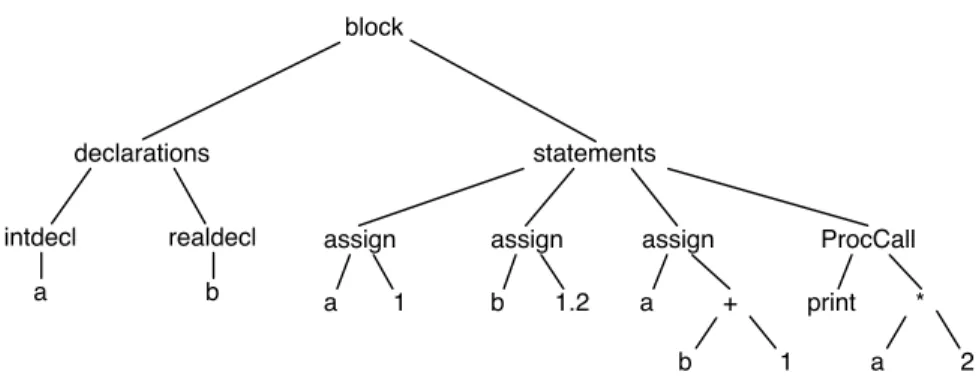
Next, the syntax analyser examines the sequence of items produced by the lexical analyser and discovers how the items relate together to form ‘phrase’ fragments, how the phrases inter-relate to form larger phrases and so on. The most general description of these relationships of the fragments is a tree, as shown in figure 1.6.
Each node of the tree includes a tag or type field which identifies the kind of source program fragment described by that node, together with a number of pointers to nodes which describe the subphrases which make it up. Figure 1.7 shows how part of the tree shown in figure 1.6 might actually be represented as a data structure. There are of course a number of different ways of representing the same tree, and that shown in figure 1.7 is merely an example. There are as many different ways of drawing the structure, and throughout most of this book I shall show trees in the manner of figure 1.6. The only significant differences between the two picturings is that, in the first, nodes aren’t shown as sequences of boxes and names aren’t shown as pointers to the symbol table. Figure 1.7 is perhaps more faithful to reality, so it should be borne in mind whenever you encounter a simplified representation like that in figure 1.6.
After syntax analysis, the object description phase takes the tree and the symbol table entries produced by the lexical analyser. It analyses the declarative nodes in the tree, producing descriptive information in the symbol table as shown in figure 1.8. Standard procedures, such as ‘print’, may receive a default declara-tion before transladeclara-tion: figure 1.8 shows a possible entry in the symbol table. Note that, since the tree contains a pointer to the symbol table in each node which contains a reference to an identifier, neither object description phase nor translator need search the symbol table but need merely to follow the pointer to the relevant entry.
After the object description phase has filled in the descriptors in the symbol table, a simple translation phase can take the tree of figure 1.7 together with the symbol table of figure 1.8 and produce an instruction sequence like that shown in figure 1.9.4
3 The item which represents a number may also contain a pointer to a table which contains
a representation of the number. For simplicity figures 1.5 and 1.6 show the value of the number as part of the lexical item itself.
18 CHAPTER 1. PHASES AND PASSES The addresses used in the instructions need finally to be relocated by the loader. Suppose that, when the program is loaded into store, its memory cell space starts at address 23. Then the first line of figure 1.9 would be converted into ‘LOAD 1, 24’ and the last line into ‘STORE 1, 23’.
Optimisation of the object code in this case could produce an enormous im-provement in its execution efficiency. The total effect of the program is to print the number ‘4’. By looking at the way in which the values of variables are used throughout the program and by deferring translation of assignment statements until their result is required – in this case they are never required – an optimi-sation phase could reduce the program just to the single statement ‘print(4)’. Optimisation is a mighty sledgehammer designed for bigger nuts than this ex-ample, of course, and it is always an issue whether the expense of optimisation is worth it: in the case of figure 1.4 it would certainly cost more to optimise the program than it would to run it!
Summary
The underlying organisation of compilers is simple and modular. This chapter discusses how the various phases cooperate so that later chapters can concen-trate on the separate phases in isolation.
Input and lexical analysis is discussed in chapters 4 and 8; syntax analysis in chapters 3, 16, 17 and 18; object description in chapter 8; translation in chapters 5, 6, 7 and 9; optimisation in chapter 10; loading in chapter 4; run-time support in chapters 11, 12, 13 and 14; run-time debugging in chapter 20.
Chapter 2
Introduction to Translation
The most important task that a compiler performs is to translate a program from one language into another – from source language to object language.Simple translationis a mechanism which takes a representation of a fragment of
the source program and produces an equivalent fragment in the object language – a code fragment which, when executed by the object machine, will perform the operations specified by the original source fragment.
Since the object program produced by a simple translator consists of a sequence of relatively independent object code fragments, it will be less efficient than one produced by a mechanism which pays some attention to the context in which each fragment must operate. Optimisationis a mechanism which exists to cover up the mistakes of simple translation: it translates larger sections of program than the simple translator does, in an attempt to reduce the object code inefficiencies caused by poor interfacing of code fragments.
In order to be able to produce object code phrases the translator must have access to asymbol tablewhich provides a mapping from source program names to the run-time objects which they denote. This table is built by the lexical analyser (see chapters 4 and 8) which correlates the various occurrences of each name throughout the program. The mapping to run-time objects is provided by the object description phase (see chapter 8) which processes declarative in-formation from the source program to associate each identifier in the symbol table with a description of a run-time object.
This chapter introduces the notion of a ‘tree-walking’ translator, which I believe is a mechanism that is not only easy to construct but which can readily and reliably produce efficient object code fragments. Such a translator consists of a number of mutually recursive procedures, each of which is capable of translating one kind of source program fragment and each of which can generate a variety of different kinds of object code fragments depending on the detailed structure of the source fragment which is presented to it.
Because the process of translation depends on the selection at each point of one 19
20 CHAPTER 2. INTRODUCTION TO TRANSLATION Statement:
if hour*60+minute=1050 or tired then leave(workplace)
conditional statement
[EXPRESSION] Boolean or
[STATEMENT] procedure call
[LEFT] relation =
[RIGHT] name
tired [LEFT]
arithmetic +
[RIGHT] number
[PROCEDURE] name
[ARGUMENTS] name
leave workplace
1050 [LEFT]
arithmetic *
[RIGHT] name minute [LEFT]
name hour
[RIGHT] number
60
Figure 2.1: Tree describing a simple statement
of a number of possible code fragments translators tend to be voluminous, but since the selection of a fragment is fairly simple and generating the instructions is very straightforward, they tend to run very rapidly. A simple translator will usually use less than 15% of the machine time used by all phases of the compiler together, but will make up more than 50% of the compiler’s own source code.
2.1
Phrases and Trees
In this chapter I introduce the technical termphrase, which is used to describe a logically complete fragment of source program. Statements, for example, are phrases; so are expressions. Phrases are either ‘atomic’ – e.g. a name, a number – or are made up of sub-phrases – e.g. a statement may have a sub-phrase which is an expression, the statement itself may be a sub-phrase of a block which is a sub-phrase of a procedure declaration, and so on. In this chapter the largest phrase shown in the examples is an expression or a simple structured statement. In a multi-pass compiler the unit of translation is the entire program – at least
2.1. PHRASES AND TREES 21
cond
or
=
+
*
call
numb 1050
numb 60
tired (in symbol table)
leave (in symbol table)
workplace (in symbol table)
minute (in symbol table)
hour (in symbol table)
22 CHAPTER 2. INTRODUCTION TO TRANSLATION at the topmost level – but a single page isn’t large enough to show the necessary trees!
The state of the art in programming language translation is now, and will remain for some time, that a program can only be translated if it is first analysed to find how the phrases inter-relate: then the translator can consider each phrase in turn. The result of the analysis shows how the program (the phrase being translated) can be divided into sub-phrases and shows how these sub-phrases inter-relate to make up the entire phrase. For each sub-phrase the description shows how it is divided into sub-sub-phrases and how they are inter-related. The description continues to show the subdivision of phrases in this way until the atomic phrases – theitemsof the source text – are reached.
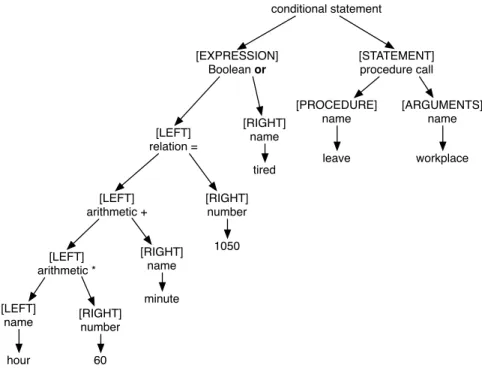
The most general representation of the results of such an analysis is a tree like that in figure 2.1. The lines arebranches, the place where branches start and finish are nodes. The topmost node of the tree is its root – the tree is conventionally drawn ‘upside down’. Nodes which don’t divide into branches
areleavesand represent the atomic items of the source program. Each phrase of
the source program is represented by a separate node of the tree. To translate a phrase it is merely necessary to concentrate on one node and, if it has sub-nodes, to translate its sub-nodes as well.
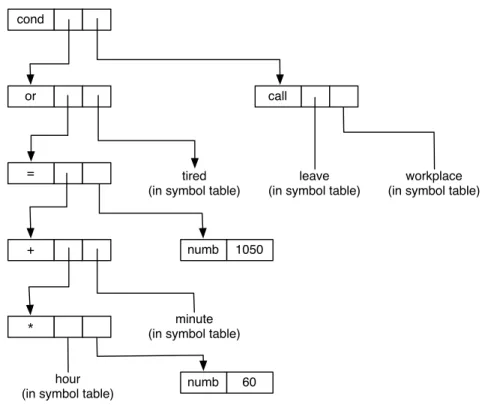
Figure 2.2 shows a possible data-structure representation of the tree of figure 2.1 using record-vectors and pointers. Many other representations are possible – for example one in which each pointer is represented by a subscript of a large integer vector. The tree structure, no matter how it is represented, gives the translator the information it needs in order to translate the statement – it shows which phrases are related, and how they are related. From the source statement it isn’t immediately obvious what the object program should do. Should it, for example, evaluate ‘hour*60’ ? Must it evaluate ‘minute=1050’ ? What about ‘1050ortired’ ? A glance at the tree gives the answers – only the first is represented by a node because analysis has shown it to be a phrase of the program.
In order to be able to translate a phrase of a program it isessentialto know what kind of phrase it is, what its sub-phrases are and how they are inter-related. There can be non-tree-like representations of the necessary information, but the tree holds and displays the information in its most accessible and useful form. In addition it emphasises the essentially recursive nature of translation – a nature which is somewhat hidden, but not denied, in so-called ‘linear’ representations.
2.2
Tree Walking
It’s extremely easy to translate – generate code for – a phrase if you know how to generate code for its sub-phrases. Figures 2.3 and 2.4 show some sample procedures which translate in this way. Each procedure translates a phrase by generating a single instruction, or a short sequence of instructions, which links together the code fragments that are the translation of its sub-phrases. Only
2.2. TREE WALKING 23
• Conditional statement (if-then):
1. call procedure which generates code to load value of expression part into register 1;
2. invent a label #Lf;
3. generateJUMPFALSE 1, #Lf;
4. call procedure which generates code to carry out statement part; 5. generate#Lf:.
• Booleanor(result to be in register k):
1. : call procedure which generates code to load value of left operand into register k;
2. call procedure which generates code to load value of right operand into register k+1;
3. generateORr k, k+1.
• Relation ‘=’ (result to be in register k):
1. call procedure which generates code to load value of left operand into register k+1;
2. call procedure which generates code to load value of right operand into register k+2;
3. generateLOADn k, TRUE SKIPEQr k+1, k+2 LOADn k, FALSE.
• arithmetic ‘+’ (result to be in register k):
Exactly as for Booleanor, except that the final instruction is
ADDr k, k+1.
• arithmetic ‘*’ (result to be in register k):
Exactly as for Booleanor, except that the final instruction is
MULTr k, k+1.
24 CHAPTER 2. INTRODUCTION TO TRANSLATION
• name (value to be loaded into register k)
generateLOAD k,<run-time address of variable denoted by name> • number (value to be loaded into register k)
if value is small enough then
generateLOADn k,<value of number>
else generateLOAD k,<run-time address where value will be found> Figure 2.4: Translation procedures for leaf nodes
ADDr 2, 3 LOADn 3, 1050 LOADn 1, TRUE SKIPEQr 2, 3 LOADn 1, FALSE LOAD 2, tired JUMPFALSE 1, #Lf ....
<procedure call> #Lf:
<rest of program> LOAD 2, hour LOADn 3, 60 MULTr 2, 3 LOAD 3, minute
ORr 1, 2
.... ....
[name]
[name]
[name] [number]
[number] [*]
[+] [=]
[or]
[if]
2.3. LINEAR TREE REPRESENTATIONS 25 hour, 60, *, minute, +, 1050, =, tired,or
Figure 2.6: Linearised expression
for indivisible phrases (leaf nodes) is it necessary to know how to translate the entire phrase. In order to generate code for a sub-phrase, all the translator needs to do is to look at the type of phrase it is – the ‘tag’ or ‘type’ field of the tree node – and to call the relevant translation procedure.
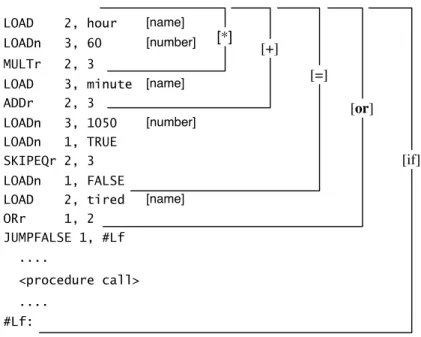
Figure 2.5 shows the code produced by these procedures when presented with the tree of figure 2.1. (The figures don’t show the translation procedure which handles the procedure call node, or the code produced – section III deals with this topic.) Starting at the root of the tree, the translator works downwards. It’s essentially a recursive process – one operand of a ‘+’ node may be another ‘+’ node or may contain a ‘+’ node, for example. Since the process is recursive it’s trivially easy to translate structured statements like the conditional statement which might at first seem the hardest to translate. Imagine how straightforward it is to translate a PASCAL compound statement or an ALGOL 68 serial clause! The most important thing to note about figure 2.5 is that the code wouldwork if it was given to the object machine to execute. Tree walking is a powerful technique precisely because it is easy to design procedures like those in figures 2.3 and 2.4 which really will generate accurate code. The object code produced by these procedures isn’t optimal by any means, but it’s relatively trivial to change the procedures to improve it. Each procedure is a separate module: although figure 2.3 doesn’t include all of the standard programming language expression operators, it wouldn’t be necessary to make any changes to the existing set when new node-translating procedures are added.
2.3
Linear Tree Representations
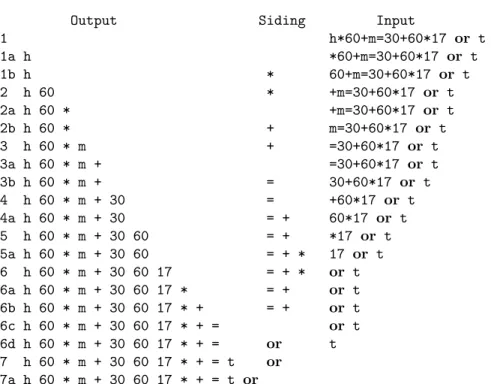
Before describing how to improve the code produced by the translation proce-dures of figure 2.3 and 2.4 it is necessary to dispose of a red herring – ‘Reverse Polish’ or ‘postfix string’ representation. The collection of procedures in figures 2.3 and 2.4 describe atree walk– a process which visits the nodes of the tree in a particular, predetermined order. If the nodes of the expression part of the tree of figure 2.1 are written out in just the order in which the tree walker would visit them then a translator can walk them with a non-recursive algorithm. Figure 2.6 shows the nodes of the tree from figure 2.1, written out in the order in which they are visited by the tree walker.
Considering only the string which represents the expression part of the tree in figure 2.1, it is possible to define a simple iterative procedure which generates code for it: figure 2.7 shows a possible algorithm. There is a slight difficulty with the ‘=’ node, which is in effect ‘visited’ twice in the tree walk, once to reserve the register which will hold TRUE or FALSE and once to actually generate the
26 CHAPTER 2. INTRODUCTION TO TRANSLATION
k := 1 /* k records next free register */
until end-of-string do
switchon current-element into case name:
Gen(LOAD, k, <address of variable>) k := k+1 endcase
case number:
if number is small enough then
Gen(LOADn, k, <value of number>)
else
Gen(LOAD, k, <address where value will be found>) k := k+1 endcase
case ‘+’:
Gen(ADDr, k-2, k-1); k := k-1 endcase
case ‘*’:
Gen(MULTr, k-2, k-1); k := k-1 endcase
case ‘=’:
Gen(LOADn, k, TRUE) Gen(SKIPEQr, k-1, k-2) Gen(LOADn, k, FALSE) Gen(LOADr, k-2, k) k := k-1 endcase
case ‘or’:
Gen(ORr, k-2, k-1); k := k-1 endcase
default: CompilerFail("invalid element in string")
current-element := next-element
2.4. IMPROVING THE TREE WALKER 27
LOAD 1, hour
LOADn 2, 60 MULTr 1, 2
LOAD 2, minute
ADDr 1, 2
LOADn 2, 1050 LOADn 3, TRUE SKIPEQr 1, 2 LOADn 1, FALSE
LOADr 1, 3 /* extra instruction */ LOAD 2, tired
ORr 1, 2
Figure 2.8: Code produced by the linear string walker
instructions which carry out the comparison. In the case of a simple Reverse Polish string the operator appears only once, so that the code for the ‘=’ node must move the computed value into its intended register – the ‘extra instruction’ shown in figure 2.8.
The string walking algorithm uses a stack of registers, so its status as ‘non-recursive’ is in doubt anyway. Note that it is impossible to vary the way in which the tree is walked, according to some code generation strategy, after the string has been generated. Use of a postfix string representation of the source pro-gram merely freezes the compiler into a particular kind of tree walk. Although the string-walking algorithm could be improved quite easily in some ways (e.g. avoiding ‘LOAD,ADDr’ instructions in sequence) most of the improvements which are introduced below and discussed in detail in later chapters involve changing the way the tree is walked and so are impossible (or at best extremely difficult) using any linear representation.
2.4
Improving the Tree Walker
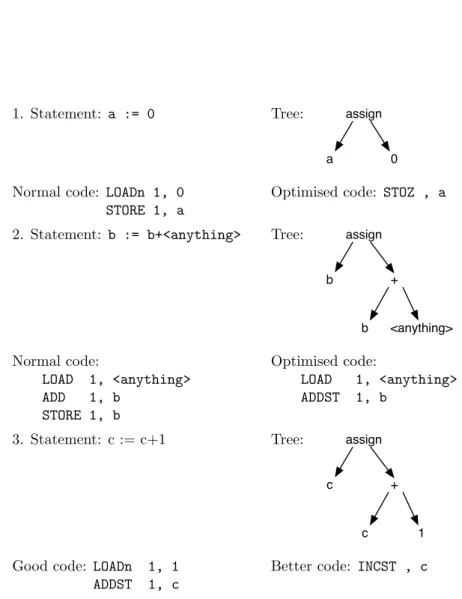
Once you have a working translator, you are in business as a compiler-writer. Using tree walking will get you to this point faster. It will also help you to get farther and faster along the road to better code than any ad hoc solution could. Improving the efficiency of the code produced by a tree-walking translator means looking at the code fragments generated by one or more of the procedures and deciding that the procedure’s strategy was weak, or that it should look out for that particular source construct and generate a specially selected code fragment for it. The various possibilities are summarised in figure 2.9. It’s hard to decide where tactics shade into strategy: figure 2.10 shows an improved arithmetic ‘+’ procedure. This procedure saves an instruction and a register when the right operand is a leaf: I would classify this as a tactical manoeuvre. Using this
28 CHAPTER 2. INTRODUCTION TO TRANSLATION
1. Generate special code for a node with a special local property (tactics). 2. Alter the way the tree is walked when a node has a particular general
property (strategy).
3. Modify the tree before it is walked (optimise the tree).
4. Modify the code which was generated, after the tree walk has finished (optimise the code).
Figure 2.9: Tactics and strategy
• arithmetic ‘+’ (result to be in register k)
1. generate code to calculate value of left operand in register k 2. if right operand is a name then
generateADD k,<address of variable> else if right operand is a number then
generateADDn k,<value of number>
or ADD k,<place where value will be found> else
(a) generate code to calculate value of right operand in register k+1; (b) generateADDr k, k+1.