Research Article
a
April
2018
Computer Science and Software Engineering
ISSN: 2277-128X (Volume-8, Issue-4)
Critical Analysis of Numerous Attacks Irreverent Security in
Remote Sensor Networks
Er. Komal Sharma
M.Tech Student, SIET, Aliyaspur Ambala, Haryana, India
Er. Anuradha Saini
A.P. CSE Deptt., SIET, Aliyaspur Ambala, Haryana, India
Abstract: Remote Sensor Networks have risen as innovation of the current century and has givenan intense blend of dispersed detecting, figuring and correspondence of attacks. With its developing application regions, especially in mission-basic applications, for example, military observing frameworks and war zone observation, security has turned into a critical need keeping in mind the end goal to ensure the touchy information included. The need of viable and effective security systems is necessary and to secure sensor systems has pulled in a lot of scientists' consideration making it hot research zone in the current years. Among the quantity of assaults on the sensor arrange, the Selective Forwarding attack, assumed name as grayhole attack, is a genuine and difficult to-distinguish security assault that can render the system ineffective if the attack was left undetected. In this attack, the principal objective of the attacker is to keep the critical delicate information from achieving the base station. To accomplish this objective, the harmful hub specifically drops certain nodes, in view of some picked criteria, and advances the remaining. The assault turns out to be more viable when the attacker incorporates itself on the way of the information flow. This paper aims to give an outline and investigation of existing ways to deal with counter particular sending assault in remote sensor systems.
Keywords: - DoS, Gray hole Attack, Selective Forwarding Attack, Remote Sensor Network.
I. INTRODUCTION
Remote Sensor Networks have risen as “Modern Day Technology" drawing in a lot of researcher’s consideration. The current advances in the minimal effort, low power gadgets, and the radio advances have strengthened the development of remote sensor systems with the wide region of uses including the front line reconnaissance, military observing framework, home mechanization, ecological checking, human services checking and some more. Remote sensor systems provide a large number of applications particularly that comprise of an expansive number of ease, low power, asset obliged, minor savvy sensors, imparting utilizing the remote medium and are thickly and arbitrarily sent with no settled topology in remote and threatening areas. The sensor nodes are normally battery fueled and have extremely constrained assets as far as vitality, stockpiling, and handling abilities. To detect, locally process the data and convey it to the base station are the three key undertakings of a sensor hub. Other than giving the unlimited openings, the sensor arranges likewise give security challenges as a result of the delicate information included, constrained battery and memory assets and unattended condition.
Sensor systems are powerless against various security attacks which can be either outside attack or inside attack [1]. Outside attacks are not exceptionally successful and do not make much harm to the system since they don't have the entrance to the system data. Inside attacks, then again, are extremely powerful and can disturb the typical system working as the enemy is a piece of the system and approaches the system data. This makes it hard to identify the enemy which utilizesvarious security components, approval and confirmation, as the enemy is true blue individual from the system. One such security assault on the sensor systems is the Selective Forwarding attack, which is propelled with goal to destroy the essential data with the base station. Such an attack is hard to recognize and is even more powerful when the attacker incorporates itself on the way of information flow of data out of source to goal [5]. The assault is for the most part unsafe if there should be an occurrence of mission basic applications and can possibly upset the ordinary system task and render the system pointless. Various security components have been proposed so far to counter the specific sending assault either by discovery or by aversion. This paper design an outline of the current ways to deal with counter the attack.
II. SELECTIVE FORWARDING ATTACK
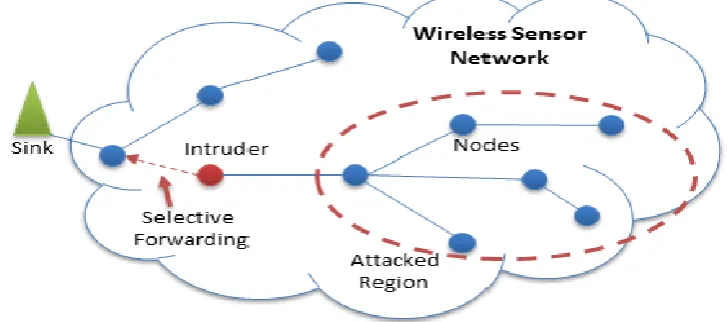
ISSN(E): 2277-128X, ISSN(P): 2277-6451, pp. 68-75 guaranteeing they are not engendered any further." It is by and large accepted that the halfway hubs, in multihop sensor systems, taking an interest in the correspondence procedure between the source and the sink, reliably forward the messages they get from alternate hubs [4 ,9]. In the Selective forwarding attack, otherwise called grayhole assault, the traded off node endeavors to disturb the typical correspondence process by specifically dropping the specific bundles while sending the others. The opponent may drop the parcels starting from the specific hub or a gathering of hubs, hence causing the foreswearing of administration for that node(s) or the bundles of a specific kind, for instance, bundle announcing the directions of the tank in front line. The specific sending attacker can be propelled as inside assault by trading off a true blue hub inside the system to drop the subset of parcels while sending the others.
Figure 1: Selective Forwarding Attack
To be more successful, the enemy tries to put itself on the genuine information stream way between the two conveying nodes as this will get more movement. In light of the constrained transmissiongo, sensor arranges advances the nodes to the base station in multihop way and keeping in mind that being directed to the base station bundles might be dropped due to crash, clog or other system issues. The specific sending assault abuses these system issues and in this manner turns out to be harder to recognize.
III. TYPES OF SELECTIVE FORWARDING ATTACK
In Selective forwarding attack the compromised node tries to block the communication between the communicating nodes by dropping packets. Figure shows the other forms of selective forwarding attacks.
Black Hole Attack: -In this attack the malicious node drops down every packet it receives & forward the packet to wrong path thus creates false information regarding the routing information [6].
Neglect and Greed: -In this attack the malicious node neglect out the forwarded packet but still acknowledge the reception of data information to the sender. When the node gives priority to its own messages, it becomes greedy, thus dropping the packets received from the other nodes and forwarding its own messages.
Blind Letter Attack: -In this assault the self-assertively pernicious hubs ought to ensure that the hub, to which the following jump hub advances the handing-off parcel, is extremely a neighbor of the following bounce hub.
IV. EXISTING SECURITY MECHANISMS RELATED TO SELECTIVE FORWARDING ATTACK
There exist a large number of security mechanism that are related to Wireless Sensor Networks which can be categorized as prevention and detection schemes. The major difference between these two is that prevention scheme only
Selective Forwarding
Attack
Black Hole Attack
Neglect and Greed
ISSN(E): 2277-128X, ISSN(P): 2277-6451, pp. 68-75 focuses on to deliver the packet to the destination bypassing the malicious node and in detection scheme, it tries to identify the malicious node and isolate it from the network after informing about its presence to the authentic node.
Detection methods are further classified into two categories. Centralized and Distributed. In the first one, the main responsibility is of the cluster head to have an effective communication in the whole network and to block the attacks that are caused by selective forwarding attack[8]. The remaining nodes of the network do not participate in the whole communication.While in the later one, Distributed method involves the participation of all the nodes with the cluster head or the base station to block the attacks done by selective forwarding scheme.
V. LITERATURE REVIEW
1. P Suma, O Nagaraju, MA Hussainet.al [1] In this author proposed an answer for averting mystery tuning in of information called listening stealthily and furthermore in decreasing the level of harm through various assaults like worm opening, dim gap assaults and numerous others. Furthermore, the primary favorable position is the accomplishment of security with slightest cost and least time for transmission. This is accomplished utilizing Secure and Effective Random Paths Selection (SERPS) Algorithm to give security in MANETs. The fundamental topic behind this calculation is ascertaining hub disjoint ways and after that the base cost ways among them. At that point the directing is done through all the chose ways in irregular. As a rule for correspondence between hubs, a particular way must be concluded for information transmission. This way has numerous transitional hubs (say N). The entire information is isolated into bundles and these parcels need to go through every single halfway hub (N1, N2....Nm). Assume an assailant is available at N5 and can read every one of the information going through. So security is lost for the secret information. With a specific end goal to deal with such calamity, SERPS calculation functions admirably. This calculation works utilizing the accompanying three stages 1) Find the hub disjoint ways between the source and goal. 2) Find the cost of every hub disjoint ways and select few among them (at least 4 ways). This choice depends on the base cost (number of bounces between the sender and recipient). This should be possible by applying Loop less k most limited way calculation to all the hub disjoint ways. Utilizing this calculation, we can discover the base cost way, as well as the cost of the considerable number of ways in expanding request. 3) Route the bundles by choosing the courses (hub disjoint and least cost) in arbitrary.
2. Yuxin Mao and Ping Zhu et.al [2], In this paper, an algorithm known as SERPS (Secure and Effective Random Paths Selection) is proposed which defines the concept of minimum cost in order to achieve security. Among them all a Minimum of 4 cost paths are selected .After then data packets are sent randomly by selecting the path with the condition that no two consecutive packet will follow the same path. Because of this strategy attacker is able to get only the random information of packets not the complete data about them so that security can be achieved in a much better way.
3. C. Anand, R. K. Gnanamurthy et.al [3] In this paper the author suggested that there is a need to give radio connection multi-jump correspondences with a specific end goal to give administrations of remote sensor organizes that have different asset limitations. Because of this reason, these systems are inclined to different kinds of assaults. These assaults moderate the preparing of system from numerous points of view. With a specific end goal to keep such assaults from corrupting the execution of the system, different safety efforts are to be proposed. The safety efforts recognize the kinds of assaults and give different measures so as to either avert or expel them. The assault which is created by a solitary or gathering of hubs that preclude the transmission from securing information exhibit inside different hubs from the source to different assets is known as dissent of administration (DoS) assault. Hi surge assaults are additionally the sort of DoS assaults which are frequently recognized inside the WSNs. Because of the nearness of such assaults, there is an absence of assets inside the systems for every hub. Keeping in view the end goal to decide the issues looked by DoS assaults, a procedure has been created in this paper. It is to be guaranteed that a protected and dependable sort of information transmission happens inside the system by killing the DoS assault from the way settled between the source and goal.
ISSN(E): 2277-128X, ISSN(P): 2277-6451, pp. 68-75 strategies have enhanced the outcomes in contrast with the leaving techniques. Inside the WSN in 3D conditions, the different recreation aftereffects of the proposed show are given the assistance of Gaussian sensors appropriation strat egy
5. Suparna Biswas, Subhajit Adhikari et.al [5] The author proposed the different sorts of security assaults, the impacts they cause and the safeguard techniques to be connected so as to evacuate them. Because of the different properties and the points of confinement of remote sensor arranges, the security assaults can enter inside them. Based on the system layer in which the assault is available, the different assaults are classified inside the system. The system layers also have their own security highlights and fundamental properties according to the area of the assault, the transmission data and convention based layers. The various assaults would thus be able to be ensured with the assistance of different safety efforts introduced. Contingent upon the different security assaults, their belongings and the strategies that are required to anticipate them, an investigation is proposed which is introduced in this paper. In connection to the different security issues and the current assaults show inside the system, there is an extremely enhanced strategy proposed for examination in this paper. There are introduced different manners by which a protected remote sensor system can be created in future. Different securitytechniques are additionallyaccommodatedshielding the system from differentassaults.
6. Megha Joshi, Saumil Patel et.al [6], In this author suggested that the sensor hubs are little and have less effect of the littler areas due which there is a need to upgrade the Micro-Electro-Mechanical Systems (MEMS) remote interchanges. Because of these techniques, there are straightforward and low power sensor hubs gave inside the systems. Keeping in mind the end goal to give finish execution, there is a need to deal withdifferent imperatives which shouldbe possible with the assistance of giving a suitable strategy that can send sensors hubs. So as to address such issues, different techniques have been proposed and an examination has been led identified with them in this paper. Keeping in mind the end goal to pick up trust and give a presumed answer for such issues, different examinations have been investigated and with the assistance of this, the remote sensor organize has been secured. A brought together strategy has been proposed here inside these systems and the dependable base station has been chosen here to give better result. This additionally helps in limiting the power utilization and different counts being made for the sensor hubs.
7. Leena Rani, Veena Rani et.al[7] In this paper author proposes adjustment in the system which shows vitality proficiency and the adaptation to non-critical failure conventions. The support of both of the parameters is essential thus the different strategies have been proposed which can keep the assaults to happen. The fundamental debasement of vitality happens because of the assaults that are caused by the gatecrashers. The confusion assault, a sort of DoS assault has caused a considerable measure of issues as it is hard to be recognized. Methodologies like bunch based approach are clarified in this article which will keep the vitality from being decimated. Through this, the support of the throughput is additionally done. The article has proposed different such techniques which will help in the anticipation of the considerable number of assaults and will help keep up the system secure.
8. Ruchita Dhulkar, Ajit Pokharkar, Rohini Pise et.al [8] In this author proposed Study on various assaults in Wireless Sensor Networks and their counteractive action framework", 2015 This article clarified about the security of the remote sensor systems. There are numerous assaults which are risky for the execution of the system like a dark opening, sticking, and wormhole and so on. Confusion is most unsafe directing assaults arrange. In this paper, they proposed a method to identify vindictive hub to work organize part in the information steering.
9. Ju young Kim, Ronnie D. Caytiles, Kyung Jung Kim et.al [9], In this author explained unmistakable vulnerabilities, dangers and assaults for Wireless Sensor Networks. Feasible organization of the dangers associated with remote development requires a sound and careful evaluation of peril given nature and progression of a course of action to soothe recognized dangers. In this paper, the investigating of system scientists is exhibited. Promote the different system security dangers are additionally contemplated here for giving answers for all such related issues being confronted. Remote Sensor Networks give different opportunities to extending benefit and limiting expenses. It gives gigantic central focuses to various applications that would not have been doable for the past. The different vulnerabilities, dangers, and assaults that could put WSNs in a significant or fundamental situation have been perceived and discussed in their paper. The various arrangements for these dangers are described to recognize a possible countermeasure design relevant for each hazard portrayal.
ISSN(E): 2277-128X, ISSN(P): 2277-6451, pp. 68-75
11. Chun-Hsin Wang and Yang-Tang Li et.al [11]have disclosed that keeping in mind the end goal to give steering ways to answering of parody directing information, the noxious hubs introduce themselves as the quick hubs accessible. The information bundles are stolen tweaked and furthermore contain inside them totally insignificant information. So there is a need of altering convention. Keeping in mind the end goal to recognize the different noxious hubs display inside the system, a novel approach has been proposed in this paper. There is a need of less number of location hubs for giving conventions that may help in distinguishing and expelling the malignant hubs show inside these systems. It is seen through the recreation comes about accomplished that the there is an improvement in the parcel conveyance proportion from 17%. The overhead for every hub is expanded by 0.1 KB/s with the assistance of this proposed technique.
12. Roshan Singh Sachan, Mohammad Wazid, Avita Katal, D P Singh, R H Goudar et.al[12] In this the author have examined different sorts of assault that the remote sensor organize faces. There are a great deal of occurrences that have been happening in which the identification of the assault of DoS and confusion assaults has not been conceivable. The hub in deluded such that the hub ranges to some other hub with the exception of the goal hub. The corruption of execution happens because of such cases. Here in the article, such an assault has been proposed for the topological investigation of the remote system. A calculation is proposed which will give an assistance to the help with throughput and postponing of the bundles. Better execution is seen in the tree arrange topology than in the work topology organize.
13. Hero Modares et.al [13]have proposed a technique which comprises of different security issues and security standards. The paper speaks to the different distinctive security assaults and uses the diverse cryptographic strategies which impacts the security of client in various ways
14. Roshan Singh Sachan, Mohammad Wazid et.al [14] "The author have displayed a Cluster-Based Intrusion Detection and Prevention Technique for Misdirection Attack inside WSN", the remote sensor systems have confronted numerous difficulties, including the devastation of the remote media, and the sending of the specially appointed nature. There is a need to build up some new security frameworks which can anticipate such assaults to happen. Confusion assault which is a kind of DoS assault is exceptionally hard to be recognized. The interloper drives the parcel that has been sent starting with one end then onto the next end which in not the goal closures of the bundle. There is a conclusion to-end defer in the exchanging of the bundles. The throughput of the system gets diminished. There is more prominent need to recognize and expel the assault from the system. A bunch based interruption and discovery method is composed. There are a few parameters that are figured by the strategy. These parameters give crude data in regards to the assault and the subtle elements of the parcels sending and getting data. The data is valuable in identifying the starting point of the assaults and follows the subtle elements. The strategy has helped Thus, in the identification of the assault and the counteractive action techniques can be connected to it effortlessly.
15. Yi-Ying ZHANG, Xiang-zhen LI, Yuan-an LIU et.al [15] Author plans a novel message in their paper, "The identification and safeguard of DoS assault for remote sensor organize", In this paper the discovery of the assault and the different preventive measures are proposed to keep the DoS assault. Based on spatial-worldly connection strategy, the MoM is connected that includes the closeness work for perceiving the substance assaults. This further aides in recognizing the recurrence assault inside these systems. With the assistance of this proposed technique, the DoS assault is isolated from the system alongside the minimization of vitality utilization done inside these systems.
16. Dr. Shahriar Mohammadi et.al [16]recommended that there are different applications in which the remote sensor systems can be used despite the fact that they confront various issues. There are various hubs conveyed inside a system and they have their own particular cost for arrangement according to different elements. Nonetheless, these hubs have little size and obliged asset sensors inside the system. There are different connection layer assaults found inside the systems and to anticipate such assaults, different strategies have been proposed. Be that as it may, because of different reasons, for example, the compelled assets, the sharing idea of correspondence channel, the organization of system inside open conditions, it is exceptionally hard to locate a fitting arrangement. In this manner, keeping in mind the end goal to deal with the imperatives and essentials of these systems, a proper security technique is required. In this paper, the remote sensor organize is separated into four classes and gives a layout to these systems for upgrading their security. To keep the WSNs from different connection layer assaults, a wide situation of system is proposed here. The goal and effects of connection layer assaults is exhibited inside these systems here. The different arrangements that can be connected to keeping in mind the end goal to keep thestrategies from interface layer assaults are given in this paper. More feasible strategies are proposed keeping in mind the end goal to unravel such issues and so as to do as such, the past examinations are broke down.
ISSN(E): 2277-128X, ISSN(P): 2277-6451, pp. 68-75 vulnerability since hubs are frequently set in an unpleasant or unsafe condition where they are not physically secured. They have presented the outline of the WSNs dangers impacting differing layers close by their security framework. They derive that the monitor framework presented just gives rules about the WSN security dangers; the unmistakable course of action depends on upon the kind of use the WSN is sent for. There are various security frameworks which are used as a piece of "layer-by-layer" preface as a security instrument. Starting late authorities are going for a coordinated structure for the security framework rather than concentrating on different layers unreservedly. The author have alsoendeavored to present the most generally perceived security dangers in various layers and their no doubt course of action.
18. Hossein Jadidoleslamy et.al [18],”Authors have proposed a progressive identification technique for remote sensor arranges and clarify how different assaults can be arranged. There are numerous assaults which are powerless against the system. In this paper, they clarify the starting method of distinguishing assault utilizing Mint ROUTE Protocol. Mint Route is the most broadly used coordinating convention as a piece of sensor arrange associations, using the connection quality metric to gather the relating directing tree. Test comes about demonstrate that proposed system is superior to existing as far as precision and throughput.
19. Teodor G et.al [19], In this paper creator have examined the real issue inside the remote sensor systems is the security. A system in which no assaults can happen and can set up a way in s secure way is proposed from source to goal. In the event that in any circumstance there are any sorts of assault inside these systems, it will bring about causing loss of data and security of the substance show inside the hubs. Along these lines, extremely secure techniques are to be created here which can help in giving dependable correspondences.
20. Dr. G. Padmavathi et.al [20] presentedin their paper "A study of assaults, Security Mechanisms, and Challenges in Wireless Sensor Networks", the security objectives for sensor systems, different assaults in remote sensor systems and various security component identified with various assaults. The paper additionally displayed the difficulties of sensor system.
21. Maan younis Abdullah et.al [21], In this authors have proposed different difficulties that a remote sensor organize faces because of the confusion assaults. This kind of assault does not enable the parcels to be gotten by the goal address. The bundles are exchanged to the next area. There is additionally another kind of method for assaulting the remote systems by sending various pointless bundles to the system. This secures a ton of vitality and the general proficiency of the system diminishes a great deal. The inactivity likewise increments when the parcels are misled. The interloper thinks about it as his principle target of not enabling the parcels to be gotten on the opposite end or the goal. The message of its own is sent by the assailant on the opposite end. The arrangements have kept the assaults to a more prominent degree and have helped in keeping up the effectiveness of the systems.
22. Michael Collins et.al [22] In this authors have talked about the different strategies proposed for giving safety efforts to the system. The prior proposed cryptographic strategies are introduced in this paper. With a specific end goal to give new techniques and keep the sensor hubs from malignant hubs to enter the system, different angles are featured in this paper. The hubs that have just been presented to assault are isolated from the system and the changes are to be made inside them. So a protected lightweight design, ASLAN has been proposed in this paper to give which gives the limitations identified with the sensor systems. Keeping in mind the end goal to give solid association among the hubs, a progressive system topology is introduced in this paper. The pernicious sensor hubs are distinguished and isolated from the ASLAN technique. A convention is displayed here for acknowledgment and partition of such assaults. There are two fragments introduce inside this convention which are hub to-hub and bunch go to hub. They both cooperate in connection to each other. Any hub that has distinguished the exchange off and expelled the assault is finished with the assistance of this convention.
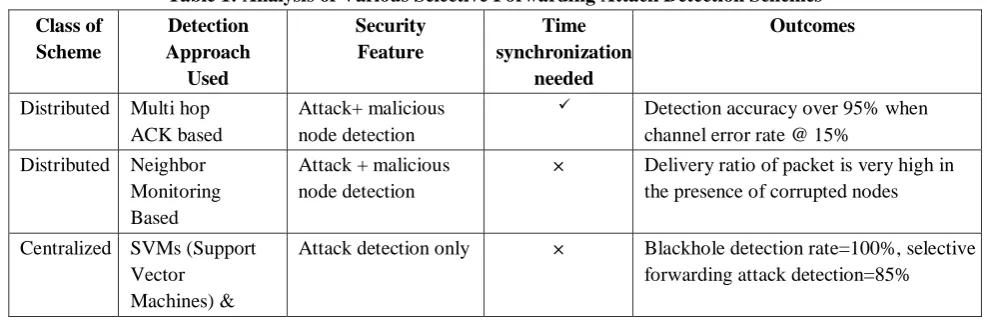
Table 1: Analysis of Various Selective Forwarding Attack Detection Schemes Class of
Scheme
Detection Approach
Used
Security Feature
Time synchronization
needed
Outcomes
Distributed Multi hop ACK based
Attack+ malicious node detection
Detection accuracy over 95% when
channel error rate @ 15% Distributed Neighbor
Monitoring Based
Attack + malicious node detection
× Delivery ratio of packet is very high in
the presence of corrupted nodes
Centralized SVMs (Support Vector Machines) &
Attack detection only × Blackhole detection rate=100%, selective
ISSN(E): 2277-128X, ISSN(P): 2277-6451, pp. 68-75 sliding windows
Distributed Neighbor
monitoring Based
Attack detection only × Detection rate=80%
Centralized ACK based Attack + malicious
node detection
× Successful detection without broadcast
authentication Distributed Neighbor
monitoring Based
Attack + malicious node detection
× Detection with 100% packet delivery
ratio Centralized Watermark
Based
Attack + malicious node detection, detects modified packets
× Detection rate 95% approx. when
packet loss rate below 10%
VI. CONCLUSION
The selective forwarding attack is one of the serious threat that is related to wireless sensor network and it is hard to detect because the attacker includes himself on the path of data flow in the form of malicious nodes. As seen from the analysis table, there are some schemes which provide better detection rate but no mechanism is there which can assure delivery of data in presence of the attack, while there are some schemes which can provide better detection accuracy and efficient delivery of data but they consume high energy. In future, more work can be done towards developing a scheme that is more efficient in the form of energy and is able to detect and prevent the attack which are having high accuracy. The selective forwarding attack also destroys the network natural packets by creating congestion in the network and producing a great amount of loss to the network but if we can somehow able to detect if the packets which are dropped due to congestion or malicious activity, detecting the malicious node can become more efficient and easy.
REFERENCES
[1] P Suma, O Nagaraju, MA Hussain, “Node Disjoint Random and Optimal Path Selection (NDROPS) Algorithm
for Security in MANETS”, International Journal of Electrical and Computer Engineering (IJECE), Vol. 7 Issue. 3, pp. 1197-1203, 2017.
[2] Yuxin Mao and Ping Zhu, "A Game Theoretical Model for Energy-Aware DTN Routing in MANETs with Node's Selfishness", Mobile Networks and Applications, Vol. 20, no. 5, pp. 593-603, 2017.
[3] C. Anand, R. K. Gnanamurthy,” Localized DoS Attack Detection Architecture for Reliable Data Transmission
Over Wireless Sensor Network”, 2016 Springer Science + Business Media New York
[4] Omar Said and Alaa Elnashar,” Scaling of wireless sensor network intrusion detection probability: 3D sensors,
3D intruders, and 3D environments”, 2016 Springer.
[5] Suparna Biswas, Subhajit Adhikari,” A Survey of Security Attacks, Defenses and Security Mechanisms in Wireless Sensor Network”, 2015 International Journal of Computer Applications (0975 – 8887) Volume 131 – No.17.
[6] Megha Joshi, Saumil Patel," Centralized Signature based Approach for Wireless Sensor Network using RSA algorithm", 2015 International Journal of Technological Research in Engineering Volume 2, Issue 8.
[7] Leena Rani, Er. Veena Rani,” A Novel Study on Data Flow Routing with Energy Optimization under Different
Attacks in WSN”, 2015
[8] Ruchita Dhulkar, Ajit Pokharkar, Mrs. Rohini Pise,” Survey on different attacks in Wireless Sensor Networks
and their prevention system”, 2015
[9] Ju young Kim, Ronnie D. Caytiles, Kyung Jung Kim, “A Review of the Vulnerabilities and Attacks for Wireless
Sensor Networks” Journal of Security Engineering, 2014, pp.241-250
[10] Juby Joseph, Vinodh P Vijayan,”Misdirection Attack in WSN Due to Selfish Nodes; Detection and Suppression
using Longer Path Protocol”, 2014 Vol.4
[11] Wang Chun-Hsin and Li Yang-Tang, “Active Black Holes Detection in Ad-Hoc Wireless Networks”,
Ubiquitous and Future Networks (ICUFN) 2013 Fifth International Conference on Da Nang, pp. 94-99, IEEE, 2013
[12] Roshan Singh Sachan, Mohammad Wazid, Avita Katal, D P Singh, R H Goudar,” A Cluster-Based Intrusion Detection and Prevention Technique for Misdirection Attack inside WSN”, 2013 IEEE 978-1-4673-4866-9/13/
[13] Hero Modraes, Rosli Salleh and Amir hossein Moravjosharieh, “Overview of Security Issues in Wireless Sensor
ISSN(E): 2277-128X, ISSN(P): 2277-6451, pp. 68-75
[14] Roshan Singh Sachan, Mohammad Wazid, D.P. Singh, Avita Katal and R.H. Goudar, “Misdirection Attack in
WSN: Topological Analysis and an Algorithm for Delay and Throughput Prediction”, 2012 IEEE 978-1-4673-4603.
[15] Yi-Ying ZHANG, Xiang-zhen LI, Yuan-an LIU, “The detection and defense of DoS attack for wireless sensor
network”, Elsevier Journal of China Universities of Posts and Telecommunications, Vol19, pp. 52-56, Oct-2012.
[16] Dr. Shahriar Mohammadi and Hossein Jadidoleslamy,” A COMPARISON OF LINK LAYER ATTACKS ON
WIRELESS SENSOR NETWORKS”, 2011, GRAPH-HOC, Vol.3, No.1
[17] Kalpana Sharma and M K Ghose, “Wireless Sensor Networks: An Overview on its Security Threats”IJCA Special Issue on “Mobile Ad-hoc Networks” MANETs, 2010, pp.42-45
[18] Hossein Jadidoleslamy,” A Hierarchical Intrusion Detection Architecture for wireless sensor networks”, 2011
Vol.3, No.5.
[19] Teodar-Grigopou, “Main Types of Attacks in Wireless Sensor Network”, Recent Advances in Signals and Systems, ISSN: 1790-5109, 2009.
[20] Dr. G. Padmavathi, Mrs. D. Shanmugapriya, “A Survey of Attacks, Security Mechanisms and Challenges in Wireless Sensor Networks”, International Journal of Computer Science and Information Security, Vol. 4, No. 1 & 2, 2009, pp. 1-9.
[21] Maan younis Abdullah, Gui Wei Hua, Naif Alsharabi, “Wireless Sensor Networks Misdirection Attacker Challenges and Solutions”, 2008 IEEE 978-1-4244-2184-8/08/
[22] Michael Collins, Simon Dobson, Paddy Nixon,” Securing Wireless Sensor Networks: Introducing ASLAN - A