Studies on the film formed by 2-carboxyethylphosphonic acid and Ni on carbon steel Section B-Research Paper
CYCLIC VOLTAMMETRIC STUDY OF PROTECTIVE FILM
FORMED BY 2-CARBOXYETHYLPHOSPHONIC ACID - Ni
2+SYSTEM ON CARBON STEEL
K. Kavipriya
[a], J. Sathiyabama
[a]and S. Rajendran
[a,b]*Keywords: corrosion inhibition; carbon steel; sea water; cyclic voltammetry; FTIR
The corrosion inhibition effect of carbon steel in sea water by 2-carboxyethylphosphonic acid (2-CEPA) and Ni2+ has been investigated
using weight loss method and cyclic voltammetry. The results show that 73% inhibition efficiency is achieved with binary system consisting of 250 ppm of 2-CEPA and 50 ppm of Ni2+. Surface evaluation technique like FTIR is used to determine the nature of the
protective film formed on the metal surface. The protective film consists of Fe2+ – 2-CEPA complex, Ni2+ – 2-CEPA complex and Ni(OH) 2.
Cyclic voltammetry study reveals that the protective film is more compact and stable even in 3.5% NaCl environment.
Corresponding Authors
E-Mail: [email protected]
[a] Corrosion Research Centre, PG and Research Department of Chemistry, GTN Arts College, Dindigul, India 624 005, E-mail: [email protected]
[b] * RVS School of Engineering and Technology, Dindigul, India 624 005, E-mail: [email protected]
INTRODUCTION
The corrosion in sea water is severe due to the presence of chloride ions and dissolved oxygen. Corrosion can cause great damages to marine steel infrastructures such as bridges, wharfs, platforms, and pipeline systems. It has been estimated that some 20% of the corrosion cost is due to microbial corrosion and degradation.1 Metals obtain stability when their surfaces are separated from the normal terrestrial environment.2 If this isolation is not achieved, they undergo a process of embrittlement, suffer fatigue, and transform into oxides, which peel off or just dissolve away. Metals become unstable when they contact moist atmosphere containing carbon-dioxide or sodium chloride suspension in marine atmosphere. The spontaneous corrosion of metal or its alloys results from the charged transfer reactions at their interface between the metal and its electrolytic environment.3,4 The goal of studying the processes of corrosion is to find methods of minimizing or preventing it. Inhibition of corrosion and scaling can be done by the application of inhibitors. Most of the organic inhibitors containing nitrogen, oxygen, sulfur atoms, and multiple bonds in their molecules facilitate adsorption on the metal surface.5,6 Several phosphonic acids have been used as corrosion inhibitor.7-11 Phosphonic acids are organic compounds containing R-PO(OH)2 or R-PO(OR)2 groups. They are effective chelating agents that are used in cooling water and desalination systems to inhibit scale formation and corrosion. Phosphonic acids are extensively used now-a-days due to their complex forming abilities, high stability under harsh conditions, and low toxicity.12,13 The inhibition efficiency of phosphonates depends on the number of phosphono groups in a molecule and also on different substituents. Compounds with a phosphonic functional group are considered to be the most effective chemical for inhibiting
the corrosion process and it is well known that short-chain-substituted phosphonic acids are good corrosion inhibitors for iron and low-alloyed steels.14
An environmental friendly compound, 2-carboxyethylphosphonic acid, contains not only phosphono groups, but also carboxyl and ethyl groups, which can decrease corrosion. The present study aims a) to find out the corrosion inhibition effects of 2-CEPA and Ni2+ system on carbon steel in sea water medium using weight-loss method; their inhibitive action is due to coordination of the oxygen atom of the carboxylate anion to the metal ions to form metal-inhibitor complexes b) electrochemical techniques provide information on the corrosion rate, as well as on processes at interfaces affected by additives c) to analyze the protective film by Fourier Transform Infrared Spectroscopy (FTIR) d) to propose a suitable mechanism of corrosion inhibition based on the results from the above studies.
EXPERIMENTAL
Preparation of Specimen
Carbon steel specimen [0.0267 % S, 0.06 % P, 0.4 % Mn, 0.1 % C and the rest iron] of dimensions 1.0 cm x 4.0 cm x 0.2 cm were polished to a mirror finish and degreased with trichloroethylene.
Weight-Loss Method
Carbon steel specimens in triplicate were immersed in 100 mL of the solutions containing various concentrations of the inhibitor in the presence and absence of Ni2+ (as NiSO4. 6H2O) for one day. The weight of the specimens before and after immersion was determined using a Shimadzu balance, model AY62. The corrosion products were cleaned with Clarke’s solution.15 The inhibition efficiency (IE, %) was then calculated using the equation:
2
100 1 W (1)
IE
W
Studies on the film formed by 2-carboxyethylphosphonic acid and Ni on carbon steel Section B-Research Paper where W1 is the weight loss value in the absence of
inhibitor and W2 is the weight loss value in the presence of inhibitor.
Cyclic Voltammetry
Cyclic voltammograms were recorded in VersaSTAT MC electrochemical system. A three-electrode cell assembly was used. The working electrode was carbon steel. The exposed surface area was 1 cm2. A saturated calomel electrode (SCE) was used as the reference electrode and a rectangular platinum foil was used as the counter electrode. The cyclic voltammetry curves were recorded in the scan range of −1.8 to −1.8 V (SCE) with a scan rate of 20 mV s−1.
Fourier Transform Infrared Spectra (FTIR)
The FTIR spectra were recorded in a Perkin-Elmer-1600 spectrophotometer. The film formed on the metal surface was carefully removed and mixed thoroughly with KBr making the pellet
.
RESULTS AND DISCUSSION
Weight-Loss Method
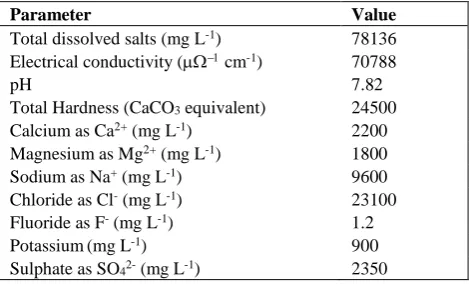
The physicochemical parameters of sea water are given in Table 1. Table 2 gives values of the corrosion inhibition efficiencies and the corresponding corrosion rates of 2-carboxyethyl phosphonic acid (2-CEPA) – Ni2+ in controlling corrosion of carbon steel in sea water for a period of 24 hours at room temperature. The 2-CEPA alone has high rate of corrosion. The inhibition efficiency of 2-CEPA is improved by adding various concentrations of Ni2+. Similar observations have been made by Abdallah et al.,16 who studied the inhibiting effect of 3-methylpyrazolone with Ni2+ cation for carbon steel in sulfuric acid solution. However, increasing the concentration of 2-CEPA as well as Ni2+, the maximum inhibition is achieved and the corrosion rate is decreased. It is found that 250 ppm of 2-CEPA and 50 ppm of Ni2+ has 73% inhibition efficiency. The inhibition efficiency increases with the increase of concentration of inhibitors. This behavior could be attributed to the increase of the surface area covered by the adsorbed molecules of phosphonic acid with the increase of its concentration. It is generally assumed that the adsorption of the inhibitor at the metal/solution interface is the first step in the mechanism of inhibition in aggressive media.
Cyclic Voltammetry
Cyclic voltammograms have been used to investigate the corrosion behaviour of metals.17-20 Deyab and Keera 20 have analysed the influence of sulphide, sulphate, and bicarbonate anions on the pitting corrosion behaviour of carbon steel in formation water containing chloride ions by means of cyclic voltammetry technique. The cyclic voltammograms were recorded in the presence of
increasing amounts (0.1 to 0.3 M) of NaCl at a scan rate of 10 mV s-1. The anodic response exhibits a well-defined anodic peak followed by a passive region. The anodic peak is due to active metal dissolution and formation of ferrous hydroxide.21 The cathodic sweep shows two cathodic peaks. The appearance of cathodic peak around -1.1 V is due to reduction of corrosion product, namely iron oxide to iron. The appearance of cathodic peak around -0.7 V is due to the reduction of pitting corrosion products precipitate on the electrode surface.
Table 1. The physicochemical parameters of natural sea water collected in Mandapam, Tamilnadu, India.
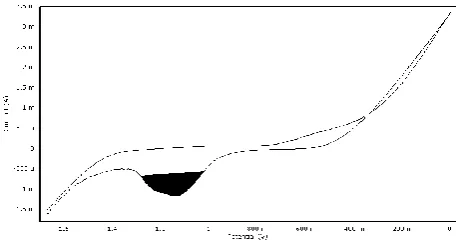
In the present study, cyclic voltammograms were recorded by measuring the working electrode, carbon steel, in 3.5% NaCl solution. The cyclic voltammogram of carbon steel immersed in 3.5% NaCl is shown in Fig.1a. It is observed that during anodic scan, no peak is observed but a passive state is noticed. This can be explained as follows: When the metal dissolves, ferrous hydroxide is formed. When the concentration of ferrous oxide at the anodic surface exceeds its solubility product, precipitation of solid oxide occurs on the electrode surface. When the surface is entirely covered with oxide passive film, anodic current density does not increase indicating onset of passivation.20 In the passive state, the Cl- ion can be adsorbed on the bare metal surface in competition with OH- ions. As a result of high polarizability of the Cl- ions, the Cl- ions may adsorb preferentially.22
The cathodic sweep shows only one peak at -1.12 V. This is due to the reduction of corrosion product, iron oxide to iron. The peak due to reduction of pitting corrosion product is absent.
The cyclic voltammogram of carbon steel, which has been immersed in sea water for one day and dried is shown in Fig.1b. (brown iron oxide is observed on the carbon steel electrode). It is observed that during anodic sweep, no peak appears, but a passive region is observed. During the cathodic sweep, the peak due to reduction of pitting corrosion product appears at -528 mV indicating that pitting corrosion takes place. However, the peak due to reduction of corrosion product, iron oxide, appears at -1.133 V. The current density increases from -1.148 x10⁻³ A to -1.172 x10⁻³ A.
Parameter Value
Total dissolved salts (mg L-1) 78136
Electrical conductivity (cm-1) 70788
pH 7.82
Total Hardness (CaCO3 equivalent) 24500
Calcium as Ca2+ (mg L-1) 2200
Magnesium as Mg2+ (mg L-1) 1800
Sodium as Na+ (mg L-1) 9600
Chloride as Cl- (mg L-1) 23100
Fluoride as F- (mg L-1) 1.2
Potassium(mg L-1) 900
Studies on the film formed by 2-carboxyethylphosphonic acid and Ni on carbon steel Section B-Research Paper
Table 2. The inhibition efficiency (IE%) and the corrosion rate (mm y-1) of 2-CEPA – Ni2+ system are determined by weight-loss
method.
This indicates that when carbon steel electrode is immersed in sea water for one day, a protective film of iron oxide is formed on the electrode surface. It is stable in 3.5% NaCl solution. The increase in current density is explained as follows: Chloride ion is adsorbed on the passive film. The adsorbed chloride ion penetrates the oxide film especially at the flaws and defects in the oxide film.23 When the penetrated chloride ion reaches the metal surface, they promote local corrosion.
When the carbon steel electrode is immersed in sea water containing 250 ppm of 2-CEPA and 50 ppm of Ni2+ for one day, a protective film is formed. It consists of Fe2+– 2-CEPA complex, Ni2+– 2-CEPA complex, and Ni(OH)2 as revealed by FTIR spectroscopy. The cyclic voltammogram of carbon steel electrode deposited with the above protective film is shown in Fig.1c. It is observed that during anodic sweep, dissolution of metal does not take place. This indicates that the protective film is stable and compact. Electrons are not transferred from the metal surface, and a passive region is observed. During cathodic sweep, the peak corresponding to reduction of pitting corrosion product appears at -500 mV. However, the peak due to reduction of iron oxide to iron appears at -1.476 V. The current density increases from -1.148 x10⁻³ A to -3.388 x10⁻³ A. The increase in current density may be explained as above. It is observed from the Fig.1a, 1b, 1c that the pitting potentials for the three systems are at -644.4 mV, -755.5 mV, and -606.3 mV respectively. That is when carbon steel electrode is immersed in the sea water medium, the pitting potential is shifted to more negative side (active side, i.e., -755.5 mV). It accelerates corrosion because the protective film formed is porous and amorphous. When the electrode is immersed in the inhibitor medium, the pitting potential is shifted to the noble side, i.e., -606.3 mV. This indicates that the passive film found on the metal surface in the presence of inhibitors is compact and stable. It can withstand the attack of chloride ion present in 3.5 NaCl.
FTIR Spectra
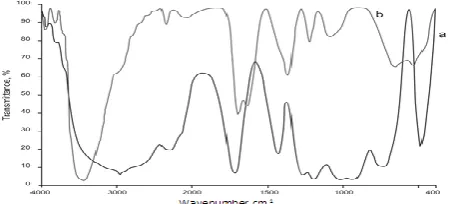
FTIR spectra have been used to analyze the protective film found on the metal surface.24,25 The FTIR spectrum (KBr) of pure 2-CEPA is shown in Fig. 2a. The P-O stretching frequency appears at 1017 cm-1 and the C=O stretching frequency of the carboxyl group appears at 1721 cm-1. The FTIR spectrum of the film formed on the metal surface after immersion in sea water containing 250 ppm of 2-CEPA and 50 ppm of Ni2+ is shown in Fig. 2b.
Figure 1a. Cyclic voltammogram of carbon steel electrode immersed in 3.5% NaCl.
Figure 1b. Cyclic voltammogram of carbon steel electrode submerged in 3.5% NaCl solution after its immersion in sea water for one day.
Figure 1c. Cyclic voltammogram of carbon steel electrode submerged in 3.5% NaCl solution after its immersion in sea water containing 250 ppm of 2-CEPA and 50 ppm of Ni2+
for one day. 2-CEPA,
ppm
Ni2+ (ppm)
0 25 50
IE, % CR, mm y-1 IE, % CR, mm y-1 IE, % CR, mm y-1
0 - 0.1858 8 0.1709 15 0.1579
50 15 0.1579 22 0.1449 51 0.0910
100 21 0.1468 28 0.1338 60 0.0743
150 26 0.1375 33 0.1245 65 0.0650
200 30 0.1301 39 0.1133 69 0.0576
Studies on the film formed by 2-carboxyethylphosphonic acid and Ni on carbon steel Section B-Research Paper The P-O stretching frequency has shifted from 1017 to
1090 cm-1 and the C=O stretching frequency has shifted from 1721 to 1701 cm-1. It is inferred that oxygen atom of the carboxyl group has coordinated with Fe2+ resulting in the formation of Fe2+ – 2-CEPA complex formed on the anodic sites of the metal surface. The possibility of formation of Ni2+ – 2-CEPA complex, to some extent, on the metal surface cannot be ruled out. The peak at 3432 cm-1 is due to –OH stretching. The band due to Ni-O appears at 1369 cm-1. These results confirm the presence of Ni(OH)2 deposited on the cathodic sites of the metal surface. Thus, FTIR spectral study leads to the conclusion that the protective film consists of Fe2+ – 2-CEPA complex, Ni2+ – 2-CEPA complex and Ni(OH)2.
Figure 2. FTIR Spectra a) pure 2-CEPA b) film formed on metal surface after immersion in sea water containing 250 ppm of 2-CEPA and 50 ppm of Ni2+
Mechanism of Corrosion Inhibition
In order to explain the above results, the following mechanism of corrosion inhibition is proposed: When carbon steel is immersed in an aqueous solution, the anodic reaction is,
Fe → Fe2+ + 2e- (2)
The corresponding cathodic reaction is reduction of oxygen to hydroxyl ions,
O2 + 2H2O + 4e- → 4OH- (3)
When the formulation consists of 250 ppm of 2-CEPA and 50 ppm Ni2+ in sea water, there is formation of 2-CEPA – Ni2+ complex in solution.
When carbon steel is immersed in this environment, the 2-CEPA – Ni2+ complex diffuses from the bulk of the solution to the metal surface. The 2-CEPA – Ni2+ complex is converted into 2-CEPA – Fe2+ complex on the anodic sites of the metal surface, the stability of Fe2+ – 2-CEPA complex is higher than the corresponding Ni complex.
Ni2+ – 2-CEPA + Fe2+ → Fe2+ – 2-CEPA + Ni2+ (4)
The released Ni2+ combines with OH- to form Ni(OH)2 on the cathodic sites of the metal surface.
Ni2+ + 2OH- → Ni(OH)2 (5)
The possibility of formation of Ni2+ – 2-CEPA complex, to some extent, on the metal surface cannot be ruled out.
Thus, the protective film consists of Fe2+ – 2-CEPA complex, Ni2+ – 2-CEPA complex, and Ni(OH)2.
CONCLUSIONS
The conclusions drawn from the results may be given as,
(1) The inhibition of corrosion of carbon steel in sea water has been evaluated in the absence and presence of 2-carboxyethylphosphonic acid and Ni2+.
(2) Weight-loss method and cyclic voltammetry have been used for this purpose.
(3) The formulation consisting of 250 ppm of 2-CEPA and 50 ppm of Ni2+ provides 73% inhibition efficiency.
(4) FTIR study reveals the protective film consists of Fe2+ – 2-CEPA complex, Ni2+ – 2-CEPA complex, and Ni(OH)2.
(5) Cyclic voltammetry study reveals that the protective film is more compact and stable even in 3.5% NaCl environment.
REFERENCES
1Heitz, E., Flemming, H. C., Sand W., (Eds.),Microbially Influenced Corrosion of Materials, Springer-Verlag, Berlin, 1996, 6.
2Bockris J. O. M., Reddy, A. K. N., Modern Electrochemistry,
Plenum Press, New York, 1977,2, 861.
3Jeyaprabha, C., Sathiyanarayanan, S., Venkatachari, G., Appl. Surf. Sci., 2005, 246, 108.
4Fontana, M. G., Greene, N. D., Corrosion Engineering,
McGraw Hill, New York, 1978.
5Badr, G. E., Corros. Sci., 2009, 51, 2529.
6Gao, G., Liang, C. H., and Wang, H., Corros. Sci.,2007, 49,
1833.
7Amar, H., Benzakour, J., Derja, A., Villemin, D., Moreau,
B., J. Electroanal. Chem., 2003, 558, 131.
8Amar, H., Benzakour, J., Derja, A., Villemin, D., Moreau,
B., Braisaz, T., Tounsi, A., Corros. Sci., 2008, 50, 124.
9Gopi, D., Manimozhi, S., Govindaraju, K. M., J. Appl. Electrochem., 2007, 37, 439
10Apparao, B. V., Christina, K., Indian J. Chem. Technol., 2006, 13, 275.
11Labjar, N., Lebrini, M., Bentiss, F., Chihib, N. E., El Hajjaji,
S., Jama, C., Mater. Chem. Phys.,2010,119, 330.
12Ochoa, N., Basil, G., Moran, F., Pebere, N., J. Appl. Electrochem., 2002, 32, 497.
13Horvath, T., Kalman, E., Russ. J. Electrochem., 2000, 36,
Studies on the film formed by 2-carboxyethylphosphonic acid and Ni on carbon steel Section B-Research Paper 14Fang, J. L., Li, Y., Ye, X. R., Wang, Z. W., Liu, Q., Corrosion,
1993, 49, 266.
15Wranglen, G., Introduction to corrosion and protection of Metals, London: Chapman & Hall., 1985, 236.
16 Abdallah, M., Meghed, H. E., Sobhi, M., Mater. Chem. Phys., 2009, 118, 111.
17Dutra, C. A. M., Codaro, E. N., Nakazato, R. Z., Mater. Sci. Appl., 2012, 3, 348.
18Feng, L., Yang, H., Wang, F., Electrochim. Acta., 2011, 58,
427.
19Li, Y., Kumar, P., Shi, X., Nguyen, T. A., Xiao, Z., Wu, J., Int. J. Electrochem. Sci., 2012, 7, 8151.
20Deyab, M. A., Keera, S. T., Egypt. J. Petrol., 2012, 21, 31.
21Gouda, V. K., in: Proc. 12th Int. Corrosion Cong., Houston, TX, USA, 1993, 19.
22Refaey, S. A. M., Abd El-Rehim, S. S., Taha, F., Saleh, M.
B., Ahmed, R.A., Appl. Surf. Sci.,2000, 158, 190.
23Kannagara, D. C. W., Conway, B. E., J. Electrochem. Soc., 1987, 134. 894.
24Rajendran, S., Anuradha, K., Kavipriya, K., Krishnaveni,
A., Angelin Thangakani, J., Eur. Chem. Bull., 2012, 1, 503.
25Rajendran, S., Apparao, B. V ., Palaniswamy, N.,
Periasamy, V., Karthikeyan, G., Corros. Sci.,2001, 43,
1345.