Available online throug
ISSN 2229 – 5046
PROPERTIES OF DUST ACOUSTIC SOLITARY WAVES
IN PLASMA WITH NON-THERMAL ELECTRONS
BANAJIT SARMAH*
Department of Mathematics,
Girijananda Chowdhury Institute of Management and Technology, India.
(Received On: 14-02-17; Revised & Accepted On: 09-05-17)ABSTRACT
A
Plasma model is considered, having contaminated with negatively charged dust particles to study the properties of the nonlinear wave profile, in which the ions are the Maxwellian and electrons are non Maxwellian. Inertial dust motion is possible due to their heavy mass in comparison to the much smaller masses of ions and electrons. The occurrence of the nonlinear waves leading to formation and propagation of dust acoustic solitary waves (DASW) in the plasma is augmented through energy integral. A pseudo potential approach is employed to derive this integral knownas the Sagdeev Potential (S.P) equation. The important parameters for our study are considered as
z
d,
µ
,
α
,
M
signifying respectively the number of charged dust particle, equilibrium density ratio of dust and ion, population of non thermal electron and wave Mach number. The nature of soliton is also studied by deriving well-known small amplitude K-dV solution of the S.P equation.
Key Words: DASW, Maxwellian, Pseudo potential, S.P. equation, Non thermal.
1. INTRODUCTION
The term “solitary wave” has been an important object of mathematical analysis since the historical first observation by John Scott Russel in 1834 as a large solitary elevation, a rounded, a smooth and well defined heap of water, which coursed along a channel without change of form or diminution of speed [1]. A solitary wave is a stationary and localized structure due to nonlinear wave formation `propagating in dispersive media. Mathematically such a wave is essentially a hill in potential field
φ
and is represented by an appropriate function ofφ
[2].Plasma is a very complex state of dispersive matter occupying most parts of the universe. In order to understand the basic properties of the nonlinear solitary waves propagating in plasma, we are to consider the effect of the characteristic frequencies of the different plasma species, leading to the coherent oscillations of the charged particles of plasma. Due to the dispersive character of plasma, the coherence of the nonlinearity gets reduced. As a result, some typical balance between nonlinearity and dispersion occurs and the resulting wave structure propagates without change of size and shape for long time. Such waves, called solitary waves or solitons are finite energy structures. Recent trend of research in the line of nonlinear plasma waves shows high interest of mathematicians/ plasma scientists. The nonlinearity of plasma which leads to the formation and propagation of nonlinear solitary waves was studied by many people [3-7].
The different plasma species have great influence on the collective behaviour of the medium. Due to the heavy mass of dust grains in comparison to ion and electron, they can have collision with both and can be charged both positively or negatively. Negatively charged dust particles can give rise to new kind of nonlinear plasma wave modes. Baluku & Hellberg [8] studied both small & large amplitude dust acoustic solitary waves. The study of dusty plasma has become more important after Rao et.al published their paper on dust acoustic wave mode for the first time [9]. Dusty plasma is a complex plasma medium consisting of dispersed kind of solid grains of micron or submicron level of size. [10]. Effect of dust like grains was studied in the laboratory by Langmuir et.al. [11]. In the process of dusty plasma wave formation, the presence of charged dust species plays very important dynamical role. As a result, the collective behaviour depends on densitry, charge, temperature and other properties of the dust species. Most of the dusty plasma wave studies are seen to consider negatively charged dust species since the high mobility of the electrons leads to quick charging due to contact with the dust particles. The ions are considered as Maxwellian because of the considerable mass difference between the ions and the dust particles. Basically the electron thermal energy has been considered effectively in the form of Maxwellian/inertial/nonthermal character in such wave studies.
Nonlinear wave modes in plasma are produced due to the transient behaviour of the medium as a result of different types of oscillations of the constituent components (both charged and neutrals).Most of the problems in plasmas are treated by perturbation technique. But higher order approximations are not negligible in case of the large amplitude waves. So perturbation technique is not adequate to study such waves. Therefore a variety of nonperturbative approaches were developed by many researchers [12-13]. In order to study the plasma acoustic waves of arbitrary amplitude derived by nonperturbative approach known as Sagdeev (1966) Potential analysis [14]. However the method was 1st discussed by Davis et al. (1958) [15] in the context of fluid dynamics. Exact solution of the differential equations describing full nonlinearity can be obtained through a standard method known as the Sagdeev’s Pseudpotential (SP) method. Pseudopotential shows the motion of the oscillatory charged particles by energy integral
equation having unit mass whose pseudoposition is
φ
and pseudovelocity isξ
φ
d
d
in a pseudopotential well
S
( )
φ
.In this paper we have considered a fluid model of plasma governed by a set of basic equations consisting of continuity and motion equation of dust and ion, nonthermal equation of electron and Poisson’s equation. By applying nonperturbative technique the S. P. equation has been derived. The dust acoustic solitary wave profiles have been studied graphically for different values of the parameters through the pseudpotential. The solution of the soliton equation is derived to know the nature of the solitary wave. The amplitude and width of the solitary wave can be expressed in terms of different parameters.
2. BASIC EQUATIONS
We have considered the following equations for one dimensional dust acoustic plasma model.
For dust,
(
)
=
0
∂
∂
+
∂
∂
d d
d
n
v
x
t
n
(1)
x
z
x
v
v
t
v
d d d d
∂
∂
=
∂
∂
+
∂
∂
φ
(2)
For ion
( )
=
0
∂
∂
+
∂
∂
i i
i
n
v
x
t
n
(3)
0
=
∂
∂
+
∂
∂
+
∂
∂
x
x
v
v
t
v
ii
i
φ
(4)Poisson’s equation
(
d)
e id
d
n
z
n
n
z
x
=
+
−
−
∂
∂
φ
µ
µ
1
2 2
(5)
For nonthermal electron
(
βφ
βφ
)
φe
n
e=
1
−
+
2 (6)where
n
d,
n
i,
n
e are the number densities of dust grain, ion and electron respectively.v
d,
v
ibeing respectively thefluid velocities of dust and ion and
φ
is the electrostatic plasma potential. The parameterz
drefers to the number ofcharged dust particles,
0 0
i d
n
n
=
µ
wheren
d0,
n
i0are respectively the equilibrium dust and ion densities,α
α
β
3
1
4
+
=
,α
being the population of nonthermal electron [16].3. DERIVATION SAGDEEV POTENTIAL EQUATION
To derive the Sagdeev Potential equation, we have introduced a new variable
ξ
by the transformationξ
=
x
−
Mt
, where M is the wave Mach number. The partial differential equations (1)-(5) thus are transformed to the following ordinary differential equations:(
)
=
0
+
−
dn
dv
dd
d
d
dn
M
ξ
ξ
(7)ξ
φ
ξ
ξ
d
d
z
d
dv
v
d
dv
M
d dd
d
+
=
−
(8)( )
=
0
+
−
in
iv
id
d
d
dn
M
ξ
ξ
(9)0
=
+
+
−
ξ
φ
ξ
ξ
d
d
d
dv
v
d
dv
M
i ii (10)
(
d)
e i dd
n
z
n
n
z
dx
d
−
−
+
=
µ
µ
φ
1
2 2
(11)
Integrating (7) and (9) w.r.to
ξ
with boundary conditionsv
d,
v
i→
0
,
ξ
→
∞
asn
d,
n
i→
1
, we get respectively,d d
v
M
M
n
−
=
(12)i i
v
M
M
n
−
=
(13)Integrating (8) w.r.to
ξ
with boundary conditionφ
→
0
asv
d→
0
and using (12) we get,2
2
1
1
M
z
n
d dφ
+
=
(14)Integrating (10) w.r.to
ξ
with boundary conditionφ
→
0
asv
i→
0
and using (13) we get,2
2
1
1
M
n
iφ
−
=
(15)Now using equations (6), (14) and (15) we get from equation (11),
(
)
(
)
2 2 2 2 22
1
1
1
1
2
1
1
M
e
z
M
z
z
dx
d
d d dφ
βφ
βφ
µ
φ
µ
φ
φ−
−
+
−
−
+
+
=
Integrating w.r.to
ξ
with boundary conditions→
ξ
→
∞
ξ
φ
,
0
d
d
as
φ
→
0
, we get(
) (
{
)
}
122 2 2 2 1 2 2 2
2
1
3
3
1
1
2
1
2
1
−
+
+
−
+
−
+
+
=
M
M
e
e
e
z
M
z
M
d
d
dd
φ
µ
β
βφ
βφ
φ
µ
ξ
φ
φ φ φExpanding in binomial and exponential series and neglecting the terms containing fourth and higher powers of
φ
, we get an energy integral of the form2
2 3
1
2
d
A
B
d
ϕ
ϕ
ϕ
ξ
=
−
(16)where
(
)(
)
2 2
2
2
1
2
1
1
2
1
M
M
z
z
A
dd
−
−
−
−
=
µ
β
µ
µ
d(
z
dµ
)
M
z
M
B
=
−
−
1
−
6
1
2
2
1
4 3
4
Which is the Sagdeev Potential equation and Sagdeev Potential is
( )
φ
φ
2φ
3B
A
S
=
−
+
Solving the equation (16) by tanh-method [17-18], we get the well known small amplitude K-dV soliton solution for the wave profile as
=
ξ
φ
2
sec
h
2A
B
A
, where
B
A
is the amplitude and
A
2
represents the width of the soliton.
4. RESULTS AND DISCUSSIONS
The conditions for occurrence of solitary waves are
(i)
S
( )
φ
=
0
forφ
=
0
(ii)
S
′
( )
φ
=
0
forφ
=
0
and (iii)S
′′
( )
φ
<
0
forφ
=
0
For the condition (iii),
A
must be positivei.e
(
)(
)
0
2
1
2
1
1
2
1
2 2
2
>
−
−
−
−
M
M
z
z
dµ
β
µ
dSo, we have to assign the values of the parameters as
.
1
and
01
.
0
,
1
<
>
<
µ
M
α
With the prescribed values of the parameters B is found to be negative. The nature of the solitary wave, i.e whether compressive or rarefactive is determined by the values of A and B. Since A and B are of opposite signs, it represents a rarefactive solitary wave [19].
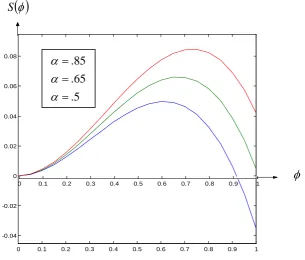
The effect of different parameters on the dust acoustic solitary wave are investigated. Figure 1 shows the effect of population of nonthermal electron
α
on the solitary wave. It is observed that the amplitude and width of the soliton both increases asα
increases.
S
( )
φ
Figure-1:
S
( )
φ
vs.φ
forµ
=
0
.
002
,
z
d=
10
,
M
=
1
.
1
and
α
=
0
.
5
,
0
.
65
,
0
.
85
Figure 2 is to investigate the structure of the solitary wave for different values of Mach number.
S
( )
φ
Figure-2:
S
( )
φ
vs.φ
forµ
=
0
.
002
,
z
d=
10
,
α
=
0
.
5
and
M
=
1
.
10
,
1
.
15
,
1
.
30
0 0.1 0.2 0.3 0.4 0.5 0.6 0.7 0.8 0.9 1 -0.04
-0.02 0 0.02 0.04 0.06 0.08
0 0.1 0.2 0.3 0.4 0.5 0.6 0.7 0.8 0.9 1
0 0.1 0.2 0.3 0.4 0.5 0.6 0.7 0.8 0.9 1
-0.04 -0.03 -0.02 -0.01 0 0.01 0.02 0.03 0.04 0.05
0 0.1 0.2 0.3 0.4 0.5 0.6 0.7 0.8 0.9 1
φ
5
.
65
.
85
.
=
=
=
α
α
α
30
.
1
15
.
1
10
.
1
=
=
=
M
M
M
Figure-3:
S
( )
φ
vs.φ
forz
d=
10
,
α
=
0
.
5
and
M
=
1
.
1
and
µ
=
0
.
002
,
0
.
003
,
0
.
004
5. CONCLUSIONS
Thus the co-operative phenomena in respect of the collective behavior of the plasma medium under the present model can occur. Hence the nonlinear plasma wave structures in the form of solitary wave are found to exist in plasma as dust acoustic solitary waves. As a future scope of the present work, the different regions of propagation of dust acoustic
solitary plasma waves under the effect of nonthermal electrons can be earmarked by computing
S
( )
φ
versusφ
. Theparameters of importance for such computation being
z
d,
µ
,
α
,
M
.
REFERENCES
1. Solitary Waves in Fluids, Editor, R.H.I. Grimshow WIT Press, Southampton, Baston.
2. Nonlinear Dispersive Equations, Jaime Angulo Pava, Mathematical Surveys and Monographs Vol. 156 3. Rao et. Al, N.N., Planet sp. Sc., 38, 543, (1990).
4. Shukla P.K. and Silin V.P., Phys. Scr. 45, 508, (1992).
5. Barkan A., Merlino R. L. and Angelo N.D., Phys. Plasmas, 2, 3563, (1995). 6. Nakamura Y., and Sharma A., Phys. Plasmas, 8, 3921, (2001).
7. Samsonov D., Ivelev A.V., Quinn R.A. and Morfill G., Phys. Rev. Lett., 88, 095004, (2002).
8. Baluku, T. K. & Hellberg, M. A. (2008). Dust acoustic solitons in plasmas with kappa-distributed electrons and/or ions. Phys. Plasmas, 15,123705.
9. N.N. Rao, P.K. Shukla and M. Y. Yu., Planet. Space Sci., 38 (4), 543 (1990). 10. U. de Angelis, Phys. Scripta, 45, 465-474 (1992).
11. I. Langmuir, G. Found and A.F. Dittmer, Science N.Y., 60,392 (1924).
12. Chatterjee P., “Nonperturbative Approach to Solitary Waves in Plasmas”, Jadavpur University, Thesis(1995)). 13. Mamun A.A., Cairns R.A. and Shukla P.K., Phys. Plasmas, 3 (1996), 702
14. Sagdeev R.Z., Review of Plasma Physics, New York Consultant Bureau, 4, 52, (1966). 15. Davis L.,, Lust R. and Schluter A.., Zeit Natur Forsch 13a, 916, (1958).
16. Cairns R.A. et.al Geophys. Res. Lett., 22, 2709, (1995)
17. Das G.C., Dwivdi C.B., Sarma J. and Talukdar M., Phys. Plasmas, 4, (1997), 4326. 18. Das G.C., Sarma J. and Talukdar M., Phys. Plasmas, 5, (1997), 63.
19. Das G.C., Devi K., Sarma J. and Devi N., Indian Journal of Pure and Applied Physics, Vol. 42, april 2004, pp. 265-274
Source of support: Nil, Conflict of interest: None Declared.
[Copy right © 2017. This is an Open Access article distributed under the terms of the International Journal of Mathematical Archive (IJMA), which permits unrestricted use, distribution, and reproduction in any
0 0.1 0.2 0.3 0.4 0.5 0.6 0.7 0.8 0.9 1 -0.6
-0.5 -0.4 -0.3 -0.2 -0.1 0 0.1
0 0.1 0.2 0.3 0.4 0.5 0.6 0.7 0.8 0.9 1