International Journal Advances in Social Science and Humanities
Available online at: www.ijassh.com
RESEARCH ARTICLE
Developing Model of Entrepreneurship Culture Based on
Acculturation of Socio-Religion Values and Local Cultural Wisdom
Arif Julianto Sri Nugroho
Faculty of Economics, Widya Dharma University Klaten, Republic of Indonesia.
Abstract
The aim of this research is integrate the Islamic entrepreneur values, theological dimension value, Islamic social responsibility and local cultural wisdom to intention and behavior. This research design used explanatory quantitative method. This research is done by hypothesis test which is formulated using SEM (Structural Equation Model). The sample of population in this research is villager and urban area Islamic businessmen in four regency Klaten, Sukoharjo Boyolali and Surakarta district. The method of taking sample is purposive sampling consist of 170 respondences. The analysis result shows that four out of five research hyphothesis are supported, namely Islamic entrepreneur values, theological dimension values, social responsibility, Intention have positive influence and significant to the behavior but local cultural wisdom is not supported to intention
Keywords: Islamic entrepreneurs values, Theological values, Social responsibility, Local wisdom,
Intention.
Introduction
In building Indonesia's economy, despite the economic contribution of entrepreneurs is still limited, there are millions of people who cultivate micro, small and medium enterprises. They are the mainstay of economic growth in Indonesia. These efforts do not yet have employees in large numbers led by one or several entrepreneurs. They are self-contained, durable, flexible in moving and efficient as done by the whole family. They generally do not rely on debt and the strength of their businesses based on local resources.
According to Mc Clelland, a country will prosper only if there are entrepreneurs at least 2% of the population. Based on Global Entrepreneurship Monitor report, from the data in 2005 the state of Singapore has the entrepreneur as much as 7.2% of the population. Meanwhile, according to data from the Cooperation Ministry of Indonesia and Middle Small-scale Entrepreneurship, in the end of 2014 Indonesia only has a number of entrepreneurs 1.65% of the population. So, the income per capita of the state of Singapore is tens of times higher
than Indonesia [1]. The lag of this competitiveness must not be allowed to go on. Indonesian government is optimistic that entrepreneurs in this country will continue to grow, especially at this time social entrepreneurship based on technological innovation is growing more and more.
Agribusiness as a paradigm of development is not as a new opinion. This paradigm sees the development of agriculture as the locomotive of economic development by uniting the activities of agricultural
production, supporting industries,
processing and agricultural services from upstream to downstream, so as a business
system. The rationale here is
industrialization without fixing the agricultural sector in village resulting in an imbalance of economic transformation.
that entrepreneurship is an integral part of worship in order to achieve the ultimate goal of human being khusnul khotimah.
There is much development in today's society, the emergence of new entrepreneurs that emphasize innovation efforts, uphold the values of God’s oneness dimension, remain to pay attention and have a social responsibility to the society and by the individual consciousness they still preserve local cultural wisdom.
Literature Review
Islamic Entrepreneur Values
Religion plays a big role in giving direction to the course of human life. In religion there is a rule how someone maintains a good relation to both Almighty God and the fellow human being. In Islam it is very clear that the relationship to Dien namely Allah must be done in a balance way by doing good deeds to fellow human being/ muamallah deeds. Islam considers people empowerment very important [2]. The values of Islamic entrepreneurship are mostly found in the Qur'an and Sunnah, tradition an customs of the Prophet Muhammad [3] such as Tough like Quran Ar ra 'd : 11, Pursuing results such as the Word of Allah QS An-Nisa : 9, Dare to take risks such as the Word of Allah in Surah Quran Al Jumuah : 10, Working for a sustainability, Hadis (Moslem traditions) Muslim history "Work to the world as if you would live forever and work for the Hereafter as if tomorrow you would die"
Business success and business as well as in activities of muamalah (social affairs) are not determined solely by economic factors. Non-economic factors such as moral values of religion also have a dominant role. Mental and spiritual factors that have a major role include honest nature, intentions of venture for worship, the hard willing to go forward, always doing things sincerely, being devoted to God, being tolerant to each other and always overwhelmed with qonaah (simple) atmosphere.
Based on the above description, it can be taken research hypothesis as follows:
H1: There is a significant influence of entrepreneurship Islamic values towards entrepreneurial
intention.
The Theological Dimension in
Entrepreneurship
Theological dimension is the source of motion of all the other elements of capital. Religious capital is a wealth in material and non-material nature that is used to facilitate human effort in order to create the highest human values in the eyes of Allah (taqwa) through market mechanisms that is permitted by Allah. This dimension includes the elements of devotion, praying, alms, fasting, pilgrimage intentions and prayer [4].
Shalat (five obligatory daily prayers). The devotion of doing daily prayers on time in congregation amid the busy trade does not reduce the success of the business, even it can increase productivity. The main advantage of carrying out this mandatory order is as a form of devotion to God Almighty who has created man and has given His luck. Shalat implies the presence of servants directly in the presence of God, the Giver of sustenance. With congregational prayers, there will be formed togetherness in solving various problems associated with business activities and means of friendship related to information on business opportunities and so on.
Zakat (alms) is one element of devotion that has multiple functions and benefits, that is social benefits due to the form of the expenditure of part of the wealth which is given to those in need, while another benefit is obedience to God's command as an obligation. By giving alms, it is believed that the owned property becomes clean and easy to develop.
Muslims’ dining room table tends to overflow. There is a belief among Moslems that sunnah fasting on Monday and Thursday will further open the door luck.
Intention is a statement of heart dedicated to God Almighty. Intention is very important in running a business, so it must be declared before running a business. Islam affirms everything which is achieved depends on its intention. Including the intention of the pilgrimage, many Moslems in the initial intention try to complete the worship to be able to save for purposes of pilgrimage, the more the growing of business with hard work coupled with the intention to save Umrah (visit to a holy place as part of a pilgrimage) and Hajj the more increasingly the luck that God gives.
Prayer is a direct appeal to God. Whatever is intended should be accompanied by prayer and hard work in order to achieve the ideals of business success. Prayer is the heart of worship, in which the most appropriate means is when running the obligatory prayers, tahajud (prayer between Isya’ and Subuh prayers) prayers (Shalat Lail) and Dhuha (prayer between Shubuh and Dhuhur prayers) prayer.
Based on the above description, it can be taken research hypothesis: H2: There is a significant influence of the dimension of theological values towards
entrepreneurial intention.
The Social Dimension
Entrepreneurship
In running a business it is known three main objectives to be achieved, namely to create value for the entity, the continuous sustainability of business and must care for the surrounding community. With the success of the business through the capital of achieved material, it makes the Moslems entrepreneurs have a great chance to grab a great advantage as the main instrument to encourage the advancement of business, so the opportunity for social care such as alms, charity, infaq (spending money as God’s command) increases.
Moslems are encouraged to seek wealth (material) as much as possible in God’s command to be richer. Their wealth should be used for the benefit of the people, in the sense that Muslim entrepreneurs should be generous entrepreneurs [4].
Based on the above description it can be taken research hypothesis: H3: There is a significant influence of the values of the
social dimension towards the
entrepreneurial intention.
Local Cultural Wisdom Values
In the discipline of anthropology it is known term local genius. Haryati Soebadio says that the local genius is cultural identity, the identity of personality/ culture of the nation that causes that nation is able to absorb and process foreign cultures appropriate to its own character and ability [5]. Moendardjito states that the elements of a regional culture is potential as local genius as its ability is proven to survive until now by having the following characteristics [6] be able to survive against foreign cultures, 2) have the ability to accommodate the elements of foreign cultures, 3) have the ability to integrate the elements of a foreign culture into the native culture, 4) have the ability to control, 5) give a direction to the development of culture.
I Ketut Gobyah [7] states local wisdom/local genius is a truth that has been as a tradition or steady in an area. Local wisdom is the combination of the values of the holy word of God and the existing values. Local wisdom is formed as a culture superiority of local community and geographic conditions in the broad sense. Local wisdom is a product of ancient culture that should continually hold onto life. Although local the value contained in it is considered very universal. Mulyani
[8] examined the small-micro
Based on the above description it can be taken research hypothesis: H4: There is a significant influence of the values of local
wisdom dimensions towards the
entrepreneurial intention.
Intention and Entrepreneurial
Behavior
Intention means intend to do something. The concept of intention is explained by several theories. Various models have been developed in the concept of intention. One of them is planned behavior Theory which is an extension of Reasoned Action Theory, where the main determinant of intention is the attitude-behavior and subjective norm by adding perceived behavior control which is the perception of the ease or difficulty in fulfilling the interests of behaviorism [9]. According to this theory intention is the tendency of a person to choose to do or not to do a job.
The theory of planned behaviour describes the exogenous variables which include entrepreneurial attitude, e.g. affective tendency to react in facing business risk, subjective norm is the belief of individuals to comply with the direction or encouragement of those around to take part in business activities as well as self-efficacy that is individual's perception of the ability to form a behavior [10]. Those exogenous variables significantly influence on the intention of which is the tendency of individuals to commit entrepreneurial acts by creating new products through business opportunities and risk-taking as well as the final stage leading to entrepreneurial behavior, that the individual’s real action indicated by the entrepreneurship decision [11].
According to Azjen [10] a behavior control contributes directly or indirectly to the behavior through intention. The role of behavior control to the behavior is directly or indirectly still a matter of controversy in various social studies [11].
Based on the above description it can be taken research hypothesis: H5: There is a significant influence of the entrepreneurial intention towards entrepreneurial behavior.
Research Methods
Operationalization of Required Data Items
In searching for a dimension of items on questionnaire, it is planned dimensions that include:
Entrepreneurship Islamic values include the values of creativity, innovation, honesty, responsibility, trust, discipline, hard work, like to express gratitude, pursue the results, dare to take risks, the Theological dimension includes devotion, taking prayer (shalat), alms , fasting, Hajj-Umrah, intention and prayer [4], the Social dimension covers alms for the poor family, obedient to pay alms, help orphans, the expansion of business according to Islamic ethics, job opportunities for the people [12], Values of Local Wisdom includes values of Paternalism: the role of parents, the role of religious leaders, the role of public figures, values of Fatalism: supernaturalism, situational-fatalism values: luck [8].
The dimension of Entrepreneurship
Intention covers choosing lines of business rather than working with other people, choosing a career as an entrepreneur, planning to start a business [13].
The final stage of the intention consequent variables is Reputation Entrepreneur Behavior which includes the real action of having run the business by considering the quality, entrepreneurial decision, and statement of support for the development of existing businesses [10].
The Method of Collecting Data
to 200 be used for ML estimation method [14]. Based on that argument this research takes 170 respondents as a sample.
Model Testing
This research will test models which include the validity and reliability of items, outlier multivariate test, data normality test, testing on the suitability of the goodness of fit model and testing of hypothesis significance confirmatory factor through the analysis of Structural Equation Model via AMOS program.
Result and Discussion
Description of Quantitative Data
Description of quantitative data is done after the primary data are collected. This activity is performed to obtain an initial description of research respondent characteristics such as the gender of respondents, age, the concentrated agribusiness sector and the area distribution of business domicile. Gender of respondents, based on the collected data, the female respondents in this research are more than male respondents. Age of respondents, based on
the data it can be concluded that most of the respondents in productive age are between 41-60 years, continued in young age and the last in the age above 60 years. Agribusiness sector, based on primary data, it can be concluded that the majority of respondents have a food/culinary business followed by agriculture and farm. Questionnaire distribution based on territory, the greatest distribution of respondents is in the territory of Klaten district followed by Sukoharjo district, Boyolali and Surakarta city
Confirmatory Factor Testing
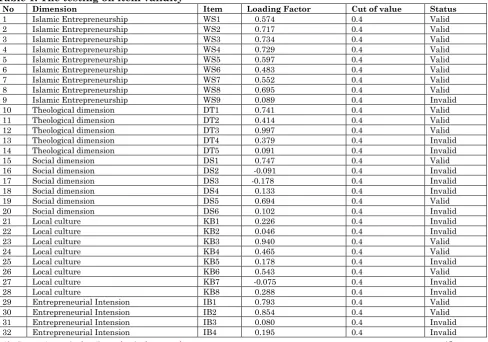
Confirmatory factor testing phase is the measurement phase of the dimensions that form the latent variables in the model. The purpose of the confirmatory factor testing is to test confirmatory factor unidimensions of dimension forming each latent variable. To measure the validity of the items, the confirmatory factor is calculated by comparing the value of loading factor to a cut of value above 0.4 which is described on table 1.
Table 1: The testing on item validity
No Dimension Item Loading Factor Cut of value Status
34 Entrepreneurial Behavior PW1 0.564 0.4 Valid 35 Entrepreneurial Behavior PW2 0.625 0.4 Valid 36 Entrepreneurial Behavior PW3 0.631 0.4 Valid 37 Entrepreneurial Behavior PW4 0.541 0.4 Valid 38 Entrepreneurial Behavior PW5 0.598 0.4 Valid 39 Entrepreneurial Behavior PW6 0.206 0.4 Invalid Source: author’s research
The table shows the calculation of confirmatory construct on each indicator
such as the values of Islamic
entrepreneurship, theological dimension,
social dimension, intention and
entrepreneurs’ behavior is said to be valid if each item gets loading value above 0.4. On the table it is obtained some question items with a value below 0.4, they are items of WS9, DT4, DT5, DS2, DS3, DS4, DS6, KB8, KB1, KB2, KB5, KB7, IB3, IB4, IB5 and PW6. Therefore, except for the items stated above, other items are said to be valid. For
the observed questions that are invalid, then the item in each dimension should be discarded.
ReliabilityTesting
Reliability testing is used to the extent of the measuring instrument can give relatively similar results when measurements are done again to different objects with different time. The minimum reliability value of dimension forming valid latent variable accepted to be reliable through CR and VE
values is described on table 2.
Table 2: Reliability testing
No Dimension Item Standard
Loading
Error Standard
loading 2
Composite Reliability Variance Extract 1 2 3 4 5 6 7 8 9 10 11 12 13 14 15 16 17 18 19 20 21 22 23 Islamic Entrepreneurship Islamic Entrepreneurship Islamic Entrepreneurship Islamic Entrepreneurship Islamic Entrepreneurship Islamic Entrepreneurship Islamic Entrepreneurship Islamic Entrepreneurship TOTAL
Theological Dimension Theological Dimension Theological Dimension
TOTAL
Social Dimension Social Dimension TOTAL
Local Culture Wisdom Local Culture Wisdom Local Culture Wisdom TOTAL
Entrepreneurial Intension Entrepreneurial Intension TOTAL
Entrepreneurial behaviour Entrepreneurial behaviour Entrepreneurial behaviour Entrepreneurial behaviour Entrepreneurial behaviour TOTAL WS1 WS2 WS3 WS4 WS5 WS6 WS7 WS8 DT1 DT2 DT3 DS1 DS5 KB3 KB4 KB6 IB1 IB2 PW1 PW2 PW3 PW4 PW5 0.574 0.717 0.734 0.729 0.597 0.483 0.552 0.695 5.081 0.741 0.414 0.997 2.152 0.947 0.694 1.641 0.940 0.465 0.543 1.948 0.793 0.854 1.647 0.564 0.625 0.631 0.541 0.598 2.959 0.671 0.481 0.461 0.469 0.643 0.766 0.695 0.517 4.703 0.451 0.829 0.005 1.285 0.104 0.519 0.623 0.117 0.784 0.117 1.607 0.286 0.224 0.510 0.682 0.609 0.602 0.707 0.643 3.243 0.329 0.514 0.539 0.531 0.357 0.234 0.305 0.483 3.292 0.549 0.171 0.994 1.714 0.896 0.481 1.377 0.883 0.216 0.294 1.393 0.628 0.729 1.357 0.318 0.391 0.398 0.293 0.357 1.757 0.840 0.782 0.812 0.700 0.840 0.720 0.700 0.695 0.752 0.540 0.68 0.480
Source: author’s research
Based on observations, composite reliability value and variance extract can be obtained. Ghozali [14] states each dimension item is called reliable if the value of composite reliability is > 0.70 and the value of variance extract is > 0.50. From table composite reliability value is obtained for each
0:50. However, that one dimension remains to be stated reliable because the value of its composite reliability has been reliable. Multivariate OutlierEvaluation
Outliers are observations on the data having unique characteristics that look very far different from other observations and appear in the form of extreme value, either for a single variable or combination variables [15] Detection of multivariate outliers is done by paying attention to Mahalonobis distance value on the attachment sheet of output hypothesis testing. The criteria used is based on the kai squares value on the degrees of freedom (df) 23, that is the number of indicator variables at a significance level of p <01. Mahalanobis distance Value x 2 (23. 0:01) = 41.63. This
means that all the cases that have md greater than 41.63 are multivariate outliers. Because there is no value above 41.63 on output result, it can be concluded that there are no outliers in the data.
Data Normality Testing
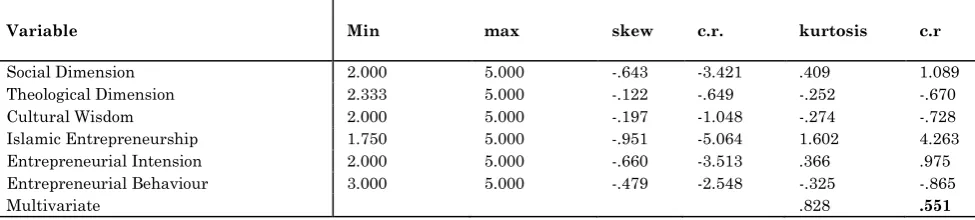
This test aims to analyze the degree of normality of the data used in the study. Data normality assumption must be met in order that the data can be processed further for modelling SEM. Univariate normality testing is to examine the value of critical ratio skewness of the data used is the range between - 2.58 and + 2.58 at the 0.01 level, so the data used can be said to be normal [11]. Univariate and multivariate normality of the data in the study are presented on the table of normality testing. The complete results of normality testing are shown on table 3.
Table 3: Normality testing table
Variable Min max skew c.r. kurtosis c.r
Social Dimension 2.000 5.000 -.643 -3.421 .409 1.089 Theological Dimension 2.333 5.000 -.122 -.649 -.252 -.670 Cultural Wisdom 2.000 5.000 -.197 -1.048 -.274 -.728 Islamic Entrepreneurship 1.750 5.000 -.951 -5.064 1.602 4.263 Entrepreneurial Intension 2.000 5.000 -.660 -3.513 .366 .975 Entrepreneurial Behaviour 3.000 5.000 -.479 -2.548 -.325 -.865
Multivariate .828 .551
Source: author’s research
Based on the table above it is shown that there are three out of the six critical ratio values that are outside of ± 2.58, so it can be concluded in a univariate data way the research is relatively good and can be said to be normally distributed. Then, in a multivariate normality way, the research data are in normal category because they have a value of cr by 0.551 under a range of 2.58. The study of Hair, et al [15] states that the data which are multivariate normal must also be univariate normal. But on the
contrary, if the overall data are univariate normal, it does not guarantee normal in a multivariate way.
Suitability of Model Testing/Goodness of Fit
The suitability of model testing is used to test how well the goodness of fit level of the research model. The complete results of the testing are presented on table 4.
Table 4: The Suitability of goodness of fit model
Goodness of fit index Cut of value Result Evaluation model
Chi-square
Significant Probability RMSEA
GFI AGFI CMIN / DF TLI CFI NFI RFI IFI
Must be little ≥0.05 ≤0.08 0 to 1 ≥0.90 ≤2.00 ≥0.90 ≥0.90 ≥0.90 ≥0.90 ≥0.90
7.347 0.119 0.070 0.986 0.927 1.837 0.887 0.970 0.942 0.782 0.973
Fit Fit Fit Fit Fit Fit Marginal
Fit Fit Marginal
Fit
Based on the test results presented above, it is known from the criteria and the value of the results of several indicators that are in good condition (Fit) except there are two indicators that have the value of marginal goodness of fit but almost close to the value of the required criteria. With this result, so as a whole it can be said that the research model has the goodness of fit level which is good.
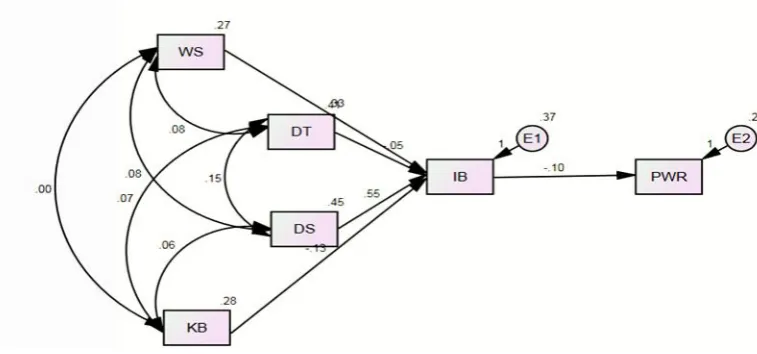
The next stage is the analysis of Structural Equation Model (SEM) in Full Model intended to test the model and hypotheses developed in the research. Model test activities are performed after a three-stage suitability testing. From this SEM testing it can be known regression coefficient significance testing. An overview of research model through the SEM testing in Full Model is presented in Figure 1.
Figure 1: SEM full model
After SEM model in Full Model is known,
the tested research hypothesis is presented on table 5 of regression weights.
Table 5: Hypothesis Testing
Estimate SE CR P Label
Entrepreneurial Intention Islamic Entrepreneurship Entrepreneurial Intention Cultural Wisdom Entrepreneurial Intention Theological Dimension Entrepreneurial Intention Social Dimension
Entrepreneurial Behaviour Entrepreneurial Intension
.330 -.128 .052 .548 .102
.094 .092 .081 .077 .047
3.503 -1.401 1.989 7.158 2.184
000 .161 .019 000 .029
par_1 par_2 par_3 par_4 par_5
Source: author’s research
This hypothesis testing is used to analyze the critical ratio (CR) and probability value (P) if the result of the data analysis is compared to the statistical limitations required, namely above 1.96 for the value of CR or t-test and below 0.05 for the value of P. If the result of the data analysis shows the qualified value, then hypothesis proposed is acceptable. Hypothesis testing is discussed in detail in stages in accordance with the proposed framework. In this research, there are five hypotheses proposed. The discussion is as follows:
Hypothesis 1
Hypothesis 1 in this study is there is a
significant influence of entrepreneurship Islamic values towards entrepreneurial intention. Based on the result of the data analysis, it is known that the value of CR on table 9 is 3.503 with a P value of 0.000. The result from these two values provides information that there is a significant influence of entrepreneurship Islamic values towards entrepreneurial intention, as eligible for the CR value above 1.96 and below 0.05 for the value of P. Thus, it can be stated that hypothesis 1 in this study is supported.
Hypothesis 2
theological values towards entrepreneurial intention. Based on the result of the data analysis, it is known that the value of CR on the table is 1.989 with a P value of 0.019. The result from these two values provides information that there is a significant influence of the dimension of theological values towards the entrepreneurial intention, as eligible for the CR value above 1.96 and below 0.05 for the value of P. Thus, it can be stated that hypothesis 2 in this study is supported.
Hypothesis 3
Hypothesis 3 in this study is that there is a significant influence of the values of social dimension towards the entrepreneurial intention. Based on the result of the data analysis, it is known that the value of CR on the table is 7.158 with a P value of 0.000. The result from these two values provides information that there is a significant influence of the values of social dimension towards entrepreneurial intention, as eligible for the CR value above 1.96 and below 0.05 for the value of P. Thus, it can be stated that hypothesis 3 in this study is supported.
Hypothesis 4
Hypothesis 4 in this study is there is a significant influence of the values of local
wisdom dimension towards the
entrepreneurial intention. Based on the result of the data analysis, it is known that the value of CR on the table is 1.401 with a P value of 0.161. The result from these two values provides information that the values of local wisdom dimension do not have a
significant influence towards
entrepreneurial intention, as not eligible for CR value above 1.96 and below 0.05 for the value of P. Thus, it can be stated that hypothesis 4 in this study is not supported. Hypothesis 5
Hypothesis 5 in this study is there is a significant influence of entrepreneurial intention towards the entrepreneurial behavior. Based on the result of the data analysis, it is known that the value of CR on the table is 2.184 with a P value of 0.029.
The result from these two values provides information that there is a significant
influence of entrepreneurial intention towards the entrepreneurial behavior, as eligible for CR value above 1.96 and below 0.05 for the value of P. Thus, it can be stated that hypothesis 5 in this study is supported [16-21].
Conclusion
Testing on criteria of Goodness of Fit model: from multivariate outlier testing, output results are concluded that there are no outliers in the data, on the normality testing data it can be obtained multivariate normal data, because it has a value of multivariate CR below the range of values of 2.58, from the suitability model testing/goodness of fit known from criteria and values from the results of several indicators, the model is in a good condition (Fit) except there are two indicators that have a marginal goodness of fit value but almost close to the value of the required criteria. With this result, so as a whole it can be said that the research model has a goodness of fit level which is good.
In the testing on model causality through SEM analysis it is known that a significance testing of regression coefficient through cut of value the value of the critical ratio (CR) and probability (p) from five hypotheses, four hypotheses are supported and one hypothesis is unsupported.
From the conclusions it can be given some suggestions as follows:
It is suggested that entrepreneurial culture behavior should be examined by various dimensions, for example of a custom dimension, ethnicities, different religions because the region of Central Java in particular and Indonesia in
general have the multi-cultural
characteristics through Pancasila with the motto ‘Unity in Diversity’.
It should be further developed through research on Incubator Moslems
entrepreneur innovation by encouraging them with a Moslem entrepreneurial ethos, a theological dimension, social dimension and values of local wisdom and innovation, so there grows young entrepreneurs among students and university graduates who have competitiveness.
Acknowledgement
Special thanks for the Ministry of Hihger Education Research Technology Republic of Indonesia for granted the research.
References
1. Wijaya Toni (2008) Kajian Model Perilaku Berwirausaha UKM DIY dan Jawa Tengah Jurnal manajemen dan kewirausahaan, 10(2):93-104. 2. Hastin Umi Anisah (2012) Penerapan Nilai-nilai
kewirausahaan Islami dalam Meningkatkan
Keunggulan Bersaing UMKM
eco-enterepreneurship seminar & Call for paper, FE Universitas Negeri Semarang.
3. Hastin Umi Anisah, Djumahir (2008) Peran Budaya
Banjar dalam Meningkatkan Kinerja dan
Keunggulan Bersaing Melalui Kewirausahaan Islami dan Strategi: Studi pada Industri Kecil Menengah Batu Mulia di Martapura Kalimantan Selatan Jurnal Aplikasi Manajemen.
4. Samdin (2008) Pemahaman Modal dalam praktik dagang masyarakat Muslim Gu-lakudo di Sulawesi tenggara, Jurnal Aplikasi Manajemen, 6(3):391-495. 5. Ayatrohaedi (1986) Kepribadian Budaya Bangsa (
local genius ), Pustaka Jaya : Jakarta.
6. Sartini (2004) Menggali kearifan Lokal Nusantara Sebuah kajian Filsafati Jurnal Filsafat, jilid 37 no 2. 7. Balipos.co.id (2003) Holding the local wisdom article
I Ketut Gobyah, 17/09/2003.
8. Mulyani Endang (1990) Pengaruh Sikap Mental Tradisional, Achievement Motivation dan Keinovatifan Pengusaha Terhadap Kinerja perusahaan UMKM di sukoharjo, Skripsi, Perpustakaan FISIPOL UGM.
9. Ajzen I (1991) The theory of planned behaviour, Organization Behaviour and Human Decision Process, 50:1979-211.
10. Ajzen I (2008) Attitude and attitude Change, Psycology Press: WD Crano eds.
11. Wijaya Toni (2008) Analisis Structural Equation Model menggunakan AMOS, Jogyakarta: Penerbit Atmajaya Yogyakarta.
12. Yazilmiwati Y Azmi ( 2012) Enterpreneur’s social responsibilities from Islamic perspective: A study of muslim enterpreneurs in Malaysia, Journal of Global Strategic Management, 5-13.
13. Ramayah T, Harun Z (2005) Enterpreurial Intention Among The Student Of University Sains Malaysia, International Journal Of Management and Enterpreneurship, 1:8-20. 14. Ghozali Imam (2011) Struktural Equation
Model,concept and application with AMOS 21.0 Program, BP Undip: Semarang.
15. Hair JF, Anderson RL Tatham, Black WC (2006) Mulitivariate Data Analysis, 6th edition, Upper Sadle River, New jersey, Prentice Hall, Inc. 16. Al-Bukhari (1987/ 1407 H), Kitab Nafaqat,
Kutubu Sittah, Riyadh: Maktabah Darul Sala 17. Ambroise Yvon (1993) the Education Values, EM
Kaswardi (ed), The Education Values enter the 2000 year, Jakarta: Grasindo.
18. Fishbein M, Ajzen I (1975) Beliefs, attitude, Intention and behaviour: An introduction to Theory and Research, Sydney: Addison-Wesley Publishing Company.
19. Nawawi Al Bantany (2011) Al Qur’an Tafsir Per Kata Tajwid Kode Angka Al Hidayah Jakarta: Penerbit Kalim.
20. Sholahuddin Muhammad (2013) Tantangan
Perbankan Syariah dalam Peranan
Mengembangkan UMKM” Proceding Call paper FE UMS.