AGGREGATION AND COMPLEX FORMATION OF COBALT(II)
SULFONATED PHTHALOCYANINE WITH
1,4-DIAZABICYCLO[2.2.2]OCTANE IN WATER-ORGANIC
MEDIUM
Anna Filippova,
[a]Alena Voronina,
[a]Natalya Litova,
[a]Mikhail Razumov,
[a]Artur Vashurin
[a]*and Svetlana Pukhovskaya
[a]Keywords: cobalt(II) tetrasulfophthalocyaninate, solution, self-association, water, ethanol, DABCO
Self-association of water-soluble Co(II)-phthalocyanine has been studied. Influence of axial coordination of DABCO and nature of solvent on self-association of metallophthalocyanines is shown. Features of solvation interaction of cobalt(II) tetrasulfophthalocyaninate in water and water-ethanol mixture are identified.
* Corresponding Authors E-Mail: [email protected]
[a] Ivanovo State University of Chemistry and Technology, Ivanovo, 153000 Sheremetevsky str. 7, Russia
Introduction
The relevance of present study emanates from the use of cobalt(II) tetrasulfophthalocyanine as catalyst for mild oxidation processes of organic compounds.1-3 It is known
that the homogeneous catalytic process is accompanied by self-association processes of the phthalocyanine catalyst.4-7
Influence of self-association of metallophthalocyanines on their catalytic properties is ambiguous. On one hand the activity of phthalocyanine as catalyst decreases, on other hand, self-association processes favors the formation of phthalocyanine supramolecular structures8-10 that can result
in increased output of the target product of catalysis in the synthesis.
To decrease aggregation and increase catalytic activity of
metallophthalocyanines, a procedure of macrocycle
heterogenization on the surface of solid-phase carrier need to be carried out.11-15 It leads to increased chemical bonding
of macrocycle and polymer surface.
However, presently there is no way to control the processes of association and increase catalytic activity of metallophthalocyanines in homogenous medium. Research directed to use various alloying supplements in homogenous catalysis is mainly empirical and often have random nature. Such supplements, casually represented by axial ligands, are considered as part of models, imitating active site of mono- and dioxygenases enzymes. As of now there are many examples of catalytic reactions, when a small amount of specific supplement increases the rate of reaction but not output. Usually unproved mechanisms of supplementary action has been suggested by the authors.16
Hence the possibility to control the self-association of metallophthalocyanines due to axial coordination processes and variation of solvating power of medium to create catalytic active liquid-phase systems is promising Accessibility of metallophthalocyanines reaction center for bonding of additional ligand during axial coordination is very important.
There is almost no works about association in the presence of bidentate axial ligands in the literature. However, it is known, that formation of molecular associates with polydentate ligands can change coordination ability of macroheterocycles and type of metallophthalocyanines associates in solution.17-20 Besides interaction between
metallophthalocyanines and polydentate ligands is
interesting for fundamental studies of supramolecular liquid-phase systems formation also.
The possibility to control the monomer-dimer associative equilibrium for cobalt(II) terasulfophthalocyaninate due to
molecular complex formation with
1,4-diazabicyclo[2.2.2]octane (DABCO) and variation of solvating power of medium is considered in this work.
Experimental
Cobalt(II) tetrasulfophthalocyaninate (CoPc) was
synthesized and purified by a known direct sulfonation method.21
Its composition and structure is confirmed by electron-absorbtion (UV-Vis) spectroscopy, IR spectroscopy and elemental analyzes. IR-spectra were recorded on the Avatar 360 FT-IR spectrophotometer using KBr tablets. There are intense bands at 700, 1032-1035, 1192-1197 cm-1, it is
caused by presence of sulfonic groups. Oscillation in 839-855 cm-1 is caused by C-H vibrations of three-substituted
N
N N
N
N N N
N
Cî
SO3H
H3OS
SO3H
H3OS
CoPc
Figure 1. Cobalt(II) tetrasulfophthalocyaninate
1,4-Diazabicyclo[2.2.2]octane (DABCO) was commercial product (Sigma-Aldrich) with 99.98% purity and was used as received.
Degassed distilled water was used for preparing the solutions. Solvents, used for the work, was purified by known methods.22,23 Water content in ethanol was
determined by potentiometric titration according Fisher’s method.23
Coordination of DABCO with CoPc was studied by spectrophotometric method. UV-Vis spectra were registered with UNICO-2800 spectrophotometer. Investigations were carried out at 298.15 K in quartz cell with depth of absorbing layer of 10 mm, placed in a thermostatic cell.
To calculate stability constants of molecular complexes analytical wavelengths from UV-Vis spectra were used.
(1)
Equilibrium concentration of molecular complex was calculated according to eqn. (2)
(2)
where cLCoPс is equilibrium LCoPс concentration, c0CoPc is an
initial CoPс concentration, A0, Ap and Ak are initial,
equilibrium and final optical density of the solution respectively.
Concentration of unbonded ligand was calculated according to the Eqn. (3).
(3)
Combination of equations (1) and (3) leads to equation (4), which enables one to calculate the equilibrium constant.
0 p p k
y 0 0
L CoPc 0 p 0 k
[( - )/( - )] =
[ - ·( - )/( - )]
A A A A
K
c c A A A A (4)
Investigation was carried out with a hundredfold excess of the ligand to relative CoPc, therefore the equilibrium concentration of the ligand was taken as its initial concentration. It simplified the calculation of Ky equation
(5).
(5)
Results and Discussion
We have investigated the self-association processes of CoPc in water previously.6 Earlier data showed that in
concentration range of 2 x 10⁻⁵ – 2 x 10⁻⁴ mol L-1, the
phthalocyanine is mostly dimerized, caused by π-π interaction between macrocycles molecules. π-π-Dimers are formed due to π-σ-contraction and π-π-repulsion of macrocycles electron systems.24 Variation in the solvents’
solvation properties lead to a shift in the monomer-dimer equilibrium (6) and hence in the catalytic activity of CoPc.
(6)
Introduction of strong electron donors in the system, for example pyridine that is able to form stable axial complexes25 with CoPc, leads to shift of associative
equilibrium (6) towards the monomeric form due to destruction of π-π – dimer and domination of π-π – repulsion of electrons systems of two macromolecules that causes changes in its solvation environment. The solvation power is reduced by lowering the dielectric constant of the medium (εPy 12.3; εH2O 78.5)26 of mixed solvent. However, it is
amplified by specific solvation electron-donor properties of an organic solvent (DNPy 33.1; DNH2O 18).26
Pyridine, displacing water from the near solvation field of metal cation in phthalocyanine, forms stable axial complex (Ky 800 ± 20 L mol-1). It is not a favorable factor.
Mechanisms of oxidation of certain organic compounds with phthalocyanines complexes suggest easy removal of solvent from inner coordination sphere of CoPc, freeing it for substrate. Herewith molecules of CoPc must not aggregate.27-31
The principle of chemical transformations acceleration, based on favorable orientation of reagent, provided by hydrogen bonds or hydrophobic interactions of environment, is known as characteristics of enzymatic catalysis.32
Thus, the solvent for catalytically active liquid-phase system must be able to solvate CoPc and to form labile molecular complexes due to specific solvation (ε from 20 to 50; DN < 25). Probably use of mixed solvents, allowing the fine tuning of these parameters, is the most promising.
KyLCoPc =
CoPc L
0
py 0
0 k L
A A
K
A A c
0 p
0
LCoPc CoPc
0 k
A A
c c
A A
0
0 0
0
p
L L CoPc
k
A A c c c
A A
2
2
CoPc
р1(CoPc
)
Based on foregoing, water-organic mixtures, for example water-ethanol, are chosen as medium for liquid-phase
modeling of catalytic process with coordinated
metallophthalocyanines. Ethanol is miscible with water in different molar ratios and have the necessary salvation characteristics (ε 24.3; DN 19.6)26, that allows control of
monomer-dimer equilibrium for CoPc.
Figure 2 depicts the changes in the optical density of CoPc as observed in the electronic absorption spectrum at different concentration of ethanol.
0,00001 0,00002 0,00003 0,00004 0,00005 0,2
0,4 0,6 0,8 1,0 1,2 1,4 1,6 1,8 2,0
c, mol l-1
A
Beer-Lambert-Bouguer
y = 40642x
r2 = 0,997
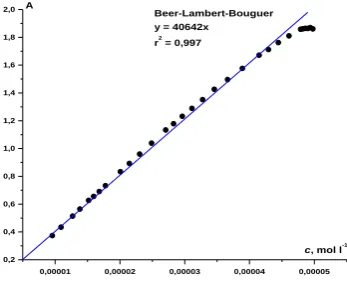
Figure 2. Dependence of optical density (Q-band λ 669 nm) of CoPc’s ethanol solution on concentration, at 298.15 K
Data in figure 1 show that dependence of CoPc’s absorption in Q-band, in the range of ethanol concentration from 0 to 4.7 x 10⁻⁵ mol L-1 obeys Beer-Lambert-Bouguer
law, indicating the existence of monomeric form of CoPc. Obviously, equilibrium (6) is shifted to the left. Value of molar extinction coefficient (ε) for Q-band is 40600 ± 50 L (mol cm)-1. Probably, it will favor the catalytic activity of
CoPc.
Figure 3 shows UV-Vis spectra for solutions of CoPc in water and ethanol.
450 500 550 600 650 700 750 800
0,0 0,2 0,4 0,6 0,8 1,0 1,2 1,4 1,6 1,8 2,0
2 А
, nm
1
Figure 3. UV-Vis spectra of CoPc’s solution with concentration of 4.61 x 10⁻⁵ mol L-1, at 298.15 K in (1) water, (2) ethanol.
Data in figure 2 shows differences between CoPc’s spectra in water and ethanol. Perusal of spectra indicates the presence of associated forms of CoPc in solution. Wide absorption peaks in the visible region of the spectrum is characteristic of aqueous solution of CoPc. Absorption bands of almost equal intensity in area of 627 nm (dimeric form of CoPc) and Q-band in area of 670 nm (monomeric
form of macrocycle) are recorded in the UV-Vis spectra. In ethanol, for CoPc, intensive Q-band in area of 669 nm and negligible absorption in area of 595 nm are obtained. These data let us to suggest that the extent of dimerization of the macrocycle in ethanol is rather lower than that in water solution. Probably, it caused by presence of equilibrium (7) in system, induced by the formation of molecular complexes due to axial coordination of solvent molecule.
(7)
From the point of view of green chemistry and technology, water is preferable to ethanol. Hence, the catalysis is implemented technologically in the water. Based on this, influence of the addition of ethanol on the association process of CoPc was studied.
Figure 4 shows alteration in UV-Vis spectra of aqueous solution of CoPc, when 4.91 x 10⁻⁵ mol L-1 of ethanol is
added.
400 450 500 550 600 650 700 750 800 850
0,0 0,1 0,2 0,3 0,4 0,5 0,6 0,7 0,8 0,9 1,0 1,1
A
, nm
Figure 4. Alteration of UV-Vis spectra of aqueous solution CoPc at 298.15 K when ethanol is added.
There are significant spectral changes by the addition of ethanol to the aqueous solution of CoPc. Absorption band in area of 670 nm is increased, dimeric form band (627 nm) is decreased and showed a hypsochromic shift of 30 nm. These data suggest dissociation of CoPc-dimers due to formation of axial complexes with ethanol (Ky = 107 ± 8 L mol-1), which, however, are not as stable as the complexes with pyridine. Calculations by the method of Bent-Ffrench33
indicated axial coordination of one ethanol molecule only. Back titration does not cause significant spectral changes. These data show there is a low competition for water molecules by cobalt cation of the phthalocyanine. The results demonstrate the possibility of variation in the associative equilibrium of CoPc in water by an addition of ethanol.
Interchange of axial ligands, containing different heteroatoms, forms the basis of metallophthalocyanines catalysis. However, the usefulness of replacing ethanol from amine derivatives of phthalocyanine is limited because of possibility of association.34
yTherefore, we studied possibility of ligand exchange in CoPc by displacement of solvent from coordination cavity of macrocycle with another ligand in the next stage of the work. The complex formation of CoPc with DABCO was studied for these purposes. This process simulates the exchange of coordinated solvent molecules on the substrate during the catalysis.
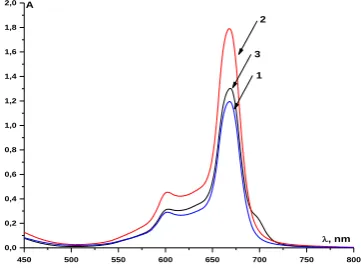
Introduction of DABCO in ethanol solution of CoPc causes consistent increase in the intensity of absorption Q -band region (ΔmaxA 0.483) (Figure 5). It is due to the axial
coordination of DABCO on the central metal cation of CoPc.
450 500 550 600 650 700 750 800
0,0 0,2 0,4 0,6 0,8 1,0 1,2 1,4 1,6 1,8 2,0
1 3 A
, nm
2
Figure 5. UV-Vis spectra of CoPc solution (с 4.98 ·10-5 mol L-1) in
ethanol at 298.15 K, 1) without DABCO; 2) n (DABCO) 3.46·10-5
mol; 3) n (DABCO) 17.35·10-5 mol.
An isosbestic point is obtained in the UV-Vis spectra. It indicates the formation of new chromophore in solution. Obviously, the chromophore is molecular complex, L-CoPс, with DABCO in the ratio of 1:1. Stability constant of this complex (Ky = 280 ± 8 L mol-1), calculated by the equation
(5), is more than twice of the stability constant of complex with ethanol. Further, it should be noted that complex CoPc -DABCO in aqueous solution is rather stable. It indicates influence of solvation processes on complex formation and dimerization. Probably it is caused by the effect of donor-acceptor interaction of DABCO and the solvent on the DABCO molecular associate formation.35
When the ratio [CoPc]:[DABCO] reaches 1:0.0139, there is a decrease in intensity of Q-band absorption (ΔmaxA 0.592)
and a shift of the isosbestic point.
Probably, these alterations are connected with the coordination of second metalophthalocyanines molecule and the formation of sandwich-type dimers CoPс-DABCO-CoPс (Figure 6). Thermodynamic stability constant of sandwich-type dimer is 50 ± 4 L mol-1.
Thus, this work shows that there are possibilities of controlling the associative monomer-dimer equilibrium for CoPc in solutions by molecular complex formation and varying the solvating power of the medium.
Co Co
N N
Figure 6. Scheme of sandwich dimer of CoPс-DABCO-CoPс
Acknowledgments
The work was financially supported by the Ministry of Education and Science of the Russian Federation (state assignment) and Russian Foundation for Basic Research (research projects No. 13-03-00615-a and 13-03-01343-a).
References
1Sorokin, A. B., Chem. Rev., 2013, 113, 8152
2Basu, B., Satapathy, S., Bhatnagar, A. K., Catal. Rev.: Sci. Eng.,
1993, 35,571
3Das, G., Sain, B., Kumar, S., Catal. Today, 2012, 198, 228 4Schelly, Z. A., Harward D.J., Hemmes, P., Eyring E. M., J. Phys.
Chem., 1970, 74, 3040
5Yang, Yu-Ch., Ward, J. R., Seiders, R. P., Inorg. Chem., 1985, 24,
1765
6Voronina, A. A., Kuzmin, I. A., Vashurin, A. S., Shaposhnikov, G.
P., Pukhovskaya, S. G., Golubchikov, O. A. Russ. J. Gen. Chem., 2014, 84, 1777
7Iliev, V., Alexiev, V., Bilyarska, L., J. Mol. Catal.A: Chem., 1999,
137, 15
8Beletskaya, I., Tyurin, V. S., Tsivadze, A. Y., Guilard, R., Stern,
C., Chem. Rev., 2009, 109, 1659
9Tong, S.-L., Zhang, J., Yan, Ya. , Hu, Sh., Yu, J., Yu, L., Solid
State Sci., 2011, 13, 1967
10Ishikawa, N., Kaizu, Y., Coord. Chem. Rev., 2002, 226, 93 11Wu, S.-H., Wu, J.-L., Jia, Sh.-Y., Chang, Q.-W., Ren, H.-T., Liu,
Yo., Appl. Surf. Sci., 2013, 287, 389
12Sharma, R. K., Gulati, S., Pandey, A., Inorg. Chim. Acta, 2013,
397, 21
13Marfin, Yu. S., Vashurin, A. S., Rumyantsev, E. V., Puhovskaya,
S. G., J. Sol-Gel Sci. Technol., 2013, 66, 306
14Voronina, A. A., Tarasyuk, I. A., Marfin, Yu. S., Vashurin, A. S.,
Rumyantsev, E. V., Pukhovskaya, S. G. J. Non-Cryst. Solids,
2014, 406, 5
15Voronina, A., Kuzmin, I., Vashurin, A., Pukhovskaya, S.,
Futerman, N., Shepelev, M., Eur. Chem. Bull., 2014, 3, 187
16Shul’pin, G. B., J. Mol. Catal. A: Chem., 2002, 189, 39
17Lebedeva, N., Pavlycheva, N., Petrova, O., Vyugin,A., Kinchin,
A., Parfenyuk, E., Mayzhlish, V., Shaposhnikov, G., Mend. Commun., 2003, 13, 237
18Palewska, K., Sworakowski, J., Lipinski, J., Opt. Mater.,2012,
19Palewska, K., Sworakowski, J., Lipinski, J., J. Photochem.
Photobiol. A: Chem., 2011, 223, 149
20Günsel, A., Yarasir M. N., Kandaz, M., Koca, A., Polyhedron,
2010, 29, 3394
21Kulinich, V. P., Shaposhnikov, G. P., Badaukaite, R. A.,
Macroheterocycles, 2010, 3, 23
22Weissberger, A., Proskauer, E. S., Riddick, J. A., Toops, E. E.
Organic solvent: physical properties and methods of purification, Interscience Publishers Inc, New York 1955.
23Gordon, J. A., Ford, R. A. The Chemist's Companion: A
Handbook of Practical Data, Techniques, and References, John Wiley & Sons, New York, 1972
24Snow, A. W., The Porphyrin Handbook. Phthalocyanines:
Properties and Materials, Elsevier Science, Amsterdam,
2003, 17, 129
25Berezin, B. D. Coordination compounds of porphyrins and
phthalocyanines, John Wiley, Toronto, 1981
26Moskva, V. V., Soros Educ. J., 1999, 4, 44 (in Russ))
27Hoffman, M., The sciences of the Total Environmental, 1987, 64,
99
28Borisenkova, S. A., Russ. J. Petrol. Chem., 1991, 31, 391 29Fischer, H., Schulz-Ekloff, G., Wohrle, D., Chem. Eng. Technol.,
1997, 20, 624
30Buck, T., Bohlen, H., Wöhrle, D., Schulz-Ekoff, G., Andreev, A..
J. Mol. Catal.,1993, 80, 253
31Tyapochkin, E. M., Kozliak, E. I., J. Mol. Catal. A: Chem., 2005,
242, 1
32Nekipelov, V. M., Zamaraev K. I., Coord. Chem. Rev. 1985,
61,185
33Bent, H. E., French, C. L., J. Am. Chem. Soc.,1941, 63, 568 34Zaichikov, A. M., Krestyaninov M. A., Antonova O. A., J. Therm.
Anal. Calorim., 2014, 115, 1857
35Zhiltsova, E. P., Pashirova, T .N., Kashapov, R. R., Lukashenko,
S. S., Voloshina, A. D., Kulik, N. V., Zobov, V. V., Zakharova, L. Ya., Konovalov, A. I., Gaisin, N. K., Gnezdilov, O. I., Russ. Chem. Bull., 2011, 61, 113