SYNTHESIS, CHARACTERIZATION AND BIOLOGICAL
ACTIVITY OF SOME METAL COMPLEXES OF
BENZOYLACETONE SCHIFF BASE
T. I. Kashar
[a,b]Keywords: Schiff base; synthesis; IR; thermal analyses; biological activity.
N-Anilinoacetohydrazobenzoylacetone (H2L) and their manganese(II), cobalt(II), nickel(II), copper(II) and zinc(II) complexes have been
synthesized and characterized by IR, electronic spectra, molar conductivities, thermal analyses and magnetic susceptibilities. Binuclear complexes with molar ratios of M:L=2:1 are formed. IR spectra show that the ligand (H2L) coordinates to the metal ions in a tetradentate
manner with O2N2 donor sites in Mn(II), Co(II), Ni(II) and Zn(II) complexes while in the Cu(II) complexes the ligand coordinates as
bidentate via N and O donor atoms. The electronic absorption spectra and magnetic susceptibility measurements show that all the complexes have octahedral structure. The copper(II) complexes shows higher antibacterial activity towards G+ bacteria (Bacillus subtilis )
than the ligand and other complexes while Mn(II) complex shows higher antifungal activity than the free ligand. Corresponding Author
E-Mail: [email protected]
[a] Department of Chemistry, Faculty of Science, Menoufia University, Shebin El-Kom, Egypt .
[b] Department of Chemistry, Faculty of Science, Qassim University,Saudia Arabia
Introduction
Schiff bases have wide applications in many fieldssuch as biological, inorganic and analytical chemistry1,2 and are
used in optical and electrochemical sensors, as well as in various chromatographic methods, to enable detection of enhanced selectivity and sensitivity.3-5 Transition metal
complexes of Schiff base have been widely studied because of their industrial, antifungal, antibacterial, anticancer, antiviral and herbicidal applications.6-10 Complexes of Ni(II),
Co(II) and Cu(II) with Schiff base ligands derived from β-diketones and p-anisidine have been studied,11 these
complexes have antimicrobial activity and show higher activity than the free ligands. There has been increasing interest in the synthesis and characterization of unsymmetrical Schiff base ligands and their metal complexes of biological interest. Phenylaminoacetic acid ethyl acetoacetate-2-ylmethylenehydrazone and its Mn(II), Fe(III), Co(II), Ni(II), Cu(II) and Zn(II) complexes have been synthesized and characterized by elemental analyses, IR, UV-vis, electrical conductivity, magnetic moment and thermal analyses (DTA, TGA).12 The ligands behave as di-
or tridentate mono or dibasic acid in these mononuclear complexes. Density functional theory (DFT) calculations indicated that the diketo form is the most stable tautomer and the agreement between the calculated and experimental vibrational frequencies is very good.12 In this work N-anilinoacetohydrazobenzoylacetone (H2L) and their metal
complexes were synthesized and studied.
Experimental
All compounds and solvents used were resorced from BDH or Aldrich and used as received. The ligand was prepared by mixing ethanolic solutions of
N-anilino-acetohydrazide (0.05 mol) and benzoylacetone (0.05 mol) with reflux for 3 h. The resulting product was filtered off and crystallized from ethanol. The complexes were prepared by the following general method. To a hot ethanolic solution of β-diketone hydrazone (0.05 mol) of metal salts (MCl2)
were added where [M=Mn(II), Co(II), Ni(II), Cu(II) and Zn(II)] or Cu(NO3)2 in (2:1) metal: ligand stoichiometric
ratio. The reaction mixture was refluxed on a water bath for 4 hours. The formed complexes were filtered off, washed several times with pure dry methanol and dried in vacuum over anhydrous CaCl2.
Measurements
Elemental analyses (C, H, N and Cl) were carried out at the microanalytical Unit of the University of Cairo. Metal ions were determined using atomic absorption with a Perkin Elmer (model 2380) spectrophotometer. The IR spectra were measured as KBr discs using a Perkin-Elmer 1430 infrared spectrometer (4000-200 cm-1). Electronic
absorption spectra were recorded in the 200-900 nm region on a Perkin-Elmer 550 spectrophotometer. The magnetic susceptibilities were measured at room temperature using the Gouy method with mercury(II) tetrathiocyanato-cobaltate(II) as magnetic susceptibility standard, diamagnetic corrections were made using Pascal’s constants.13 A Bibby conductimeter MCl was used for
conductance measurements. The thermal analyses (TGA) were carried out on a Shimadzu TG-50 thermal analyzers in the 27-800 oC range at a heating rate of 10 oC min-1.
Bacteria media
Nutrient agar medium was prepared by standard method.14
The antibacterial activity of the ligand and its complexes were tested using the paper disc diffusion method15 against
cm3 of the tested bacteria was spread over the medium using
a spreader. Discs of Whatman No.1 filter paper having diameter of 5.00 mm, containing compounds were placed in the inoculated Petri plates. The plates were incubated at 28 °C for 24–48 h and the zone of inhibition was calculated in millimetres.
Fungus media
The test compounds in measured quantities were dissolved in DMF to a concentration of 1000 ppm of compounds. Czapek dox agar medium was prepared by a standard method.14 Penicillum notatum was spread over each dish by
using a sterile bent loop rod. Disks were cut by a sterilised cork borer and then taken by sterilised needle. The resulting pits were sites for the test compounds, the plates are sites for the test compounds. The plates were incubated at 30 °C for 24–48 h and any clear zones present were detected, the zone of inhibition was calculated in millimetres.
Results and Discussion
A new polydentate Schiff base (H2L) was synthesized
from the condensation of N-anilinoacetohydrazide with benzoylacetone in EtOH in 1:1 molar ratio. The ligand formed was characterized by elemental analysis,1 HNMR
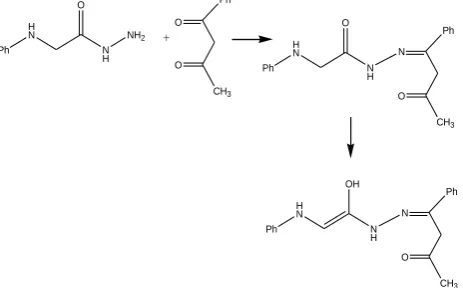
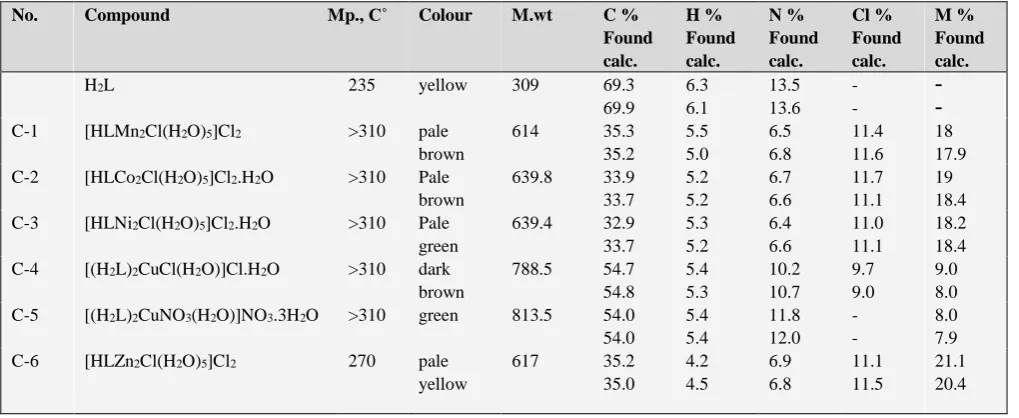
and IR spectral analyses. The results of elemental analyses with molecular formula and the melting point are presented in Table 1. The results obtained are in a good agreement with those calculated for the suggested formula and the melting point is sharp indicating the purity of the prepared Schiff base (Scheme 1)
Scheme 1 IR Spectra
The data of the IR spectra of Schiff base ligand (H2L) and
its complexes are listed in Table 2. The ligand (H2L) has
tautomeric forms as shown in Scheme 1. The IR spectrum of the ligand shows a broad band in the 3400–3100 cm-1 ranges
which may be assigned to stretching vibration of hydroxyl groups associated through inter- and intramolecular hydrogen bonds.1 The spectrum shows strong bands at 3059,
1654 and 1600 cm-1 are assigned to the ν
NH, νC=O and νC=N
respectively.17-21 The IR spectra of the complexes are
compared with the free ligand in order to determine the coordination sites that may be involved in chelation. New peaks are also guide peaks as well as νOH of water of
coordination, and these characteristic peaks are listed in Table 2. The spectra of the metal complexes reveals that the presence of lattice water molecules in the prepared complexes, except C-1 and C-6. It is assigned by the broad band around 3400 cm-1 which is usually assigned to OH
stretching modes of lattice water. However the broad band due to the coordinated water molecules appears in the 3400– 3200 cm-1 range.22,23 Two weaker bands around 950 and 800
cm-1 could be assigned to out of plane deformation modes of
OH bands stretching, rocking and wagging modes of vibrations. In complexes C-4 and C-5 the
νNH
appears as strong band at 3243 and 3059 cm-1.22,23 All the complexesshow a strong band at 1654 – 1651 cm-1 Table 2 which is
assigned to
νC=O
of β-diketone moiety.24 In complexes C-4and C-5
νC=O
of hydrazide moiety appeared as strong band at 1728 and 1726 cm-1. TheνC=N
andνN–N
bands are shiftedto lower or higher wave length indicating that these groups participate in coordination.25,26 All the complexes showing
new medium and weak bands at 694–602 and 514–504 cm-1
ranges due to
νM-O
andνM-N
vibrations, respectively27,28indicated that the bonding of the metal ions to the H2L is
through the oxygen and nitrogen atoms. All the complexes show a medium band at 450–400 cm-1 range except C-5
corresponding to terminal and bridging chloride atoms.27
Therefore from the IR spectra it is concluded that H2L
behaves as monobasic or neutral tri or bidentate ligand coordinated to the metal ion via carbonyl oxygen of benzoylacetone and enolic oxygen of hydrazide moiety and azomethine nitrogen atom.
1H NMR spectra
The 1H NMR spectrum of the ligand H
2L in DMSO-d6
confirmed the proposed structure. The peaks at 6.3 and 4.6 are assignable to the protons of NH group (s, 1H, NH).29
Multiplet signals at 7.8–7.2 ppm range are observed due to aromatic protons (m, 5H, Ar-H). The resonances at 2.1-2.3 ppm correspond to CH2 groups. The methyl group signal is
appeared as a single peak at 1.3 ppm. The OH group signal is appeared at 3.8 ppm as broad peak. 1H NMR spectrum of
the Zn(II) complex reveals the following signals: 7.5–7.3 ppm (m, 5H, Ar-H), 7.8 and 4.5 ppm (s, 1H, NH ), 2.5 ppm (s, 2H, CH2), 1.9 ppm (s, 3H, CH3). The comparison of the
spectrum of Zn(II) complex with the parent Schiff base shows that the peak of OH which appeared at 3.8 ppm in the ligand has disappeared in the spectrum of Zn(II) complex indicating that the coordination occurs through enolic oxygen of hydrazide moiety.12
Electronic spectra
The electronic spectral data of the ligand (H2L) and its
complexes are listed in Table 3. The ligand shows four bands at 340, 320, 280 and 240 nm which may be due to n-π* and π-n-π* transitions. All the complexes show two bands in the 350–300 and 300–240 nm ranges which are assigned to intra-ligand transitions.30 The binuclear complexes of
Mn(II), Co(II) and Ni(II) show two bands at 550–530 nm and 400–350 nm due to 3T
13T2 and 3T1(F)3T2(P) d-d
transitions.31 The copper(II) complexes show different bands
at 600, 480 and 620, 430 nm are assigned to ligand metal charge transfer 2B
1 2E and 2B1 2B2 transition
respectively indicating a distorted octahedral structure. Ph
H N
N H
NH2 O
O N
CH3 Ph
+
Ph H N
N H O
O N
CH3 Ph
Ph H N
N H OH O
O
Table 1. Elemental analyses of the ligand H2L and its complexes .
Table 2. Important IR spectral bands of the ligand H2L and its complexes.
Magnetic moments
The room temperature magnetic moments of the complexes are shown in Table 3. The magnetic moment values of manganese(II) complex are 3.53 BM33 while for
the copper(II) complexes these are 1.8 and 2.3 BM33
indicating octahedral structure. The zinc (II) complex show diamagnetic value .
Molar conductance measurements
The chelates are dissolved in DMF and the molar conductivities of 10-3 M solutions are measured. Table 3
shows the molar conductance values of the complexes. It is concluded from the results that the Mn(II), Co(II), Ni(II) and Zn(II) complexes have molar conductivity values in the range 130.8–167.3 Ω-1 mol-1 cm2 indicating 1 : 2 electrolyte
while copper(II) complexes have a molar conductance values of 61.6 and 86.6 Ω-1 mol-1 cm2 which indicates 1:1
electrolyte.34
TGA Thermal Analyses
Thermogravimetric analyses (TGA) of the ligand and their complexes are used to: (i) get information about the thermal stability of these complexes (ii) decide whether the water molecules are inside or outside the inner coordination
sphere of the central metal ion. In the present investigation, heating rates were suitably controlled at 10 oC min-1 under
nitrogen atmosphere, and the weight loss was measured from the ambient temperature up to 800 oC. The results of
the thermogravimetric analysis of the metal complexes show that the metal complexes lost their lattice water in the range 100-180 oC while some coordinated water is lost within the
temperature range 110-240 oC35 and then displayed the loss
of other coordinated water and decomposition of the organic ligand within the temperature range from 220-300 oC. The
coordinated water is lost in two steps in all complexes except C-4 and C-5 which is lost in one step. In C-1, C-2, C-4 and C-6 complexes the coordinated water is lost with one aniline molecule with percentage weight loss of 24.5 %, 22.9 % and 34.1 %, respectively, while in C-3 complex the coordinated water is lost with one HCl molecule with percentage weight loss of 14.2 %. One coordinated water and two HNO3 are lost in C-5 complex with percentage
weight loss of 17.7 %.
Antibacterial and antifungal screening
The aim of the producing and synthesising of any antimicrobial compound is to inhibit the microbe without any side effects on the patients The antimicrobial screening data, Table 4, show that the compounds exhibit antimicrobial properties, the metal chelates exhibiting a
M % Found calc. Cl % Found calc. N % Found calc. H % Found calc. C % Found calc. M.wt Colour Compound Mp., C˚
No.
-
-
- -13.5 13.6 6.3 6.1 69.3 69.9 309 yellow 235H2L
18 17.9 11.4 11.6 6.5 6.8 5.5 5.0 35.3 35.2 614 pale brown >310
[HLMn2Cl(H2O)5]Cl2
C-1 19 18.4 11.7 11.1 6.7 6.6 5.2 5.2 33.9 33.7 639.8 Pale brown >310
[HLCo2Cl(H2O)5]Cl2.H2O
C-2 18.2 18.4 11.0 11.1 6.4 6.6 5.3 5.2 32.9 33.7 639.4 Pale green >310
[HLNi2Cl(H2O)5]Cl2.H2O
C-3 9.0 8.0 9.7 9.0 10.2 10.7 5.4 5.3 54.7 54.8 788.5 dark brown >310
[(H2L)2CuCl(H2O)]Cl.H2O
C-4 8.0 7.9 - -11.8 12.0 5.4 5.4 54.0 54.0 813.5 green >310
[(H2L)2CuNO3(H2O)]NO3.3H2O
C-5 21.1 20.4 11.1 11.5 6.9 6.8 4.2 4.5 35.2 35.0 617 pale yellow 270
[HLZn2Cl(H2O)5]Cl2
C-6 υM-O υN-N υC=N υc=o hydrazide υc=o
-diketone υNH,CH
υOH (H2O)
Compound No. - 1075 (s) 1592 (s) - 1654 (s) 3059 (s) 2951 (s) 3400 (br)
H2L
507 (s) 1100 (m) 1558 (s) - 1651 (s) 3431 (br)
[HLMn2Cl(H2O)5]Cl2
C-1 510 (s) 1100 (w) 1555 (s) - 1651 (s) 3551 ( br )
[HLCo2Cl(H2O)5]Cl2H2O
C-2 510(m) 1100 (m) 1591 (s) - 1652 (s) 3430 (br)
[HLNi2Cl(H2O)5]Cl2.H2O
C-3 507 (s) 1100 (m) 1595 (s) 1726 (s) 1654 (s) 3243 (br) 3350 (br) [(H2L)2CuCl(H2O)]Cl.H2O
C-4 514 (s) 1100 (m) 1593 (s) 1728 (s) 1651 (s) 3059 (s) 3300 (br) [(H2L)2CuNO3(H2O)]NO3.3H2O
C-5 504 (s) 1100 (m) 1590 (s) - 1651 (s) 3440 (br)
[HLZn2Cl(H2O)5]Cl2
Table 3. Electronic spectra, coductivity and magnetic moments of the ligand H2L and its complexes .
µeff, B.M
Λ, Ω-1 mol-1 cm2 max, nm
Compound No.
-10 340, 320, 280, 240
H2L
3.53 167.3
550, 393, 350, 301, 288, 243 [HLMn2Cl(H2O)5]Cl2
C-1
3.43 167
530, 399, 350, 327, 310, 302, 288, 240 [HLCo2Cl(H2O)5]Cl2H2O
C-2
3.04 139
543, 400, 350, 320, 313, 290, 240 [HLNi2Cl(H2O)5]Cl2.H2O
C-3
1.86 61.6
600, 480, 345, 309, 303, 240 [(H2L)2CuCl(H2O)]Cl.H2O
C-4
2.36 86.6
620, 430, 350, 310, 300, 240 [(H2L)2CuNO3(H2O)]NO3.3H2O
C-5
Dia 130.8
393, 351, 302, 292, 245 [HLZn2Cl(H2O)5]Cl2
C-6
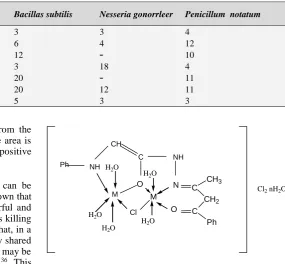
Table 4. Antimicrobial activity of the ligand H2L and its complexes.
greater inhibitory effect than the parent ligand. From the data obtained, it is observed that the inhibition zone area is much larger for metal complexes against the gram positive bacteria, gram-negative bacteria and fungi.
The increased activity of the metal chelates can be explained on the basis of chelation theory.36 It is known that
chelation tends to make ligands act as more powerful and potent bactericidal agents and antifungal agents, thus killing more of the bacteria than the ligand. It is observed that, in a complex, the positive charge of the metal is partially shared with the donor atoms present in the ligand, and there may be π-electron delocalisation over the whole chelate.36 This
increases the lipophilic character of the metal chelate and favours its permeation through the lipoid layer of the bacterial membranes. Also, there are other factors which also increase the activity, such as solubility, conductivity and bond length between the metal and the ligand.
The mode of action may involve the formation of a hydrogen bond through the azomethine nitrogen and oxygen atom with the active centres of the cell constituents, resulting in interference with the normal cell process. The variation in the effectiveness of different compounds against different organisms depend either on the impermeability of the cells of the microbes or the difference in ribosomes of microbial cells.
There is a marked increase in the bacterial activities of the ligand and complexes for gram positive bacteria. The results showed that the copper(II) complexes have higher antibacterial activity towards Gram-positive bacteria (Bacillus subtilis) than the other complexes.
Ni(II) complex shows higher antibacterial activity towards Gram-negative bacteria (Nesseria gonorrleer). Mn(II) complex shows higher antifungal activity than the other complexes.
M = Mn2+, Co2+, Ni2+ or Zn2+; n=1 for Co2+and Ni2+ complexes
X.nH2O
X = Cl- or NO
3-; n = 1 when X = Cl- ; n = 3 when X = NO3
-Figure 1. Proposed structure of the complexes
Penicillum notatum Nesseria gonorrleer
Bacillas subtilis
Compound No. of
compound
4 3
3 H2L
12 4
6 [HLMn2Cl(H2O)5]Cl2
C-1
10
-12 [HLCo2Cl(H2O)5]Cl2H2O
C-2
4 18
3 [HLNi2Cl(H2O)5]Cl2.H2O
C-3
11
-20 [(H2L)2CuCl(H2O)]Cl.H2O
C-4
11 12
20 [(H2L)2CuNO3(H2O)]NO3.3H2O
C-5
3 3
5 [HLZn2Cl(H2O)5]Cl2
C-6
O N
M
O
CH2 C
Ph C
CH3
M
Cl NH
Ph
CH
C NH
H2O
H2O
H2O
H2O
H2O
Cl2 nH2O
NH
Ph CH2 C
O NH N O C
C CH2
CH3
Ph
Cu N
O C
C
CH2
CH3
HN
Ph C O
CH2
H2O
X
N H
Conclusion
N-Anilinoacetohydrazobenzoylacetone and its Mn(II), Co(II), Ni(II), Cu(II) and Zn(II) complexes have been synthesized and characterized. The structural characterization showed that the hydrazone ligand is coordinated to the metal ions as monobasic tetradentate manner with O2N2 donor sites in Mn(II), Co(II), Ni(II) and
Zn(II) complexes while in the Cu(II) complexes the ligand is coordinated as bidentate. The copper(II) complexes show higher antibacterial activity towards G+ bacteria (Bacillus
subtilis ) than the ligand and other complexes while Mn(II) complex shows higher antifungal activity than the free ligand.
References
1Cimerman, Z., Miljanic, S., Galic, N., Croat. Chem. Acta, 2000, 73, 81.
2Elmali, A., Kabak, M., Elerman, Y., J. Mol. Struct., 2000, 477,
151.
3Valcarcel, M., Laque de Castro, M. D., Flow-Through Biochemical Sensors, Elsevier, Amsterdam., 1994.
4Spichiger-Keller, U., Chemical Sensors and Biosensors for Medical and Biological Applications, Wiley-VCH, Weinheim, 1998.
5Lawrence, J. F., Frei, R. W., Chemical Derivatization in Liquid Chromatography, Elsevier, Amsterdam, 1976.
6Brown, D. In: Insect Ecology, Chapmann and Hall, London, 1990. 7Singh, K., Barwa, M. S., Tyagi, P., Eur. J. Med. Chem., 2007, 42,
394.
8Ferrari, M. B., Capacchi, S., Pelosi, G., Reffo, G., Tarasconi, P.,
Albertini, R., Pinelli, S., Lunghi, P., Inorg. Chim. Acta, 1999,
286, 134.
9Canpolat, E., Kaya, M., J. Coord. Chem., 2004, 57, 1217. 10Yildiz, M., Dulger, B., Koyuncu, S. Y., Yapici, B. M., J. Indian
Chem. Soc., 2004, 81, 7.
11Atkins, R., Brewer, G. A., Kokot, E., Mockler, G. M., Sinn, E., Inorg. Chem., 1985, 24, 127.
12Kashar, T. I., El-Nahas, A., El-Mughamsi, A. M., Asian J. Chem.,
2011, 23(1), 159-165.
13El-Tabl, A. S., Transit. Metal Chem., 1996, 21, 428.
14El-Tabl, A. S., El-Saied, F. A. and Al-Hakimi, A., Transit. Metal Chem., 2007, 32, 689.
15Tang, H. A., Wang, L. F. and Yang, R. D., Transit. Metal Chem.,
2003, 28, 395.
16Kashar, T. I., Thermochim. Acta, 2010, 507, 66-70.
17El-Tabl, A. S., Kashar, T. I., El-Bahnaswy, R. M., Ibrahim, A. E., Polish. J. Chem., 1999, 73, 245.
18Kashar, T. I., El-Magams, A. M., Egypt. J. Chem., 2006,49(2),
261-268.
19Singh, K., Singh, R.V., Tandon, J. P., Polyhedron, 1988, 7, 151. 20El–Boraey, H. A., El–Tabl, A .S., Pol. J. Chem., 2003, 77, 1759 . 21Mishra, L. A., Yadaw, K. T., Transit. Met. Chem., 1997, 22, 406. 22El-Tabl, A. S., El-Baradie, K., Issa, R. M., J. Coord. Chem.,2003,
56, 1113 .
23Hegazy, W. H ., Monatsh. Chem., 2001, 132, 639
24Raman, N., Kulanadai Ssmy, A., Thangaraia, C. Manisankar, P.
S., Swanathan, V., Vedhi, C., Transit. Met. Chem., 2004, 29, 129 .
25Abdou El-Enein, S. A., El-Saied, F. A., Kasher, T. I., Wardany,
A. H., Spectrochimica Acta, Part A, 2007, 67, 737-743.
26Athappan, P., Rajagopal, G., Trans. Met. Chem., 1997, 22, 84. 27El-Tabl, A .S., J . Chem . Res., 2002, 529 .
28Ramadan, A. E. M., Sawodny, W., El-Baradie, G, M., Transit. Met. Chem., 1997, 22, 211 .
29Gudasi, K. B., Patil S. A., Vadvav, R. S., Shenoy, R . V., Nethagi,
M., Transit. Met. Chem., 2006, 31, 586 .
30Praakar, B., Reddy, K., Lingaiant, P., Indian J. Chem., 1988, 27A,
217 .
31Chiumia, G. C., Phillips, D. J., Rae, A. D., Inorg. Chim. Acta,
1995, 238, 197 .
32El-Shereafy, E., El-Tabl, A. S., Bahnasawy, R. M., Issa, Y. M.,
Kashar, T. I., Polish. J. Chem., 1999, 73(12), 1952.
33Gudasi, K. B., Patil, S. A., Vadvavi, R. S., Shenoy R. V. and
Nethaji, M., Transit. Metal Chem.,2006, 31, 586.
34Hegazy, W.H., Monatsh. Chem., 2001, 132, 639
35Rao, M. S. and Reddy, K. H., Indian J. Chem. Sect. A –Inorg. Bio-Inorg. Phys. Theor. Anal. Chem., 1999, 38, 262-266.
36Sengupta, S. K., Pandy, O. P., Srivastava B. K. and Sherma, V.
K., Transit. Met. Chem., 1998, 23(4), 349