ARTIGO ORIGINAL
ABSTRACT
Introduction: The purpose of this study was to understand the reasons and quantify the number of ultrasounds and computed tomographies that are potentially wasted in the hospital emergency in our institution, and the importance that the radiologist can have in the management and screening of these exams.
Material and Methods: It was decided that urgent tests that were pending for more than seven days would be the object of analysis as to why they were not performed, consulting the electronic medical records. Six causes were used to cancel the requests: ‘Changing the patient’s status’, ‘Patient’s withdrawal, refusal or abandonment’, ‘Patient’s death’; ‘No criteria or contraindicated’, ‘Lack of human resources’ and ‘Mistaken request’.
Results: In the year 2015 we obtained 1211 canceled exams, since they were pending more than a week ago. The first four causes totaled 602 exams (sum of 283, 94, 41 and 184). The last two, 609 (sum of 29 and 580).
Discussion: It was verified that the 602 exams corresponding to the sum of the first four causes reflected a potential waste in clinical tests since they were not determinant in the approach of the Emergency episode nor on the final destiny of the patient. Under the tip of the iceberg may exist further examinations and patients who have not escaped inadequate or unjustified examinations.
Conclusion: The radiologist can better manage the required radiological examinations, effectively screening within a multidisciplinary team environment, promoting the development and supporting the respect of guidelines, and potentially reducing requests through opinions or second opinions.
Keywords: Diagnostic Imaging; Emergency Service, Hospital; Radiology; Unnecessary Procedures
Volume or Value? The Role of the Radiologist in
Managing Radiological Exams
Volume ou Valor? O Papel do Radiologista na Gestão
dos Exames Radiológicos
1. Serviço de Imagiologia. Centro Hospitalar de Setúbal. Setúbal. Portugal.
Autor correspondente: Carlos Francisco Silva. [email protected]
Recebido: 28 de setembro de 2016 - Aceite: 03 de maio de 2017 | Copyright © Ordem dos Médicos 2017
Carlos Francisco SILVA1, Teresa GUERRA1
Acta Med Port 2017 Sep;30(9):628-632 ▪ https://doi.org/10.20344/amp.8253
RESUMO
Introdução: Pretendeu-se perceber os motivos e quantificar o número de ecografias e tomografias computorizadas que potencialmente são desperdiçadas a nível da urgência hospitalar na nossa instituição, e a importância que o radiologista pode ter na gestão e triagem desses exames.
Material e Métodos: Definiu-se que os exames urgentes pendentes há mais de sete dias seriam objeto de análise quanto ao motivo de não realização, consultando os registos médicos eletrónicos. Foram usadas seis causas para cancelamento dos referidos pedidos: ‘Alteração do estado do doente’, ‘Desistência, recusa ou abandono do doente’, ‘Falecimento do doente’; ‘Sem critério ou contraindicado’, ‘Falta de recursos humanos’ e ‘Engano na marcação’.
Resultados: No ano de 2015 obtivemos 1211 exames cancelados, por estarem pendentes há mais de uma semana. As quatro primeiras causas totalizaram 602 exames (somatório de 283, 94, 41 e 184). As duas últimas, 609 (somatório de 29 e 580).
Discussão: Verificou-se que os 602 exames correspondentes ao somatório das quatro primeiras causas refletem um potencial desperdício em exames pois não foram determinantes na abordagem do episódio de Urgência e no destino final do doente. Debaixo desta ponta do iceberg poderão estar ainda mais exames e doentes que não escaparam a exames inadequados ou injustificados.
Conclusão: O radiologista poderá gerir melhor os exames radiológicos requisitados, triando eficazmente, num ambiente de equipa multidisciplinar, promovendo a elaboração e apoiando a aderência a normas de orientação e diminuindo potencialmente as requisições através de pareceres ou segundas opiniões.
Palavras-chave: Diagnóstico por Imagem; Procedimentos Desnecessários; Radiologia; Serviço de Urgência
INTRODUCTION
A new paradigm has emerged in radiology and the tran-sition from a volume-based payment model focused on the payment for a certain workload, usually called a piecework payment model, to a value-based model is currently on the
way.1
This transition stemmed from a continuous increase in healthcare costs associated with imaging and was enhanced by the global economic and financial environment with
greater focus on the North-American healthcare system.2
Therefore, a value-based rather than a volume-based payment model would tend to control costs. The advantages of the value-based model would come from the absence of
a conflict of interests regarding redundant or unnecessary radiology tests, with a greater focus on the patient and the acute care episode, which would be obtained with improved imaging management. Imaging tests would be originally screened by radiologists, moving away from the volume-based model, in which any test requested by the ordering physician is simply scheduled and carried out.
ARTIGO ORIGINAL
that the quality of this service has been median or suboptimal, with many failures, mistakes, omissions and incorrect reports, even though test scheduling and availability was improved, particularly beyond 2011 constraints upon which
any external imaging request became unavailable.3
The Choose Wisely joint initiative has been launched in 2012 by the American Society of Internal Medicine together with 50 other medical societies and specialty colleges involving different evidence-based recommendations,
29% of these related to imaging4 (mostly corresponding
to diagnostic tests and procedures). This initiative was aimed at an improved adequacy between lab and imaging test requests and good-management and cost reduction, mainly in a time when insurance-based North-American healthcare system is already defining different profiles of ordering physicians, involving the analysis of those with higher prescription rates of negative or redundant tests and
leaving out of pocket those with the poorest rates.5,6 This
guiding principle is in line with the models already used
in Portuguese Family Medicine7 namely regarding Family
Health Units (unidades de saúde familiar) and dealing
with indicators and maximum health expenditure ceilings regarding Auxiliary Diagnostic and Therapeutic Means
[meios complementares de diagnóstico e terapêutica
(MCDT)].
This system was not yet applied to hospitals and there is still some difficulty to accept the radiologist support to screening and selection of the more suitable imaging techniques for the clarification of diagnostic doubts. This study mainly aimed at the identification of the role of radiologists in imaging management and screening, as well as the identification of the reasons and number of imaging tests potentially wasted in our hospital’s Emergency Department.
MATERIAL AND METHODS
Booking requests for CT-scan and ultrasound tests, including those from Emergency and those from the different specialty wards in the hospital are daily (08:00 to 20:00)
sent through the radiology RIS-Glintt® software. A report for
X-ray tests is hardly ever requested and therefore these were not included in the study. Between 20:00 and 08:00 on the following day, radiological emergencies (CT-scan imaging only) are ensured by a teleradiology company, with no radiologist present at the institution and with no previous screening, following a volume-based model payment. The reasons why any test having been requested more than seven days before was not performed were analysed. Electronic medical records were analysed in order to allow for the identification of the reasons for the cancellation and patient’s final destination.
The following reasons for test cancellation or removal
from database were considered by the RIS-Glintt® software:
- ‘Change in patient status’: patients discharged from Emergency (reception or observation unit) and transferred to a ward or discharged from the hospital, to general practitioner or to the outpatient clinic were included in this
group. In short, tests showing a non-urgent clinical condition were included in this group;
- ‘Patient’s withdrawal, refusal or drop-out’ from Emergency;
- ‘Deceased patient’;
- ‘Imaging criteria were not met or were contraindicated’: used in case of medical support to screening by radiologists whenever these were available at the hospital, namely in case of any contraindication for a requested CT-angiography associated with the intravenous administration of an iodinated contrast or in which any diagnostic doubt could have been solved with any other imaging test that the patient had recently undergone and was still available from the hospital’s archive, in which case a new test would become unnecessary;
-‘Shortage of human resources’: patients transferred to another hospital in order to obtain the clarification of any urgent clinical doubt that would not have been possible at our hospital (obtaining an ultrasound test at dawn in a situation of testicular torsion, for instance);
- ‘Mistaken (and duplicated) appointment’.
All cancelled requests throughout 2015 according with the abovementioned criteria were included into the study.
The RIS-Glintt® software has been used for data
collection and more than one test could have been assigned to the same patient (for instance, kidney and bladder ultrasound imaging or abdominal and pelvic CT-scan is frequently ordered for the same patient).
This study was approved by the Ethics Committee of
the hospital (Comissão de Ética para a Saúde e Grupo de
Investigação e Desenvolvimento).
RESULTS
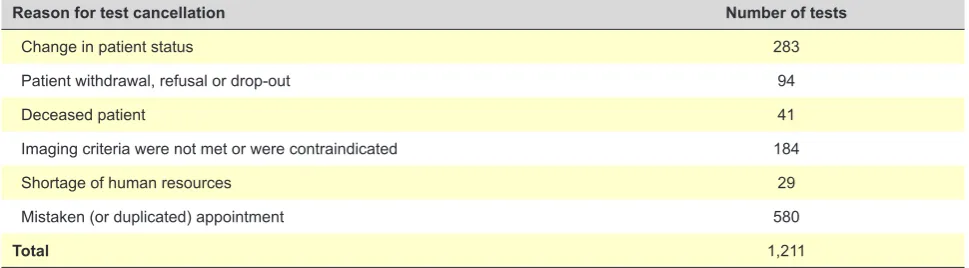
Numeric distribution of the tests that were cancelled from the worksheet over a seven-day period and according with the reasons previously selected from the cancellation options is shown in Table 1.
A total of 283 imaging tests were cancelled more than seven days from the initial request as an urgent test due to a change in patient’s clinical status. In many cases, laboratory and imaging tests have been ordered by physicians after patient had been examined and usually the former were more rapidly obtained and were sufficient for the patient’s medical approach in the Emergency Department. When that emergency episode ended, the request for imaging tests
was not automatically cancelled at the RIS-Glintt® database
nor was cancelled by the ordering physician and remained as pending or ‘forgotten’ in the radiology worksheet. In many cases, an urgent ultrasound was requested at the Emergency Department by a physician who was unaware of the lack of coverage by a radiologist at that time. Upon becoming aware of that situation, the patient was discharged to home or to outpatient clinic and the test was in fact not performed and was not crucial for the medical approach at the Emergency Department.
ARTIGO ORIGINAL
typical urinary tract infections in adults or in children were predominant in this group of situations.
A total of 94 tests were cancelled due to patient’s withdrawal, refusal or drop-out and 41 tests due to a deceased patient situation before the test could have been carried out. A patient’s drop-out from Emergency has been found in most of these situations, after a few hours of waiting and upon symptomatic treatment. Only one situation has been found in which the physician asked the police authorities to notify the patient at home for the real need to come back to the Emergency Department for treatment and regarding the risk of not complying with the warning. A request for a brain CT-scan aimed at the clarification of a neurological disorder was mostly the case involving deceased patients, frequently affecting elderly patients with multiple comorbidities. These patients mostly died in a few minutes or a few hours after the test had been ordered. A total of 184 cancelled tests were ranked as ‘Imaging criteria were not met or were contraindicated’ in situations with the support to screening by a radiologist, corresponding to approximately 15% of the total or to 31% of the subtotal of the leading four reasons shown in Table 1 (602 tests). ‘Shortage of human resources’ has been assigned in situations when no radiologist was present at the hospital, which may have occurred during some weekends and during the night shift (20:00/08:00), an ultrasound test had been ordered and this could have not been carried out at the hospital and the patient was transferred to another hospital; this was applied to 29 cancelled tests in 2015, corresponding to 19 patients.
Situations were sometimes found in which a correct change in the priority of a test has occurred during Emergency clinical handovers, with or without the support of a radiologist. Therefore, in the case of cancer staging, cancer of unknown primary or clarification of pulmonary nodules, new imaging test requests were many times sent or re-scheduled with a normal priority, at the time when the patient had already been admitted to a ward discharged from Emergency and the original request had remained pending in radiology.
A total of 580 duplicated tests were cancelled and ‘Mistaken appointment’ has been used as this was the most similar reason provided by the software, even though this
was not actually any mistaken appointment and rather a duplicated request.
In many cases, different requests were duplicated as a new request for a test was made some hours upon the initial one, as soon as the patient was available or due to any haemodynamic recovery. In daily practice, this is an alternative way to communicate to radiology that the patient is available at that moment for the test.
DISCUSSION
A total of 1,211 cancelled tests have been found, regarding ultrasound and CT-scan tests (from General Radiology and Neuroradiology) from 1 Jan 2015 to 31 Dec 2015. An estimated 30,000 urgent ultrasound and CT-scans were carried out at our hospital that year (official data unavailable).
A total of 602 tests were in fact not carried out at the Emergency Department nor in the short term anywhere else, when the last two reasons of the chart are excluded (mistaken appointment and shortage of human resources), involving situations in which an urgent imaging assessment had in fact been carried out at a different institution or in the short term during the hospital stay.
The total number of urgent ultrasound and CT-scan tests involved not only patients who underwent relevant tests as also others who were submitted to some form of unreasonable obstinacy or dysthanasia, such as some of those in the group of deceased patients before any test could have been made available.
These results were in line with the awareness of the reality at the Emergency Department. In addition, these were also in line with the recent Annual Report on the
Access to Healthcare (Relatório Anual sobre o Acesso a
Cuidados de Saúde)8 in which an estimated 40% hospital
emergencies corresponded to the inappropriate use of the Emergency room and also in line with the study by the
Portuguese Observatory on Palliative Care (Observatório
Português dos Cuidados Paliativos)9 in which approximately
51% of the patients admitted to hospital were in need for palliative care and 16% of these with short life expectancy and considered as still recoverable by physicians in that study.
The radiologist’s role as screening assistant working
Table 1 – Distribution of cancelled imaging test requests, removed from RIS-Glintt® software according to the different reasons for
cancellation
Reason for test cancellation Number of tests
Change in patient status 283
Patient withdrawal, refusal or drop-out 94
Deceased patient 41
Imaging criteria were not met or were contraindicated 184
Shortage of human resources 29
Mistaken (or duplicated) appointment 580
ARTIGO ORIGINAL
together with the ordering physician as a multidisciplinary team seems crucial.
This assistance could be obtained with higher compliance with clinical guidelines, leading to new ones and updating those already existing at the hospital, including
evidence-based recommendations (Appropriateness Criteria[ACR],
for instance) and establishing a quicker and easier access to guidelines in computer systems for daily use, apart from considering the judgement of the radiologist present at the
hospital.10
A better parameter adjustment of the patient’s outcome, further training and access to palliative care, associated with more accurate criteria for the selection of imaging tests would be crucial for an improved optimization of imaging test management.
The definition of indicators, management profiles or metrics, as well as maximum health expenditure ceilings for hospital physicians, similar to those already used by physicians working within the USF-model healthcare centres would improve this interaction between radiologists and other physicians, reducing some difficulty to accept the radiologist’s judgement. The conflict of interests associated with a volume-based model and a piecework payment model regarding unnecessary or inappropriate tests would be removed.
Our study had some limitations, namely related to some inter-observer variability regarding the analysis of electronic medical records in search for reasons associated with non-completed tests explaining for its cancellation or database removal, even considering that uniform criteria among the available options considered within the software were used and could not have been changed by the authors.
In addition, only a simple list of the total number of imaging tests was available and the correlation with the number of patients and the exact amount of ultrasound and CT-scan tests was difficult to obtain considering the complexity of the software.
This study regarded only one year and showed the reality of a local hospital which is probably different from central hospitals where less staff specialist or generalist physicians and more emergency medicine physicians are usually working.
Some patients classified as ‘Patient’s withdrawal, refusal or drop-out’ could have been transferred to another hospital or could have been re-admitted some days later.
Most tests were removed from the RIS-Glintt® program well
beyond seven days of a pending status, sometimes up to two weeks later and no re-admissions to our hospital were found in most cases.
Some tests were directly cancelled by physicians at the Emergency Department, where a different program is available, with no cancellation reason, which can have underestimated our results.
Further studies will be necessary for the comparison and assessment of these data.
Despite these constraints, our results seem in line with what has been expressed by the Portuguese Medical
Radiology Association [Associação Médica Portuguesa de Radiologistas (AMPR)] considering that a shortage of radiologists in hospitals of the Portuguese Healthcare
System (Serviço Nacional de Saúde) led to the misuse of
tests involving the exposure to ionising radiation (namely CT-scans used in teleradiology).
These imaging tests are often inappropriate for the clarification of diagnostic doubts when not previously
assessed by the radiologist, with subsequent risks11 mainly
to the young population and an estimated 24% increase in
long-term risk for cancer in this population12 and increasing
with each further CT-scan.
Imaging test purchase to external companies could also be reduced or even removed if medical procedures in radiology were not considered a non-refundable MCDT expenditure in hospital funding and this measure would encourage hospital administrations the hiring of radiologists. The development of a radiology outpatient clinic is planned within a medium and long-term framework, leading to the upgrade of the medical act of radiologists and there are currently successful North-American experiences
underway.13
CONCLUSION
Radiologists have a crucial regulation and even deterrent role in hospitals. Unnecessary risks for patients could be avoided, including those associated with radiation exposure, in addition to the avoidance of duplicated tests, reducing patient’s anxiety and waiting time as non-urgent and unreasonable tests could be removed from waiting lists. Promoting multidisciplinary work with ordering physicians and improving screening and adequacy of imaging tests would save costs.
ACKNOWLEDGMENTS
The authors wish to acknowledge area manager Luís
Lagartinho at the Centro Hospitalar de Setúbal for his
contribution to data collection and listing.
HUMAN AND ANIMAL PROTECTION
The authors declare that the followed procedures were according to regulations established by the Ethics and Clinical Research Committee and according to the Helsinki Declaration of the World Medical Association.
DATA CONFIDENTIALITY
The authors declare that they have followed the protocols of their work centre on the publication of patient
data.
CONFLICTS OF INTEREST
The authors declare that there were no conflicts of interest in writing this manuscript.
FINANCIAL SUPPORT
ARTIGO ORIGINAL REFERENCES1. Sarwar A, Boland G, Monks A, Kruskal JB. Metrics for radiologists in the era of value-based health care delivery. RadioGraphics. 2015;35:866– 76.
2. Rao VM, Levin DC. The overuse of diagnostic imaging and the Choosing Wisely initiative. Ann Intern Med. 2012;157:574-6.
3. Governo de Portugal, Despacho n.o 10430/2011 - Diário da República,
2.a série — N.o 158 — 18 de agosto de 2011.
4. Rao VM, Levin DC. The Choosing Wisely initiative of the American Board of Internal Medicine Foundation: what will its impact be on radiology practice? AJR Am J Roentgenol. 2014;202:358–61. 5. Cassel CK, Guest JA. Choosing wisely: helping physicians and patients
make smart decisions about their care. JAMA. 2012;307:1801-2. 6. Morden NE, Colla CH, Sequist TD, Rosenthal MB. Choosing wisely - the
politics and economics of labeling low-value services. N Engl J Med. 2014;370:589–92.
7. Governo de Portugal. Portaria n.o 377-A/2013 - Diário da República, 1.a série — N.o 252 — 30 de dezembro de 2013.
8. Governo de Portugal. Relatório Anual sobre o Acesso a Cuidados de Saúde nos Estabelecimentos do SNS e Entidades Convencionadas (2014). 2015. [consultado 2016 ago 29]. Disponível em: https://www.
sns.gov.pt/wp-content/uploads/2016/07/2015-07-20-RA_Acesso_2014-VFinal.pdf.
9. Associação Portuguesa de Cuidados Paliativos. Reflexão da Associação Portuguesa de Cuidados Paliativos sobre o Manifesto Morrer com Dignidade. [consultado 2016 ago 29]. Disponível em: http://www.apcp. com.pt/uploads/Manifesto_Pro_Eutanasia_Posicao_da_APCP_vfinal. pdf.
10. Bautista AB, Burgos A, Nickel BJ, Yoon JJ, Tilara AA, Amorosa JK, et al. Do clinicians use the American College of Radiology Appropriateness criteria in the management of their patients? AJR Am J Roentgenol. 2009;192:1581–5.
11. Associação Médica Portuguesa de Radiologistas. Carta ao Ministro da Saúde, 5 de maio de 2015. [consultado 2016 dez 13]. Disponível em: http://bit.ly/2gTfraH.
12. Mathews JD, Forsythe AV, Brady Z, Butler MW, Goergen SK, et al. Cancer risk in 680,000 people exposed to computed tomography scans in childhood or adolescence: data linkage study of 11 million Australians. BMJ. 2013;346:f2360.