Proceedings of the
Second International Workshop on
Bidirectional Transformations
(BX 2013)
On Propagation-Based Concurrent Model Synchronization
Fernando Orejas Artur Boronat Hartmut Ehrig Frank Hermann Hanna Sch¨olzel
19 pages
Guest Editors: Perdita Stevens, James F. Terwilliger
Managing Editors: Tiziana Margaria, Julia Padberg, Gabriele Taentzer
On Propagation-Based Concurrent Model Synchronization
Fernando Orejas1∗Artur Boronat1 2 †Hartmut Ehrig3Frank Hermann4Hanna Sch¨olzel3
1Universitat Polit`ecnica de Catalunya, Barcelona, Spain.
2The University of Leicester, UK
3TU Berlin, Germany
4Interdisciplinary Center for Security, Reliability and Trust,
Universit´e du Luxembourg, Luxembourg
Abstract:The aim of concurrent model synchronization is to merge pairs of updates on interrelated models. For instance, this situation may occur in the context of model driven software development when the work is distributed between different teams. A first problem is that, if the updates are in conflict, this conflict is never explicit. The reason is that the updates do not interfere directly since they are assumed to modify different models. For this reason, detecting and solving conflicts becomes already more difficult than in the more standard case of synchronizing concurrent updates over a given model. Existing general approaches define the solution to this problem in terms of the solution to the simpler problem of update propagation in bidirectional model transformation. We call these approachespropagation based.
In this paper, we first state some properties that, in our opinion, must be satisfied by a concurrent synchronization procedure to be considered correct. Then, we show how to check whether the given updates are conflict-free and, in this case, we present a correct synchronization procedure based on this check. Finally, we consider the case where the given updates are in conflict and we show how we can build solu-tions that satisfy some of the correctness properties but, in general, not all of them. Specifically, we present counter-examples that show how some of these properties may fail.
Keywords: Model synchronization, bidirectional model transformation, model-driven development
1
Introduction
The aim of concurrent model synchronization is to merge pairs of updates on interrelated models. For instance, this situation may occur in the context of model-driven software development when different teams are working on different (related) models of the same software artifact. This
∗This work has been partially supported by the CICYT project (ref. TIN2007-66523) and by the AGAUR grant to
the research group ALBCOM (ref. 00516).
problem is a generalization of (standard) model synchronization, where updates on one model must be propagated to its related model. In particular, in standard model synchronization we look for operations that implement this propagation. However, concurrent model synchronization is more difficult due to the possible existence of conflicts between the given pair of updates. An additional complication comes from the fact that these conflicts are not explicit, since the updates are applied to different models, but they are only apparent when trying to propagate the effects of the given updates.
The only approaches [XSHT09,XSHT13,HEEO12] that we know that provide a general so-lution to this problem define concurrent synchronization procedures in terms of the propagation operations defined for solving the standard synchronization problem. In [XSHT13], the authors present a procedure for synchronizing conflict-free concurrent updates that roughly works as fol-lows. Given two interrelated modelsMandNand two updatesuandvonMandN, respectively, in the first step the procedure propagatesutoN in order to check if there are conflicts withv. This is easy to see, since bothv and the propagation of u, prop(u), are updates on the same model. Then, if there are no conflicts the procedure mergesvandprop(u)and propagates back the result toM. If the procedure finds a conflict, or some other problem, then the procedure reports an error. The approach presented in [HEEO12] is similar, but allowing for the possi-bility of handling conflicts using results from [EET11]. In this paper, we say that this kind of approaches arepropagation-based, because their solution is defined in terms of the propagation operations defined for standard synchronization. As we have seen, their main advantage is that, since we can put together the given updates and their propagation, we can easily detect conflicts by making them explicit and, so, we can decide how to handle them. Another advantage is that these procedures are quite generic: we define them independently of how standard synchroniza-tion procedures are defined. However, as we will see in this paper, this approach has also some limitations. For instance, propagation-based procedures are not hippocratic in general.
In this paper, we study at a general level the correctness and the limitations of propagation-based concurrent synchronization. For this purpose, we provide an abstract and formal view for propagation based synchronization that covers different existing approaches. Since some of the well established properties are too restrictive for several applied cases, we present new proper-ties that overcome these restrictions in an elegant way. Moreover, we present formal properproper-ties concerning additional relevant aspects such as maximal preservation of given updates and sound-ness (avoidance of side effects). Then, we show how we can check whether the given updates are conflict-free and, in this case, we also show how we can construct a correct synchronization (Theorem 1). Moreover, when the given updates are in conflict, we present a propagation-based procedure for concurrent synchronization and show its correctness concerning most of the prop-erties (Theorem 3). Finally, we show that existing solutions satisfy some of the correctness properties but, in general, not all of them. Specifically, we present counter-examples that show how some of these properties may fail.
concurrent synchronization problem, first for the conflict-free case and, then, for the general case. Finally, in Section 6, we present some related work and present some conclusions.
2
Running Example
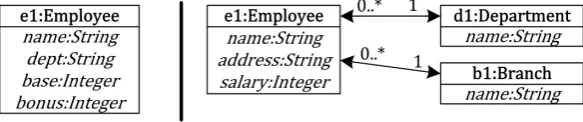
To help in providing some explanations and counter-examples we use a very simple example. Source and target models describe different views of (part of) the information system of a com-pany. They both describe information about their employees. Following the metamodels, de-picted in Fig. 1, the source metamodel, on the left, describes the employees of a certain branch of the given company, for instance the employees of the Barcelona branch. It consists just of a single class, Employee, with attributesname (the name of the employee), dept (the name of the department where the employee works),base(the base salary of the employee), andbonus. The target metamodel, depicted on the right, describes the employees of the whole company. In particular, the metamodel includes three classes: Employee, Dept and Branch. Branch and Dept include just a name attribute, but Employee includes three attributes: name, salary (the total salary received by the employee) andaddress (the address of the employee). In addition, each employee must be associated to the branch and to the department where he currently works.
A source and a target model are consistent if the following conditions hold:
• Every employee in the source model is also present in the target model and is associated to the Barcelona branch. Conversely, every employee associated to the Barcelona branch in the target model must also be present in the source model.
• The salary of each employee associated to the Barcelona branch in the target model is the addition of the base and bonus of that employee in the source model.
• The department of an employee in the source model is a string D if and only if that em-ployee is associated to the department of name D in the target model.
We may notice that source and target models share some information, but also include some in-formation of their own. For instance, source models include more inin-formation about the salaries of the employees. Conversely, target models include the address of employees, and they also include information about the employees of other branches different than Barcelona.
Figure 1: Source and target metamodels
Moreover, we assume that updates on the source or target models are propagated as follows:
the sum of its base and bonus. Moreover, if the department of the new employee is not present in the target model, then the new department is also added. Finally, the employee is associated with its department and the Barcelona branch.
• Conversely, if an employee is added to the target model and it is associated to the Barcelona branch, the modification is propagated to the source model by adding that employee to-gether with the corresponding department. Moreover, we set the base and bonus attributes to 3/4 and 1/4 of the salary, respectively.
• Finally, if an employee is deleted from either the source or the target model, its propaga-tion consists of the delepropaga-tion of that employee from the other model (if present), without any additional side-effects, like the deletion of its associated branch or department. How that employee is identified depends on specific details of the given models. For instance, if the models would be represented by a triple graph [SK08] then there would be a cor-respondence element relating each employee in the source model to the same employee in the target model. Otherwise, probably a key would identify each employee on the two models.
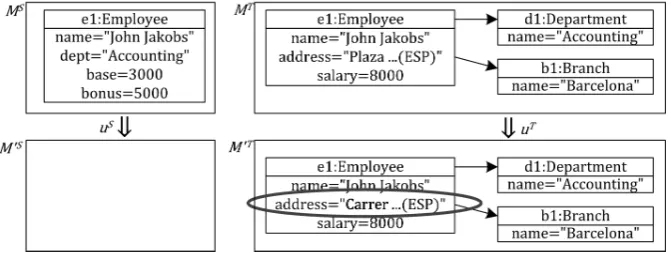
In this scenario, source and target updates occurring in parallel can cause several types of conflicts, which have to be resolved by a concurrent synchronization operation. Consider, e.g., the situation depicted in Fig.2. The source updateuSdeletes employeee1and the target update uT modifies the address of this person. PropagatinguS to the current state of the target domain would remove that person. On the other hand, propagatinguT to the source domain would undo the deletion and create a new person with a base salary of 6000 and a bonus salary of 2000. There are several possibilities on how the synchronization works in the concurrent case to handle such conflicts and we will study different properties of concurrent synchronization in this paper.
Figure 2: A parallel update
3
The Basic Framework
could be some frameworks where our results do not completely apply. In this sense, first, we present our assumptions about the given model framework and, then, we present a generic notion of model update or modification, and study some properties of this notion. Thereafter, in the second subsection, we present our framework of integrated models and the description of the operations of update propagation, together with the properties that we may expect that they satisfy.
3.1 Models and updates
We assume that, technically, our model classes form M-adhesive categories [LS05, EEPT06,
EGH10], which roughly means that our models are some kind of structured sets where union, intersection and set difference can be defined in terms of pushouts, pullbacks and pushout com-plements. For example, not only sets, but most classes of graphical structures form M-adhesive categories, e.g., plain graphs, typed attributed graphs, hyper graphs, petri nets, and high-level petri nets.
Our approach isδ-based[DXC10], which means that, when considering the update of a model, we do not take into account only the models before and after the update. Instead, we deal with updates representing explicitly which elements have been added to or deleted from the given model (for a discussion on the advantages ofδ-based approaches in comparison to state based approaches, see [DXC10]). More precisely, anupdateormodification[EET11] of a modelM, denotedM⇒M0 is a span of inclusions (or, in general, injective morphisms) M←M0→M0. Intuitively, the elements inMthat are not inM0are the elements deleted by the modification, and
the elements inM0that are not inM0are the elements added by the modification. So,M0consists
of all the elements ofMthat remain invariant after the modification. Updatesu1:M1⇒M2and
u2:M1⇒M2may be equivalent, denotedu1∼u2, in the sense that they yield the same result,
but that they are technically different, because they are defined as different spans. For instance, the identity updateid:M←M→Mis equivalent to any updateu:M←M0→M, butid,uif
M,M0. Intuitively,idneither deletes nor adds any element toM, whileuwould delete all the
elements inMwhich are not inM0and, then, it would add them again.
Updates are closed under composition, i.e., given updatesu1:M1←M0→M2andu2:M2← M00→M3there exists the compositionu2◦u1:M1←M→M3defined by the diagram below:
M1oo M0 //M2oo M00 //M3
M
aa ==
(1)
where (1) is a pullback (intuitively, the intersection of M0 and M00), i.e. M includes all the
elements ofM1that are neither deleted byu1nor byu2.
Sometimes, as we will see in the sections below, we are interested, not in the composition of updates, but in their decomposition. Intuitively, an update u3:M1⇒M3 can be decomposed
asu2◦u1, denotedu3
d
=u2◦u1, withu1:M1⇒M2 andu2:M2⇒M3 if, on the one hand, the
will survive the full update, and if an element is deleted it will remain deleted for the full update. Formally,u3=d u2◦u1 if, in the above diagram,(1) is a pullback and a pushout. Obviously, if
u3
d
=u2◦u1thenu3=u2◦u1, but the converse is not necessarily true. For instance, u1may be
likeu3but adding some extra elements andu2may just delete these additional elements. In that case, we would have thatu3=u2◦u1but notu3=d u2◦u1. Moreover, we say thatu1decomposes
u3or thatu1is asubmodificationofu3, denotedu1Eu3, if there existsu2such thatu3
d
=u2◦u1.
We may notice that, according to the previous definitions, the only submodification of the identity updateid:M←M→Mis the identity update itself. The reason is that, if there would be another submodification u1 ofid, then either u1 would delete some element from M or it
would add some new element toM. But, then, anyu2such thatu2◦u1=id would need to add
or delete the corresponding elements. Formally, if in the diagram above,M1=M3=M, the only way that (1) is a pushout and a pullback is thatM0=M2=M00=M.
It is easy to define the inverse of an updateu:M←M0→M0. It is enough to reverse the span,
i.e.u−1=M0←M0→M. However, we may notice thatu−1◦u∼idbut, in general,u−1◦u,id. When several users want to apply different updates on the same model we need to have a merge operation that combines these modifications into a single one. This problem has been studied by several authors, but here we essentially follow the work in [EET11]. A main problem is that there may be conflicts between the given modifications. For instance, an updateu1may specify the deletion of a certain elemente1andu2may specify the addition of an elemente2that
needs the existence ofe1. This is called a delete/insert conflict in [EET11]. For example,u1may
specify the deletion of a node in a graph model andu2may specify the addition of an edge e2
that is connected toe1. Hence, a first problem is how to detect if there are conflicts between the
given modifications.
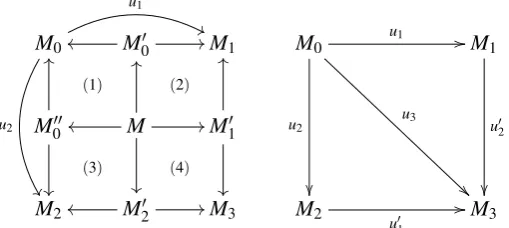
Two modifications are conflict-free, if none of them deletes an element that is needed by the other one. This condition is formalised in Definition 1. Intuitively, by defining M as the pullback of (1), we are defining Mas the intersection of M00 andM000, i.e. u3 deletes fromM0
all the elements that are deleted either byu1 oru2. Then, the existence ofM10 andM201 means that no element added byu1or byu2needs the existence of an element deleted byu2or byu1,
respectively. Finally, if (4) is a pushout, the elements added toM byu1⊗u2 are the union of
the elements added byu1and byu2. In the case of conflict-free modifications, we can define the result of this merging as the modificationu3=u1⊗u2:M0←M→M3, where diagram (4) is
a pushout. Notice that, by construction,u1andu2are submodifications ofu1⊗u2, as we would
expect.
Definition 1 (Conflict-free updates) Let u1:M0 ←M00→M1 and u2:M0 ←M000 → M2 be
two modifications. LetMbe constructed via the pullback(1)inFigure 3. Then,u1andu2 are
conflict-free, if there are objectsM01andM02yielding pushouts(2),(3)and(4).
In case that u1 and u2 are in conflict, solving the conflicts would typically mean finding
conflict-free maximal submodifications u01 Eu1 and u02 Eu2 and merging them, as described
above, where maximality means that ifu01Eu001Eu1andu02Eu002Eu2andu001 andu002are
conflict-1 In adhesive categories, pushout complements along monomorphisms as they appear in graph modifications are
M0
(1)
u1 ' ' u2
M00
(2)
o
o //M1
M000
(3)
O
O
M
(4)
O
O
o
o //
M01
O
O
M2oo M20 //M3
M0
u1 //
u2
u3
M1
u02
M2
u01
//M3
Figure 3: Condition for conflict-free modificationsu1andu2
free, thenu01 =u001 andu02=u002. In this paper, we are not concerned with specific procedures or strategies for solving conflicts. For example, in [EET11] a procedure is described to find solutions where delete/insert conflicts are solved giving priority to insertions.
3.2 Integrated Models and Update Propagation
We assume that two classes (categories) of models are given,MS andMT, called the classes of source and target models, respectively, even if in a bidirectional framework there may be no specific notion of source or target. And we consider that an integrated model M is just a pair M = hMS,MTi consisting of a source and a target model. In previous work (e.g. [HEO+11,HEEO12]) we considered that an integrated model is acorrespondence,r:MS↔MT, that relates the elements of both models. For many purposes, we think that working in terms of correspondences is more adequate. However, in this paper, we do not make any use of knowing the relation between the elements of both models. Therefore, for the sake of simplicity we will assume that the class of integrated modelsIMis the cartesian productMS× MT.
We also assume that a subclass of consistent integrated models,C ⊆ IMis also given. The notion of consistently integrated models induces a notion of consistence of models. In particular, a source modelMS(resp. a target modelMT) is consistent if there is a consistent integrated model hMS,MTithat includes that model for some target modelMT (resp. for some source modelMS). In addition, we assume that our framework is equipped with propagation operations that solve thebasic synchronization problem. This means that, given an integrated modelMand an update on one domain, either MS or MT, these operations propagate the given changes to the other domain. More precisely, we assume that our framework includes suitable total forward and backward functions fPpgandbPpg. In the case offPpg, the input is an integrated modelM∈ IM together with a source model update uS :MS⇒ M0S, and the output is a target update
original and the resulting integrated models.
There are several properties that have been proposed by different authors (e.g. [Ste10,
DXC+11b] to consider that propagation operations are correct. Below we can find the main ones. However, due to lack of space, we just state these properties for forward propagation, since the corresponding properties for backward propagation are similar. The most basic ones are the ones that we callConsistency,IdentityandHippocraticness. Consistency states that if the given update yields a consistent model then the resulting integrated model should be consistent.
1. Consistency: IffPpg(M1,uS:MS1⇒M2S) = (uT :M1T ⇒M2T)andM2Sis consistent, then
hMS2,M2Tiis also consistent.
Identity states that if the given update is the identity and the given correspondence is consistent, then the propagation operations change nothing.
2. Identity:IfhMS,MTiis consistent thenfPpg(M,IdS) =IdT
Finally, Hippocraticness states that if after the given update the resulting models are already consistent then propagation should also do nothing. Notice that identity is a special case of Hippocraticness.
3. Hippocraticness: Given M1 =hM1S,M1Ti and uS:M1S⇒M
S
2, if hM
S
2,M
T
1i is consistent
thenfPpg(M1,uS) =IdT
Another property that has been proposed by several authors is the so called put-put law, stating the compatibility of propagation with respect to update composition:
4. Compatibility of propagation and update composition: IffPpg(M1,uS1:MS1⇒M2S) = (uT1 :MT1 ⇒M2T)andfPpg(M2,uS2) =uT2 thenfPpg(M1,uS2◦uS1) =uT2◦uT1
However, the put-put law is too strong in general. For instance, in the example described in Section 2, if we delete an employee from the source model and, then, we add it again, after propagating both updates, the employee in the target model would have the address ”XXX”. However, the composition of the two updates is, obviously, equivalent to the identity, whose propagation is also equivalent to the identity. Hence if the address of that employee in the target model before the update was not ”XXX”, the put-put law would not be satisfied.
Instead of the put-put law, we propose the following alternative law that states the compatibil-ity of propagation with respect to update decomposition:
5. Compatibility of propagation with update decomposition: If fPpg(M1,uS1 : M
S
1 ⇒ M2S) = (uT
1 :MT1 ⇒M2T)andfPpg(M2,uS2) =uT2 anduS3
d
=uS2◦uS1thenfPpg(M,uS3) =uT3,
withuT3 =d uT2◦uT1
Strong invertibility is a law that is also too strong in many contexts (see, e.g. [FKPT08,
6. Strong invertibility:IffPpg(M,uS) =uT thenbPpg(M,uT) =uS
A weaker version is invertibility that roughly says that ifu2is the update propagation of u1
and u3 is the update propagation (in the reverse direction) of u2 then u2 must be the update
propagation ofu3:
7. Invertibility:IffPpg(M,uS1) =uT1 andbPpg(M,uT1) =uS2thenfPpg(M,uS2) =uT1
In [Ste12] the relations between some of these and other properties are studied in detail.
4
Propagation-based Concurrent Synchronization
The aim of concurrent synchronization is to merge pairs of updates (in what follows, parallel updates) on interrelated models. A first problem is that, if the updates are in conflict, this conflict is not explicit. The reason is that, here, on the contrary to what we have seen in Sect. 3.1, the updates do not interfere directly since they are assumed to modify different models. The conflicts may arise when we try to build a consistent integrated model out of the two updated models. As we show in Section5, a simple way of approaching the problem is to use the forward and backward propagation operations, described in Section3.2 both to detect conflicts and to implement the synchronization procedure. We say that this kind of approaches are propagation-based.
In general, the result of concurrent synchronization is not unique: each possible way of solving the existing conflicts may be considered a possible solution, where the users may decide whether each result corresponds to their needs. In particular, given a parallel updateu=huS,uTi, if there are conflicts between uS anduT, we may consider that each possible result corresponds to the merging of two conflict-free submodifications,uS0EuSanduT0 EuT, obtained after backtracking some of the conflicting operations involved inuSanduT. This condition is addressed in this sec-tion by the formal propertiessoundnessandmaximal preservation. For instance, in the example described in Section2, if we have a source update that includes the deletion of an employee and a target update that includes a change on the salary of that employee, the two updates would be in conflict. To solve the conflict, we would need to either backtrack the deletion of the employee from the source model or to backtrack the change of salary of that employee in the target model. Before studying the problem in more detail, we should note that if MS and MT are M-adhesive categories then the category of integrated models, IM=MS× MT, is also M-adhesive, and its updates are parallel updatesu=huS,uTi. Therefore we can apply the concepts and techniques presented in Section3to work with these updates.
More formally, we consider that a concurrent synchronization procedureCSyncis a nondeter-ministic function whose input is a pair consisting of an integrated modelMand a parallel update
u1:M⇒M1 and the output are parallel updatesu2:M⇒M2, whereuS2anduT2 could be seen as the result of merginguS1 anduT1 or some of its submodifications. Moreover, when we write
CSync(M,u1) =u2 we mean thatu2 is a possible result of this synchronization. Our notion of
a practical point of view, the latter notion suggests that, when we start the synchronization oper-ation, the given updatesuS1 anduT1 have already been performed, i.e. the given state consists of the modelsM1SandMT1, so the resulting updatesuS2anduT2 are applied to that state yielding the final statehM2S,MT2i. This means that, if conflicts are found in the synchronization process, then
uS2anduT2 would have to undo some of the modifications included inuS1anduT1. On the contrary, the current notion suggests that, when the synchronization operation starts, the given updatesuS1
anduT1 would have not been executed so the current state is still hMS,MTi. Instead, these up-dates would have been kept or stored in some way, and the synchronization process would, first, find the possible conflicts betweenuS1 anduT1, then, it would compute the resulting updatesuS2
anduT2 and, finally, it would execute these updates over the initial state, leading to the final state hM2S,M2Ti. However, from a theoretical point of view, both notions can be considered equivalent, in the sense that, in general, from one kind of solution we can construct the other one.
Let us now see what properties should be satisfied by a propagation-based concurrent synchro-nization procedureCSyncwhen applied to an integrated modelMand a parallel updateu1. The first three properties are just the concurrent version of the corresponding properties defined for propagation operations presented in Section3.2. The first property states that any result must be consistent; the second one says that if the given modifications are the identity then the resulting updates should also be the identity (when the given interrelated model is consistent: otherwise the former properties would be contradictory); finally the third property is the concurrent version of hippocraticness. It just says that if the interrelated model after applying two updates is already consistent, then we may consider that the updates are already synchronized.
1. Consistency: Given the integrated model M and a parallel update u1 :M ⇒ M1, if CSync(M,u1) = (u2:M⇒M2), thenM2∈ C.
2. Identity:IfMis consistent andCSync(M,hIdS,IdTi) =u2thenu2=hIdS,IdTi.
3. Hippocraticness:Givenu:M⇒M1, ifM1∈ CthenCSync(M,u) =u.
The above properties say very little about the relation between the resulting modifications and the given updates. In particular, a concurrent synchronization procedure that returns some updates that have nothing in common with the original modifications may satisfy these proper-ties. Hence, we have to relate the output modifications with the input updates. In the context of propagation-based concurrent synchronization, we may consider that each updateuS on the source model not only specifies some given modifications onMS, but it also specifies the mod-ifications included in its propagation f Ppg(M,uS)on the target model, and similarly for target updates. Therefore, in this framework, we may consider that a concurrent synchronizationCSync
issoundif wheneveru2=CSync(M,u1), then all the modifications included inu2are part ofuS1
anduT1 or their propagation. This is stated by saying that the resulting updates can be obtained by merging some submodifications of the input updates and their propagation.
4. Soundness: IfCSync(M,u1) =u2 then there are submodifications v1 and v2, such that v1Eu1,vS2EbPpg(M,uT1),vT2 E f Ppg(M,uS1), andv1⊗v2=u2.
may expect is that any resulting updateu2should include as much as possible the modifications
specified by the input updateu1. In particular, when there are no conflicts betweenuS1anduT1,u2
should include all the modifications specified byuS1anduT1.
5. Maximal preservation: If CSync(M,u1) = u2, then for all parallel updates v1 : M ⇒ M01 and v2 : M ⇒ M20, such that v1 is conflict-free, v1 E u1, v2 = v1 ⊗ hbPpg(M,vT1),f Ppg(M,vS1)iandM20 ∈ C, then ifu2Ev2, we havev2=u2.
Finally, we may consider that, after conflict resolution, we have backtracked certain modifica-tions included in the given input updateu1, so that what we really want is to synchronize some
conflict-free submodificationu0Eu1. Then, we may also consider that the resulting updateu2
should only include modifications fromuS0anduT0 and their propagation.
6. Strong soundness:IfCSync(M,u1) =u2then there is a parallel updateu0Eu1, such that uS0⊗bPpg(M,uT0) =uS2, and f Ppg(M,uS0)⊗uT0 =uT2.
It is not difficult to see that strong soundness implies the properties of soundness and identity:
Proposition 1 If CSync(M,u1) =u2is a strongly sound solution then it also satisfies the prop-erties of identity and soundness.
Proof sketch.
• Identity. Ifu1 is the identity parallel update then, the only updateu0 satisfying u0Eu1
is also the identity update. But, ifu0 is the identity, according to the Identity property of
basic synchronization, we have thatbPpg(M,uT0) =id, and f Ppg(M,uS0) =id. But this means thatuS0⊗bPpg(M,uT0), and f Ppg(M,uS0)⊗uT0 are also the identity.
• Soundness. Let us suppose thatCSync(M,u1) =u2 and there is an updateu0, such that
u0 Eu1, u0S⊗bPpg(M,uT0) =uS2, and f Ppg(M,uS0)⊗uT0 =uT2. Then, by the property
of preservation of decomposition of basic synchronization, we have thatbPpg(M,uT0)E
bPpg(M,uT2), and f Ppg(M,uS0)E f Ppg(M,uS2). Therefore, if we take as submodifications
v1=u0,v2S=bPpg(M,uT0), andvT2 =f Ppg(M,uS0), then we have thatv1andv2satisfy the
conditions stated in the soundness property.
5
Strategies for propagation-based concurrent synchronization
all the properties defined in Section4, except hippocraticness. Then, in the second subsection we consider the case whereuS anduT are in conflict and we show that using propagation and conflict resolution, as presented in Section3, we can build solutions that satisfy some of the above properties, but not all of them.
5.1 Conflict-free concurrent synchronization
The simplest approach to make conflicts explicit in a parallel updateu1 is to consider
simulta-neously the given updates,uS1 anduT1, and their propagation over the given integrated model. In particular, if we define u2=hbPpg(M,uT1),f Ppg(M,uS1)i, we can first check if u1 andu2 are
in conflict, according to the notion of conflict studied in Section3. However, this check only tells us if all modifications defined byu1are compatible with the modifications defined by u2, but it does not tell us if the result of mergingu1 andu2,u1⊗u2, is consistent. In particular, if
it is inconsistent, we should consider that there is also some kind of conflict betweenu1 andu2.
Hence, a simple procedure to check conflict-freeness ofu1would be:
1. Letu2=hbPpg(M,uT1),f Ppg(M,uS1)i.
2. Ifu1andu2are conflict-free andu1⊗u2:M→M2withM2∈ Cthen returntrue; otherwise
returnfalse.
Now, if u1 satisfies the above check, then we can defineCSync0(M,u1) = (u1⊗u2) as the
concurrent synchronization ofu1.
Theorem 1 (Properties of conflict-free concurrent synchronization) If u1 = huS1,uT1i is a conflict-free parallel update over M, then CSync0(M,u1) = (u1 ⊗u2), where u2 =
hbPpg(M,uT1),f Ppg(M,uS1)i, satisfies the properties of 1) Consistency, 2) Identity, 4) Sound-ness, 5) Maximal preservation and 6) Strong soundness.
Proof sketch. According to Prop1, strong soundness implies identity and soundness. Hence, it is enough to prove the properties of consistency, maximal preservation and strong soundness.
• Consistency. By construction, the result ofu1⊗u2is consistent.
• Maximal preservation. If we have that v1 : M ⇒ M01 and v1 E u1 this means that
hbPpg(M,vT1),f Ppg(M,vS1)i E hbPpg(M,uT1),f Ppg(M,uS1)i, as a consequence of the compatibility of propagation and update decomposition. But this means thatv2=v1⊗
hbPpg(M,vT1),f Ppg(M,vS1)iEu2. Therefore, ifu2Ev2, we havev2=u2.
• Strong Soundness. It is enough to take as submodificationu0=u1.
Unfortunately, in general,CSync0 does not satisfy hippocraticness. The reason is that, given u1:M⇒M1, ifM1∈ C, in general, we cannot expect thatu1= (u1⊗u2), whereu2 is defined
integrated model. Then, by including this additional check, we avoid the extreme case, where no additional modifications are needed. However, from an informal viewpoint, we may conclude that propagation-based synchronization approaches are not hippocratic since, when propagating the given updates, we may be performing more modifications than needed.
In [XSHT13] a conflict-free concurrent synchronization procedure, calledSY NC, is defined in a slightly different way. However, this difference causes thatSY NCmay fail to deliver a result in cases when there are no conflicts. Roughly2, given a modelMand a parallel updateu1,SY NC
builds the resulting updateu2in four steps:
• First, it does a backward propagation ofuT1.
• Then, if there are no conflicts between uS1 andbPpg(M,uT1), it merges the two updates obtaining the source updateuS2=uS1⊗bPpg(M,uT1).
• In the third step, it forward-propagatesuS2, obtaining the target updateu2T = f Ppg(M,uS2).
• Finally, it checks if the solution found, u2 preserves the given update u1, which
essen-tially means thatu2includes all the modifications specified byu1. Ifu2 preservesu1, the
procedure returnsu2, otherwise it reports an error.
The problem can be seen in the following example. Let us suppose, following Section 2, that the source updateuS1consists of the addition of some employeee1and the target updateuT1
consists of the addition of a different employeee2 that works in the Berlin branch. Obviously,
there is no conflict between the two updates. Now, according to [XSHT13],SY NCwould behave as follows:
• The backward propagation ofuT1 would be the trivial identity update, sincee2is not
work-ing in the Barcelona branch. As a consequence,uS2=uS1.
• uT2 =f Ppg(M,u2S), i.e.uT2 consists just of the addition ofe1to the target model.
• Unfortunately,u2does not preserveu1, since employeee2is not added now to the target model. Thus the procedure would deliver an error.
The problem is related with the properties of invertibility and strong invertibility of (backward) propagation. In particular, ifbPpgis strongly invertible then, if there are no conflicts,SY NCis always preserving, but if it is not strongly invertible thenSY NCmay be not preserving and, as a consequence, it may report an error, when the updates are conflict-free, as shown with the previous example.
Proposition 2 If uS1and uT1 are conflict-free updates of an integrated model M, bPpg is strongly invertible, and SY NC(M,u1) =u2then u1Eu2.
Proof sketch.We know thatuS2=uS1⊗bPpg(M,uT1), so by construction (cf. Section3.1)uS1EuS2. Let us now show thatuT1 EuT2. By construction, we know that there is some target updatevT1 such
2The approach in [XSHT13] is not
thatvT1◦bPpg(M,uT1)=d uS2. By the property of compatibility of propagation with update
decom-position, we have that f Ppg(M0,vT1)◦f Ppg(M,bPpg(M,uT1))=d f Ppg(uS2), whereM0is the inte-grated model obtained after applying the parallel updatehbPpg(M,uT1),f Ppg(M,bPpg(M,uT1))i onM. But, ifbPpgis strongly invertible, f Ppg(M,bPpg(M,uT1)) =uT2 implyinguT1 EuT2.
5.2 Conflicts and concurrent synchronization
Given an integrated modelM, if the given parallel updateu1includes some conflicts, to ensure
the properties of consistency, identity, maximal preservation and strong soundness, we would need to find (maximal) conflict-free subupdatesvEu1. Then, for each suchv, we could find
a solution just computingCSync(M,v) as described in the previous section. A simple solution could consist: a) in computing all subupdatesvEu1; b) for eachv, checking if it is
conflict-free; and, finally, c) returning the maximal subupdates found. Obviously, the problem of this kind of approach is that it may be computationally very costly. In what follows we study two approaches that are more efficient in general, although we may be unable to ensure some of the above properties.
The first approach was proposed in [HEEO12] and can be seen as a variation (including con-flict resolution) of the procedure SYNC defined in [XSHT13] and analyzed above. The proposed procedure, which we will callCSync1can be described in four steps. We assume to have an in-tegrated modelMand a parallel updateu:M⇒M1:
• In the first step, we compute the forward propagation ofuS. Now, we have two updates overMT,uT :MT →M1T and f Ppg(M,uS):MT →M0T.
• If there are no conflicts between uT :MT →M1T and f Ppg(M,uS):MT →MT0 we just merge these updates, otherwise we find a solution to them. Hence, after this step we have computed a target updatevT:MT→M3T that is equal to the merging of conflict-free subupdatesvT0 EuT andvT1 E f Ppg(M,uS). Now, we may notice that there must exist an updatewT such that wT◦uT is equivalent to vT. The reason is that ifwT0 is the update
such thatuT d=wT0◦vT0 andwT1 is the update such thatvT d=wT1 ◦vT0, it is enough to define
wT=wT1◦(wT
0)−1. Intuitively,wT first undoes the modifications which are part ofuT but
that are not part ofvT, and then it applies the additional modificationswT1.
• Next, we find a maximal consistent submodel M2T of the target modelMT3. Obviously, ifMT3 is already consistent thenM2T =M3T. Let now wT1 :M3T →M2T be the update that deletes all the elements inMT3 which are not inM2T.
• Finally, we apply backward propagation of the update wT1 ◦wT to M1, leading to a source model M2S. In this context the resulting integrated model after the concurrent synchronization would be hM2S,M2Ti, which means that, in our terms3, CSync1(M,u) =
hbPpg(wT1◦wT)◦uS,wT1◦vTi.
3As mentioned in Sect.4, givenMand a parallel updateu:M⇒M
1, in [HEEO12], it is assumed that the result of
It is not difficult to prove thatCSync1 satisfies the properties of consistency and identity. In
particular, we know that the resulting model M2=hM2S,MT2i is consistent because of the con-sistency of backward propagation, since, by construction, M2T is consistent andM2is obtained
applying backward propagation to the update that lead toMT2. The case of the Identity property is simpler. It is enough to notice that if the given parallel updateu:M⇒M1 is the identity, then all the updates defined in the above procedure, by construction, are also the identity. As a consequence, we have:
Theorem 2(Properties ofCSync1) CSync1satisfies the properties of consistency and identity.
However, CSync1 is not sound. Let us consider the example presented in Section2 that is
depicted in Fig. 2. In that example, the source updateuS includes the deletion of an employee
e1with a base salary of 5000 euro and a bonus of 3000 euro, and the target updateuT includes a
change of the address ofe1:
• Suppose, that the conflict between the deletion ofe1 and its change of address is solved
delivering a target update wT that does not include that deletion, and suppose that the resulting target modelM3T is consistent.
• Now,e1is included inM3T with an overall salary of 8000 euros, but it is not included in
M1S. Then, the backward propagation ofwT would include the addition ofe1to the source
model including a base salary of 6000 euro and a bonus of 2000 euro.
This modification of base salary and bonus is not specified byu, so the synchronization is un-sound.
The problem with soundness is, in a way, similar to the problem that we found in the previous section that causes that the procedure in [XSHT13] may be unable to find a synchronization, even if the given parallel update is conflict-free. However, in this case, if forward propagation is strongly invertible this does not necessarily mean thatCSync1 should be sound. The problem is
in the third step, when constructing the maximal consistent submodelM2T ofMT3 we may delete some elements from the latter model that need not be deleted according to the given update.
The second approach, which we will callCSync2, is an extension, including conflict resolution,
of the procedure presented in Section5.1. Again, we start assuming that we have a parallel update
u1:M⇒M1over an integrated modelM.
• First, we compute the parallel updateu2=hf Ppg(M,uS1),bPpg(M,uT1)i:M⇒M2.
• If u1 and u2 are conflict-free and u1⊗u2 ∈ C, then we can define the result u = CSync(M,u1) = (u1⊗u2), as in the previous section. Otherwise, we look for a
maxi-mal update u:M⇒M0 that is a solution to the conflicts and such thatM0 is consistent. How we can finduandM0 depends on the specific framework. In particular, in the case of working with triple graph grammars, we could use a technique similar to consistency creation (see, e.g., [HEEO12]).
CSync2 satisfies the properties of consistency, identity, soundness and maximal preservation.
• Suppose that the source updateuS1consists of the addition of a new employeee1, working
at a new departmentDtoMS. So the propagation of this update would include addinge1
andDto the target modelMT.
• Suppose that addinge1toMT creates a conflict with the given target updateuT1 (for exam-ple, becauseuT1 includes the addition of another employee with the same name and it is forbidden to have in our model two employees with the same name).
• Suppose that the conflict is solved by not addinge1toMT, which means that we would
backtrack the addition ofe1toMS.
• Now, the fact that addinge1to theMTcreates a conflict, it does not mean that the addition
ofDcreates any conflict. Hence, in the conflict resolution step we would keep the addition ofDtoMT. However, if we have backtracked the addition ofe1toMS, addingDtoMT
would not be a consequence of the propagation of the resulting source update, nor of the original target update. Hence, the procedure would not be strongly sound.
Theorem 3 CSync2 satisfies the properties of consistency, identity, soundness and maximal preservation.
Proof sketch. CSync2is consistent since the resulting integrated model is consistent by
construc-tion. Ifu1 is the identity andMis consistent, thenu1 has no conflicts and, as we have seen in Thm1, the result of synchronization is the identity. CSync2 is sound since, by construction, all
the modifications included inu1are, by construction, part of u1 or ofu2. Finally,CSync2 also
satisfies maximal preservation because of the construction ofu1.
6
Related Work
Incremental model transformation or (standard) model synchronization is a problem that has been largely studied in different areas of computer science like databases, software engineer-ing, and programming languages (see, e.g., [DB82,FKPT08,Ste10,HPW11,BPV06,TCC12]. However, to our knowledge, the only approaches that deal with the problem of concurrent syn-chronization of general models were presented by Xiong et al. [XSHT09,XSHT13] handling the conflict free case and by Hermann et al. [HEEO12] handling the general case including pos-sibly conflicting updates. We studied both of them in detail in this paper based on an abstract framework of for propagation-based synchronization. Other authors have also considered the problem of concurrent synchronization, albeit in a more restrictive setting. In particular, Foster et al. [FGK+05] consider this problem, but models are restricted to tree like structures and the target model is an abstract of the source. Also, Xiong et al.[XHZ+09] consider this problem when updates are defined in terms of a given set of operations.
Different kinds of synchronization frameworks that are based on the concept of lenses [BPV06, HPW12] solve the view update problem in the domain of programming lan-guages. Some of these works considered the put-put law as a major requirement [DXC11a,
papers and also for our example, the put-put law is often too restrictive for solving the general concurrent synchronization problem. Therefore, we presented the properties of soundness and strong soundness that do not enforce compositionality in general, but only in cases where com-position of the given updates is compatible with decomcom-position. This allows us to show that concurrent synchronization can ensure soundness (Theorem 3) and even strong soundness in the case of conflict free updates (Theorem 1).
However, propagation-based approaches have also some disadvantages. The main one, which is not explicit in the paper, is that these procedures may be unable to find some reasonable so-lutions for the synchronization of a given parallel update. The problem is caused by the fact that, given an update on a given model (e.g. the source model), there may be different ways of propagating that update to the target model. However, since propagation operations are supposed to be deterministic, the operation f Ppgwould only implement one of these ways. Hence, given a parallel updateu, the solutions that we may obtain by a propagation-based procedure would only be built from the specific ways of propagatinguSanduT implemented in f PpgandbPpg. In particular, if f PpgandbPpgdiffer from each other in this sense, then the derived synchro-nization approaches are not hippocratic [Ste08], which would require that the synchronization has no effect, if the current integrated model is already consistent. The second problem is related with the fact that, in case of conflicts, the procedures that we have studied do not satisfy some of the properties (especially, soundness or strong soundness) that, a priori, we thought that they should satisfy. However, this is not as important as it may seem to be. Our soundness properties are based on the idea that the modifications specified by each source or target update consist of the modifications included in the update and the ones included in its propagation. We believe that this is reasonable in the context of propagation-based methods, but it would be too strong in general. The reason is that, according to the ideas discussed above, there may be reasonable solu-tions to the synchronization problem that are not based on the given propagation operasolu-tions. As a consequence, these solutions would probably be unsound, in view of our notion of soundness.
7
Conclusion and Future Work
In this paper, we provided a general and abstract framework for handling the problem of con-current model synchronization using propagation-based approaches. The use of propagation operations has mainly two advantages. The first one is that they provide a simple way of check-ing the existence of conflicts in a given parallel update. The second one is that the operations for concurrent synchronization are relatively easy to implement, since we may reuse propaga-tion operapropaga-tions defined for the basic synchronizapropaga-tion problem. In our main results (Theorem 1
andTheorem 3), we have shown under which conditions propagation based synchronization ap-proaches ensure maximal preservation of the given updates and soundness (avoidance of side effects).
Bibliography
[BPV06] A. Bohannon, B. C. Pierce, J. A. Vaughan. Relational lenses: a language for updat-able views. InProceedings of the Twenty-Fifth ACM SIGACT-SIGMOD-SIGART Symposium on Principles of Database Systems. ACM, 2006.
[DB82] U. Dayal, P. A. Bernstein. On the Correct Translation of Update Operations on Relational Views.ACM Trans. Database Syst.7(3):381–416, 1982.
[DXC10] Z. Diskin, Y. Xiong, K. Czarnecki. From State- to Delta-Based Bidirectional Model Transformations. InProc. ICMT 2010. Lecture Notes in Computer Science 6142, pp. 61–76. Springer, 2010.
[DXC11a] Z. Diskin, Y. Xiong, K. Czarnecki. From State- to Delta-Based Bidirectional Model Transformations: the Asymmetric Case.Journal of Object Technology10:6: 1–25, 2011.
[DXC+11b] Z. Diskin, Y. Xiong, K. Czarnecki, H. Ehrig, F. Hermann, F. Orejas. From State- to Delta-Based Bidirectional Model Transformations: The Symmetric Case. InModel Driven Engineering Languages and Systems, MODELS 2011. Lecture Notes in Computer Science 6981, pp. 304–318. Springer, 2011.
[EEPT06] H. Ehrig, K. Ehrig, U. Prange, G. Taentzer. Fundamentals of Algebraic Graph Transformation. EATCS Monographs of Theoretical Comp. Sc. Springer, 2006.
[EET11] H. Ehrig, C. Ermel, G. Taentzer. A Formal Resolution Strategy for Operation-Based Conflicts in Model Versioning Using Graph Modifications. In Fundamen-tal Approaches to Software Engineering, FASE 2011. Lecture Notes in Computer Science 6603, pp. 202–216. Springer, 2011.
[EGH10] H. Ehrig, U. Golas, F. Hermann. Categorical Frameworks for Graph Transfor-mation and HLR Systems based on the DPO Approach. Bulletin of the EATCS
102:111–121, 2010.
[FGK+05] J. N. Foster, M. B. Greenwald, C. Kirkegaard, B. C. Pierce, A. Schmitt. Schema-directed data synchronization. Technical report MS-CIS-05-02, University of Penn-sylvania, 2005.
[FKPT08] R. Fagin, P. G. Kolaitis, L. Popa, W. C. Tan. Quasi-inverses of schema mappings.
ACM Trans. Database Syst.33(2), 2008.
[GJ12] J. Gibbons, M. Johnson. Relating Algebraic and Coalgebraic Descriptions of Lenses.Electronic Communications of the EASST (ECEASST)49, 2012.
[HEO+11] F. Hermann, H. Ehrig, F. Orejas, K. Czarnecki, Z. Diskin, Y. Xiong. Correctness of Model Synchronization Based on Triple Graph Grammars. In Model Driven Engineering Languages and Systems, MODELS 2011. Lecture Notes in Computer Science 6981, pp. 668–682. Springer, 2011.
[HPW11] M. Hofmann, B. C. Pierce, D. Wagner. Symmetric lenses. In Proceedings of the 38th ACM SIGPLAN-SIGACT Symposium on Principles of Programming Lan-guages, POPL 2011. Pp. 371–384. ACM, 2011.
[HPW12] M. Hofmann, B. C. Pierce, D. Wagner. Edit lenses. In Field and Hicks (eds.),Proc. Symp. on Principles of Programming Languages (POPL’12). Pp. 495–508. ACM, 2012.
[LS05] S. Lack, P. Sobocinski. Adhesive and quasiadhesive categories. Theor. Inf. App.
39:511–545, 2005.
[SK08] A. Sch¨urr, F. Klar. 15 Years of Triple Graph Grammars. In Proc. Int. Conf. on Graph Transformation (ICGT 2008). Pp. 411–425. 2008.
doi:10.1007/978-3-540-87405-8 28
[Ste08] P. Stevens. Towards an Algebraic Theory of Bidirectional Transformations. In Ehrig et al. (eds.), Proc. Int. Conf. on Graph Transformation (ICGT’08). Lecture Notes in Computer Science 5214, pp. 1–17. Springer, 2008.
[Ste10] P. Stevens. Bidirectional model transformations in QVT: semantic issues and open questions.Software and System Modeling9(1):7–20, 2010.
[Ste12] P. Stevens. Observations relating to the equivalences induced on model sets by bidirectional transformations.ECEASST 49, 2012.
[TCC12] J. F. Terwilliger, A. Cleve, C. Curino. How Clean Is Your Sandbox? - Towards a Unified Theoretical Framework for Incremental Bidirectional Transformations. InTheory and Practice of Model Transformations - 5th International Conference, ICMT 2012. Lecture Notes in Computer Science 7307, pp. 1–23. Springer, 2012.
[XHZ+09] Y. Xiong, Z. Hu, H. Zhao, H. Song, M. Takeichi, H. Mei. Supporting automatic model inconsistency fixing. InESEC/FSE 2009. Pp. 315–324. 2009.
[XSHT09] Y. Xiong, H. Song, Z. Hu, M. Takeichi. Supporting Parallel Updates with Bidirec-tional Model Transformations. InTheory and Practice of Model Transformations, ICMT 2009. Lecture Notes in Computer Science 5563, pp. 213–228. Springer, 2009.