ISSN-L: 2501 - 1235 Available on-line at: www.oapub.org/edu
doi: 10.5281/zenodo.1469063 Volume 4 │ Issue 11 │ 2018
ADJUSTMENT OF BLOOD PRESSURE DURING
EXERCISE STRESS TEST IN ELITE RUNNERS
FROM MANIPUR, INDIA
Ramananda Ningthoujam1i,
Takhellambam Inaobi Singh2
1Department of Physical Education, Nambol L. Sanoi College, Manipur, India 2Department of Physical Education & Sports Science,
Manipur University, Manipur, India
Abstract:
Objectives: Adjustment is a short term response in the body that is associated with exercise. The objective of the study was to observe the adjustment in blood pressure
during rest, exercise and recovery in Manipuri elite long distance runners. Design:
Observational study. Methods: 12 Manipuri elite long distance runners underwent a 12
minutes treadmill stress test following the standard Bruce protocol. Blood pressure monitoring was done at resting (supine, standing, and hyperventilation), during exercise, and recovery stages during treadmill test by mercury sphygmomanometer with auditory confirmation. Descriptive analysis was used to interpret the data and
Mann-Whitney U test to compare the mean. Results: In male runners, the mean resting
blood pressure (BP rest) was SBP/DBP (±SD); 118/70 (±7/6) mmHg and rose up-to
maximum blood pressure (BP max) of SBP/DBP (±SD); 163/90 (±8/0.0) mmHg whereas, in
the female runners, mean resting blood pressure was SBP/DBP (±SD); 110/70 (±6/6) mmHg rose up-to maximal blood pressure of 148/86 (±9/5) mmHg. In male runners, DBP increases slightly during exercise and becomes plateau at steady stage at 6 minutes of exercise. The mean recovery blood pressure (BP rec.) value at 3 minutes in male
runners indicated higher chances of future hypertension. Rate of perceived exertion of
the runners’ measure through Borg CR10 scale rating ranges from 3-5. Conclusions:
SBP and DBP value did not change at resting phase i.e. supine, standing, and hyperventilation position. However, SBP increases rapidly with the onset of exercise and the increase in the DBP is slow and steady yet reaches the plateau faster than the SBP. Regular blood pressure monitoring is recommended for athletes to diagnose
hypertension and prevent from sudden cardiac arrest during physical training and competition.
Keywords: adjustment; stress test; plateau; hypertension
1. Introduction
Regular physical activity and training are associated with reductions in blood pressure (BP), yet elevated BP is one of the most common abnormalities found during the
pre-participation physical evaluation of athletes1. An excessive rise in either systolic blood
pressure; SBP (over 260 mmHg) or diastolic blood pressure; DBP (over 115 mmHg) indicated an abnormal exercise response and is considered a major reason for discontinuing the exercise test or exercise session2. The increase in systolic blood
pressure is caused by the increased cardiac output, which outweighs the decrease in resistance. An excessive elevation of SBP during exercise testing has been a stronger
predictor of mortality due to cardio vascular diseases (CVD) than SBP at rest3.
2. Methods
2.1 Participants
To see the BP adjustment to 12 minutes multistage treadmill exercise, probability proportional to size sampling design was adopted on twelve (12) Manipuri elite long distance runner (LDR) out of 24 runners, based on the inclusion criteria: Manipuri healthy elite LDR (≥ 3 km and above) with no history of chest pain, heart diseases, hypertension, non-smoker, and their continuous regular practice for participating in international competitions and represented Manipur who won medals in state, national level and international running events were recruited for the study, and the exclusion criteria: Novice runners` (Beginners < 15 years), recreational runners and master athletes (> 35 years) were not included in the study. For the present study, healthy elite long distance runners of Manipur, India were selected as subject since it is believed that an endurance exercise training can produce numerous metabolic and cardio vascular effects to the athletes.
2.2 Study design
Number: CTRI/2014/07/004745
http://www.ctri.nic.in/Clinicaltrials/pmaindet2.php?trialid=7877
2.3 Procedure
The entire test was done on standard Bruce protocol motorized treadmill (GE CardioSoft, V6.62 (2), USA) at exercise physiology laboratory of Babina Diagnostic Centre, Imphal (An ISO Company) under similar air condition environmental conditions (20◦C, 50% relative humidity) at the same time of the day (13:00 – 15:00 standard time) for 4 days with the help of certified medical personnel. All of them had previous experience with treadmill running, including a thorough familiarization session (duration ~ 10 min). Systolic blood pressure (SBP) and diastolic blood pressure (DBP) were measured at resting and end of every stage (pretest, exercise stages, and recovery stage) manually by mercury sphygmomanometer with auditory confirmation at the right side of brachial artery. Functional capacity of the heart was measured in metabolic equivalents (or METs, where one MET is 3.5 ml/kg/min of oxygen
consumption) given by Jette M.4 Mean arterial pressure (MAP) was calculated from the
equation given by Salvi P. (2012)5: MAP = DBP + (SBP – DBP)/4. Where, SBP indicates
Systolic blood pressure and DBP means Diastolic blood pressure to observe the average arterial pressure during a single cardiac cycle. Rate of Perceived Exertion (RPE) was
measured by using Borg CR106 rating scale.
2.4 Statistical analysis
Owing to the relatively small size (n = 6 and n = 6 in male and female group respectively), the non-parametric Mann-Whitney U test was used to compare the mean by using SPSS software. Descriptive analysis was calculated to interpret the data.
3. Results
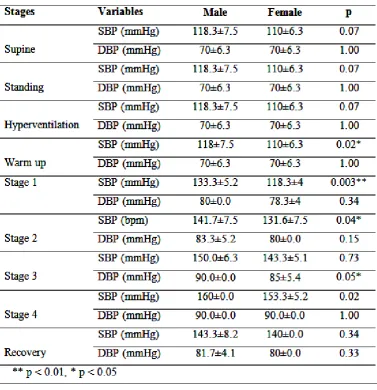
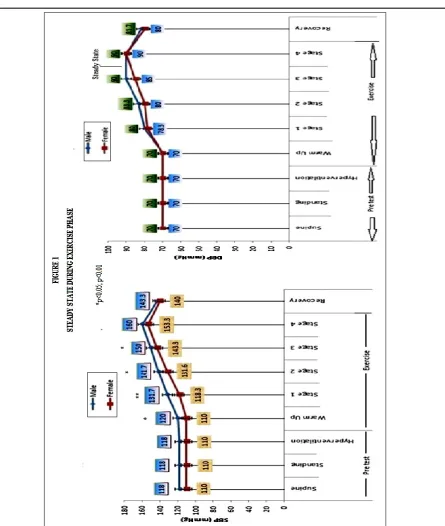
All the runners completed treadmill exercise without shoes up to 12 minutes (Stage 4 at 4.2 mph up a 16 % grade, workload; 13.3 METS) with a mean energy expenditure of 46.6 ml/kg/min (one MET is 3.5 ml/kg/min of oxygen consumption) approximately. The physiological adjustment of the runners is shown in Table 1. In male runners, the mean resting blood pressure (BP rest) rose from SBP/DBP (±SD); 118/70 (±7/6) mmHg to maximum blood pressure (BP max) of 163/90 (±8/0.0) mmHg. Whereas, in female runners, mean resting blood pressure was SBP/DBP (±SD); 110/70 (±6/6) mmHg rose up-to maximal blood pressure of 148/86 (±9/5) mmHg (Fig. 1).
steady state (90mmHg) at 6 minutes (Stage 3) during exercise stress test which indicated that the energy expenditure provided during exercise is balanced with the energy required to perform the exercise.
In female runners, steady state was not seen during the exercise at the end of 12 minute exercise. The recovery blood pressure (BP rec.) at 3 minutes for male and female runners was 143.3±8.2mmHg and 140±0.0 mmHg respectively. The blood pressure variation (Δ BPV) during the sub-maximal exercise was Δ SPV/ Δ DPB (±SD); 45/20(±5/6) mmHg and 38/11 (±9/4) mmHg in male and female athletes respectively. The female athletes had significantly lowered resting systolic blood pressure (SBP rest), maximum systolic blood pressure, (SBP max), and delta blood pressure (Δ DPV) than male runners at p < 0.05. There was no significant difference between male and female runners in mean arterial pressure (MAP) which indicated an average BP during a single cardiac cycle during 12 minutes incremental treadmill exercise.
Functional capacity of heart measured in term of METS values indicated excellent heart function (i.e. > 13.3 METS) with response to the exercise. Inappropriate BP response to exercise, abrupt BP increases and decreases such as slow acceleration and an inappropriate rapid deceleration as well as symptoms such as exercise intolerance, chest pain, dizziness, angina, vertigo, and vomiting were not seen among the runners. The rate of perceived exertion of the runners’ measure through Borg CR10 scale rating ranges from 3-5.
3.1 Discussion
Many researchers suggested pre participation examination of athletes before participating in vigorous exercise training and they are usually thought to be free of cardiovascular disease and hypertension because of their apparently high level of fitness7. Athletes should be screened for hypertension since regular physical activity
appears to counteract sympathetic nervous system activation, which is one of the physiological mechanisms responsible for development of hypertension and target
organ damage8. The sixth report of the Joint National Committee on Prevention,
Detection, Evaluation, and Treatment of High Blood Pressure9 suggested that if
hypertension is diagnosed, appropriate treatment should be started to reduce the risk of morbidity and mortality associated with cardiovascular disease. Most of the previous studies conducted on athletes for pre-participation examination monitor BP at rest. However, in this study, the blood pressure of the athletes was monitored during rest, during stress and recovery after giving stress to the heart since the recorded BP during and after exercise can give us valuable information clinically10.
The result in the present study suggested that the mean blood pressure of the elite Manipuri runners at resting phase falls into optimal stage (SBP <120mmHg; DBP <80mmHg) when compared with the classification given by the sixth report of the Joint National Committee on Prevention, Detection, Evaluation, and Treatment of High Blood Pressure (1997)11. This result indicated that the elite Manipuri long distance
<85mmHg) which may be due their aerobic type of training. This result is supported by the study on Indian by Punia S. and team and Sandip M. Hulke12 on blood pressure.
Punia S. and co-author found that aerobic training reduces the blood pressure in Indians and there was mean reduction of −05.00 mmHg in SBP and −03.09 mmHg in DBP after aerobic training. Sandip M. Hulke and co-author concluded that exercise training over a period of sixteen weeks found a significant decrease in systolic and diastolic blood pressure at the end of sixteen-week moderate intensity endurance exercise program. However, this study is not aligned with the study by De Matos L.D., Caldeira N.A., Perlingeiro P.S.13 ; Sealy D.P., Pekarek L., Russ D. ; Leddy J.J., Izzo J.14;
Corrado D., Basso C., Schiavon M.15 reviewed by Berge H.M. and their team16 where
they found that high BP is the most common abnormal finding during pre-participation cardiac screening of athletes. Also according to our study, it is observed that SBP did not change at supine, standing, and hyperventilation in resting stage which is on the contrary of the findings of the study by Eser I. and co-author17 on Turkish healthy
young adults where they found that blood pressure tend to drop in the standing position compared with the sitting and supine position. They also found that systolic and diastolic blood pressure was the highest in supine position which again is not in agreement with our findings.
Although blood pressure is usually measured during and in recovery from a stress test, there are no clearly established figures of an abnormal response10. However, few studies show a relationship between an abnormal response and future hypertension and cardiovascular mortality. According to American College of Sports Medicine exercise testing guidelines, SBP and DBP rose > 260 mmHg and >115 mmHg respectively during exercise indicated abnormal responses to exercise. In the present study, the SBP and DBP rose up to mean of 155.8±11.7mmHg and 88.3±3.9mmHg respectively at stage 4 Bruce protocols which indicated normal responses to the given stress and they can continue the exercise further. However, the exercise was stop at stage 4 which is one of the limitations in our study.
With regard to BP during recovery, Singh et al.18, in the Framingham Heart Study
suggested a value that SBP recovery at 3 minutes 142 mmHg indicated a predictor of future hypertension in men. He further added that no standard values have been determined which are accepted globally, perhaps in part, due to the different methods used in their studies. According to our study, elite Manipuri male runners have a higher chance of future hypertension. So, it may be suggested that regular blood pressure measurement for the athletes will be beneficial for them to prevent sudden death during training and competition.
4. Conclusions
pressure monitoring is recommended for athletes to diagnose hypertension and prevent from sudden cardiac arrest during physical training and competition. Monitoring BP at rest might not give us the actual figure of the cardiovascular response to predict the chances of future hypertension but monitoring the BP response after giving stress to the heart will give a clear picture of the functioning of the cardiac.
Acknowledgements
This study was financially supported by University Grants Commission, New Delhi; Grant number: UGC NET JRF: 2709/ (NET-DEC.2012). We also thank Mrs Deepa Khomdram, for proofreading.
Conflict of Interest
None.
About the Author (s)
1Assistant Professor; Department of Physical Education, Nambol L. Sanoi College,
Government of Manipur, India;
ResearchGate: https://www.researchgate.net/profile/Ramananda_Ningthoujam3
Orchid ID: http://orcid.org/0000-0001-6300-6934
ResearcherID: http://www.researcherid.com/rid/D-1348-2016
2Associate Professor; Department of Physical Education and Sports Science, Manipur
University, Manipur, India.
References
1. Leddy, J.J. and Izzo, J. Hypertension in Athletes. J Clin Hypertens; 2009, 11: 226–
233. doi: 10.1111/j.1751- 7176.2009.00100.x
2. American College of Sports Medicine: Guidelines for Exercise Testing and Prescription (6th edition). Philadelphia: Lea & Febiger (2000)
3. Mundal R., Kjeldsen S.E., Sandvik L. et al.. Exercise blood pressure predicts
mortality from myocardial infarction. Hypertension; 1996, 27(pt 1): 324–329
4. M. Jette, K. Sidney, G. Blumchen. Metabolic Equivalents (METS) in Exercise
Testing, Exercise Prescription, and Evaluation of Functional Capacity.
Clin.Cardiol., 1990;13, 555-565.
http://onlinelibrary.wiley.com/doi/10.1002/clc.4960130809/pdf
5. Salvi P. Pulse Waves, doi: 10.1007/978-88-470-2439-7_2, ©Springer-Verlag Italia
2012
6. Borg G.A.V. Borg’s Rating of Perceived Exertion and Pain Scales. Champaign, IL:
7. Mark W. Niedfeldt. Managing hypertension in athletes and physically active
patients. Am Fam Physician, 2002, 1;66(3):445-452.
http://www.aafp.org/afp/2002/0801/p445.html
8. Grassi G.. Assessment of sympathetic cardiovascular drive in human
hypertension: achievements and perspectives. Hypertension;2009; 54(4), 690–697.
https://doi.org/10.1161/HYPERTENSIONAHA.108.119883
9. The sixth report of the Joint National Committee on Prevention, Detection,
Evaluation, and Treatment of High Blood Pressure. Arch Intern Med; 1997; 157: 2413–2446.
http://www.aafp.org/afp/2002/0801/p445.html#afp20020801p445-b5
10.Miguel Chiacchio Sieira, Alberto Omar Ricart, Rafael Suau Estrany Blood
pressure response to exercise testing. Apunts Med Esport. ; 2010; 45(167):191-200
11.Punia, S., Kulandaivelan, S., Singh, V. et al.. Effect of Aerobic Exercise Training
on Blood Pressure in Indians: Systematic Review. Int J Chronic Dis.; 2016; pp: 1-8.
Article Id: 1370148. http://doi.org/10.1155/2016/1370148
12.Hulke S.M. Vaidya Y.P., Ratta A.R.. Effects of sixteen weeks exercise training on
left ventricular dimensions and function in young athletes. Natl J Physiol Pharm
Pharmacol; 2012; 2:152-158.
13.De Matos L.D., Caldeira N.A., Perlingeiro P.S. et al.. Cardiovascular risk and clinical factors in athletes: 10 years of evaluation. Med Sci Sports Exerc ; 2011; 43:943–950. doi: 10.1249/MSS.0b013e318203d5cb.
14.Sealy D.P., Pekarek L., Russ D., et al.. Vital signs and demographics in the
pre-participation sports exam: Do they help us find the elusive athlete at risk for
sudden cardiac death? Curr Sports Med Rep; 2010; 9:338–341. doi:
10.1249/JSR.0b013e3182014ed6.
15.Corrado D., Basso C., Schiavon M., et al. Pre-participation screening of young
competitive athletes for prevention of sudden cardiac death. J Am Coll Cardiol;
2008; 52:1981–1989. doi: 10.1016/j.jacc.2008.06.053.
16.Berge H.M., Isern C.B., Berge E.. Blood pressure and hypertension in athletes: a
systematic review. J Sports Med; 2015; 49:716–723. doı: 10.1136/bjsports-2014-093976
17.Eşer I., Khorshid L., Güneş U.Y., et al.. The effect of different body positions on
blood pressure. J Clin Nurs.; 2007; 16(1):137-140.
doı:10.1111/j.1365-2702.2005.01494.x
18.Singh J.P., Larson M.G., Manolio T.A., et al.. Blood pressure response during treadmill testing as a risk factor for new-onset hypertension: the Framingham
Heart Study. Circulation; 1999; 99: 1831–1836.
Table 1: Physiology Adjustment during Rest and Peak Exercise
Creative Commons licensing terms