A Comparison of Vocabulary Learning Strategies
among Elementary Iranian EFL Learners
Shohreh Kashani
Department of English, Isfahan (Khorasgan) Branch, Islamic Azad University, Isfahan, Iran
Sajad Shafiee
Department of English, Shahrekord Branch, Islamic Azad University, Shahrekord, Iran
Abstract—A multitude of factors are involved in learning a second language, among which knowing ample
vocabulary plays a crucial role. Despite many efforts for vocabulary learning, one of the first problems of foreign language learners, especially Iranian EFL learners, is how to commit lots of foreign words to memory. The present study aimed to compare three vocabulary learning strategies (flashcard strategy, sentence writing method, and vocabulary notebook strategy) with the traditional way of vocabulary learning (repetition) among Iranian elementary EFL learners to find out which one was the most efficient approach to vocabulary learning and best increased long-term retention of meaning. To do this end, four groups (three experimental groups and one control group) were chosen to take part in the experiment. The groups were all homogenized in the wake of administering a vocabulary pretest, and then each of the experimental groups was exposed to its pertinent treatment. After the completion of the experiment, and in the light of a vocabulary posttest, the results showed that there existed differences among the four strategies in terms of vocabulary learning and retention. In terms of vocabulary learning, the difference among the four groups was significant, but the difference on posttest which examined the long-term retention of the new vocabularies was not statistically significant. The study revealed that flash card strategy was the best strategy for vocabulary learning process among elementary level learners.
Index Terms—vocabulary learning strategies, flashcard strategy, sentence writing method, vocabulary
notebook strategy, repetition
I. INTRODUCTION
A wealth of factors are involved in learning a second language, among which knowing lots of vocabulary plays an important role. Vocabulary is “a set of lexemes (the smallest unit in the meaning system of a language that can be distinguished from other similar units), including single words, compound words and idioms” (Richards & Schmidt, 2002, p. 580). Vocabulary is the base of any language and learning vocabulary is the most important part of learning a language. The more words one possesses, the more s/he will be able to understand what s/he reads and hears, and the better s/he will convey his/her messages when speaking. However, in Asian countries, vocabulary seems to be given little emphasis in the university curriculum (Fan, 2003). The main obstacle in learning another language is limited vocabulary size. If students do not have a base vocabulary to work with, they cannot study grammar, they cannot do spelling or pronunciation exercises, and also they will not be able to read and write. If one spends most of his/her time studying grammar, his/her English will not improve enormously; much improvement is attained if one learns more words and expressions; little can be said without grammar but almost nothing without words (Thornburry, 2002). Laufer (1997) argues for the fact that vocabulary learning is at the heart of any language learning and language use. There are many methods and strategies for vocabulary learning, but based on the learners' levels, styles, and interests, teachers should choose the best ones.
The motivation to perform this study was in discovering what worked best in teaching English vocabulary to students at elementary level by comparing four methods; in addition, the findings were assumed to provide some recommendations for future beginner teachers. The key to teaching learners vocabulary is to let them make use of the words. Without practice and creativity in the learning process, students will simply memorize the words for a few days and then forget them by the end of the learning course. Even though researchers, teachers, and materials writers agree on the importance of vocabulary knowledge for a second language acquisition, they still do not know the best methods that help learners acquire vocabulary. According to Mak (2009), in vocabulary teaching, the use of teaching aids will enable the students particularly for elementary levels to increase their vocabulary mastery.
to learn words for use in a specific class, but it is also useful in expanding one's own vocabulary and therefore seems more intelligent. Another strategy for vocabulary learning is making a vocabulary note book. Vocabulary notebooks are frequently advocated as a way for students to take control of their vocabulary learning (Fowle, 2002), with the added benefit of improvements in vocabulary learning (Laufer & Nation, 1999; Schmitt & Schmitt, 1995). This study is designed to compare three methods and strategies of learning vocabulary, which include flash card strategy, sentence writing method, and making vocabulary notebook with the traditional way which is repetition to investigate their influence on learning and retention of vocabularies among Iranian EFL learners at elementary level.
II. REVIEW OF THE LITERATURE
Many students think that knowing vocabulary is only knowing its form and translated meaning. Due to complexity of vocabulary acquisition, classroom teachers must take a more comprehensive approach to vocabulary development in order for students to reach a higher quality and quantity of second language output (Sanaoui, 1996; Swain, 1996). Sökmen (1997) describes that vocabulary learning strategies are basically actions made by the learner in order to help them to understand the meaning of words, learn them and remember them later. According to Nation (2001), learners should be able to choose from available vocabulary learning strategies.Flashcards are mainly used as a learning drill to aid memorization by way of spaced repetition. Lynch (2008) says that a flashcard is a card which has a picture on one side and the word on the other side, or the picture and the word on one side, and its translation/explanations on the other. Some researchers demonstrate that working with flash cards helps learners in acquiring vocabulary more effectively than some other strategies (Mondria & Mondria-de Vries, 1994; Schmitt & Schmitt, 1995). Crookall’s study (1990) revealed that flashcards use was one of the most widely-used vocabulary learning strategies. Al-Shuwairekh (2001) concluded that using flashcards was a helpful strategy for both auditory and visual learners.Regardless of whether it is a native, second, or foreign language, language learners often use flashcards to either learn new words or test themselves (Kornell, 2009) regarding the retention of new or difficult words.
Another way to learn new words is to continuously practice their usage. Writing sentences with new vocabulary after understanding the words is helpful. The Sentence Writing Method (also known as the Sentence Generate Method) is recommended by reading researchers as a way to increase vocabulary learning, and involves having learners make a sentence containing the target word to be memorized (Dale, O’Rourke & Bamman, 1971; Gipe, 1979 – cited in Pressley et al. 1982). Some research studies suggest that sentence writing is an effective method for facilitating memorization of words (Coomber, Ramstad, & Sheets, 1986; Laufer, 1997). Another strategy for vocabulary learning is vocabulary notebook, which is a form of note-taking that students carry out with elements that improve the learning of new and useful vocabulary items (Fowle, 2000). It is defined as a kind of notebook used for the recording of new and useful words and several additional information related to those words (McCrostie, 2007). By making vocabulary notebooks, students become autonomous (Thornbury, 2002). It can be said when students take notes on a lesson, they are developing their own independence, which could build their confidence in their ability to act independently of the teacher (Schmitt, 1997).
Despite many efforts for vocabulary learning, One of the first problems a foreign language learner encounters is how to commit a large number of foreign words to memory and the first and easiest strategy people choose and use naturally is, simply, repeating new words until they can be recognized (Gu, 2003). Crothers and Suppes (1967) in one of their research studies working on repetition discovered that almost all of their participants remembered all 108 word pairs after 7 repetitions, and about 80% of 216 word pairs were learned by most participants after 6 repetitions. It was suggested that students should start repeating newly learned words immediately after the first encounter. It also was found that, repeating words aloud helps retention far better than silent repetition.
To recap, all the four vocabulary learning strategies of flashcard, sentence writing, vocabulary notebook, and repetition have been shown to be fruitful. What has remained unearthed so far is which of the four strategies best suits the needs of elementary Iranian EFL learners. That is why the present study embarked on an investigation to find answers to the following research questions:
Research Question 1: Is there a significant difference among flash card strategy, sentence writing method, and making a vocabulary notebook in comparison with repetition in learning new vocabularies by Iranian EFL learners at elementary level?
Research Question 2: Is there a significant difference among flash card strategy, sentence writing method, and making a vocabulary notebook in comparison with repetition in retaining new vocabularies by Iranian EFL learners at elementary level?
III. METHODOLOGY
This study was carried out to see if there was a significant difference among flash card strategy, sentence writing method, and making a vocabulary note book in comparison with repetition in learning and retention of new vocabularies by Iranian EFL learners at elementary level.
This study was conducted at Khuzestan Language Institute in Ahvaz, Iran. The participants were four classes, each of which consisted of 10 EFL learners with the age range of 13 to 15 all of whom were female students. Three of the classes were experimental groups and one of them was the control group. The groups were chosen nonrandomly. The samples were selected by the researcher herself by means of convenience sampling, because the samples were easily accessible to her. The teacher herself assigned a strategy for each group. One of them received flash card strategy (class A), the second one received sentence writing method (class B), and the third one received making vocabulary notebook strategy (class C) as treatment. The fourth class with repetition method (class D) was the control group.
B. Materials
In order to conduct the present study, three instructional materials were used. The primary material was a course book named Hip Hip Hooray 6, the vocabularies of which were taught to all the four groups. Another one was a package of flash cards related to the book for class A and the third one consisted of some researcher-made papers including new words of each session which were delivered to class B to write sentences with them. The group members of class C themselves prepared a notebook for new vocabularies.
C. Instruments
Three measurement instruments were used in this study. In order to find out whether the groups were homogenous in terms of vocabulary knowledge, a Nation Level Test was administered at the beginning of the experiment. The other two instruments were multiple-choice test and posttest prepared by the researcher based on the students' course book. The researcher-made test was designed to see if there was a difference among the four groups in learning new vocabularies and the researcher-made posttest was prepared to see if there was a difference in the retention of vocabularies among them.These researcher-made tests were piloted by a group similar to the participants of this study (elementary female students) before starting the procedure in order to examine the reliability of them. The obtained reliability indexes, calculated through the split-half method, were .84 for the test and .87 for the posttest.
D. Procedure
There were three stages in this research. At first, in order to find out whether the groups were homogenous in terms of vocabulary knowledge or not, a Nation Level Test was administered to all of them. For teaching new words, the teacher utilized repetition at the beginning of each session because repetition was necessary for elementary learners in order to master the oral form of the lexical items (Gairns & Redman, 1986, as cited in Ramachandran & Rahim, 2004). Then for the last 15 minutes, the experimental groups received their treatments: class A received flash card strategy, class B received sentence writing method, and class C received making vocabulary notebook strategy as treatment. Class D was the control group with repetition method.
In Stage Two, after covering two units in six sessions, which took about two weeks, an unannounced researcher-made multiple-choice test was carried out for each groups including 20 multiple-choice items in order to examine which way was the most efficient one for vocabulary learning. If the students were aware of the test, they might use the common way of learning vocabulary to prepare themselves for the test, so the test was unannounced. Each unit covered 16 new vocabularies; overall, 32 words for two units. In Stage Three, after a week, the participants received an unannounced posttest including 30 taught words to test whether the four vocabulary learning ways had different effects on the retention of learners. It should be noted, “the bound between short-term memory and relative long-term memory was considered as a week according to the Forgetting Curve” (Baddeley, Eysenck, & Anderson, 2009).
IV. DATA ANALYSIS
First of all, to make sure that the participants of the study (Groups A, B, C, and D) were homogenous, a one-way ANOVA was used. Descriptive and inferential statistics were conducted to discover if there were any differences among the four groups in terms of their vocabulary knowledge. To see if there was a statistically significant difference between control group and experimental groups after the intervention, the researcher used one-way ANOVA again twice: once for analyzing the scores from the test and once for analyzing the posttest scores.
A. Results of the Nation's Level Test
Descriptive statistics were calculated to make sure that the participants of the study were homogenous in terms of vocabulary knowledge.
TABLE 1.
DESCRIPTIVE STATISTICS COMPARING THE FOUR GROUPS ON THE NATION’S LEVEL TEST
N Mean Std. Deviation Std. Error
95% Confidence Interval for Mean Minimum
Maximum Upper Bound Lower Bound
FCS 10
17.5000 1.35401
.42817 16.5314
18.4686 16.00
20.00
SWS 10
17.1000 1.37032
.43333 16.1197
18.0803 15.00
19.00
VNS 10
17.0000 1.69967
.53748 15.7841
18.2159 15.00
20.00
Rep 10 16.7000 1.33749
.42295 15.7432
17.6568 15.00
19.00
Total 40
17.0750 1.42122
.22471 16.6205
17.5295 15.00
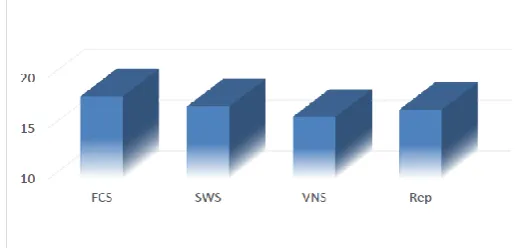
The mean of four groups, that is flash card strategy (M = 17.50), sentence writing method (M = 17.10), vocabulary notebook strategy (M = 17.00) and repetition (M = 17.07) were close to each other (all in range of 17). Nevertheless, to prove the groups’ homogeneity, a one-way ANOVA was used to check the p value.
TABLE 2.
ONE-WAY ANOVA RESULTS COMPARING THE FOUR GROUPS ON THE NATION’S LEVEL TEST
Sum of Squares df Mean Square F Sig. Between Groups 3.275 3 1.092 .521 .671 Within Groups 75.500 36 2.097 Total 78.775 39
The Sig. value in Table 2. (.671 > .05) shows that there were no differences among the four groups on the Nations’ Level Test.
Figure 1. Comparing the four groups on the Nation’s Level Test
As it can be seen, the difference between the experimental groups and control group on Nation's level test was very slight and this implies that the groups were all homogenous.
B. Results of the First Research Question
The first research question of the study was: Is there a significant difference among flash card strategy, sentence writing method, and making a vocabulary notebook in comparison with repetition in learning new vocabularies by Iranian EFL learners at elementary level? To find the answer to this question, descriptive statistics of the vocabulary test of four groups were calculated.
TABLE 3.
DESCRIPTIVE STATISTICS COMPARING THE FOUR GROUPS ON THE VOCABULARY TEST
N Mean Std. Deviation Std. Error
95% Confidence Interval for Mean Minimum
Maximum Upper Bound Lower Bound
FCS 10 18.2000 1.47573 .46667 17.1443 19.2557 15.00 20.00 SWS 10 17.7000 1.56702 .49554 16.5790 18.8210 15.00 20.00 VNS 10 15.9000 2.13177 .67412 14.3750 17.4250 13.00 19.00 Rep 10 16.8000 1.61933 .51208 15.6416 17.9584 14.00 19.00 Total 40 17.1500 1.87494 .29645 16.5504 17.7496 13.00 20.00
As it can be seen in this table, there exist differences among the groups. The mean scores of the flash card strategy group (M = 18.20), sentence writing strategy group (M = 17.70), vocabulary notebook strategy group (M = 15.90), and repetition group (M = 16.80) were more or less different from one another on the vocabulary test. Based on the obtained statistics, flash card strategy group with mean score of 18.20 performed best in comparison with repetition group with mean score of 16.80 on vocabulary test. After flash card strategy group, sentence writing strategy group with the mean score of 17.70 performed better than repetition group and finally, vocabulary notebook strategy with the mean score of 15.90 had a poor performance in comparison to the control group and the other two experimental groups. To find out whether the differences among these mean scores were significant or not, one had to examine the p value under the Sig.
column in the ANOVA table below.
TABLE 4.
ONE-WAY ANOVA RESULTS COMPARING THE FOUR GROUPS ON THE VOCABULARY TEST
Since the Sig. value in Table 4 was found to be less than the alpha level (.025 < .05), it could be argued that there was a significant difference among the vocabulary test mean scores of the four groups. A post hoc Scheffe test was run to go back through the data and shed more light on these differences.
TABLE 5.
POST HOC SCHEFFE TEST COMPARING THE FOUR GROUPS ON THE VOCABULARY TEST
95% Confidence Interval Sig.
Std. Error Mean Difference (I-J) (J)Groups (I)Groups Upper Bound Lower Bound 2.7524 4.5524 3.6524 -1.7524 .0476 -.8524 .935 .044 .359 .76811 .76811 .76811 .50000 2.30000* 1.40000 SWS VNS Rep FCS 1.7524 4.0524 3.1524 -2.7524 -.4524 -1.3524 .935 .159 .714 .76811 .76811 .76811 -.50000 1.80000 .90000 FCS VNS Rep SWS -.0476 .4524 1.3524 -4.5524 -4.0524 -3.1524 .044 .159 .714 .76811 .76811 .76811 -2.30000* -1.80000 -.90000 FCS SWS Rep VNS .8524 1.3524 3.1524 -3.6523 -3.1524 -1.3524 .359 .714 .714 .76811 .76811 .76811 -1.40000 -.90000 .90000 FCS SWS VNS Rep
Pair-wise analyses in the table above revealed that there existed a significant difference between flash card strategy and vocabulary notebook strategy; it was found that among the four compared strategies, flash card strategy had the strongest power in helping elementary level students learn vocabulary. The table indicates that it was better (though not significantly) than common way of vocabulary learning (repetition), and that there was a slight difference between flash card strategy and sentence writing strategy. The bar chart below also illustrates this.
Figure 2. Comparing the four groups on the vocabulary test
C. Results of the Second Research Question
The second research question of the current study was formulated to compare three experimental groups with the control group to see whether there existed significant differences among them in retention of the new words. To this end, descriptive statistics were analyzed, as shown in table below:
TABLE 6.
DESCRIPTIVE STATISTICS COMPARING THE FOUR GROUPS ON THE VOCABULARY POSTTEST
N Mean Std. Deviation Std. Error
95% Confidence Interval for Mean Minimum
Maximum Upper Bound Lower Bound
FCS 10 18.1000 1.66333 .52599 16.9101 19.2899 15.00 20.00 SWS 10 17.1000 1.66333 .52599 15.9101 18.2899 14.00 19.00 VNS 10 16.1000 1.91195 .60461 14.7323 17.4677 13.00 19.00 Rep 10 16.8000 1.61933 .51208 15.6416 17.9584 14.00 19.00 Total 40 17.0250 1.80438 .28530 16.4479 17.6021 13.00 20.00
TABLE 7.
ONE-WAY ANOVA RESULTS COMPARING THE FOUR GROUPS ON THE VOCABULARY POSTTEST
Sum of Squares df
Mean Square F
Sig.
Between Groups 20.675
3 6.892
2.334 .090
Within Groups 106.300
36 2.953
Total 126.975
39
The p value under Sig. column is larger than the alpha level (i.e. .09 > .05); therefore, it shows that the groups were not significantly different from each other.
Figure 3. Comparing the four groups on the vocabulary posttest
To summarize, the results of the data analysis showed that the four groups were homogenous in terms of vocabulary knowledge at the outset of the study, but there were differences among the groups on vocabulary test and posttest in terms of vocabulary learning and vocabulary retention. The obtained results showed that the differences among the four groups on the test were significant (with flashcard group outperforming the other groups, followed by sentence writing group, repetition group, and vocabulary notebook group), but there were not significant differences among the four compared groups in terms of long-term retention of newly learned vocabularies.
V. DISCUSSION
A. Research Question One
By comparing the findings of the first research question of the four groups, it was found that there existed a significant difference among four groups in vocabulary learning. In comparison to repetition, at first flashcard strategy group and after that sentence writing strategy group performed better than repetition. Vocabulary notebook strategy was a little weak in comparison to repetition. The results of the study indicated that though the four methods had positive effects on vocabulary development of the learners, among the experimental groups, flashcard strategy seemed to be better than the control group and the other two strategies. It might be because of elementary level student's interest in fun experiences and joyful classroom environment. The results revealed that there was a difference in the efficiency of flash card compared to traditional teaching method, i.e. repetition. It was confirmed that learning vocabulary through flash card would lead to better learning than traditional method (Mondria & Mondria-de Vries, 1994; Nakata, 2008; Schmitt & Schmitt, 1995), so this study was in line with their statement and findings.
Waltes & Bozkurt (2009) studied the effect of sentence writing on vocabulary learning. They found that students used target words more effectively through writing. Therefore, their findings were similar to the results of the present study, which revealed that after flash card strategy, sentence writing method is more effective than repetition and vocabulary notebook strategy.
B. Research Question Two
Again based on the results achieved by descriptive statistics and one-way ANOVA for the second research question, concerning with retention of newly learned vocabularies, the mean scores of flash card strategy and sentence writing method in sequence were a bit more than the mean score of repetition. Thus, this indicated that flashcard strategy had more effect on retention of newly learned vocabularies, and after that sentence writing method, which connected the previous knowledge with the new one, was better than repetition. The study indicated that no difference existed between vocabulary notebook strategy and repetition in terms of retention. The results showed that somehow there existed difference among groups on posttest but the difference however was not statistically significant.
It was found that the utilization of vocabulary flash card in teaching vocabulary to students at elementary level not only led to a high level of vocabulary improvement, but also resulted in greater long-term retention, too. After flash card strategy, it was sentence writing method that presented better results in vocabulary learning and retention of those new vocabularies.
language learning. For example, elementary students do not like looking up in dictionary and searching for meanings and new information related to new vocabularies all the time. All the learners at this level are not eager to learn extra information than their books. This strategy is suggested to be suitable for learners at intermediate and upper-intermediate level, because they are interested in learning more information than the ones in their books.
VI. CONCLUSION &IMPLICATIONS
The results of the study indicated that there existed a significant difference among flash card strategy, sentence writing method, and vocabulary notebook strategy in comparison with repetition in vocabulary learning, but in terms of long-term memory retention, the difference among the four strategies was not significant. It was found that among these compared strategies, flash card and sentence writing strategies best suited elementary level student's vocabulary learning processes, but vocabulary notebook strategy is not a suitable strategy for learners at this level. The implications for teaching are clear: Based on the findings, if teachers want their students to be able to recognize and use the vocabularies they teach them, flashcards and sentence writing papers are useful tools in addition to the language classroom routine, particularly for motivated students. In specific, these strategies can pave the way for vocabulary learning and retention.
REFERENCES
[1] Al-Shuwairekh, S. (2001). Vocabulary learning strategies used by AFL (Arabic as Foreign Language) learners in Saudi Arabia. MA thesis. University of Leeds.
[2] Baddeley, A. D., Eysenck, M., & Anderson, M. C. (2009). Memory. Hove: Psychology Press.
[3] Chastain, K. (1988). Developing second-language skills: Theory and practice. San Diego: Harcourt Brace Jovanovich Publishers.
[4] Clark, E. V. (2009). "Lexical Meaning" In E. L. Bavin, The Cambridge handbook of child language. New York: Cambridge University Press.
[5] Coomber, J., D. Ramstad & D. Sheets. (1986). Elaboration in vocabulary learning: A comparison of three rehearsal methods.
Research in the Teaching of English, 20(3), 281-293.
[6] Crothers, E., & Suppes, P. (1967). Experiments in second-language learning. New York: Academic Press.
[7] Crookall, D., & R. Oxford. (1990). Language learning through simulation/gaming New York: Newbury House/Harper & Row. [8] Dale, E., O' Rourke, J., & Bamman, H. (1971). Techniques in teaching vocabulary. Palo Alto: Field Educational Publications. [9] Fan, Y. M. (2003). Frequency of use, perceived usefulness, and actual usefulness of second language vocabulary strategies: A
study of Hong Kong learners. The Modern Language Journal, 87(2), 222-241.
[10] Fowle, C. (2002). Vocabulary notebooks: implementations and outcomes. ELT Journal, 56(4), 380-88
[11] Gairns, R., & Redman, S. (1986). Working with words: A guide to teaching and learning vocabulary. In S.D. Ramachandran, H.A. (2004). 35(2), 161-178.
[12] Gipe, J. P. (1979). Investigating techniques for teaching word meanings. Reading Research Quarterly, 14, 624–644.
[13] Gu, Y. (2003). Vocabulary learning in second language: Person, task, context and strategies. Electronic Journal TESL-EJ, 7(2), 1–26.
[14] Kornell, N. (2009). Optimising learning using flashcards: Spacing is more effective than cramming. Applied Cognitive Psychology, 23, 1297--1317. doi: 10.1002/acp.1537
[15] Laufer, B. (1997). The lexical plight in second language reading.Cambridge: Cambridge University Press.
[16] Laufer, B., & Nation, P. (1999). A vocabulary-size test of controlled productive ability. Language Testing, 16(1), 36–55. [17] Mak, Elaine. (2009). ''Do Glenn Doman Flash Cards Work?'' GOARTICLES. COM. (Online).
http://goarticles.com/doglenndomanflashcardswork/article. [Accessed: 21 November 2014].
[18] Lynch, L. M. (2008). English language error correction—A key language skills development tool. Retrieved July 13, 2010, from http://www.EzineArticles.com.
[19] McCrostie, J. (2007). Examining learner vocabulary notebooks. ELT Journal, 61(3), 246-255.
[20] Mondria, J. A., & Mondria-de Vries, S. (1994). Efficiently memorizing words with the help of word cards and hand computer: Theory and applications. System, 22(1), 47-57.
[21] Nakata, T. (2008). English vocabulary learning with word lists, word cards and computers: Implications from cognitive psychology research for optimal spaced learning. RECALL, 20(1), 3-20.
[22] Nation, I. S. P. (2001). Learning vocabulary in another language. Cambridge: C. U. P.
[23] Richards, J. C. & Schmidt, R. (2002). Longman dictionary of language teaching and applied linguistics. Edinburgh Gate: Pearson EducationLimited.
[24] Sanaoui, R. (1996). Processes of vocabulary instruction in 10 French as a second language classroom. The Canadian Modern Language Review,52 (2) 179-199.
[25] Schmitt, N., & Schmitt, D. (1995). Vocabulary notebooks: Theoretical underpinnings and practical suggestions. ELT Journal, 49, 133-142.
[26] Schmitt, N., & McCarthy, M (1997). Vocabulary. Cambridge: Cambridge University Press.
[27] Sokmen, A. (1997). Current trends in teaching second language vocabulary.In N. Schmitt & M.McCarthy (eds.), Vocabulary: Description, Acquisition and Pedagogy (pp. 237-257). Cambridge: University Press.
[28] Thornbury, S. (2002). How to teach vocabulary. England: Longman.
Shohreh Kashani received her B.A. in English Translation in Ahvaz, Iran (2008-2012). She studied her MA in English Language Teaching at IAU, Isfahan (Khorasgan) Branch, Isfahan, Iran. Shohreh Kashani is currently an English teacher and also a translator.