ARTIGO ORIGINAL
Stapedo-Vestibular Ankylosis: Retrospective Study of Five
Cases in São Tomé e Príncipe
Anquilose Estapedo-Vestibular: Estudo Retrospetivo de
Cinco Casos em São Tomé e Príncipe
1. Centro Clínico e Universitário de Otorrinolaringologia. Hospital CUF Infante Santo. Lisboa. Portugal.
2. Departamento de Otorrinolaringologia. NOVA Medical School. Faculdade de Ciências Médicas de Lisboa. Lisboa. Portugal.
Autor correspondente: Paula Campelo. [email protected]
Recebido: 13 de dezembro de 2016 - Aceite: 04 de maio de 2017 | Copyright © Ordem dos Médicos 2017
Paula CAMPELO1, Cristina CAROÇA1,2, Catarina TINOCO1, Diogo OLIVEIRA E CARMO1,2, João PAÇO1,2 Acta Med Port 2017 Oct;30(10):713-718 ▪ https://doi.org/10.20344/amp.8568
RESUMO
Introdução: A otosclerose é uma causa frequente de hipoacusia de condução caracterizada pela alteração da remodelação óssea lo-calizada exclusivamente à cápsula ótica. Diferenças rácicas são evidentes na literatura e, ao contrário dos caucasianos, as descrições na população de origem africana são raras. Neste trabalho pretende-se reportar cinco casos observados, e cirurgicamente confirma-dos, de otosclerose em indivíduos de raça negra, em São Tomé e Príncipe.
Material e Métodos: Desde fevereiro de 2011, efetuam-se consultas e cirurgias de Otorrinolaringologia no Hospital Ayres de Menezes, em São Tomé e Príncipe, inseridas no projeto ‘Saúde para todos – Especialidades’. Neste trabalho realizou-se um estudo retrospetivo dos doentes submetidos a estapedotomia ou estapedectomia parcial durante estas missões até fevereiro de 2014. Recolheu-se infor-mação relativa à apresentação clínica, resultados audiométricos e relatórios cirúrgicos.
Resultados: Cinco doentes, adultos, foram submetidos a procedimento cirúrgico. Todos apresentavam otoscopia normal, ausência de história de traumatismo cranioencefálico ou quadro infecioso, audiograma com hipoacusia mista ou de condução e timpanograma tipo A, sem reflexos estapédicos. Em três doentes foi possível realizar audiograma pós-operatório, verificando-se melhoria do gap
aero-ósseo.
Discussão: Neste trabalho documentam-se cinco casos de otosclerose clínica, e cirurgicamente confirmada, na população negra de São Tomé e Príncipe. Efetuada uma revisão temática, constata-se que, apesar de a otosclerose ser considerada rara nesta raça, os dados disponíveis parecem insuficientes para determinar se, de facto, diferentes raças têm diferentes incidências da doença.
Conclusão: Apesar de rara, a otosclerose não pode ser ignorada como uma possível causa de hipoacusia de condução em São Tomé e Príncipe.
Palavras-chave: África; Anquilose; Cirurgia do Estribo; Grupo com Ancestrais do Continente Africano; Otosclerose
ABSTRACT
Introduction: Otosclerosis is a common form of conductive hearing loss characterized by abnormal bone remodeling exclusively in the otic capsule. The prevalence of otosclerosis varies in racial populations and is described as being rare in black African populations. In this paper we aim to report five cases of clinical, and surgically confirmed, otosclerosis in black individuals, in São Tomé and Príncipe.
Material and Methods: Since February 2011, Ear, Nose and Throat consultations and surgeries specialty have been carried out at Dr. Ayres de Menezes Hospital in cooperation with the project ‘Health for all’. A retrospective analysis was undertaken of the records of all patients subjected either to stapedectomy or partial stapedectomy until February 2014. Information regarding clinical presentation, audiometric data and surgery reports was recorded.
Results: Five adult patients underwent stapedectomy or partial stapedectomy. All of them presented with normal otoscopy, conductive or mixed hearing loss on audiogram and normal tympanometry with absent stapedial reflexes. None of the patients had signs of infec-tion or history of head trauma. Three cases showed improvement in the air-bone gap after surgery. The other two were lost to follow-up.
Discussion: We documented and surgically confirmed five cases of clinical otosclerosis in this population. A thematic review was car-ried out and concluded that, despite being described as a rare event in this race, available literature on this topic is not enough to state that there is lower prevalence of otosclerosis amongst the African population.
Conclusion: Even if not common, otosclerosis cannot be disregarded as a possible cause for conductive hearing loss among the population of São Tomé and Principe.
Keywords: Africa; African Continental Ancestry Group; Ankylosis; Otosclerosis; Stapes Surgery
INTRODUCTION
Otosclerosis is a primary disease affecting the otic cap-sule exclusively in humans.1 It is a disorder of bone metabo-lism and the consequence of an abnormal bone remodelling process within a structure normally showing little or no os-teoclastic or osteoblastic activity.1,2 New bone formation of the otic capsule and stapes footplate subsequently occurs, showing different areas of bone resorption and new bone formation. Otosclerotic lesions usually start around the fis-sula ante fenestram, confined to the bone just anterior to the oval window, leading to the calcification of the annular
ARTIGO ORIGINAL Patients usually present with a progressive conductive, mixed or sensorineural hearing loss, usually occurring be-tween the third and the fifth decade of life.2 The presence of ethnicity differences in genetic susceptibility seems evi-dent.2-5 A lower prevalence of clinical as well as histologic otosclerosis (found only on microscopic examination but with no symptoms) has been found in Blacks when com-pared to Caucasians, according with different epidemio-logical studies.2-5 However, very few studies on otosclerosis have been carried out in Africa according with a revision of the literature7 and this seems to be the first study on oto-sclerosis carried out in São Tomé and Príncipe (STP). The islands of the República Democrática de São Tomé e Príncipe have been discovered and initially populated by the Portuguese and were a slave warehouse for those com-ing from the Guinea region; settlements of traders, noble-men, convicts and Jewish children, the latter coming from Spain, subsequently came to the islands,8,9 which were in-vaded several times by Angolan, English, French and Dutch people and again integrated into the Portuguese Crown in 1750 up to the independence in 1975. A total of 187,000 people currently live in STP, mainly with a young popula-tion.8–10
The Department of Otolaryngology of the Hospital CUF Infante Santo became involved since Feb 2011 in the Pro-gram ‘Saúde para todos – Especialidades’ which was car-ried out by the Instituto Marquês de Valle Flor, including three medical mission trips per year to the country, each with a weekly duration. Outpatient otolaryngology visits and audiology tests were made available at the Hospital Ayres de Menezes, in the island of São Tomé.
Different Black patients with otosclerosis were found during these missions. This study aimed at the identification of surgically confirmed cases of stapes footplate fixation in the Black population living in STP, considering the absence of any studies published on this issue over the past few years and the general belief on the rarity of otosclerosis in this race.
MATERIAL AND METHODS
This was a retrospective study involving a review of the surgical patients attended by the medical teams of the Hos-pital CUF Infante Santo at the HosHos-pital Ayres de Menezes between Feb 2011 and Feb 2014. Only the patients hav-ing undergone otosclerosis surgery (either stapedotomy or stapedectomy) were included in the study and the following clinical variables were analysed: patient gender, age at sur-gery, operated ear and family history of hearing loss. Pa-tient’s audiometric information has been obtained pre and postoperatively (air-bone gap (ABG), thresholds of hearing, types of tympanograms and presence of ipsilateral stapedi-al reflexes). All operated patients were previously examined
by the team and underwent pure tone audiometry and im-pedance audiometry (tympanometry with measurement of ipsilateral reflexes). Audiometric testing was carried out by an audiologist and a Madsen Midimate 622 audiometer was used. Due to the lack of resources at the local hospital, the audiology tests were carried out without the use of a sound proof audiometric cabin and testing with TDH 39 audiomet-ric earphones in a closed room were used instead, which may have biased the test; nevertheless, tests were carried out with a sound level <35 dB measured by the Schabel-DoesIT GbR, Munich, Germany (version 1.0.0) iPhone ap-plication and were considered as acceptable by the British Society of Audiology according with the BS EN ISO 8253-1:1998.11 The calibration of the audiometry equipment was carried out according with the BS EN ISO 389-3:1999.11 The patients were ranked according with the World Health Organization criteria12 whereby the threshold of hearing is considered as the arithmetic mean of the tone thresholds at 0.5, 1, 2 and 4 kHz frequencies. Pre and post-operative ABG have been calculated by subtracting the mean bone-conduction tone threshold from the mean air-conduction tone threshold value.
Patients were operated by different surgeons during the presence of the different medical teams at the Hospital Ay-res de Menezes.
RESULTS
A total of 573 patients attended Audiology outpatients throughout the several medical missions, 261 from which presented with hearing loss criteria. A total of five patients from the 229 who underwent surgery (32 underwent otolog-ic surgery) were submitted to surgery for otosclerosis, previ-ous intraoperative identification of stapes footplate fixation. All these patients were submitted to surgery of the right ear: three patients underwent a stapedectomy and two a partial stapedectomy with placement of a teflon piston (0.5 mm * 4.5 mm). All the patients were discharged within 48 hours. Two patients presented with postoperative vertigo.
The patients operated for otosclerosis corresponded to 0.9% of all the attended patients, 1.9% of the patients with hearing loss and 2.2% of the patients operated during the medical missions in STP (Table 1). All the patients included in the study were Black and presented preoperatively with progressive conductive hearing loss, normal otoscopy and had no personal history of traumatic brain injury or recent infection. All the patients had no family history of hearing loss.
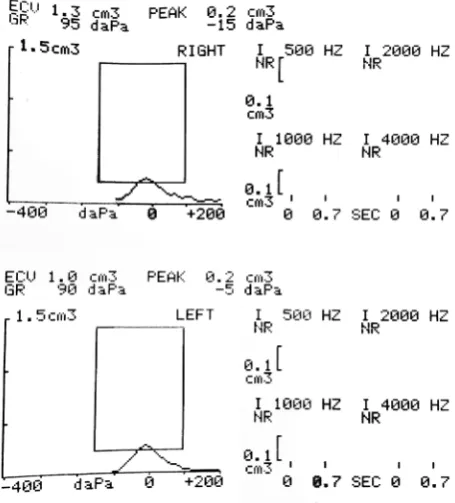
Four of the operated patients were male and aged 23 to 45 at time of surgery (Table 2). Pre and postoperative au-diometric results are shown in Table 3. All the patients pre-sented with a type A tympanogram in impedance audiom-etry, absent ipsilateral stapedial reflexes and two patients
Table 1 – Total number of patients examined over the study period
Examined patients Patients with hearing loss Patients with clinical otosclerosis
Audiology 573 261 5
ARTIGO ORIGINAL
Figure 1 – Example of impedance audiometry: type As tympano-gram, with absent ipsilateral stapedial reflexes
presented with a type As (Fig. 1) tympanogram. All the pa-tients presented with bilateral disorder, with ABG ranging between 20 and 63 dB (mean ABG 37.8 dB). Three patients presented with moderate hearing loss, while the remaining two presented with severe hearing loss, according with the WHO classification.12
Three patients presented with postoperative ABG rang-ing between 7 dB and 15 dB, with a mean ABG of 9.7 dB, corresponding to a mean gain of 28.1 dB. The remaining two patients were lost to follow-up.
DISCUSSION
Otosclerosis is the most frequent cause for progres-sive conductive hearing loss in the adult.1 Clear ethnicity differences in genetic susceptibility to the development of otosclerosis can be found in literature,1-5 with an estimated prevalence of clinical otosclerosis (i.e. symptomatic) be-tween 0.04 and 1% (0.3% on average) in Caucasians,6,13 a lower prevalence in Asians14 and near to zero in Blacks, with some exceptions.7,15 In addition, histologic otosclerosis is considered as more frequent and reaching a prevalence of 10% in Caucasians, 5% in Asians and 1% in Afro-Ameri-cans in studies carried out in the United States.5,16
Few studies on the epidemiology of otosclerosis have been published over the past decade (Table 4). Studies with Black patients, particularly in the African population, are rare and, to our knowledge, no studies have been carried out in the population of STP so far. In Africa, Rosen et al. did not find any cases in Sudan,2 while Tshifularo et al. have de-scribed 31 patients with otosclerosis in a Black population in South Africa, where the disease is considered as extremely rare or non-existent.7
The presence of stapes fixation has been found in five patients in our study, which is compatible with a clinical diagnosis of otosclerosis. Surgery has been the option in patients with clinically suspected otosclerosis, due to its proven efficacy and low morbidity1 as well as considering the constraints found in STP regarding the availability and follow-up of hearing aid rehabilitation.
Operated patients were aged between 23 and 45, in line with the age described for symptom onset (between 30 and 40 years of age). All the patients presented with a bilateral disease, which is often the case in otosclerosis, in which bilateral presentation is expected in between 70 and 80% of the patients.5 Despite the well-known genetic basis of otosclerosis, all the patients in our group denied any fam-ily history of hearing loss. The scarce health literacy found in this population throughout the medical missions, namely
Table 2 – Demographic characteristics of the study population
Patient Age Gender Operated ear
P1 23 ♀ Right
P2 45 ♂ Right
P3 23 ♂ Right
P4 26 ♂ Right
P5 32 ♂ Right
Table 3 – Pre and postoperative audiometric data
Patient Hearing loss Tonal threshold Tympanogram Preop ABG Postop ABG(follow-up)
P1 RE: C Moderate As 32 15 (9 months)
LE: C Moderate As 37
P2 RE: M Severe A 63 7 (12 months)
LE: C Moderate A 38
P3 RE: M Moderate A 48 LF
LE: M Moderate A 42
P4 RE: M Moderate As 33 7 (3 months)
LE: M Moderate As 23
P5 RE: M Severe A 32 LF
LE: M Severe A 30
ARTIGO ORIGINAL
regarding the importance and value of hearing loss, may on its own have explained for the absence of any descrip-tion regarding family history. Other authors have already de-scribed this effect and, in different case series, the presence of a family history of hearing loss was only described in 49% - 58% of the patients, below the 70% rate described in the presence of a genetic basis.1
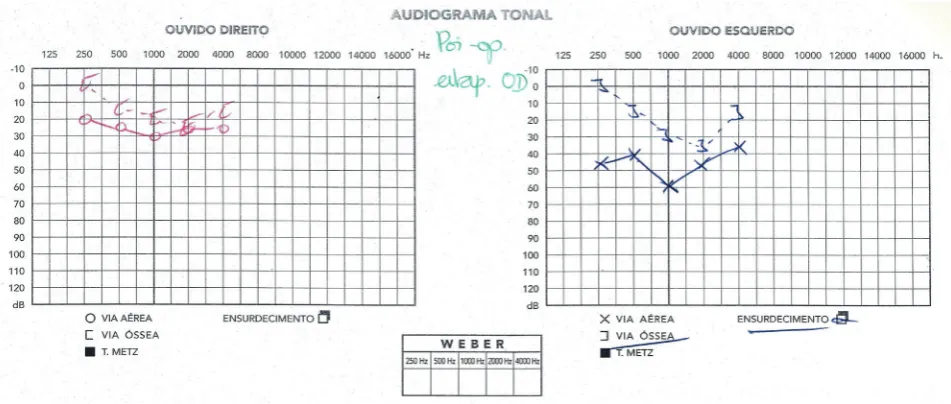
From the 10 ears that were examined, five presented with conductive hearing loss and in the remaining five one with mixed hearing loss has been found, all with ABG > 15 dB at 500, 1,000 and 2,000 Hz frequencies. In one case, even a Carhart notch was found (Fig. 2), which is the typical audiologic characteristic of otosclerosis. A reduction in the Carhart effect and ABG closure was found in both patients who were postoperatively assessed (Fig. 3).
A type A tympanogram was found in all the patients and type As in two patients, which is more characteristic of a more advanced otosclerosis. Ipsilateral stapedial reflexes are a sensitive measurement of the movement of the stapes in response to an ipsilateral sound stimulus.1 Due to stapes fixation, these are characteristically abnormal in otosclero-sis (diphasic effect) or even absent and with a remaining
contralateral reflex.1 No patient in our group presented with ipsilateral stapedial reflexes. However, given that all the patients presented with bilateral disease and that no infor-mation regarding contralateral reflexes was available (the impedanciometer that was used did not allow for the meas-urement of such reflexes), we were unable to determine in patients with conductive hearing loss whether the absence of reflexes was due to severe hearing loss (afferent path-way of the reflex) or to the stapes footplate fixation (efferent pathway) which is a typical finding in otosclerosis.
No computed tomography imaging was available in STP. Even though this test can be useful for the confirma-tion of the diagnosis, disease extent and surgical planning, it is known that those abnormalities typically associated with otosclerosis are not specific of this condition. The use of CT imaging is still not consensual for the diagnosis of otoscle-rosis.1,17
Even though clinically compatible with otosclerosis, one of the limitations of the study was the fact that we were un-able to confirm the diagnosis through a microscopic exami-nation. Stapes fixation can also be associated with other disorders such as tympanosclerosis, congenital stapes
Figure 2 – Example of a preoperative audiogram: Carhart effect can be observed on both ears Table 4 – Studies on otosclerosis in the African population when compared to other populations
Author Patients (n) Relative frequency (M, anos)Age Gender (♂:♀) Laterality(Bil:Unil) ABG(M) Black population
Study population
(STP) 5 0.9% (Out) 1.9% (HL) 29.8 4:1 5 37.8
Tshifularo et al7
(South Africa) 31 ? 41 9:22 27:4 40.3
Seltzer15
(Philadelphia) 16 ? ? ♂<♀ ? ?
Other ethnicity
Sakihara et al13
(Caucasians, Copenhagen) 556 0.1% of the population 75 166:390 ? ?
Yagi14
(Asians, Japan) 80 0.22% (HL) ? ? 72:8 31.7
ARTIGO ORIGINAL
Figure 3 – Example of a postoperative audiogram: Carhart effect disappeared upon closure of air-bone gap on the right ear
footplate fixation, degenerative disorder, Paget’s disease and osteogenesis imperfecta.1 However, none of the pa-tients in our group presented with any other clinical abnor-malities that could suggest any of these diagnoses. This group of Black patients from STP with stapes foot-plate fixation is worth documenting as otosclerosis has been so rarely described in Blacks. Ethnicity differences in genetic susceptibility to the disease can reflect genetic differences even though environmental differences should not be ignored. Different issues should be taken into con-sideration. At first, there is the question of knowing whether otosclerosis is nearly non-existent in the African population or is just underdiagnosed due to the few studies carried out so far. In an opinion article published in 1961 by Speltzer, an otolaryngologist from Philadelphia, the author sustained that the prevalence of otosclerosis in Blacks vs. Caucasians in the study’s group of patients was not as different as it has been previously considered and that social and economic factors could explain for the underdiagnoses in Black pa-tients.15
In this study, the five patients corresponded to 0.9% of the population examined as outpatients, which is in line with the prevalence of otosclerosis in the general population, de-scribed in Caucasians. When the prevalence of otosclero-sis is compared among patients with hearing loss, a similar rate (1.9%) to the one described in Asian studies (1.1%) in which the disease is considered as less frequent1,14 has been found8 even though it is lower than in Caucasians (5%).1 Despite regarding a small group of patients, these data showed that otosclerosis, even though scarce, is not so rare as it would be expected from literature.
Otosclerosis is currently considered as a multifactorial disease caused by the association of different genetic (au-tosomal dominant condition showing low penetrance) and environmental factors (measles, endocrine factors or low concentrations of sodium fluoride in drinking water, for in-stance).4
Based on Japanese studies19 and if a higher incidence of otosclerosis were to be confirmed in STP, this may be explained by (i) a greater prevalence of otosclerosis in the island, (ii) a higher activity within the foci of otosclerosis or (iii) by different locations of these foci within the otic capsule with a poorer outcome. Further epidemiological and histo-logical studies are necessary to allow for the confirmation of these data.
Considering the STP history, its own colonisation and the fact that STP has been populated by different Cauca-sian people,9,10 an ethnic mixture may also exist, explaining for the cases of otosclerosis. Environmental factors, such as measles, against which there is no vaccination available in the country, may have also contributed to the manifesta-tion of the disease. Further studies could explain the real prevalence and aetiology of otosclerosis in STP.
CONCLUSION
Even though the incidence and prevalence of otosclero-sis is still not entirely known in STP, this disease should be considered in the differential diagnosis of conductive hear-ing loss in this population.
Understanding the ethnic differences in the clinical man-ifestation of otosclerosis can give a contribution to a better clarification of the aetiology and prevention of the disease.
OBSERVATIONS
This study was presented as an oral communication to the 61st Congresso Nacional da Sociedade Portuguesa de Otorrinolaringologia e Cirurgia Cervico-Facial, which was held in Lisbon in 1-4 May 2014.
HUMAN AND ANIMAL PROTECTION
ARTIGO ORIGINAL DATA CONFIDENTIALITY The authors declare that they have followed the proto-cols of their work centre on the publication of patient data.
CONFLICTS OF INTEREST
The authors declare that there were no conflicts of inter-est in writing this manuscript.
FINANCIAL SUPPORT
The authors declare that there was no financial support in writing this manuscript.
REFERENCES
1. House J, Cunningham III C. Otosclerosis. In: Flint P, Haughey B, Lund V, Niparko J, Robbins K, Thomas J, et al, editors. Cummings otolaryngology: head and neck surgery. 6th ed. Philadelphia: Saunders;
2015. p. 2211–9.
2. De Souza C, Glasscock III ME. Otosclerosis and stapedectomy: diagnosis, management & complications. New York: Thieme; 2004. p. 3-22.
3. Karosi T, Sziklai I. Etiopathogenesis of otosclerosis. Eur Arch Otorhinolaryngol. 2010;267:1337–49.
4. Schrauwen I, Van Camp G. The etiology of otosclerosis: a combination of genes and environment. Laryngoscope. 2010;120:1195–202. 5. Markou K, Goudakos J. An overview of the etiology of otosclerosis. Eur
Arch Otorhinolaryngol. 2009;266:25–35.
6. Declau F, Spaendonck M Van, Timmermans JP, Michaels L, Liang J, Qiu JP, et al. Prevalence of otosclerosis in an unselected series of temporal bones. Otol Neurotol. 2001;22:596–602.
7. Tshifularo M, Joseph C. Otosclerosis and TGF- β 1 gene in black South Africans. S Afr Med J. 2008;98:720–3.
8. Araujo MB. A ilha de São Tomé - alguns problemas históricos. Rev Univ Coimbra. 1991;36:261–76.
9. Tomas G, Seco L, Seixas S, Faustino P, Lavinha J, Rocha J. The peopling of Sao Tome (Gulf of Guinea): origins of slave settlers and admixture with the Portuguese. Hum Biol. 2002;74:397–411.
10. Trovoada MJ, Tavares L, Gusmão L, Alves C, Abade A, Amorim A, et al. Dissecting the genetic history of São Tomé e Príncipe: a new window from Y-chromosome biallelic markers. Ann Hum Genet. 2007;71:77–85.
11. British Society of Audiology. Recommended procedure. Pure-tone air-conduction and bone-conduction threshold audiometry with and without masking [Internet]. 2011. [consultado 2017 mar 20]. Disponivel em: http://www.thebsa.org.uk/wp-content/uploads/2014/04/BSA_ VRA_24June2014_Final.pdf.
12. WHO. Guidelines for hearing aids and services for developing countries [Internet]. 2nd ed. World Health Organization. Geneva; 2004 [consultado
2015 FeV 15]. Disponível em: http://www.who.int/pbd/deafness/en/ hearing_aid_guide_en.pdf.
13. Sakihara Y, Parving A. Clinical otosclerosis, prevalence estimates and spontaneous progress. Acta Otolaryngol. 1999;119:468–72.
14. Yagi T. Incidence and characteristics of otosclerosis in the Japanese population. Auris Nasus Larynx. 2002;29:257–60.
15. Seltzer A. The incidence of otosclerosis among negroes. J Natl Med Assoc. 1961;53:502–3.
16. Hueb MM, Goycoolea MV, Paparella MM, Oliveira JA. Otosclerosis: the University of Minnesota temporal bone collection. Otolaryngol Head Neck Surg. 1991;105:396–405.
17. Velegrakis GA. Otosclerosis: state of the art. Otorhinolaryngol Head Neck Surg. 2011:6–16.
18. Horiguchi S, Onchi Y. Studies on clinical otosclerosis in Japan. J Laryngol Otol. 1955;69:437–56.