ISSN-L: 2501 - 1235 Available on-line at: www.oapub.org/edu
doi: 10.5281/zenodo.3532134 Volume 5 │ Issue 12 │ 2019
THE DEGREE OF QUALIFYING STUDENTS
TO APPLY THE PRINCIPLES OF COMPREHENSIVE
QUALITY DURING THEIR PERIOD OF FIELD TRAINING
Amani Asii Department of Physical Education, Faculty of Arts, Al-Quds University, P.O. Box: 20002, East Jerusalem, Palestine
Abstract:
This study aims to identify the extent of qualifying field training students to apply the principles of comprehensive quality during their practical training period. (56) students were chosen deliberately, and to achieve the objectives of the study, the researcher used a questionnaire as a tool to collect data consisted of (40) paragraphs distributed over four areas: the field of quality in classroom management, the field of quality in the teaching methods used, the field of quality in the development of the learner’s scientific qualities. The researcher recommended the necessity of holding courses and workshops for students of physical education to clarify the concepts of comprehensive quality in the educational and teaching process, in addition to supervision and continuous evaluation of field training students so as to ensure the extent to which they apply the principles of total quality during their practical training.
Keywords: comprehensive quality, field training, qualifying students
1. Introduction
All educational institutions all over the globe seek to care for the university student and prepare and train him through the preparation and provision of necessary training and educational programs commensurate with the needs and requirements of the times. Where the current educational systems suffer from that university students in general and students of physical education in particular, find it difficult to apply what they learned in their universities and transfer to their working lives.
Our university has become just a place where students receive abstract study materials based on the principle of memorization and indoctrination, and it is hoped that these educational systems will change their philosophy in order to prepare
students for practical and professional life. Rather, the university is a life in itself, and students should reflect on the issues they have learned at the university and bring it to life through the use of different thinking skills (Masmouh, 2016).
Hayek and Khasawneh (2013) emphasize the importance of the planning process for preparing teachers of sports education in line with the accelerated scientific progress which has become a prominent role in the plans of sports development. Attention to the preparation of teachers of physical education professionally to acquire a lot of knowledge and skills and theoretical and practical experience, and provide them with educational and pedagogical knowledge, which includes many strategies to suit that trend.
We are witnessing a wave of transformation towards total quality in the field of education, where the educational output is the entrance to all other productive and industrial sectors. Teaching and learning is focused on providing students with the necessary skills and developing their abilities (Al-Maqtari, 2008).
The quality of education is meant to obtain a good product, including graduates, environmental development and community service, by improving the inputs of the educational process and improving performance (Nasr, 2008).
Al-Masri (2012) emphasizes the importance of the field training course in the process of refining the abilities of the student teacher and preparing and preparing them professionally, which is the translation and application of the information, knowledge, experience and theories through the actual practice. Organized and deep during the period of field training, the student in this period needs guidance and supervision and a resident teacher at the school takes his hand towards the best ways to perform the tasks assigned to him efficiently and professionally.
The researcher found that there is a need to know the extent of qualifying field training students to apply the principles of total quality during their practical training in order to prepare a teacher of physical education of high quality, which contributes to raise the level of the educational process and education for the better.
University education is witnessing a remarkable development and efforts to reach high-quality educational outputs in line with modern scientific knowledge and technological developments, but the followers of university education in general find that there is a clear correlation between university education and traditional teaching methods that do not help to produce high educational outcomes Quality, although it achieves some educational goals, but they are not in line with the numbers of students in line with educational development plans. Practical training in the faculties of physical education is particularly important in being a practical field for the application and employment of all the information and skills students learn during their study of various college subjects.
necessary teaching skills for their professional and educational future with high efficiency. The experience of the researcher as a supervisor of the field training course at Al-Quds University for several years and her awareness of the importance of the field training course in refining the personality of students and rehabilitation of students, motivated and inspired the author to conduct this study to identify the extent of qualification of field training students to apply the principles of total quality during the period of their practical training.
2. Objectives of the Study
This study seeks to identify:
1) The extent of qualifying field training students to apply the principles of total quality during their field training.
2) The differences in the extent of qualification of field training students to apply the principles of total quality during the period of their field training due to gender.
3) The differences in the extent of qualification of field training students to apply the principles of total quality during the period of their field training due academic level.
4) The differences in the extent of qualification of field training students to apply the principles of comprehensive quality due to the level of field training.
2.1 Questions of the Study
This study seeks to answer the following questions:
1) What is the extent of qualifying field training students to apply the principles of comprehensive quality during their field training?
2) Are there any statistically significant differences at the level of significance (α 0.05 in the extent of qualifying field training students to apply the principles of comprehensive quality during their filed training due to gender, academic level, and the level of field training?
2.2 Terms of the Study
Total quality: Educational process aimed at the continuous and continuous improvement of the educational process and learning outcomes in line with the satisfaction of students and teachers and the requirements of the labor market. (*) Field Training: Compulsory course in the university study plan for students of Bachelor of Physical Education at Al-Quds University. This contributes to a better understanding of teaching concepts and the integration of professional experience.
2.3 Limitations of the Study
Spatial limitation: This study was limited to field training students at Al-Quds University.
Time limitation: This study was applied in the first semester of the academic year (2017/2018)
Human limitation: Students of field training (1) and (2) for the first semester of the academic year (2017/2018) at the Department of Physical Education / Al-Quds University.
2.4 Previous Studies
Samreen (2017) aimed to identify the effectiveness of an educational program in improving the thinking and some competencies of teaching physical education among field training students at Al-Quds University. The sample of the study consisted of (40) male and female students, based on the problem-solving strategy in teaching the field training course.
Cathlan and Kire (2016), a qualitative study aimed at examining the concept of evaluation for learning (AFL) and its necessity for teacher students in the program of preparation for teachers of physical education in a British university, and to what extent. The application of the concept on the ground, the researchers have deliberately selected some of the tasks and competencies of teaching such as effective teaching and evaluation in the lessons of physical education methodology and remote decisions, especially those related to feedback learner-oriented taken by the student teacher during the actual teaching. The study also aimed to identify the extent to which the student teachers understand this principle and its relation to the previous literature that is taught to students in the program during their learning. The study sample was chosen from the teachers intentionally and they reached (22) teacher students applied in secondary schools for six weeks in the classroom where they were assigned specific tasks related to the evaluation of the teaching within the purposes and objectives of the preparation program in order to help them reach the quality of quality in the performance evaluation Secondary school students during their teaching of physical education classes. The results showed that most of the student teachers in the preparation program have been able to theoretical aspects related to the concept and practical applications related to effective teaching and strategies and the ability to make objective judgments to learn students in school curriculum lessons during the field training.
extent of their application of the total quality standards in the share of physical education attributed to the variables of sex and school year
The study of Rawahi and Hanani (2013) aimed to identify the degree of possessing the teaching competencies of teachers and teachers of physical education school in the Sultanate of Oman, the sample of know-how consisted of (142) and (168) teachers, and the researchers used the descriptive approach to suit the nature of the study, and to achieve the objectives of the study. The two researchers identified the questionnaire as a tool to collect the necessary data and information. The results of the study showed that the degree of ownership of the study sample of teaching competencies ranged from low to medium and high, and the study showed that there are no statistically significant differences due to the variables of gender and the educational region.
Halawa et al. (2012) aimed to identify the reality of student performance (teacher) in the application of the field training program in the light of modern physical education curricula from the point of view of students according to the GPA variable, sex and school, as well as to identify the reality of students performance from the point of view of their supervisors in the field The study sample consisted of (131) male and female teachers and (60) male and female students. After the statistical analysis the results showed that the reality of the student (teacher) in the application of the field application program in the light of modern physical education curricula achieved significantly from their point of view. And the absence of statistically significant differences between males and females and the reality of student performance (teacher) in the application of the field training program in the light of modern physical education curricula from their point of view.
Al-Masri’s study (2010) aimed at identifying the obstacles facing the students of practical field training in sports education department at Al-Aqsa University / Gaza. The researcher used the descriptive analytical method, where the questionnaire was used for the survey of students, and the study reached the following results: Coaching, and the absence of statistically significant differences in the constraints attributable to the sex variable
Trappen’s study (2006) aimed to identify the concepts of quality to improve education in Southern California, to ensure the delivery of high quality, the study focused on the description of total quality education and other methods that can lead to integration and success in public schools, and conducted the study on three schools using the quality system In Southern California, the results showed that the use of TQM techniques improves the learning environment.
and the organizational needs of faculty members in secondary schools, the study reached results confirming the use of total quality management method in the organization function within secondary schools, confirmation of university work and rely on the principle of partnership and get rid of the traditional methods of providing knowledge.
3. Method and Procedures
3.1 Methodology of the Study
The researcher used the descriptive method for its suitability and the nature of this study.
3.2 Study Population
The study population consisted of all field training students in the first semester of the academic year (2017/2018) and the number of (72) students.
3.3 Sample of the Study
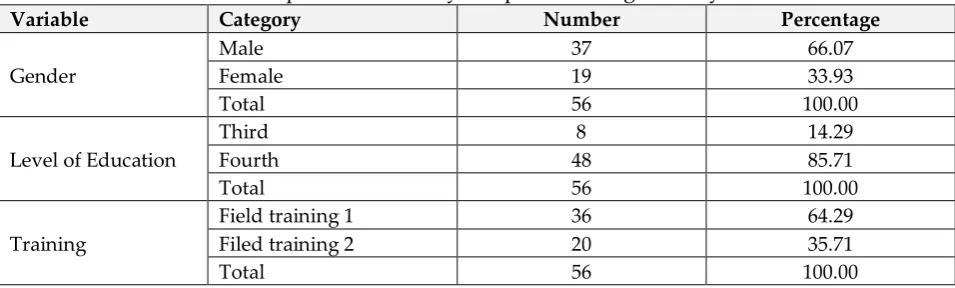
The study sample consisted of (56) male and female students from the study population. Table (1) shows the description of the study sample according to the study variables.
Table 1: Description of the study sample according to study variables
Percentage Number
Category Variable
66.07 37
Male
Gender Female 19 33.93
100.00 56
Total
14.29 8
Third
Level of Education Fourth 48 85.71
100.00 56
Total
64.29 36
Field training 1
Training Filed training 2 20 35.71
100.00 56
Total
3.4 Instrument of the Study
In order to achieve the objectives of this study, the researcher reviewed many previous researches and studies that focus on the modern teaching roles and duties of physical education teachers in the information age.
3.5 Validity of the Instrument
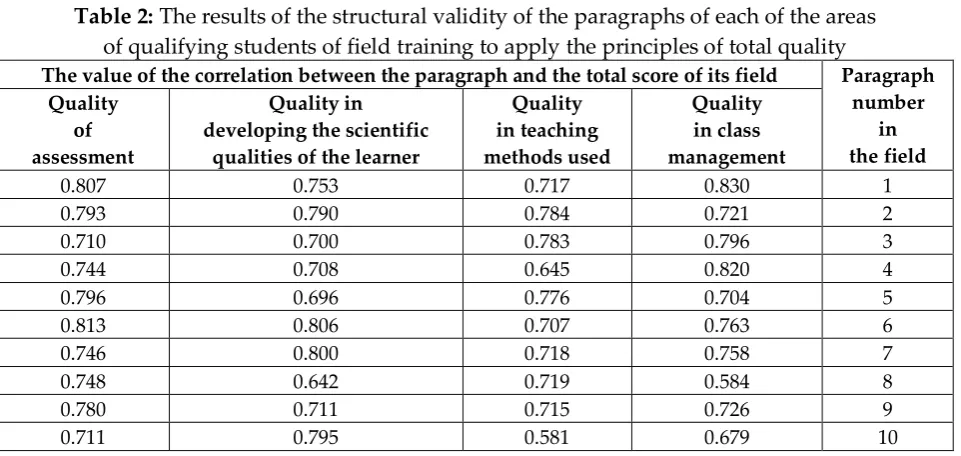
Table 2: The results of the structural validity of the paragraphs of each of the areas of qualifying students of field training to apply the principles of total quality
Paragraph number
in the field The value of the correlation between the paragraph and the total score of its field
Quality in class management Quality in teaching methods used Quality in
developing the scientific qualities of the learner Quality of assessment 1 0.830 0.717 0.753 0.807 2 0.721 0.784 0.790 0.793 3 0.796 0.783 0.700 0.710 4 0.820 0.645 0.708 0.744 5 0.704 0.776 0.696 0.796 6 0.763 0.707 0.806 0.813 7 0.758 0.718 0.800 0.746 8 0.584 0.719 0.642 0.748 9 0.726 0.715 0.711 0.780 10 0.679 0.581 0.795 0.711
Table 2 shows the values of the Pearson correlation coefficient between the score of each paragraph and the total score of the field to which it belongs. A review of the correlation coefficients shows that the lowest correlation value showed in the field of quality in class management was (0.584) which is related to paragraph (8). The value of the correlation coefficient in the field of quality in the development of the learner's qualities was shown in paragraph (8).
While the lowest value of the correlation coefficient in the field of quality in the evaluation has emerged between paragraph (3) and the total score of the field where this value was (0.711). Thus, these results help to verify the idea of the relevance of each paragraph to its domain, which means the credibility of the domain of these paragraphs and thus the validity and possibility of use.
3.6 Reliability of the Instrument
The internal coherence coefficient of the tool as a whole has been calculated in its four domains of which the tool was made using “Cronbach Alpha”.
Table 3: Results of the stability of the areas of qualification of field training students to apply the principles of total quality in the manner (Cronbach Alpha)
# Field Number of paragraphs Value of Cronbach alpha 1 Quality of class management
10 0.906
2 Quality in teaching methods used
10 0.893
3 Quality in developing the scientific qualities of the learner
10 0.908
4 Quality of assessment
10 0.921
Total 10
Table (3) shows that the domains have high internal consistency values. (0.908) for the quality field in developing the scientific qualities of the learner and (0.921) for the quality field in the evaluation.
3.7 Variables of the Study
The study included the following independent and dependent variables.
3.8 Independent Variables Gender: Male / Female
Academic Level: Third year / Fourth year
Field Training Level: Field Training (1) / Field Training (2)
3.9 Dependent variables
Rehabilitation of field training students to apply the principles of total quality during their field training
3.10 Statistical Procedures
To answer the questions of the study, data were entered into the SPSS software and the following statistical treatments were performed:
1) Percentages;
2) Arithmetic averages; 3) Standard deviations;
4) Analysis of variance mono; 5) T. Test;
6) Cronbach Alpha.
4. Results of the Study
4.1 Presentation and discussion of the results
Question 1: What is the extent of qualifying field training students to apply the principles of total quality during their practical training?
To answer this question, arithmetic averages and standard deviations were calculated.
Table 4: Arithmetic averages and standard deviations for the areas of qualification of field training students to apply the principles of total quality in descending order
# Field
SMA Std.
deviation Relative
importance Scope of
application Rank
1 Quality of class management 3.66
0.81 73.20
High 1
3 Quality in developing the scientific
qualities of the teacher 3.64
0.73 72.80
High 2
4 Quality of assessment
3.61 0.80
72.20 High
3
2 Quality of teaching methods used 3.33
0.83 66.60
Medium 4
Total 3.56
0.73 71.20
It is noted from Table (4) that the areas of the qualification of field training students to apply the principles of total quality were high, where the mean was (3.56) of relative importance (71.20), and the level of areas between average and high, where the averages ranged between (3.66-3.33) In the first rank came the field of quality in classroom management with a mean (3.66) and relative importance (73.20), and in the last place came the field of quality in teaching methods used with an average (3.33) of relative importance (66.60).
The researcher believes that this result shows that the university physical education program contains many effective educational attitudes that contribute to the development and improve the level of students and acquire many of the skills, knowledge and experience that contribute to their qualification to apply the principles of total quality during the period of practical training, the researcher believes that this result shows The students possess teaching and teaching skills that are commensurate with the requirements of total quality and they apply the practical training seriously and possess the qualifications that make them able to influence and influence the educational process and teaching.
The result of this study is consistent with Halawa et al. (2012) which showed that the reality of the student (teacher) in the application of the field application program in the light of modern physical education curricula is achieved greatly from their point of view, and the result of this study differs with the study of Hayek et al. (2014). Hayek and Shawa (2011), which showed that there are deficiencies in the curricula of physical education in the number of individuals and keep abreast of recent developments.
The areas of the qualification of the field training students to apply the principles of total quality were analyzed according to its paragraphs as follows:
A. First: the field of quality in grade management.
The arithmetic averages, and standard deviations, were calculated for the field of quality in grade management and table (5) shows that.
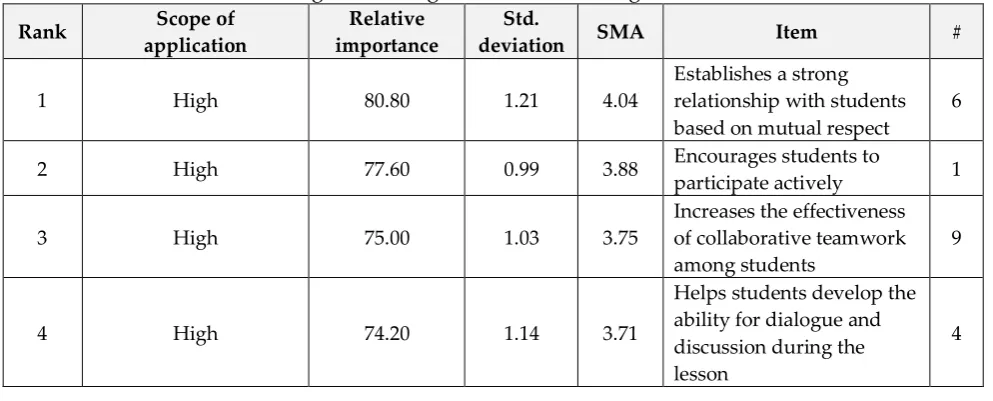
Table 5: Arithmetic averages and standard deviations of quality items in grade management in descending order
# Item
SMA Std.
deviation Relative
importance Scope of
application Rank
6 Establishes a strong
relationship with students based on mutual respect 4.04
1.21 80.80
High 1
1 Encourages students to
participate actively 3.88
0.99 77.60
High 2
9 Increases the effectiveness of collaborative teamwork among students
3.75 1.03
75.00 High
3
4 Helps students develop the ability for dialogue and discussion during the lesson
3.71 1.14
74.20 High
7 Helps students develop
challenge and excellence skills during the lesson 3.68
1.11 73.60
High 5
3 Helps the student express himself in front of his classmates
3.64 1.17
72.80 High
6
2 Helps students look for
new ideas 3.63
0.96 72.60
High 7
5 Students are trained in
methods of discovery and problem solving
3.54 1.14
70.80 High
8
8 Allows the student to
choose the educational experiences and activities he or she wishes
3.46 1.09
69.20 High
9
10 Helps students learn
self-evaluation 3.27
1.07 65.40
Medium 10
Quality in class management 3.66
0.81 73.20
High
It is noted from Table (5) that the level of quality field in classroom management was high, with the mean (3.66) of relative importance (73.20), and the level of paragraphs of the field between the average and high, the averages ranged between (3.57 - 2.31), came in The first rank, paragraph (6), which "establishes a strong relationship between him and the students based on mutual respect" with an arithmetic average (4.04) and a relative importance (80.80), and in the last rank paragraph (10), which is "helps students learn self-evaluation" average (3.27) of relative importance (65.40).
It is clear from the result that the quality of classroom management was high and the researcher believes that this result confirms that the students are serious in practical training and that they are interested in developing themselves in the field of quality education and that they have been exposed to educational experiences based on total quality during their university studies. The researcher believes that the use of methods of total quality works to develop the learning environment and the development of the level of paint, which is confirmed by the study of Trapen (2006), which showed that the use of methods of total quality works to develop the learning environment, which in turn leads to the satisfaction of the beneficiaries of the school and students.
B. Second: the field of quality in the teaching methods used
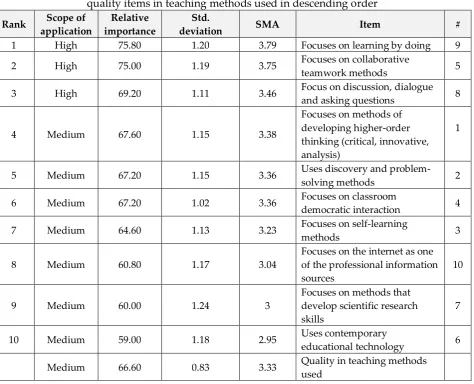
Table 6: Arithmetic averages and standard deviations of quality items in teaching methods used in descending order
# Item SMA Std. deviation Relative importance Scope of application Rank 9 Focuses on learning by doing 3.79 1.20 75.80 High 1 5 Focuses on collaborative
teamwork methods 3.75 1.19 75.00 High 2 8 Focus on discussion, dialogue and asking questions
3.46 1.11 69.20 High 3 1 Focuses on methods of
developing higher-order thinking (critical, innovative, analysis) 3.38 1.15 67.60 Medium 4 2 Uses discovery and problem-solving methods 3.36 1.15 67.20 Medium 5 4 Focuses on classroom
democratic interaction 3.36 1.02 67.20 Medium 6 3 Focuses on self-learning
methods 3.23 1.13 64.60 Medium 7 10 Focuses on the internet as one of the professional information sources 3.04 1.17 60.80 Medium 8 7 Focuses on methods that
develop scientific research skills 3 1.24 60.00 Medium 9 6 Uses contemporary educational technology 2.95 1.18 59.00 Medium 10
Quality in teaching methods used
3.33 0.83
66.60 Medium
It is noted from Table (6) that the level of quality field in the teaching methods used was average, the mean was (3.33) of relative importance (66.60), and the level of paragraphs of the field between medium and high, where the averages ranged between (3.79 - 2.95), In the first rank, paragraph (9), which "focuses on learning by doing" with an arithmetic average (3.79) and with relative importance (75.80), and in the last rank paragraph (6), which "uses modern educational technology" with an average of (2.95) with relative importance ( 59.0).
that the more diverse activities and teaching methods, the more students allow new experiences and meet more needs.
C. Third: the field of quality in the development of scientific qualities of the learner
Arithmetic averages, and standard deviations, were calculated for the field of quality in the development of the learner's scientific qualities and Table (7) shows that.
Table 7: Arithmetic averages and standard deviations of quality items in the development of learner's scientific qualities in descending order
# Item SMA Std. deviation Relative importance Scope of application Rank 10 Helps gifted students develop their distinctive abilities 4.04 0.97 80.80 High 1 7 Helps students highlight
their personalities in front of their peers 3.88 0.88 77.60 High 2 2 Helps students gain
leadership qualities 3.86 1.02 77.20 High 3 3 Helps students develop
the ability to accept the opinions of others 3.8 0.96 76.00 High 4 6 Helps students acquire
lifelong learning skills 3.73 1.05 74.60 High 5 1 Helps students develop
creative thinking 3.66 0.98 73.20 High 6 8 Helps students acquire skills of analysis and connectivity 3.46 0.97 69.20 High 7 9 Helps prepare students
for the labor market 3.39 0.98 67.80 Medium 8 4 Helps students acquire
skills in the use of technological means of communication 3.36 1.07 67.20 Medium 9 5 Develops the ability to
think critically 3.27 1.02 65.40 Medium 10
Quality in the development of scientific learning qualities 3.64
0.73 72.80
High
The researcher attributed this result to the fact that the specialization of physical education is one of the most specializations that contribute to the acquisition of many important features and skills in building an integrated personality and balanced, through the educational attitudes to which they are exposed, these educational attitudes enable them to make their way to life and bear individual and collective responsibility. The result of this study is consistent with the study (Shana & Asi, 2016) which showed that the life skills acquired by the students of sports education were high.
D. Fourth: the field of quality in the evaluation
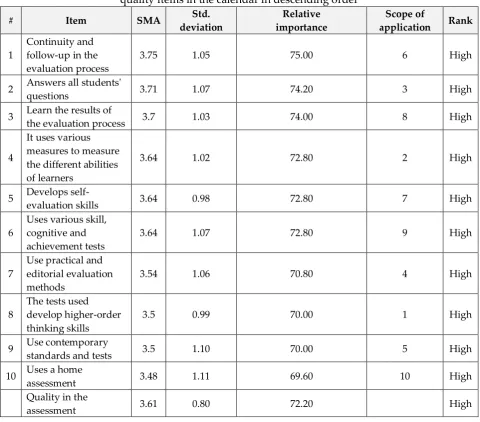
Arithmetic averages and standard deviations were calculated for the quality field in the calendar and Table (8) shows that.
Table 8: arithmetic averages and standard deviations of quality items in the calendar in descending order
Rank Scope of application Relative importance Std. deviation SMA Item # High 6 75.00 1.05 3.75 Continuity and
follow-up in the evaluation process 1 High 3 74.20 1.07 3.71 Answers all students'
questions 2 High 8 74.00 1.03 3.7 Learn the results of
the evaluation process 3 High 2 72.80 1.02 3.64 It uses various
measures to measure the different abilities of learners 4 High 7 72.80 0.98 3.64 Develops self-evaluation skills 5 High 9 72.80 1.07 3.64 Uses various skill,
cognitive and achievement tests 6 High 4 70.80 1.06 3.54 Use practical and
editorial evaluation methods 7 High 1 70.00 0.99 3.5 The tests used
develop higher-order thinking skills 8 High 5 70.00 1.10 3.5 Use contemporary
standards and tests 9 High 10 69.60 1.11 3.48 Uses a home
assessment 10 High 72.20 0.80 3.61
Quality in the assessment
is high, where the averages ranged between (3.75 - 3.48), and came in the first rank paragraph (6) "Continuity and follow-up in the evaluation process" with an arithmetic mean (3.75) and a relative importance (75.0), and came in the last paragraph (10) and "uses the home calendar" with an average of (3.48) with a relative importance (69.60).
The researcher believes that this result reflects that the field training students possess the necessary teaching competencies in the field of evaluation, where the field of evaluation is one of the necessary teaching competencies for the teacher of physical education. This result was consistent with the Khasawneh study (2013) which showed the existence of teaching competencies in the teachers of physical education, while it differed with the results of the study of Rawahi and Hanani (2013), which showed that the degree of the sample of the study of the teaching competencies ranged between a few, medium and high.
Question 2: Are there significant differences at the level of significance (α 5 0.05) in the extent of qualifying field training students to apply the principles of total quality during the period of their practical training due to gender, academic level, level of field training?
A. First: Variable Gender
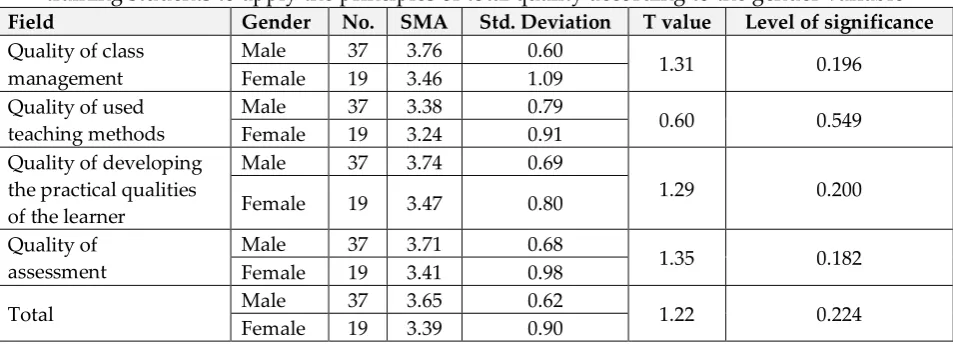
Arithmetic averages, standard deviations, responses of the study sample were calculated on the areas of the qualification of field training students to apply the principles of total quality according to gender variable, and table (9) shows the results.
Table 9: Results of the "T" test for the differences between the means of qualifying the field training students to apply the principles of total quality according to the gender variable
Level of significance T value
Std. Deviation SMA
No. Gender Field
0.196 1.31
0.60 3.76
37 Male
Quality of class
management Female 19 3.46 1.09
0.549 0.60
0.79 3.38
37 Male
Quality of used
teaching methods Female 19 3.24 0.91
0.200 1.29
0.69 3.74
37 Male
Quality of developing the practical qualities
of the learner Female 19 3.47 0.80
0.182 1.35
0.68 3.71
37 Male
Quality of
assessment Female 19 3.41 0.98
0.224 1.22
0.62 3.65
37 Male
Total
0.90 3.39
19 Female
methods used and (1.29). The level of significance (0.200) for the quality field in the development of the scientific qualities of the learner and (1.35) the level of significance (0.182) for the quality field in the And where upright it indicates that there is no statistically significant differences at the level of significance (α ≤ 0.05) because the level of significance of the calculated values were greater than (0.05).
The researcher believes that this result confirms that sex is not an effective factor in the rehabilitation of field training students to apply the principles of total quality. The results of this study are consistent with the Egyptian study (2010) and the study of Halawa et al. (2012).
Which showed no statistically significant differences between males and females to the reality of the performance of the student (teacher) in the application of the field training program, and differed with the study Hayek et al. The share of physical education attributed to the sex variables.
B. Second: Academic Level Variable
Arithmetic averages, standard deviations, responses of the study sample were calculated on the areas of the qualification of field training students to apply the principles of total quality according to the academic level variable, and table (10) shows the results.
Table 10: Results of the T-Test for Differences between the Achievements of the Field Students' Qualification for the Application of Total Quality Principles
according to the Academic Level Variable
Level of significance T value
St. deviation SMA
No. Academic level Field
0.111 1.62
0.82 3.24
8 Third
Quality of class
management Fourth 48 3.73 0.79
0.425 0.80
0.88 3.11
8 Third
Quality of used
teaching methods Fourth 48 3.37 0.82
0.063 1.89
0.83 3.20
8 Third
Quality of developing the practical qualities
of the learner Fourth 48 3.72 0.70
0.348 0.94
1.04 3.36
8 Third
Quality of
assessment Fourth 48 3.65 0.76
0.165 1.40
0.85 3.23
8 Third
Total
0.70 3.62
48 Fourth
For the field of quality in the teaching methods used and (1.89) level of significance (0.063) for the field of quality in the development of scientific qualities of the learner and (0.94) level of significance (0.348) for the field of quality in the evaluation and where there are no statistically significant differences at the level of significance (α ≤ 0.05) because the calculated significance level values were greater than 0.05.
The researcher attributes this result to the fact that the field training course is offered to the third and fourth year students provided that all previous requirements for the field training are completed. This means that the third and fourth year students have been exposed to similar educational attitudes. This result is consistent with the Samrin study (2017) which showed no statistically significant differences in the teaching competencies of the students of the field training were attributed to the variable of the academic level and differed with the study of Hayek et al. (2014) which showed that there are statistically significant differences in the viewpoint of the sample respondents in the extent of their application of the total quality standards in the share of physical education attributed to the school year.
C. Third: Field application variable
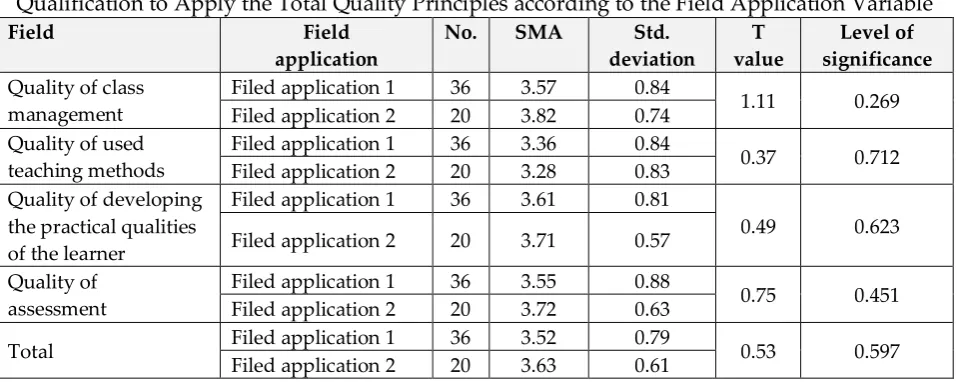
Arithmetic averages, standard deviations, responses of the study sample were calculated on the areas of the qualification of field training students to apply the principles of total quality according to the field application variable, and table (11) shows the results.
Table 11: Test Results for Differences between the Achievements of the Field Students' Qualification to Apply the Total Quality Principles according to the Field Application Variable
Level of significance T
value Std.
deviation SMA
No. Field
application Field
0.269 1.11
0.84 3.57
36 Filed application 1
Quality of class
management Filed application 2 20 3.82 0.74
0.712 0.37
0.84 3.36
36 Filed application 1
Quality of used
teaching methods Filed application 2 20 3.28 0.83
0.623 0.49
0.81 3.61
36 Filed application 1
Quality of developing the practical qualities
of the learner Filed application 2 20 3.71 0.57
0.451 0.75
0.88 3.55
36 Filed application 1
Quality of
assessment Filed application 2 20 3.72 0.63
0.597 0.53
0.79 3.52
36 Filed application 1
Total
0.61 3.63
20 Filed application 2
of significance (0.712) for the field of quality in the teaching methods used and ( 0.49) with a level of significance (0.623) for the field of quality in the development of learner scientific qualities.
And (0.75) level of significance (0.451) for the field of quality in the calendar, which indicates that there are no statistically significant differences at the level of significance (α ≤ 0.05) because the values of the calculated level of significance was greater than (0.05). The researcher believes that this result came because the students of the field training applied in schools as qualified teachers, so they must provide work befitting them as educators and teachers of generations, which strengthened their self-confidence and the effects of their motivation to work, whether they are field training (1) or (2).
5. Conclusions
1) The level of qualification of field training students to apply the principles of total quality high level.
2) Quality in class management is one of the most applied and mastered field training students.
3) There are no statistically significant differences in the level of qualification of field training students to apply the principles of total quality according to variable (gender, academic level, level of field training).
5.1 Recommendations
1) Holding courses and a workshop for students of physical education to clarify the concepts of total quality in the educational process and teaching.
2) Supervision and follow-up of field training students by supervisors and provide necessary guidance to them.
3) Continuous evaluation of students field training to ensure that they apply the principles of total quality during their practical training.
4) Conducting similar studies to identify the extent of employing total quality in the teaching and teaching process and the difficulties that hinder its application and the proposed solutions.
References
Hayek, Sadeq, Khasawneh, Ghada (2013). The Impact of a Knowledge-Based Educational Program for the Development of the Gymnastics Curriculum, Fifth Scientific Conference on Mathematical Creativity, Vol. I, Amman, Jordan.
Hayek, Sadiq & Kilani (2007). Evaluation of the performance of the teacher of physical education in the light of the requirements of total quality in Jordan. Third Volume of the Curriculum Development Conference in the Light of Quality Standards, Egyptian Curriculum and Teaching Methods Association, Cairo, Egypt.
Hayek, Sadeq, Shawa, Hala (2011). The Role of Educational Curricula at the University of Jordan in Preparing Students to Meet Societal Challenges, Jerash University Conference Journal, Jordan.
Halawa, Rami Saleh, Hussein Abdul-Salam Jaber, Zayoun, Mohammad Salim, Al-Sarhan, Khaled, (2012). Teaching competencies of school sports teachers in the Sultanate of Oman and their relationship with the reasons for choosing the teaching profession. Educational and Psychological Journal, 39(2): 351-362.
Rawahi, Nasser and Hanani, Juma (2013). Teaching competencies of school sports teachers in the Sultanate of Oman and their relationship with the reasons for choosing the teaching profession. Journal of Educational and Psychological Sciences, 14(1), Sultanate of Oman.
Samarin, Suha (2017). The Effectiveness of an Educational Program Based on Problem Solving Strategy in Improving Reflective Thinking and Some Competencies of Teaching Physical Education among Field Training Students at Al-Quds University, Unpublished Ph.D. Thesis.
Masri, Wael Salama (2012). The extent of applying the supervisory competencies of the field training supervisors in the field of physical and sports education. Sports Culture, a quarterly refereed scientific journal, Volume IV, second issue, p. 44, Al-Aqsa University, Gaza, Palestine.
Masri, Wael Salama (2010). Obstacles of Field Training among Students of the Department of Mathematical Education, Al-Aqsa University, Gaza, Al-Azhar University Journal, Humanities Series, Vol. 12, No. 2, pp.
Al-Maqtari, Taha (2008). Evaluating the Objectives of the Science Curriculum in the Light of the Requirements of Scientific Culture, The Twentieth Scientific Conference, Curricula and Cultural Identity, Egyptian Association for Curricula and Teaching Methods, Volume 2.
Manar, Mohammed (2013). The Extent of Applying Physical Education Curricula at the University of Bahrain to Total Quality Standards from the Perspective of Students and Faculty, Unpublished PhD Thesis, University of Jordan, Amman, Jordan.
Mohammed, Manar & Hayek, Sadeq (2014). The extent to which physical education curricula meet the quality standards from the perspective of students and faculty members at the University of Bahrain, published in the Journal of the University of Algiers 3.
performance of teachers. Unpublished Master Thesis, Islamic University, Gaza, Palestine.
Nasr, Mohamed (2005). A vision for activating the role of educational curricula to preserve cultural identity in the face of globalization. 20th Scientific Conference, Curricula and Cultural Identity, Egyptian Association for Curricula and Teaching Methods, Vol. 2.
Catalan, E. L. (2016). Student Teacher Understanding and Application of Assessment for Learning during a Physical Education Teacher Education Course. European Physical Education Review, 22 (2),65-81
Trapen, William. (2006). A review of quality Education Concepts to Improve Teaching (Dissertation, California State University, Dominguez) AAT 1427249.
Gulten, Herguner. (2000). Going Against Culture Grain, A Longitudinal Case Study of Organization Culture in Turkish Higher Education, Total Quality Management, 11(1): 45-56.
Creative Commons licensing terms
Authors will retain the copyright of their published articles agreeing that a Creative Commons Attribution 4.0 International License (CC BY 4.0) terms will be applied to their work. Under the terms of this license, no permission is required from the author(s) or publisher for members of the community to copy, distribute, transmit or adapt the article content, providing a proper, prominent and unambiguous attribution to the authors in a manner that makes clear that the materials are being reused under permission of a Creative Commons License. Views, opinions and conclusions expressed in this research article are views, opinions and conclusions of the author(s). Open Access Publishing Group and European Journal of Physical Education and Sport Science shall not be responsible or answerable for any loss, damage or liability caused in relation to/arising out of conflict of interests, copyright violations and inappropriate or inaccurate use of any kind content related or integrated on the research work. All the published works are meeting the Open Access Publishing requirements and can be freely accessed, shared, modified, distributed and used in educational, commercial and