CALCULATION OF ACTIVATION ENERGY OF DIFFUSION
AND SELF-DIFFUSION
G. А. Korablev
[a]*Keywords: Spatial-energy parameter, structural interactions, diffusion, activation energy.
The methodology is given for the evaluation of activation energy of diffusion and self-diffusion based on the application of spatial-energy parameter (Р-parameter). The corresponding calculations are made for 57 structures. The calculation results are in accordance with the experimental data.
* Corresponding Authors
E-Mail: [email protected]
[a] Izhevsk State Agricultural Academy, 426069, Russia, Izhevsk, Studencheskaya St., 11
Introduction
Activation energy is one of the basic characteristics of diffusion processes. A lot of works are dedicated to theoretical calculations and experimental evaluations of this value.1-10 However the comparison of reference data reveals
rather contradictory results on many systems. For instance, a significant discrepancy between theoretical and experimental data of activation energy was obtained even for such well-investigated process as silicon self-diffusion (3.2 eV and 4.76 eV, respectively).3-5
It is customary to distinguish between several types of main diffusion mechanisms in crystals viz., diffusion by internodes, vacancy mechanism, replacement mechanism, etc. The diffusion activation energy equals the value of the potential barrier that has to be overcome by the atom to take a new balanced position in the neighboring node or internode.
Theoretical calculations of activation energy are very difficult. Therefore different authors tried to correlate it with some other values that can be calculated or defined theoretically. Thus according to Frenkel11 during
self-diffusion process the activation energy should be close to the value of crystal evaporation heat. However, as a rule, lower values are experimentally observed. Braune5 tried to
correlate the activation energy with melting temperature of crystals. However the correlation proposed by him is useful only for rough estimation of activation energy since the criterion for selecting the empirical constant of initial equation is missing.
A well-known Arrhenius equation is widely used for energy estimation of diffusion processes.
𝛬 = 𝛬0𝑒𝑥𝑝 (− 𝐸a
𝑅𝑇) (1)
where
=coefficient of diffusion,
0= pre-exponential factor,
Еа = activation energy of diffusion,
R = gas constant and
Т = thermodynamic temperature.
The dependence of initial parameters upon the temperature and pressure, the presence of pre-exponential factor in the equation rather complicate the issue of rational objectivity of data being obtained, in particular, when comparing diffusion mechanisms near the surface and inside the crystal.
In this research there is an attempt to numerically calculate the activation energy of diffusion based on initial spatial-energy characteristics of free atoms (methodology of P-parameter).
Spatial-energy parameter
The comparison between multiple regularities of physical and chemical processes allows assuming that in many cases the principle of adding inverse values of volume energies or kinetic parameters of interacting structures is fulfilled. Some examples are ambipolar diffusion, total rate of topochemical reaction, change in the light velocity when moving from vacuum to the given medium, resulting constant of chemical reaction rate (initial product – intermediary activated complex – final product).
Lagrangian equation for relative motion of isolated system of two interacting points with masses m1 and m2 in coordinate х with acceleration α can look as follows:
1
1 1 𝑚1𝑎∆𝑥
+ 1
𝑚2𝑎∆𝑥
≈ −∆𝑈 (2)
1 ∆𝑈≈
1 ∆𝑈1+
1
∆𝑈2 (3)
where
The atom system is formed of differently charged masses of nucleus and electrons. In this system the energy characteristics of sub-systems are orbital energy of electrons and effective energy of nucleus taking into consideration the screening effects. At the same time the bond energy of electrons or ionization energy of atom (Ei) can be used as orbital energy. Therefore, assuming that the resulting interaction energy in the system orbital-nucleus (responsible for inter-atom interactions) can be calculated following the principle of adding inverse values of some initial energy components, the introduction of P-parameter12 as an
averaged energy characteristics of valence orbitals based on the following equations can be substantiated.
1
𝑞2 𝑟i
+ 1 𝐸i=
1
𝑃E (4)
𝑃E= 𝑃0
𝑟i (5)
1 𝑃0=
1 𝑞2+
1 (𝐸𝑟)i
(6)
𝑞 =𝑍∗
𝑛∗ (7)
where
Еi is the atom ionization energy,13
ri is the orbital radius of i–orbital,14
and Z* and n* are effective charge of nucleus and effective main quantum number, respectively.15,16
Р0 will be called a spatial-energy parameter and РE an
effective Р-parameter. Effective PE parameter has a physical
sense of some averaged energy of valence electrons in an atom and is measured in energy units, e.g. in electron-volts (eV).
According to the calculations12 the values of Р E
parameters are numerically equal (in the range of 2 %) to the total energy of valence electrons (U) by atom statistic model. Using the known relation between the electron density () and intra-atomic potential by atom statistic model, it is possible to obtain the direct dependence of РE parameter on the electron density at the distance ri from nucleus by Eqn. (8).
βi
2 3=𝐴𝑃0
𝑟i = 𝐴𝑃E (8)
where A is a constant.
The reliability of this equation was confirmed experimentally by determining the electron density using wave functions by Clementi and comparing it with the value of electron density calculated via the value of РE-parameter.
Modifying the rules of adding inverse values of energy magnitudes of subsystems as applied to complex structures, the equation (Eqn. 9) for calculating РS-parameter of
complex structure can be obtained
1 𝑃s= (
1 𝑁𝑃E)1+ (
1
𝑁𝑃E)2+ ⋯ (9)
where N1 and N2 are a number of homogeneous atoms in the subsystem.
The same electron density should be fixed during the formation of solution and other structural interactions in the spots of contact between atoms-components. This process is followed by the redistribution of electron density between valence zones of both particles and transition of part of electrons from one external sphere to adjoining ones. Apparently, the frame electrons of atoms do not participate in such an exchange.
Obviously, the proximity of electron densities in free atoms-components results in the minimization of transition processes between boundary atoms of particles, thus favouring the formation of a new structure. Therefore, the task of estimating the degree of structural interactions in many cases means a comparative estimation of electron density of valence electrons in free atoms (on averaged orbitals) participating in the process.
The less is the difference (P0/ri - P0/ri), the more
energetically favourable is the formation of a new structure or solid solution.
The estimation of mutual solubility for structural interactions of isomorphic type in many (over one thousand) simple and complex systems12 was carried out based on this
technique. Isomorphism as a phenomenon is considered as applied to crystalline structures. But, apparently, analogous processes can also proceed between molecular compounds where their role and value are none the less than in purely Coulomb interactions. It seems diffusion processes, replacement in particular, can also be estimated via the methodology of P-parameter.
Calculation methodology
It is established that during self-diffusion the activation energy often equals the total of enthalpies of formation and transition of vacancies. Obviously, in any actual situation different diffusion mechanisms can act simultaneously, but the activation energy must always be defined by inter-atom interactions in structures.
Thus, the task of estimating the activation energy is to define the actual energy of paired inter-atom interaction of diffusion atom and atoms of diffusion medium, for each specific type of interactions.
Earlier the diffusion coefficients of some refractory oxides were calculated using initial spatial-energy notions17 via
total P-parameter of interacting diffusion atoms and diffusion medium.
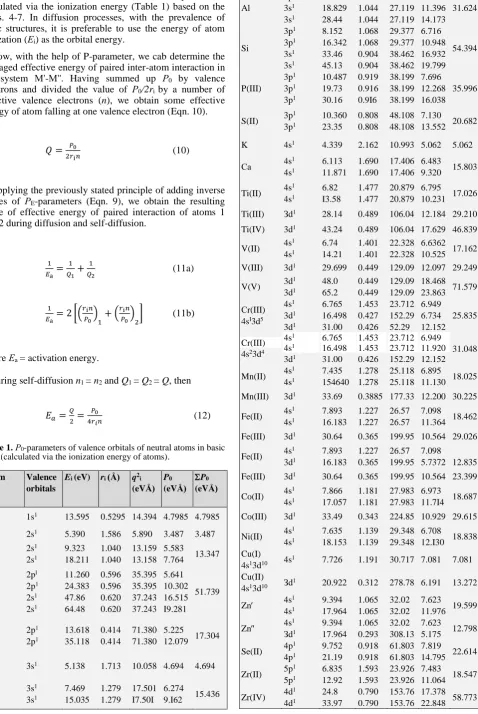
For this we use the tabulated values of Р0-parameters
calculated via the ionization energy (Table 1) based on the Eqns. 4-7. In diffusion processes, with the prevalence of ionic structures, it is preferable to use the energy of atom ionization (Еi) as the orbital energy.
Now, with the help of P-parameter, we cab determine the averaged effective energy of paired inter-atom interaction in the system М'-М''. Having summed up Р0 by valence
electrons and divided the value of Р0/2riby a number of
effective valence electrons (n), we obtain some effective energy of atom falling at one valence electron (Eqn. 10).
𝑄 = 𝑃0
2𝑟i𝑛 (10)
Applying the previously stated principle of adding inverse values of РE-parameters (Eqn. 9), we obtain the resulting
value of effective energy of paired interaction of atoms 1 and 2 during diffusion and self-diffusion.
1 𝐸a=
1 𝑄1+
1
𝑄2 (11a)
or
1 𝐸a= 2 [(
𝑟i𝑛
𝑃0)1+ (
𝑟i𝑛
𝑃0)2] (11b)
where Еа = activation energy.
If during self-diffusion n1 = n2 and Q1 = Q2 = Q, then
𝐸𝑎= 𝑄 2=
𝑃0
4𝑟𝑖𝑛 (12)
Table 1.Р0-parameters of valence orbitals of neutral atoms in basic
state (calculated via the ionization energy of atoms).
Atom Valence
orbitals
Ei (eV) ri (Å) q2 i (eVÅ)
P0 (eVÅ)
P0 (eVÅ)
Н 1s1 13.595 0.5295 14.394 4.7985 4.7985
Li 2s1 5.390 1.586 5.890 3.487 3.487
Be 2s
1 2s1 9.323 18.211 1.040 1.040 13.159 13.158 5.583
7.764 13.347
С 2pl 2p1 2s1 2s1 11.260 24.383 47.86 64.48 0.596 0.596 0.620 0.620 35.395 35.395 37.243 37.243 5.641 10.302 16.515 I9.281 51.739
O 2p
1 2p1 13.618 35.118 0.414 0.414 71.380 71.380 5.225
12.079 17.304
Na 3s1 5.138 1.713 10.058 4.694 4.694
Mg 3s
1 3s1 7.469 15.035 1.279 1.279 17.501 I7.50I 6.274
9.I62 15.436 Al 3p1 3s1 3s1 5.986 18.829 28.44 1.312 1.044 1.044 26.443 27.119 27.119 6.055 11.396 14.173 31.624 Si 3p1 3p1 3s1 3s1 8.152 16.342 33.46 45.13 1.068 1.068 0.904 0.904 29.377 29.377 38.462 38.462 6.716 10.948 16.932 19.799 54.394 P(III) 3p1 3p1 3p1 10.487 19.73 30.16 0.919 0.916 0.9I6 38.199 38.199 38.199 7.696 12.268 16.038 35.996
S(II) 3p
1 3p1 10.360 23.35 0.808 0.808 48.108 48.108 7.130
13.552 20.682
K 4s1 4.339 2.162 10.993 5.062 5.062
Са 4s1
4s1 6.113 11.871 1.690 1.690 17.406 17.406 6.483
9.320 15.803
Ti(II) 4s
1 4s1 6.82 I3.58 1.477 1.477 20.879 20.879 6.795
10.231 17.026
Ti(III) Зd1 28.14 0.489 106.04 12.184 29.210
Ti(IV) 3d1 43.24 0.489 106.04 17.629 46.839
V(II) 4s
1 4s1 6.74 14.21 1.401 1.401 22.328 22.328 6.6362 10.525 17.162 V(III) 3d1 29.699 0.449 129.09 12.097 29.249
V(V) 3d
1 3d1 48.0 65.2 0.449 0.449 129.09 129.09 18.468 23.863 71.579
Сr(III) 4sI3d5
4s1 3d1 3d1 6.765 16.498 31.00 1.453 0.427 0.426 23.712 152.29 52.29 6.949 6.734 12.152 25.835 Cr(III) 4s23d4
4s1 4s1 3d1 6.765 16.498 31.00 1.453 1.453 0.426 23.712 23.712 152.29 6.949 11.920 12.152 31.048
Mn(II) 4s
1 4s1 7.435 154640 1.278 1.278 25.118 25.118 6.895
11.130 18.025
Mn(III) 3d1 33.69 0.3885 177.33 12.200 30.225
Fe(II) 4s
1 4s1 7.893 16.183 1.227 1.227 26.57 26.57 7.098
11.364 18.462
Fe(III) 3d1 30.64 0.365 199.95 10.564 29.026
Fe(II) 4s
1 3d1 7.893 16.183 1.227 0.365 26.57 199.95 7.098
5.7372 12.835
Fe(III) 3d1 30.64 0.365 199.95 10.564 23.399
Co(II) 4s
1 4s1 7.866 17.057 1.181 1.181 27.983 27.983 6.973
11.7I4 18.687
Co(III) 3d1 33.49 0.343 224.85 10.929 29.615
Ni(II) 4s
1 4s1 7.635 18.153 1.139 1.139 29.348 29.348 6.708
12.I30 18.838 Cu(I)
4s13d10 4s1 7.726 1.191 30.717 7.081 7.081
Cu(II) 4s13d10 Зd
1 20.922 0.312 278.78 6.191 13.272
Zn 4s
1 4s1 9.394 17.964 1.065 1.065 32.02 32.02 7.623
11.976 19.599
Zn 4s
1 Зd1 9.394 17.964 1.065 0.293 32.02 308.13 7.623
5.175 12.798
Se(II) 4p
1 4p1 9.752 21.19 0.918 0.918 61.803 61.803 7.819
14.795 22.614
Zr(II) 5p
1 5p1 6.835 12.92 1.593 1.593 23.926 23.926 7.483
11.064 18.547
Zr(IV) 4d
Nb(III) 5s14d4
5s1
4d1
4d1
6.882 14.320 28.1
1.589 0.747 0.747
20.191 113.64 113.64
7.093 9.776 17.718
34.587
Mo(II) 5s14d5
5s1
4d1
7.10 16.155
1.520 0.702
21.472 110.79
7.182
10.293 17.475
W′(II) 6s1 5d1
7.98 17.70
13.60 0.746
38.838 161.43
8.483
12.206 20.689
W″(II) 6s1 6s1
7.98 17.70
1.360 1.360
38.838 38.838
8.483
14.861 23.344 Ag(I)
5s14d10 5s
1 7.576 1.286 26.283 7.108 7.108
Sn(II) 5p
1
5p1
7.332 14.6
1.240 1.240
47.714 47.714
7.637
13.124 20.761
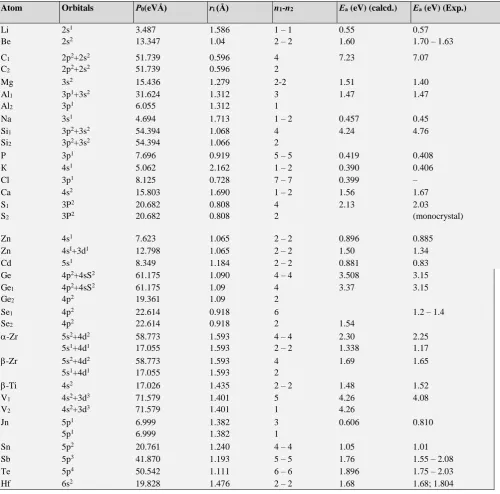
The results of calculations based on Eqn. 11 and 12 are given in table 2. An example of calculations for self-diffusion of carbon atom (as shown in table 2) is given below.
1
𝐸a= 2 × (
0.596×2 51.739 +
0.596×4
51.739) = 7.23𝑒𝑉 (13)
The activation energy of diffusion of various elements in germanium has been calculated (Table 3). Here for hydrogen atom the ion radius equal to 1.36Å has been used. As an example the calculation of activation energy of diffusion of aluminium in germanium is shown. 1/Еа = 1/Q1
+ 1/Q2; 1/Q = (2 1.312 3)/31.24 + (2 1.90
4)/61.76, Еа = 2.55 eV, Еа (exp) = 2.70 eV.
Table 2. Calculation of activation energy of volume self-diffusion.
Atom Orbitals Р0(eVÅ) ri (Å) n1-n2 Еа (eV) (calcd.) Еа (eV) (Exp.)
Li 2s1 3.487 1.586 1 – 1 0.55 0.57
Be 2s2 13.347 1.04 2 – 2 1.60 1.70 – 1.63
C1
C2
2p2+2s2
2p2+2s2
51.739 51.739
0.596 0.596
4 2
7.23 7.07
Mg 3s2 15.436 1.279 2-2 1.51 1.40
Al1
Al2
3p1+3s2
3p1
31.624 6.055
1.312 1.312
3 1
1.47 1.47
Na 3s1 4.694 1.713 1 – 2 0.457 0.45
Si1
Si2
3p2+3s2
3p2+3s2
54.394 54.394
1.068 1.066
4 2
4.24 4.76
P 3p1 7.696 0.919 5 – 5 0.419 0.408
К 4s1 5.062 2.162 1 – 2 0.390 0.406
Cl 3p1 8.125 0.728 7 – 7 0.399 –
Ca 4s2 15.803 1.690 1 – 2 1.56 1.67
S1
S2
3P2
3P2
20.682 20.682
0.808 0.808
4 2
2.13 2.03
(monocrystal)
Zn 4s1 7.623 1.065 2 – 2 0.896 0.885
Zn 4sI+3d1 12.798 1.065 2 – 2 1.50 1.34
Cd 5s1 8.349 1.184 2 – 2 0.881 0.83
Ge 4p2+4sS2 61.175 1.090 4 – 4 3.508 3.15
Ge1
Ge2
4p2+4sS2
4p2
61.175 19.361
1.09 1.09
4 2
3.37 3.15
Se1
Se2
4p2
4p2
22.614 22.614
0.918 0.918
6
2 1.54
1.2 – 1.4
-Zr 5s2+4d2
5s1+4d1
58.773 17.055
1.593 1.593
4 – 4 2 – 2
2.30 1.338
2.25 1.17
-Zr 5s2+4d2
5s1+4d1
58.773 17.055
1.593 1.593
4 2
1.69 1.65
-Ti 4s2 17.026 1.435 2 – 2 1.48 1.52
V1
V2
4s2+3d3
4s2+3d3
71.579 71.579
1.401 1.401
5 1
4.26 4.26
4.08
Jn 5p1
5p1
6.999 6.999
1.382 1.382
3 1
0.606 0.810
Sn 5p2 20.761 1.240 4 – 4 1.05 1.01
Sb 5p3 41.870 1.193 5 – 5 1.76 1.55 – 2.08
Те 5p4 50.542 1.111 6 – 6 1.896 1.75 – 2.03
Table 3. Calculation of activation energy of volume self-diffusion in germanium. Initial data for germanium: Orbital 4p1: Р
0 = 7.128, n=1,
ri = 1.090 Å. Orbital 4p2 Р0 = 19.361 eVÅ, ri = 1.090 Å, n=2. Orbitals 4p2 + 4s2: Р0 =61.17 eVÅ, n= 4, rmax 1.090 Å.
Diffusing element Germanium Еа (eV)
Calculated
Еа (eV) Experimental
Atom Orbitals P0(eVÅ) ri(Å) n Orbitals P0(eVÅ) n
Li 2s1 3.487 1.586 1 4p1 7.128 1 0.469 0.46
Zn 4s2
41+3d1
19.599 12.798
1.065 1.065
2 2
4p2+4s2
4S pPp2+4s2
61.176 61.176
4 4
2.78 2.104
2.80 2.16
Al 3p1+3s2 31.624 1.312 3 4p2+4s2 61.176 4 2.55 2.70
In 3p1+5s2 40.749 1.328 3 4p2+4s2 61.176 4 2.96 3.2
Sn 5p2 20.761 1.240 2 4p2 19.361 2 2.15 1.90
Pb 6p2+6s2 71.221 1.215 4 4p2+4s2 61.176 4 3.58 3.60
Н 1s1 4.794 RИ=1.36 2 4p1 7.128 4 0.44 0.38
As 4p3 39.448 1.001 5 4p2+4s2 61.176 4 2.52 2.51
В 2pI+2s2 26.753 0.776 1 4p2+4s2 61.176 4 5.09 4.54
La 4pI+4s2 37.678 1.254 3 4p2+4s2 61.176 4 2.95 2.5-3.14
P 3p3 35.996 0.919 5 4p2+4s2 61.176 4 2.51 2.49
Sb 5p3 41.870 1.193 5 4p2+4s2 61.176 4 2.34 2.42
Be 2s2 13.347 1.040 2 4p2+4s2 61.176 4 2.20 2.50
N 2p3 33.664 1.578 3 4p2+4s2 61.176 4 2.36 2.58
Bi 6p3 48.483 1.295 5 4p2+4s2 61.176 4 2.44 2.42
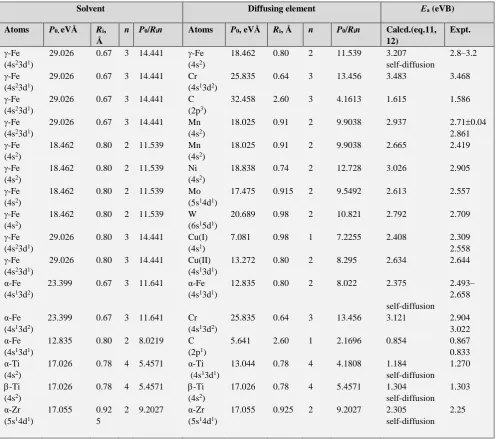
Table 4. Estimation of activation energy of diffusion and self-diffusion in metal systems
Solvent Diffusing element Еа (eVB)
Atoms P0, eVÅ Ri,
Å
n P0/Rin Atoms P0, eVÅ Ri, Å n P0/Rin Calcd.(eq.11,
12)
Expt.
-Fe (4s23d1)
29.026 0.67 3 14.441 -Fe (4s2)
18.462 0.80 2 11.539 3.207 2.8–3.2
self-diffusion -Fe
(4s23d1)
29.026 0.67 3 14.441 Cr
(4s13d2)
25.835 0.64 3 13.456 3.483 3.468
-Fe (4s23d1)
29.026 0.67 3 14.441 C
(2p3)
32.458 2.60 3 4.1613 1.615 1.586
-Fe (4s23d1)
29.026 0.67 3 14.441 Mn
(4s2)
18.025 0.91 2 9.9038 2.937 2.710.04
2.861 -Fe
(4s2)
18.462 0.80 2 11.539 Mn
(4s2)
18.025 0.91 2 9.9038 2.665 2.419
-Fe (4s2)
18.462 0.80 2 11.539 Ni
(4s2)
18.838 0.74 2 12.728 3.026 2.905
-Fe (4s2)
18.462 0.80 2 11.539 Mo
(5s14d1)
17.475 0.915 2 9.5492 2.613 2.557
-Fe (4s2)
18.462 0.80 2 11.539 W
(6s15d1)
20.689 0.98 2 10.821 2.792 2.709
-Fe (4s23d1)
29.026 0.80 3 14.441 Cu(I) (4s1)
7.081 0.98 1 7.2255 2.408 2.309
2.558 -Fe
(4s23d1)
29.026 0.80 3 14.441 Cu(II) (4s13d1)
13.272 0.80 2 8.295 2.634 2.644
α-Fe (4s13d2)
23.399 0.67 3 11.641 α-Fe
(4s13d1)
12.835 0.80 2 8.022 2.375 2.493–
2.658 self-diffusion
α-Fe (4s13d2)
23.399 0.67 3 11.641 Cr
(4s13d2)
25.835 0.64 3 13.456 3.121 2.904
3.022 α-Fe
(4s13d1)
12.835 0.80 2 8.0219 C
(2p1)
5.641 2.60 1 2.1696 0.854 0.867
0.833 α-Ti
(4s2)
17.026 0.78 4 5.4571 α-Ti
(4s13d1)
13.044 0.78 4 4.1808 1.184 1.270
self-diffusion -Ti
(4s2)
17.026 0.78 4 5.4571 -Ti (4s2)
17.026 0.78 4 5.4571 1.304 1.303
self-diffusion α-Zr
(5s14d1)
17.055 0.92 5
2 9.2027 α-Zr (5s14d1)
17.055 0.925 2 9.2027 2.305 2.25
self-diffusion
-Zr (5s2)
18.547 0.92 5
4 5.0127 -Zr (5s2)
18.547 0.925 4 5.0127 1.253 1.305
self-diffusion -Zr
(5s2)
18.547 0.92 5
4 5.0127 -Zr (5s14d1)
17.055 0.925 2 9.2027 1.623 1.65
self-diffusion Ca
(4s2)
15.803 1.04 2 7.5976 C
(2p2)
15.943 2.60 2 3.066 1.092 1.010
Ca (4s2)
15.803 1.04 2 7.5976 Fe
(4s2)
18.462 0.80 2х2 4.011 1.31 1.29
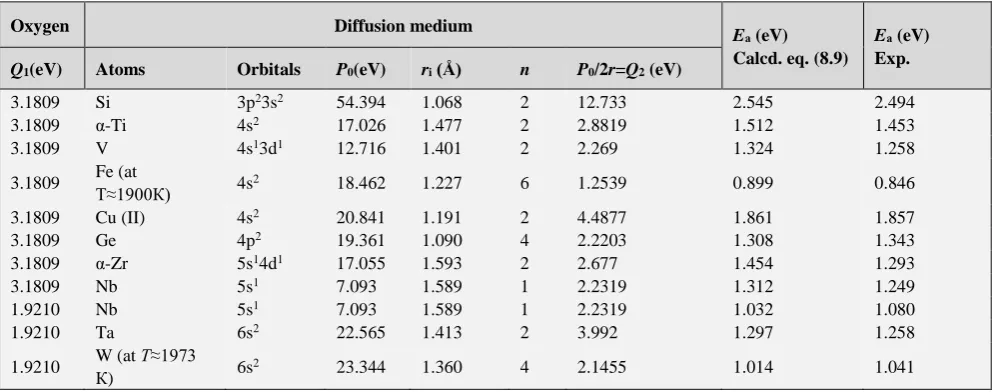
Table 5. Calculation of activation energy of diffusion of oxygen atoms
Oxygen Diffusion medium
Eа (eV) Calcd. eq. (8.9)
Eа (eV) Exp.
Q1(eV) Atoms Orbitals P0(eV) ri (Å) n P0/2r=Q2 (eV)
3.1809 Si 3p23s2 54.394 1.068 2 12.733 2.545 2.494
3.1809 α-Ti 4s2 17.026 1.477 2 2.8819 1.512 1.453
3.1809 V 4s13d1 12.716 1.401 2 2.269 1.324 1.258
3.1809 Fe (at
Т≈1900К) 4s2 18.462 1.227 6 1.2539 0.899 0.846
3.1809 Cu (II) 4s2 20.841 1.191 2 4.4877 1.861 1.857
3.1809 Ge 4p2 19.361 1.090 4 2.2203 1.308 1.343
3.1809 α-Zr 5s14d1 17.055 1.593 2 2.677 1.454 1.293
3.1809 Nb 5s1 7.093 1.589 1 2.2319 1.312 1.249
1.9210 Nb 5s1 7.093 1.589 1 2.2319 1.032 1.080
1.9210 Ta 6s2 22.565 1.413 2 3.992 1.297 1.258
1.9210 W (at Т≈1973
К) 6s2 23.344 1.360 4 2.1455 1.014 1.041
Analogous calculations for oxygen diffusion are shown in Table 5. In this Table for oxygen:
𝑄1= 17.304
21.361= 3.1809 𝑒𝑉 (orbital 2p
2) (14)
𝑄1= 5.215
21.362= 1.9210 𝑒𝑉
(orbital 2р
1) (15)
In all cases either the number of valence electrons of one sublevel or number of all valence electrons of the given main number of atom was used as the number n.
For hydrogen atom n=2, this corresponds to the realization number of all its possible bonds. For elements of groups 1 and 2n equals the group number, for groups 3a during self-diffusion n1=3, n2=1. For groups 4-а n1=4, n2=2. For Na and
Kn1=1 and n2=2, this reflects the possibility of generalizing
valence electrons in inter-structural interactions.
The comparison of calculation and experimental values, 1-10,18 of activation energy of diffusion (Table 2-5) shows that
these values are in satisfactory accordance (in the limits of experiment accuracy). Temperature factor, that can also have values in diffusion processes, was indirectly considered in this approach via selecting the most valence-active orbitals of the atom. Thus, for instance, for trivalent iron 4s23d1 can usually be valence-active orbitals at lower
temperatures, and 4s13d2 at higher temperatures of the
process.
Conclusion
Since the resulting value of P-parameter of a complex structure is quite easily calculated, this method can be applied for predicting the activation energy of diffusion and self-diffusion processes not only in simple but also in complex systems, in bio-systems as well.
References
1Kofstad, P., Deviation from stoichiometry, diffusion and electrical
conductivity in simple oxides of metals, Mir, Moscow, 1975, 398.
2Bokshtein, B. S., Diffusion in metals, Metallurgiya, Moscow, 1978,
248.
3Dzhafarov, Т. D., Defects and diffusion in empitaxial structures,
Nauka, Leningrad, 1978, 207.
4Show, D., Atomic diffusion in semiconductors, Mir, Moscow,
1975, 684.
5Boltaks, B. I., Diffusion and spot defects in semiconductors,
Nauka, Moscow, 1972, 384.
6McDaniel, I., Mason, E., Mobility and diffusion of ions in gases,
Mir, Moscow, 1976, 422.
7Bolotov, V. V., Vasiliev, А. V., Smirnov, L. S., Relaxation in
8Bardeen, J., Herring, С., Imperfections in Nearly Perfect Crystals,
Wiley, New York, 1952, 261.
9Stark, D. P., Diffusion in solids, Energiya, Moscow, 1980, 240. 10Krasnenko, Т. I., Zhukovskaya, А. S., Slobodin, B. V., Fotiev, А.
А., Self-diffusion of Са in calcium vanadates, News of Acad. Sci. USSR, Inorganic materials, 1982, 18(6), 1005-1007.
11Frenkel, Ya. I., Kinetic theory of liquids, Nauka, Leningrad, 1975,
592.
12Korablev, G. A., Spatial-Energy Principles of Complex
Structures Formation, Brill Academia Publishers and VSP, Leiden, The Netherlands, 2005, 426.
13Alen, K. U., Astrophysical values, Mir, Moscow, 1977, 446. 14Waber, J. T., Cromer, D. T., Orbital Radii of Atoms and Ions, J.
Chem. Phys., 1965, 42(12), 4116- 4123. doi.org/10.1063/1.1695904
15Clementi, E., Raimondi, D. L., Atomic Screening constants from
S.C.F. Functions, J. Chem. Phys., 1963, 38 (11), 2686-2689. doi.org/10.1063/1.1733573
16Clementi, E., Raimondi, D. L. Atomic Screening Constants from
S.C.F. Functions, J. Chem. Phys., 1967, 47 (4), 1300-1307. doi.org/10.1063/1.1712084
17Korablev, G. A., Diffusion, sorption and phase transformations
in the process of metal reduction, Nauka, Moscow, 1981, 4-6.
18Smeatles, K. J., Metals, Metallurgiya, Moscow, 1980, 447.