Available online throug
ISSN 2229 – 5046
EEFECT OF HALL CURRENT AND RADIATION ABSORPTION
ON CONVECTIVE HEAT AND MASS TRANSFER FLOW OF A MICROPOLAR FLUID
IN A ROTATING FLUID PAST A VERTICAL POROUS PLATE
C. Sulochana
1*and K. Gnana Prasunamba
21
Department of Mathematics, Gulbarga University, Gulbarga, Karnataka state, India.
(Received on: 14-11-13; Revised & Accepted on: 04-12-13)
ABSTRACT
A
n attempt has been to investigate effect of Hall currents, thermal radiation and radiation absorption on mixed convective heat and mass transfer flow of Micropolar fluid in as rotating fluid past a porous vertical plate. The equations governing the flow, heat and mass transfer have been solved by assuming that the solution consists of harmonic and non-harmonic terms. the effect of Hall currents, soret effect and chemical reaction on all the flow characteristics have been analysed.Keywords: Hall currents, Radiation absorption, Chemical reaction, Heat sources and Porous medium.
1. INTRODUCTION
In recent years, there has been a considerable interest in rotating hydro magnetic fluid flows due to possible applications to geophysical and astrophysical problems. An order of magnitude analysis shows that in the basic field equations, the Coriolis force is very significant as compared to the inertial force. Furthermore, it reveals that the Coriollis and magneto hydro- dynamic forces are of comparable magnitude. It is generally admitted that a number of astronomical bodies (e.g. the Sun, Earth, Jupiter, Magnetic stars, Pulsars) possess fluid interiors and (at least surface) magnetic fields, changes in the rotation rate of such objects suggest the possible importance of hydro magnetic spin-up. This problem of spin-up in magneto hydro dynamic rotating fluids has been examined under varied conditions by many researchers notably Gilman and Benton [1], Benton and Loper [2], Chawala [3], Debnath [4-5] and Singh [6].
The theory of micropolar fluids was first introduced and formulated by Eringen[7]. This theory displays the effect of local rotary inertia and couple stress. This theory is expected to provide a mathematical model for the non-Newtonian fluid behavior observed in certain fluid such as exotic lubricants, polymeric fluid. Colloidal fluids, liquid crystals, dirty oils, animal blood, etc., which is more realistic and important from a technological point of view. The theory of thermomicropolar fluids was developed by Eringen [8], by extending his theory of micropolar fluid. Physically, they represent fluids consisting of randomly oriented particles suspended in a viscous medium (Lukaszawicz [9]).
The micropolar fluids which contain micro-constituents and can undergo rotation has been proposed by Eringen[10]. These kind of fluids are utilized in analyzing exotic lubricants, the flow of colloidal suspensions, paints, liquid crystals, animal blood, fluid flowing in brain, turbulent shear flows and body fluids both mathematically and industrially. In addition due to its practical application to boundary layer control and thermal protection in high energy flow by means of wall velocity and mass transfer, considerable attention has been paid to the thermal boundary layer flows over moving boundaries [11]. The oscillatory boundary layer flow with constant heat source in the case of MHD free convection currents and mass transfer has been considered by Rahman and Sattar [12]. Khonsari and Brewe [13] have examined the effect of viscous dissipation on the lubrication characteristics of micropolar fluids. The effect of non zero values of micro gyration vector on semi-infinite moving porous plate with constant velocity when the magnetic field is imposed transversely to the plate and the temperature of the plate is oscillating with time have been analyzed by Kim and Lee[14].
Deka et. al. [15] investigated the effect of first order homogeneous chemical reaction on the process of an unsteady flow past an infinite vertical plate with a constant heat and mass transfer. Muthucumaraswamy and Ganesan [16] discussed the effect of the chemical reaction and injection on flow characteristics in an unsteady up-ward motion of an isothermal plate.
Corresponding author: C. Sulochana
1*© 2013, IJMA. All Rights Reserved 303 In modern technology, considerable interest has been developed in the study of interaction between magnetic fields and convection flow of incompressible electrically conducting micropolar fluids past a porous plate embedded in a porous medium, owing to its wide range of applications in geophysics, plasma studies, oil exploration, nuclear reactors and the boundary layer control in the field of aerodynamics [16-18]. Seddeek studied the flow of a micropolar fluid by the presence of magnetic field over a continuously moving plate. Gibben [19] considered the MHD boundary layer flow over a semi-infinite plate with an aligned magnetic field in the presence of pressure gradient. He has obtained solutions for large and small magnetic Prandtl numbers using the method of matched asymptotic expansion. Kim and Lee [20] analytically studied an MHD oscillatory flow of a micropolar fluid over a vertical porous plate. Raptis [21] presented the flow of a micropolar fluid past a continuous moving plate by the presence of radiation. El-Arabawy [22] analyzed the effect of suction/injection on the flow of a micropolar fluid past continuously moving plate in the presence of radiation.
MHD flow of uniformly stretched vertical permeable surface in the presence of heat generation/absorption and a chemical reaction has been considered by Chamkha[17].Rahman and Satter[18] examined MHD convective flow of micropolar fluid past a continuously moving vertical porous plate in the presence of heat generation/absorption.Ibrahim et al [23] obtained the analytical solution for unsteady MHD free convection flow past a semi-infinite vertical permeable moving plate with heat source and chemical reaction. Rahman et al. [24] studied heat transfer in micropolar fluid with temperature dependent fluid properties along a non-stretching sheet. Rahman et al. [25-26] considered heat transfer in micropolar fluid along an inclined plate with variable fluid properties under different boundary conditions. Damesh et al.[27] have investigated heat and mass transfer free convective flow adjacent to a continuous moving vertical porous plate for incompressible micropolar fluid in the presence of heat generation/absorption and a first order chemical reaction. Rahman and AL-Lawatia [28] developed the problem by considering higher order of chemical reaction.
In this paper we investigate the effect of combined influence of Hall effect, chemical reaction, and radiation absorption on rotating hydromagnetic convective heat and mass transfer flow of a micro polar fluid bounded by a semi infinite porous plate in the presence of heat generating sources. The dimensionless grouping equations for this investigation on solved using small perturbation approximation. The effect of various dimensionless parameters entering to the problem on the velocity & temperature concentration micro rotation profiles across the boundary layer are investigated to graphs. Also the result of the couple stress coefficient, the rate of heat and mass transfer at the wall are evaluated for different parameters.
2. FORMULATION AND SOLUTION OF THE PROBLEM
We consider the unsteady three dimensional flow of an incompressible, viscous, electrically conducting micropolar fluid past a semi-infinite vertical permeable moving plate embedded in a uniform porous medium and subjected to a constant transverse magnetic field Bo in the presence of thermal and concentration buoyancy effects with chemical reaction and thermal radiation. It is assumed that there is no applied voltage which implies the absence of an electric field .The flow is assumed to be in the x-direction which is taken along the plate in the upward direction and z-direction is normal to it. Also it is assumed that the whole system is rotate with a constant frame Ω in a micropolar fluid about z-axis. The fluid is assumed to be gray, absorbing-emitting but not scattering medium. The radiation heat flux in x-direction is considered negligible in comparison that the z-x-direction. Due to the semi-infinite plate surface assumption, furthermore, the flow variables are functions z and time only.
When the strength of the magnetic field is very large we include the Hall current so that the generalized Ohm’s law is modified to
)
(
E
q
x
H
H
x
J
J
+
ω
eτ
e=
σ
+
µ
e (1)where q is the velocity vector. H is the magnetic field intensity vector. E is the electric field, J is the current density
vector,
ω
eis the cyclotron frequency,τ
e is the electron collision time,σ is the fluid conductivity andµ
eis the magnetic permeability. Neglecting the electron pressure gradient, ion-slip and thermo-electric effects and assuming the electric field E=0, equation (1) reducesw
H
J
H
m
j
x−
0 y=
−
σµ
e 0 (2)u
H
J
H
m
J
y+
0 x=
σµ
e 0 (3)where m=
ω
eτ
e is the Hall parameter.Substituting Jx and Jy from equations (2) & (3) the governing equations are
z r y
e yy
r z
nt o
t
u
mH
v
J
g
T
T
g
C
C
H
m
H
u
v
u
Ae
w
u
2 0 2,0 2
0 2 2
)
(
)
(
)
(
1
)
(
2
)
1
(
ε
ν
ν
σµ
+
+
β
−
+
β
−
−
ν
ω
+
+
+
=
Ω
−
−
−
• ∞∞
(4)
z r x e
yy r z
nt o
t
mH
u
v
J
H
m
H
v
u
v
Ae
w
v
2 0 1,0 2
0 2 2
)
(
1
)
(
2
)
1
(
ε
ν
ν
σµ
−
+
ν
ω
+
−
+
=
Ω
+
−
−
(5)2 1 2 1
0 1
)
1
(
z
j
z
e
w
t
nt
∂
∂
Α
=
∂
∂
+
−
∂
∂
ω
ρ
ω
ε
ω
(6)
2 2 2 2
0
2
(
1
)
z
j
z
e
w
t
nt
∂
∂
Α
=
∂
∂
+
−
∂
∂
ω
ρ
ω
ε
ω
(7)
The energy equation is
)
(
)
(
)
(
)
1
(
2 1'2
0
+
−
∞∂
∂
−
−
+
∂
∂
=
∂
∂
+
−
∂
∂
C
C
Q
z
q
T
T
Q
z
T
k
z
T
e
w
t
T
C
re f
nt
p
ε
© 2013, IJMA. All Rights Reserved 305 The diffusion equation is
2 2 1
1
(
z
C
D
z
C
e
w
t
C
nt o∂
∂
=
∂
∂
−
+
∂
∂
ε
(9)The equation of state is
)
(
)
(
0
=
−
T
−
T
o−
C
−
C
o−
ρ
β
β
•ρ
(10)Where T,C are the temperature and concentration in the fluid. kf is the thermal conductivity, Cp is the specific heat
constant pressure, D1 is molecular diffusivity,
β
is the coefficient of thermal expansion, •β
is the coefficient of volume expansion ,Q is the strength of the heat source,Q
1' is the radiation absorption coefficient and qr is the radiative heat flux.By Rosseland approximation, the radiative heat flux is given by
z
T
q
r r∂
′
∂
−
=
•(
)
3
4
4β
σ
(11)Expanding
T
′
4about Te by Taylor expansion and neglecting the higher order terms we get4 3 4
3
4
TT
eT
eT
′
≅
−
(12)where
σ
•is the Stefan-Boltzmann constant andβ
ris the mean absorption coefficient. Substituting (11) & (12) in (8) we obtain 2 2 2 ' 1 2 2 03
16
)
(
)
(
)
1
(
z
T
T
C
C
Q
T
T
Q
z
T
k
z
T
e
w
t
T
C
R f nt p∂
∂
+
−
+
−
+
∂
∂
=
∂
∂
+
−
∂
∂
• ∞ ∞ ∞β
σ
ε
ρ
(13)The boundary conditions are
0
,
,
,
0
,
0
,
0
0
)
(
,
)
(
,
5
.
0
,
5
.
0
,
,
0
)),
exp(
1
(
0
,
,
0
,
0
2 1 2 1 2 1>
∞
→
=
=
=
=
=
=
=
−
+
=
−
+
=
∂
∂
=
∂
∂
−
=
=
+
=
≤
=
=
=
=
=
=
∞ ∞ ∞ ∞ ∞ ∞t
z
as
C
C
T
T
v
u
z
on
e
C
C
C
C
e
T
T
T
T
z
u
z
v
v
nt
U
u
t
for
C
C
T
T
v
u
nt w w nt w w rω
ω
ε
ε
ω
ω
ε
ω
ω
(14)On introducing the non-dimensional variables
∞ ∞ ∞ ∞
−
−
=
′
−
−
=
=
′
=
′
=
′
=
′
=
′
=
′
=
′
C
C
C
C
C
T
T
T
T
U
U
U
n
n
U
v
v
U
u
u
tU
t
zU
z
w w r r r r r r r,
,
,
,
,
,
,
,
222 2 1 1 2 2
θ
ν
ω
ω
ν
ω
ω
ν
ν
ν
(15)the equations (4)-(7),(9)&(13) reduces to
z yy
z nt
t
u
mw
G
NC
m
M
u
Rv
u
e
S
u
2 2,2
)
(
)
(
1
)
1
(
)
1
(
ε
+
+
θ
+
−
ω
+
−
∆
+
=
−
+
−
(16)z yy
z nt
t
mu
w
m
M
v
Ru
v
e
S
v
2 1,2
)
(
1
)
1
(
)
1
(
ε
−
+
ω
+
+
∆
+
=
+
+
2 1 2 1 1
)
1
(
z
z
e
S
t
nt∂
∂
=
∂
∂
+
−
∂
∂
ω
ε
ω
λ
ω
(18) 2 2 2 2 2
)
1
(
z
z
e
S
t
nt∂
∂
=
∂
∂
+
−
∂
∂
ω
ε
ω
λ
ω
(19)
C
Q
P
N
N
e
S
zz r z nt t 1 11
(
)
3
)
4
3
(
)
1
(
(
θ
−
+
ε
θ
=
+
θ
−
αθ
+
(20)2 2
1
)
1
(
(
z
C
Sc
C
e
S
C
t nt z∂
∂
=
+
−
ε
(21)where
2
2
r
U
R
=
Ω
ν
(Rotation parameter), 0σν
/
ρ
r
U
B
M
=
(Magnetic parameter)f p r
k
C
P
=
µ
(Prandtl number),1
D
Sc
=
ν
(Schmidt Number02 2 ' 1 1
)
(
)
(
r w f wU
T
T
k
C
C
Q
Q
∞ ∞−
−
=
ν
(Radiation absorption parameter),3
)
(
r wU
T
T
g
G
=
β
ν
−
∞ (Grashof number))
(
)
(
∞ ∞ •−
−
=
T
T
C
C
N
wβ
β
(Buoyancy ratio), r oU
w
S
=
(Suction parameter)3 1
4
• ∞=
T
k
N
R fσ
β
(Radiation parameter),
m
=
ω
eι
(Hall parameter)2 2
r
U
Q
ν
α =
(Heat source parameter),j
µ
λ ∆
=
(micro rotation parameter)ν
ν
r=
∆
(Viscosity ratio parameter), 1 2 1 2 1 1 24
3
3
N
PN
P
N
N
N
=
α =
α
+
=
The transformed boundary conditions are
0
,
0
,
0
,
0
,
0
,
0
0
1
,
1
,
5
.
0
,
5
.
0
,
0
)),
exp(
1
(
0
0
,
0
,
0
,
0
2 1 2 1 2 1>
∞
→
=
=
=
=
=
=
=
+
=
+
=
∂
∂
=
∂
∂
−
=
=
+
=
≤
=
=
=
=
=
=
t
z
as
C
v
u
z
on
e
C
e
z
u
z
v
v
nt
u
t
for
C
v
u
nt ntθ
ω
ω
ε
ε
θ
ω
ω
ε
θ
ω
ω
(22)We now simplify the equations (16)-(21) by putting the fluid velocity and angular velocity in the complex form as
q=u+iv, ω=ω1+iω2
and we obtain
)
(
1
)
1
(
)
1
(
)
1
(
2 2 1NC
G
i
q
m
im
M
q
D
q
iRq
q
e
S
q
t nt z yy+
z+
+
+
−
−
−
∆
+
=
+
+
−
ε
−ω
θ
(23) 2 2
)
1
(
z
z
e
S
t
nt∂
∂
=
∂
∂
+
−
∂
∂
ω
ε
ω
λ
ω
© 2013, IJMA. All Rights Reserved 307
C
Q
P
N
N
e
S
zz r z nt t 1 1 1)
(
3
)
4
3
(
)
1
(
(
θ
−
+
ε
θ
=
+
θ
−
αθ
+
(25)2 2
1
)
1
(
(
z
C
Sc
C
e
S
C
z nt t∂
∂
=
+
−
ε
(26)The corresponding boundary conditions are
0
0
,
0
,
0
,
0
0
1
,
1
,
5
.
0
,
1
0
0
,
0
,
0
,
0
>
∞
→
=
=
=
=
=
+
=
+
=
∂
∂
=
+
=
≤
=
=
=
=
t
for
z
as
C
q
z
at
e
C
e
z
q
e
q
t
for
C
q
nt nt ntθ
ω
ε
ε
θ
ω
ε
θ
ω
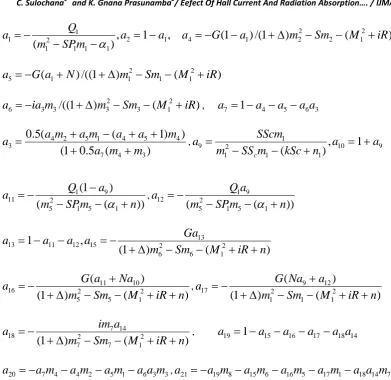
(27)3. METHOD OF SOLUTION
To find the analytical solutions of the above system of partial differential equations (23)-(26)in the neighbourhood of the plate under the above boundary conditions (27), we express q,ω,θ and C as
1 1 1 0 1 0
C
e
C
C
e
e
q
e
q
q
nt o nt o nt ntε
θ
ε
θ
θ
ω
ε
ω
ω
ε
+
=
+
=
+
=
+
=
(28)Invoking the above expansions into the equations(23)-(26) and equating the steady And transient parts and neglecting
the higher order terms of O(
ε
2)
,we obtain the following set of equations to the zeroth order are0 0 0 0 2 1 2 0 2 0
(
)
)
1
(
+
+
∂
∂
+
+
−
∂
∂
∆
+
=
∂
∂
−
G
NC
z
i
q
iR
M
z
q
z
q
s
ω
θ
(29)0
0 2 0 2=
∂
∂
+
∂
∂
z
S
z
ω
ω
λ
(30)o r
C
Q
z
P
N
N
z
S
2 0 10 2 1 1 0
3
)
4
3
(
+
−
∂
∂
+
=
∂
∂
−
θ
θ
αθ
(31)0 2 0 2 0
1
kC
z
C
Sc
z
C
S
−
∂
∂
=
∂
∂
−
(32)and to the first order are
)
(
)
(
)
1
(
1 0 1 11 2 1 1 1 2 0 2
NC
G
z
q
S
z
i
q
iR
n
M
D
z
q
S
z
q
−
+
∂
∂
−
=
∂
∂
+
+
+
+
−
∂
∂
+
∂
∂
∆
+
−ω
θ
(33)
0
1 2 1 2=
∂
∂
+
∂
∂
z
S
z
ω
ω
λ
(34)1 1 0 1 1 1 1 2 1 2
)
(
Q
C
z
S
n
z
SP
z
∂
−
∂
−
=
+
−
∂
∂
+
∂
∂
θ
θ
α
θ
θ
The corresponding boundary conditions can be written as
0
0
,
0
,
0
,
0
0
1
,
1
,
1
,
1
,
,
5
.
0
,
,
5
.
0
,
1
,
1
1 1 1 1 1 1 1 1 0 1>
∞
→
=
=
=
=
=
=
=
=
=
=
=
=
=
∂
∂
=
∂
∂
=
=
=
t
fot
z
as
C
C
q
q
z
at
C
C
z
q
z
q
q
q
o o o o o o o oθ
θ
ω
ω
θ
θ
ω
ω
(37)Solving equations (29)-(35) under the boundary conditions (37) we obtain the expressions for the translational velocity, microrotaton, temperature and concentration as
)
exp(
m
1y
C
o=
−
)
exp(
)
exp(
)
1
(
a
2m
2y
a
1m
1y
o
=
−
−
+
−
θ
)
exp(
3 30
=
a
−
m
y
ω
)
exp(
))
exp(
))
exp(
)
exp(
4 4 2 5 1 6 3 37
0
a
m
y
a
m
y
a
m
y
a
a
m
y
q
=
−
+
−
+
−
+
−
)
exp(
)
exp(
)
1
(
9 5 9 11
a
m
y
a
m
y
C
=
−
−
+
−
)
exp(
)
exp(
)
exp(
6 11 5 12 113
1
=
a
−
m
y
+
a
−
m
y
+
a
−
m
y
θ
) exp( ) exp( ) exp( ) exp( ) exp( 7 14 18 1 17 5 16 8 19 1 7 14 1 y m a a y m a y m a y m a q y m a − + − + − + − = − =ω
4. RATE OF HEAT AND MASS TRANSFER
The rate of heat transfer (Nusselt Number) at z=0 is given by
23 22
0 1 0
0
a
e
a
z
e
z
Nu
nt z nt zε
θ
ε
θ
=
+
∂
∂
+
∂
∂
=
== The rate of mass transfer (Sherwood Number)
at z=0 is given by 1 24
0 1 0
0
m
e
a
z
C
e
z
C
Sh
nt z nty
ε
=
−
+
ε
∂
∂
+
∂
∂
=
= =The couple stress coefficient at z=0 is given by 3 3 14 7 0 1 0
m
a
e
m
a
z
e
z
C
nt z nt wε
ω
ε
ω
−
−
=
∂
∂
+
∂
∂
=
=where 2
2 2 1
1
)
1
(
m
im
M
M
+
−
=
(
4
(
)
)
/
2
,
(
4
1)
/
2
,
2 1 2 1 2 2 2
1
=
SSc
+
S
Sc
+
KSc
m
=
SP
+
S
P
+
α
m
)
1
(
2
/
)
(
4
(
,
4 2 123
=
m
=
S
+
S
+
M
+
iR
+
∆
S
m
λ
,
2
/
)
)
(
4
(
2 25
SSc
S
Sc
kSc
n
m
=
+
+
+
λ
α
2
4
,
2
/
))
(
4
(
2 7 1 2 1 2 1 6n
S
S
m
n
P
S
SP
m
=
+
+
+
=
+
+
)
1
(
2
/
)
(
4
(
2 1 28
=
S
+
S
+
M
+
iR
+
n
+
∆
© 2013, IJMA. All Rights Reserved 309
,
1
,
)
(
1 1 1 2 12 1
1
1
a
a
m
SP
m
Q
a
=
−
−
−
−
=
α
(
1
)
/(
1
)
(
)
2 1 2 2 2 1
4
G
a
m
Sm
M
iR
a
=
−
−
+
∆
−
−
+
)
(
)
1
/((
)
(
1 12 1 125
G
a
N
m
Sm
M
iR
a
=
−
+
+
∆
−
−
+
)
(
)
1
/((
32 3 123 3
6
ia
m
m
Sm
M
iR
a
=
−
+
∆
−
−
+
,a
7=
1
−
a
4−
a
5−
a
6a
3)
(
5
.
0
1
(
)
)
1
(
(
5
.
0
3 4 7 4 5 4 1 5 2 4 3m
m
a
m
a
a
m
a
m
a
a
+
+
+
+
−
+
=
, 10 91 1
2 1
1
9
,
1
)
(
kSc
n
a
a
m
SS
m
SScm
a
c+
=
+
−
−
=
))
(
(
)
1
(
1 5 1 2 5 9 1 11n
m
SP
m
a
Q
a
+
−
−
−
−
=
α
,(
52 1 5(
1))
9 1 12
n
m
SP
m
a
Q
a
+
−
−
−
=
α
)
(
)
1
(
,
1
2 1 6 2 6 13 15 12 11 13n
iR
M
Sm
m
Ga
a
a
a
a
+
+
−
−
∆
+
−
=
−
−
=
)
(
)
1
(
)
(
2 1 5 2 5 10 11 16n
iR
M
Sm
m
Na
a
G
a
+
+
−
−
∆
+
+
−
=
,)
(
)
1
(
)
(
2 1 1 2 1 12 9 17n
iR
M
Sm
m
a
Na
G
a
+
+
−
−
∆
+
+
−
=
)
(
)
1
(
7 122 7 14 7 18
n
iR
M
Sm
m
a
im
a
+
+
−
−
∆
+
−
=
,a
19=
1
−
a
15−
a
16−
a
17−
a
18a
143 3 6 1 5 2 4 4 7
20
a
m
a
m
a
m
a
a
m
a
=
−
−
−
−
,a
21=
−
a
19m
8−
a
15m
6−
a
16m
5−
a
17m
1−
a
18a
14m
71 1 2 9
22
(
a
1
)
m
a
m
a
=
+
−
−
,a
23=
−
a
13m
6−
a
11m
5−
a
12m
1,a
24=
m
5(
a
9−
1
)
−
a
9m
15. RESULTS AND DISCUSSION
We analyze the combined effect of Hall currents, thermal Radiation and Radiation absorption on Convective heat and mass transfer flow of a micro polar fluid past a vertical porous plate. The velocity, temperature, concentration and the micro rotation are analyzed for different variations.
Fig 1-7 represents the primary velocity u with variations in m, R, K, Q, N1, λ and ∆. It is found that the primary velocity enhances with increase in |G| and Rotation parameter R (fig1&7). An increase in Hall parameters m ≤ 1.5 reduces |u| and enhances with higher m ≥ 2.5(fig 1). The effect of the suction velocity on u is shown in fig-2. Fig-3 represents u with chemical reaction parameter γ. It can be seen from the profiles that the primary velocity enhances with increase in γ≤ 1.5 and enhances with higher γ≥ 2.5.From fig.4 we find that an increase in the Radiation absorption parameter Q1 results in an enhancement of |u|. Fig-5 represents u with Radiation parameter N1. It is found that higher the Radiative heat flux, larger |u| in the entire flow region. Fig-6 represents u with microrotation parameter λ. It can be seen from the
profiles that |u| enhances with increase in λ.Fig-7 represents u with viscosity ratio parameter ∆. We notice a depreciation in u with increase in ∆.
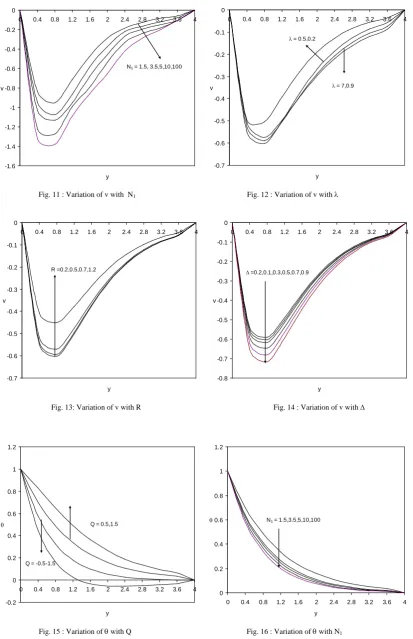
The secondary velocity (v) is shown in fig.8-14 for different parametric values. Fig-8 represents v with Hall parameter m. It is found that an increase in m ≤ 1.5 enhances |v| and for further higher m ≥ 2.5, |v| reduces in the boundary. The variation of v with chemical reaction parameter k shows that |v| enhances with k ≤ 1.5 and depreciates with k ≥ 2.5(fig.9). An increase in the Radiation absorption parameter Q1 ≤ 1 reduces |v| and enhances with higher Q1 ≥ 1.5. Higher the Radiative heat flux larger the magnitude of secondary velocity v (fig-10). An increase in radiation parameter N1 enhances |v (fig 11)|. Fig-13 represents v with Rotation parameter R. I t is observed that |v| exhibits decreasing tendency with increase in R. Fig-12 represents v with microrotation parameter λ. It is found that |v| enhances with
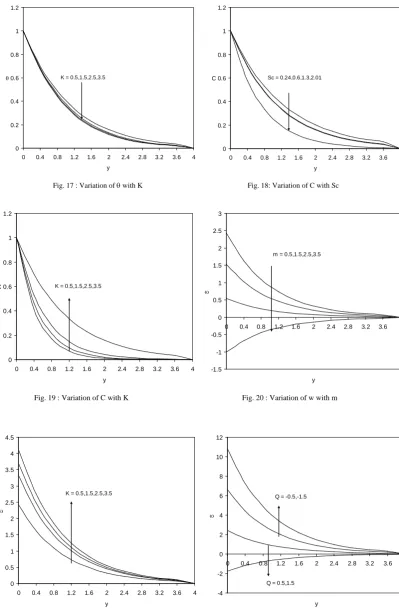
The non-dimensional temperature (ϴ) is shown in fig.15-17 for different values of k, Q1, and N1. It is found that the non-dimensional temperature is positive for all variations. This shows that the actual temperature is greater than the ambient temperature T∞. The actual temperature enhances with increase in Q1 or radiation parameter N1 (fig 16). Also the non dimensional temperature depreciates in the degenerating chemical reaction case (17).
The non-dimensional concentration distribution (C) is shown in fig. 18-19 for different values of Sc, k. It is found that the non-dimensional concentration is positive for all variations. It is found that the actual concentration depreciates with increase in Sc (figs. 18). Also it reduces in the degenerating chemical reaction case (fig.19).
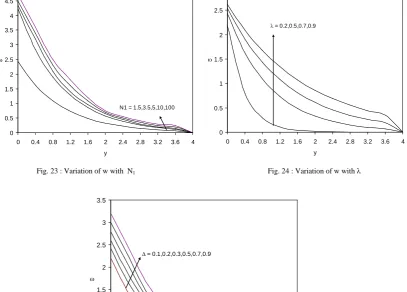
The micro rotation distribution (ω) is shown in fig. 20-25 for different values of different parametric values. An increase in the Hall parameter m≤2.5 resukts in an enhancement in |ω| and enhances with higher m≥3.5(fig.20). An increase in Q1≤1.5 leads to a depreciation in |ω| and for higher Q1≥2.5 we notice an enhancement in |ω| in the entire boundary layer.(fig.22). The effect of radiation parameter N1 on ω is shown in fig.23. It is found that higher the radiative heat flux, larger |ω| in the region. Fig.21 represents ω with micro rotation parameter k. It can be seen from the profiles that an increase in k enhances |ω| in the flow region. Fig-24 represents v with microrotation parameter λ. It is found that |ω| enhances with increase in λ ≤ 0.5 and for higher λ ≥ 0.7 it reduces in the boundary layer. The variation of ω with viscosity ratio parameter ∆ is shown in fig.25. We notice an increasing tendency in |ω| with increase in ∆.
-0.6 -0.4 -0.2 0 0.2 0.4 0.6 0.8 1 1.2
0 0.4 0.8 1.2 1.6 2 2.4 2.8 3.2 3.6 4
y u
m = 0.5,1.5,2.5,3.5
Fig. 1 : Variation of u with m
-1 -0.8 -0.6 -0.4 -0.2 0 0.2 0.4 0.6 0.8 1 1.2
0 0.4 0.8 1.2 1.6 2 2.4 2.8 3.2 3.6 4
y u
R = 0.2,0.5,0.7,1.2
Fig. 2 : Variation of u with R
-0.6 -0.4 -0.2 0 0.2 0.4 0.6 0.8 1 1.2
0 0.4 0.8 1.2 1.6 2 2.4 2.8 3.2 3.6 4
y u
K = 0.5,1.5,2.5,3.5
-5 -4 -3 -2 -1 0 1 2
0 0.4 0.8 1.2 1.6 2 2.4 2.8 3.2 3.6 4
y u
Q = -0.5, -1.5 Q = 0.5,1.5
© 2013, IJMA. All Rights Reserved 311 -1.5
-1 -0.5 0 0.5 1 1.5
0 0.4 0.8 1.2 1.6 2 2.4 2.8 3.2 3.6 4
y u
N1 = 1.5,3.5,5,10
-0.6 -0.4 -0.2 0 0.2 0.4 0.6 0.8 1 1.2
0 0.4 0.8 1.2 1.6 2 2.4 2.8 3.2 3.6 4
y u
λ = 0.5,0.2,0.7,0.9
Fig. 5 : Variation of u with N1 Fig. 6 : Variation of u with λ
-0.6 -0.4 -0.2 0 0.2 0.4 0.6 0.8 1 1.2
0 0.4 0.8 1.2 1.6 2 2.4 2.8 3.2 3.6 4
y u
∆ = 0.5,0.2,0.7,0.9
Fig. 7 : Variation of u with ∆
-1 -0.9 -0.8 -0.7 -0.6 -0.5 -0.4 -0.3 -0.2 -0.1 0 0.1
0 0.4 0.8 1.2 1.6 2 2.4 2.8 3.2 3.6 4
y v
m = 0.5,1.5,2.5,3.5
Fig. 8 : Variation of v with m
-1 -0.9 -0.8 -0.7 -0.6 -0.5 -0.4 -0.3 -0.2 -0.1 0
0 0.4 0.8 1.2 1.6 2 2.4 2.8 3.2 3.6 4
y v
K = 0.5,1.5,2.5,3.5
Fig. 9 : Variation of v with K
-3.5 -3 -2.5 -2 -1.5 -1 -0.5 0 0.5 1
0 0.4 0.8 1.2 1.6 2 2.4 2.8 3.2 3.6 4
y v
Q = -0.5,-1.5 Q =0.5,1.5
-1.6 -1.4 -1.2 -1 -0.8 -0.6 -0.4 -0.2 0
0 0.4 0.8 1.2 1.6 2 2.4 2.8 3.2 3.6 4
y v
N1 = 1.5, 3.5,5,10,100
Fig. 11 : Variation of v with N1
-0.7 -0.6 -0.5 -0.4 -0.3 -0.2 -0.1 0
0 0.4 0.8 1.2 1.6 2 2.4 2.8 3.2 3.6 4
y v
λ = 0.5,0.2
λ = 7,0.9
Fig. 12 : Variation of v with λ
-0.7 -0.6 -0.5 -0.4 -0.3 -0.2 -0.1 0
0 0.4 0.8 1.2 1.6 2 2.4 2.8 3.2 3.6 4
y v
R =0.2,0.5,0.7,1.2
Fig. 13: Variation of v with R
-0.8 -0.7 -0.6 -0.5 -0.4 -0.3 -0.2 -0.1 0
0 0.4 0.8 1.2 1.6 2 2.4 2.8 3.2 3.6 4
y v
∆ =0.2,0.1,0.3,0.5,0.7,0.9
Fig. 14 : Variation of v with ∆
-0.2 0 0.2 0.4 0.6 0.8 1 1.2
0 0.4 0.8 1.2 1.6 2 2.4 2.8 3.2 3.6 4
y
θ Q = 0.5,1.5
Q = -0.5-1.5
Fig. 15 : Variation of θ with Q
0 0.2 0.4 0.6 0.8 1 1.2
0 0.4 0.8 1.2 1.6 2 2.4 2.8 3.2 3.6 4 y
θ N1 = 1.5,3.5,5,10,100
© 2013, IJMA. All Rights Reserved 313
0 0.2 0.4 0.6 0.8 1 1.2
0 0.4 0.8 1.2 1.6 2 2.4 2.8 3.2 3.6 4
y
θ K = 0.5,1.5,2.5,3.5
Fig. 17 : Variation of θ with K
0 0.2 0.4 0.6 0.8 1 1.2
0 0.4 0.8 1.2 1.6 2 2.4 2.8 3.2 3.6 4
y
C Sc = 0.24,0.6,1.3,2.01
Fig. 18: Variation of C with Sc
0 0.2 0.4 0.6 0.8 1 1.2
0 0.4 0.8 1.2 1.6 2 2.4 2.8 3.2 3.6 4 y
C K = 0.5,1.5,2.5,3.5
Fig. 19 : Variation of C with K
-1.5 -1 -0.5 0 0.5 1 1.5 2 2.5 3
0 0.4 0.8 1.2 1.6 2 2.4 2.8 3.2 3.6 4
y
ω
m = 0.5,1.5,2.5,3.5
Fig. 20 : Variation of w with m
0 0.5 1 1.5 2 2.5 3 3.5 4 4.5
0 0.4 0.8 1.2 1.6 2 2.4 2.8 3.2 3.6 4 y
ω
K = 0.5,1.5,2.5,3.5
Fig. 21 : Variation of w with K
-4 -2 0 2 4 6 8 10 12
0 0.4 0.8 1.2 1.6 2 2.4 2.8 3.2 3.6 4
y
ω
Q = -0.5,-1.5
Q = 0.5,1.5
0 0.5 1 1.5 2 2.5 3 3.5 4 4.5 5
0 0.4 0.8 1.2 1.6 2 2.4 2.8 3.2 3.6 4 y
ω
N1 = 1.5,3.5,5,10,100
Fig. 23 : Variation of w with N1
0 0.5 1 1.5 2 2.5 3
0 0.4 0.8 1.2 1.6 2 2.4 2.8 3.2 3.6 4 y
ω
λ = 0.2,0.5,0.7,0.9
Fig. 24 : Variation of w with λ
0 0.5 1 1.5 2 2.5 3 3.5
0 0.4 0.8 1.2 1.6 2 2.4 2.8 3.2 3.6 4 y
ω
∆ = 0.1,0.2,0.3,0.5,0.7,0.9
Fig. 25 : Variation of w with ∆
The Rate of heat transfer (Nusselt number) at η = 0 is depicted in table.1. The variation of Nu with chemical reaction parameter K ≤1.5 leads to a reduction in |Nu| and for higher K ≥ 2.5; we notice an enhancement in |Nu|. An increase in the radiation absorption parameter Q1 results in an enhancement in |Nu| at the plate (table-1).
The rate of mass transfer (Sherwood number) at the Wall η = 0 in |Nu| and for higher K ≥ 2.5; we notice an enhancement in |Nu|.
The Couple stress (Cw) at η = 0 is shown in tables 3-5 for different parametric values. An increase in Q1≤1.5 reduces .|Cw and enhances with higher Q1≥2.5. An increase in the radiation parameter N1≤3.5, we notice a depreciation in |Cw| for G>0 and enhancement for G<0 and for further higher N1≥5, .|Cw| enhances for G>0 and reduces for G<0.An increase in the rotation parameter R enhances. |Cw|. With increase in microrotation parameter λ |Cw| reduces and enhances for higher λ≥0.9. Also it reduces with increase in micro viscosity ratio parameter ∆ leads to a depreciation. The Also |Cw| enhances in the degenerating chemical reaction parameter k(table.10). From table.3, we find that |Cw| enhances for G>0 and reduced for G<0 with increase in the Hall parameter m≤ 1.5 and reduces with higher values of m≥ 2.5.
Table - 1
Nusselt Number(Nu) at η=0
Sc I II III IV V
0.24 -1.7820 0.47593 -0.5822 -3.2613 -4.65399 0.6 -1.9512 -1.0873 -0.6983 -4.2496 -6.28833 1.3 -2.6542 -0.5886 -0.8787 -23.954 -39.0970 2.01 -1.248 -0.8843 -1.0382 2.3341 4.77006
K 0.5 1.5 2.5 0.5 0.5
© 2013, IJMA. All Rights Reserved 315
Table - 2
Sherwood Number(Sh) at η=0
Sc I II III
0.24 -0.7872 -1.33761 -1.69151 0.6 -0.8424 -1.42976 -1.78360 1.3 -0.9594 -1.62460 -1.97478 2.01 -1.1077 -1.86994 -2.20647
K 0.5 1.5 2.5
Table - 3 Couple stress(Cw) at η=0
G I II III IV V VI VII VIII
10 0.03484 3.27509 -6.06123 -6.08860 -11.7112 -0.88666 -0.77910 -0.19351 20 -2.90286 4.01148 -14.0059 -13.6859 -25.5439 -3.47960 -2.92888 -0.24363 -10 4.13340 1.78445 9.88764 9.88764 15.50315 4.64543 4.56178 3.98238 -20 6.65133 0.97869 17.74663 17.66292 29.71136 7.08876 5.32633 3.46851
Q 0.5 1.5 1.5 2.5 3.5 0.5 0.5 0.5
m 0.5 0.5 0.5 0.5 0.5 1.5 2.5 3.5
Table - 4 Couple stress(Cw) at η=0
G I II III IV V VI VII VIII IX
10 2.49488 1.93087 2.04346 2.15503 -1.1094 -0.2173 -0.63293 -0.7640 -0.8178 20 5.53553 3.43477 3.85550 4.69710 -2.3816 0.17291 -2.16496 -2.7064 -2.8534 -10 1.29809 1.86134 1.74913 1.63798 4.61685 2.38460 4.37766 4.45619 4.47865 -20 -1.00692 0.45597 0.28480 -0.1272 6.12719 2.36659 5.97493 6.50296 6.72277
1.5 3.5 5 10 1.5 1.5 1.5 1.5 1.5
λ 0.5 0.5 0.5 0.5 0.3 0.9 0.5 0.5 0.5
R 0.2 0.2 0.2 0.2 0.2 0.2 0.5 0.9 1.20
Table - 5 Couple stress(Cw) at η=0
G I II III IV V VI VII
10 -0.8178 3.44497 4.12413 4.81686 -0.5251 -0.616 -0.672 20 -2.8534 3.87264 4.70311 5.289461 -3.1205 -3.238 -3.292 -10 4.47865 2.29668 3.13461 3.84684 4.30084 4.3620 4.4352 -20 6.72277 2.20431 2.63682 3.32315 6.53366 6.51378 6.9076
K 0.5 1.5 2.5 3.5 0.5 0.5 0.5
∆ 0.2 0.2 0.2 0.2 0.5 0.7 0.9
6. REFERENCES
1. P.A.Gilman and E.R.Benton, Influence of an axial magnetic field on the steady linear Ekman-boundary layer, Phys, Fluids,Vol.11(1968), PP.2397-2407
2. E.R.Benton and D.E.Lopper, On the spin up of an electrically conducting fluid, J. Fluid Mech., Part 1,Vol.39(1969),pp.561-586.
3. S.S.Chawala, On hydro magnetic spin-up,J-Fluid Mech.,part-3,Vol.53(1972), PP.545-555.
4. L.Debnath,Resonant oscillations of a porous plate in an electrically conducting rotating Viscous fluid,Phys.Fluid,Vol.17,No.9(1974),pp.1704-1706
5. L.Debnath, On unsteady magneto hydrodynamic boundary layers in a rotating flow, Z.Angew, Math.Mech, Vol.52 (972), PP.623-626.
6. K.D.Singh –An oscillatory hydro magnetic Couttle flow in a rotating system,Z.Angew,Math.Mech.Vol 80,No.6(2000),PP.429-432.
7. Eringen A.C.(1972),Theory of thermomicro fluids,J. Math.Anal. Appl.,Vol.38, pp.480-496 8. A.C.Eringen,Theory of micropolar fluids,J.Math.Mech.16(1964) 1-18
9. Lukaszewicz.G(1999),Micropolar fluids-theory and applications. Boston: Birkhauser. 10. A.C.Eringen,Theory of micropolar fluids,J.Math.Mech.16(1964) 1-18
11. R.Bhargava,H.S.Takhar,Numerical study of heat transfer characteristics of the micropolar boundary layer near a sagnation points on a moving wall, int.J.Eng. Sci.38 (2000) 383-394.
13. M.M.Khonsari,D.E.Brewe,Effects of viscous dissipation on the lubrication characteristics of micropolar fluids,Acta Mech.105(1994) 57-68
14. Y.J.Kim.J.C.Lee Analytical studies on MHD oscillatory flow of a micropolar fluid over a vertical porous plate,surf.Coat Technol.171(2003) 187-193.
15. R.Deka,U.N.Das,V.M.Soundalgekar, Effects of mass transfer flow past an impulsively started infinite vertical plate with constant heat flux and chemical vertical plate,Forch.Ingenieurwes.60(1994) 284-287
16. R.Muthucumaraswamy,P.G.anesan, Effect of the chemical eaction and injection on flow characteristics in an unsteady upward motion of an isothermal plate.J.Appl.Mech.Tech.Phys.42(2001) 284-287
17. A.J.Chamkha, MHD flow of a uniformly stretched vertical permeable surface in the presence of heat generation/absorption and a chemical reaction, Int.Commun. Heat Transfer Vol.30 (2003) 413-422
18. M.M. Rahman, M.A. Sattar, MHD c o n v e c t i v e flow of a micropolar fluid past a continuously moving vertical porous plate in the presence of heat generation/absorption, ASME J. Heat Transfer 128 (2006) 142–152.
19. Gibben R.J.(1965),The magnetohydrodynamic boundary layer in the presence of a pressure gradiant,Proc.Soc.,Vol.287(A),pp.123-141
20. Kim Y.J.and Lee J.C. (2003), Analytical studies on MHD oscillatory flow of a micropolar fluid over a vertical plate,surface and Coatings Technology,Vol.171, pp.187-193. 111118.8.6.
21. Rapits A (1998), Flow of a micropolar fluid past a continuously moving plate by the presence of radiation,Int.J.Heat Mass Transfer Vol.41, pp.2865-2866
22. El-Arabawy H.A.M.(2003),Effect of suction/infection on the flow of a micropolar fluid past continuously moving plate in the presence of radiation, Int. J. Heat and Mass Transfer,Vol.46,pp.471-1477.
23. F.S. Ibrahim, A.M. Elaiw, A.A. Bakr, Effect of the chemical reaction and radiation absorption on the unsteady MHD free convection flow past a semi infinite vertical permeable moving plate with heat source and suction, Commun. Nonlinear Sci. Numer. Simul. 13 (2008) 1056–1066
24. M.M. Rahman, M.A. Rahman, M.A. Samad, M.S. Alam, Heat transfer in micropolar fluid along a non -linear stretching sheet with temperature dependent viscosity and variable surface temperature, Int. J. Thermophys. 30 (2009) 1649–1670.
25. M.M. Rahman, M.J. Uddin, A. Aziz, Effects of variable electric conductivity and non-uniform heat source (or sink) on convective micropolar fluid flow along an inclined flat plate with surface heat flux, Int. J. Ther Sci. 48 (2009) 2331–2340.
26. M.M. Rahman, A. Aziz, M. Al-Lawatia, Heat transfer in micropolar fluid along an inclined permeable plate with variable fluid properties, Int J. Ther Sci. 49 (2010) 993–1002.
27. R.A. Damseh, M.Q. AL-Odat, A.J. Chamkha, A. Benbella Shannak, Combined effect of heat generation or absorption and first order chemical reaction on micropolar fluid flows over a uniform stretched permeable surface, Int. J. Thermal Sci. 48 (2009) 1658–1663.
28. M.M. Rahman, M. Al-Lawatia, Effects of higher order chemical reaction on micropolar fluid flow on a power law permeable stretched sheet with variable concentration in a porous medium, Can.J.Chem.Eng.88 (2010)23– 32.
29. A.C. Cogley, W.E. Vincenty, S.E. Gilles, Differential approximation for radiation in a non-gray gas near equilibrium, AIAA J. 6 (1968) 551–553.
30. MD. Abdus Sattar, Kalim MD. Hamid, Unsteady free-convection interaction with thermal radiation in a boundary layer flow past a vertical porous plate, J. Math. Phys. Sci. 30 (1996) 25–37.
31. K. Vajravelu, Flow and heat transfer in a saturated porous medium, ZAMM 74 (1994) 605–614.
32. M.A. Hossain, H.S. Takhar, Radiation effect on mixed convection along a vertical plate with uniform surface temperature, Heat Mass Transfer 31 (1996) 243–248.
33. Raptis, Radiation and free convection flow through a porous medium, Int.Commun. Heat Mass Transfer 25 (1998) 289–295.
34. O.D. Makinde, Free convection flow with thermal radiation and mass transfer past a moving vertical porous plate, Int. Commun. Heat Mass Transfer 32 (2005) 1411–1419.
35. F.S. Ibrahim, A.M. Elaiw, A.A. Bakr, Influence of viscous dissipation and radiation on unsteady MHD mixed convection flow of micropolar fluids, Appl. Math. Inf. Sci. 2 (2008) 143–162.
36. M.M. Rahman, M.A. Sattar, Transient convective flow of micropolar fluid past a continuously moving vertical porous plate in the presence of radiation, Int. J.Appl. Mech. Eng. 12 (2007) 497–513.
37. F.S. Ibrahim, A.M. Elaiw, A.A. Bakr, Effect of the chemical reaction and radiation absorption on unsteady MHD mixed convection flow past a semi-infinite vertical permeable moving plate with heat source and suction, Commun. Nonlinear Sci. Numer. Simul. 13 (2008) 1056–1066.
38. M.M. Rahman, Convective flows of micropolar fluids from radiate isothermal porous surfaces with viscous dissipation and Joule heating, Commun. Nonlinear Sci. Numer. Simul. 14 (2009) 3018–3030.
39. A.A. Bakr, Effects of chemical reaction on MHD free convection and mass transfer flow of a micropolar fluid with oscillatory plate velocity and constant heat source in a rotating frame of reference, Commun. Nonlinear Sci. Numer. Simul. 16 (2011) 698–710.
© 2013, IJMA. All Rights Reserved 317 41. D.Rees and I. Pop, Free convection boundary-layer flow of a micropolar fluid from a vertical flat plate, IMA
Journal of Applied Mathematics, 61(1998)179-197.
42. R.C.Sharma, U.Gupta, Thermal convection in micropolar fluids in porous medium, Int. J. Eng. Sci. 33 (1995) 1887–1892.
43. J.Prathap Kumar, J.C.Umavathi, J.Chamkha Ali, I. Pop, Fully developed free convective flow of micropolar and viscous fluids in a vertical channel, Applied Mathematical Modeling, 34(2010) 1175-1186.
44. P.Muthu, B.V.Rathish Kumar, Peeyush Chandra, Peristaltic motion of micropolar fluid in circular cylindrical tubes: Effect of wall properties, Applied Mathematical Modelling, 32(2008)2019-2033.
45. D.Srinivasacharya, J.V.Ramana murthy, D.Venugopalam, Unsteady Stokes flow of micropolar fluid between two parallel porous plates, Int. J. Engg. Sci. 39 (2001) 1557-1563.
46. R.Muthuraj , S.Srinivas, Heat and mass transfer in MHD micropolar flow over a Fully developed MHD flow of a micropolar and viscous fluids in a vertical porous space using HAM , Int. J. of Appl. Math and Mech. 6 (2010) 55-78.
47. Kim, Y.J. MHD micropolar fluid flow past a vertical moving plate.Vertical moving plate in a porous medium, Trans Porous Media, 56(2004)17–37.
55. K.Das et al., Effect of chemical reaction and thermal radiation on heat and mass transfer flow of MHD micropolar fluid in a rotating frame of reference, Int. Heat and Mass Transfer, V.54, 3505-3513, (2011).
60. T.Hayat, S.B.Khan and M.Khan, The influence of Hall current on the rotating oscillating flows of a fluid in a porous medium, Non linear dynamics, V.47(2007),pp.353-362.