513
© 2018 by the Serbian Biological Society How to cite this article: Ozturk IK, Ersoy F, Akkaya MS. HvGCN2 silencing in barley displays enhanced Blumeria graminis f. sp. hordei susceptibility. Arch Biol Sci. 2018;70(3):513-20.
HvGCN2
silencing in barley displays enhanced
Blumeria graminis
f. sp.
hordei
susceptibility
Ibrahim Kutay Ozturk1, Figen Ersoy2,# and Mahinur Sezener Akkaya1,*
1Middle East Technical University, Biotechnology Graduate Program, Department of Chemistry, Cankaya, TR-06800,
Ankara, Turkey
2Uludag University, Department of Molecular Biology and Genetics, Görükle Kampusu, Nilüfer, TR-16059, Bursa, Turkey
Corresponding authors: *[email protected]; #[email protected]
Received: October 17, 2017; Revised: February 20, 2018; Accepted: March 20, 2018; Published online: March 29, 2018
Abstract: Powdery mildew disease, caused by Blumeria graminis f. sp. hordei (Bgh), which belongs to the order Erysiphales, is a major crop disease. The general control nondepressible-2 (GCN2) gene of barley was previously found to be overex-pressed during the powdery mildew resistance response. Recently, Arabidopsis thaliana GCN2 (AtGCN2) was shown to be involved in disease resistance against biotrophic and necrotrophic pathogens. In order to understand the function of Hordeum vulgareGCN2 (HvGCN2) in the barley powdery mildew resistance response, this gene was silenced by barley stripe mosaic virus (BSMV), mediated by virus-induced gene silencing (VIGS). This is the first study showing the potential importance of HvGCN2 in powdery mildew disease of barley. Based on our observations, when HvGCN2 was silenced on average by 53.5%, Bgh development was increased by 18.7 to 32.1%, which was determined by primary, secondary and lon-gest hyphae measurements. The number of germinated spores also increased 2.8-fold in HvGCN2 silenced plants compared to control plants (BSMV:00). On the other hand, under the resistant condition, no difference was observed in HvGCN2 -silenced plants compared to non--silenced lines although the gene was found to be overexpressed in incompatible interaction.
Key words: general control non-depressible 2(GCN2); barley; Blumeria graminis f. sp. hordei; powdery mildew; virus-induced gene silencing (VIGS); plant disease resistance
INTRODUCTION
Blumeria graminis is an important disease of barley that decreases the yield and causes serious economic losses [1]. Currently, fungicides are used to limit Blu-meria graminis, but the fungus quickly becomes resis-tant to the applied chemicals [2]. Blumeria graminis f. sp. hordei (Bgh)is the subspecies that can infect Hor-deum vulgare [3]. Other than Bgh,there are subgroups that can infect oat(f. sp. avenae), rye (f. sp. secalis), poa (poae), ryegrass (lolii), and bromus (bromi) [4]. The genome of Bgh was sequenced and found to be larger than 120 Mb [5].The availability of sequence data will aid developing strategies to cope with this disease in barley.
Plants have a tightly controlled defense system that is specifically designed towards their pathogens. There remains much to investigate in the molecular pathways of this resistance system in plants. The hy-persensitive response (HR), a type of programmed
cell death, is an important local defense mechanism in plants. This local mechanism results in systemic acquired resistance (SAR) in plants coping with the disease [6]. Activation of phytohormones such as sali-cylic acid (SA), jasmonate (JA) and ethylene (ET) are well known in plant disease resistance responses [7]. SA signaling is primarily involved in resistance against biotrophs, whereas JA/ET signaling is generally ef-fective against necrotrophs [8]. Activation of the SA-dependent signaling pathway results in expression of pathogenesis-related (PR) proteins [8]. Understanding the signaling pathways for HR and SAR activation is crucial for developing plants resistant to pathogens.
GCN2 is a serine threonine kinase [9]that is re-sponsible for sensing and responding to amino acid starvation in yeast [10]. The expressed sequence tag (EST) and genomic databases were screened with the
bar-ley [11]. It was shown that wheat eukaryotic transla-tion initiatransla-tion factor 2α (eIF2α) is phosphorylated by yeast GCN2 protein in yeast cells, indicating that this mechanism might be conserved from yeast to plants [12]. Arabidopsis eIF2α was not phosphorylated in an
AtGCN2 knockout mutant, indicating that AtGCN2 is the only kinase phosphorylating eIF2α [13], in con-trast to mammals, which also have heme-regulated inhibitor (HRI) kinase, protein kinase R (PKR), and PKR-like ER-localized eIF2α kinase (PERK) in addi-tion to GCN2 [14-16]. Several studies on Arabidop-sis thaliana have shown that AtGCN2 was functional during stress responses (biotic and abiotic), normal development of the plant and plant-hormone cross talk [12, 17-20]. AtGCN2 was shown to be essential for growth under stress conditions, including wounding, starvation, exposure to methyl jasmonate, salicylic acid, or the ethylene precursor, 1-aminocyclopropane-1-carboxylic acid (ACC) [12]. Furthermore, AtGCN2
knockout mutants had better heat, drought, and os-motic stress tolerance [17]. AtGCN2 also had a role in β-aminobutyric acid (BABA)-induced growth sup-pression, and resistance induced by BABA did not depend on AtGCN2 [21].
Recently, it was reported that at different devel-opmental stages there are both positive and negative influences of AtGCN2 on plant immunity against both biotrophic and necrotrophic pathogens. However, the Arabidopsis AtGCN2 mutant displays enhanced dis-ease susceptibility towards biotrophic pathogens dur-ing early developmental stages [18]. It is likely that
AtGCN2 might act as a universal immune regulator in plants by controlling both SA- and JA-mediated defenses [18].
Using yeast two-hybrid analysis, yeast SRP72 was found to physically interact with YR10protein of wheat [22]. When the response of HvGCN2 in barley during Bgh resistance was tested by qRT-PCR, it was shown that its expression level was increased almost three-fold [22]. The gene was silenced using VIGS in order to confirm its function. The method takes advantage of the plant RNAi mechanism to knock down a gene of interest in order to explore its function [23]. In this technique, a specifically modi-fied complementary DNA (cDNA) of viral origin is introduced to the plant [23]. As the virus replicates, dsRNAs are encoded and cleaved into siRNAs by
Dicer enzyme, then siRNA molecules target their complementary mRNA fragments and successfully prevent their translation [24]. VIGS is preferred for its convenience and ability to target specific gene loci [23]. The most crucial advantage of the technique is that the silencing phenotype can be established in 1 to 2 weeks after the application [23]. Since decreased or limited plasmodesmatal activities can result in inefficient silencing [24,25], its efficiency can never reach 100%. Most of the time; it is still sufficient not to knock out the gene completely, especially if the gene is a housekeeping one. Silencing efficiency also differs in different genotypes [26]. Since the understanding of the genes involved in the regulation of disease re-sistance mechanism can facilitate the development of novel applications in the fight against pathogens, the role of HvGCN2 in the defense mechanism in barley was studied using BSMV-mediated VIGS. Three con-trol and four silencing treatments were conducted on seedlings, and changes were determined by compar-ing powdery mildew growth in control and silenced groups, and the level of silencing was confirmed via
qRT-PCR.
MATERIALS AND METHODS
Plant materials and growth conditions
Barley seeds of Pallas-01 (with the Mla1 resistance-gene) were planted in soil and grown under 16 h light and 8 h dark cycles in a Sanyo Versatile Environmen-tal Test Chamber (Model MLR-351H) at 18ºC for 10
days. The seedlings were watered with tap water once every 2 days.
HvGCN2 cloning and silencing
desaturase (PDS) gene fragment which was replaced with a 310 bp-long fragment (HO208991.1), after PCR amplification with primers with PacI and NotI sites (TA-HV-GCN2-F-310: 5ʹ-CACTTAATTAAGGAG-GAGAGATGCTAGAACT-3ʹ and TA-HV-GCN2-R-310: 5ʹ-CATGCGGCCGCAACTCCTGCCCAA-CAAA-3ʹ, corresponding to positions 2542 to 2850 on TaGCN2 (FR839672.1)). The plasmids (4 µg) were linearized with restriction enzymes: PauI (BssHII) for pBSMVγ:GCN2; BcuI (SpeI) for pBSMVβΔβα, and MluI for pBSMVα and pBSMVγ in a 50-μL reaction volume. In vitro transcription reactions were carried out on the linearized plasmids according to the man-ufacturer’s protocol (Ambion mMessage mMachine T7 in vitro transcription kit; Invitrogen, CA, USA). The silencing procedure was adapted from [27] and [28], with a modifications. The aliquots of BSMV transcripts of each genome were mixed in equal pro-portions as a 1.5 μL transcription mix (without LiCl2 RNA precipitation) in 27.5 μL of FES (0.2 M glucose, 0.3 M K2HPO4, ddH2O). The inoculation solutions were rub-inoculated from bottom to top on the first leaves of 10-day-old Pallas-01 seedlings. At 14 days post-silencing (dps), the third leaves of the plants were cut into four fragments of which two of the fragments were used for RNA analysis and the other two were used for Bgh inoculations.
RNA extraction and cDNA synthesis
RNA extraction from the leaf fragments was carried out using a QIAGEN RNeasy Plant Mini Kit, accord-ing to the manufacturer’s instructions (QIAGEN, Germany), by pooling leaf fragments from the same leaf into one sample to obtain 100 mg of tissue. Re-sidual DNA in the RNA isolates was removed using Fermentas DNase I (Fermentas, MA, USA) according to the manufacturer’s specifications, and lack of any DNA was confirmed by the absence of product in PCR amplification of HvGAPDH with primer pairs: Hv-GAPDH-cw1: 5ʹ-CGTTCATCACCACCGACTAC-3ʹ and Hv-GAPDH-ccw1: 5ʹ- CAGCCTTGTCCTTGT-CAGTG-3ʹ. cDNA synthesis was carried out using In-vitrogen SuperScript®II Reverse Transcriptase with both random hexamers and oligo-dT primers in one RT reaction. The cDNA products were used in the qPCR analysis.
qRT-PCR
A common strategy using at least one of the prim-ers targeting either upstream or downstream the cloned region, in silencing level determination by qRT-PCR. Both qRT-PCR primers were designed to correspond to the outside of the GCN2 target region. For qRT-PCR analysis we used the primers GCN2-F-134: 5ʹ-CTGACGCAGATGTGAATGCT-3ʹ and GCN2-R-134: 5ʹ-CAGTTGTTGGGTCGAAACCT-3ʹ amplified between nucleotides 500 and 635, which corresponds to positions 615-635 and 500-519 on
TaGCN2 (FR839672.1). Products of expected sizes were confirmed by PCR. Also, we observed a single peak by melting curve analysis. The reactions were carried out as indicated in the manufacturer’s proto-col (SYBR Green JumpStart Taq Ready Mix; Sigma-Aldrich, MO, USA), on Stratagene Mx3005p. Three PCR technical repeats were performed on equal cDNA concentrations of the leaf fragments from each of the four silenced seedlings and leaf fragments of each of the three naked virus transcript inoculated seedlings.
Five different reference genes were tested as fol-lows: actin (AY145451.1), GAPDH (M36650.1), elon-gation factor (Z50789.1), ubiquitin (M60175.1), and
α-tubulin (Y08490.1). GeNorm eliminates the candi-date with the highest M value and keeps calculating until the last two candidate reference genes are left. The last two candidates are then named as the opti-mum pair of reference genes [29]. M value calculation is based on the variation of the candidate reference gene with respect to all other candidate genes. As a result, geNorm software provides average expression stability for each candidate reference gene as com-pared to the rest of the candidate reference genes. The
Cary, NC, 2007). The percent HvGCN2 expression level after silencing was also calculated by dividing the logarithmic transformation of the fold-change in HvGCN2 silenced plants to the value in BSMV:00 control plants and multiplying with 100.
Blumeria graminis f. sp. hordei inoculations and determination of level of powdery mildew development
Pathogen inoculations were performed using Blu-meria graminis f. sp. hordei races Bgh-95(53/01) and
Bgh-103(64/01), having virulence and avirulence to Pallas-01, respectively. The detached Pallas-01 leaves (post-challenge with BSMV constructs) were posi-tioned onto 1.5% water agar plates with 1% benz-imidazole and inoculated by blowing the spores on the leaves in separate chambers to give about 25-30 sporulating colonies per cm2. Hyphal growth
develop-ment was determined at 3 days post-inoculation (dpi) and 5 dpi by Trypan blue staining. Trypan blue stain-ing was performed accordstain-ing to Hein et al. [31]. The fungal hyphae were classified as the ones emerging from the germinating spore itself (primary hyphae), as emerging from the primary hyphae (secondary hy-phae), and as the longest hyphae. Pictures were taken using a Leica DM4000B microscope/DFC 280 camera, and hyphal lengths were measured using the Leica Application Suite LAS V3.1.
Statistical analysis
Eight control and eight silenced plant detached leaves were used for statistical analysis. For each leaf, the number of germinated spores and the average hyphae metric (longest, primary, secondary hyphae) was cal-culated and data were used to conduct Student’s t-test using JMP®, Version 7.0 (SAS Institute Inc., Cary, NC,
2007).
RESULTS
For the selection of best suitable reference genes, ge-Norm software was used to calculate M-values. Actin
(AY145451.1) and elongation factor (Z50789.1) genes were selected as reference genes for the determination of the HvGCN2 silencing level, as they were found to be the most stable under the applied experimental condition (Fig. 1).
The same individual silenced plant leaf was used for qRT-PCR and powdery mildew inoculations in order to examine the fungal developmental changes due to silencing. In the VIGS experiments, four indi-vidual samples of Pallas-01 seedlings were used for silencing. The qRT-PCR analysis results showed that
Fig. 1. Average expression stability values of candidate reference genes. GAPDH – glycer-aldehyde 3-phosphate dehydrogenase; Ubi – ubiquitin, EF – elongation factor. Actin and EF were selected as the reference genes as they were the most stable genes in BSMV:00-inoculated and HvGCN2-silenced leaf samples.
HvGCN2 was silenced in a range of 33-71%, with an average value of 53.5% in the silenced samples as com-pared to four biological replicates of control samples (BSMV:00, naked viral RNA inoculations), which cor-responds to a nearly -1-fold change in log2 (Fig. 2).
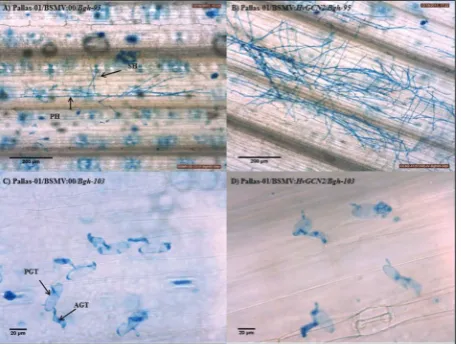
HvGCN2 silenced plants were inoculated with a compatible race of Blumeria graminis f. sp. hordei, Bgh-95. Three and five days after Bgh inoculations, leaf fragments were collected for microscopic analysis to determine the number and the length of hyphal for-mations in HvGCN2-silenced samples and compared with the control samples. The intense surface network on the 5 dpi samples prevented accurate quantita-tive measurements; however, the differences in the amount of hyphal formations were obvious across all silenced samples (Fig. 3). Quantitative evaluations were only conducted on the 3 dpi samples (Fig. 4). The powdery mildew hyphal formation levels were analyzed to correlate with the silencing levels mea-sured via qRT-PCR. For quantitative assessment, a total of 292 germinated Bgh spores were analyzed under the compatible interaction condition. Among these 292 fungi, 216 belonged to the HvGCN2 silenced samples and 76 belonged to the control samples in
the same number of leaf pieces and the same total area. A 2.8-fold difference in the germination rates of control samples with HvGCN2-silenced samples (p=0.0053) was observed. The average hyphae length within each leaf was calculated by following the classi-fications of primary and secondary hyphae. Then, the mean values were used to calculate the average lengths of the hyphae used in Fig. 4. They displayed 18.7% difference in longest hyphae lengths between control and silenced groups (p=0.0155), 20.3% difference in primary hyphae lengths between control and silenced groups (p=0.0078) and 32.1% difference in secondary hyphae lengths between control and silenced groups (p=0.0445). This result is consistent with the qualita-tive analyses presented in Fig. 3. These differences in the germination rates and the size of the hyphae were estimated to be about three-fold increased in silenced plants with respect to control plants after visual in-spection at 5 dpi.
When another set of HvGCN2 silenced and con-trol Pallas-01 (harboring Mla1 gene) samples was in-oculated with the incompatible race of pathogen Bgh-103, no differences were observed in the resistance responses (Fig. 3C and D). The number of germinated spores, developmental stages of primary germ tube, appressorial germ tube, and appressorial lobe forma-tions of the avirulent pathogen race were similar at both 3 and 5 dpi after visual inspection.
Fig. 3. Pathogen growth at 5 days post inoculation on a control (A and C; BSMV:00 rub-inoculated Pallas-01) and a HvGCN2 silenced sample (B and D; BSMV:HvGCN2 rub-inoculated Pal-las-01). Powdery mildew inoculations with (A and B) Bgh-95 (compatible interaction) at 10X magnificationand (C and D) Bgh-103 (incompatible interaction) at 40X magnification of samples 14 days after silencing of Pallas-01. PH – primary hyphae; SH – secondary hyphae; AGT – appressorium germ tube; PGT – pri-mary germ tube.
DISCUSSION
GCN2 is responsible for the phosphorylation of eIF2α. This phosphorylation results in global reduction in protein synthesis, which is important for cell homeo-stasis [32]. Also, Arabidopsis eIF2-α is phosphorylated by GCN2 after treatment with defense hormones SA and JA [12]. Plant GCN2 is believed to function as a sensor and regulator of several stress responsive path-ways, including plant defense against insect herbivores [12]. The activation of GCN2 protein is believed to be beneficial for the plant in coping with stress [33]. In
Arabidopsis thaliana, the presence of GCN2 protein fa-cilitates the action of glyphosate since the effects of the herbicide were minimized in Gcn2 knock-out mutants [20]. Recently it was found that AtGCN2 protein serves as a general regulator of SA- and JA-mediated immune responses triggered after infection with biotrophic and necrotrophic pathogens [18]. There are examples of both positive and negative influences of AtGCN2 on plant immunity at different developmental stages, and this is explained by the variable amount of abscisic acid (ABA) accumulation in plants lacking functional
AtGCN2 at early stages of development [18].
In this study, HvGCN2 was silenced via the BSMV-VIGS system. Using HvGCN2 mutants rather than gene silencing can affect growth of the plant as
AtGCN2 has also been shown to be involved in growth and developmental processes [18]. For this reason, transient gene silencing was preferred. In order to determine the silencing level of HvGCN2 accurately, reference genes that were most unaffected by HvGCN2
silencing and powdery mildew infection had to be found. Under similar conditions to the present study, the ubiquitin [31] or actin [34] genes were used as a reference. We tested five common housekeeping genes (actin, elongation factor, GAPDH, ubiquitin and α-tubulin) as candidate reference genes. As a re-sult of geNorm analysis, actin and elongation factor genes were selected as the reference genes being the most stable gene pair during the applied experiment.
In the course of the experiment, HvGCN2 was found to be 53.5% silenced on average. Silencing values above 30% are generally considered significant and even 10% was previously reported as a silenced sample [35].
Following gene silencing, the seedlings were in-oculated with Bgh to determine the importance of
HvGCN2 in barley defense against powdery mildew. Silencing of HvGCN2 affected both the number and sizes of the germinated spores. The number of germi-nated spores were 2.8-fold lower in silenced HvGCN2
samples than in BSMV:00-inoculated samples. On the other hand, hyphae growth measurements at differ-ent time points and visual inspection of the powdery mildew spores under the microscope showed that the hyphae in HvGCN2 silenced samples were up to 32.1% longer when compared to BSMV:00-inoculated samples. These two results showed that the silenc-ing of HvGCN2 renders Bgh-susceptible plants ex-tremely vulnerable to the disease. However, the plant response to the avirulent pathogen was not changed by silencing HvGCN2, indicating that HvGCN2 be-haves as a negative regulator of pathogen growth only during susceptibility. As expected, powdery mildew resistance-breaking phenotypes were not observed in HvGCN2-silenced Bgh resistant barley because
HvGCN2 itself is not responsible for complete resis-tance. The plants that were used in this study were young seedlings and Bgh is a biotrophic pathogen, therefore the results presented here are in accordance with the results of Liu et al. [18] who reported that an Arabidopsis AtGCN2 mutant displayed enhanced disease susceptibility towards biotrophic pathogens during early developmental stages.
Understanding the role of GCN2 protein in plant disease resistance is of vital importance. As hypoth-esized by Liu et al. [18], pathogens feed on the host and this may induce amino acid starvation, resulting in GCN2 protein activation. GCN2 phosphorylates eIF2α and the repression of general protein synthesis may initiate plant disease resistance. The gene is not only important for biotic but also for abiotic stresses in plants.
Acknowledgments: This work was supported by funding from TUBITAK (The Scientific and Technical Research Council of Tur-key) Grant No. 110T984. We are grateful to Dr. Mogens Hovmoller from Aarhus University, for providing Bgh races.
Author contributions: Study concept and design — FE; MSA; preparation of plant materials — IKO; VIGS methodology — IKO, FE; real time PCR analysis — IKO, FE; interpretation of data — IKO, FE, MSA; draft of the manuscript — FE, MSA; final approval of the version to be published — IKO, FE, MSA.
REFERENCES
1. Dean R, Van Kan JAL, Pretorius ZA, Hammond-Kosack KE, Di Pietro A, Spanu PD, Rudd JJ, Dickman M, Kahmann R, Ellis J, Foster GD. The Top 10 fungal pathogens in molecular plant pathology. Mol Plant Pathol. 2012;13(4):414-30. 2. Glawe DA. The powdery mildews: a review of the world’s
most familiar (yet poorly known) plant pathogens. Annu Rev Phytopathol. 2008;46:27-51.
3. Wyand RA, Brown JKM. Genetic and forma specialis diversity in Blumeria graminis of cereals and its implica-tions for host-pathogen co-evolution. Mol Plant Pathol. 2003;4(3):187-98.
4. Inuma T, Khodaparast SA, Takamatsu S. Multilocus phyloge-netic analyses within Blumeria graminis, a powdery mildew fungus of cereals. Mol Phylogenet Evol. 2007;44(2):741-51. 5. Spanu PD, Abbott JC, Amselem J, Burgis TA, Soanes DM, Stüber K, Ver Loren van Themaat E, Brown JK, Butcher SA, Gurr SJ, Lebrun MH, Ridout CJ, Schulze-Lefert P, Talbot NJ, Ahmadinejad N, Ametz C, Barton GR, Benjdia M, Bidzinski P, Bindschedler LV, Both M, Brewer MT, Cadle-Davidson L, Cadle-Davidson MM, Collemare J, Cramer R, Frenkel O, Godfrey D, Harriman J, Hoede C, King BC, Klages S, Kleemann J, Knoll D, Koti PS, Kreplak J, López-Ruiz FJ, Lu X, Maekawa T, Mahanil S, Micali C, Milgroom MG, Montana G, Noir S, O’Connell RJ, Oberhaensli S, Parlange F, Pedersen C, Quesneville H, Reinhardt R, Rott M, Sac-ristán S, Schmidt SM, Schön M, Skamnioti P, Sommer H, Stephens A, Takahara H, Thordal-Christensen H, Vigouroux M, Wessling R, Wicker T, Panstruga R. Genome expansion and gene loss in powdery mildew fungi reveal tradeoffs in extreme parasitism. Science. 2012;330(6010):1543-6. 6. Dong X .Genetic dissection of systemic acquired resistance.
Curr Opin Plant Biol 2001;4(4):309-14.
7. Spoel SH, Dong X. How do plants achieve immunity? Defense without specialized immune cells. Nature Rev Immunol. 2012;12(2):89-100.
8. Glazebrook J. Contrasting mechanisms of defense against biotrophic and necrotrophic pathogens. Annu Rev Phyto-pathol. 2005;43:205-27.
9. Wek SA, Zhu S, Wek RC. The histidyl-tRNA synthetase-related sequence in the eIF-2 alpha protein kinase GCN2 interacts with tRNA and is required for activation in response to starvation for different amino acids. Mol Cell Biol. 1995;15:4497-506.
10. Hinnebusch AG. Translational regulation of GCN4 and the general amino acid control of yeast. Annu Rev Microbiol. 2005;59:407-50.
11. Halford NG. Regulation of carbon and amino acid metab-olism, roles of sucrose nonfermenting-1-related protein kinase-1 and general control nonderepressible-2-related protein kinase. Adv Bot Res. 2006;43:93-142.
12. Lageix S, Lanet E, Pouch-Pélissier, MN, Espagnol MC, Robaglia C, Deragon JM, Pélissier T. Arabidopsis eIF2alpha kinase GCN2 is essential for growth in stress conditions and is activated by wounding. BMC Plant Biol. 2008;8:134. 13. Zhang Y, Wang Y, Kanyuka K, Parry MAJ, Powers SJ,
Hal-ford NG. GCN2-dependent phosphorylation of eukaryotic
translation initiation factor-2α in Arabidopsis. J Exp Bot. 2008;59:3131-41.
14. Chen JJ, London IM .Regulation of protein synthesis by heme-regulated eIF-2 alpha kinase. Trends Biochem Sci. 1995;20(3):105-8.
15. Feng GS, Chong K, Kumar A, Williams BR. Identification of double-stranded RNA-binding domains in the interferon-induced double-stranded RNA-activated p68 kinase. Proc Natl Acad Sci USA. 1992;89(12):5447-51.
16. Shi Y, Vattem KM, Sood R, An J, Liang J, Stramm L, Wek RC. Identification and characterization of pancreatic eukaryotic initiation factor 2 alpha-subunit kinase, PEK, involved in translational control. Mol Cell Biol. 1998;18(12):7499-509. 17. Terry BC, Liu X, Muphey AM, Pajerowska-Mukhtar KM.
Arabidopsis thaliana GCN2 is Involved in Responses to Osmotic and Heat Stresses. Int J Plant Res. 2015;5(4):87-95. 18. Liu X, Kørner CJ, Hajdu D, Guo T, Ramonell K, Argueso
C, Pajerowska-Mukhtar KM. Arabidopsis thaliana AtGCN2 Kinase is Involved in Disease Resistance Against Pathogens with Diverse Life Styles. Int J Phytopathol. 2015;04(02):93-104.
19. Merchant A, Pajerowska-Mukhtar K. Arabidopsis thaliana Dynamic Phenotypic Plasticity in Response to Environmen-tal Conditions. Int J Mod Bot. 2015;5:23-8.
20. Faus I, Zabalza A, Santiago J, Nebauer SG, Royuela M, Ser-rano R, Gadea J. Protein kinase GCN2 mediates responses to glyphosate in Arabidopsis. BMC Plant Biol, 2015;15:14. 21. Luna E, van Hulten M, Zhang Y, Berkowitz O, López A,
Pétriacq P, Sellwood MA, Chen B, Burrell M, van de Meene A. Plant perception of β-aminobutyric acid is mediated by an aspartyl-tRNA synthetase. Nat Chem Biol. 2014;10:450-6. 22. Yildirim-Ersoy F, Ridout CJ, Akkaya MS. Detection of
physi-cally interacting proteins with the CC and NB-ARC domains of a putative yellow rust resistance protein, Yr10, in wheat. J Plant Dis Prot. 2011;118(3/4):119-26.
23. Lu R, Martin-Hernandezn AM, Peart JR, Malcuit I, Baul-combe DC. Virus-induced gene silencing in plants. Meth-ods. 2003;30(4):296-303.
24. Gould B, Kramer EM. Virus-induced gene silencing as a tool for functional analyses in the emerging model plant Aquile-gia (columbine, Ranunculaceae). Plant Methods. 2007;3:6. 25. Velásquez AC, Chakravarthy S, Martin GB. Virus-induced
gene silencing (VIGS) in Nicotiana benthamiana and tomato. J Vis Exp. 2009;(10):1292.
26. Lee WS, Rudd JJ, Kanyuka K. Virus induced gene silenc-ing (VIGS) for functional analysis of wheat genes involved in Zymoseptoria tritici susceptibility and resistance. Fungal Genet Biol. 2015;79:84-8.
27. Holzberg S, Brosio P, Gross C, Pogue GP. Barley stripe mosaic virus-induced gene silencing in a monocot plant. Plant J. 2002;30(3):315-27.
28. Dagdas YF, Dagdas G, Unver T, Akkaya MS. A new ZTL-type F-box functions as a positive regulator in disease resis-tance: VIGS analysis in barley against powdery mildew. Physiol Mol Plant Pathol. 2009;74(1):41-4.
aver-aging of multiple internal control genes. Genome Biol. 2002;18,3(7):research0034.1–0034.11.
30. Pfaffl MW. A new mathematical model for relative quantification in real-time RT-PCR. Nucleic Acids Res. 2001;29(9):e45.
31. Hein I, Barciszewska-Pacak M, Hrubikova K, Williamson S, Dinesen M, Soenderby IE, Sundar S, Jarmolowski A, Shirasu K, Lacomme C. Virus-induced gene silencing-based func-tional characterization of genes associated with powdery mil-dew resistance in barley. Plant Physiol. 2005;138(4):2155-64. 32. Sattlegger E, Hinnebusch AG, Barthelmess IB. Cpc-3, the Neurospora crassa homologue of yeast GCN2, encodes a
polypeptide with juxtaposed eIF2 alpha kinase and histi-dyl-tRNA synthetase-related domains required for general amino acid control. J Biol Chem. 1998;273:20404-16. 33. Baena-González E. Energy signaling in the regulation of
gene expression during stress. Mol Plant. 2010;3(2),300-13. 34. Meng Y, Moscou MJ, Wise RP. Blufensin1 negatively impacts basal defense in response to barley powdery mildew. Plant Physiol. 2009;149,271-85.