THE STUDY OF GENETIC ALGORITHM & its ROLE IN THE FILED OF PLANNING AND SHEDULING ACTIVITIES
V. Rama Rao1, Dr.Arvind Kumar Sharma2
Department of Computer Science and Engineering
1,2
OPJS University, Churu (Rajasthan)
Abstract
Customarily, booking and process planning are considered as two distinct capacities in an assembling situation. In this paper we consider the synchronous determination of best process plan and planning of employments in an occupation shop condition. We propose a spreadsheet based hereditary calculation (GA) to tackle this class of issue. The shop model is implicit Microsoft Excel spreadsheet to discover the streamlined procedure arrange and comparing plan. Benchmark issues officially distributed in the writing have been taken to exhibit the execution of the proposed calculation. Comes about got from proposed approach are equivalent or superior to the prior reviews. It is likewise demonstrated that the proposed calculation is universally useful and could be utilized to upgrade any target work without changing the model or the GA schedule.
Index Terms – Genetic Algorithm (GA), Process planning,Scheduling, Job Shop, Spreadsheet
I. INTRODUCTION
Prepare planning and booking are two of the most essential capacities in assembling. Prepare planning capacity affects the
booking capacities. Society of
Manufacturing Engineers (SME)
characterizes prepare planning as "the precise assurance of the techniques by which an item is to be produced monetarily and intensely"[1]. Planning is the allotment of errands to the accessible assets (material, work or hardware) over an era. The goal of planning is to fulfill different generation imperatives and boost/limit a coveted target work.
Prepare planning capacity gives a
fundamental contribution to the booking capacity. Handle planning underscores the specialized prerequisites of an occupation, while booking worries with the planning part of it. Therefore it is in struggle with the booking capacity as the procedure organizer does not have the view or control of the real
shop floor status. In this manner,
At the point when both booking and process planning are performed autonomously, the calendar that is delivered needs versatility and adaptability, accordingly so as to finish compelling and practical timetables due consideration must be given to these two capacities [2]. Besides, elective arranges likewise empower designation of errands to
different machines with included
adaptability and hence decreasing the likelihood of the crash between a machine and work.
The point of this examination is to coordinate the procedure planning and booking capacities to all the while create a chose procedure plan and calendar for the employments on accessible machines. We build up a hereditary calculation (GA) those capacities as include inside the spreadsheet
condition for limiting the aggregate
fulfillment for the occupations which may have numerous preparing plans.
II. LITERATURE REVIEW
Integrating process planning and booking capacities is an outlook change for most assembling associations. Past work on the utilization of option operations for a specific occupation revealed that option arranges
prompt advantage in an assembling
situation. As indicated by these papers, elective arrangements can effectively be utilized for:
1. Solving interruption issues on the
shop floor, for example, surge orders, machine over-burdens
and machine breakdowns;
2. Reduction of in-process stock;
3. Increasing gear usage.
A few specialists have likewise underlined upon the idea to coordinate process planning and planning for a vocation shop [3]. The
writing reports three noteworthy
methodologies for the mix of process planning and booking capacities [4] are:
1. Non-direct approach
2. Closed-Loop approach, and
3. Distributed approach
III. PROBLEM & ASSUMPTIONS
In exemplary booking hypothesis, planning of occupation in employment shop has a place with NP-difficult issues, along these lines by and large, prepare planning capacity is thought to be free of the booking capacity. In any case, in the ebb and flow look into we have incorporated process planning capacity with booking capacity. The issue therefore progresses toward becoming to pick the best procedure arrange for that limits the arrangement of occupations [5].
In the present review it is accepted
occupations comprise of requested
fundamental suspicions utilized as a part of the review are:
1. Preemption of employment is
not permitted.
2. All employments are all the
while accessible at time zero.
3. Each operation has a clear
handling necessity and an
operation time.
4. After a vocation has completed
the process of handling on a specific machine it is promptly
moved to the following
machine. The time required for
the development or
transportation for the
employment between the
machines is incorporated into the preparing time and along these lines thought to be irrelevant.
5. Set-up time for a specific
operation is not arrangement subordinate and is incorporated into the handling time.
IV. GENETIC ALGORITHMS
Hereditary Algorithms (GA) have a place with a stochastic class of issues propelled
from the procedure of common
advancement. GAs was initially presented by Holland [7] at University of Michigan, USA in 1970s. GAs starts with a populace of arrangements called chromosomes. Two arrangements are then chosen as guardians to play out the hybrid operation. In the hybrid procedure the data between the two
guardians is swapped to create at least one tyke arrangements. In the following stride,
change process is played out that
haphazardly alters a few qualities inside the chromosome. The entire procedure is guided by the rule of survival of the fittest. The inquiry continues until a predefined ceasing rule is come to. For each progressive era the fitter arrangements are chosen to frame
another populace. An exhaustive
presentation alongside different applications has been given by Goldberg.
The most punctual GA application to process planning and booking has been accounted for by Candido. From that point forward numerous different analysts have additionally connected GAs for coordinated process planning and booking issue [8].
In this exploration a business GA bundle Evolver has been utilized. The product capacities include to Microsoft Excel
spreadsheet. Spreadsheet's implicit
capacities are utilized to build up the occupation shop show for incorporated
process planning and booking. The
procedure arranges, imperatives, factors and target capacity are characterized in the relating cells of the spreadsheet. Fig. 1 demonstrates the Evolver-Microsoft Excel design [9]. Populace of arrangements is created in the spreadsheet condition, which after hybrid and transformation operations are passed back to the model as the fittest arrangement. After achieving the halting
criteria, the model gives the best
Another preferred standpoint of utilizing the spreadsheet condition for the present application was its commonality by a typical client on the shop floor and are utilized generally in assembling industry, since they are anything but difficult to utilize, snappy to adjust or make, and simple to change. The
consistent course of action of information in an unthinkable frame makes it advantageous for a shop floor laborer to comprehend the issue [10]. Additionally, the graphing and imagine a scenario in which investigation elements of spreadsheet permit the client to better envision the issue.
Fig. 1: Evolver-Microsoft Excel architecture
A. Chromosome Representation
For integrated process planning and
scheduling problem, chromosome
representation is as shown in Fig. 2.
Fig 2: Chromosome representation for integrated process planning and scheduling
to be performed in work shop to be prepared on four machines where each of the operation can be handled on more than one machine. The initial nine qualities speak to the employment operation. 1-1, 2-1, 1 - 2 would be perused as occupation 1-operation 1, work 2-operation 1 and employment 1 - operation 2 separately. Errand 1-2 would take after 1-1 and correspondingly for
different examples, there are
pre-characterized priority limitations. Next nine qualities speak to the machine related with each employment operation mix and would be perused as takes after: errand 1-1 to be prepared on machine 1; assignment 2-1 on machine 4; undertaking 1-2 on machine 3; assignment 3-1 on machine 1; undertaking 3-2 on machine 2 et cetera[11].
Every substance of the chromosome in Fig. 2 is registered at an alternate area within the spreadsheet, lastly connected together to ascertain the coveted target work, which in this exploration is the aggregate consummation time for an arrangement of occupations.
B. Crossover & Mutation Operators
Initial nine qualities of the chromosome i.e. work operation mix requires stage portrayal where the request of the qualities is to be resolved keeping in view the priority imperatives. For this reason we utilize the "Arrange Solving Method" which fuses Order hybrid administrator [12]. While for the machine task i.e., the last nine qualities, an irregular number from among the machines that are accessible to process that
undertaking is produced. For this we utilize "Formula Solving Method" is utilized that joins Uniform hybrid administrator [13].
"Arrange Solving Method" performs
transformation by swapping a few qualities
by changing their position in the
chromosome; this is to protect the first values. The quantity of swaps reductions or builds is proportionate to the lessening or increment of the transformation rate. In the "Formula Solving Method", the change is performed by taking a gander at every individual quality [14]. An irregular number in the vicinity of 0 and 1 is created for every quality in the chromosome, and if a quality gets a number that is not exactly or equivalent to the transformation rate (for instance, 0.06), then that quality is changed. Changing a quality includes supplanting it with an arbitrarily produced esteem (inside a substantial min-max run).
V. EXPERIMENTAL ANALYSIS
A. Implementation of Algorithm
For the machine task relating to each occupation operation mix, i.e., for qualities 9-18 (Fig. 2), an irregular whole number is created by the calculation considering every one of the limitations that have at first been characterized in the model. Limitations are set of conditions that must be met for an answer for be substantial. In this specific situation, the requirements for the employments are the priority imperatives, while for the machine comparing to each occupation, it is a whole number that will be chosen from among the accessible machine which for this situation are numbers like 1, 2, 3……… etc.
B. Computational Analysis
Set of issues officially distributed in the writing have been utilized to show the viability and quality arrangement found by the proposed approach. All recreations were keep running on a Dual Core 2.10 GHz PC with 4 GB RAM.
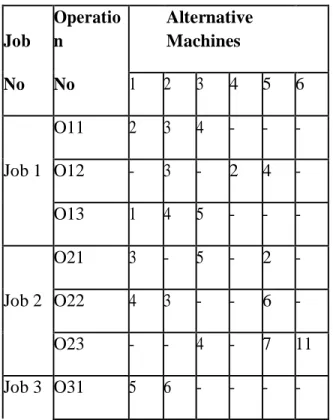
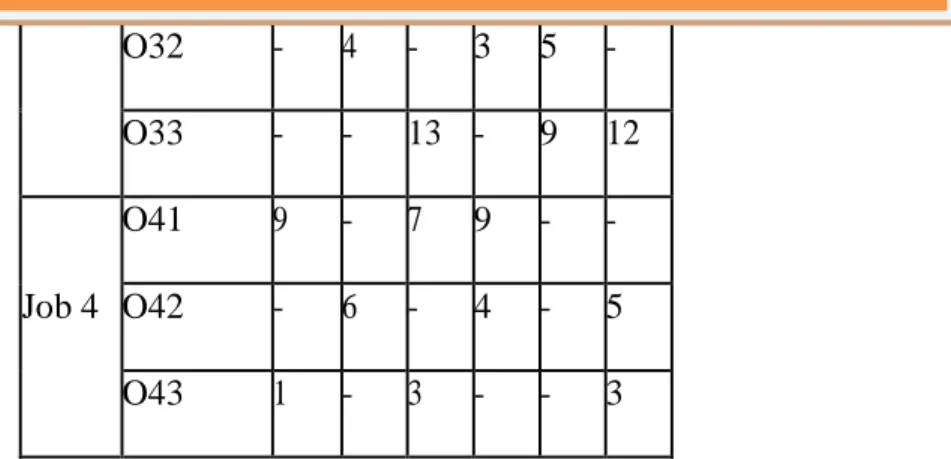
The principal occasion has been taken from Nasr and Elsayed [16]. The case comprises of four employments each having three operations to be prepared on six machines. There might be various machines
to handle any one operation. The
employment shop information is given in Table 1:
Table 1: Problem data for Nasr and Elsayed
Job
Operatio n
Alternative Machines
No No 1 2 3 4 5 6
Job 1
O11 2 3 4 - - -
O12 - 3 - 2 4 -
O13 1 4 5 - - -
Job 2
O21 3 - 5 - 2 -
O22 4 3 - - 6 -
O23 - - 4 - 7 11
O32 - 4 - 3 5 -
O33 - - 13 - 9 12
Job 4
O41 9 - 7 9 - -
O42 - 6 - 4 - 5
O43 1 - 3 - - 3
The aftereffect of the heuristic method created by Nasr and Elsayedis contrasted and the proposed GA. Nasr and Elsayed's heuristic gives a normal stream time of 12.25 with stream time of each employment as 7, 11, 18 and 13 separately, be that as it may, proposed GA finds a mean stream time of 11.75 with stream time for occupation 1,
2, 3 and 4 as 6, 11, 17 and 13 individually[17].
The second occasion has been embraced from the occurrence comprises of eight occupations to be handled on six machines with an aggregate of twenty operations. The priority relationship of the occupations is appeared in fig. 3.
Fig 3. Precedence relationship diagram for instance 2
The proposed GA got an estimation of 23 for the makespan for example 2. The makespan for a similar issue detailed by Lee et al. utilizing GA, Chan et al. utilizing
utilizing half breed GA was 34, 26, 24, 30, and 23 separately. The subsequent Gantt outline is given in Fig. 4.
Third case has been received from Lee and DiCesare. The occasion comprises of five employments to be prepared on three machines. The goal is to limit makespan. The outcomes revealed by Lee and
DiCesare utilizing petrinet based technique , Kumar et al. utilizing insect state streamlining (ACO) , Leung et al. utilizing ACO , Chan et al. utilizing GAs and Leung et al. were 439, 420, 390, 360 and 380 individually. The proposed GA approach acquired the makespan estimation of 360 for a similar issue[18].
Fig. 4 Gantt Chart for instance 2
VI. CONCLUSION
In this paper we exhibited a GA approach for incorporated process planning and booking. The universally useful GA routine is the Microsoft Excel. The proposed approach utilizes a broadly useful GA
calculation. The model joining the
imperatives on a shop floor are actualized
in the spreadsheet demonstrates.
Examination with prior reviews
demonstrates that the execution of the proposed calculation is better than the already announced outcomes.
Coherent plan of information as tables inside the spreadsheet condition empowers a client to complete moment consider the
possibility that investigation. Besides, any target capacity could be utilized without either changing the shop demonstrate or the GA schedule. Also the model can extremely be effectively tweaked to incorporate extra imperatives, machines, employments and so forth all things considered.
REFERENCES
1. CHUNWEI ZHAO AND ZHIMING
WU, A Genetic Algorithm Approach to the Scheduling of FMSs with Multiple Routes, The International Journal of Flexible Manufacturing Systems, 13, 71-88, 2001
in search, optimization and machine learning, 1989, Addison-Wesley, Boston.
3. Holland, John H (1975), Adaptation
in Natural and Artificial Systems, University of Michigan Press, Ann Arbor
4. K. F. Man, K. S. Tang, S. Kwong&
W. H. Ip (2000): Genetic algorithm
to production planning and
scheduling problems for
manufacturing systems, Production Planning & Control, 11:5, 443-458
5. Kim K.H, Egbelu P.J.: Scheduling
in a production environment with multiple process plans per job. International Journal of Production Research, 37 (1999) 2725-2753
6. Kruth, J.P. and Detand, J., 1992, "A
CAPP System for Nonlinear Process Plans", Annals of the CIRP, 41(1), 489-492.
7. Lee, H. and Kim, S., 2001.
Integration of process planning and scheduling using simulation based
genetic algorithms. International
Journal of Advanced Manufacturing Technology, 18, 586-590.
8. M. A. B. CANDIDO , S. K.
KHATOR and R. M. BARCIA, A genetic algorithm based procedure
for more realistic job shop
scheduling problems, int. j. prod. res., 1998, vol. 36, no. 12, 3437-3457
9. Mitsuo Gen, Lin Lin, Haipeng
Zhang, Evolutionary techniques for optimization problems in integrated manufacturing system: State-of-the-art-survey, Computers & Industrial Engineering 56 (2009) 779-808
10.Morad, N. and Zalzala, A., 1999.
Genetic algorithms in integrated process planning and scheduling. Journal of Intelligent Manufacturing, 10, 169-179.
11.Nasr N, Elsayed EA. Job shop
scheduling with alternative
machines. International Journal of Production Research 1990;28:1595-609.
12.Rakesh Kumar Phanden, Ajai Jain &
Rajiv Verma (2011): Integration of process planning and scheduling: a state-of-the-art review, International Journal of Computer Integrated Manufacturing, 24:6, 517-534
13.Shafaei R, Brunn P. Workshop
scheduling using practical
(inaccurate) data. Part 3: a
framework to integrate job releasing, routing and scheduling functions to create a robust predictive schedule. International Journal of Production Research 2000;38:85-99.
14.Sundaram, R. Meenakshi, and
Shong-Shun Fu, "Process Planning and scheduling," Computers and Industrial Engineering 15.1-4 (1988): 296-301.
15.WEI TAN and BEHROKH
process planning and scheduling - a
review, Journal of Intelligent
Manufacturing (2000) 11, 51-63
16.Wilhelm, W.E. and Shin, H.-M.,
1985, "Effectiveness of Alternate
Operations in a Flexible
Manufacturing System",
International Journal of Production Research, 23(1), 65-79.
17.Xinyu Li, Liang Gao, Chaoyong
Zhang and Xinyu Shao, A review on Integrated Process Planning and Scheduling, Int. J. Manufacturing Research, Vol. 5, No. 2, 2010, 161-180.
18.Xirouchakis, P., Kiritsis, D. and