www.ijseat.com
Page 120
Token Based Fair Queuing Algorithms for Wireless Networks
Ravindra R Patil Assistant Professor, CSE,
Sir M. Visvesvaraya Institute of technology, Bngalore-562157
Abstract
Token Based Fair Queuing (TBFQ) algorithm has been proposed for single carrier Time Division Multiple Access (TDMA) systems, to suit WINNER Orthogonal Frequency Division Multiple Access (OFDMA) air-interface. This algorithm takes Quality of Service (QoS) attributes such as priorities, interflow fairness, and time bound constraints into account. We use a token-based scheduler to determine which packet should be scheduled to transmit in the next frame. By selecting the user terminals (UTs) in a certain prioritized manner derived from QoS attributes, the performance of the UTs, suffering from high interference, can be improved. In This paper, TBFQ algorithm has been simulated in a multicell environment in the presence of intercell interference by comparing with reference Score Based (SB) algorithm. The simulation results show that the presented algorithm provide a better fairness at a lower implementation at all level implementation complexity while simultaneously achieving comparable network utilization by considering time bound associated to particular packets.
Keywords: QoS, scheduling, Fairness, time bound.
1. Introduction
In recent years there has been tremendous growth in the wireless networking industries. With the increasing usage of wireless networks in both indoor and outdoor computing environments, the issue of providing fair channel access among multiple contending packet flow over a scarce and shared wireless channel has come to the fore[1]. Recently, a number of algorithms have been proposed for adapting fair queuing to the wireless domain [2-4]. However, there has not been any work to precisely characterize the desired service model in terms of a wireless fair service and to define unified wireless fair queueing architecture to achieve wireless fair service [5]. In addition, the failure of traditional fluid fair queueing in the presence of location-dependent
channel error [6] and the compensation model flows that perceive channel error and the trade-off between full separation and compensation, and its impact on fairness of channel access [7]. Wireless fair queueing (WFQ) is an approximation algorithm designed for providing fairness and delay bound properties and delay bound properties to emulate the generalized processor sharing (GPS) scheme, which is based on a fluid model but cannot be practiced in the real world, at the packet level. Many other packet fair queuing algorithms, such as start-time fair queuing [8], self-clocked fair queuing, and worst-case fair weighted fair queuing are also proposed to approximate the service of GPS [9]. Consequently, the fair queueing algorithms proposed in literature for wire-line networks do not apply directly to wireless networks. In a related work, the proposed WFQ algorithm that addressed a number of the issues raised above. The objective of this work was to simulate a WFQ based Token-based packet scheduling scheme classify packets into time deadline and non time deadline packets. Each category packets are inserted into two queues first preference is for time deadline packets then non time deadline packets. This scheme is investigated through extensive simulation considering system parameters. The rest of the paper is organized as follows. In Section II, the system model and TBFQ algorithm is described in detail along with its parameter selection and methods of fairness assessment. The simulation parameters and Simulation results are presented in Section III. Section IV concludes the work.
2. System Model
provided the user terminal (UT) does not exceed its bandwidth allocation in the long term. This prevents sudden degradation of quality of service experienced by the end user as a result of traffic profile violations. TBFQ penalizes violating traffic less severely as it is able to service a packet, which might otherwise be discarded by per flow policing mechanism, by distributing unused bandwidth from other connections. A work conserving scheduler is never idle while there are packets waiting to be transmitted in the service queues [11]. On the other hand, a non-work conserving scheduler may be idle even if their packets waiting to be served. In a wireless network it may be better to postpone a terminal from transmitting if the channel condition is poor; this gives the opportunity for other terminals to utilize the bandwidth while their channel condition may be better [12]. The postponing of scheduling service due to impaired channel condition can turn a work conserving algorithm to a non-work conserving one. The parameters of the algorithm are defined with respect to a packet based system. Each frame in a TBFQ can be considered as a round in a round robin based system except that in each frame the order of service will change according to the priorities assigned to the users[13]. A round is generally defined as having varied time intervals and the length of which depend on the completion of servicing all the flows in turn in the system. Frames are intervals with fixed time period [14]. The structure for TBFQ in the downlink is shown in Fig. 1.
Consider l is the size of the packet that is checked by the token-based scheduler, is the jth packet of flow i which is scheduled in the next frame, Li is the total length of the scheduled packets of flow i. That is Li = ∑ jl ji, Remained slots available for scheduling = C - ∑i┌L i┐ Assume that there are C slots available for downlink traffic each frame, each flow i maintains a token value ti, The token value of every session i has fixed token incremental rate ri, the unit of ri is slots / frame.
At each beginning of a frame, the token value of session i is increased by ri slots. The work of updating the token value of every flow at the beginning of a frame is done by the token generator.
When a packet of flow i with size l (normalized to slots) is scheduled to transmit, it must take the token value equal to the amount of the size of the packet away. And the number of slots available for scheduling is also decreased by Li is the total length of the scheduled packets of flow i and with size l is scheduled ti -1, L+=1, remained slot = C - ∑i┌L i┐. There should be an upper bound of the token value Ti then frame starts ti
flow I. We can regarded ri as the protected capacity of flow i. The configuration of ri can affect the system performance significantly. The basic principal of scheduling is assumed is as follows.
[1] The packet has sufficient token value to transmit it has the higher priority, or it has the lower priority
[2] For the packets with the same priority, the scheduling order is according to the order in TBFQ scheduler
www.ijseat.com
Page 122
The selection procedure and debt allocationprocedure are given below.
Pack selection procedure (Fig-3)
system_capacity {
remained_slotsystem_capacity; for (each flow j) {blockj= 0}
for (each virtual queue, from highest priority to lowest priority)
While (packet not checked in the virtual queue) { ithe flow the packet belong to;
lthe size of the checked packet; if (remained_slot┌L
i+l┐-┌Li┐and ltiand blocki = = 0)
{ schedule this packet in the next frame; Remaind_slot - =┌L
i+l┐-┌Li┐; Ti- = l;
} else blocki=1; }}
Debt-allocation-procedure (remained_slot); }
Debt allocation procedure (Fig-5)
Debt_allocation_procedure (remained_slot) { for(each flow j)
blocki0;
for (each virtual queue, from the highest priority to the lowest priority){
while (packets not checked and not scheduled in the virtual queue){
ithe flow the packet belong to; lthe size of the packet; if (remained_slot┌L
i+l┐-┌Li┐and blocki!=1) { schedule the packet in the next frame
debt-1*max(ti-l, -l);
ti - = l;
remained_slot - =┌L
i+l┐-┌Li┐; for(all real-time flows k) {
= + ∑∗
, ;
}} else Blocki1}}}
3. System simulation results
Parameter Used Value/Model Signal bandwidth: 3kHz Scheduler TBFQ Frame duration Maximum of 1 second Traffic model Payload data model Packet size 64 kb Packet drop criterion Maximum 1 second Simulation Time 50 seconds Simulation Tool Matlab .
Table 1. Summary of Simulation Parameters
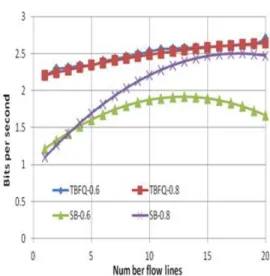
Fig. 7 shows the comparison of spectral efficiency of the TBFQ algorithm with that of scored based when the number of users is varying. Two levels of interference activity factor (0.6 and 0.8) are shown. It is seen that for low loading levels, TBFQ outperforms scored based.
This difference is due to the opportunistic nature of scored based as it tries to take advantage of multiuser diversity which is not available at low loading levels. This becomes more evident at medium to high loading when scored based outperforms ATBFQ when there are more flow lines (users). It tries to maximize the spectral efficiency by selecting users with the best channel conditions whereas TBFQ tires to maintain fairness by distributing resources to deprived users with bad channel condition. This will
become more evident when the performance results for queuing delay.
Fig.9 and Fig. 10 show the effect of number of flow line and activity factor on queueing delay in milli second for TBFQ and SB respectively.
www.ijseat.com
Page 124
fairness at high loading, it incurs high queuingdelays.
4. Conclusion
TBFQ is well designed algorithms with low complexity offering fairness among and potentially differentiation between different data-flows is important in the evolution of networks. It is also shown how the TBFQ scheduler can significantly improve the performance for cell edge users in terms of throughput and packets distribution. The developed TBFQ algorithm provides short and long term fairness among all flows which perceive a clean channel with bounded channel error, optimal schedulable region by decoupling delay, weights and support both delay sensitive and error sensitive flows.
References
[1] F. Tsou, H. Chiou, and Z. Tsai, “WDFQ: An Efficient Traffic Scheduler with Fair Bandwidth Sharing for Wireless Multimedia Services,” IEICE TRANS. COMMUNICATIONS, Vol. E00-A, No. 1, Jan. 2000
[2] T. E. Kolding, K. I. Pedersen, J. Wigard, F. Frederiksen, and P. E. Mogensen, "High Speed Downlink Packet Access: WCDMA Evolution," IEEE Vehicular Technology Society News, February 2003, pp. 4-10.
[3] P. Viswanath, D. Tse, and R. Laroia , “Opportunistic beam forming using dumb antennas,” IEEE Transactions on Information Theory, vol. 48, no. 6, June 2002.
[4] T. E. Kolding, “Link and system performance aspects of Proportional Fair scheduling in WCDMA/HSDPA,” Proceedings of 58th IEEE Vehicular Technology Conference (VTC), Florida USA, October 2003, pp. 1454-1458.
[5] L. Erwu, and K. K. Leung, "MAC 205 -Proportional Fair Scheduling: Analytical Insight under Rayleigh Fading Environment", IEEE Wireless Communications and Networking Conference, April 2008
[6] Z. Shen, J. G. Andrews, and B. L. Evans, “Adaptive resource allocation for multiuser OFDM with constrained fairness,” IEEE Transactions on Wireless Communications, 4(6): 2726-2737, Nov. 2005.
[7] Y. Lu, C. Wang, C. Yin ,and G. Yue, “Downlink scheduling and radio resource allocation in adaptive OFDMA wireless communication system for user-individual QoS,” International Journal of Electrical, Computer, and Systems Engineering 2009 [8] P. Zhou, O. Yang Design and analysis of per-flow queueing switches and VC-merge switches
based on per-VC queueing architecture Computer Communications Volume 23, Issues 14–15, 30 August 2000, Pages 1400–1409
[9] Dirk Abendroth, Martin E. Eckel, Ulrich Killat, Solving the trade-off between fairness and throughput: Token bucket and leaky bucket-based weighted fair queueing schedulerse AEU -International Journal of Electronics and Communications, Volume 60, Issue 5, 2 May 2006, Pages 404-407
[10] L. Lenzini, E. Mingozzi, G. Stea, Packet timed token service discipline: a scheduling algorithm based on the dual-class paradigm for providing QoS in integrated services networks Computer Networks, Volume 39, Issue 4, 15 July 2002, Pages 363-384
[11] Abhinav Kamra, Huzur Saran, Sandeep Sen, Rajeev Shorey, Fair adaptive bandwidth allocation: a rate control based active queue management discipline
Computer Networks, Volume 44, Issue 2, 5 February 2004, Pages 135-152
[12] Tetsuji Yamaguchi, Yutaka Takahashi, A queue management algorithm for fair bandwidth allocation Computer Communications, Volume 30, Issue 9, 30 June 2007, Pages 2048-2059
[13] Suwon Lee, Kiseon Kim, Aftab Ahmad, Delay and data rate decoupled fair queueing for multimedia services in wireless networks, Computer Communications, Volume 26, Issue 17, 1 November 2003, Pages 1944-1956