Successful Planner/Developer Collaborations
for “Workforce” Housing in California
Hemalata Dandekar
PhD; Professor, City and Regional Planning Department, Cal Poly.ousing afforda ilit is a significant arrier to social and economic growth in alifornia. n this article,
r. emalata ande ar reports on her research on successful housing projects for low and moderate
income families private sector and non profit developers in colla oration with cit and count planning
departments. The research was funded the alifornia epartment of ousing and ommunit evelopment.
A
˜ordable housing that is proximate to places of employment is crucial to sustaining California’s economic competitiveness.1 A signiÿcant barrier to this is particularly so in highly impacted metropolitan California communities, located in high amenity regions such as coastal and scenic recreation areas, is borne out by the high median price of housing in these areas.Here the demand for housing is met at the higher end by conventional market driven residential development. But this market rate housing is out of reach for and renders “housing burdened” a signiÿcant number of working but low and moderate income families. And these low and moderate-income families are increasingly displaced from, or voluntarily leave, amenity-rich high cost coastal areas for less expensive housing markets in the region. They have thus inherited or taken on long commutes to and from job centers and the related impacts of these commutes on families and on their local communities.In the San Francisco Bay Area's Silicon Valley, the growth of the high technology industry and its impact on regional housing markets has been widely noted including in the popular media.2 And ongoing academic researchers have examined the
1 See Driving Home Economic Recovery: How Workforce Housing Boosts Jobs and Revenues in Marine (http://nonproÿthousing.org/ wpcontent/uploads/DrivingHomeEconomicRecovery.pdf; accessed Oct. 12, 2014) and Building Livable Communities Enhancing Economic Competitiveness in Los Angeles (http://labcinstitute.org/ÿles/LABC_ MHTJ_Report_2012_only_ÿnal_r-1.pdf ; accessed Oct. 12, 2014). See also studies by the Marin Community Foundation (www.marincf.org). 2 See J. Kloc “Tech Boom Forces a Ruthless Gentriÿcation in San Francisco” (Newsweek, April 15, 2014; http://www.newsweek. com/2014/04/25/tech-boom-forces-ruthless-gentriÿcation-san-francisco- 248135.html) and S. Chokshi "Mapping Silicon Valley’s Gentriÿcation Problem Through Corporate Shuttle Routes" (Wired, September 2013; http://www.wired.com/2013/09/mapping-silicon-valleys-corporate-shuttle-problem/
resulting gentriÿcation and potential for displacement on the health and economic wellbeing of communities.3 The urgent need to seek housing solutions for low and moderate-income households in California, loosely referred to as “workforce”4 households, through private sector initiatives is re˛ected in data on housing prices.5 A study supported by four key state agencies analyzed the cost of building multifamily housing in California listed as its ÿrst conclusion (pg. 5) that:
“Local factors have an impact on costs. Speciÿcally, projects with more community opposition, signiÿcant changes imposed by local design- review requirements, or that received funding from a redevelopment agency cost more, adding 5 percent, 7 percent, and 7 percent, respectively, to the cost per unit, on average.”6
The above observation, that housing is quintessentially deÿned and enabled by local realities, is the underlying premise that was explored in a study led by the author and supported by a grant from the Division of Housing, Policy Development
3 K. Chappel, Mapping Susceptibility to Gentriÿcation: The Early Warning Toolkit. http://communityinnovation.berkeley.edu/reports/ Gentriÿcation- ˝Report.pdf; August 2009.
of the California Department of Housing and Community Development (CDHCD).7 It provides some hopeful ÿndings, namely that private sector and non-proÿt developers in collaboration with city and county planning departments have constructed, without deep state or federal government subsidy, housing for low and moderate-income “workforce” families.
Identifying such successful projects was not easy. The examples that were found are “demonstration projects” and attributable to the tenacity of many individuals - developers, city and county planners, construction managers, architects, urbanists, real estate agents, executives of non-proÿt organizations and housing trust funds and their commitment to seeing these buildings to completion and occupancy. They provided the detailed information of on-the-ground realities that only those who are directly engaged with construction know intimately. And as such their insights o˜er valuable lessons to both planners and developers seeking to expand the units of housing for low and moderate-income families in a climate where only scant federal and state support for such production is available and perhaps not cost e˜ective.
Research Method
The study's goal was not only to identify exemplary projects but also distill from them the “take away” characteristics that made for success and thus help others to replicate such e˜orts in other communities and contexts.
The experience of some eighty-two experts, many of them planners at the city and county levels and developers, was tapped in that initial e˜ort to identify successful projects. They responded to an on-line survey developed by the Cal Poly CRP research team that helped deÿne the context of housing in various regions of California. The survey consisted of ÿfteen questions aimed at identifying:
• Perception of need for low and moderate-income housing; • Location of housing projects that demonstrated
innova-tions in design, regulatory practices, and/or, ÿnance.
A total of 82 responses were received between mid-March 2015 to end of June 2015 from individuals employed in the following sectors: 71% Public; 14% Private; and 15% Non-Proÿts.
Question 7 of the survey asked if there was a need for housing a˜ordable to low and moderate-income households in their region, and to estimate the level of need. 52 respondents
7 Hemalata C. Dandekar, Designing A°ordability: Innovative Strategies for Meeting the A°ordability Gap between Low Income Subsidy and the Market in High Cost Areas. Report submitted to the California Department of Housing + Community Development, Division of Housing Policy Development; December 2015.
answered as follows: • 65% High • 25% Moderate • 6% Low • 4% None
Thus, some 90% of respondents identiÿed a high or moderate need for housing for the low and moderate- income group. And respondent comments corroborated this overview indicator.8 The survey responses also helped identify potential case studies that had promise of meeting the stipulated criteria –housing for low and moderate income families constructed without beneÿt of state or local subsidy.9
Twenty-three planning and architecture students in the CRP 442 Housing and Planning Spring 2015 class taught by the author also identifyied suitable cases and developed preliminary descriptions. Eight of these were further researched as selected case studies in the ÿnal report. The research team developed a matrix of 38 successful projects located throughout California which were winnowed down to ten projects that scored highest for innovations along the following parameters:
Design: The design categories examined included smaller by design, manufactured homes, modules or components, ˛exible design, and, adaptive reuse. The design analysis also included examining projects for design strategies such as mixed use, small lot, multifamily and higher density.
8 A planner from the City of Cupertino, South Bay Area said: “Housing for moderate income workers in Cupertino is virtually nonexistent.” Another planner from the City of Lindsay in the Central Valley noted: “Our local projects that are targeted for the low to moderate income population are generally backed by some sort of assisted funding mechanism. Without assistance, home ownership and sometimes even apartment rental is incredibly di˝cult to achieve for the low to moderate income population.”
This planner went on to pinpoint some pitfalls inherent in the approach that is taken by local planners in the face of few incentives for incentives to create housing for workforce households: “When the preference to target low to moderate income population is over-exercised we neglect the development of moderate to high income housing. This leaves communities over saturated with a population that struggles to obtain basics like food and clothing for their families and thus have virtually nothing left over for extras like movie theaters, shopping malls, new cars, etc. that increase local tax dollars and the need for new businesses that could also provide new jobs."
Regulation: The regulatory categories examined included
relaxation of parking requirements, density and height increases, setbacks and plot size reduction as well as streamlining approvals and deferring fees.
Finance: Financial strategies considered include innova-tive ownership, tenancy and rental arrangements such as shared ownership/occupancy in co-ops/co-housing, house-sharing, ancillary dwellings and live-work arrangements.
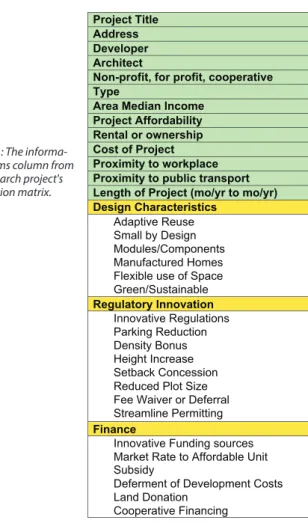
The 38 selected projects were analyzed on their innovations in design, regulation and ÿnance in a matrix format (Figure 1).
Findings
The successful housing is recent, built in the last decade, and primarily located in regions of California where housing and land prices have escalated, employment has increased, and the demand for housing is extremely high. These successful projects o˜er an alternative approach, predicated upon the convergence of entrepreneurial design, responsive government and shifting housing preference. They vary greatly, responding to local needs in high cost areas, to ÿll the a˜ordability gap between subsidized and market rate housing.
Our Designing A°ordability study features ten cases that underscore the localized, context-grounded nature of housing choices low and moderate-income households are making to obtain housing close to work that is not a burden on household budgets. The developments track trends in housing preference more recently attributed to young professionals - an acceptance of smaller housing, closer to amenities, with a reduced dependency on the automobile. The trade-o˜s in housing consumption that these preferences represent, and the ways in which some entrepreneurial developers and local governments are responding, provides useful lessons.
These lessons are not a blueprint for project-speciÿc replication, but identify opportunities for housing households not typically served by public investment yet priced out of the competitive high amenity housing markets in California. Featured case studies showcase rental and ownership projects located near work and public transit, student housing near educational facilities, and shared open space residential development within walking distance of jobs, recreation, shopping and services. They highlight key planning and development strategies:
Key Attributes of Identiÿed Projects
• Changes in land use regulations that enable increased density, lot coverage, and smaller units.
• Flexible space conÿguration to respond to changing market demand and client preferences.
Figure 1: The informa-tion items column from the research project's innovation matrix.
Project Title Address Developer Architect
Non-profit, for profit, cooperative Type
Area Median Income Project Affordability Rental or ownership Cost of Project Proximity to workplace Proximity to public transport Length of Project (mo/yr to mo/yr) Design Characteristics
Adaptive Reuse Small by Design Modules/Components Manufactured Homes Flexible use of Space Green/Sustainable
Regulatory Innovation
Innovative Regulations Parking Reduction Density Bonus Height Increase Setback Concession Reduced Plot Size Fee Waiver or Deferral Streamline Permitting
Finance
Innovative Funding sources Market Rate to Affordable Unit Subsidy
Deferment of Development Costs Land Donation
Cooperative Financing
• Pragmatic attention to detail, aesthetically designed for environmental sustainability and long-term functionality.
• Cross subsidy from units sold at market rate.
Areas of Innovation in Ten Selected Projects
1. Small by Design (90%)
Smaller size units reduce the cost of entry to housing (Figure 2). These units have been accepted and are selling in the market which supports the building professions’ sense that in high land value contexts smaller, denser, minimalist housing, shared amenities and open space with neighbors, is gaining acceptance. Young urban professionals are the demographic that is most receptive to these units.
2. Flexibility in Unit Design and Mix (70%)
Figure 2: Micro-units in Downtown San Francisco. The Panoramic, by developer Patrick Kennedy (in the foreground).
Figure 3: Accessary Dwelling Unit (ADU) in Santa Cruz resulting from adopting the prototype designs commissioned by the city.
space, storage or workshop), or put to a di˜erent use (nursery, guest room, accessory dwelling unit). This ˛exibility promises to provide a hedge against obsolescence (Figure 3).
3. Green by Design (80%)
Projects designed to exceed California (CalGreen) building standards and/or adopt adaptive reuse strategies yield energy and cost savings that might allow units to retain greater a˜ordability into the future. Repurposed units also restrain costs when the project is reconÿgured on a smaller-by-design and/or mixed-use footprint.
4. Parking Reduction or Elimination (80%)
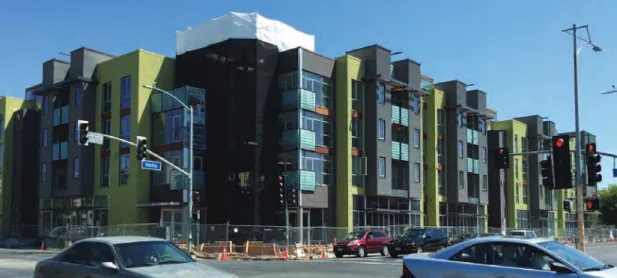
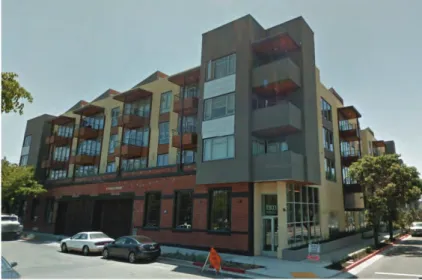
Projects strategically located near sites of employment, education, recreation, and services encourage residents to use alternative modes of travel including bikes, electric scooters, and public transport (Figure 4 & 5). Low or no parking requirements are extremely important in the success of almost all the featured projects.
5. Density Bonus (90%), Height Increases (80%), Setbacks Concessions (90%)
All projects have beneÿtted from one or more regulatory concessions on the maximum allowable built-up area, setback requirements, density bonuses and allowable height. These have at times enabled a doubling or more of the total square footage built.
6. Cross Subsidy from Units Sold at Market Rate (70%)
Proÿts from sale of units at market rate, as well as from commercial and retail/service space sold or leased at market rate have cross-subsidized the price of units for low and moderate-income households (Figure 6 a & b). In one case, direct transfer of in lieu fees captured from a commercial development to land held in trust for a˜ordable housing provided interim ÿnancing for predevelopment costs, allowing
a public non-proÿt developer to obtain a conventional loan to construct shared-equity townhomes for local workers.
Summary
There is insu˙cient publicity about creative solutions such as these projects. Clearly they are still being tested by the market. The fact is that the projects described in the study such as Parc on Powell in Emeryville, Moylan Terrace in San Luis Obispo and the Panoramic in San Francisco and others have received favor-able publicity and won awards. They deserve to receive wider recognition for their innovations and what they have been able to achieve. This study navigated local planning, design and building channels in order to gain access to how creatively bundled incentives can work. For each location included in this study the successful project development team analyzed local risk, market, interest, and collaboration to formulate an invest-ment strategy that has worked for speciÿc sites under circum-stances particular to local conditions and prevailing construc-tion costs —land, labor, materials and ÿnance. Developers did not seek tax credits and other federal or State public funds for these projects. They note as deterrents the underlying costs of reporting, documentation, labor constraints, and timing when funds become available to apply to projects.
The ideas and innovations represented in these projects are not radical or particularly new, but they were creatively assembled, implemented and timed well. In most cases, reduced parking requirements, zoning and building codes that supported smaller building footprint and design, set back reductions, height increases and density bonuses, allowed for more units to be constructed on expensive land so as to restrain cost per unit and provide a cross subsidy for a˜ordable units.
The manner in which the partners resolved the inevitable ten-sions that arise amidst planning and design, regulatory over-sight, evolving and proprietary investment, escalating hous-ing prices and broader market ˛uctuations sets these projects apart. The variety of ways in which these experts, in their sepa-rate ÿelds, teamed up to identify barriers and created stsepa-rate- strate-gies to navigate the local planning process, governmental regulation and economic uncertainty is worth understanding. Their e˜orts have made it possible to o˜er market-rate a˜ord-able housing options to middle income workers who are ineli-gible for government subsidies but unable to a˜ord conven-tional housing in high cost areas. These examples o˜er some good news in a bleak landscape of housing inaccessibility for low and moderate-income families. They should encourage local governments and housing developers to ÿnd their own winning strategies to build housing that meets the needs of these “workforce” households in Californians.
Figure 5: Corner view of the Parc on Powell in Emeryville. The project received several variances to include 22% of its units below market rate.