S T U D Y P R O T O C O L
Open Access
A screen-based simulation training
program to improve palliative care of
people with advanced dementia living in
residential aged care facilities and reduce
hospital transfers: study protocol for the
IMproving Palliative care Education and
Training Using Simulation in Dementia
(IMPETUS-D) cluster randomised controlled
trial
Joanne Tropea
1*, Christina E. Johnson
2, Debra Nestel
3, Sanjoy K. Paul
1, Caroline A. Brand
1,
Anastasia F. Hutchinson
4, Ross Bicknell
5and Wen Kwang Lim
5Abstract
Background:Many people with advanced dementia live in residential aged care homes. Care home staff need the knowledge and skills to provide high-quality end-of-life (EOL) dementia care. However, several studies have found EOL dementia care to be suboptimal, and care staff have reported they would benefit from training in palliative
care and dementia. Simulation offers an immersive learning environment and has been shown to improve learners’
knowledge and skills. However, there is little research on simulation training for residential care staff.
This article presents the development and evaluation protocol of IMproving Palliative care Education and Training Using Simulation in Dementia (IMPETUS-D) - a screen-based simulation training program on palliative dementia care, targeted at residential care staff. IMPETUS-D aims to improve the quality of palliative care provided to people living with dementia in residential care homes, including avoiding unnecessary transfers to hospital.
(Continued on next page)
© The Author(s). 2019Open AccessThis article is distributed under the terms of the Creative Commons Attribution 4.0 International License (http://creativecommons.org/licenses/by/4.0/), which permits unrestricted use, distribution, and reproduction in any medium, provided you give appropriate credit to the original author(s) and the source, provide a link to the Creative Commons license, and indicate if changes were made. The Creative Commons Public Domain Dedication waiver (http://creativecommons.org/publicdomain/zero/1.0/) applies to the data made available in this article, unless otherwise stated. * Correspondence:[email protected]
1Melbourne EpiCentre, Royal Melbourne Hospital, University of Melbourne
and Melbourne Health, 7 East Main building, 300 Grattan Street, Parkville, VIC 3050, Australia
(Continued from previous page)
Methods:A cluster RCT will assess the effect of IMPETUS-D. Twenty-four care homes (clusters) in three Australian cities will be randomised to receive either the IMPETUS-D intervention or usual training opportunities (control). The primary outcome is to reduce transfers to hospital and deaths in hospital by 20% over 6-months in the intervention compared to the control group. Secondary outcomes include uptake of goals of care plans over 6 and 12 months, change in staff knowledge and attitudes towards palliative dementia care over 6 months, change in transfers to hospital and deaths in hospital over 12 months. For the primary analysis logistic regression models will be used with standard errors weighted by the cluster effects. A mixed methods process evaluation will be conducted alongside the cluster RCT to assess the mechanisms of impact, the implementation processes and contextual factors that may influence the delivery and effects of the intervention.
Discussion:In Australia, the need for high-quality advanced dementia care delivered in residential aged care is growing. This study will assess the effect of IMPETUS-D a new simulation-based training program on dementia palliative and EOL care. This large multisite trial will provide robust evidence about the impact of the intervention. If successful, it will be distributed to the broader residential care sector.
Trial registration:ANZCTR,ACTRN12618002012257. Registered 14 December 2018.
Keywords:Dementia, Cluster RCT, Palliative care, End-of-life care, Simulation training, Care worker education, Nursing education, Long-term care homes; nursing homes, Quality of care, Process evaluation,
Background
Dementia is a progressive, terminal neurological disease. As dementia progresses, cognition and physical function declines and care needs increase, often resulting in ad-mission to residential care. In Australia, residential care is a key provider of palliative and end-of-life (EOL) care to people with advanced dementia, with over 50% of people living in residential care having a confirmed diag-nosis of dementia [1]. This number is likely to be an under-estimate due to the under-diagnosis of dementia.
Features of high-quality palliative care for people with dementia includes: a person-centred approach, clear communication, shared decision making including set-ting care goals and advance care planning, optimal treat-ment of symptoms, continuity of care, psychosocial and spiritual support, family care and involvement, societal and ethical issues, and prognostication and timely recog-nition of dying [2]. However, several studies have shown people with advanced dementia living in residential care often receive suboptimal palliative care - advance care planning is not adequately addressed, unnecessary trans-fers to hospital occur, uncomfortable interventions are common, and distressing symptoms are not always ad-equately recognised or managed [3,4].
Studies have also reported health care workers who provide care to people with dementia lack confidence in their skills, and recommend educational strategies to im-prove the quality of palliative and EOL dementia care [5,
6]. This was highlighted in a survey conducted by Alz-heimer’s Australia, in which 90% of care professionals indicated that additional training on palliative care and dementia would be beneficial [4].
Although those providing palliative care to people with dementia feel they would benefit from additional
training, there is limited evidence to support use of palliative care training. Previous studies have shown either no impact on clinical outcomes or, have been of low methodological quality with high risk of bias due to study design [7, 8]. This was highlighted in a narrative review by Raymond et al. (2014) where dementia-specific palliative care training failed to show benefits for people with dementia [8].
The palliative care training and education interven-tions assessed in previous studies used train-the-trainer, and workshops with predominantly didactic presenta-tions. Simulation is an innovative training concept in the residential care workforce. Simulation-based training of-fers an immersive learning environment that facilitates deliberate practice. There are many types of simulation modalities with technological developments fostering the uptake of screen-based approaches. That is, simulations that are viewed on computers, tablets or smartphones, offering features such as audio-visual sharing and cap-ture of information, repetitive practice and feedback for both individual and group use, that are available when and where they are needed assuming internet and other infrastructure is accessible. A screen-based approach of-fers a way to upskill the busy and often time poor resi-dential aged care workforce as it can be accessed at their convenience.
In this study the effect of a new training program IM-proving Palliative care Education and Training Using Simulation in Dementia (IMPETUS-D) will be assessed. IMPETUS-D is a screen-based simulation training pro-gram designed to improve care for people with advanced dementia living in residential care. The targeted learners will be nursing and care attendant staff in residential care settings.
This study will use a cluster randomised controlled trial (RCT) design, in parallel with a process evaluation using mixed-methods research. The primary hypothesis is that residential care facilities that participate in the IMPETUS-D training program will reduce the propor-tion of transfers to hospital and/or deaths in hospital among residents with dementia by 20% over 6 months, compared with the control group.
Methods/design
Study design
This is a multi-centre, facility-level cluster RCT, with parallel mixed methods process evaluation. Residential aged care facilities (RACFs) will be randomly allocated to the intervention (IMPETUS-D program) or the con-trol group (usual training).
Study setting
The study will be conducted in 24 RACFs (12 interven-tion and 12 controls) of one Australian private aged care provider, across three Australian cities: Sydney, Mel-bourne and Adelaide.
Recruitment of RACFs (clusters)
All RACFs that participate are part of a single Australian private aged care provider. The provider is a collabora-tive partner in the study. To be eligible for inclusion in the study RACFs needs to have at least 20 people with dementia permanently living in the care home and re-quiring high level care. The residential care homes that meet the inclusion criteria will be recruited into the study for randomisation and group allocation.
Randomisation and blinding
Individual RACFs (clusters) in the trial will be rando-mised to training or control group, with staff at the RACF receiving either the intervention training or the control group. The allocation sequence will be generated by an independent statistician using a computer-generated allocation sequence. The randomisation will use blocks of 4 stratified by city location (Sydney, Mel-bourne or Adelaide) and facility size (small or large, based on the total number of residents). Small RACFs are defined as having 70 or less residents and large RACFs defined as having greater than 70 residents living in the care home. The randomisation list will be stored
and maintained in a secure location by a statistician who is independent from trial recruitment or training so as to preserve blinding.
Intervention
Development of the intervention
The intervention comprises 11 modules covering key as-pects of high-quality palliative care for people with de-mentia towards the EOL. These topics were judged to be the most relevant for nursing and care staff, informed by multiple sources including, staff working in residential care, published literature, and the advice of the IMPETUS-D Project Working and Advisory Group which included palliative care, dementia and aged care experts. Experts in simulation education and health pro-fession education developed the modules in accordance with principles of high quality online education [13,14]. The aim is to increase staff motivation, competence and confidence into offering high quality care using inter-active and simulation-based learning.
The modules can be used on mobile technologies as this format offers users greater convenience for access. They allow self-paced learning, easily re-entering the module at users’ convenience, for example if they run out of time or if want to review a specific video a few weeks later. The modules take into account variable edu-cation and literacy levels, and that English may not be the primary language of some care home staff.
The module content reflects common scenarios in residential care that raise opportunities or dilemmas for staff in providing high quality palliative care (known as ‘trigger narratives). Examples include outlining the fea-tures of useful and practical GOC plans or addressing myths around perceived barriers to providing adequate pain relief. The modules were designed to give the locus of control to users. They were provided with relevant knowledge and these illustrated and then applied to the narratives. The narratives also served as prompts for learner application and are in text, still image with text or video. In most modules, the central case scenario in-volves a brief video sequence of 1–2 min. This is accom-panied by additional still images and text guiding staff through questions or how to competently accomplish key tasks, along with succinct relevant information, to encourage active learning.
on their phone, listen to it and reflect, then revise it until they feel satisfied with it and then listen to a good ex-ample response in the module. Staff will be invited to upload their own recordings and add comments, so a variety of anonymous authentic responses can be se-lected and made available on a users’ discussion board to provide additional education resources and encourage collaborative learning.
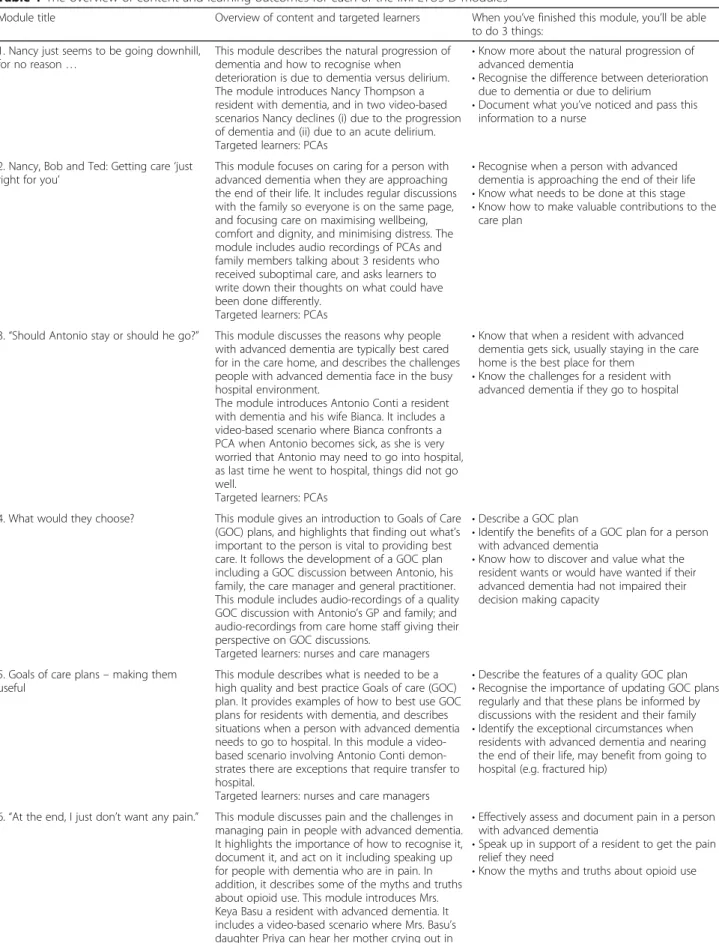
Module topics include the natural progression of de-mentia and how to recognise when deterioration is due to dementia versus delirium, recognising when a person with dementia is approaching the EOL, goals of care (GOC) plans and discussions, symptom management in-cluding management of pain, breathlessness, not eating or drinking, and terminal restlessness, communicating with residents and their families, and staff wellbeing when a resident dies. Further details on the modules can be found in Table1.
Each module has been designed to take approximately 15-30 min, and participants can access the training pro-gram at their discretion throughout the study timeframe. There will be no limit on the number of times staff ac-cess the training program. The training program can be accessed on a desktop computer, laptop, tablet or smartphone.
Modules 1–3, 6–9 and 11 have been designed for per-sonal carers as the targeted learners; and Modules 4 and 5 have been designed for nurses as the targeted learners. Module 10 has been designed for all care home staff.
Personal carers (or PCAs) will be expected to complete at least 5 of the modules – Modules 1–3 and 10, and one symptom management module (Modules 6–9). The remaining modules on goals of care discussions, goals of care plans, and staff well-being will be recommended for them to complete. Nurses will be expected to complete the two goals of care modules and the communication module. All other modules will be recommended for nurses to complete. The aim is for 80% of staff to complete the‘expected to complete’modules.
The modules will be published in HTML5 (scorm 1.2) located on a learning management system (LMS) hosted by Kontent Labs propriety system [15]. The amount of usage (hits and time spent) will be collected via the LMS.
Implementation of the intervention
The implementation of IMPETUS-D has been guided by the Consolidated Framework for Implementation Re-search (CFIR) [16], the UK Medical Research Council process evaluation framework [17], and the Expert Rec-ommendations for Implementing Change [18]. Due to the complexity of this large multi-site study, an imple-mentation plan has been developed to increase the likeli-hood of successful implementation of the IMPETUS-D
program. See Additional file 1 for outline of the imple-mentation strategies that will be conducted as part of the study.
Three local Project Coordinators will be appointed, one in each city, to assist in the day to day running of the project including recruitment of RACF staff and im-plementation and data collection activities throughout the project timeline. The Project Coordinators will be nurses with experience working in residential care. They will receive training on the project data collection methods and implementation activities to ensure a stan-dardised approach.
The IMPETUS-D program will be implemented over a 2-month training period during which time we antici-pate most targeted staff at the intervention sites will complete the training program. During the training period Project Coordinators will actively engage with staff to promote and encourage their participation in the program, including sending weekly reminder texts and emails and attending staff meetings in-person where up-take is low. The 2-month training period will be followed by 12 months of prospective data collection of primary and secondary outcomes.
Figure1outlines the Schedule of enrolment, interven-tions, and assessments for the IMPETUS-D study.
Control group
Staff from RACFs in the control group will not receive the IMPETUS-D training but will be able to receive usual training opportunities which includes training that may be provided by the facility or health care profes-sionals visiting the facility, or may involve no training during the trial timeframe.
Outcome measures Primary outcome
The primary composite outcome measure is: 20% reduc-tion in proporreduc-tion of hospital transfers or deaths in hos-pital over 6 months in the intervention group (IMPETUS-D) compared to the control group.
Secondary outcomes Secondary outcomes are:
Proportion of hospital transfers or deaths in hospital over 12 months
Proportion of hospital transfers over 6 and 12 months
Proportion of deaths in RACF over 6 and 12 months
Uptake of Goals of Care plans over 6 and 12 months
Table 1The overview of content and learning outcomes for each of the IMPETUS-D modules
Module title Overview of content and targeted learners When you’ve finished this module, you’ll be able to do 3 things:
1. Nancy just seems to be going downhill, for no reason…
This module describes the natural progression of dementia and how to recognise when deterioration is due to dementia versus delirium. The module introduces Nancy Thompson a resident with dementia, and in two video-based scenarios Nancy declines (i) due to the progression of dementia and (ii) due to an acute delirium. Targeted learners: PCAs
•Know more about the natural progression of advanced dementia
•Recognise the difference between deterioration due to dementia or due to delirium
•Document what you’ve noticed and pass this information to a nurse
2. Nancy, Bob and Ted: Getting care‘just right for you’
This module focuses on caring for a person with advanced dementia when they are approaching the end of their life. It includes regular discussions with the family so everyone is on the same page, and focusing care on maximising wellbeing, comfort and dignity, and minimising distress. The module includes audio recordings of PCAs and family members talking about 3 residents who received suboptimal care, and asks learners to write down their thoughts on what could have been done differently.
Targeted learners: PCAs
•Recognise when a person with advanced dementia is approaching the end of their life
•Know what needs to be done at this stage
•Know how to make valuable contributions to the care plan
3.“Should Antonio stay or should he go?” This module discusses the reasons why people with advanced dementia are typically best cared for in the care home, and describes the challenges people with advanced dementia face in the busy hospital environment.
The module introduces Antonio Conti a resident with dementia and his wife Bianca. It includes a video-based scenario where Bianca confronts a PCA when Antonio becomes sick, as she is very worried that Antonio may need to go into hospital, as last time he went to hospital, things did not go well.
Targeted learners: PCAs
•Know that when a resident with advanced dementia gets sick, usually staying in the care home is the best place for them
•Know the challenges for a resident with advanced dementia if they go to hospital
4. What would they choose? This module gives an introduction to Goals of Care (GOC) plans, and highlights that finding out what’s important to the person is vital to providing best care. It follows the development of a GOC plan including a GOC discussion between Antonio, his family, the care manager and general practitioner. This module includes audio-recordings of a quality GOC discussion with Antonio’s GP and family; and audio-recordings from care home staff giving their perspective on GOC discussions.
Targeted learners: nurses and care managers
•Describe a GOC plan
•Identify the benefits of a GOC plan for a person with advanced dementia
•Know how to discover and value what the resident wants or would have wanted if their advanced dementia had not impaired their decision making capacity
5. Goals of care plans–making them useful
This module describes what is needed to be a high quality and best practice Goals of care (GOC) plan. It provides examples of how to best use GOC plans for residents with dementia, and describes situations when a person with advanced dementia needs to go to hospital. In this module a video-based scenario involving Antonio Conti demon-strates there are exceptions that require transfer to hospital.
Targeted learners: nurses and care managers
•Describe the features of a quality GOC plan
•Recognise the importance of updating GOC plans regularly and that these plans be informed by discussions with the resident and their family
•Identify the exceptional circumstances when residents with advanced dementia and nearing the end of their life, may benefit from going to hospital (e.g. fractured hip)
6.“At the end, I just don’t want any pain.” This module discusses pain and the challenges in managing pain in people with advanced dementia. It highlights the importance of how to recognise it, document it, and act on it including speaking up for people with dementia who are in pain. In addition, it describes some of the myths and truths about opioid use. This module introduces Mrs. Keya Basu a resident with advanced dementia. It includes a video-based scenario where Mrs. Basu’s daughter Priya can hear her mother crying out in
•Effectively assess and document pain in a person with advanced dementia
•Speak up in support of a resident to get the pain relief they need
Process evaluation
Discrepancies between the implementation plan and its operationalization
Intervention activities that took place and who conducted the intervention activities
Uptake of the training program: proportion of PCAs and nursing staff at the intervention sites who
completed the training - number of logins, time spent on each module, number of modules completed
Qualitative research measures
Improved staff and family perception of and satisfaction with care
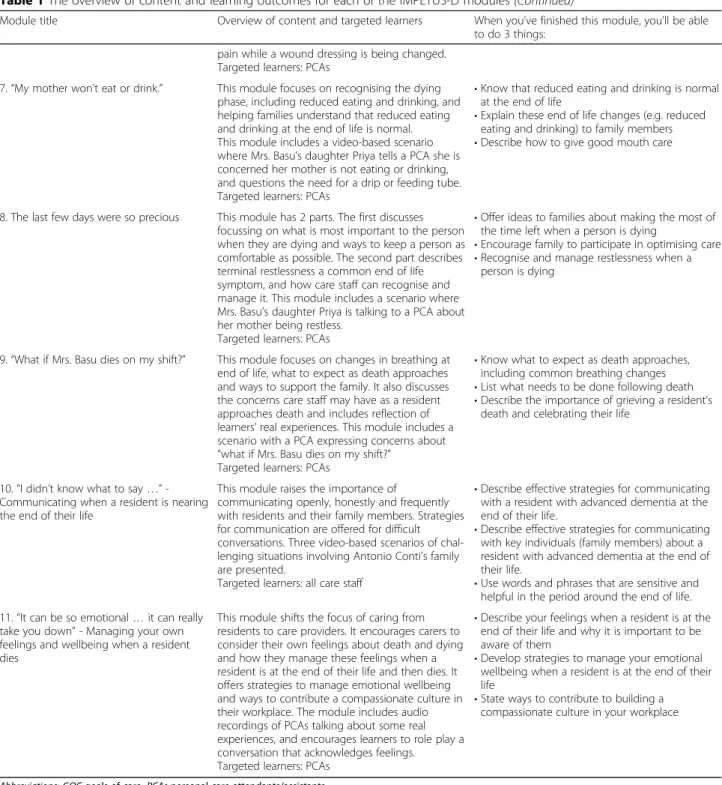
Table 1The overview of content and learning outcomes for each of the IMPETUS-D modules(Continued)
Module title Overview of content and targeted learners When you’ve finished this module, you’ll be able to do 3 things:
pain while a wound dressing is being changed. Targeted learners: PCAs
7.“My mother won’t eat or drink.” This module focuses on recognising the dying phase, including reduced eating and drinking, and helping families understand that reduced eating and drinking at the end of life is normal. This module includes a video-based scenario where Mrs. Basu’s daughter Priya tells a PCA she is concerned her mother is not eating or drinking, and questions the need for a drip or feeding tube. Targeted learners: PCAs
•Know that reduced eating and drinking is normal at the end of life
•Explain these end of life changes (e.g. reduced eating and drinking) to family members
•Describe how to give good mouth care
8. The last few days were so precious This module has 2 parts. The first discusses focussing on what is most important to the person when they are dying and ways to keep a person as comfortable as possible. The second part describes terminal restlessness a common end of life symptom, and how care staff can recognise and manage it. This module includes a scenario where Mrs. Basu’s daughter Priya is talking to a PCA about her mother being restless.
Targeted learners: PCAs
•Offer ideas to families about making the most of the time left when a person is dying
•Encourage family to participate in optimising care
•Recognise and manage restlessness when a person is dying
9.“What if Mrs. Basu dies on my shift?” This module focuses on changes in breathing at end of life, what to expect as death approaches and ways to support the family. It also discusses the concerns care staff may have as a resident approaches death and includes reflection of learners’real experiences. This module includes a scenario with a PCA expressing concerns about
“what if Mrs. Basu dies on my shift?” Targeted learners: PCAs
•Know what to expect as death approaches, including common breathing changes
•List what needs to be done following death
•Describe the importance of grieving a resident’s death and celebrating their life
10.“I didn’t know what to say…” -Communicating when a resident is nearing the end of their life
This module raises the importance of
communicating openly, honestly and frequently with residents and their family members. Strategies for communication are offered for difficult conversations. Three video-based scenarios of chal-lenging situations involving Antonio Conti’s family are presented.
Targeted learners: all care staff
•Describe effective strategies for communicating with a resident with advanced dementia at the end of their life.
•Describe effective strategies for communicating with key individuals (family members) about a resident with advanced dementia at the end of their life.
•Use words and phrases that are sensitive and helpful in the period around the end of life.
11.“It can be so emotional…it can really take you down”- Managing your own feelings and wellbeing when a resident dies
This module shifts the focus of caring from residents to care providers. It encourages carers to consider their own feelings about death and dying and how they manage these feelings when a resident is at the end of their life and then dies. It offers strategies to manage emotional wellbeing and ways to contribute a compassionate culture in their workplace. The module includes audio recordings of PCAs talking about some real experiences, and encourages learners to role play a conversation that acknowledges feelings. Targeted learners: PCAs
•Describe your feelings when a resident is at the end of their life and why it is important to be aware of them
•Develop strategies to manage your emotional wellbeing when a resident is at the end of their life
•State ways to contribute to building a compassionate culture in your workplace
Acceptability of the intervention
Barriers to uptake of the IMPETUS-D training program
Enablers to uptake of the IMPETUS-D training program
Data collection
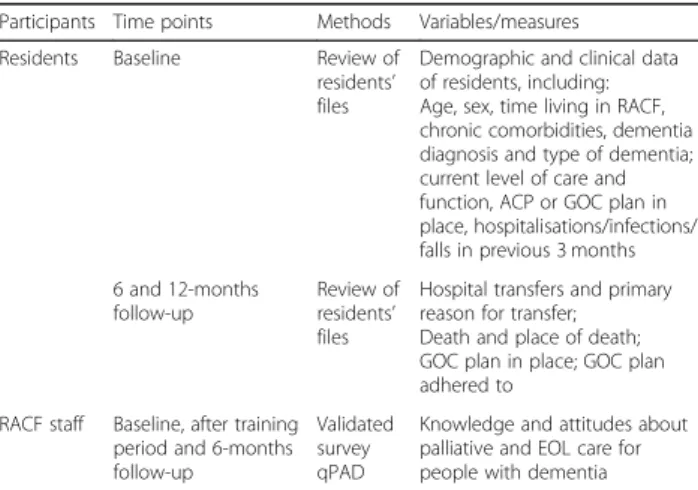
Table 2 summarises the data collection methods that will be undertaken to collect primary and secondary out-come measures and baseline resident demographic and clinical data.
Resident demographic characteristics and clinical in-formation, including whether an advance care plan (ACP) or GOC plan is in place, will be collected from the RACF resident files. During the follow-up period, any changes in uptake of ACP or GOC plans and whether they were adhered to in relation to transfers to hospital and place of death will be extracted from RACF files.
RACF staff’s knowledge and attitudes about palliative and EOL care for people with dementia will be assessed Fig. 1Schedule of enrolment, interventions, and assessments for the IMPETUS-D study. t1: 2-month training period.t2: 6-months follow up. t3:
12-months follow up
Table 2Outcome measures, data collection methods and time points by participant group
Participants Time points Methods Variables/measures
Residents Baseline Review of
residents’ files
Demographic and clinical data of residents, including: Age, sex, time living in RACF, chronic comorbidities, dementia diagnosis and type of dementia; current level of care and function, ACP or GOC plan in place, hospitalisations/infections/ falls in previous 3 months
6 and 12-months follow-up
Review of residents’
files
Hospital transfers and primary reason for transfer; Death and place of death; GOC plan in place; GOC plan adhered to
RACF staff Baseline, after training period and 6-months follow-up
Validated survey qPAD
Knowledge and attitudes about palliative and EOL care for people with dementia
Abbreviations:ACPadvance care plans,EOLend-of-life,GOCgoals of care,
at baseline, immediately after the training period and at 6-months follow-up using the Questionnaire on Pallia-tive Care for Advanced Dementia (qPAD) [19]. The qPAD is a validated 2-part instrument consisting of 23-item knowledge test and 12-23-item attitude scale.
Primary outcome data
Unplanned transfers to hospital, including the primary reason for transfer, and deaths of residents, date of death and place of death (RACF, hospital, other) will be ex-tracted from the RACF files throughout the 6- and 12-month follow up period.
Participants and recruitment
Routinely collected data from the files of residents living permanently in the RACFs will be used in the study. Residents will not be required to undertake any add-itional assessments or tests and they will not be receiv-ing any additional treatment or intervention. Residents and their family will be provided with plain language in-formation about the study via the RACF noticeboards and newsletters.
The Project Coordinators will visit the RACFs to ex-plain the study to staff and encourage participation. All staff will be invited to participate via email, face-to-face at staff meetings, and via notices in staff rooms. Plain language statements will be provided in hard copy and or electronically via email to all potential participants and consent obtained from those willing to participate. Participation by RACF staff is voluntary.
Process evaluation
A mixed methods process evaluation will be conducted alongside the cluster RCT. As described in the Medical Research Council’s evaluation framework, the process evaluation will aim to‘explain discrepancies between ex-pected and observed outcomes, to understand how con-text influences outcomes, and to provide insights to aid implementation’[17].
The aims of the process evaluation are:
(i) to explore the impact of contextual factors on the delivery and effectiveness of IMPETUS-D, including barriers and facilitators;
(ii) to assess how the intervention was delivered and achieved, capturing implementation fidelity and dose; and
(iii) to explore participants’experience and responses to the intervention, including reach, acceptability, satisfaction and knowledge acquisition.
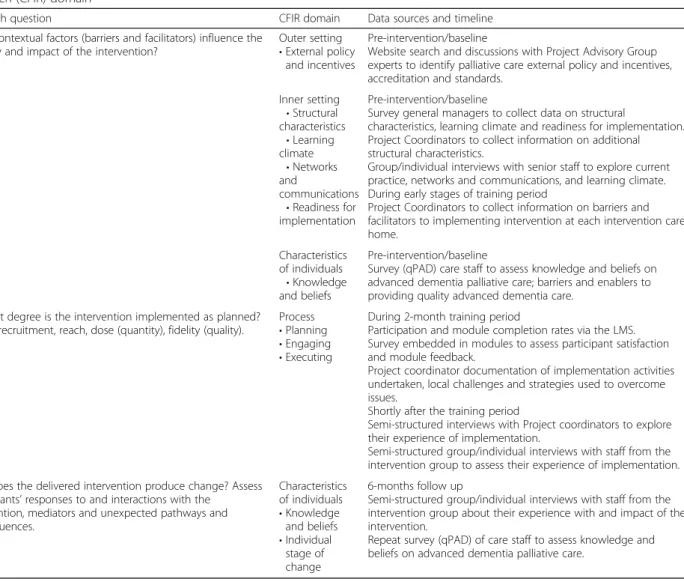
Table3summarises the process evaluation data collec-tion activities by CFIR domain [16]. Qualitative and quantitative data collection methods include purposive
sampling for semi-structured individual and group inter-views as well as participant surveys during the pre- and post-intervention phase.
Data management
A dedicated study database has been developed using the Research Electronic Data Capture (REDCap) elec-tronic data capture tools hosted at the University of Melbourne [20]. REDCap is a secure, web-based applica-tion designed to support data capture for research stud-ies, providing 1) an intuitive interface for validated data entry; 2) audit trails for tracking data manipulation and export procedures; 3) automated export procedures for seamless data downloads to common statistical pack-ages; and 4) procedures for importing data from external sources. Paper documentation will be securely stored in a locked filing cabinet. All records will be kept for a minimum of 5 years post study completion. Only listed research staff working on the project will have access to these files.
Power calculation
In this study 24 facilities (12 intervention sites and 12 control sites) will be recruited. The power analyses were based on the following assumptions: proportion of com-posite events of 0.65 and 0.85 over 6 months of follow-up in the intervention and control grofollow-ups respectively, two-sided significance level of 0.05 (alpha), 12 clusters (facilities) in each study arm, 20–25 residents with de-mentia in each cluster, an Intra-Cluster Correlation (ICC) of 0.05. With these assumptions, the minimum power to observe a difference of proportion by 0.20 be-tween the intervention and control group is 94%. If the number of residents with dementia per cluster reduces to 15 only, the power to observe this difference reduces to 0.93%. If the cluster size in each group is reduced to 10 and the number of residents in each cluster is only 15, then the study would have a power of 88% to observe a difference in proportion by 0.20.
The assumptions on the composite of events for this study were based on the information reported in the study by RS Martin (2017) [21].
Statistical methods
To compare the proportion of composite events for the primary outcome and the proportions for in-dividual components of the primary outcome (sec-ondary outcomes), logistic regression models will be used with standard errors weighted by the cluster ef-fects. The uptake of GOC is a binary measure at the individual resident level, and will be analysed using logistic regression. Odds ratios and 95% confidence interval will be presented, along with the p value, for comparison between intervention and control groups. The change in RACF staff’s knowledge and attitudes about palliative and EOL dementia care immediately following the training period and at 6-months from baseline will be measured using the qPAD. The me-dian change in qPAD score immediately following training and at 6-months follow-up will be compared between the study groups using quintile regression model (adjusted for cluster effects). All statistical
tests will be two-sided with a significance level of 0.05.
Additional exploratory analyses will be conducted to evaluate the primary and secondary outcomes of the study, adjusting for potential confounders such as age, sex and comorbidities.
Discussion
With the ageing population, the number of people with dementia is expected to increase, and so too will the need for high quality advanced dementia care delivered in RACF settings. This cluster RCT will evaluate the ef-fectiveness of an innovative screen-based simulation training program on caring for people with advanced de-mentia, aimed at staff working in the residential care set-ting. This large multisite trial will provide robust evidence about the impact of the intervention.
Table 3Process evaluation research questions and data collection methods by Consolidated Framework for Implementation Research (CFIR) domain
Research question CFIR domain Data sources and timeline
What contextual factors (barriers and facilitators) influence the delivery and impact of the intervention?
Outer setting
•External policy and incentives
Pre-intervention/baseline
Website search and discussions with Project Advisory Group experts to identify palliative care external policy and incentives, accreditation and standards.
Inner setting
•Structural characteristics
•Learning climate
•Networks and
communications
•Readiness for implementation
Pre-intervention/baseline
Survey general managers to collect data on structural
characteristics, learning climate and readiness for implementation. Project Coordinators to collect information on additional structural characteristics.
Group/individual interviews with senior staff to explore current practice, networks and communications, and learning climate. During early stages of training period
Project Coordinators to collect information on barriers and facilitators to implementing intervention at each intervention care home.
Characteristics of individuals
•Knowledge and beliefs
Pre-intervention/baseline
Survey (qPAD) care staff to assess knowledge and beliefs on advanced dementia palliative care; barriers and enablers to providing quality advanced dementia care.
To what degree is the intervention implemented as planned? Assess recruitment, reach, dose (quantity), fidelity (quality).
Process
•Planning
•Engaging
•Executing
During 2-month training period
Participation and module completion rates via the LMS. Survey embedded in modules to assess participant satisfaction and module feedback.
Project coordinator documentation of implementation activities undertaken, local challenges and strategies used to overcome issues.
Shortly after the training period
Semi-structured interviews with Project coordinators to explore their experience of implementation.
Semi-structured group/individual interviews with staff from the intervention group to assess their experience of implementation.
How does the delivered intervention produce change? Assess participants’responses to and interactions with the
intervention, mediators and unexpected pathways and consequences.
Characteristics of individuals
•Knowledge and beliefs
•Individual stage of change
6-months follow up
Semi-structured group/individual interviews with staff from the intervention group about their experience with and impact of the intervention.
Repeat survey (qPAD) of care staff to assess knowledge and beliefs on advanced dementia palliative care.
In this study we assess a new and innovative screen-based simulation training program. The training program is designed to address the current status of the RACF workforce in Australia, including high staff turnover, vary-ing skill sets and literacy levels. The trainvary-ing resource has been developed with input from the end-users and subject matter, education and simulation experts. Furthermore, being screen-based and accessible online will allow the often time poor residential care workers, greater conveni-ence and opportunity to participate.
The modules include narratives derived from experts’ experiences and in consultation with residential care staff. The modules aim to achieve functional task align-ment (the simulator does what is required to meet the learning objective) and learner engagement (the extent to which the learner participates or ‘buys-in’ to in the activity to meet the learning objective) – two concepts considered more valuable than‘fidelity’[22]. The narra-tives went someway to addressing these concepts through development with those intimately acquainted with this work from provider and user perspectives, by shooting the videos and selected still images in local fa-cilities and seeing and hearing the voices of actual care staff in narratives.
The generalisability of findings from studies involving multiple RACFs is always a challenge. However, various aspects of heterogeneity of the RACFs in different Aus-tralian cities have been considered in this cluster rando-mised study, and block design in the randomisation has been used. The study is adequately powered under dif-ferent possibilities, allowing us to draw robust inference.
The process evaluation has been designed to explore the degree to which IMPETUS-D is implemented as intended, the impact of contextual factors on interven-tion delivery, and the participants’response to and inter-actions with the intervention. A mixed methods approach has been incorporated in this process evalu-ation–using qualitative research methods (including in-dividual and group interviews), as well as quantitative methods (including self-report surveys, automated on-line data collection). Where effectiveness varies between care homes, the process evaluation will assist in asses-sing the contextual factors and implementation pro-cesses associated with effectiveness and differences in outcomes. The process evaluation will provide valuable information that helps explain and interpret the results of the cluster RCT.
Finally, the demand for high quality EOL dementia care in residential care homes is growing. It is imperative the care workers have the skills and knowledge to pro-vide high quality palliative care. If the IMPETUS-D training program is shown to be effective, it will be made available to care homes nationally via a dementia train-ing website.
Supplementary information
Supplementary informationaccompanies this paper athttps://doi.org/10. 1186/s12904-019-0474-x.
Additional file 1:Summary of the implementation strategies that will be conducted as part of the study.
Abbreviations
ACP:Advance care plans; CFIR: Consolidated framework for implementation research; EOL: End-of-life; GOC: Goals of care; IMPETUS-D: IMproving Palliative care Education and Training Using Simulation in Dementia; LMS: Learning management system; qPAD: Questionnaire palliative care for advanced dementia; RACF: Residential aged care facility; RCT: Randomised controlled trial
Acknowledgements
The authors acknowledge Luke Buizen from the Melbourne EpiCentre, and the IMPETUS-D Project Working Team and Advisory Group and IMPETUS-D Steering Committee, including Lee-Anne Henley, Stephen Wiblin, Barbara Hayes, Brian Le, Gideon Caplan, Liz Reymond, Irene Blackberry, Robyn Smith, Anita Goh, Margaret Winbolt and Lyn Franco.
Melbourne EpiCentre, University of Melbourne acknowledges the support from the Australian Government’s National Collaborative Research Infrastructure Strategy (NCRIS) initiative through Therapeutic Innovation Australia.
Authors’contributions
WKL (lead investigator), CEJ, DN, AFH, JT and RB conceptualised and secured funding for the research project. WKL, JT, SKP, CAB, AFH and RB designed the trial and evaluation. JT drafted the first version and coordinated the writing of this paper. All authors contributed to revisions of the manuscript, and read and approved the final manuscript.
Funding
This study is supported by funding from the Australian Government Department of Health under the Dementia and Aged Care Services Grant Opportunity 1. The funders do not have any input in the study design, analysis or manuscript development.
Availability of data and materials
Data will be available after analyses is finalised and report / publication has been submitted and approved. Unidentifiable individual participant data and related data dictionaries will be available. Access is subject to approval by the Principal Investigator.
Ethics approval and consent to participate
Ethics approval was received by the Melbourne Health Human Research and Ethics Committee (HREC/17/MH/336). Consent for participation in IMPETUS-D and the associated evaluation will be at the facility level. Individual written consent from RACF staff who participate in the research will be sought. Con-sent from individuals living in the residential care facilities has been waived, as it was deemed unnecessary by the Melbourne Health Human Research and Ethics Committee.
Patient safety.
The number of deaths and hospital transfers will be monitored in the control and intervention groups. The plain language statements include contact details of the principal investigator, project coordinator and the ethics committee that participants can contact in the event of a complaint or concern about the project. Any reported issues, adverse events and other unintended effects of the trial intervention will be collected and reported to the IMPETUS-D Project Working and Advisory Group and the IMPETUS-D Steering Committee.
Study management and oversight.
This study is managed by the IMPETUS-D Project Working and Advisory Group, consisting of the principal investigator, co-investigators and represen-tation from the aged care home provider. The IMPETUS-D Steering Commit-tee with members from stakeholder groups provides additional governance oversight for the study monitoring.
Consent for publication
Not applicable.
Competing interests
SKP has acted as a consultant and/or speaker for Novartis, GI Dynamics, Roche, AstraZeneca, Guangzhou Zhongyi Pharmaceutical and Amylin Pharmaceuticals LLC. He has received grants in support of investigator and investigator initiated clinical studies from Merck, Novo Nordisk, AstraZeneca, Hospira, Amylin Pharmaceuticals, Sanofi-Avensis and Pfizer.
All other authors do not have any competing interests to declare.
Author details
1
Melbourne EpiCentre, Royal Melbourne Hospital, University of Melbourne and Melbourne Health, 7 East Main building, 300 Grattan Street, Parkville, VIC 3050, Australia.2Monash Doctors Education, Monash Health Faculty of
Medicine, Nursing and Health Sciences, Monash University, Monash Medical Centre, 246 Clayton Rd, Clayton, VIC 3168, Australia.3Monash Institute for Health & Clinical Education, Monash University, 27 Rainforest Walk Wellington Road, Clayton, VIC 3800, Australia.4School of Nursing and
Midwifery, Deakin University, Locked Bag 20000, Geelong, VIC 3220, Australia.
5
Department of Medicine and Aged Care, Melbourne Health and Department of Medicine - Royal Melbourne Hospital, University of Melbourne, 300 Grattan Street, Parkville, VIC 3050, Australia.
Received: 2 March 2019 Accepted: 2 October 2019
References
1. Australian Institute of Health and Welfare. Dementia in Australia. Cat. no. AGE 70. Canberra: AIHW; 2012.
2. van der Steen JT. Dying with dementia: what we know after more than a decade of research. J Alzheimers Dis. 2010;22(1):37–55.
3. Mitchell SL, Teno JM, Intrator O, et al. Decisions to forgo hospitalization in advanced dementia: a nationwide study. J Am Geriatr Soc. 2007;55(3):432–8. 4. Palliative Care Australia and Alzheimer’s Australia. End of life care for people
with dementia. Survey Report 2014. 2014.
5. Dening KH, Greenish W, Jones L, et al. Barriers to providing end-of-life care for people with dementia: a whole-system qualitative study. BMJ Support Palliat Care. 2012;2(2):103–7.
6. Mitchell SL, Kiely DK, Hamel MB. Dying with advanced dementia in the nursing home. Arch Intern Med. 2004;164(3):321–6.
7. Livingston G, Pitfield C, Morris J, et al. Care at the end of life for people with dementia living in a care home: a qualitative study of staff experience and attitudes. Int J Geriatr Psychiatry. 2012;27(6):643–50.
8. Raymond M, Warner A, Davies N, et al. Evaluating educational initiatives to improve palliative care for people with dementia: a narrative review. Dementia (London). 2014;13(3):366–81.
9. Goelz T, Wuensch A, Stubenrauch S, et al. Specific training program improves oncologists’palliative care communication skills in a randomized controlled trial. J Clin Oncol. 2011;29(25):3402–7.
10. Gillan PC, Jeong S, van der Riet PJ. End of life care simulation: a review of the literature. Nurse Educ Today. 2014;34(5):766–74.
11. Wilkinson S, Perry R, Blanchard K, et al. Effectiveness of a three-day communication skills course in changing nurses’communication skills with cancer/palliative care patients: a randomised controlled trial. Palliat Med. 2008;22(4):365–75.
12. Kortes-Miller K, Jones-Bonofiglio K, Hendrickson S, et al. Dying with Carolyn: using simulation to improve communication skills of unregulated care providers working in Long-term care. J Appl Gerontol. 2016;35(12):1259–78. 13. Masters K, Ellaway R. E-learning in medical education guide 32 part 2:
technology, management and design. Med Teach. 2008;30(5):474–89. 14. Masters K, Ellaway RH, Topps D, et al. Mobile technologies in medical
education: AMEE guide no. 105. Med Teach. 2016;38(6):537–49. 15. Kontent Labs.https://www.kontentlabs.com.au/. Accessed 12 Dec 2018. 16. Damschroder LJ, Aron DC, Keith RE, et al. Fostering implementation of
health services research findings into practice: a consolidated framework for advancing implementation science. Implement Sci. 2009;4:50.
17. Moore GF, Audrey S, Barker M, et al. Process evaluation of complex interventions: Medical Research Council guidance. BMJ. 2015;350:h1258.
18. Powell BJ, Waltz TJ, Chinman MJ, et al. A refined compilation of implementation strategies: results from the expert recommendations for implementing change (ERIC) project. Implement Sci. 2015;10:21. 19. Long CO, Sowell EJ, Hess RK, et al. Development of the questionnaire on
palliative care for advanced dementia (qPAD). Am J Alzheimers Dis Other Dement. 2012;27(7):537–43.
20. Harris PA, Taylor R, Thielke R, et al. Research electronic data capture (REDCap): a metadata-driven methodology and workflow process for providing translational research informatics support. J Biomed Inform. 2009; 42(2):377–81.
21. Martin RS. Implementation and evaluation of goals of patient care medical treatment orders in residential aged care facilities: a mixed methods study: University of Melbourne; 2017.https://minerva-access.unimelb.edu.au/ bitstream/handle/11343/213146/Ruth%20Simone%20Martin%20thesis. pdf?sequence=1&isAllowed=y. Accessed 13 June 2019.
22. Hamstra SJ, Brydges R, Hatala R, et al. Reconsidering fidelity in simulation-based training. Acad Med. 2014;89(3):387–92.
Publisher’s Note